Retail News CRM

Tag: waze

  • Waze launches Cupid-themed driving experience just in time for Valentine’s Day

    Waze launches Cupid-themed driving experience just in time for Valentine’s Day

    Waze is not missing any chance of bringing new driving experiences to its users, so it’s no wonder that this time of the year we’re getting a Valentine’s Day-themed voice pack to guide us in our travels. Earlier today, Waze revealed that a new Cupid driving experience will be available everywhere in the world.

    We’re not sure who’s supposed to impersonate Cupid but installing the new driving experience implies that you’ll be hearing his words of wisdom. Waze is also “warning” users that Cupid might have some hot takes “on the state of dating and love in 2022,” so if you’re not ready for some dad jokes, you better skip this one (unless Waze has something else in mind).

    Just so you know, the pack will include Cupid’s voice, which can be paired with the limited edition Lovewagon and a Cupid Mood, if you really want to get into the Valentine’s Day mood.

    Of course, the Cupid driving experience will only be available to download for a limited time, but once installed, it’s yours to keep forever. It’s only available in English, but even if you don’t understand the language, I see no reason not to go full Valentine’s Day mode if you love the celebration of romance and love.

  • Waze adds new feature that won’t totally rely on crowd-sourced data

    Waze adds new feature that won’t totally rely on crowd-sourced data

    Over the years, the navigational and mapping app Waze has created several innovative tools that eventually made their way to stablemate Google Maps. Speed limit notifications, crowdsourced accident and speed trap reports have become part of the Google Maps experience after debuting on Waze. Google reportedly paid over $1 billion to buy Waze in 2013 and there are some differences between the two.

    While both get you from point “A” to point “B” safely, and in the fastest possible time, Google Maps will also help you find things to do, tell you where you should eat, where you can spend the night, and more once you reach your destination. And while both apps will warn you about any issues that could cause you to arrive later than expected, Waze relies on crowdsourced information more than Google Maps does.

    For example, if a road is flooded, on Waze you typically would not be informed of this unless another Waze user had first reported it. That isn’t very safe for the first Waze user who drives onto a flooded street without getting a warning. So according to auto evolution, Waze is going to take advantage of a partnership between Google’s RISE Organization and FloodMapp.

    FloodMapp has created a real-time system that analyzes certain data to help predict exactly where a flood will take place. This information is sent to Waze where it can be used to alert drivers if their travels will be taking them too close to roads that are flooded. The bottom line is that some unlucky person doesn’t have to get stuck in a flooded-out location and report it to Waze to warn other drivers about this problem.

    Waze is hoping that users warned to avoid a road that is flooded still report in if they happen to see it in person. By using visual confirmation, Waze will know whether its system is working as it should. And if a flooded road is confirmed, it will help the app reroute drivers away from impassable roads and suggest an alternative route.

    The new flood warnings for Waze users will first be available in Norfolk, Virginia. However, if everything works as expected, the feature will be made available to additional regions. At last count, Waze has 140 million monthly users with 30 million users in the U.S.

    Back in October, Waze CEO Guy Berkowitz revealed some sobering news about the app’s capabilities. “We have a problem with the algorithm,” he said. “The more people we serve, the more it’s affected. The coronavirus has put us in a situation where we have to reinvent our algorithm.” Using crowdsourced data, it makes sense that if there are fewer people on the road because of the virus, the number of crowdsourced reports sent to Waze each day will decline.

    But there is another aspect to this issue. In Israel, where Waze was first developed, the pandemic kept many motorists off the road. Once these drivers went back behind the wheel, traffic patterns changed dramatically which messed with the algorithms used to recommend to Waze users which route they should take. Waze users complained that they were being rerouted to locations far away from their desired destinations and as one upset Waze user put it, the app “just went crazy.”

    Many of the crowdsourcing features in Waze are now available in Google Maps which begs the question, why hasn’t Google shut Waze down? Apparently, the company feels that there is enough of a difference between the two. And looking at the apps, that is true. Google Maps looks like a polished, professional effort while Waze can take on the appearance of a cartoon.

    Additionally, Waze shows hyperlocal ads with content that is relevant to the driver’s current location. The app’s own promotional material for advertisers highlights its ability to help drivers find advertisers’ businesses. As Waze cleverly says, “Become part of your customer’s journey.”

  • Waze users say they are not always being alerted about speed traps

    Waze users say they are not always being alerted about speed traps

    Google Maps is the most popular mapping and navigation app in the U.S. Google also owns Waze which it purchased for a price believed to be in the $1.1 billion to $1.3 billion range. Like Maps, Waze is an app that delivers turn-by-turn directions to help users safely and quickly get from point “A” to point “B.” However, Waze uses information that is crowdsourced to help enhance the data that users receive.

    The information crowdsourced includes police presence, accidents, traffic jams, and more. While Google has taken some features from Waze and added them to Google Maps (such as showing the speed limit on the screen, and the ability to report accidents, and police presence), there are still some major differences between the two apps. Waze’s navigation is mostly suited for cars while Google Maps provides directions for those walking, driving, biking, or taking public transportation.

    In addition, the Waze UI is less detailed than Google Maps as it focuses on the driver experience instead of listing places to go, things to do, and hotels to stay at every destination (which you’ll find on Google Maps). Waze also requires an internet connection while Google Maps will work even if you’re offline. If you drive along rural roads in the U.S. and use Waze, you might want to have Google Maps installed just in case you find yourself in an area without an internet connection.

    Waze users have recently been experiencing inconsistency, especially when dealing with police reports and speed traps. These users say that they are no longer receiving a speed trap alert when they drive toward a location where one was previously reported. While the speed trap does appear on the display as you move closer to it, there is no alert which means that in order to know that a police trap is ahead, the driver has to take his eyes off of the road and put them on the display.The Waze help page includes a question from a Waze user which asks, “I have alerts and notifications selected but I no longer get notified (about police and speed traps) and .. wondering if Waze is no longer allowed to do this? Or is anyone else experiencing this?” A Googler  responded that “People should still be receiving these alerts, we’re not aware of any bugs surrounding this at the moment.”

    He goes on to say, “Do keep in mind that there is a bit of a delay (some minutes) for these to appear. Also, if several people downvote the report when they get it, it becomes more likely that the report will disappear quite quickly. There is also a system that determines how trustworthy reports are from each user. While not too likely, it could always be that someone’s reports don’t actually get shown to other users based on their history.”

    Another thing to consider is that these alerts are directional. A notification alert about a temporary speed trap that you report will most likely not result in a notification for Waze drivers motoring in the opposite direction from you, even though it will be viewable on the app.

    The big issue here is the inconsistency of the feature. One Waze user pointed out that she is hearing the app alert her by saying “police ahead, but only “50% of the time.” Hearing that the odds of receiving an alert about a speed trap before driving into that trap is the same as picking heads or tails is not going to placate Waze users who depend on the app for that early warning so that they can slow down in time and avoid receiving a ticket from their friendly neighborhood police officer.

  • Waze survey: more than 50% of Americans would quit their jobs for a shorter commute

    Waze survey: more than 50% of Americans would quit their jobs for a shorter commute

    Waze’s days of being just a simple navigation app are long gone. Today’s Waze is a fully automated companion for drivers all around the globe that not only provides navigational directions, but also entertainment (in many forms). And since there are so many people using Waze while driving, wouldn’t be interesting to know what they’re using the app for?

    Today, Waze released its first-ever Year in Rear View survey, which puts US driving behaviors from 2021 under the spotlight. Using first- and third-party data, the navigation app is taking a look back at its year in travel to see the places where Waze users drove the most, the books and music that were listened to the most, as well as other interesting habits.

    The full survey includes data from Waze users in the US, Canada, UK, France, Italy, Israel, Brazil, and Mexico, but we’re going to take a look at how US drivers made use of the app throughout the year.

    What behaviors, trends or quirky habits did drivers showcase in 2021?

    • 60% of global respondents are happy drivers, rating themselves 8 or above (out of 10). Drivers in Brazil and Mexico were ranked the happiest drivers, while drivers in the U.S. scored 7. In the US, 35–44-year-olds are the happiest drivers
    • Brits are known for being polite, so it’s no surprise 60% would wait patiently if a car ahead of them wasn’t moving. Meanwhile, 35% of Americans are more likely to honk their horns to get moving!
    • Shopping was the main reason 43% of Americans used their cars in 2021, with visiting family (36%) and commuting to and from work (36%) following behind
    • Older Americans are more confident parallel parkers: while 33% of 18–24-year-olds refused to parallel park, only 8% of those 65 and over said they wouldn’t

    As far as entertainment goes, the results are totally unsurprising, especially when it comes to drivers in the United States.

    What kept drivers entertained this year?

    • Sweets and candy were the top snack of choice for drivers across the globe, except in the U.S. where drivers prefer fast food as their favorite snack
    • U.S. drivers felt that “Easy on Me” by Adele, “Leave the Door Open” by Silk Sonic, and “Peaches” by Justin Bieber featuring Daniel Caesar and Giveon best reflected their year on the road
    • Podcasts are a more popular option for younger American drivers with 45% of 25–34-year-olds choosing this entertainment, compared to 20% of 55-64-year-olds
    • Globally, those listening to podcasts used their time to stay informed with NPR News Now, The Daily, ABC News Briefing, Times News Briefing and Sur Le Fil ranked as the top podcasts drivers listened to on Spotify via Waze
    • 45% of 18–24-year-olds in the U.S. would give up their phones if it meant a year with no traffic; while 38% of 65-year-olds and over wouldn’t give up anything to avoid traffic

    Most Waze drivers would have Elon Musk ride with them

    The survey also reveals that James Bonds’ Aston Martin was the top car of choice for North American drivers with 32% of users choosing the muscle car. Jennifer Lopez and Elon Musk were the top female and male celebs who made headlines this year that drivers across the globe would most like to have in their passenger seat, yet US drivers would rather have Beyonce and Elon Musk or Joe Biden riding with them.

    Here is something very interesting though: more than 50% of US residents would quit or change their jobs just to benefit from a shorter commute. Also, carpooling remains the best option to avoid traffic with Americans (39%) more likely to share their journey with a friend or colleague to avoid traffic than drivers in other countries.

    Finally, Waze’s survey also contains data bout US cities where the app’s users drove the most this summer: New York, Los Angeles, Washington, D.C., Chicago, Houston, Boston, Philadelphia, Atlanta, Dallas, and Nashville.

  • Waze blames a glitch for sending drivers into dead end roads

    Waze blames a glitch for sending drivers into dead end roads

    Back in late October, we told you that Google-owned mapping and navigation app Waze was giving drivers the wrong directions and sending them right into the heart of traffic jams. Waze CEO admitted that “We have a problem with the algorithm. The more people we serve, the more it’s affected. The coronavirus has put us in a situation where we have to reinvent our algorithm.”

    Those problems that Waze was having were affecting their Israeli users. Now, according to road.cc, Waze is having problems directing users in the U.K. through the Royal Parks of London. A tweet sent from the charity to Waze said that it “would like to talk to someone about several of the reasons you [sic] we’d prefer you not directing drivers down closed roads in a park, what’s the best way to reach you please?”

    The tweet included a screenshot from Waze that showed the app directing drivers through Richmond Park. Waze at first said that it would look into the matter, and eventually, it acknowledged that it routed drivers through closed roads. While the company said that it wasn’t sure why it happened, it added that it wasn’t seeing any issues with routes at that moment and wondered whether the earlier problem was nothing more than a temporary glitch.

    Social Media users did what social media users do best; they criticized both Waze and The Royal Parks for not doing everything that they could to end the problem. The Department of Parks & Recreation told The Royal Parks: “We welcome your engagement with routing providers, although we think you should tell the providers not to route through the park at all.”

    Richmond Park, the subject of the initial tweet, is known for hosting cyclists leading Merton Cycling Campaign to complain to The Royal Parks, “You’re enabling this. You own the problem. Just close the gates to through traffic as responsible stewardship of a national nature reserve during a climate emergency requires.” Another tweet from a “Marty Velo” also blamed The Royal Parks and said, “why have you guys not tried to get in touch with them since the app was released years ago? It’s a bit late now, isn’t it? The parks are overrun with dangerous rat-running drivers.”

    And yet another tweet, this one disseminated by Madeleine Baines, showed directions inside the same park from Google Maps and the latter also navigated users to closed routes.

    Waze started life as a crowdsourced navigation app that depended on the Waze community to inform users about accidents, traffic jams, police speed traps, and more. After Google bought Waze in 2013, many questioned why Google would make the deal considering that Google Maps was (and still is) the most popular mapping and navigation app. But over the years Google took some of the most innovative features from Waze and added them to Google Maps.

    For example, back in August Google Maps started showing the cost of tolls on bridges and roads that are crossed as part of the user’s journey. This came from Waze as did incident reporting. This was one of the first features that Google added to its Maps app and it came just months after the acquisition of Waze was announced by the gang at Mountain View.

    Six years later, Google announced that Google Maps users could report slowdowns on their journey from “A” to “B” along with crashes and speed traps. Waze still has some popular features such as setting up the app to give you turn-by-turn directions in your own voice.

  • Waze brings the college football experience to drivers on Android and iOS devices

    Waze brings the college football experience to drivers on Android and iOS devices

    Waze has been putting out a lot of new themes for its users all over the world, but the new experience released this week is aimed at US users only. Thanks to a partnership with Goodyear, Waze is bringing its users the College Football experience beyond the stadium to the roads.

    Although it will only be available for a limited time, Waze announced that its users will be able to download it starting this week and through January 31, 2022, so plenty of time to do that. If you’re living in the United States, you can now select the Goodyear Blimp icon to guide you to your destination.

    Additionally, drivers can receive navigation instruction from famous college football analyst Kirk Herbstreit as the voice for their trips on Waze. Furthermore, all 129 D1 college football stadiums will be marked on the Waze map to make it easier for fans to travel to their favorite stadium.

    On a side note, Goodyear will be hosting sweepstakes now through November 13. Fans who submit their predictions on the teams who will make it to the championships will have a chance to win tickets to the 2021 Goodyear Cotton Bowl Classic and the 2022 CFP National Championship.

  • Waze launches soothing experience to combat negative effects of driving

    Waze launches soothing experience to combat negative effects of driving

    We live in a world where driving has become an activity that often affects our mental health. Traffic is probably in top three reasons for stress, and can many times lead to much worse effects, including back pain, depression, and even blood pressure.

    To help combat these negative effects of driving, Waze launched a new Headspace experience that is meant to help drivers learn “how to find more joy and meaning on the road.” Headspace is a new Waze theme that provides users with custom navigation prompts from the mindfulness teacher and Director of Meditation, Eve Lewis Prieto.

    There are five moods that can be selected when listening to the Headspace experience: Aware, Bright, Hopeful, Joyful, and Open. Also, the new theme allows users to swap out the in-car icon with an air balloon.

    Equally important is the fact that drivers can stream a custom Spotify playlist with music and content from Headspace, which is also available via the Waze Audio Player. The Headspace experience is rolling out today and is available for a limited time in English, French, Spanish, and Portuguese.

    If you’re looking for a soothing driving experience, you can activate the new theme by tapping My Waze to find the “Drive with Headspace” banner.

  • Waze adds cats and dogs voices and moods, car icons to its app

    Waze adds cats and dogs voices and moods, car icons to its app

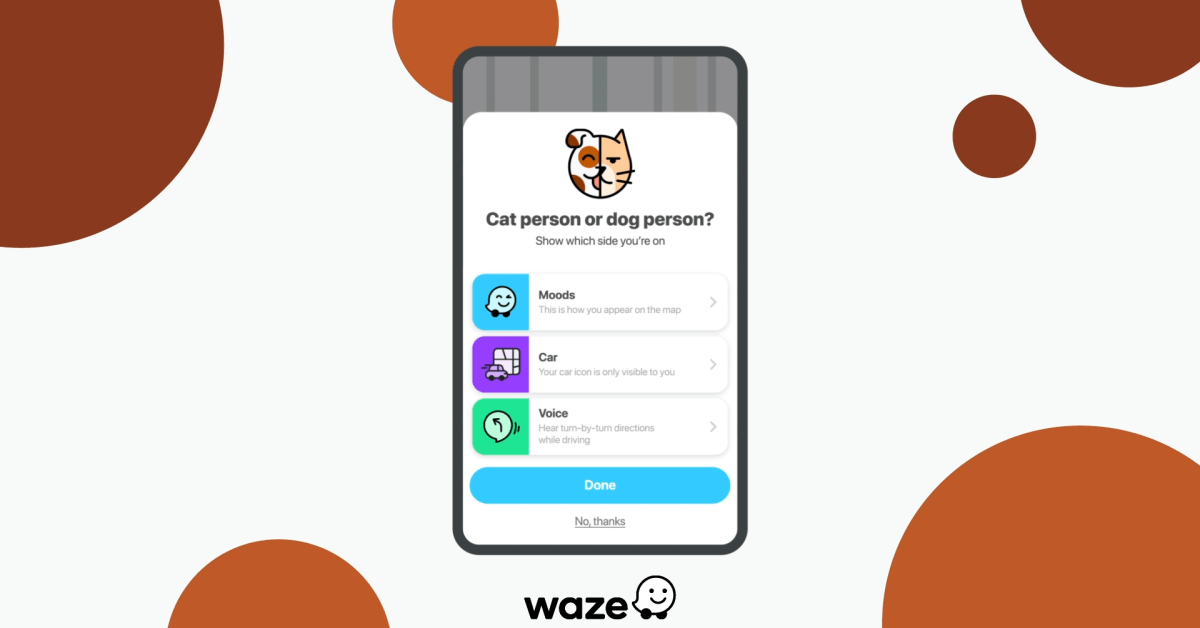
    More voices are coming to one of the most popular navigation app, Waze. This time we have something special to talk about, as Waze is adding cats and dogs voices to its mobile apps. So, regardless of whether you’re a cat or dog person, Waze now has you covered.

    From today for a limited time, Waze users can choose between two navigation voices that personify a dog or a cat. But we’re getting a lot more than just two voices, as each is themed toward a different mood.

    The dog voice is upbeat, positive, encouraging, and excited (distracted too!), while the cat voice is c, but also funny and irreverent. So it’s up to each user to choose the theme they like.

    In addition to the new voices, Waze introduces new car icons that can be used on the live map, such as the Meow Mobile and the Woof Wagon. There are also meant to show the user’s pet preference as they’ll have to change their mood to Cat or Dog.

    Keep in mind that the Cat & Dog theme will be available in English, French, and Spanish for a limited time, so make sure to download them before they’re gone.

  • Waze adds Audible integration on Android and iOS devices

    Waze adds Audible integration on Android and iOS devices

    Last year, Waze added Amazon Music integration and Google Assistant support to its navigation app. Starting this week, yet another major streaming service makes its way to Waze’s Audio Player, Audible.

    Today, Waze announced that Audible has joined its Audio Player Program, thus allowing drivers to listen to their favorite audiobooks, podcasts, as well as more than 600,000 Audible Originals. Audible members can start listening on Waze by opening the app and tapping the music note icon to select Audible as their audio player.

    Naturally, Audible members will also receive next turn directions from Waze inside the Audible app, a nifty feature to have while driving. According to Waze, the new Audible integration will begin rolling out from today, so Android and iOS users should check for a new update to get the new features on their phones.

    Currently, Waze offers integration with multiple streaming services, including Spotify, YouTube Music, iHeartRadio, and Amazon Music. You’ll just have to select whichever audio player you prefer if you’re subscribed to more than one strea

  • Waze announces partnership with Amazon Music, adds new features

    Waze announces partnership with Amazon Music, adds new features

    During its first major virtual event suggestively called Waze On, the navigation company owned by Google revealed a slew of new features coming to the app, as well as an important partnership with another big name – Amazon.

    First off, Waze confirmed that Amazon Music will join its audio player partner program in the coming months so that Waze users can listen to Amazon Music in the app’s audio player without having to switch between apps.

    As far as the new features go, Waze revealed a bunch of those that will be available sooner or later on all compatible platforms. Lane Guidance is one of the new features announced today that will probably make many drivers very happy.

    With Lane Guidance, drivers will receive information in real-time about which lane to be when merging or exiting a stretch of freeway or highway. This is rolling out to users worldwide starting right now.

    Traffic Notifications is another important feature that will be available to users next month. It tells drivers how traffic will impact their journey to favorite/frequent destinations, in addition to one-time planned drives.

    Another major improvement coming to Waze users in October is Trip Suggestions, which shows personalized recommendations based on trips taken in the past, as well as locations are recently driven to. With Waze Trip Suggestions, drivers will get all the information they need before leaving, including the time the trip will take and the traffic along the way.

    Finally, there are some carpool features that Waze users in some markets will get later this month. The so-called “real-time rides” feature is meant to notify Waze drivers when they leave about riders on their route that are looking to carpool. This feature will also include integration with Moovit.

  • Waze has hidden a secret Mood emoticon

    Waze has hidden a secret Mood emoticon

    At the end of last month, we told you about a UI overhaul for mapping app Waze. 30 colorful and funny emoticons have been added to represent your current mood. The app was purchased by Google in June of 2013 for a price believed to be in the range of $1.1 billion to $1.3 billion and it uses crowd-sourced traffic information to get you from point “A” to point “B” safely and on time.

    Some of the possible Mood choices include Funny, Sunny, Zombified, Wild, Chill, Furious, Geeky, Happy, Loved-up, Sneaky, Eco-friendly, Proud, Sad, Skeptical, Shy, Carsick, Zen and Speedy. To change your Mood, open the app, and tap on the Search box at the lower left of the screen. Tap on your name at the top of the screen to be taken to the “My Waze” screen. Click on Mood and select your emoticon.

    That sounds easy enough, but there is a hidden “Monster Mood” emoticon that you can select by tapping in a code. To summon the monster, you need to first make sure that you have updated Waze to the latest version of the iOS or Android app. Open the app and tap on Search. Instead of typing in a destination under your name, type in ##@morph. You will find that a one-eyed purple monster is now your selected emoticon right above your name on the My Waze page. It couldn’t be easier.

    Waze says that it is continuing to work on adding more Mood emoticons. “There is such an expansive world there for us to dig into, with so many unique emotions and feelings that we can represent through the Moods (our first set of 30 is just the beginning). We want to represent all different types of people in all different moments on their journey, and make people smile…even when there might not be much to smile about.”

    Even if you already consider Google Maps or Apple Maps to be your default navigator, why not give Waze a shot. Sure, some of the app’s features have been added to Google Maps, but there are many community-related features that make using Waze a completely different experience. On iOS, install the app by visiting the App Store. If you’re using an Android device, install the app from the Google Play Store.

  • FTC to investigate Google’s purchase of Waze years after the deal closed

    FTC to investigate Google’s purchase of Waze years after the deal closed

    Just a few days ago we told you that the Federal Trade Commission (FTC) had requested information from Google parent Alphabet, Apple, Facebook, Amazon, and Microsoft. The regulatory agency is investigating acquisitions made by the five between Jan. 1, 2010 and Dec. 31, 2019. These are transactions that were small enough to escape scrutiny by antitrust agencies.
    In June 2013, Google acquired the Israeli company behind the crowdsourced navigation app Waze for $1.1 billion. While Google already offered its Google Maps app with turn-by-turn directions, Waze was different. Users exchanged traffic information about accidents, police speed traps, construction and inclement weather conditions that could cause a delay to fellow drivers motoring in the same vicinity. Some considered Waze to be a navigation app and a social media site where drivers could communicate with each other. Most of this still holds true today, although Google has been adding Wave’s best features to Maps. More on that below.
    At the time of Google’s announcement that it was buying Waze, the latter had very minimal U.S. revenue which is why the merger did not have to be reported under the Hart-Scott-Rodino (HSR) Act. The HSR Act requires that the DOJ and the FTC receive a pre-merger notification. The deal is not allowed to close for a period of 30 days while the regulatory agencies investigate. If the agencies don’t take any action after 30 days, the merger can then close.
    It appears that the U.K. gave a more thorough examination to Google’s acquisition of Waze than U.S. regulators did. While investigating the transaction, the U.K. asked Google to keep Waze separate from the rest of its operations. In December 2013, the final report from the Office of Fair Trading said that with the purchase, Google was eliminating the closest competition to Maps. Waze CEO Noam Bardin agreed; just two months before Google announced the deal to buy Waze, the executive said, “We’re the only reasonable competition to [Google] in this market of creating maps that are really geared for mobile, for real-time, for consumers — for the new world that we’re moving into.”
    At the time, many figured that Google would move over some of Waze’s features to Google Maps and shut down Waze since they seemed to compete with each other. Others figured that Google was simply buying Waze to keep it out of the hands of another company. When the deal was announced in 2013, RBC Capital Market analyst Mark Mahaney said that the “move eliminates Waze as a potential acquisition target for competitors who could use the app’s collection of data and 50 million users to bolster their own location-based products.”
    There was some truth to the idea that Google was buying Waze to keep it out of the hands of a competitor. Before Google came in with its bid, Waze was reportedly close to a deal to have its app pre-installed on phones made by an unnamed company. In addition, Waze could have worked out a deal with Facebook that would allow users to meet up at certain locations using Waze’s turn-by-turn directions. The U.K. regulator decided to approve the deal noting that with Apple Maps, there already was a strong competitor to Google Maps in the marketplace.
    Not everyone believes that the merger should have been allowed to go through. Sally Hubbard, director of the enforcement strategy at the Open Markets Institute says, “It was literally Google acquiring its number one competitor in maps. It was a bad deal that should have been blocked.” Google has kept Maps and Waze separate but it has used data collected from Waze to improve the delivery of its ads. As RBC’s Mahaney told clients last September, “New ad formats in Google Maps have clear similarities to existing formats in Waze (coincidence?). Google has now collected enough data through Waze to effectively roll out broader solutions for advertisers in Google Maps and provide them attractive returns on investment without severely impacting the user experience.”
    Google has moved over many of Waze’s best features to Google Maps. Users of the latter can now report accidents, detours and police speed traps with the press of a button. And with a feature taken straight from Waze, Google Maps will now warn you when you are exceeding the speed limit.
    Former Justice Department antitrust official and Yale University economist Fiona Scott Morton believes that the FTC might be interested in the Waze purchase years after the deal closed because the location data Waze collects makes Google’s search advertising more precise. The FTC does have the ability to examine acquisitions made years ago although it isn’t clear what kind of punishment it could impose on Google.
  • Waze makes it easier to navigate through wintry weather

    Waze makes it easier to navigate through wintry weather

    Waze announced that starting this week, driving through wintry landscapes will be a bit easier thanks to a new feature the developer is adding to its navigational app. The new feature lets Waze users report snow conditions in real-time, as well as view reports of winter weather hazards on the map overview before they decide to take a trip or not.

    Developed in collaboration with the Virginia Department of Transportation, the new snow reporting feature allows Waze users from over 185 countries where the app is accessible to learn about the weather and road conditions during winter weather. The new feature goes beyond just snow reporting, as Wazers will be able to indicate roads that haven’t been plowed and are almost impractical.

    What makes the feature even more useful is that the Virginia Department of Transportation plans to monitor all reports coming from the navigational app during this winter, and decide how they can use the data into their operations for the following winter.

    The new feature can be found in the latest version of Waze under Hazards / Weather / Unplowed Road. With the addition of the new feature, Waze users can now report about five weather conditions such as fog, hail, flood, ice, and snow.

  • Waze brings back a beloved voice for a limited time

    Waze brings back a beloved voice for a limited time

    Waze has just announced that due to popular demand it has decided to bring back a beloved voice. Starting today, in celebration of Cookie Monster’s birthday this month, Waze users will be able to download the Cookie Monster voice for a limited time in the United States.

    Cookie Monster is Waze’s most downloaded voice in the United States to date with over 130 million monthly active users on the road using this specific voice. The voice was originally released in the US this summer as part of the company’s partnership with Sesame Street.

    Just as with all Waze famous voices, Cookie Monster was only available for a limited time, but if you didn’t manage to get it for whatever reason, now would be a good time to fix that.

    To get Cookie Monster’s voice, Waze users must open the application and click the magnifying glass. Then, simply open the Settings menu and choose “voice and sound.” The last step is tapping the “Waze Voice” and choosing the Cookie Monster voice, which, once again, will only be available for download for a limited time.

  • Waze is getting Google Assistant support in the US

    Waze is getting Google Assistant support in the US

    Google Assistant support is coming to Waze, which means you’ll be able to use voice commands while navigating to your destination. The new feature is rolling out starting today and should become available to all English-speaking Android users in the United States in the next few days.

    Waze users can now say “Hey Google” within the app to access the Assistant. It will let them make a calendar appointment, play music, make calls, or find a coffee shop nearby, without having to leave the Waze navigation screen.

    If you don’t see Google Assistant when you open Waze, simply tap the mic or head to the Google Assistant settings in Voice & Sound. In the next window, tap “Enable now” to start using Google Assistant in Waze.

    Here are some of the voice commands that you can use in Waze once Google Assistant becomes available:

    • Hey Google, navigate home
    • Hey Google, navigate to a coffee shop
    • Hey Google, find gas stations
    • Hey Google, report traffic
    • Hey Google, what’s my ETA?
    • Hey Google, show alternative routes
    • Hey Google, show directions
    • Hey Google, allow/avoid tolls

    Waze hasn’t mentioned anything about the availability of Google Assistant outside of the United States, nor whether or not non-English speaking users will get it.