Tag: william li

  • Nio Warns Heavy EVs Cause 2.07 Times More Road Damage

    Nio Warns Heavy EVs Cause 2.07 Times More Road Damage

    Nio founder and chief executive William Li warned at the 2026 World Internet Conference in Wuzhen that increasing an electric vehicle’s weight by 20 per cent causes 2.07 times the damage to public roads.

    Speaking at an industry forum on Thursday, Li explained that road engineering’s fourth-power law means pavement damage rises exponentially relative to vehicle axle load, amplifying the infrastructure burden created by heavy electric cars.

    Some passenger models across China now install 120-kWh batteries weighing 700 to 800 kilograms, whereas Nio limits its battery packs to 400 to 500 kilograms to restrain curb mass, accepting smaller capacity and shorter driving range as a trade-off.

    The Cost of Cutting Kilograms

    Trimming excess bulk carries steep development costs once a vehicle approaches standard production boundaries. Engineering teams can cut curb weight from two tons down to 1.9 tons with standard adjustments, but shaving each subsequent kilogram costs roughly 1,000 yuan ($149).

    Nio enforces an internal weight verification system across all model lines. Product teams must secure direct sign-off from Li for every single kilogram added above targeted design limits.

    Battery weight trade-offs dictate commercial strategy across the sector. Premium competitors pack larger cells into passenger vehicles to eliminate consumer range anxiety, driving curb weight upward and externalising highway maintenance expenses onto municipalities.

    Expanding Curbs Across China Fleets

    Data from the Ministry of Industry and Information Technology show average new passenger car curb weight climbed to 1,704 kilograms in 2024, up from 1,312 kilograms in 2012. Electric and plug-in hybrid passenger models averaged 1,939.3 kilograms during the first four months of 2026.

    National authorities are intervening with statutory caps. A mandatory vehicle energy consumption standard introduced on January 1, 2026 limits power consumption based on curb weight, imposing strict limits on models exceeding 2,710 kilograms.

    Under those rules, a two-ton vehicle cannot exceed 15.1 kilowatt-hours per 100 kilometres. That requirement tightens previous recommended targets by 11 per cent, forcing carmakers to improve motor efficiency rather than simply enlarging battery packs.

    Shifting Tax Systems and Swapping Networks

    Chasing long-range credentials with oversize batteries exposes manufacturers to regulatory headwinds. Regulators in Beijing are reviewing tax reforms that levy vehicle duties directly against curb weight, an adjustment that will raise retail ownership costs on heavyweight luxury electric sports utility vehicles.

    Automakers relying on fixed, high-capacity battery packs face margin pressure if weight-based taxation penalises heavy vehicles. Swappable battery platforms skirt part of that penalty by letting drivers run lighter packs for everyday commuting while taking on larger packs only for highway travel.

    Nio and Zhejiang Geely Holding Group established a comprehensive partnership on September 28 covering charging networks and battery swapping architecture. Li shared the forum stage with Geely chairman Eric Li to coordinate lifespan management and replenishment standards across shared fleets.

    National Guidance on Vehicle Bulk

    Li previously warned in a July 2025 livestream that the industry was blindly expanding battery capacity, noting that heavier cars cause greater damage to roads and that many countries levy taxes based on vehicle weight. In May this year, he told Yicai in an interview that “if China’s more than 300 million vehicles all become heavy vehicles, the roads will be crushed,” calling for national-level restrictions on vehicle weight and warning that without national guidance, the industry would descend into disorderly competition.
  • Nio Schedules Guangzhou Tech Day Following 15.23% Delivery Drop

    Nio Schedules Guangzhou Tech Day Following 15.23% Delivery Drop

    Nio will hold its Nio IN 2026 innovation and technology day in Guangzhou on November 25, unveiling AI-driven vehicle cockpits and assisted driving products after vehicle deliveries fell 15.23 percent in October.

    Monthly volume dropped to 34,246 units, ending 31 straight months of year-on-year expansion and raising the stakes for hardware and software shows ahead of the city’s automotive exhibition.

    The announcement from Nio Inc on Wednesday revives the standalone tech event after it skipped 2025. Founder and chief executive William Li aims to highlight the company’s shift into an AI-native organization alongside updates to smart driving systems.

    Expanding Proprietary Silicon Beyond Vehicles

    Hardware commercialization has become a central piece of the carmaker’s corporate posture. Its chip design subsidiary, GeniTech Co Ltd, was spun off in June 2025 and has pushed its proprietary semiconductors into applications beyond passenger cars.

    The unit’s premium NX9031X processor runs across the entire vehicle portfolio of both the core Nio marque and the lower-priced Onvo brand. Filings from July showed cumulative shipments of that processor exceeded 300,000 units.

    At the World AI Conference, GeniTech showed three distinct chips: the NX9031X, NX9031U, and NX9031C. Those designs cover assisted driving, embodied intelligence, and agent inference, signaling an effort to build a commercial client roster outside its own assembly plants.

    The Software Pitch Ahead of Guangzhou Auto Show

    Positioning the presentation two days before the Guangzhou Auto Show opens on November 27 gives the manufacturer a head start against domestic rivals. Auto Home reported the brand plans to unveil a special edition of its third-generation ES8 sport utility vehicle during the trade exhibition.

    Consumer tech integration remains the primary battleground for Chinese EV manufacturers fighting brutal discounting across domestic showrooms. Software functions such as natural language voice controls and vision-based highway navigation often sway showroom buyers faster than marginal battery capacity gains.

    For automotive investors, the risk lies in heavy capital spending that outpaces consumer monetization. Developing bespoke silicon and large foundation models requires continuous cash outlays that squeeze operating margins when monthly sales hit turbulence.

    Corporate Structure Realigned for Artificial Intelligence

    The corporate push gained formal structure in January when William Li, founder, chairman, and chief executive of Nio, formed an internal AGI committee. That body oversees software adoption across research, assembly lines, supply chains, and driver-assistance platforms.

    Talent acquisition followed in May with the rollout of the Nio AGI Superstar Program. The global recruitment drive targeted university researchers specializing in physical-world foundation models, end-to-end driving models, the SkyOS vehicle operating system, and the NOMI in-vehicle voice assistant.

    Speaking at an earnings media briefing in September, Li stated that Nio is essentially not just an automaker, but also an AI and energy company. He argued that public markets have yet to fully value its technology stack, computing assets, and battery-swapping infrastructure.

    A Line of Development Dating to Shanghai

    The previous edition of the developer day ran in Shanghai on July 27, 2024. That event yielded the tape-out of the five-nanometer Shenji NX9031 autonomous driving processor, the debut of SkyOS, the second-generation Nio Phone, and the Nio World Model for vehicle guidance.

    Year-to-date delivery figures maintain positive momentum despite the sudden October contraction. The automaker delivered 334,547 cars during the first ten months of the year, an increase of 38.46 percent compared with the same period a year earlier.

    Guangzhou Auto Show opens its media preview on November 27.

  • Nio Delivers 150,000 Third-Generation ES8 SUVs in First Year

    Nio Delivers 150,000 Third-Generation ES8 SUVs in First Year

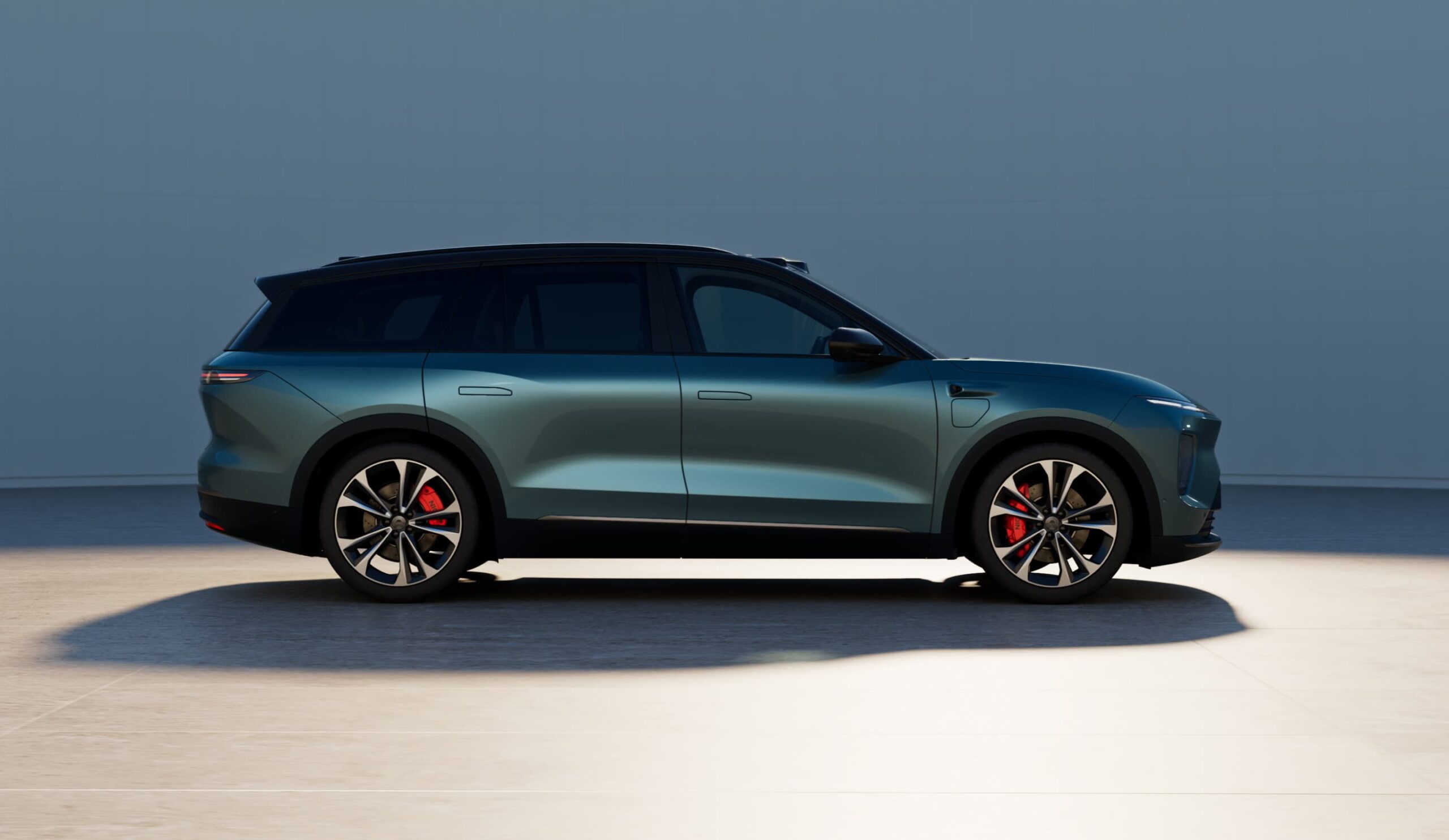
    Nio delivered its 150,000th third-generation ES8 in Beijing on Sunday. The handover reached that volume milestone exactly one year after the large electric SUV launched.

    Customer Tang Limei took delivery of the milestone vehicle. Nio built and delivered the final 10,000 units of that run in just 30 days.

    Qin Lihong, co-founder and president, attended the Beijing event. Sales began on September 20, 2025, and deliveries started the next day. The ES8 is the fastest vehicle in Nio’s lineup to hit this operating scale. China Passenger Car Association data shows the model logged 99,948 deliveries in the first eight months of 2026. That accounted for 62.21 per cent of the core Nio brand’s volume, and 38.02 per cent of deliveries across all Nio Inc operations.

    Volume Concentration at the Top End

    Showroom traffic for the premium brand now leans heavily on the ES8. Together with the larger ES9, the two SUVs delivered 17,480 units in August. That represented 82.55 per cent of all Nio-branded deliveries that month. The concentration reflects a deliberate pivot toward high-margin family and executive vehicles. Mass-market buyers are left to the company’s sub-brands.

    Component suppliers and battery exchange operators benefit from this heavy mix in the 400,000 yuan bracket, which generates steady cash flow and higher revenue per car. But it exposes the automaker to risk if luxury spending softens in top-tier Chinese cities. Nio leads the 400,000 yuan bracket across all powertrains, defending sales against plug-in hybrid and pure electric rivals. Keeping that volume requires constant retail incentives.

    Expanding Through Layout and Pricing Adjustments

    Broader configuration choices helped drive showroom momentum over the summer. On July 9, Nio launched a five-seat ES8 alongside its existing six- and seven-seat versions. Deliveries began the next day.

    Pricing for the five-seat version started at 382,800 yuan with the battery pack, a 5.9 per cent drop from three-row models. Buyers using the battery-as-a-service subscription saw the upfront vehicle price fall to 274,800 yuan. The lower entry price helped lift monthly ES8 deliveries to 10,288 units in July and 11,001 in August, a sequential gain of 6.93 per cent.

    The Trajectory from Launch to Scale

    Delivery numbers climbed quickly after initial factory ramps in late 2025. Nio delivered 2,812 units in September 2025 before volume surged past 22,000 in December. Monthly numbers dipped during the broader auto slowdown in early 2026, but the model held above 10,000 units for most of the year.

    At the Chengdu Auto Show on August 21, the carmaker handed over its 140,000th ES8. Reaching the next 10,000 cars in 30 days proved supply chains and assembly plants maintained steady output into the third quarter.

    Production Schedules Ahead of Model Cycle Shifts

    Management is now focusing capacity on this product core while conserving capital for future launches. Chief executive William Li told staff earlier this month to focus resources on the main premium lineup and core regional markets over the next three years.

    All eyes are on the final stretch of the year. Nio must now prove the ES8 can hold monthly deliveries above 11,000 units through the fourth-quarter rush, before major platform updates arrive in 2027.