Tag: Woowa Brothers

  • South Korea Fines Coupang Won300.8bn over Delivery App Rules

    South Korea Fines Coupang Won300.8bn over Delivery App Rules

    South Korea’s Fair Trade Commission hit Coupang with a provisional Won300.8bn ($222.8m) administrative fine for forcing restaurant merchants into parity agreements on its food delivery platform.

    The penalty lands alongside a provisional Won331.1bn fine on market leader Woowa Brothers, operator of Baedal Minjok, bringing combined regulatory penalties across the country’s two dominant food delivery services to Won631.9bn.

    Regulators found that Coupang abused its dominant market position by forcing restaurants to offer commercial terms equal to or better than those listed on rival platforms. The company monitored six operating areas, including menu pricing and operating hours, between July 2023 and January 2026. Restaurants that failed to comply lost their status as designated WOW Stores.

    The WOW Store Squeeze

    Losing that designation carried direct commercial consequences. Coupang had restricted delivery perks for paying WOW Membership subscribers exclusively to transactions completed at WOW Stores starting in April 2023.

    The commission reported that 57,907 merchants were stripped of their WOW Store status at least once for non-compliance. The pressure worked swiftly. The share of compliant WOW Stores surged from 13.49 per cent in July 2023 to 93.78 per cent by October 2025.

    Investigators concluded that these most-favoured-nation clauses breached the Monopoly Regulation and Fair Trade Act by stifling commission competition between delivery apps. Platforms could raise take rates without fearing that restaurants would offer lower prices elsewhere to steer diners toward cheaper channels.

    Commission Calculations Under Fire

    The regulator also took aim at how Coupang calculated platform fees. Under the Coupang Eats Merchant Pricing Policy, the service calculated order amounts using pre-discount retail prices. That formula forced food vendors to pay platform commissions on price cuts they funded out of their own pockets.

    The watchdog ordered Coupang to revise the fee calculation clause within 60 days of receiving the corrective order. Additional corrective remedies cover strict prohibition of parity demands, public notification, record deletion, regular compliance reporting, and mandatory staff education.

    The watchdog also ordered a re-examination into coercive transaction conduct allegations. Differing interpretations in the examiner’s report regarding principal and secondary products had constrained deliberations during the initial hearings.

    A Duopoly Under Regulatory Siege

    Coupang and Woowa Brothers control more than 90 per cent of South Korea’s food delivery sector. The regulator argued that both operators abused their bargaining power by imposing abnormal operational terms that squeezed vendor margins and elevated consumer dining costs.

    Woowa Brothers faced penalties for similar parity demands enforced between May 2024 and October 2025, alongside sanctions for deceptively advertising estimated delivery times and coercing vendors onto its proprietary delivery fleet. For restaurant brands and food operators, the crackdown provides immediate use to differentiate pricing strategies across digital storefronts without risking algorithmic demotion.

    The antitrust action reflects a broader campaign by Seoul against platform lock-in tactics. Coupang entered the delivery sector in May 2019, initially offsetting higher commission rates against faster fulfillment before deploying membership bundling to capture market share from Baemin.

    Legal Battles Loom

    The sanction arrives while Coupang remains locked in legal battles over domestic regulatory scrutiny. Earlier this year, the US-listed firm received a record Won624.68bn fine over a customer data leak, a ruling it continues to challenge in court.

    Coupang disputed the delivery findings immediately. The company maintained that its entry into delivery had injected competition into a market where an entrenched incumbent once held an 80 per cent share, asserting that its business practices aimed to lower consumer friction.

    Coupang Eats will carefully review the final ruling and fully present its position through appropriate legal procedures.

    The Fair Trade Commission will fix the final fine amounts before issuing its written decision, while Coupang prepares its courtroom challenge and faces the 60-day deadline to overhaul merchant discount fee calculations.
  • How new player joined Vietnam’s food delivery battle

    How new player joined Vietnam’s food delivery battle

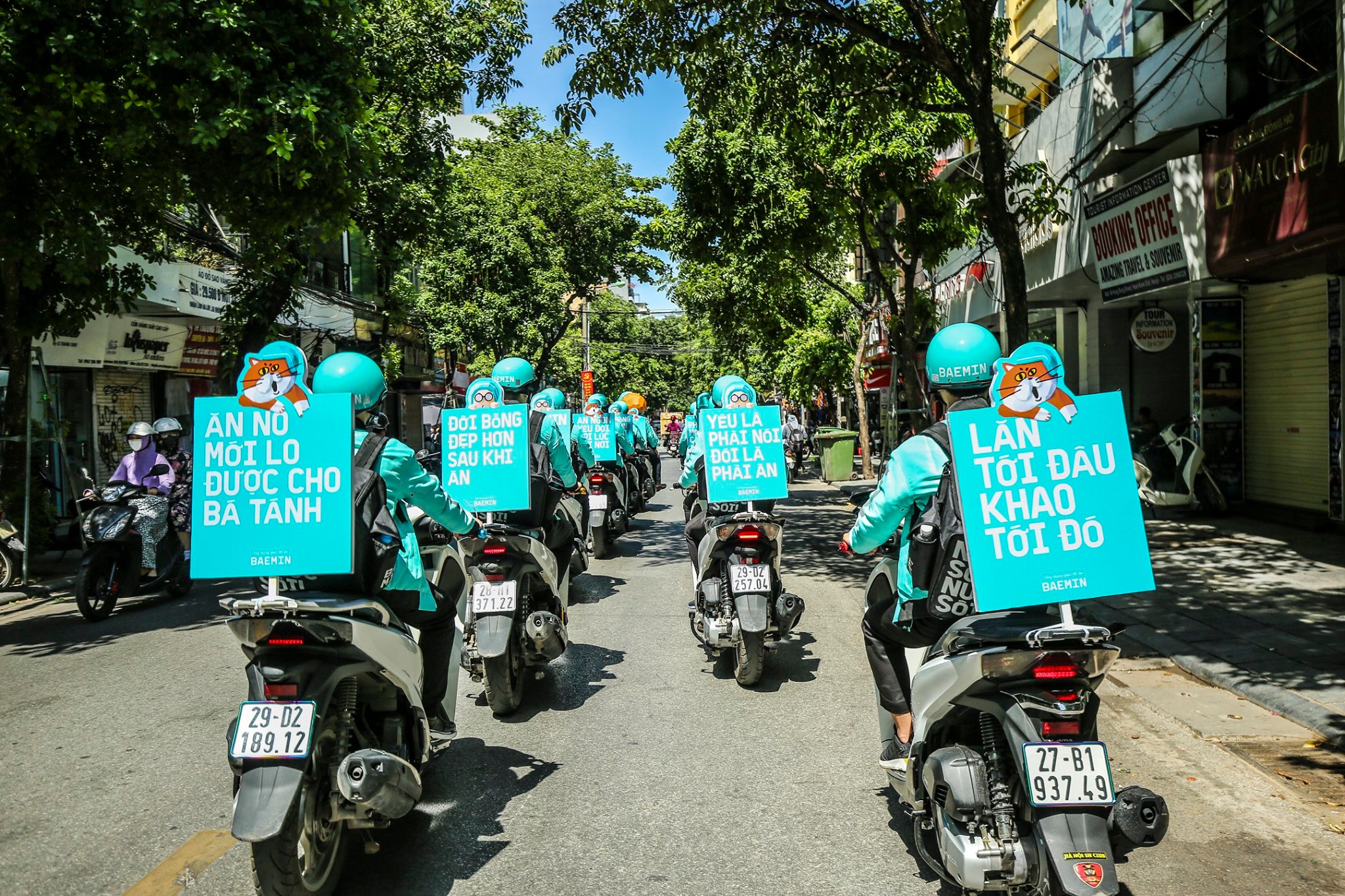
    Joining the market later than competitors, Baemin, a food delivery application of South Korean unicorn Woowa Brothers, concentrates on rider training and supporting food stores.

    Tuan, 28, from HCMC, is on his way to the headquarter of Baemin in District 3 to take part in a training course. He said, by the end of the course, he would have had to take an entrance exam before being granted an account as a Baemin rider. Before that, during the online application process, Tuan also had to undergo a pre-qualification exam before attending the intensive training.

    Most riders joining the Baemin network have to pass two entrance exams, a paradox compared to other food delivery businesses today.

    “We want to leave a good first impression on our customers with Baemin’s well-mannered and polite rider team,” said Nguyen Trung Thanh, COO of Baemin Vietnam, Woowa Brothers’ leading online food delivery service.

    Right after taking the lead in South Korea, Woowa Brothers expanded its market to Vietnam, where more than 40 percent of the population is of working age, loves technology and is quite familiar with Korean culture. However, Baemin still joined the Vietnamese market later than many other competitors.

    The boom in delivery applications has resulted in a shortage of riders and problems with service quality. Therefore, Baemin chose its own path by starting with careful training of its rider team in each market then gradually expanding within the city where the demand for food delivery is up to 90 percent (according to market research company GComm).

    Ho Chi Minh City and Hanoi are two typical examples of Baemin’s approach. “In Vietnam, FoodTech is still a very new market, so companies in this field have to invest a lot in building their own delivery team and putting them into operation,” Thanh noted.

    Baemin focuses on building professional food delivery services, its professionalism helping it succeed in a short period.

    According to a recent survey, although Baemin only appeared in Vietnam from mid-2019, it quickly caught up with Gojek, another application in food delivery, in its proportion of users (up to 46 percent). Baemin also takes up 16 percent among the most frequently used apps.

    According to the report, GrabFood is said to be popular among the old while Baemin suits younger generations.

    Investing in rider partners is not enough in Baemin’s long-term development strategy in Vietnam.

    “In Korea, where third-party logistics infrastructure is already developed, Woowa Brothers focuses on customer care, advertising and tradition,” said Thanh.

    “However, in Vietnam, it is a completely different story.”

    In addition to delivery resources, Baemin also has to pay attention to connecting with partners participating in its platform by providing flexible payment methods, with the most important being accompanying partners in the transition of the business model into an online format.

    According to Thanh, in new markets like Vietnam, restaurants, and stores, especially traditional ones, are yet to grow accustomed to online sales. Thus, during this period, the most practical thing is generating a revenue stream.

    Baemin’s strategy is to send staff to guide restaurant owners on how to achieve greater profits. At the same time, the company has also developed a department to timely respond and make payments so restaurant owners could continue to operate.

    “These are very basic steps, but they create real value from which the restaurant has the confidence to establish a closer relationship with us,” Thanh emphasized.

    In the coming time, Baemin plans to help restaurant owners create products suited to online business models. According to Thanh, this would allow transformation from a pure traditional restaurant to an online model in order to gradually expand with increasing revenue.

    “More than anyone, Baemin understands that the success or failure of a company depends greatly on its partners. Although Baemin is newly launched in Hanoi, brand awareness of customers here is much higher than in Ho Chi Minh City. It may be a new city, but the market has heard a lot about us,” Thanh said.

  • Korea food delivery app popularity booms

    Korea food delivery app popularity booms

    Food delivery has become more accessible than ever in South Korea.

    Korea food delivery apps have brought together thousands of restaurants across the country into a single location-based platform, growing significantly over the past few years.

    According to Woowa Brothers Corp., which operates the leading food delivery app Baedal Minjok, the monthly number of delivery orders exceeded 10 million for the first time last month at 10.7 million, which was an increase from 5.2 million in December 2014 and 7.12 million in 2015.

    Woowa Brothers added that the average number of orders per customer is also increasing steadily, from 3.2 orders per month in 2014 to 3.6 orders in 2015.

    Industry watchers expect the market to continue its growth, taking into consideration new types of food delivery apps with differentiated services entering the market, such as Shikshin Hero, which delivers food from famous restaurants that typically don’t provide delivery services.

    Newly emerging dining trends like eating or drinking alone are also expected to add to the continued growth of delivery apps.

    The Ministry of Agriculture, Food and Rural Affairs and the Korea Agro-Fisheries & Food Trade Corporation predicted last year that “do it yourself hype” and “more food options for take-out or delivery” would drive Korea’s dining trends in 2017, forecasting a positive outlook for the food delivery industry.

    “A greater number of single-person households gave birth to more people drinking and dining alone, and a greater variety of food options are now available for delivery,” said a Woowa Brothers official. “Such factors led to the rapid expansion of the market.”