
Tag: world rank

  • Vietnam’s millionaire population growth among world’s fastest

    Vietnam’s millionaire population growth among world’s fastest

    Vietnam ranks fourth among the world’s top 10 countries with the fastest millionaire population growth, a new report says. The country’s High Net Worth (HNW) population is set to grow by 10.1 percent each year in the 2018-2023 period, says wealth research firm Wealth-X. This growth rate is only lower than Nigeria at 16.3 percent, Egypt, 12.5 percent and Bangladesh, 11.4 percent, says the report, which covered over 540,000 HNW individuals in the world.

    The report defines HNW population as those with a net worth between $1 million and $30 million. The world’s HNW population grew by 1.9 percent last year from 2017 to 22.4 million people with a combined wealth of $61.3 trillion.

    About 25 percent of the world’s HNW population were located in Asia last year, and their total wealth was $15.48 trillion.

    Although the region’s GDP went up 8 percent last year, its stock markets plunged by more than 11 percent, partly explaining why Asia’s HNW population and total wealth remained virtually unchanged from last year, the report said.

    It also said that the top 10 countries accounted for over 75.2 percent of the global HNW population and 73.8 percent of total HNW wealth last year.

    U.S. topped the list with over 8.6 million people, following by China with 1.8 million, Japan, 1.6 million and Germany over 1 million.

    In another report published last September, Wealth-X said that the number of ultra wealthy population, those with a net worth of over $30 million, has increased by 12.7 percent in Vietnam from 2012 to 2017, making it the third fastest growing country in the world in this category.
  • Indonesia Falls in 2019 Ease of Doing Business Ranking

    Indonesia Falls in 2019 Ease of Doing Business Ranking

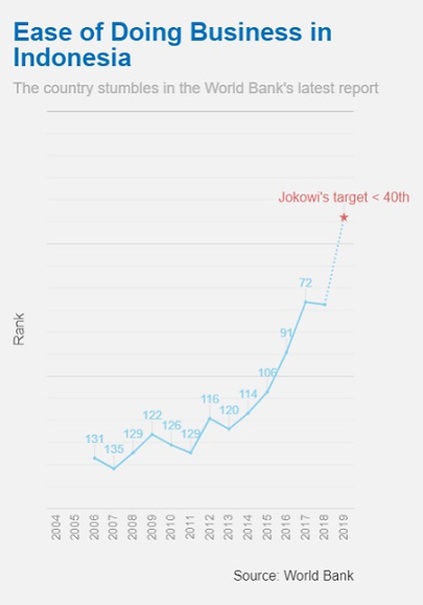
    If President Joko “Jokowi” Widodo wants to see Indonesia join the top 40 countries in the World Bank’s Ease of Doing Business ranking under his watch, he should make sure he wins re-election next year. Indonesia slipped one place to 73rd, behind Greece, the Ukraine and Kyrgyzstan, in the 2019 Ease of Doing Business report, released late on Wednesday. The president has set a target for the country to be in the top 40 by next year, but his second term will be decided in April, while the next report would not be out until next November.

    While Indonesia has made considerable progress in reforming the regulatory environment for businesses since Jokowi took office in 2014, Wednesday’s report reveals the stark realities of the country’s limited capacity to continue with these reforms.

    The country scored 67.96 out of 100 in the report’s aggregate measurement, up by only 1.46 points from last year. Slovenia, a Central European nation of only 2 million people and a $49 billion economy, sits in the coveted 40th place with an overall score of 75.61.

    Indonesia, for one, issued new rules that make starting a business, registering property and obtaining credit, easier for businesses and make it cheaper for them to get electricity. But reform stagnated in areas such as obtaining construction permits, protecting minority investors, paying taxes, trading across borders, enforcing contracts and resolving insolvencies.

    These bottlenecks allow economies like China, Kenya and Kyrgyzstan to overtake Indonesia. China made a leap to 46thplace in this year’s report, from 78th last year. Kenya moved up 19 places to 61st, while Kyrgyzstan went up seven places to 70th.

    Still, the report highlights Indonesia’s success in reforming its judiciary system and making the country a case study for others to emulate. The Supreme Court introduced training programs in 2003 for new and experienced judges, as well as special training for judges presiding over more specialized cases, such as those involving commercial or maritime disputes.

    “Indonesia’s efforts to train judges following judicial reforms bore positive results through a substantial decrease in court backlogs and insolvency case resolution times,” the World Bank said in the report.