Category: Automotive

Retail News Asia is committed to providing both local and global retailers with the latest Auto and Car news throughout the Asian market. This on a daily base.

  • Renault wants Posco auto steel in Morocco

    Renault wants Posco auto steel in Morocco

    French carmaker Renault has asked Korean steelmaker Posco to enter the Moroccan market and supply automotive steel, a person familiar with the issue said last Thursday. Renault approached the world’s fifth-largest steelmaker by output in early 2017 as part of its strategy to diversify its supply of steel, the source said, who asked not to be identified because he was not authorized to speak on the record about internal discussions.

    Renault relies on ArcelorMittal, the world’s largest steelmaker, for automotive steel.

    Posco has told Renault that the two sides will delay formal discussions on the issue, noting that it has no immediate plan to enter the North African country, said the person, who is in a position to know about the situation.

    “Posco could use Morocco as a gateway for exporting its steel products to Europe without tariffs as Morocco has a free trade agreement with the EU,” the person said.

    Last year Maghreb Steel, a Moroccan maker of flat steel products, asked Posco to invest in it and provide necessary technology.

    A Posco spokesman confirmed that Renault made the request and Posco reviewed it, but said Posco has not moved forward, citing market conditions.

    The official said he had no knowledge on Maghreb Steel’s request for Posco investment, and asked not to be named, citing policy.

    Officials of Renault and Maghreb Steel were not immediately available for comment.

    In July, the EU said it would impose tariffs of 25 percent on 23 categories of steel products if imports exceed a three-year average.

    The provisional safeguard measures – which can remain in place for a maximum of 200 days – are meant to protect the EU steel industry against a surge of imports following the U.S. imposition of tariffs on imports of steel and aluminum.

    The European Commission plans to make a final decision by early 2019, at the latest, and said definitive safeguard measures may be imposed if all conditions are met.

    Posco declined to give any details on its steel exports to the EU.

    Renault is the third-largest customer of Posco’s automotive steel, according to the person.

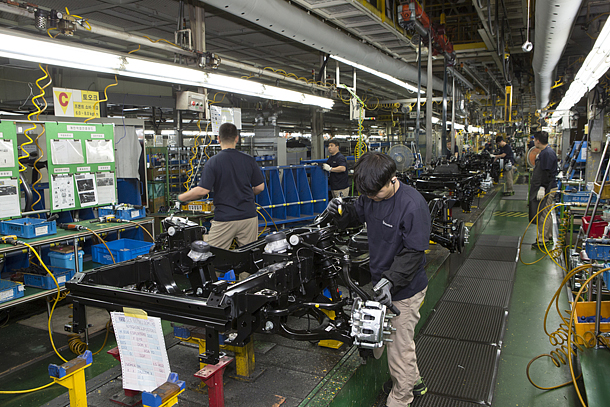
    Renault Samsung Motors – whose 79.9 percent stake is held by the French carmaker – uses Posco’s automotive steel for 99 percent of auto production at its plant in Korea’s southeastern port city of Busan.

  • Hyundai AutoEver plans IPO

    Hyundai AutoEver plans IPO

    Hyundai AutoEver, an ICT affiliate of Hyundai Motor Group, plans to go public on the Korean stock market, a move seen as a preliminary step to the group’s restructuring. The company said it submitted an application for preliminary screening to the Korea Exchange on Thursday. NH Investment and Securities will oversee the deal. “In time for the paradigm shift such as the fourth industrial revolution, [the initial public offering (IPO)] is to enhance the company’s competitiveness in digital technology as well as the company’s awareness, in addition to further secure investment for research and development,” the company said.

    Hyundai AutoEver was established in 2000 as a B2B company that develops a range of auto software systems related to connected and cloud services. It posted 1.1 trillion won ($971.4 million) in revenue last year with 52.1 billion won in net profit.

    In addition to fortifying the company’s competitiveness, the IPO is expected to relieve more than one risk at Hyundai Motor Group once it restarts its governance restructuring scheme. The company’s internal trade with other Hyundai affiliates accounted for more than 80 percent of its revenue last year.

    Kim Sang-jo, head of the Fair Trade Commission, has been pushing chaebol to eliminate trade among affiliates.

    Domestic fair trade law regulates family members of chaebol from owning more than 20 percent of the group affiliate’s shares. Hyundai Motor Group Executive Vice Chairman Chung Eui-sun slightly missed the spot by owning a 19 percent stake in Hyundai AutoEver, yet the latest push for an IPO is seen as a move to eliminate any possible risk of controversy.

    The public listing of the company is also expected to help Chung secure more funds required for the future governance restructuring as it will encompass numerous spinoffs and mergers.

    Hyundai Motor Group initially released a restructuring scheme back in March that never got off the ground due to a negative response from the market.

  • Electric vehicles, new tech focus of NAP 2019 in Malaysia

    Electric vehicles, new tech focus of NAP 2019 in Malaysia

    The National Automotive Policy (NAP) 2019 will be unveiled in the first quarter of next year, and will place emphasis on electric vehicles and new technologies, according to Deputy International Trade and Industry Minister Dr Ong Kian Ming.

    “The main focus then (NAP 2014) was on energy efficient vehicles (EEVs) and now we are moving much more towards electric vehicles and new technologies,” he said after delivering his keynote address at Kuala Lumpur International Automotive Conference 2018 today.

    “But we have to discuss with the relevant stakeholders first and make sure that we fine-tune the details, so that the needs of the whole industry are taken care of,” he added.

    Ong said his ministry together with some key companies in the automotive sector, are currently reviewing the policy, which was first introduced in 2006 to transform the domestic automotive industry.

    Furthermore, he said the revised policy, which will also include the development of the third national car project, will overlook the entire automotive ecosystem, encompassing four key pillars of connected mobility, Industrial Revolution 4.0, new generation vehicles and artificial intelligence.

    “When we talk about the third national car, we need to look at it at a holistic perspective. So let’s not just focus on the third national car project, which is an important component of the NAP review, but also look at the entire ecosystem. This ecosystem needs to be further enhanced and developed to take into consideration of new trends, such as the newly launched Industry 4.0.

    “With the new technologies coming in, including the possibility of self-driving cars, more rapid advancement in electric vehicles and necessary ecosystems such as batteries and charging stations, it is timely to review this particular sector,” he noted.

    To date, Ong said, the ministry has received over 20 proposals on the third national car project, from various sub-sectors, comprising small to large companies in the automotive sector, which include some “big players”.

    He noted that the ministry has developed a matrix to analyse and evaluate these proposals, in order to make a fair, transparent and comprehensive choice.

    “One of the deciding factors would be the financial sustainability of the project as the government will not be funding this third national car project as noted in Budget 2019,” Ong added.

    Meanwhile, the Malaysian Automotive Association (MAA) president Datuk Aishah Ahmad said in conjunction with the event that the association is hopeful that the government would continue to focus on the components emphasised in NAP 2014, including the EEV initiative.

    “Future technology is good, but we would also like them to continue to emphasis on EEV that has helped the industry. We would also like to see long-term policies rather than short-term (policies) and more consultations with the industry,” she added.

    Themed “Beyond Mobility: Moving Sustainably”, the two-day conference, which is organised by the Asian Strategy and Leadership Institute (Asli) and MAA, aims to bring together industry experts and leading players to share views concerning the automotive industry and ecosystem roadmap beyond 2025.

  • Hyundai’s Palisade performs great in snow

    Hyundai’s Palisade performs great in snow

    On Tuesday, Hyundai Motor said that its Palisade SUV will come with a new feature dubbed Snow Mode that is designed to help the vehicle navigate snowy terrain by redistributing power to its wheels. The Palisade, Hyundai Motor’s new large SUV, is slated to launch later this month.

    The new vehicle will be the first SUV in Korea to come with Snow Mode or an equivalent function, according to Hyundai Motor.

    The system helps redistribute driving power to the wheels so that a car stuck on a snowy road can regain traction.

    A video posted on a Hyundai Motor blog on Tuesday shows the Palisade crossing uneven snowy terrain. At one point, the car’s left rear wheel is left spinning in the air, but the Snow Mode quickly recognizes the lack of traction and transfers the driving power to the other wheels. Later in the video, power is shifted to the right rear wheel to give the vehicle a boost, enabling it to get back onto the road.

    The carmaker said the SUV model has been tested on 6,000 kilometers on snowy terrain in Arjeplog, Sweden over the past two years.

    The large Palisade SUV will launch on Nov. 28 at the LA Auto Show.

  • Benz shows new C-Class sedan and it’s diesel

    Benz shows new C-Class sedan and it’s diesel

    Mercedes-Benz Korea is still committed to diesel despite a global shift to eco-friendly engines, such as hybrid or electric units. The Korean section of the German premium carmaker premiered a partially revamped model of its flagship C-Class sedan in Incheon on Friday, equipped with a diesel engine.

    The C-Class sedan is one of Mercedes’ biggest models, having sold 9.5 million units worldwide since its introduction in 1982. Korea is the seventh largest market for the C-Class.

    Although not a fully revamped version, some 6,500 parts, including engine parts, have been upgraded, the company said.

    On Friday, Mercedes-Benz Korea showed a C 220d model with a four-cylinder OM 654 diesel engine, an interesting approach considering the industry’s shift to zero emissions.

    “This diesel engine’s CO2 emissions are 15 percent less than the petrol engine [with the same 2.0-liter capacity],” said Jochen Betsch, head of advanced engineering diesel at Daimler, who gave an extensive presentation on the upgraded diesel engine at a press event Friday in Incheon.

    Even while shedding 16 percent of its weight, the new engine added 24 horsepower to generate a maximum of 194 horsepower and torque of 40.8 kg.m.

    “It gets quite obvious that Daimler has strong commitment for diesel,” Betsch said.

    Dimitris Psillakis, CEO of Mercedes-Benz Korea, said a version with a gasoline engine will launch in the first half of next year, followed by a plug-in hybrid engine.

    “A diesel engine has its strong points with performance and even CO2 emissions,” Psillakis said. “It is important to offer all the options out there to our customers.”

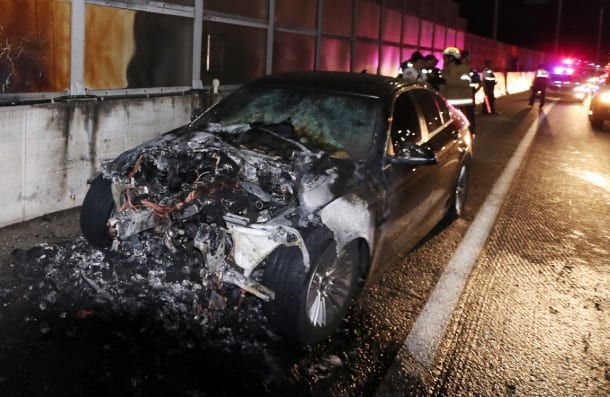
    The press event Friday included an extensive presentation on the upgraded diesel engine, a move that many saw as a reference to rival BMW diesel models that experienced a spate of fires in Korea last summer. Psillakis, however, denied such speculation, saying the “customers have the right to know about the improved features of the new diesel engine.”

    The new C-Class’ official fuel efficiency wasn’t disclosed.

    Its price starts at 55.2 million won ($48.9 thousand).

  • Vietnam’s VinFast presents models, prices

    Vietnam’s VinFast presents models, prices

    VinFast, a subsidiary of Vietnam’s biggest private firm Vingroup, presented three models and their prices at its maiden show in Hanoi Tuesday afternoon. Its five-seat sedan Lux A2.0 and seven-seat SUV Lux SA 2.0, which had already been revealed to the public for the first time at the Paris Motor Show last month, cost VND800 million ($34,305) and VND1.136 billion ($48,709) respectively.

    The smaller hatchback Fadil, presented for the very first time, costs VND336 million ($14,410).

    These prices are exclusive of a 10 percent value added tax.

    The company said it was announcing favorable prices for the “initial phase.” The original prices of the hatchback, the sedan and the SUV are VND423 million ($18,140), VND1.336 billion ($57,300) and VND1.818 billion ($78,000) respectively, it said.

    VinFast surprised industry insiders by completing its first two units, the SUV and the Sedan, within one year.But VinFast did not say for how long the promotional prices will last or how many cars will be produced in the initial phase.

    Its first two models are built on frames from BMW. Their components have been engineered by Canadian firm Magna International’s Magna Steyr, while design work was done by Italian design house Pininfarina.

    The small hatchback, Fadil, meanwhile, was developed from the background of the Opel Karl Rocks model in the European market. Its structure is almost equivalent to the latest Chevrolet Spark generation.

    Attending the exhibition, Prime Minister Nguyen Xuan Phuc said building strong Vietnamese brands means promoting patriotism, self-reliance and self-esteem and building a consumer culture in Vietnam.

    “I hope more Vietnamese companies and entrepreneurs follow in the footsteps of VinFast to express an aspiration to dominate the domestic market and reach out to the international level.”

    Vietnam’s population is around 93 million, larger than South Korea, but car consumption is only around 300,000 units a year, he said. Previously, Mike Dunne, an independent industry analyst who has spent more than three decades in Asia, said that he doubted VinFast cars would generate much demand in a country with an average income of $2,385 last year.

    While there is little doubt the market would grow, it won’t happen fast enough to absorb VinFast’s production, planned at 250,000 vehicles annually, he added.

    There are only 358 businesses in the auto industry in Vietnam compared to 2,500 in Thailand, according to the Ministry of Industry and Trade. Over 90 percent of auto parts are imported, it added.

  • Malaysia’s October vehicle sales up 0.5% to 47,273 units in Oct

    Malaysia’s October vehicle sales up 0.5% to 47,273 units in Oct

    Vehicle sales in October 2018 were up marginally 0.5% to 47,273 units from 47,041 units in the same month a year ago, according to the Malaysian Automotive Association (MAA). However, MAA said the sales volume in October 2018 was 51% higher than September 2018, due to availability of stocks replacing the depleted post-zero Goods and Services Tax (GST) period.

    In addition, it said year-to-date, the total industry volume (TIV) was 6% higher than the similar corresponding period in 2017.

    The sales volume for November 2018 is expected to be slightly better than October 2018 on the back of new model launches and aggressive year-end promotional campaigns, it added.

  • New Santa Fe designed for China

    New Santa Fe designed for China

    Hyundai Motor premiered the latest version of its Santa Fe SUV at an international auto exhibition in Guangzhou on Friday in its latest move to try and woo Chinese buyers. It also rolled out a reshuffle of its Chinese business. Vice President Lee Byung-ho was promoted to president of Hyundai Motor and Kia Motors’ China Business Division, the carmaker announced Friday.

    The automaker showcased the fourth-generation Santa Fe, which has been strategically modified for the Chinese market. The new edition is the most futuristic Santa Fe on the market anywhere in the world, including the models sold in Korea.

    After hitting rock bottom in the past two years due to diplomatic tension over the deployment of the U.S.-led Terminal High Altitude Area Defense antimissile system in Korea, Hyundai Motor has been slow in recovering sales in China. In the third quarter, it sold 177,000 units, a 6.2 percent year-on-year drop.

    Hyundai Motor said it has installed a fingerprint scanner on the door – a global first – allowing owners to lock and unlock the door without a car key. The fingerprint scanner can also turn on the engine and automatically adjust the seat and side mirror to the owner’s liking.

    The new version is also bigger than the latest Santa Fe that launched in Korea in February.

    The length was extended by 160 millimeters (6.3 inches) and the wheelbase by 100 millimeters, enlarging the space for the second and third row passengers. Other smart car technology included in the vehicle is similar to the version available in Korea.

    The car is equipped with a Rear Occupant Alert system that alerts the driver when a passenger is left behind in the back seat through ultrasound detection. It is the first time Hyundai Motor has installed such a system in cars launched in China.

    The Santa Fe is also equipped with Safe Exit Assist, which prevents collisions with oncoming traffic when exiting the vehicle.

    The car is also equipped with voice recognition through a partnership with Chinese IT giant Baidu.

    “The latest Santa Fe stands in the center of Hyundai Motor’s continuous attempts and innovation toward the ever-changing needs of the customer,” said Beijing Hyundai in a statement. “The Santa Fe will bring about changes in the premium SUV market in China with its top-notch safety and smart car features.”

    The car will go on sale starting in the first quarter of next year in China.

    Hyundai Motor set up a 1,820-square-meter (19,590-square-feet) booth at the Guangzhou International Auto Exhibition where its latest lineup of 18 cars, including a concept version of the large Grandmaster SUV and N series vehicles, such as the Veloster N and i20 WRC, were on display.

    It also showed off its hydrogen-powered Nexo SUV.

    The auto exhibition in Guangzhou runs from Saturday to Nov. 25.

  • Vietnam’s 2018 monthly car sales highest in October

    Vietnam’s 2018 monthly car sales highest in October

    October sales of 28,899 cars made it the best month of the year so far, according to Vietnam Automobile Manufacturers’ Association (VAMA). This was 3,811 cars more than the 25,088 sold in September or a 15 percent rise, a VAMA report says.

    October sales of passenger cars by VAMA members climbed 25 percent month-on-month to 21,288.

    During the same period, sales of commercial vehicles dropped 7 percent to 7,096 and that of special-purpose vehicles were up 31 percent to 515, the report says.

    While 17,599 domestically assembled cars were sold in October, up 2 percent, the number of imported completely built units (CBUs) sold was 11,300, up 46 percent over September.

    Toyota remained the leading brand last month, with sales rising 30 percent over the previous month to 8,426 units.

    Truong Hai (Thaco) group, local assembler and distributor of brands such as Kia, Mazda, Peugeot and Hyundai, and a significant player in the commercial vehicle segment, reported a 29.2 percent rise over September in group sales to 8,175 units.

    Compared to September, Ford’s sales were 9.2 percent higher at 2,574 units; while Honda sales rose 12.4 percent to 3,475 units.

    In the first 10 months of the year, VAMA members sold a total of 223,326 vehicles, up one percent over the same period last year.

  • SK unit to supply batteries to VW

    SK unit to supply batteries to VW

    SK Innovation is supplying electric car batteries to Volkswagen Group along with existing suppliers LG Chem and Samsung SDI, the Korean battery maker said Wednesday. The Volkswagen Group brands plan to launch 50 new fully electric models by 2025, and the group said it needs more battery supplies in a statement Tuesday. SK Innovation was the last of the four battery suppliers selected by the carmaker.

    SK Innovation will start supplying batteries to Volkswagen cars in Europe from 2019. LG Chem and Samsung SDI are also strategic partners in the auto company’s European operations.

    From 2022, SK Innovation will also supply batteries for the North American market.

    The group’s electric car production in China will source batteries from Chinese partner Contemporary Amperex Technology (CATL) from 2019.

    SK Group’s battery arm is planning on covering Volkswagen orders by setting up new facilities in Europe and the United States. Currently, the company is mulling three locations in the United States, it said, without giving details about the production capacity or the amount of investment. As for its newly-planned European plant, the company said it is considering multiple locations including Hungary, where it is already building a plant.

    When all planned factories are in place, SK Innovation’s battery production capacity will increase to 20 gigawatt-hours per year by 2022, the company said. Despite being a latecomer to the market, SK Innovation has been rapidly expanding its battery business. Daimler and Kia Motors are also using SK batteries.

    Its share of this year’s global battery market, excluding China, was 2.2 percent based on accumulated battery sales through the end of September, according to data from market tracker SNE Research, growing from 1.4 percent the same period last year.

    LG Chem is still the largest local player, with a 17.5 percent market share, followed by Samsung SDI, with an 8.2 percent market share.

    “With SK Innovation, LG Chem, Samsung and CATL, we have found strong partners for the long-term supply of cells for our electric vehicles,” said Stefan Sommer, a Volkswagen board member responsible for components and procurement.

  • Hyundai investing in U.S. drone company

    Hyundai investing in U.S. drone company

    Hyundai Motor, Korea’s largest carmaker by sales, said Thursday it has invested in a U.S. unmanned aerial vehicle (UAV) company to jointly develop new products. In the investment, Hyundai Motor and Top Flight Technologies will jointly seek business opportunities in the global high-end aerial drone market, the company said in a statement.

    “In addition to solving the challenges of longer-duration flight for quadcopters, Top Flight is developing the technologies needed to enable new solutions in aerial logistics and mapping which could be useful in Hyundai’s future business,” John Suh, vice president of Hyundai CRADLE in Silicon Valley, said in the statement.

    Hyundai CRADLE is Hyundai Motor’s corporate venture and open innovation business in the United States.

    “Hyundai’s investment in Top Flight confirms its commitment to autonomous vehicles and mobility solutions, whether on the road or in the air. We fully believe that Hyundai’s world-class assembly and automation capabilities will help spur the production and deployment of aerospace-grade UAVs, more efficiently than ever,” Top Flight Chief Executive Long Phan said in the statement.

    The U.S. start-up is unrivaled in the fields of cutting-edge unmanned aerial vehicles equipped with small-sized gasoline engines that can extend flight range by charging a battery, it said. Hyundai didn’t provide how much it has invested in the U.S. start-up.

    The global UAV market is expected to grow from $5.6 billion in 2016 to $12.2 billion in 2019 and to $22.1 billion in 2026, the statement said. As UAVs are mainly used for military purposes, there is big growth potential for the commercial drone market. At present, the drone delivery services market is in the early stages of development. The concept of drone delivery services began with Amazon in December 2013. The U.S. retailer said its drone service is designed to deliver packages to customers as quickly as possible using UAVs.

  • Hyundai to offer connected cars in Europe

    Hyundai to offer connected cars in Europe

    Hyundai Motor is introducing its connected-car system in Europe in partnership with Vodafone next year. The carmaker and affiliate Kia Motors signed a memorandum of understanding with Vodafone at the company’s British headquarters on Monday to roll out the service, Hyundai Motor said.

    Its Blue Link connected-car platform will be available in cars launching in Europe in the latter half of next year. The system will utilize Vodafone’s network. Kia’s Uvo connected-car system will be available in new cars sold in Europe in the first half of 2019.

    The connected-car service will offer real-time traffic information as well as information about nearby parking lots. It will also enable the remote detection of the car’s location as well as anti-theft features.

    Voice-recognition will be available in partnership with Nuance, a U.S. company. In Korea, that service is available in partnership with Kakao.

    Vodafone is one of the leading telecom companies in Europe, with 120 million users on the continent. It is established in 51 countries globally.

    The Blue Link service offered in collaboration with Vodafone will be available in eight European countries, including Britain, Germany, France and Spain. Ultimately, it will be available in 32 European countries.

    Europe is the fifth region where Hyundai Motor has introduced its connected-car service. It is already available in Korea, the United States, Canada and China.

    In July, Hyundai Motor partnered with Chinese IT firm Baidu for the introduction of connected-car services. In the United States, it is working with AT&T, and in Canada it utilizes the Bell network.

    “The latest collaboration will enable European customers to use the high-tech service,” said Suh Jung-sik, senior vice president of Hyundai Motor’s ICT department in a written statement. “The connected-car service will launch from early next year and be expanded in the future.”

  • Korea’s car companies discuss challenges

    Korea’s car companies discuss challenges

    Representatives of Korea’s major automakers and parts makers and industry officials gathered in Seoul Wednesday to discuss ways to breathe new life into the sluggish sector. The chief executives of the big five automakers — Hyundai Motor, Kia Motors, GM Korea, Renault Samsung and Ssangyong Motor — and their local parts makers and industry associations explored ways to tackle daunting challenges facing the industry.

    Korea’s auto industry is going through a hard time after GM Korea shut down its underutilized Gunsan plant in May, and Hyundai and Kia have been posting generally disappointing earnings this year.

    Small and medium-sized companies that make parts for the carmaker were more vulnerable to falling sales, with more than one-third of such Korean auto parts makers posting losses in the first half of this year, data by the think tank Korea Institute for Industrial Economics and Trade showed.

    They are also in the crosshairs as the United States is weighing slapping tariffs on foreign-made autos and auto parts on national security grounds.

    The participants called for the government to boost domestic demand, provide financial assistance to cash-strapped parts makers and lower regulations in emerging sectors, such as autonomous and electric vehicles.

    The automakers said they will seek ways to maintain over 4 million units in domestic car production and raise the number to 4.5 million by 2025.

    Hyundai Motor, the nation’s leading automaker, said it will invest 220 billion won ($193.8 million) over the next two years to develop an advanced lineup of its hydrogen-fuel electric car Nexo, with a goal of releasing over 30,000 units in the domestic market in 2022.

    GM Korea said it will hold trade shows to help its local contractors tap into the global market and supply 70 billion won in subsidies for small- and medium-sized contractors.

    Renault Samsung said it will operate a research and development fund worth 35 billion won by 2020 and form an alliance with Nissan and Mitsubishi to help its contractors make bids overseas.

    Ssangyong Motor promised to expand use of Korean-made parts and support its contractors in India.

    The Ministry of Trade, Industry and Energy said it will join industry efforts to overcome challenges and drive innovation in the sector.

    “If the auto industry and the government work together, we can come up with measures to deal with the hardship,” Industry Minister Sung Yun-mo said during a meeting with them.

    “We will gather opinions to prepare support measures, especially for parts manufacturers.”

    The ministry said it will unveil a comprehensive support package for the auto industry next month, which includes financial and R&D support as well as deregulatory measures.

  • Italian Motorcycle Makers Tease Indonesian Enthusiasts With New Models

    Italian Motorcycle Makers Tease Indonesian Enthusiasts With New Models

    Italian motorcycle manufacturers are hoping the release of new or updated models would be enough to reinvigorate interest among Indonesian enthusiasts and boost sales, which have been subdued in the past few years amid a weakening currency and slowing economic growth in Southeast Asia’s biggest economy.

    From household names such as Ducati, Piaggio and Vespa, to niche brands like Motto Guzzi and Italjet, displayed their latest models at the International Motorcycle and Accessories Exhibition in Milan last week. Thousands of visitors from across the globe, including a dozen importers from Indonesia, attended the world’s most famous exhibition dedicated to two-wheelers.

    Ducati featured the Panigale V4R, its latest road-legal competition bike, along with its new Hypermotard 950 and Diavel 1260. The company also introduced updated versions of its Scrambler and Multistrada ranges.

    Moto Guzzi showed off its new adventure bike, the V85 TT, while Vespa introduced updates to its GTS and Primavera ranges, while also launching a new electric scooter, the Elettrica.

    The new models have invoked confidence among importers looking at expanding the luxury motorcycle market in Indonesia after years of slowing demand.

    “We are ready to bring the new Ducati motorcycles to Indonesia, including the three new ones,” said Faby Tsui, marketing director of Garansindo Euro Sports, the sole authorized distributor of Ducati in Indonesia.

    Next year, the company plans to add three Ducati stores from just one currently in Jakarta. “We are looking at opening another shop in Jakarta, one in Surabaya and one in Bali,” Faby said.

    Italjet Moto, a small motorcycle manufacturer based in Castel San Pietro Terme in Bologna, aired a similar sentiment. The company has just revived its iconic Dragster scooter with a new sporty design unique to its class.

    “We would like to enter the Indonesian market. It’s an exciting market, which I believe has many scooter enthusiasts. Indonesia will be the first country outside Europe for us to market the Dragster,” Italjet Moto managing director Massimo Tartarini said.

    The company has also laid out a long-term plan for Indonesia, viewing it as a production base in the Asia-Pacific region.

    “We will start production in April or May next year. For the first year, we want to produce it in Italy. For the second year, we want to start manufacturing it in Indonesia for the Asia-Pacific market,” Tartarini said.

    However, some importers were less optimistic, pointing out that demand for luxury motorcycles has yet to return to what it used to be several years ago, when the Indonesian economy still enjoyed a windfall from a commodity boom and a strong currency.

    Indonesia’s imports of motorcycles, spare parts and accessories from Italy only amounted to $1.3 million last year, half what it was in 2012, according to data compiled by UN Comtrade, the commodity trade section of the United Nations’ statistics division.

    The Indonesian economy has yet to return to the growth levels of above 6 percent it used to see between 2010 and 2012. The rupiah now trades at 16,700 to the euro, having depreciated more than 36 percent from the 2012 level, according to Bank Indonesia.

    Meanwhile, Indonesia’s efforts to root out corruption have effectively curbed the practice among officials of collecting luxury motorcycles over the past few years.

    “I used to see government officials in store bringing all cash in backpacks to buy luxury motorcycles. Today it’s not the case anymore,” one motorbike importer said.

    Other importers pointed to the government’s recent decision to raise import taxes on luxury motorcycles and accessories as part of the country’s broader efforts to curb a widening current-account deficit.

    Many view the move was ineffective to achieve the goal, considering the relatively small size of the luxury motorcycle market in Indonesia. Italian motorcycles and accessories, for example, only accounted for a tiny part of Indonesia’s $535 million imports of bikes and accessories last year, mainly from China, Thailand and Vietnam.

    “We hope the tax will only be temporary and that conditions would return to normal soon,” Faby said.

  • Hyundai to unveil new large SUV Palisade

    Hyundai to unveil new large SUV Palisade

    Hyundai Motor’s new large SUV, set to be unveiled at the Los Angeles Auto Show later this month, will be called the Palisade. According to the carmaker Friday, its new model for the 2020 model year will be revealed on Nov. 28 during a press event at the L.A. motor show.

    The company will start taking preorders for the SUV in the Korean market starting at the end of this month, earlier than other countries. Hyundai Motor America said Thursday the car will be available in the U.S. market in the summer of 2019. Hyundai said the SUV was named after Pacific Palisades in southern California, an affluent neighborhood that boasts a series of coastal cliffs. The carmaker is hoping that the Palisade will live up to its premium-sounding name.

    The three-row SUV will offer seven or eight passenger seats, according to a spokesperson from Hyundai Motor. The major focus in designing the car is enabling everybody inside the car, even those in the third row, can enjoy their own space. In some vehicles with third rows, space is tight.

    The carmaker said its new Palisade will offer the most seating space among competing vehicles in the same segment. It also promised diverse seat adjustment options and an easy-to-use interface for adjusting car settings for passenger convenience.

    “For large SUVs, carmakers need to offer more value than just the basic driving performance,” a Hyundai spokesman said. “The spacious interior and intuitive interface for safety and convenience services offered in the car are its competitive edge.”

    The carmaker is expecting a lot from this vehicle, as it in hopes to make the Palisade its flagship SUV model when families are increasingly lean towards bigger SUVs over sedans. The Palisade will replace the Max Cruze (Santa Fe XL overseas) as Hyundai’s largest SUV.

    Specifications and pricing for the Palisade were not released on Friday.