Blog

  • Pure Gold for Changi

    Pure Gold for Changi

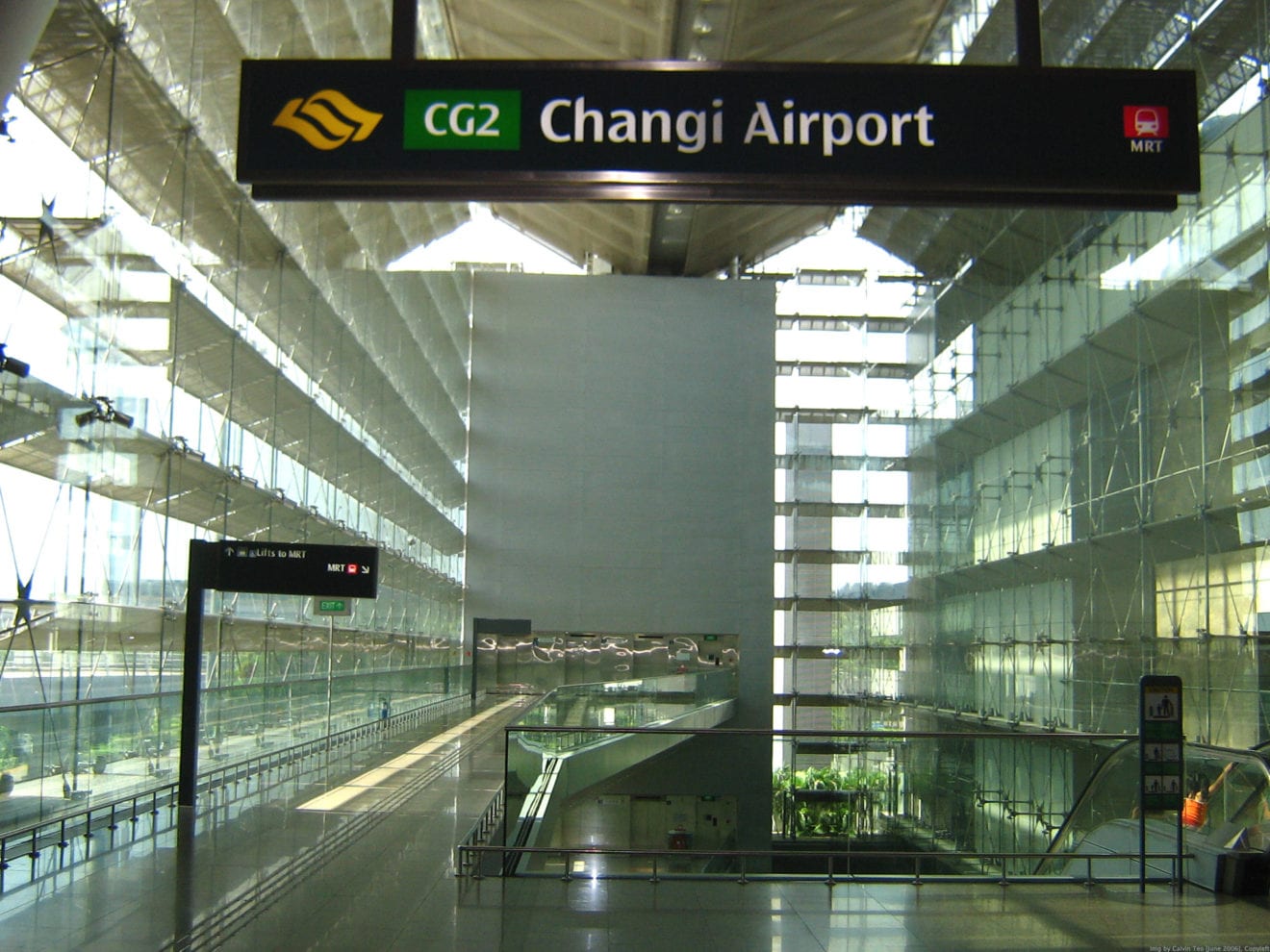
    Pure Gold has become the first Middle Eastern jeweller to be granted a concession at Singapore’s Changi International Airport.

    It will open a jewellery store in Terminal 1.

    Pure Gold is a private family-owned business founded 20 years ago which now has 125 stores in the Middle East and Asia. It plans to open a further 200 by 2018, selling products sourced from its factories in China and India.

    Chairman and founder Firoz Merchant said Changi airport is one of the busiest and best performing airports in Asia and being awarded a concession to open in the airport terminal is a big boost to Pure Gold’s travel retail business.

    “This achievement is in line with our plans to become the largest travel retailer in jewellery globally. Passengers passing through Singapore Changi International Airport can now choose from our extensive range of gold, diamond, pearls, precious and semi-precious gemstone jewellery in the latest styles and best prices.”

    Pure Gold already has a strong duty free business in the Middle East, operating at all terminals in Kuwait and Abu Dhabi international airports, and within the duty free retail facilities in Jordan, Kuwait, Muscat, Dubai and Sri Lanka.

    CEO and MD Karim Merchant added in a statement: “Travel Retail is a key area of business for us and is becoming an increasingly important sector of our overall operations. Winning the concession at Changi Airport, which has an average number of 50 million passengers per year, will help us to further strengthen our business.”

  • Esprit warns of profit decline

    Esprit warns of profit decline

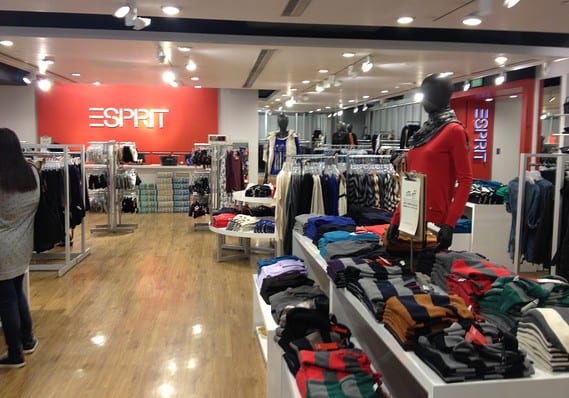
    Apparel chain Esprit has wanted shareholders its half year profit to December 31 is likely to be between HK$40 million and $50 million – half the $95 million of the same period a year earlier.

    The company said based on preliminary accounting figures, the expected lower net profit is based on falling turnover. This was due to a combination of prolonged unusually warm weather in Europe for majority part of the period, resulting in much lower than expected sales of its autumn and winter products together with special return agreements in China to address aged inventory in the wholesale channel. Although these returns were completed in the first quarter, it impacted on top line performance in the half year.

    “Notwithstanding the anticipated lower net profit in the first half of the financial year, the group has continued to devote maximum efforts to significantly improve our products, particularly in terms of design, quality, and value for money, by implementing faster and more cost efficient product development and supply chain processes as part of a vertical business model (New Business Model).

    “The New Business Model has been in place since the beginning of this financial year, in July 2014. The Spring/Summer 2015 collections, the first that have been entirely developed under the New Business Model, will arrive at stores from February onward. The products developed under the New Business Model have thus far received a positive response from our wholesale partners.

    “While the end consumer response can only be fully tested once the products reach the shop floors, we remain confident of the progress made in our product development,” the company said.

    The company will announce its interim results for the six months to December 31 in February.

  • Japanese eyes on California

    Japanese eyes on California

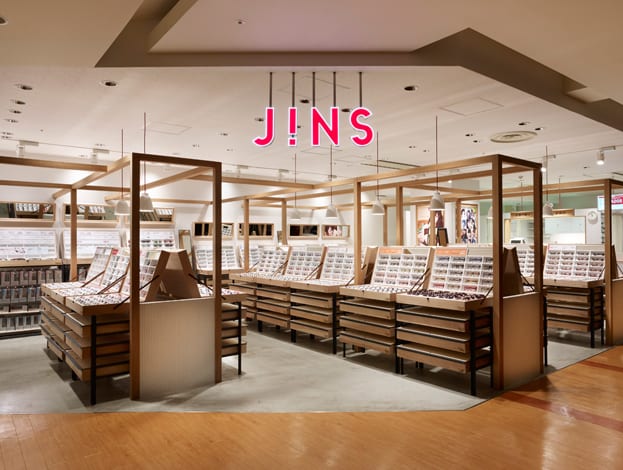
    Japan’s largest eyewear retailer Jins is to launch in the US, opening an inaugural flagship store in San Francisco’s Union Square this spring.

    Tokyo-based Jins launched its first store in 2001 and now operates more than 300 retail locations across Japan and China.

    The 4900 sqft flagship will be located at 151 Powell St and Jins promises it will stock one of the most expansive collections of eyeglasses in the city.

    In tandem with the store, Jins will launch a US eCommerce site in Spring 2015. Customers nationwide will be able to purchase Jins eyewear online with an existing prescription and San Francisco/Bay Area residents will have the opportunity to purchase their glasses online and pick them up in the store on the same day.

    Jins promises to “reinvent the in-store eyewear shopping experience” in the US, offering “unprecedented simplicity and speed”. At the new store, customers can browse, purchase and receive their prescription eyewear with custom fitting all in the same visit. Customers no longer have to wait weeks to receive their glasses in the mail because all Jins’ aspheric prescription lenses are assembled in-store using its Kanna lens lab.

    The company promises customers can receive their glasses from start to finish in approximately 30 minutes.

    The Jins store will house more than 1200 different styles, priced from US$60-120, including premium lenses.

    “We chose the Bay Area as our first stop in the US because it perfectly reflects Jins’’ progressive spirit and passion for innovation,” said Shinsuke Tomita, president of Jins Eyewear US.

    “With the opening of the San Francisco store, we hope to change the way people think about shopping for glasses in the US. Similar to how we shop for shoes or jewellery, we want our customers to explore countless designs and color options without being limited by the unnecessary complexities and inflated prices that are still the norm in the eyewear industry today.”

    Jins describes itself as “an early innovator in creating high-quality, fashion-forward prescription and nonprescription eyewear at affordable prices”.

    Jins’ point of difference is quality craftsmanship. “Jins pioneered the concept of affordable, high-quality eyewear in Japan, and has always believed that quality should never be delivered with an added surcharge for consumers. Every pair of Jins glasses is created with the passion and spirit of Japanese craftsmanship, using only the best materials, and metal frame parts sourced exclusively from Japan.”

  • Protests squeeze Clarks profits

    Protests squeeze Clarks profits

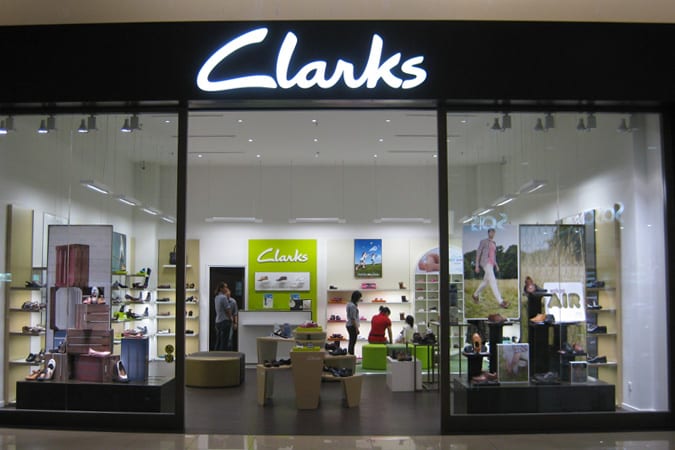
    Hong Kong distributors of shoe label Clarks has blamed the Occupy Central protests for a 45 per cent profit slump in the year to December.

    S.Culture has the exclusive distribution rights for a number of international lifestyle comfort footwear brands, including Clarks, Josef Seibel, The Flexx and Yokono. It has retail outlets in Hong Kong, Macau and Taiwan trading  under the brands S.Culture, Shoe Mart and Scoops as well as sole brand stores for Clarks, Clarks Originals and Josef Seibel.

    “The board believes the significant decrease in the unaudited consolidated net profit is mainly attributable to an unexpected deterioration of the general atmosphere of the consumer market in Hong Kong commencing in the third quarter of 2014 leading up to the Occupy Central event and its negative lingering effect until the fourth quarter of 2014.”

    However, there was a rosier side to its profit warning lodgement. It said the addition of 10 stores had taken its retail network to 122 as at December. Due to the protests and downturn in spending by Chinese mainland tourists, these new stores had yet to break even and had incurred costs in leasing, staff recruitment, stock and other overheads

    Despite the significant decrease in the unaudited consolidated net profit for the fourth quarter of 2014, the group recorded a same store sales growth of approximately 1.3 per cent.

  • A S Watson snaps up Dutch chain

    A S Watson snaps up Dutch chain

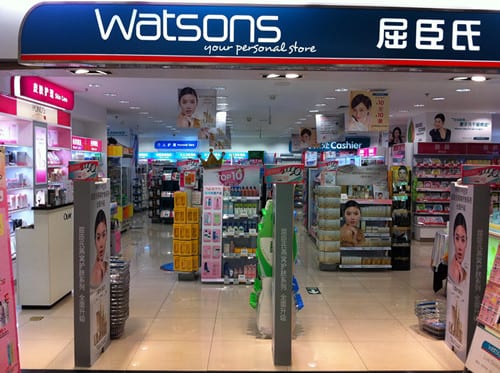
    Hong Kong based A S Watson has bought a 50-strong chain of pharmacies in the Netherlands.

    The deal with Dirx Drugstores will see all 50 stores of the Dirx health and beauty retail network fall under Watson ownership, along with five additional locations currently under development. Most of the stores are in the Randstad region.

    All Dirx employees will join A S Watson, parent of Kruidvat and Trekpleister chains in Holland. The Dirx stores will be converted to either Kruidvat or Trekpleister branding once the transaction is completed.

    The deal remains subject to approval from the Netherlands Authority for Consumer and Market. The purchase price has not been revealed.

    Gerard van Breen, CEO of A S Watson Health & Beauty Benelux said the acquisition will expand the company’s national coverage making its stores accessible to even more consumers.

    Rick Groen, director of Dirx Drugstores, said that with only 50 plus stores, the business was too small a player to independently expand in the market.

    “The A S Watson approach and focus of providing the best offers to customers at affordable prices is consistent with our philosophy. We are convinced that A S Watson is an excellent match to successfully move the business forward with our employees.”

    Kruidvat, together with Trekpleister and Prijsmepper, is part of A S Watson Health & Beauty Benelux and a major player in the Dutch and Belgian markets.

    Kruidvat, with almost 900 stores in Holland, ranked among the top three most indispensable brands in the Netherlands in a 2014 study. The chain is also active in Belgium with more than 200 stores. Trekpleister (with more than 140 stores) distinguishes itself as a neighbourhood drugstore, where expert staff plays an important role in addition to a bargain-priced range of products.

    A S Watson Health & Beauty Benelux is part of the A S Watson Group, which has more than 11,000 stores in 25 markets worldwide. It is the world’s largest international health & beauty retailer in Asia and Europe, a subsidiary of Hong Kong-based Hutchison Whampoa.

  • Starbucks names Kevin Johnson President and COO

    Starbucks names Kevin Johnson President and COO

    Starbucks has appointed Kevin Johnson as president and chief operating officer effective 1 March.

    Johnson, who has been a Starbucks board member since 2009, will lead the company’s global operating businesses across the Americas, EMEA (Europe Middle East and Africa), and China/Asia Pacific, as well as Starbucks supply chain, information technology, and mobile and digital platforms.

    “I am looking forward to working with him and our strongest management team in the company’s 44-year history,” Howard Schultz, Starbucks chairman, president and CEO.

    Johnson served as chief executive officer of Juniper Networks Inc., from September 2008 through December 2013. Prior to that, he served as the president of the Platforms Division at Microsoft Corporation and was a member of Microsoft’s senior leadership team and held a number of senior executive positions over the course of his 16 years at Microsoft.

    Prior to joining Microsoft in 1992, he worked for International Business Machine Corp.’s systems integration and consulting business. In 2008, Johnson was appointed by President George W. Bush to the National Security Telecommunications Advisory Committee (NSTAC) where he served through the end of 2013.

    “Over the past six years I have gotten to know the company well and I look forward to extending my 33 years of operating experience to help propel Starbucks to the next decade of growth and innovation. I am honored and humbled to join Starbucks, a company that I love, during this important time,” Johnson said.

  • A 48 second online store

    A 48 second online store

    The barrier to opening an online retail store just fell a lot lower…

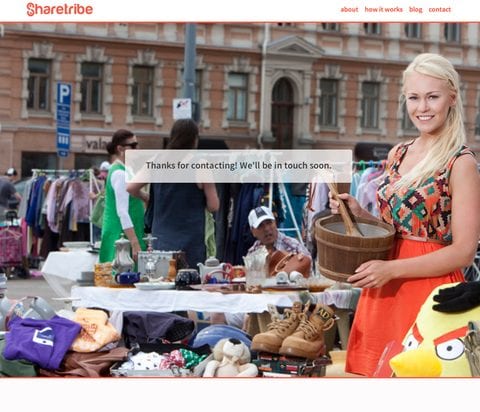
    Trend monitoring website Springwise.com reports on a new platform established by a startup called Sharetribe which allows “anyone” to set up an online marketplace in 48 seconds. All without coding.

    The concept of peer-to-peer marketplaces has exploded in the past decade thanks to platforms such as eBay, Etsy and Airbnb. But their success has relied on feature-rich web tools that regular small businesses simply couldn’t afford to build themselves.

    While we’ve recently seen The Grid offer instant website design using artificial intelligence, Finnish company Sharetribe is now helping businesses get their own online marketplace up and running without any coding.

    For businesses that need to let their users sell or swap goods, rent out their bike or car, or find someone to walk their dog, it can be expensive and timely to hire a developer to build the platform. Sharetribe promises that its set up process takes just 48 seconds, with businesses able to customise the features as they wish.

    The platform supports different types of marketplaces, offering visual listings, categorisation and browse filters, storefronts and member profiles, merchant-buyer messaging and language and currency options. Each marketplace can be completely customised to reflect the business’s brand and comes with the ability to integrate with social media.

    Sharetribe helps businesses offer a new feature for their existing communities or quickly set up a marketplace to start competing in the new sharing economy. Packages start at US$39 a month for sites with up to 300 members.

  • Haagen-Dazs to target China’s coffee drinkers

    Haagen-Dazs to target China’s coffee drinkers

    Haagen-Dazs has launched a new line of coffee at its stores in China to capture a piece of the country’s quickly growing coffee market.

    The introduction of the “rainbow latte”, a mix of Haagen-Dazs ice cream and illy coffee, served in uniquely designed hand-blown glass cups, is the culmination of several years of planning by the ice cream chain. The company also plans to open stand-alone Haagen-Dazs coffee shops to diversify beyond the ice cream market

  • Tony Romas lands in Myanmar

    Tony Romas lands in Myanmar

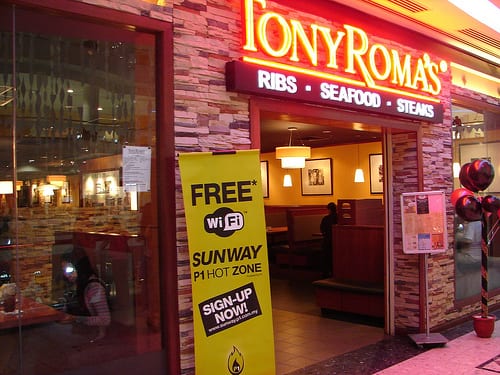
    Tony Roma’s has opened its first restaurant in Myanmar.

    The ribs and steak centric restaurant is located in the country’s former capital city of Yangon, the commercial center and largest city in the country, with a population of more than 5 million.

    Romacorp, the brand’s owner from the US, has teamed up with franchise partner Apex Food and Beverage Co to bring the Tony Roma’s brand to Myanmar.

    Romacorp President Ken Myres said Apex MD Kyaw Soe Win and his team bring a strong passion for the brand and a unique understanding of the local market to the partnership and Romacorp is confident it will establish the Tony Roma’s brand as a new favorite for Myanmar diners.

    The 6400 sqft restaurant has 210 seats including three VIP rooms, a full-service bar, and a two-story dining room. The restaurant is situated in one of the most exclusive neighborhoods in Yangon, on a street known for its restaurants and nightlife.

    “Earlier this year, I had the honor to dine in a Tony Roma’s restaurant and fell in love with the food, service culture, and, of course, their world famous ribs,” said Kyaw Soe Win.

    “We are excited to bring Tony Roma’s to the people of Myanmar, the first such venture of a Western casual dining brand in our country. Our restaurant is located in a growing, cosmopolitan area where residents are searching for new tastes, and we are delighted to introduce Tony Roma’s world-famous American fare so our guests can indulge in our ribs, steaks and seafood.”

    Romacorp is headquartered in Orlando, Florida and has more than 150 restaurant locations in more than 30 countries.

  • LVMH invests in China outlet malls

    LVMH invests in China outlet malls

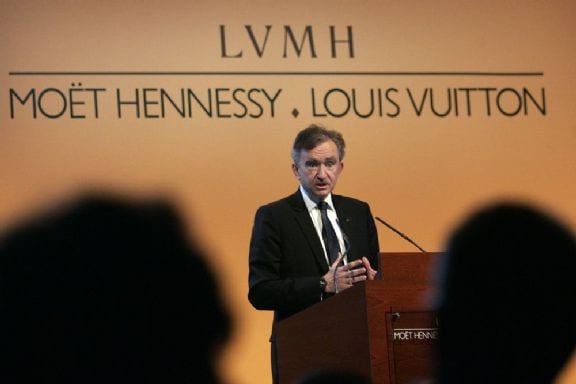
    The world’s largest luxury brand owner LVMH is to take a cornerstone stake in a unique, upmarket outlet mall business in China, Sasseur.

    The investment will come via its Singapore-based L Capital Asia investment arm, which specialises in identifying upcoming brands and providing venture capital for their growth and market development.

    L Capital Asia will invest more than US$100 million in Sasseur Cayman, which owns four outlet malls, representing the fund’s second biggest investment in China to date. Sasseur plans to open another four malls this year and eventually expand the chain to 20.

    “The outlet concept will become much bigger in China,”  L Capital Asia chairman Ravi Thakran said. “As Chinese consumers become more sophisticated, they want better value.”

    Sasseur Group describes itself on its website as “a comprehensive conglomerate with business as its core”. It uses distinctive artistic executions to lift the shopping experience above the sterile, budget nature of most modern day outlet centres around the world.

    The company dates back 20 years as a brand, having started as a coffee shop.

    It says it adhere to a core business philosophy of ‘art, technology, brand’, developing malls of “high taste”.

    Sasseur sells womens and mens fashion, high end jewellery and sports and leisure goods and provides dining and entertainment options.

    One of its early malls was designed with a blend of Italian inspired architecture and historic influence from the ancient city walls of Nanjing, eastern Sichuan houses and An Hui style architecture. Others have more abstract themes.

    Chairman and founder Xu Rongcan says his goal was to make Sasseur “an outlet with attitude”.

    “What is Sasseur attitude? That is the persistent pursuit of beauty. Sasseur is my entire understanding of art business. I am willing to implant all my understanding and persistency of beauty into my outlet, not only the buildings, luxury, decoration, business content, but also to implant these persistent and pure values into every employee, into every inch land of Sasseur. In the eco art business, let consumers experience the beauty, quality and harvest beauty.”

  • JV ‘revolutionises’ m-commerce

    JV ‘revolutionises’ m-commerce

    Chinese mobile commerce company 99 Wuxian is bringing NFC technology to China.

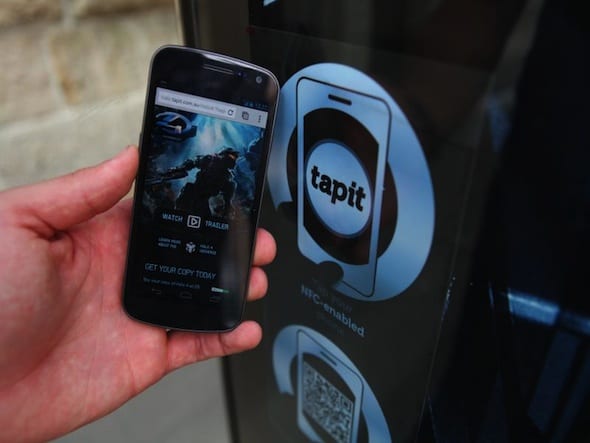
    99 Wuxian and Australian Near Field Communication (NFC) technology startup Tapit Media have joined to “revolutionise” Chinese m-commerce and offline media by integrating NFC enabled interactive offline marketing campaigns with 99 Wuxian’s platform.

    The JV will utilise Tapit’s contactless communication technology which uses a range of contactless standards including NFC and Bluetooth Low Energy (BLE) to deliver content to smartphones from offline physical media assets.

    Users with NFC-enabled smartphones have the ability to tap NFC-enabled objects to access content and information such as videos, mobile optimised pages and instant app downloads.

    It allows 99 Wuxian to provide a new and unique offering to its business partners in China by allowing smartphone users to interact with NFC-enabled offline media and 99 Wuxian m-commerce platform to complete transactions.

    The consumer engagement opportunity is significant and is expected to include using NFC-enabled smartphones to access information, buy movie tickets, receive food and beverage coupons or buy transport tickets.

    “It’s a very exciting development for 99 Wuxian and our business partners and merchants that we are bringing market leading Australian technology to China and drive direct B2C growth,” said 99 Wuxian CEO and executive director Amalisia Zhang.

  • Retail ad only works when it rains

    Retail ad only works when it rains

    A unique retail advertising concept trialled in Hong Kong has grabbed attention for both its innovation and its relevance.

    Get caught in a rain shower when walking on the streets of Hong Kong and glance down you might just see one of the most unique advertising campaigns yet devised – an advertisement encouraging you to book a flight with Cebu Pacific Airlines to sun-soaked, rain-free Philippines…

    When monsoon season hits Hong Kong, rain showers are frequent – and frustrating. So what better than to tempt wet pedestrians to take a holiday in a tropical destination in the Philippines?

    Created by ad agency Ogilvy Asia, the campaign used a water-repellent spray stencilled onto the sidewalks in busy locations, according to a report by trend monitoring website Springwise.com. When the weather was dry, the ads weren’t visible. But when the rain fell, the message appeared as if by magic, spelling out the tagline ‘It’s Sunny in the Philippines’.

    The ad incorporated a QR code that offered more information and offered discounts on flights to the Philippines when scanned with a smartphone (providing you could use your smartphone without it getting wet!). According to the creators, the Cebu Pacific site saw a 37 per cent increase in bookings as a result of the campaign.

  • Suntec reaps revamp benefits

    Suntec reaps revamp benefits

    Suntec City’s REIT parent has announced an 11 per cent boost in its income distribution in the quarter to December 31 as the reconfiguration of its crown jewel centre begins to bear fruit.

    ARA Trust Management (Suntec), manager of the Suntec Real Estate Investment Trust, announced it will redistribute S$64.6 million for the quarter. CEO Yeo See Kiat, said the increase was largely due to the completion of Suntec City Phase 2, which boosted the contribution from Suntec Singapore and from income received from an office complex it acquired in Sydney, Australia, a year earlier. As at 31 December 2014, Suntec REIT had assets under management valued at S$8.8 billion, a portfolio dominated by office buildings. But Suntec is a key component, and something of a showcase.

    Suntec is now undergoing Phase 3 of its redevelopment and Yeo said the company had already achieved 91.3 per cent leasing commitment for the entire remaking of Suntec City to-date. “The team is working actively on the leasing of the remaining space.”

    Of the already completed phases 1 and 2, occupancy is 99.6 per cent and its other major mall property, Park Mall, is fully leased.

    The overall committed occupancy for the retail portfolio stood at 99.7 per cent as at 31 December 2014.

    “Our current priorities are to focus on the completion of the remaking of Suntec City as well as proactive lease management to maintain our high occupancy levels of both our office and retail portfolios,” said Yeo

  • Pay by fingerprint

    Pay by fingerprint

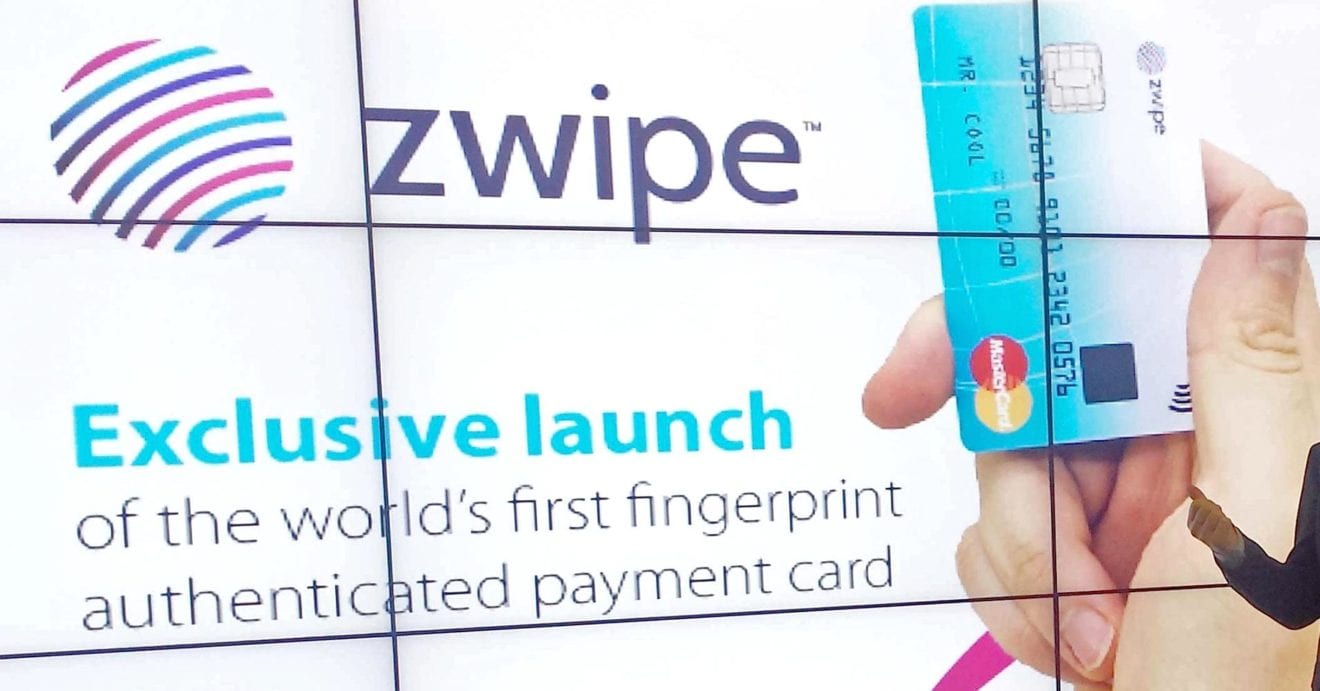
    MasterCard and a Norwegian start-up Zwipe have unveiled a prototype of the world’s first biometric contactless payment card, allowing payment confirmation by fingerprint instead of PIN.

    The card, which features an integrated fingerprint sensor, has been revealed after a successful live pilot with Norway’s Sparebanken DIN, aligned to the Eika Group.

    It’s designed as an answer to the complex challenge of providing a fast, convenient payment solution that does not compromise on security.

    The Zwipe MasterCard payment card includes an integrated biometric sensor and the Zwipe secure biometric authentication technology that holds the cardholder’s biometric data. It contains an EMV certified secure element and  MasterCard’s contactless application.

    The card is the first of its kind to combine the security of biometric authentication with the speed and convenience of contactless payment. Cardholder fingerprint data is stored directly on the card, not in an external database. After activation by a simple fingerprint scan, the Zwipe MasterCard card can be used to make contactless payments. The biometric authentication replaces the PIN entry, thus enabling cardholders to make payments of any amount, unlike other contactless payment cards on the market.

    Zwipe is now working on the next generation of its card that will be the same format as a standard card and designed to work with all payment terminals for release in 2015. This new card will harvest energy from the payment terminals without the need for a battery.

    At a media launch, Ajay Bhalla, President of Enterprise Security Solutions at MasterCard said his company believes people should be able to identify themselves without having to use passwords or PIN numbers.

    “Biometric authentication can help us achieve this. However, our challenge is to ensure the technology offers robust security, simplicity of use and convenience for the customer. Zwipe’s first trial is a significant milestone and its results are very encouraging.”

    Kim Humborstad, founder and CEO of Zwipe, added: “Feedback from our pilot with Sparebanken DIN has been very positive. Cardholders love how easy the card is to use with the added security feature. We have also had exceptionally good feedback from retailers participating in the pilot. This pilot enabled the partners to gather valuable customer feedback, experience and best practice for the enrolment and deployment phase.”

  • Glitzy Malls of Asia – Bangkok

    Glitzy Malls of Asia – Bangkok

    Central Embassy is Bangkok’s latest challenge in the luxury retail sector, not only to older malls like the SiamParagon but also to Singapore and Hong Kong as a retail destination.

    It is big and spacious with very wide walkways to ensure that it does not get packed even on busy days. It positions itself as an “ultra luxury” mall. This means, among other things, that a movie ticket here costs upwards of 1,500 baht (US$45), prompting one blogger to wonder if it comes with butler service and gold-encrusted movie stubs.

    The high-end cinema on Level 8, however, is one of the few distractions. Most of the mall is focused on just fashion and food. Fashion, in this case, includes not just the usual big international brands. More significantly, Central Embassy showcases a good selection of Thai designers. This is fully in line with the owner’s stated vision to “introduce Thailand to a global audience of taste makers and opinion formers.”

    Also consistent with this vision, the sprawling 5,000sqm supermarket and foodcourt at the basement, called Eathai, features only Thai food, with cuisines from different regions clearly differentiated. There is also a section on street foods and a cookery school. Big, colourful murals, along with walls constructed from traditional Thai kitchen utensils, add to the ambience. Other cuisines can be enjoyed at standalone eateries on the upper floors.

    The mall’s architecture is spectacular, although it takes some imagination to see how it is inspired by wats (temples) and other traditional Thai architecture. It is in the details, where traditional patterns, materials and fabrication methods are interpreted in a modern setting. The façade spans 200m and has a skin of three-dimensional ceramic tiles and protruded aluminum to project a different view with each step. Central Embassy is a sight to behold.

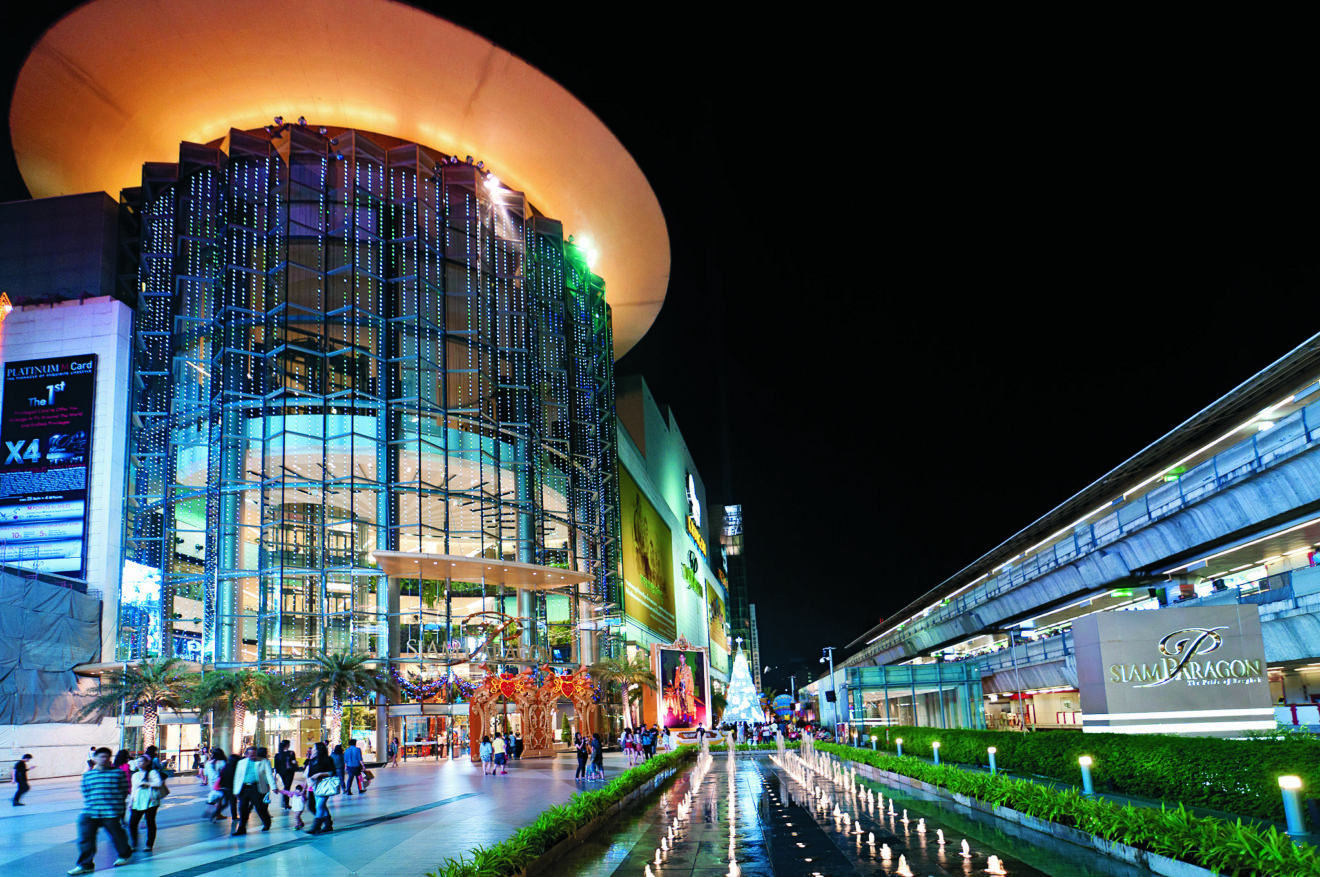
    Luxury and more at Siam Paragon

    SiamParagon redefines luxury to include more than just fashion, watches or jewellery. It means you can buy a luxury car too. Choose from Aston Martin, Ferrari, Lotus, Lamborghini, BMW, Hammar, Maserati and more. Or how about a Bentley or a Rolls Royce?

    For tourists and the Thai elite, this is the premier shopping destination. With a gigantic Paragon Department Store covering 50,000sqm over six floors, plus some 270 other shops, SiamParagon is ranked one of the largest luxury malls in Asia. But if you are not in the league for luxury goods shopping, there are lots more to do – so much more that one writer considers it “demeaning” to call SiamParagon a mall.

    One big attraction is the Siam Ocean World. Occupying some 10,000sqm at the basement, this is one of the biggest walk-through aquariums in Southeast Asia where visitors can scuba dive to get up close and personal with sharks and rays. A new attraction called Kidzania allows children to get a realistic taste of adult careers, like being a dentist or a fire fighter.

    Then there is theCineplex with 14 halls, one of which has the biggest screen and highest seating capacity in Asia. The Krunsri IMAX theatre, at 8-storeys high, is also one of the biggest in the region. There is also a 38-lane bowling alley, a karaoke, an outdoor park, an exhibition hall, an opera house, a section devoted to traditional Thai arts and the Royal Paragon Hall, a 5,000-capacity venue for concerts, conventions and other special events.

    Plus, there is an incredible range of F&B outlets featuring cuisines from around the world, at prices that range from affordable to very expensive. Even if all you want is a Starbucks coffee, SiamParagon offers a choice of at least five Starbucks outlets.