Tag: 11.11

  • Diminished Excitement Dampens China’s Singles Day Sales: A Deep Dive into the World’s Largest Shopping Festival

    Diminished Excitement Dampens China’s Singles Day Sales: A Deep Dive into the World’s Largest Shopping Festival

    China’s annual Singles’ Day shopping bonanza is drawing to a close following more than a month of promotional strategies across the nation’s main e-commerce platforms. However, this year’s event failed to generate the same level of consumer enthusiasm as previous editions due to an ongoing property crisis and increasing concerns about income security, resulting in a considerable drop in spending.

    Overcoming the Shopping Slump

    In an attempt to counteract the reduced spending, retailers have resorted to more aggressive discounting strategies throughout the year. Sales events have been extended, with billions of yuan being provided in the form of consumer subsidies and coupons. This year’s Singles’ Day, which occurs on November 11 and is also referred to as “Double 11,” started in early October, making it the longest-running event in its history.

    Josh Gardner, CEO of Kung Fu Data, a firm that handles online stores in China for global fashion and lifestyle brands, commented on the event’s performance. According to him, the results have been mixed, and the term ‘muted’ might best describe the overall public sentiment and sales outcome of this Singles’ Day event.

    Sales Performance: A Mixed Bag

    “Sales performance varied widely among brands. While some brands significantly exceeded their sales expectations, others experienced flat sales or a minor increase or decrease compared to the previous year,” Gardner said. Last year, the event generated a staggering 1.44 trillion yuan (US$202 billion) in sales, marking it as the longest-running event to date.

    In the past, major platforms, including Alibaba and JD, held extravagant celebrations to announce their record-breaking sales. Unfortunately, these companies haven’t disclosed their total Single’s Day sales for the past few years. However, JD announced that its turnover reached a new high this year, with a 40% increase in users placing orders and a nearly 60% surge in the number of orders.

    Attracting High-Spending Consumers

    In a strategic move to attract high-spending consumers, Alibaba pledged to provide 50 billion yuan in subsidies to its 88VIP members, who currently number around 53 million. Alibaba reported a 39% increase in daily active buyers from the previous year during the festival.

    Jacob Cooke, co-founder and CEO of WPIC Marketing + Technologies, mentioned that targeting 88VIP consumers is crucial. He said, “These consumers are high-spend and high-frequency buyers, which helps maintain consumption at the upper-end of the market.”

    Expanding Internationally

    Chinese e-commerce companies have been making significant efforts to expand globally. For instance, Alibaba’s Taobao extended Singles’ Day-related sales to over 20 countries this year. According to a report released in October by Bain, Chinese e-commerce companies should focus on global expansion given the lackluster consumer outlook at home.

    Questions & Answers

    Why has consumer excitement decreased during Singles’ Day?
    A slump in consumer spending has been observed due to an ongoing property crisis and concerns about income security in China.

    What strategies have retailers adopted to counteract the reduced spending?
    Retailers have implemented aggressive discounting strategies throughout the year, extended the duration of sales events, and offered billions in consumer subsidies and coupons.

    What is Alibaba’s strategy to attract high-spending consumers?
    Alibaba has pledged to provide 50 billion yuan in subsidies specifically for its 88VIP members in an effort to attract high-spending consumers.
  • Alibaba promises sustainability focus in this year’s 11.11 consumer fest

    Alibaba promises sustainability focus in this year’s 11.11 consumer fest

    “Over the last 12 years, 11.11 has showcased the tremendous consumption power of Chinese consumers and pushed boundaries for the global retail sector,” said Chris Tung, Chief Marketing Officer of Alibaba Group. “This year’s Festival marks a new chapter for 11.11. We believe we must leverage the power of 11.11 to encourage sustainable development and promote inclusiveness to consumers, merchants and partners across our ecosystem.”

    This year marks the largest Festival to date, with a record 290,000 brands participating. Tmall is offering more than 14 million deals to over 900 million consumers in China. The Festival will once again have two sales windows – the first will be from November 1 to 3, and the second will be on November 11, on the day of the main event.

    Livestreaming will be a key consumer engagement mechanism for brands and merchants to build awareness and drive sales. Starting on October 20 throughout the Festival, Taobao Live will feature 700 leading KOLs, celebrities and brand representatives in livestream sessions. In addition, Taobao will roll out a new feature for users to share their “shopping cart” items with friends and family, creating a more social shopping experience.

    “Green” Lifestyle, Eco-Friendly Consumption Top Priority This 11.11

    Tmall is taking action to promote “green” lifestyles this 11.11 by featuring a dedicated vertical to showcase energy-efficient and low-impact products, as well as issuing RMB100 million worth of “green” vouchers to incentivize shopping decisions that contribute to an environmentally friendly lifestyle.

    Alibaba’s logistics arm Cainiao Network will introduce package recycling across 10,000 Cainiao Post Stations in 20 cities to reduce the Festival’s carbon footprint beginning on November 1, the first day of the first 11.11 sales period.

    With increased use of green technology, Alibaba expects to further reduce the carbon emission per order during this year’s 11.11.

    Doing Good While Shopping

    Supporting vulnerable populations is also a key theme this year. Ahead of this year’s 11.11, the Taobao app introduced an option for “senior mode,” a new feature designed to make the user interface more accessible for senior citizens. It offers voice-assisted technology, simplified navigation, larger font size and icons. The app homepage also offers games for elderly users to unlock special discounts for groceries, making the experience more engaging for the silver generation.

    Consumers are encouraged to share their “Goods for Good” purchases with their friends and family, and Alibaba will make a RMB1 donation for every successful social media share.

    Launched in 2006, Alibaba’s “Goods for Good” program enables merchants to donate a portion of their sales to charitable organizations of their choice, while consumers can support their favorite charitable causes through their purchases. The donations from this year’s Festival will provide support to three major beneficiary groups: elderly citizens living in solitude, “left-behind children” in remote areas and low-income workers.

  • L’Oreal Asia Pacific sales reported soars

    L’Oreal Asia Pacific sales reported soars

    L’Oreal Asia Pacific sales soared by a staggering 24.1 per cent on a like-for-like basis last year. Asia was the beauty behemoth’s fastest-growing market with all divisions of the business winning market share from rivals in the region. “The dynamism of Chinese consumers, combined with the good performance of premium brands and rapid growth in several other Southeast Asian markets as well as in travel retail, were the [region’s] main growth drivers,” the company said in an earnings statement.

    Singles Day in the fourth quarter especially boosted sales in China, along with the acquisition of Stylenanda in June.

    L’Oreal Asia Pacific sales, driven by China, overtook L’Oreal’s North America business, with sales exceeding €7 billion.

    Globally, L’Oreal achieved sales of €26.9 billion (US$30.3 billion) last year, an improvement of 7.1 per cent on a like-for-like basis and 8 per cent at constant exchange rates. Net profit reached €3.89 billion euros, an increase of 8.8 per cent.

    L’Oreal’s chairman and CEO Jean-Paul Agon said the results represented the company’s best year of growth since 2007, achieved in a beauty market which had “accelerated significantly” last year.

    All divisions achieved growth, with the standouts being L’Oreal Luxe and Active Cosmetics, which both recorded double-digit sales increases. In the Luxe division, the larger brands led the way, with Lancome sales crossing the €3 billion threshold. The Active Cosmetics division achieved its highest growth for more than 10 years.

    Consumer products sales, led by L’Oreal Paris and Maybelline New York, achieved solid growth and professional products a “modest increase” thanks to a significant acceleration in the final quarter, the company said.

    A growing investment in e-commerce is paying off, with sales online up 40.6 per cent last year, now accounting for 11 per cent of group sales.

    And travel retail broke the €2 billion barrier, increasing by 27.1 per cent.

    L’Oreal reported its gross margin increased significantly and, even after strong investments in research, innovation, and business drivers, its operating margin set a new record at 18.3 per cent of sales.

  • November Singapore retail sales stagnant

    November Singapore retail sales stagnant

    November Singapore retail sales were static, rising just 0.2 per cent year on year after removing motor vehicles from the data. On a month-on-month basis, sales rose 1.4 per cent, again after disregarding motor vehicles. Perhaps the most interesting figure was the share of total retail sales which occurred online, reaching 6.6 per cent. In September, online accounted for 4.9 per cent of sales, in October 5 per cent. The November figure suggests the Singles Day shopping promotions on November 11 had a significant impact in Singapore.

    The worst-performing retail category in November Singapore retail sales was computers and telecommunications equipment, slumping 22.1 per cent year on year, which Statistics Singapore attributes to strong sales of phones in November 2017 due to the launch of new models.

    The optical goods and books categories posted sales declines of 4.6 per cent, while food retailers and supermarkets & hypermarkets fell by 3.7 per cent and 1.4 per cent, respectively.

    Department stores registered an increase of 8.7 per cent in sales, while medical goods & toiletries sales rose by 4.8 per cent.

    Turnover of fast-food outlets, restaurants and other eating places (such as cafes) increased between by 2.5 per cent and 4.5 per cent year on year in November. However, sales of food caterers decreased 2 per cent.

  • China’s slowing economy also slows Singles Day

    China’s slowing economy also slows Singles Day

    China’s slowing economy was the primary reason for the slowing growth of sales on Alibaba’s Singles Day on Sunday. This year marked the 10th anniversary of the online shopathon, and while everyone expected a new record Gross Merchandise Volume (GMV) would be set, no-one was sure whether the spectacular 39 per cent growth rate of last year would be bettered. It wasn’t.

    While the total volume of transactions this year was 213.5 billion RMB (US$30.8 billion), the growth was a more moderate 27 per cent. Singles Day still dwarfs similar events in the US, such as Black Friday ($8 billion) and Cyber day ($6.6 billion). But are there early signs the gloss is starting to wear off?

    Pascal Martin, partner at OC&C Strategy Consultants, says the striking topline Singles Day numbers demonstrate Chinese consumers continue to love these big commercial events, which allow them to try new premium brands – normally out of reach – at more affordable price points. “Singles Day is therefore a great opportunity for brands to reach out to new customers and more and more of them are excited to join the party.”

    Martin says the reduced sales growth for Singles Day reflects a slowing Chinese economy, a view backed up by Alibaba’s recent announcement that its growth for the year would be 5 per cent lower than it initially forecast. The ongoing trade war and more cautious consumer sentiment were also factors, combined with growing competition from other big promotional events such as JD’s recent 618 shopping festival, which generated a GMV of $24.7 billion over 18 days (40 per cent growth year on year) and the high number of promotional opportunities during the year, such as Spring Festival, Labour Day in May, and Golden Week.

    Martin says growing competition from e-commerce sites that offer everyday super-low prices such as Pinduoduo, an upstart e-commerce company that went from zero to 350 million customers in just three years. “Prices on Pinduoduo are hard to beat round-the-year and the application has become hugely popular in China’s smaller cities and towns.”

    Three remarkable features

    Meanwhile, Martin says there were three remarkable features of Singles Day this year:

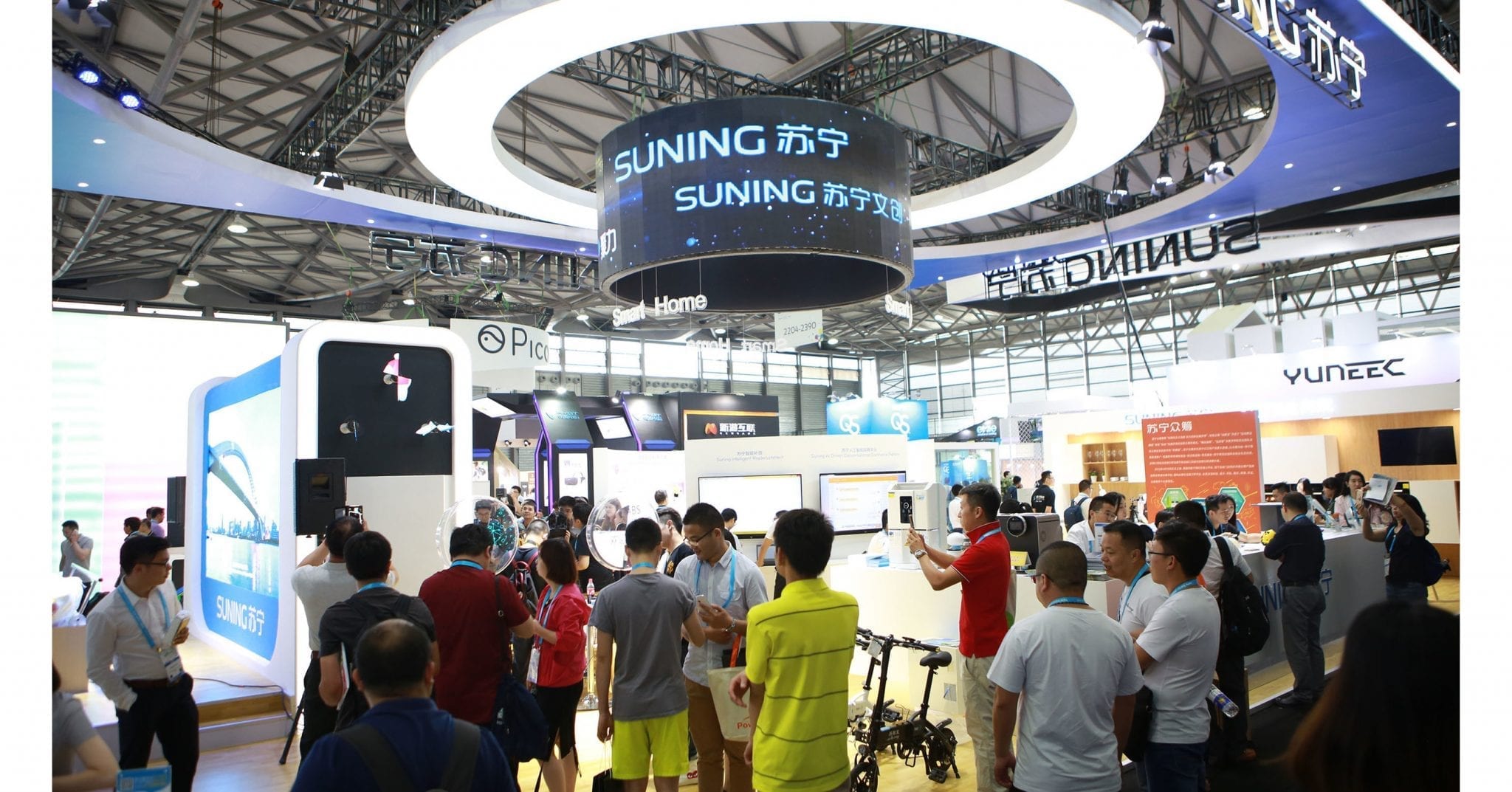
    New Retail: There were more brand partners this year, both online and offline, leveraging Alibaba’s New Retail ecosystem. “For example, Tmall’s 3000+ convenience stores, Hema and RT Mart supermarkets, Suning and Auchan, were all part of the event. Altogether 200,000 brick and mortar stores joined the party.”

    Globalisation: Singles Day has expanded beyond China through Lazada, the Southeast Asia platform owned by Alibaba. “We saw increased participation of international brands that are taking advantage of the Tmall Global platform – which is the number one by far among Chinese cross-border platforms – to get introduced to Chinese consumers without having to build a direct presence in China.”

    Diversification: The event is moving beyond just being about consumes purchasing products, it is also increasingly about purchasing a variety of services such as food delivery on Ele.com, videos on Youku to mobile games on UC, theatre tickets on Taopiaopiao, music on Xiami music and travel on Feizhu.

    Martin believes given China’s slowing economy Chinese consumers are becoming more cautious and the fact that Singles Day is now in its 10th year, it is less of a big news story. “There might be some consumer fatigue setting in.”

    Obstacles moving forward

    Martin believes three main challenges need to be addressed to sustain the growth momentum of massive commercial fairs like 11.11.

    Firstly, given the growing competition from other promotional events, Alibaba will have to continue to reach out to consumers earlier and earlier, and to expand the scope of the event even more broadly.

    “Another challenge is to continue to ensure flawless delivery for millions of parcels all over China in such a short amount of time. As the event grows, the logistical challenge becomes greater and greater. The number of parcels delivered during this year’s event hit 1 billion on Tmall alone. That’s a huge jump over last year’s 812 million parcels. Additionally, although brands don’t like to talk about it, there is a significant challenge in taking care of huge quantities of returned goods. Singles Day is a massive test bed for Alibaba’s backbone infrastructure: the network of partners that make it all possible, from payment to delivery to data management, as well as AI and cloud technologies that are put to work to ensure a successful event.

    “Finally, 11.11 has become much more than a commercial fair, it is now a major annual milestone in China’s cultural calendar. To keep the event fresh and exciting, Alibaba will need to continue to surprise Chinese consumers with entertainment and festivals around the event. This year, the double 11 gala event featured Miranda Kerr, Mariah Carey and Cirque Du Soleil, but no current big stars. Is this enough to continue to excite consumers, particularly younger generations?”

  • Alibaba breaks record Singles Day sales

    Alibaba breaks record Singles Day sales

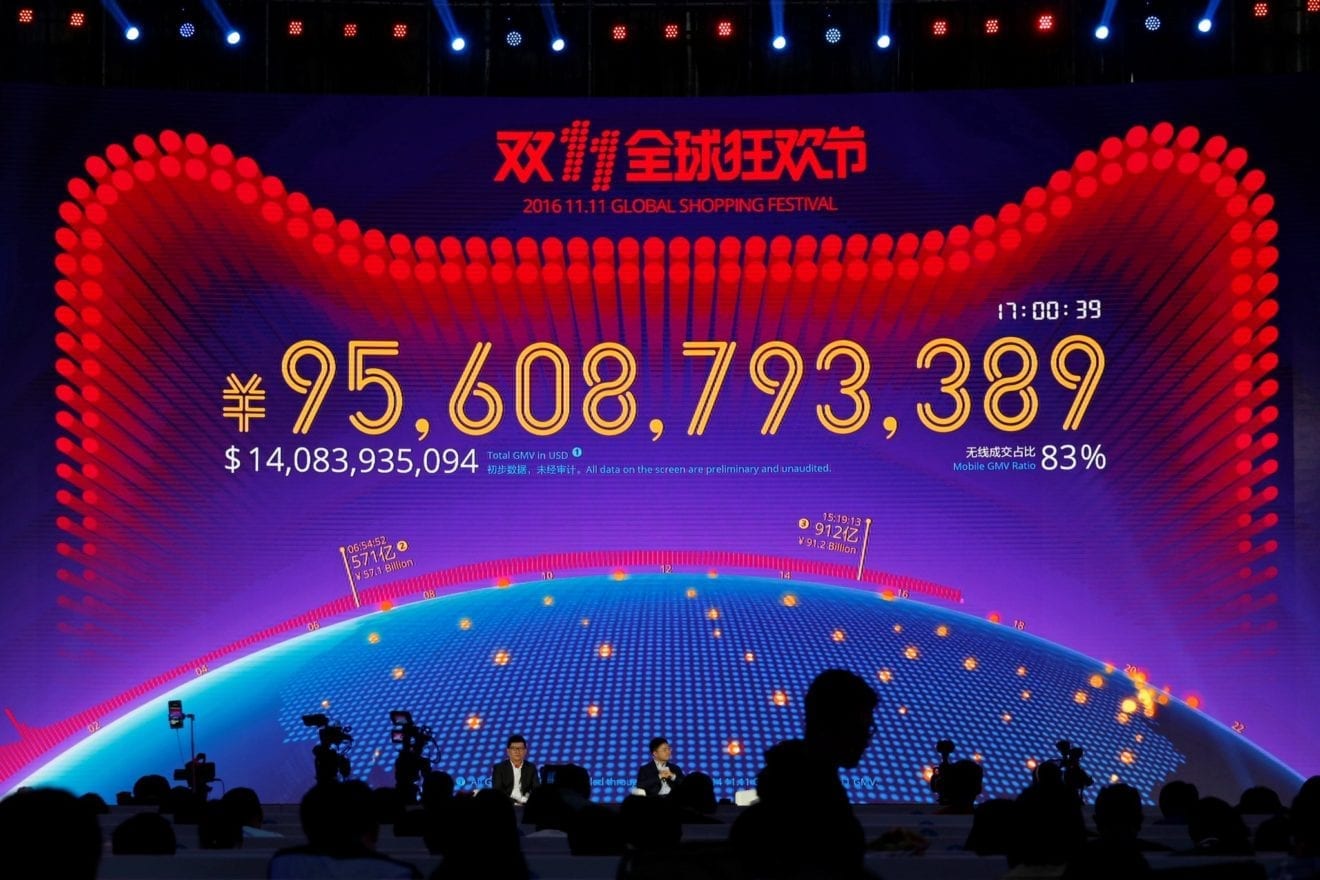
    E-commerce giant Alibaba has reported a 27 per cent increase in the gross merchandise value of goods sold during yesterday’s 11.11 shopping festival. Total GMV of Singles Day sales settled through Alipay reached RMB213.5 billion (US$30.7 billion), setting a much-anticipated record – with more than 40 per cent of consumers buying through international brands. Last year’s event brought in $25.3 billion in GMV.

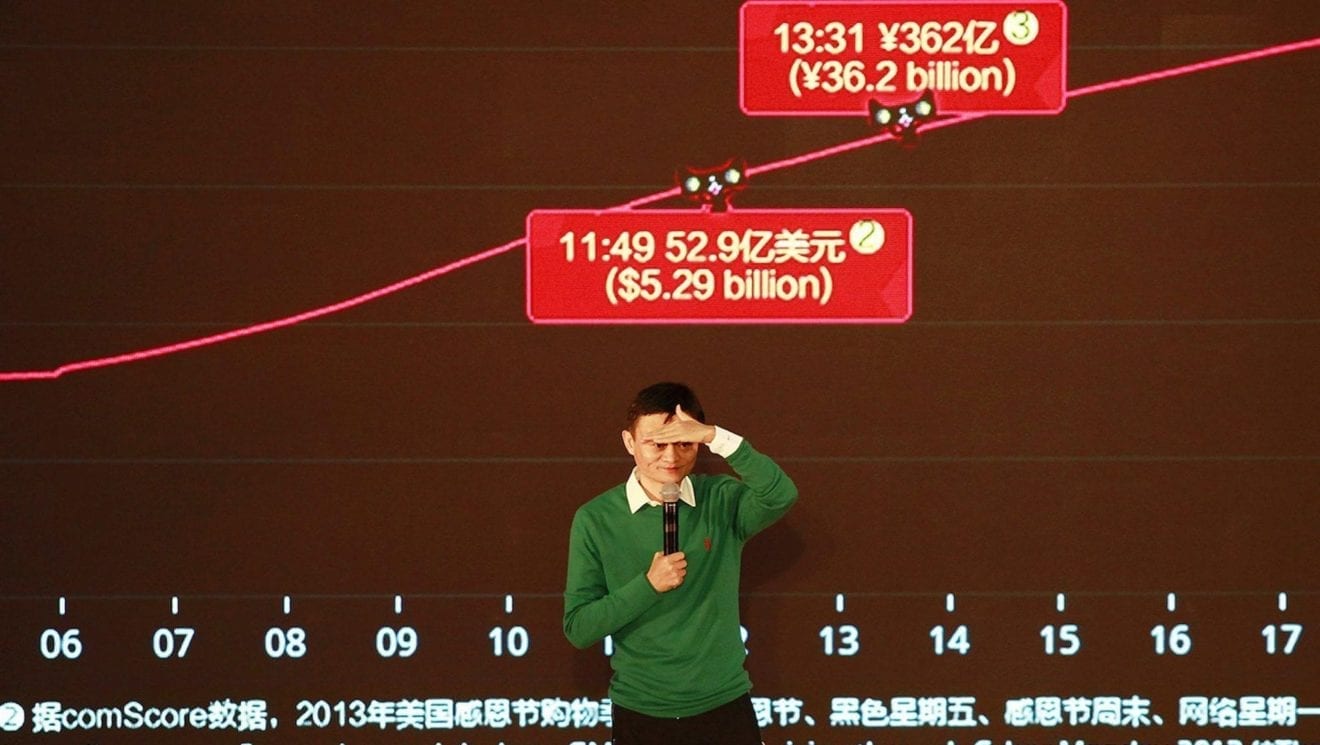
    According to Alibaba, RMB6.9 billion ($992 million) of GMV was settled in the first one minute and 25 seconds, and RMB69.3 billion ($9.967 billion) in one hour and 48 seconds.

    Comparatively, Amazon’s recent Prime Day sales were estimated to have reached approximately US$4.2 billion by Wedbush Securities analyst Michael Pachter.

    Australia, Japan, the US, South Korea and Germany were among the top countries selling in the event, with 230 markets having participated.

    Australian supplement retailer Swisse ranked as the top brand imported into China through the promotion.

    “Today we witnessed the strength and rise of China’s consumption economy, and consumers’ continued pursuit to upgrade their everyday lifestyles,” Alibaba Group CEO Daniel Zhang said.

    “Participation from the entire Alibaba ecosystem enabled our brand and merchant partners to engage with consumers like never before.”

    According to Texas A&M University’s Professor Venkatesh Shankar, customers globally want to buy both online and in-store, from any device and through any payment method, while getting a high level of customisation and service.

    Singles Day’s popularity across the world suggests a new chapter of computer-enhanced shopping experiences has begun..

    As the Chinese middle-class grows, retailers around the world are offering their own Singles Day offering in order to service a burgeoning market.

    “The global retail market is adjusting to China’s rising economic power, and Chinese customer’s desire for AI-enhanced mobile shopping experiences,” Shankar wrote.

  • Chinese Singles’ Day courts Vietnamese consumers

    Chinese Singles’ Day courts Vietnamese consumers

    Promoted by Alibaba in China for more than 10 years, Singles’ Day is now courting Vietnam with great fervor. More than a week before “Singles’ Day’ which falls on Nov. 11, major shopping firms in Vietnam had begun to update their mobile applications with a range of games designed to ‘hype up’ consumers.

    These included shaking the phone to earn coins (shopping vouchers), discount lotteries and ‘easter eggs’ giving specific discounts, and many more.

    Few retailers explain why Nov. 11 was chosen as the date for this promotional event, which some hail as “the biggest discount of the year.”

    Consumers and online businesses both acknowledge, however, that the marketing race building up to the day has been very fierce.

    The most boisterous claims came from Singapore based e-commerce group Lazada, which announced that it will gift 110,000 vouchers worth $10 million.

    General manager of Lazada Vietnam, Zhang YiXing, said he had spent the last three months fine-tuning Lazada’s app and working with vendors for the Nov. 11 event.

    Although they have no reason or specific connection with Alibaba, other e-commerce sites are not missing the opportunity to profit from Singles’ Day. Industry insiders remark that with competition so fierce, the ‘big players’ are implementing emulation strategies to grab whatever advantage they can get at.

    In particular, businesses do not want to stand idle during an event which increases the traffic and revenue of its rivals. So they’ve all jumped on the Singles’ Day bandwagon and made it spread further.

    “E-commerce is the most developed industry in Vietnam and also the most competitive,” said Tran Ngoc Thai Son, founder and CEO of e-commerce company Tiki.

    On the Tiki website, the company hails Nov. 11 as the “legendary sales season”, introducing a lottery to win laptops, phones and shopping vouchers with a total value of up to VND10 billion ($431,980).

    Meanwhile, Shopee, a consumer Internet platform provider based in Singapore, has called this day the “Super Sale.” The company has also launched a game consumers can play to earn rewards and has been promoting a different product line each day to attract attention before the official event.

    Lotte.vn has also jumped into the fray in dramatic fashion, calling the event the “Nov. 11 shopping war”, while Adayroi, run by Vietnam’s biggest private conglomerate Vingroup, has launched a full week of promotions from Nov. 1-11 with its “Sale Season”.

    Experts say that in addition to price, this years’ competing retailers have also focused more on branded goods and after-sales service.

    “Technology is no longer a challenge for Vietnam’s e-commerce sector but consumer confidence. Now choosing products and discounts from a trusted retailer is also important, not just price,” said Le Hai Binh, vice president of the Vietnam E-commerce Association.

    “Delivery and after-sales services are competitive advantages that cannot be ignored in this race.”

    Lucrative day

    Although not as fierce as this year, last Nov. 11 had made ‘a killing’ for retailers, encouraging them to step up promotions this year.

    According to data released by France-based commerce marketing company Criteo, retail sales of online shopping sites in Vietnam during the last Single’s Day campaign increased 245 percent, compared with ordinary days in the year, and marked a 70 percent increase in traffic.

    Last Nov. 11, traffic increased the most in the evening, from about 9 p.m. onwards. Shopping time “peaked” at 11 p.m., which is one hour before promotions end, so consumers were rushing to finish their shopping.

    The two most popular items last year were home appliances and electronics, with sales soaring by over 276 percent and 266 percent respectively compared to ordinary days.

    Silvia Siow, Criteo’s chief customer strategy manager for Southeast Asia, Hong Kong and Taiwan, said that these two categories were best sellers because of their high value. People tended to wait for promotions to cash in on significant discounts in absolute terms. Siow also said that Nov. 11 was playing a growing role in Southeast Asia, not just Vietnam.

    He said the real gains from Nov. 11 were not in sales but an expanded customer base and increased market share.

    “Sales are important, but traffic is more important. Increased traffic may represent newcomers who arrive and discover or rediscover products. “

    The heat of the Nov. 11 race in Vietnam is expected to last many years as it is the second most dynamic e-commerce market in Southeast Asia, behind Indonesia.

    Economist Simon Baptis, CEO of Asia region for the Economist Intelligence Unit (Economist Group) said: “Vietnam will be one of the fastest growing economies in the region with real growth constant at a high level between 2019 and 2023.

    “Reinforcing consumer confidence in e-commerce and electronic payment systems is also a need of the period.”

  • ShopBack: More people aware of 11.11 this year

    ShopBack: More people aware of 11.11 this year

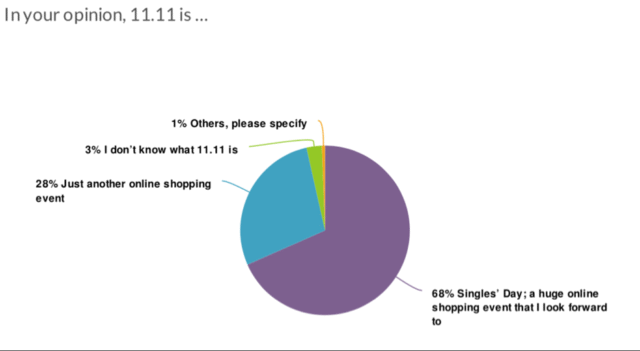
    Leading Cashback platform ShopBack conducted a survey recently and found the awareness level towards 11.11 Singles’ Day among Malaysian online shoppers has grown to 96% this year, from 69% in 2016. “In a 2016 survey to 2,000 Malaysian online shoppers, 69% answered they know what Singles’ Day is and 31% said they don’t. This year, 96% answered it is a huge online event (68%) or just another online shopping event (28%); only 3% from 2,000 respondents said they don’t know what 11.11 is, and 1% indicated that day has other meanings to them. This is an approximately 40% increase compared to 2016,” Alvin Gill, Country General Manager of ShopBack Malaysia says.

    According to Alvin, Alibaba’s investment in Lazada and massive promotions rolled out via multiple online and offline channels, as well as education efforts done by reward partners throughout the years likely contributed to the awareness growth. “Alibaba’s Taobao and Tmall have been collaborating with ShopBack on a regional level to boost market performance via cash rewards and multimedia educational efforts since 2014, of which include multi-lingual contents, digital and on-ground marketing exposures, as well as customer service support to encourage purchases through either Taobao, Tmall or Lazada’s Taobao collection, whichever suits their needs,” he adds.

    “While it is encouraging that a majority of them are looking forward to 11.11, online sellers should also target those who feel 11.11 is ‘just another shopping event’ via better product and promotional strategy. 98% of respondents said they are willing to make more purchases if the products they need are available with greater offers online. The top three offers that would encourage them to spend are high product discounts, free shipping/delivery, and promo codes/coupon,” Alvin points out.

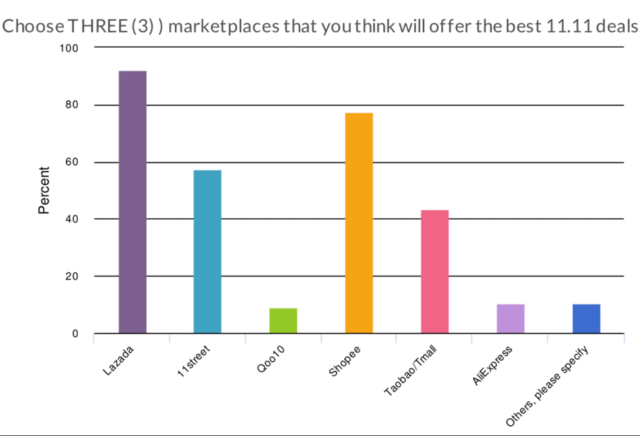
    When asked to choose three online marketplaces that they feel would provide the best 11.11 deals this year, Lazada emerged as the top choice, followed by Shopee and 11street.

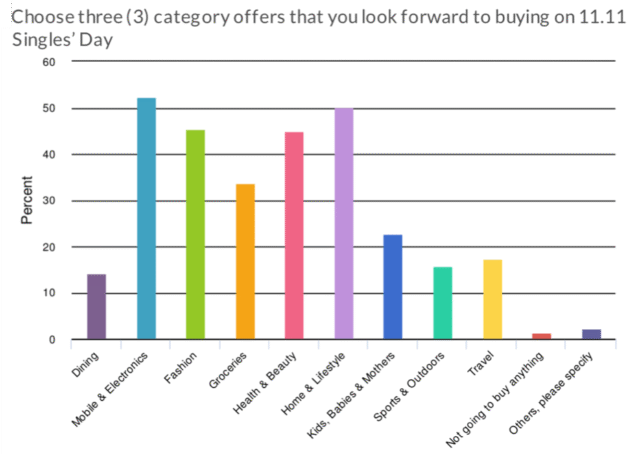
    The survey also reveals that online shoppers prefer their shopping to be affordable, fast and safe. “Mobile & Electronics emerges as the most popular category for 11.11 without surprise; the second is Home & Lifestyle which suggests shoppers could be looking for items to make over their living spaces before the New Year, followed by Fashion as well as Health & Beauty.”

    The 2018 ShopBack 11.11 online shopping survey covered views from 2,000 of ShopBack’s active online shoppers, of which 98.7% are aged 21 years old and above and around 85% have RM2,000 monthly income and above. 68.1% of the survey respondents use credit/debit card to make online payments while 25.4% select online banking as the preferred method, followed by cash on delivery 3.3%, Paypal 2.8%, and others 1.3%.

    “We witnessed 10 times more than usual web traffic directed to our partner’s sites on 11.11 in 2017, more than RM6 million worth of transactions were made through our platform and over RM200,000 cashback saved by using ShopBack. Together with our partner merchants, ShopBack Malaysia has tailor-made the 2018’s 11.11 campaign according to shopper’s needs and we aim to break the record by doubling our performance as well as cashback number this year,” Alvin says.

    Currently, more than 1 million Malaysians are using ShopBack for their daily purchases. The company works with online sites like Lazada, 11street, Taobao, Tmall, Booking.com, Expedia, Traveloka, ZALORA, Hermo, etc to give up to 30% cashback as a loyalty reward to online shoppers. Besides Malaysia, ShopBack also operates in Singapore, Indonesia, Philippines, Thailand, Taiwan and Australia. Over RM25 million worth of cashback has been given to its Malaysian users thus far. The cashback savings can be transferred out to a user’s bank account upon validation.

  • What is Singles’ Day like in the Philippines?

    What is Singles’ Day like in the Philippines?

    It all started with a few students from Nanjing University who decided to break away from the monotony of being single for one day. They chose 11.11 because of the solitary implications of the number 1 which symbolize being single. However, this simple celebration turned into one of the largest shopping days in the world.

    It turns out that this event gained great interest also in Southeast Asia.

    According to Google, in Philippines the popularity of Singles’ Day has increased more than four times in the last five years.

    Who’s taking part in Singles’ Day? What are the behaviours of consumers on that day? 

    Shopping therapy for the young and lonely

    Who shops on Singles' Day

    So, who exactly takes part in Singles’ Day?

    57% are actually women.

    In accordance with the event’s name, three out of four consumers are single.

    Of course, not only singles went on a shopping spree.

    An increase in interest, although not as significant as among singles, can also be noted in the group of people in relationships.

    The interest in Singles’ Day is especially apparent among young Filipinos.

    Compared to a regular day, the number of transactions on Singles’ Day among people aged 18-24 grew by 1022%.

    However, getting great discounts is not restricted to younger people as there is a noticeable interest in this shopping festival among all age groups.

    The day for singles to indulge themselves

    What and how Filipinos buy on 11.11

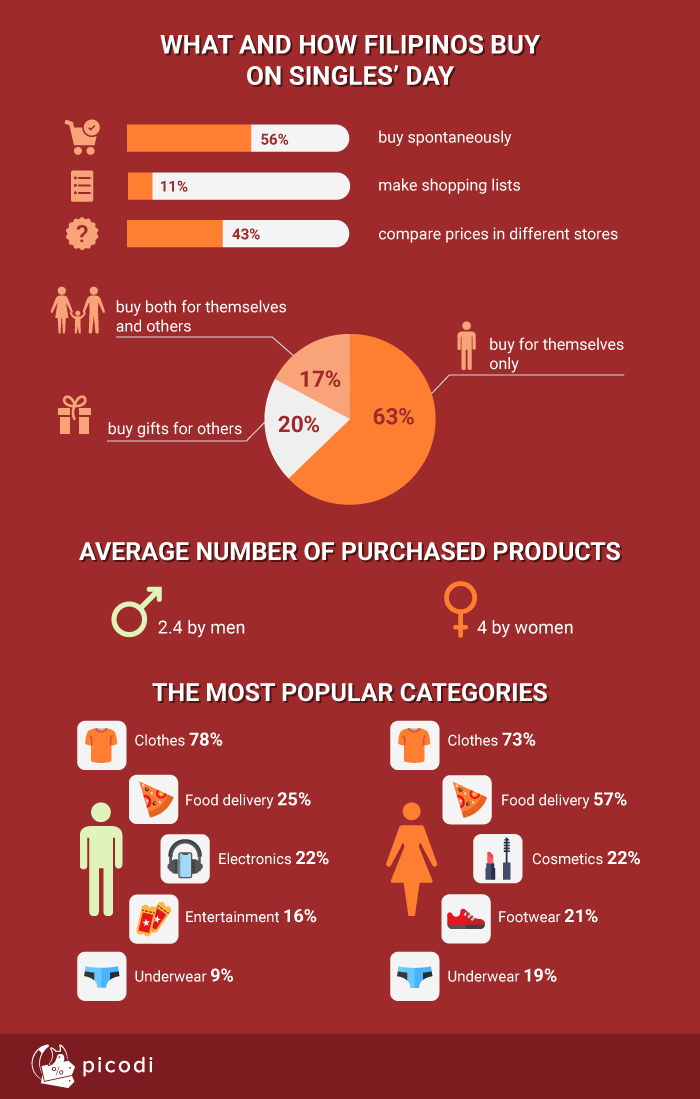
    More than half of Filipinos do not prepare for the Singles’ Day shopping craze but buy impulsively on that day.

    43% compare the prices in different stores while 11% make lists before shopping.

    It looks like most people treat 11.11 as an occasion to meet their desires rather than an opportunity to execute a well-thought-out shopping plan.

    On top of that, more than 60% of consumers buy things just for themselves and only one-third buy gifts for other people on that day.

    An average man buys less than an average woman—2.4 and 4 products respectively.

    The most desirable items among men are clothes, delivery food and electronics. Similarly, women buy mostly clothes, delivery food and cosmetics.

    Shopping fever in the middle of the day

    Shopping behaviours on Singles' Day

    It’s not surprising that Filipinos buy more than usual on Singles’ Day.

    The number of online transactions increased significantly with 970% more purchases compared to a regular day.

    On average, a Filipino is willing to spend 3050 PHP on a Singles’ Day shopping spree and sales reached a peak right in the middle of the day, at 1 PM.

    Mobile users far behind

    Singles' Day: Devices types and brands

    70% of consumers use desktops when doing their shopping on Singles’ Day.

    Only 26% of Filipinos make their purchases on mobile phones.

    Most of the transactions are made on Apple devices, followed by Samsung, OPPO, Asus and Huawei appliances.

  • Tmall, Swire Properties launch New Retail initiative

    Tmall, Swire Properties launch New Retail initiative

    Alibaba Group’s Tmall and Swire Properties are launching a New Retail initiative creating tailored retail experiences at Swire Properties’ five shopping malls in Mainland China. The partnership will bring benefits to customers in time for Alibaba’s 11.11 Global Shopping Festival on Sunday with Taikoo Li Sanlitun in Beijing the first brick-and-mortar shopping mall in Mainland China to experience this year’s 11.11 “red packet rain” this week.

    Swire Properties will introduce Tmall’s New Retail technologies at five of its developments: Taikoo Li Sanlitun and Indigo in Beijing; HKRI Taikoo Hui in Shanghai; Taikoo Hui in Guangzhou and Sino-Ocean Taikoo Li in Chengdu. The five New Retail initiatives include Tmall Smart Stores, a Tmall Pop-Up Store, Interactive Idol Engagement Photo Booths, Smart Nursery Rooms and a Smart Parking Service.

    Tmall Smart Stores: Shoppers will enjoy a seamless online and offline shopping experience from order to delivery (for participating physical stores). By signing up as members of selected brands, customers can instantly receive details on the latest promotions, and enjoy a return service by simply using their digital devices.

    Tmall Pop-Up Store: Tmall will open an interactive pop-up store featuring cutting-edge technology at Taikoo Li Sanlitun. This nine-day promotion during the Festival will offer shoppers in-depth and enhanced experiences.

    Interactive Idol Engagement Photo Booth: Fans will have a chance to ‘virtually interact with’ and snap a photo with their idol. This is the first-of-its-kind check-in hot spot in Mainland China.

    Smart Nursery Rooms: These offer mothers a relaxing and private space where they can nurse their babies at shopping malls. Vending machines will also offer essential nursing necessities.

    Smart Parking Service: By linking Alipay with their car license plates, drivers can pay parking fees with ease. This service will save drivers 80 per cent of the time usually spent on paying the parking charge and exiting the car park.

    “At Swire Properties, we are always looking for new ways to innovate and integrate the latest technologies into our business, so that we can bring unique experiences to our customers,” said Han Zhi, director, retail at Swire Properties. “Our collaboration with Tmall is a powerful example of digitisation. By harnessing rapidly developing online technologies and big data, our goal is to define the New Retail shopping experience.

    “This year marks the 10th anniversary of Taikoo Li Sanlitun and Alibaba’s 11.11 Global Shopping Festival, both of which have grown in leaps and bounds the past decade. We’re confident that our partnership, which also celebrates this milestone, will set a new benchmark in our respective industries and in the digital space.”

  • High Suning profit increase reported

    High Suning profit increase reported

    Chinese O2O retailer Suning has posted RMB172.97 billion (US$24.79 billion) in operating revenue in its third quarter performance report. The result shows a 31.15 per cent year-on-year increase on the reported figure during the first three quarters this year. The company also generated a net profit of RMB6.127 billion ($878 million), an increase of 812.11 per cent over the same period last year.

    The company credits the result to the strength of Suning’s fast-growing online sales comparative to other e-commerce platforms.

    Suning currently has more than 382 million registered users. It operates 6292 direct-sale physical stores and 1453 Suning retail cloud franchise stores.

    Suning says it will provide free delivery in the days approaching the holiday the 11.11 Singles Day shopping spree and will not raise its delivery fees on the day.

  • Singles Day 2018 faces delivery challenges

    Singles Day 2018 faces delivery challenges

    Alibaba and its partner retailers will face a massive challenge ensuring flawless delivery of millions of parcels all over China and beyond given the expectations of further growth on Singles Day 2018 next week.

    “As the event grows, the logistics challenge becomes bigger and bigger,” observes retail analyst Pascal Martin, partner at OC&C Strategy Consultants.

    “During last year’s event 812 million parcels were delivered just on Tmall. Observers are betting that this year’s milestone might be more than 1 billion parcels.”

    And, says Martin, although brands don’t like to talk about it, there is also a huge challenge in taking care of large quantities of returned goods.

    “11.11 is a massive test bed for Alibaba’s backbone infrastructure: the network of partners that make it all possible, from payment to delivery to data management, as well as AI and cloud technologies that are put to work to ensure a successful event.”

    Alibaba’s Cainiao Smart Logistics Network says it has upgraded its technology to cope with the expected increased volumes from 11.11 this year. The company boasts more than 30 million sqm of warehousing worldwide and a logistics field force of more than 3 million people.

    Domestically, Cainiao has opened a new robotic warehouse, expanded its Internet of Things (IoT) systems and built out its platform’s last-mile reach. For cross-border deliveries, more than 1000 shipping containers and 51 charter planes are booked, ready to speed orders across the world.

    Cainiao VP Ben Wang says while nobody knows how many orders Singles Day 2018 will generate, the logistics company needs to keep upgrading systems, anticipating growth and seeking higher efficiency, because of customer expectations.

    “It was only five years ago that parcel orders surpassed 100 million for the first time. Back then it took nine days to deliver the first 100 million parcels,” said Wang. “Last year, it took less than three days (2.8 days) to deliver the same number of parcels. Consumers increasingly want faster, better delivery, so that’s what we’re doing. This year, we’re striving to achieve a new high, leveraging the beauty of scale and technology.”

    Delivery “within minutes”

    Cainiao’s preparations this year also reflect the changing demands of logistics in the New Retail era. For the first time, goods ordered during 11.11 will be delivered directly from stores to customers during the Festival – sometimes within minutes. Short-distance delivery services will be available in more than 280 cities.

    “Cainiao is the logistics backbone of Alibaba’s New Retail strategy,” Wang said. “We are providing an online and offline, cross-platform supply-chain solution to merchants and enabling them to cut inventory costs, while increasing operating efficiency, especially around 11.11 ­– the busiest season of the year. Ultimately, consumers will enjoy a brand-new shopping experience, as delivery service will always be on-demand.”

    Martin expects Singles Day 2018 to include more partners, not only online but also offline, leveraging Alibaba’s New Retail ecosystem. For example, Tmall 3000+ convenience stores, Hema and RT Mart supermarkets, Suning and Auchan, will be fully integrated into the event.

    The event will also be expanding beyond China through Lazada, the Southeast Asia online platform owned by Alibaba.

    “We expect to see participation of an increasing number of international brands that are taking advantage of the Tmall Global platform – number one by far among Chinese cross-border platforms – to get introduced to Chinese consumers without any direct presence in China for many of them.”

    And diversification will be another key factor in this year’s event, he says.

    “It’s not just about purchasing products, it’s also increasingly about purchasing a variety of services, from videos on Youku to mobile games on UC, theatre tickets on Taopiaopiao, music on Xiami music, travel on Feizhu, etc… All of this will not happen without challenges.”

    Yet another test, says Martin, is for Alibaba to expand the event beyond its group companies.

    “Right now, most of the non-Tmall companies participating in the 11.11 event are Alibaba Group companies. Getting non-group companies to embark on the 11.11 band wagon will be the next step to sustain continued growth of the event in future years.

    “Finally, to keep the event fresh and exciting, Alibaba will need to continue to surprise increasingly demanding Chinese consumers with entertainment and festivals to delight them around the event. 11.11 has become much more than a commercial fair, it is now a major annual milestone in China’s cultural calendar.”

    Last year’s 11.11 event saw GMV reach 254 billion RMB (US$36.6 billion) including 168 billion RMB on Tmall alone. That turnover represented a 43.5 per cent increase over the 2016 GMV.

    Singles Day 2018 will mark the event’s 10th anniversary.

  • Tmall’s “See Now, BuyNow” Show Kicks Off 2018 11.11 Global Shopping Festival

    Tmall’s “See Now, BuyNow” Show Kicks Off 2018 11.11 Global Shopping Festival

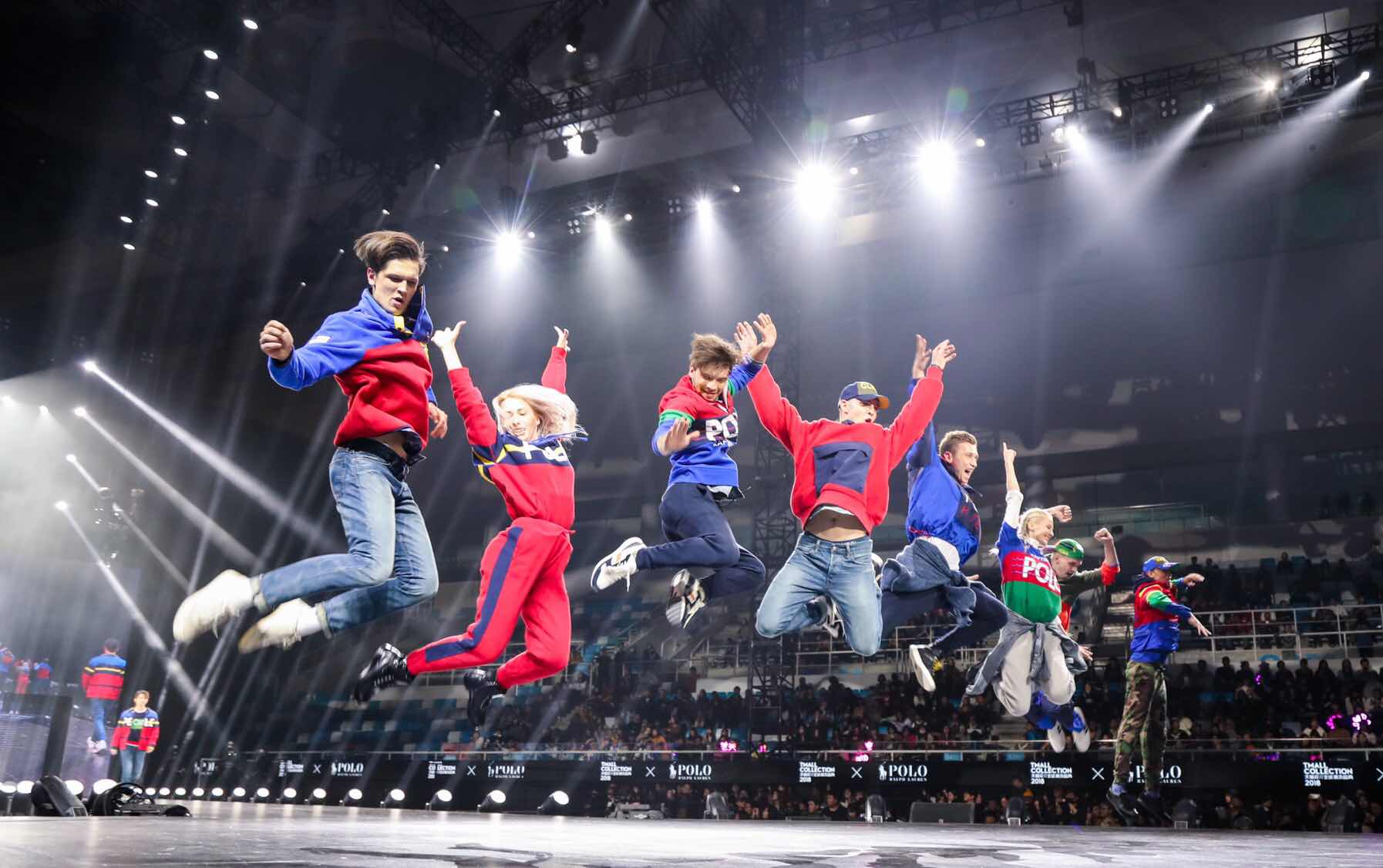
    Tmall, the largest B2C ecommerce platform for global and domestic brands and retailers in China, hosted its “See Now, Buy Now” Tmall Collection Fashion Show during the weekend in Beijing, kicking off the month-long lead-up celebration to Alibaba Group’s 2018 11.11 Global Shopping Festival.

    This year – the festival’s 10th anniversary – its fashion show added a new interactive element. In addition to popular “See Now” and “Buy Now” features that allow viewers to purchase items shown on the runway instantly from their mobile phones, this year’s fashion show also introduced an innovative feature, “Play Now”. “Play Now” gives viewers the chance to vote for their favorite outfits to create a trend report that would provide insights and instant feedback to participating brands.

    “Tmall Collection is our annual extravaganza to showcase the hottest trends in fashion. We created the ‘See Now, Buy Now’ concept two years ago, and we are excited to boost consumer engagement to a new level with the ‘Play Now’ feature, enabling viewers to share their views with brands real-time,” said Jessica Liu, President of Tmall Fashion and Luxury.  “The ‘See Now, Buy Now’ show provides a powerful sales channel for the world’s leading brands and also has the potential to reshape the fashion industry with the interactive component tailored for the always-online Chinese millennials.”

    The four-hour “See Now, Buy Now” show featured an impressive lineup of more than 60 international and domestic brands showcasing their latest collections, including Estée Lauder, Levi’s, Adidas, Guess, I.T, M.A.C.., G-Star Raw, and Swatch. More top luxury brands participated in the event than ever before, including Stella McCartney, Burberry, MCM, La Perla, Giuseppe Zanotti, and Stuart Weitzman.

    To celebrate the 10th anniversary of the 11.11 Global Shopping Festival, the fashion show also featured a special segment highlighting crossover products that are specifically designed for the Festival. Celebrities participating in the show this year included American fashion designers Anna Sui and Jason Wu, American singer Jaden Smith, and Chinese singer Chris Lee.

    The live runway show had attracted over 57 million online viewership, more than tripling that of last year. It was broadcast live on 10 platforms, including the Taobao app, Alibaba’s video platform Youku, social media platform Weibo, and short video app Tik Tok.

  • Alibaba’s Robust Ecosystem Supercharges  2018 11.11 Global Shopping Festival

    Alibaba’s Robust Ecosystem Supercharges 2018 11.11 Global Shopping Festival

    Alibaba Group Holding Limited (NYSE:BABA) today officially kicked off the 2018 11.11 Global Shopping Festival in China’s capital, promising this year’s mega-event will be the largest-ever in terms of scale and reach.

    Businesses within the Alibaba ecosystem will jointly offer hundreds of millions of consumers an enriching experience that supports their pursuit of high-quality products, entertainment and fast, reliable services. The Festival will also demonstrate the enthusiasm of consumers and brands embracing Alibaba’s New Retail strategy – the convergence of online and offline retail through technology.

    “This year marks the 10th anniversary of 11.11. On the back of China’s explosive digital transformation, the Festival’s astounding growth over the past decade has powered the steady growth of quality consumption sought by Chinese shoppers. The evolution also showcases the development of the Alibaba ecosystem over time expanding well beyond e-commerce,” said Alibaba Group CEO Daniel Zhang.

    Zhang conceived 11.11 as a concept a decade ago, turning “Single’s Day” on the Chinese calendar into the world’s largest annual shopping event. The first 11.11 in 2009 brought in US$7.8 million in gross merchandise value (GMV). Total GMV generated in 2017 was US$25.3 billion. Over the past decade, China’s number of Internet users has risen to 802 million and 98% of them are mobile1. Alibaba has captured the hearts and minds of these Chinese consumers and expects to keep leading the way in retail innovation.

    “Over the last two years, we have pioneered the concept of New Retail to accelerate the digital transformation of the offline. We are excited by the impressive results achieved to date and will continue to be the driving force innovating for merchants and customers in the coming decades. We aim to become both the number-one business partner for brands and the number-one shopping destination for consumers,” Zhang added.

    This year, 500,000 items will be available for pre-order on Tmall from October 20. Customers can enjoy additional promotional coupons on Mobile Taobao and Mobile Tmall. Specifically, the 2018 11.11 Global Shopping Festival will have the following features made possible by New Retail and interactive initiatives:

    • Brand Innovation Tmall will continue to give brands access to new digital capabilities – 180,000 brands from China and around the world will participate in this year’s celebration. 200,000 smart stores in China across the apparel, fast-moving consumer goods, beauty products, automobile and home décor industries will help boost traffic to offline and online shopping destinations. Tmall Global provides 3,700 categories of imported goods from 75 countries and regions on its platform.
    • International Consumers Tmall World, AliExpress and Lazada will bring the event to hundreds of millions of overseas users, making 11.11 a truly global event. Lazada will host its first 11.11 Shopping Festival across six countries in Singapore, Malaysia, Thailand, Indonesia, the Philippines and Vietnam, offering more engaged consumer experience and the biggest discounts of the year from LazMall and Lazada marketplace.
    • Participation of Local Services Ele.me’s on-demand platform will provide delivery services for select Starbucks stores across 11 Chinese cities, including full-service coverage in Beijing and Shanghai. In addition, 150,000 merchant partners of Koubei will offer half-price discounts on catering, beauty and hair salons and karaoke bars.
    • New Opportunities for Small Merchants 200,000 mom-and-pop stores powered by Alibaba’s Ling Shou Tong (which translates as “retail integrated”) will provide online sales promotions, along with augmented reality-based red packets that offer discounts at 3,000 “Tmall Corner Stores.” Rural Taobao will also bring coupons to its services in 800 counties across 29 provinces in China.
    • Dining and Supermarket Hema supermarket will designate 11.11 signature stores featuring a number of promotions. RT-Mart will complete the makeover of its nearly 400 stores, fully equipping them with New Retail capabilities.
    • Star-studded Entertainment Tmall Collection’s “See Now, Buy Now” Fashion Show will be broadcast live on ten platforms including Taobao, Youku, Weibo and Toutiao on October 20, starting at 6pm in China. This will provide millions of customers the opportunity to buy their favorite items on the spot and vote for their favorite looks to create a trend report. In addition, the signature countdown Gala will be held on November 10 in Shanghai’s Mercedes Benz Arena, featuring renowned stars.
  • Tmall taps 10 beauty brands for omnichannel growth

    Tmall taps 10 beauty brands for omnichannel growth

    Tmall will this year work with top beauty brands such as Estee Lauder and Lancome to help them surpass RMB 1 billion (US$157.9 million) in annual sales on the platform.

    The increased focus on the beauty sector will also see Tmall deliver an updated suite of New Retail solutions so that all merchants can better serve Chinese consumers, the Alibaba Group-owned B2C shopping site says.

    Tmall plans to partner closely with about 10 beauty brands in particular, also including SK-II and Olay, to help them break that sales threshold. New Retail initiatives include a new “try-before-you-buy” feature, where users pay a 10 per cent deposit to test a product with the promise of a simpler and faster refund process.

    “Our partnership with brands will cover every corner from online to offline,” Tmall president Jet Jing said. “We will be consistently involved in daily operations ranging from product innovation, brand building, channel management, supply chain to customer operations.”

    Tmall Supermarket would also expand its one-hour delivery service to more customers, as faster service is also a part of New Retail, Jing said. However, the biggest changes won’t come until the 11.11 Global Shopping Festival, which is typically when Alibaba rolls out its New Retail initiatives.

    The initiatives were announced during the Tmall Beauty Awards in Shanghai, where more than 1000 beauty professionals, from both international and home-grown brands, gathered for the annual event. This year, Estee Lauder, SK-II, Giorgio Armani Beauty and Givenchy each took away a “Super Brands Award,” for their outstanding performance in brand influence, marketing creativity and consumer engagement. Newcomer Givenchy on March 1 broke the single-day sales record, selling more than 58,000 lipsticks and generating over RMB 16 million – all in the first 12 hours of the day.

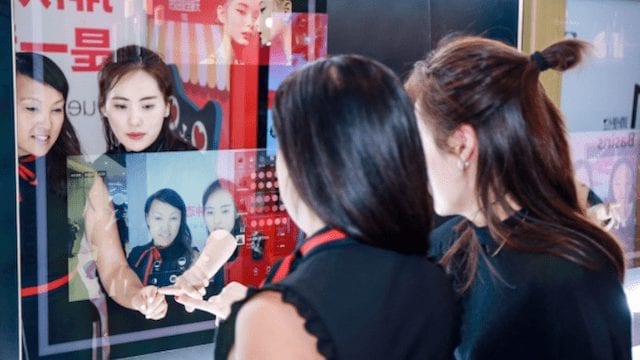
    Since launching in 2015, the awards largely have spotlighted New Retail-driven innovations. Featured technology at this year’s awards included the “Cloud Shelf” and the latest iteration of the augmented reality-powered “Magic Mirror,” which allows users to virtually try on new hairstyles, lipstick, eyeshadow and blush. Tmall said it would partner with with French cosmetics company L’Oreal to install Magic Mirrors in 50 of the beauty giant’s physical stores in China.

    Tmall hosts more than 3000 beauty brands on its platform, according to a report released by Tmall and Chinese research firm CBNData last year. Some of the newest entrants include LVMH-owned Givenchy, L’Oreal’s Giorgio Armani Beauty and Estee Lauder’s Darphin.

    “After two years of very successful acceleration in China, we felt this is the right timing to join Tmall to push artistry and premium-ness of the brand,” said Andrea Yann, GM of the China market at Giorgio Armani Beauty. “Our plan is really to understand from [Alibaba’s] database what are the main beauty concerns of Chinese women to solve their beauty issues, be very personalised still being [seen as] very artistry and premium.”

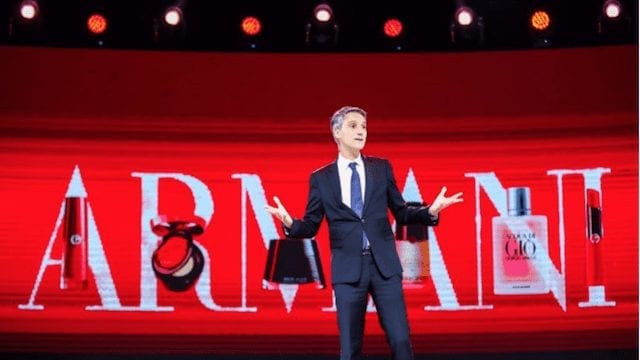
    Andrea Yann, GM of the China market at Giorgio Armani Beauty, speaks on stage.

    Younger more focused on beauty

    According to a report released by Tmall and market research consultancy Kantar, what they want is a more elaborate skincare regimen. Thirty-five per cent of respondents said they have added more steps to their beauty routines, and therefore are spending more on skincare products and cosmetics. Tmall attributed 53 per cent of the sales of beauty products on Tmall to consumers making more purchases per person.

    Beauty consumers in China – the world’s largest and fastest-growing beauty market at $22 billion – are also becoming younger than ever, the report noted. In 2017, users born after 1990 made up over 40 per cent of shoppers on Tmall Global, the site’s cross-border e-commerce channel, overtaking those born in the 1980s as the main consumption force on Tmall Global, the site’s cross-border e-commerce channel.

    Consumers born after 1990 like to try new products from new brands and less familiar origin countries, the report said.

    Embracing the new

    “In China, there’s more willingness to try new products at a faster rate than what you would see in different markets,” said Danielle Bailey, head of Asia Pacific research at digital agency L2.

    “It’s not that [Chinese beauty consumers] are less loyal, but their desire to explore is much higher,” she said. “This makes it more challenging for brands to sell to the market, but also creates new opportunities.”

    Tmall’s latest report also showed momentum for homegrown brands, particularly for skincare, where they accounted for 56 per cent of sales last year – up from 54 per cent in 2016. However, foreign brands still dominate the cosmetics category with 56 per cent of total makeup sales.

    Chinese brands are trying to boost their profiles by launching new prestige product lines or creating new products within an existing line, said Bailey. “It will be interesting to see if local brands can successfully transition to that space. It’s still a bit unclear because Western brands tend to be associated with better quality,” she added.

    From a product development standpoint, the pace of innovation in Asia has forced brands in the West to shrink development timelines to stay relevant, said Bailey. Where Western companies may take two years to release a product,” he said, “in Korea, some brands are launching new product every three months.”

    Time-to-market is indeed very important for beauty brands, said Ye Guohui, GM of Tmall’s new retail division.

    “Conducting market research alone can be very time-consuming, taking up to over a year,” he said. “But brands in China can leverage Alibaba’s data capacities to really shorten that timeline, and accelerate product development.”