Retail News CRM

Tag: APAC

  • Digital payments fueling FinTech investments in APAC

    Digital payments fueling FinTech investments in APAC

    The APAC FinTech landscape is witnessing unprecedented growth, with FinTech solutions and services expected to gross more than $70 billion in revenue by 2020.

    Market research firm Frost & Sullivan believes the market is on track to record a CAGR of 72.5% over this period.

    “Asia-Pacific FinTech investment increased exponentially in 2015. There was a four-fold increase of investments in APAC FinTech companies from 2014 to 2015 which shows growing investor confidence in the Asia-Pacific region. Meanwhile 42% of the investment deals concentrated on digital payments,” Frost & Sullivan VP for digital transformation Ajay Sunder said.

    Innovation hubs have formed around Hong Kong, Singapore and Sydney riding on the back of favorable government regulations, strong start-up ecosystems and heavy consumer demand among the 18-34 demographic group in particular.

    The emergence of new business models is enabling players to innovate and invest in technologies such as Blockchain, digital payments, cloud services, cyber security, product lines and solutions. Players must rethink strategies and align their business vision with technology goals to define their value proposition to customers and survive in the rapidly evolving digital ecosystem.

    “Digital payment will remain the largest segment, primarily driven by mobile payment solutions, while Blockchain will not remain limited to financial services; there will be new use cases for Blockchain, and traditional ICT vendors will start offering Blockchain-as-a-Service,” noted Sunder.

    Frost points to innovative services providers such as BitSE, Canopy, Coinsecure, DxMarkets, Freecharge, HedgeSPA, MOLPay, Otonomos and TranServ as addressing unmet needs, embracing new technologies and gaining a disruptive advantage by leveraging diverse opportunities.

  • Bridgestone appoints M&C Saatchi Singapore as APAC AOR

    Bridgestone appoints M&C Saatchi Singapore as APAC AOR

    Bridgestone China & Asia Pacific has appointed M&C Saatchi Singapore as its agency of record (AOR) from January 2017 following a closed-door pitch involving four global agencies.

    This win follows the agency’s recent wins as AOR for Shell Retail Singapore and the social media accounts of NETS and Bank of Singapore.

    M&C Saatchi Singapore will partner with Bridgestone China and Asia Pacific to drive digital transformation of customer experience and related operational processes.

    The agency’s remit includes developing a through-the-line brand campaign, with a focus on a thorough revamp of the current website and social media strategy. Malaysia will be the first focus market for the agency.

    In a statement, Chris Yang, GM, Bridgestone China and Asia Pacific, said the agency impressed with “their understanding of consumer insights and how it translates into solutions for our brand and business across all touch points.”

    “Consumer experience has always been at the heart of what we do at Bridgestone,” he added.

    Tanuj Philip, CEO of M&C Saatchi Singapore, said the agency has been focused on building a specialist digital and social unit within the agency, and that the win is “a testament to the expertise and experience of the team”.

    “We look forward to partnering with Bridgestone to reinvent customer experience in the category,” he added.

  • 2017 APAC Effie Awards Call for Entries Announced

    2017 APAC Effie Awards Call for Entries Announced

    The Asia Pacific Effie Awards has announced the Call for Entries for the 2017 season. Recognized by agencies and marketers to be the most prestigious effectiveness awards in the region, APAC Effie, now in its fourth edition, continues to honour marketing communication campaigns that have achieved outstanding measurable results.

    The 2017 competition offers 42 categories, spotting several changes to stay relevant to the evolving marketing landscape in Asia Pacific. 3 new Specialty Categories are introduced – Branded Content, Programmatic, and Seasonal Marketing.

    In addition, the Positive Change Effie Awards, a multinational programme run in collaboration with the World Economic Forum, is now offered as part of the APAC Effie program under Environmental – Brands and Environmental – Non-Profit. In alignment with global practices, we have rebranded Goodworks – Brands as Social- Brands, and Goodworks – Non Profit as Social – Non-Profit under the Positive Change categories this year. Full list of categories and category definitions are available in the Entry Kit.

    “As one of the most coveted accolade in this region, the APAC Effie has become the “must-enter” award in the region’s competition calendar. This is where we can demonstrate our capabilities to deliver innovation, creative solutions and results for brands,” said Anthony Wong, the 2017 Awards Chairman. He added, “I am excited to see the cases and look forward to be inspired by outstanding work that represents the best of the region – and the world.”

    The 2017 Awards is now accepting entries through to December 2016 for all marketing communication efforts that have ran in Asia Pacific during the qualifying period. Winners will be announced at the Awards Gala in Singapore in April 2017.

    Visit www.apaceffie.com for more information on the competition.

  • Cashless push stimulating APAC m-payment market

    Cashless push stimulating APAC m-payment market

    A top down regulatory push toward cashless societies will stimulate exponential growth in the mobile payment market in Asia-Pacific (excluding China and India), which will surge from $71.92 billion to $271.47 billion by 2021, research from Frost & Sullivan indicates.

    According to the research firm, the number of active customers will also double to 130.8 million users by this time.

    With standardization and increasing openness toward FinTech, competition is intensifying for the entire supply-side ecosystem. Mobile payments solution providers will need to fully understand the mobile payments market in the region to gain an edge.

    Asia-Pacific is expected to continue to lead the world in mobile payment developments as smartphone penetration here is the highest. Apple, Samsung and Google with Apple Pay, Samsung Pay and Android Pay have also addressed existing security concerns through tokenization in the payment infrastructure, supplemented by biometrics on the smartphone.

    “The mobile payments market in Asia-Pacific, however, is guided by local preferences and considerations,” noted Frost & Sullivan Digital Transformation Industry Principal Analyst Quah Mei Lee.

    “For instance, in Indonesia and the Philippines, telcos lead with their e-money products whereas in Japan, South Korea and Australia, credit card is the key payment method. Understanding these dynamics is critical for mobile payments solution providers to succeed.”

    Mobile payment in Asia-Pacific is being led by developed countries such as Japan, South Korea, Australia and Singapore. Japan and South Korea has dominated since the early days of near-field communications (NFC) in 2011 and continues to account for 89.2% of market revenue share in Asia-Pacific.

    Among mobile payment market segments, m-commerce dominates despite the rapid increase in point-of-sale (POS) payment transaction volumes. The strong deployment of NFC in some countries is expected to help expand POS payment shares.

    For now, the mobile payment market has the most promise in countries that have a mandate to go cashless, like South Korea, Australia, Singapore and Malaysia. These will be followed closely by countries such as Thailand and Vietnam which are slowly transitioning to cashless.

    “The opportunities are limitless and mainstream integration of mobile payments into everyday life is already underway,” said Quah. “Even beyond this, there is tremendous potential for growth alongside connected devices in the Internet of Things era.”

  • APAC consumers shop more on mobile

    APAC consumers shop more on mobile

    Mobile users in APAC purchase more frequently from their devices, but are less satisfied than their counterparts elsewhere, according to a new survey.

    The in-depth survey of mobile users from around the world was conducted by the Interactive Advertising Bureau (IAB).

    APAC consumers take the lead

    The IAB surveyed 3,800 respondents in 19 countries, including regional countries such as Singapore, China, Japan and Australia, and found that APAC consumers take the lead in frequent mobile purchases.

    Specifically, a third of mobile users make a weekly purchase on mobile in APAC, which is higher than the worldwide average of a quarter of mobile users. China in particular boasts of a 47% weekly purchase rate on mobile.

    On the flip side, respondents in APAC are 50% more likely to have a previous negative purchase experience, with only three in four consumers satisfied with their mobile purchase in the region compared to four in five globally.

    As a result, APAC consumers are also 11% less likely to make a repeat mobile purchase in the next 6 months, says the IAB report.

    The findings underscore the need for marketers in the region to be more transparent in their marketing efforts, and to address the negative purchase experiences cited as a key barrier to repeat purchase.

    “Many markets in APAC are mobile-first, and consumers are now mature online buyers with more discerning tastes than the global average,” says Miranda Dimopoulos, CEO IAB Singapore.

    “Advertisers who make an effort to understand their needs and craft the right messages have a tremendous opportunity to cut through the noise and seize market share.”

    “While mobile purchasers are high in APAC, poor buying experiences have dampened initial enthusiasm,” says Regina Goh, IAB mobile committee chair and managing director at ad-tech provider Blis. “Sellers in the region need to consider the consumer’s journey from the first click to post-purchase to ensure customers are delighted and come back for more.”

    The full IAB report can be downloaded here.

  • APAC pay TV faces slowing growth

    APAC pay TV faces slowing growth

    The Asia-Pacific pay-TV industry is expected to grow at a 5.8% average annual rate from 2016 to 2021, according to Media Partners Asia (MPA).

    MPA projects pay-TV industry sales across 18 major markets in Asia Pacific to climb from $54 billion in 2016 to $72 billion by 2021, rising thereafter to $81 billion by 2025.

    The pace of pay-TV subscriber and revenue growth is slowing however, weakened by an economic slowdown and increasing competition from both legal and illegal alternatives.

    Pay-TV subscriber growth declined or substantially decelerated in Hong Kong, Indonesia, Malaysia and Singapore in particular.

    At the same time however, India and Korea remain two of the region’s largest and most scalable pay-TV opportunities. Revenue growth will also accelerate in Australia and the Philippines, largely thanks to subscriber growth.

    However, MPA analysts have lowered subscriber growth forecasts across much of Southeast Asia, especially for Indonesia, Malaysia and Singapore, although ARPU should remain resilient in both Malaysia and Singapore.

    The pay-TV industry in China, meanwhile, remains the largest in the region and is becoming increasingly digitalized. Pay-TV growth opportunities for broadcasters are limited however, due to increasing regulation as well as competition from free and paid online video services.

    Elsewhere in the region, subscription-based video-on-demand (SVOD) services have had a negligible impact on pay-TV so far, despite the global launch of Netflix earlier this year, in addition to increasing competition among lower-priced regional and local SVOD services.

  • APAC telehealth market to hit $1.79b by 2020

    APAC telehealth market to hit $1.79b by 2020

    Increased usage of mobile and broadband internet in the Asia-Pacific region are driving the adoption of new healthcare delivery models, new analysis from Frost & Sullivan shows.

    The research indicates that telehealth is helping to address challenges like rising costs, increasing incidence of chronic and infectious diseases, and ageing populations.

    The telehealth market in the region, which includes telemedicine, remote patient monitoring (RPM) and mobile health (mHealth), is estimated to reach $1.79 billion in 2020 from $1.02 billion in 2015, growing at a compound annual growth rate (CAGR) of 12%.

    Telehealth is helping to optimize costs, improve resource efficiency in primary care and aged care, drive medical tourism, and engage the young and healthy population in early intervention, prevention and wellness, the report finds.

    Governments in Asia-Pacific are also playing a significant role in driving technology development and adoption by investing in infrastructure, developing telehealth and eHealth roadmaps and creating policies that directly or indirectly attract investment in health technology.

    At a country level, telecoms are also working with governments to help build Smart Cities and Smart Nation infrastructure with telehealth as a key area almost always included in a Smart City plan. Such projects allow vendors to expand their presence and penetration into strategic industries and also bring in their experience and expertise from other regions to Asia-Pacific.

    However, while the demand for telehealth technologies is strong, vendors and healthcare providers in the region, have not been able to grow their businesses to the aspired scale and volume.

    “A number of pilots have failed to reach commercialization due to poor clinician adoption, an unfavourable regulatory environment and the lack of clarity around payment models,” said Natasha Gulati, Transformational Health Industry Manager, Frost & Sullivan Asia-Pacific.

    “Establishing a sustainable business model is the single most critical business challenge for market participants today and we are constantly working with our clients to introduce business model innovation in this domain,” she said.

    The report concluded that the region now needs to explore change management strategies that will drive adoption, especially among providers.

  • Colt expands financial extranet in APAC

    Colt expands financial extranet in APAC

    Network and communications service provider Colt has expanded its Colt PrizmNet financial extranet by connecting to Equinix‘s IBX data centers in Hong Kong and Singapore.

    Colt said the deal with Equinix has allowed the company to double the size of its footprint in Hong Kong, by making it available to financial companies located close to local exchanges as well as those co-located at the HKEx data center.

    The agreement will also allow Colt to interconnect with key foreign exchange (FX) trading centers in APAC and globally, including direct connectivity to the largest FX trading facility in Asia, Equinix’s TY3 data center in Tokyo.

    “It is often challenging for traders in Asia to connect to the region’s scattered liquidity centres, particularly its FX markets,” Colt head of solution sales for capital markets Richard Man said.

    “By expanding the availability of Colt PrizmNet in Hong Kong and Singapore to customers hosted in Equinix IBX data centres in each city, we are able to provide an even more flexible and cost-effective solution.”

    Colt also connects to key Equinix data centers across Europe and the US, including London, New York, Frankfurt and Zurich. The company operates its own network of 34 data centers across Europe and Asia.

  • Half of APAC cellcos have OTT partnerships

    Half of APAC cellcos have OTT partnerships

    Nearly every Asian mobile operator is interested in pursuing partnerships with OTT players to combat the growing problem of revenue loss, a survey suggests.

    The survey, conducted by Alepo ahead of Mobile World Congress Shanghai 2016, shows that just over half of respondents already have working partnership agreements with OTT providers.

    On the other hand, nearly two thirds of Asian operators are also directly competing with OTT providers with their own video, messaging or content service.

    Respondents indicated that declining voice revenues in the face of the growing popularity of OTT voice services is one of the main challenges operators face today. But revenue loss for OTT providers is higher for SMS than other services.

    Asked about the main obstacles to partnering with OTT providers, respondents named an inability or difficulty competing with the growing number of market entrants as the largest challenge, followed by difficulty controlling QoS of OTT services. Complications involved with billing for OTT services came third.

    By comparison, a lack of willingness to partner on the part of either the OTT provider and the operator were considered the least significant challenges.

    “It’s clear that mobile network operators in Asia Pacific recognize the emerging threat of OTT services on the bottom line and are proactively seeking new strategies and business models to overcome that,” Alepo director of marketing Danielle Elaine Smith said.

    “This report indicates that the implementation of those strategies is not limited by an unwillingness to partner by either the operators or the OTT providers, but rather by poor or outdated policy and charging control infrastructure that can’t adapt to meet the new realities of today’s dynamic APAC telecom markets.”

  • Demand for inflight broadband in APAC hits new heights

    Demand for inflight broadband in APAC hits new heights

    Airlines in Asia-Pacific are seeing soaring demand for inflight broadband service, with a majority of passengers in the region expecting to have such services onboard, a new survey said.

    The survey, conducted between August 2015 and March 2016, garnered respondents from more than 9,000 passengers in Asia, Australasia, Europe, and Central and South America who had taken a short, medium or long haul flight in the past year and carried at least one personal device onboard the aircraft.

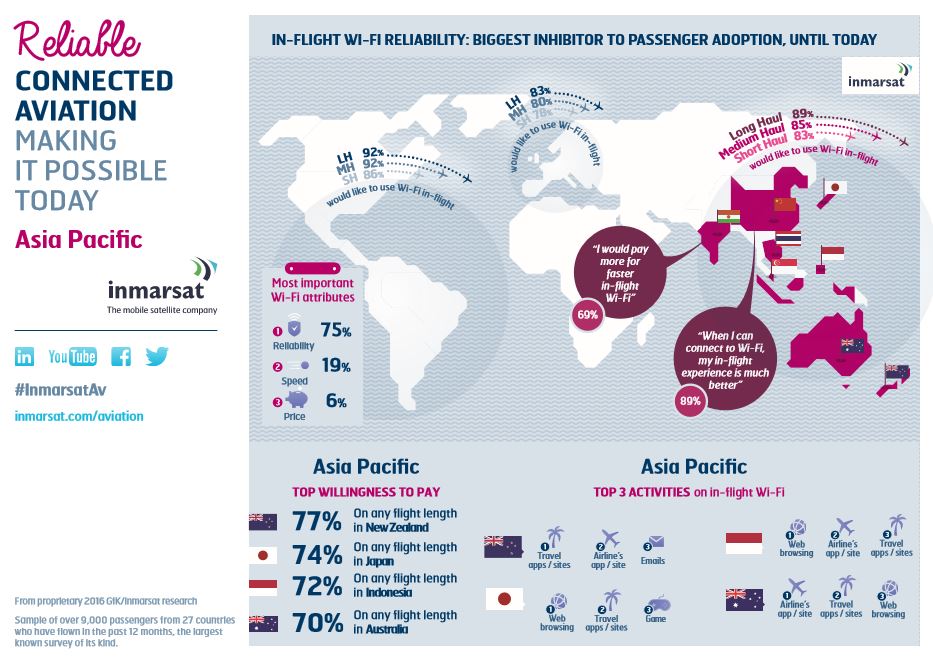
    According to the survey, conducted by Inmarsat and market research firm GfK, nine out of ten respondents from the region say the availability of onboard connectivity would influence their choice of airline, while over two thirds are willing to pay for the service.

    Meanwhile, 54% and 57% of Asia Pacific passengers would choose inflight broadband as a preferred service in short-haul and long-haul flights, compared to only 16% and 18% choosing traditional in-flight entertainment (IFE) as their preferred onboard service.

    Business flyers are even more likely to recognize the value of paying for high-speed onboard connectivity than vacationers, with 74% of business travelers surveyed indicating they are willing to pay more for faster inflight broadband compared to 62% of leisure travelers.

    The survey revealed that 64% of passengers felt that in-flight broadband can deliver all of their onboard entertainment needs. This highlights an opportunity for airlines to use in-flight broadband to increase ancillary revenues, as the majority of passengers are willing to pay for the service, with 68% of passengers under 34 years old and 55% of passengers over 45 years old willing to pay for unlimited internet usage during a flight.

    When it comes to the quality of the inflight broadband service, passengers are most concerned about reliability (that a connection does not drop out or cut off), availability (that the connection is available throughout the flight), and speed of the connection.

    Inflight WiFI reliabilityThe survey showed that quality is even more important than price in Asia Pacific, as passengers are prepared to pay more for a quality service. Some 72% of flyers in Asia Pacific would prefer not to use broadband that is of poor quality with 62% stating they would pay more for faster in-flight broadband
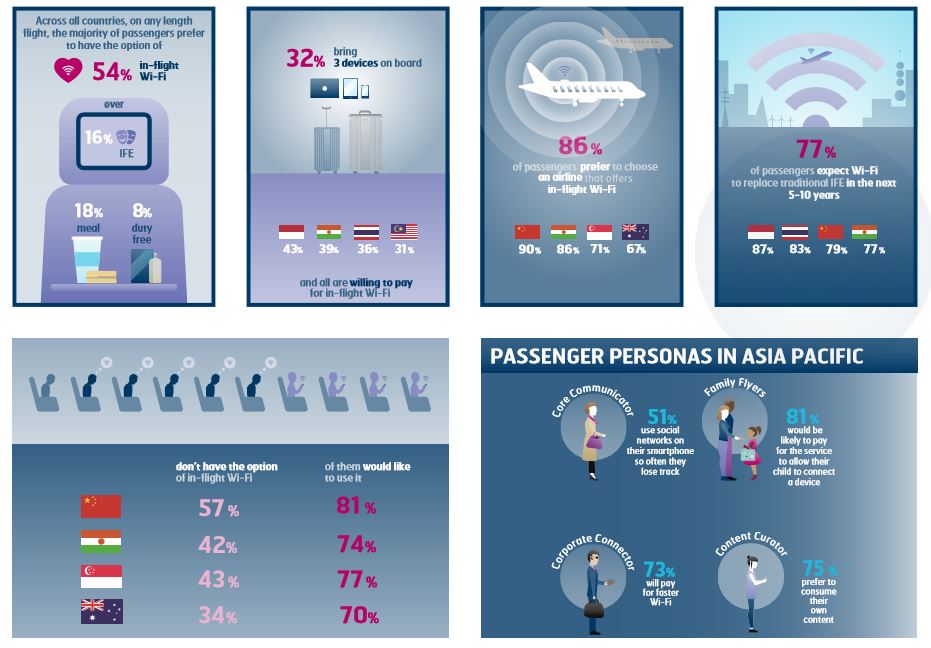


    “Our survey has highlighted a growing appetite for fast, reliable and consistent broadband in the air, with more than half of Asia-Pacific passengers preferring in-flight connectivity over a meal or traditional IFE,” said Bill Peltola, Asia Pacific regional director at Inmarsat Aviation.

    “Although three-quarters of Asia Pacific flyers would like to try onboard broadband in the future, only 3% of aircraft operating in Asia Pacific today offer the service, highlighting the potential for airlines to use it as a differentiation point to attract more customers.

    The inflight broadband connectivity survey

  • APAC tops retail e-commerce

    APAC tops retail e-commerce

    Retail e-commerce sales in Asia-Pacific will reach $877.61bn in 2015, up 35.7% from 2014, as mobile adoption and the rising middle classes in China, India and Indonesia fuel rapid growth, according to a new forecast.

    Research firm eMarketer said that, for the first time, the region will not only have the largest digital market in the world, but its share of global retail spend will reach a majority of 52.5%.

    China alone will account for more than 40% of global retail e-commerce sales this year, up nearly five percentage points from 2014, and the country is expected to continue growing its share of the worldwide market to more than 50% in 2018.

    By then, the value of retail e-commerce sales in China is forecast to be a massive $1.568 trillion compared to a worldwide total of $3.015 trillion. Meanwhile, Asia-Pacific (including China) will account for $1.892 trillion in three years’ time.

    Online retail sales in China are expected to account for 15.9% of the country’s total retail sales in 2015, compared to a global average of 7.4% and 10.2% in Asia-Pacific.

    Although China dwarfs other Asian nations in terms of online sales volumes – for example, $672bn in 2015 compared with just $14bn in India – the report also highlighted India and Indonesia as other key drivers of growth in the region.

    The latter two markets saw growth of 129.5% and 65.6% respectively in 2015, the report said.

    Monica Peart, eMarketer’s director of forecasting, said rapid online growth in Asia-Pacific, coupled with faster internet service and greater mobile uptake is heating up the competitive landscape.

    “Large local players are increasingly vying for market share by improving their logistics and mobile platforms, and in some cases moving entirely to an app-only service,” she said.

    Finally, eMarketer forecast that overall retail sales in Asia-Pacific would reach $8.57 trillion this year, rising to $11.46 trillion by 2019, or representing 20.4% of worldwide retail sales. Data sourced from eMarketer; additional content by Warc staff

  • China forecast to lead APAC in online spending

    China forecast to lead APAC in online spending

    China will lead the Asia-Pacific region in online spending this holiday season with $150 billion in sales forecast, new research from Adobe Digital Index reveals.

    China’s booming economy has led to the highest anticipated online spend in the region (55 percent), with nearly half of the country’s consumers surveyed (49 percent) predicting an increase in their online spend for the period.

    The average Chinese Internet user is predicted to spend a total of $210 online during November and December, driving one-fifth of total online sales for the year.

    Adobe’s global Online Shopping Prediction is based on an analysis of 55 million product SKUs and aggregated and anonymous data of more than one trillion retail websites over the last seven years. The holiday season represents 20 percent of worldwide online spending – with Austria and the US at the top of the list.

    Across the rest of APAC, consumer spend is expected to remain steady year-on-year with 14 percent and 16 percent of Australians and Singaporeans respectively, anticipating they will increase their total spend this holiday season.

    Japan is expected to see the second highest online spend in the region with $37 billion in online sales (a 5 percent year-on-year growth) predicted, followed by Australia at $7 billion.

    The survey found that consumers in APAC are not only shopping online more, they are also becoming increasingly efficient, with 20 percent or more in each country surveyed saying they expect to spend less time holiday shopping this year compared to last – a saving that could give them more time to spend with their families and friends.

    “Holiday shopping is a huge investment and consumers get more sophisticated every year with their online and mobile shopping in order to secure the most popular gifts at the best prices,” said Tamara Gaffney, principal research analyst, Adobe Digital Index.

    Meanwhile, Gaffney said Southeast Asia is expected to lead the charge in mobile shopping with 21 percent of e-commerce purchases to be transacted via smartphones and around 10 percent via tablets.

    Japanese shoppers won’t be too far behind, with 24 percent of e-commerce purchases predicted to be made via smartphones and 6% via tablets.

    Consumers are also finding online shopping less stressful than heading to the stores. In Australia, almost one-in-five (19 percent) consumers rated offline shopping as extremely stressful, compared to only 6 percent who said the same about online shopping. China is the only country in the region where online and offline shopping are seen as equally stressful.

  • APAC airports rank top for international traffic

    APAC airports rank top for international traffic

    For the first time in 2014, Asia Pacific’s airports collectively qualified as the world’s number one region for commercial passenger air traffic, handling 2.3bn passengers in 2014 and leaving second-ranked Europe trailing with ‘just 1.8bn’, according to Airports Council International (ACI).

    However, DF&TR industry executives know only too well that dynamic spending patterns at airports are not always ‘guaranteed’ by sheer passenger numbers, especially considering the multiple factors that can adversely influence customer spending.

    As Asia’s leading airport with a 6.1% rise to 62.9m international passengers last year, Hong Kong International Airport (HKIA) appears to be doing reasonably well however.

    It has continued to see healthy HY1 traffic growth to 33.6m to the end of June 2015, but there is certainly concern, as downtown retail sales of luxury goods to previously high-spending Chinese visitors fall dramatically.

    While Hong Kong Airport is also expanding with its Midfield Concourse, due to open at the end of this year, so is Asia’s second biggest airport at Changi in Singapore.

    Last year, Changi’s traffic grew by just 1% to 53.2m, but its shops generated retail sales of more than S$2bn ($1.50bn) in 2014 from an average of over 120,000 transactions a day, according to Lim Peck Hoon, Executive Vice President Commercial, Changi Airport Group (CAG).

    This was achieved from a total of 54.1m passengers, corresponding to a marginal 0.7% rise on the 2013 number, reflecting CAG’s cautionary comments last year that it was expecting slower traffic growth this year.