Retail News CRM

Tag: apple store

  • Apple savvy brought to Xiao Guan Tea store

    Apple savvy brought to Xiao Guan Tea store

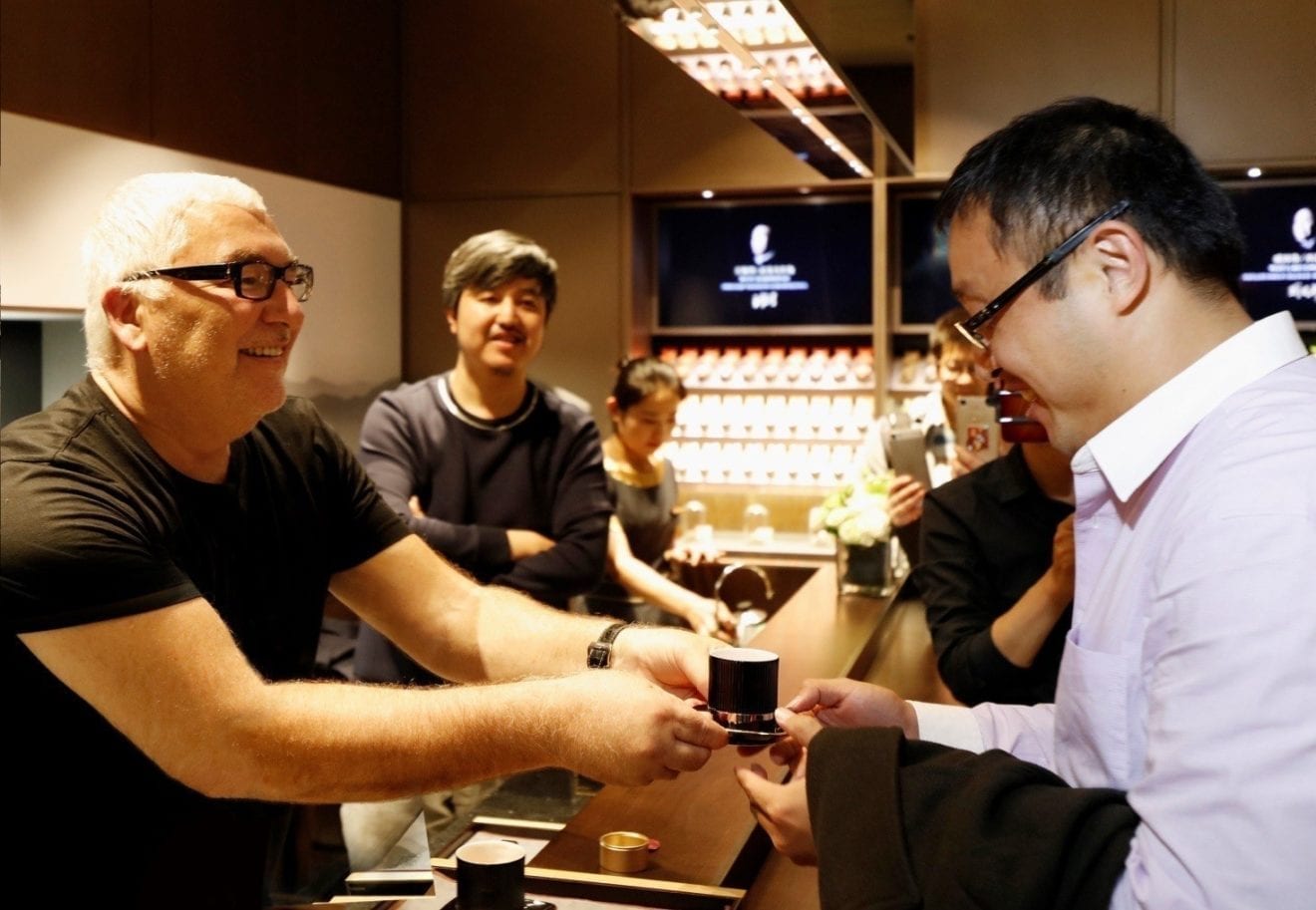
    Apple Store designer Tim Kobe was designer for the Xiao Guan Tea label’s first store, which has opened in Jinan, China.

    At the store’s grand opening, Kobe joined lead designer Jinjiang Yu, innovative experience consultant Shuo Tang and consumer experience director/company partner Hong Li about “Creating a new Chinese tea experience using the same philosophy as Apple Inc”.

    Xiao Guan Tea store 1

    Believing a traditional Chinese tea store would be too outdated for today’s young urban consumers, they analysed how concepts in store design integrate with the Chinese tea culture, proposing fresh ideas for both the tea and design industries.

    Accordingly, the Xiao Guan Tea Store sets about changing the Chinese consumer’s impression of a tea brand right from its entrance. Full-height revolving glass doors display teaware and the company’s specially designed tea capsules.

    Xiao Guan Tea store 2

    On arrival, customers enter the Tea Vault with individual displays for each type of tea, and the Tea Bar where they can sit and sample teas. There are introductory videos, and different varieties of tea leaves can be viewed inside vacuum glass containers.

    Once a customer has made a choice, a tea host places their tea capsules into a gift box.

    Xiao Guan is not just a tea shop or product display centre – it has been designed as a place where people can linger, similar to Apple’s retail philosophy. It approach was to invite eight tea masters, each representing a different style of tea, to create products with uniform quality standards, defined origin of raw materials, and limited picking time and preparation methods to ensure the freshness and authenticity of each leaf.

    Xiao Guan Tea store 3

    Also, the company invited a Japanese master engineer to design an aluminium pod for individual tea brewing.

    All this preparation took two years, the result being not only a new brand but also a more convenient and simple way for people to enjoy tea.

    “With precise product positioning plus advanced marketing strategy, Xiao Guan Tea has created an innovative consumer experience which is very different from the traditional tea industry,” says marketing director Jiang Mei.

    “Chinese tea has always been portrayed with traditional images. We have broken the traditional approach to tea selling with a new brewing method and by creating a brand experience.”

    Photo: Wei Xuliang
  • Apple Looks to Open First Store in Samsung’s Backyard

    Apple Looks to Open First Store in Samsung’s Backyard

    Apple Inc. has made inquiries about opening its first retail store in South Korea, in a signal that the technology company might be looking to step up competition in the backyard of smartphone rival Samsung Group.

    Apple looked at sites across the street from the group’s longtime headquarters in Seoul, according to people familiar with the matter.

    The Cupertino, Calif., company, which is Samsung Electronics Co.’s biggest rival in the mobile-phone market as well as a major customer of its smartphone components, is looking at locations near the South Korean company’s own three-story global flagship store in Seoul’s upscale Gangnam neighborhood, the people said. The company has sent retail executives to South Korea in recent months to check out potential sites for the store, they said.

    The people warned that Apple’s plan hasn’t been completed and a store opening could take about a year.

    “We have made no announcements about a store there,” a spokesman for Apple said.

    A spokeswoman for Samsung Electronics declined to comment.

    South Korea, Asia’s fourth-largest economy, has long been a tough market for Apple. Smartphone sales are dominated by hometown favorites Samsung and LG Electronics Inc., who together account for about 80% of the smartphone market in the country. Apple doesn’t break out sales for South Korea separately.

    After the launch of the larger-screen iPhone 6 and iPhone 6 Plus in late 2014, Apple jumped to about one-quarter of the market, before its share fell below 10% in the second quarter of 2016, according to data tracker Strategy Analytics.

    Opening a glitzy flagship store would send a message that Apple intends to compete hard on Samsung’s home turf.

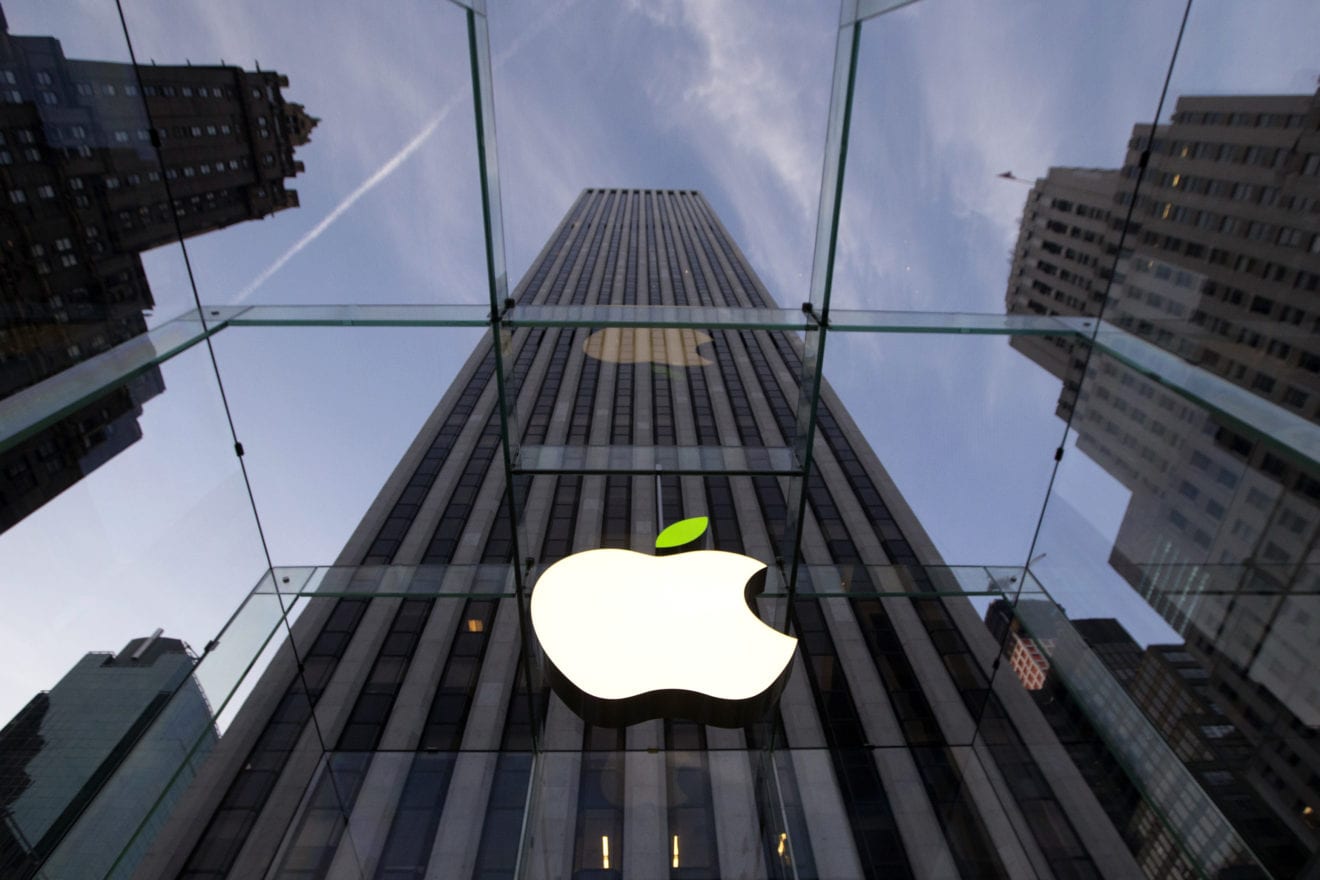
    From a glass cube on New York City’s Fifth Avenue to a Norman Foster-designed store in Istanbul, Apple has used its prominently placed retail stores to attract buzz for the brand and to sell premium handsets. In Seoul, Apple has scouted potential locations around the Gangnam subway station, Seoul’s busiest and home of the headquarters of Samsung Group, as well as another site on Seoul’s fashionable Garosu-gil shopping street, according to the people.

    In South Korea, Apple relies on third-party retailers who apply for licenses to operate as authorized Apple resellers, as well as carrier partners.

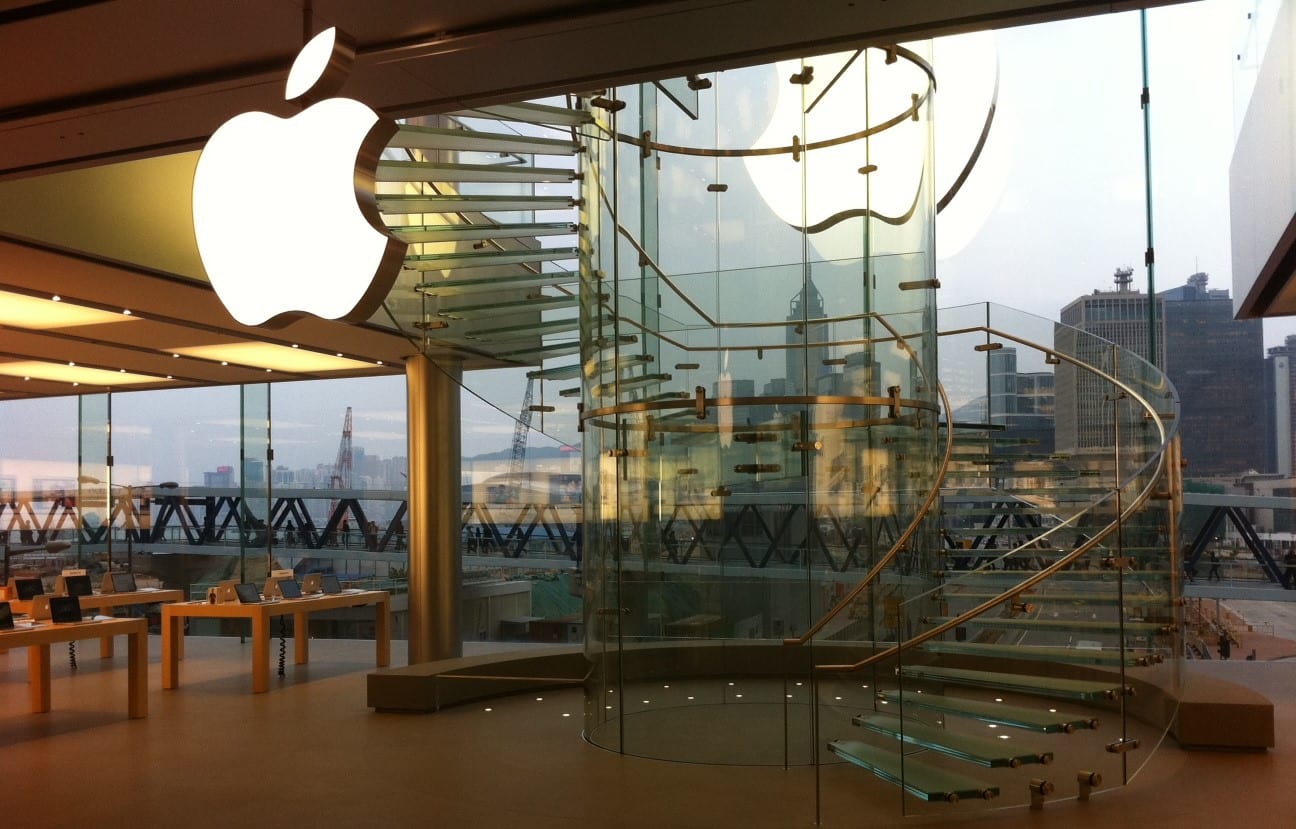
    In mainland China, a critical market for Apple, the company has opened 36 Apple stores, including in Shanghai and in second-tier cities such as Nanning, Fuzhou and Jinan. It has six Apple stores in Hong Kong and seven in Japan.

    Apple’s hunt for retail real estate in Seoul comes as Samsung grapples with a recall of its latest smartphones amid reports of batteries in the Galaxy Note 7 catching fire. Analysts estimate the recall of 2.5 million devices could cost

    Samsung more than $1 billion.Before the Note 7 recall, Samsung reported its most profitable quarter in two years in July as Apple suffered a 27% drop in quarterly net profit compared with a year earlier.

    Samsung’s share of the global smartphone market rose to 22.3% in the most recent quarter from 21.8% a year earlier, according to research firm Gartner. Over the same period, Apple’s share fell to 12.9% from 14.6%.

  • The iPhone 7 hits stores, some models are already sold out

    The iPhone 7 hits stores, some models are already sold out

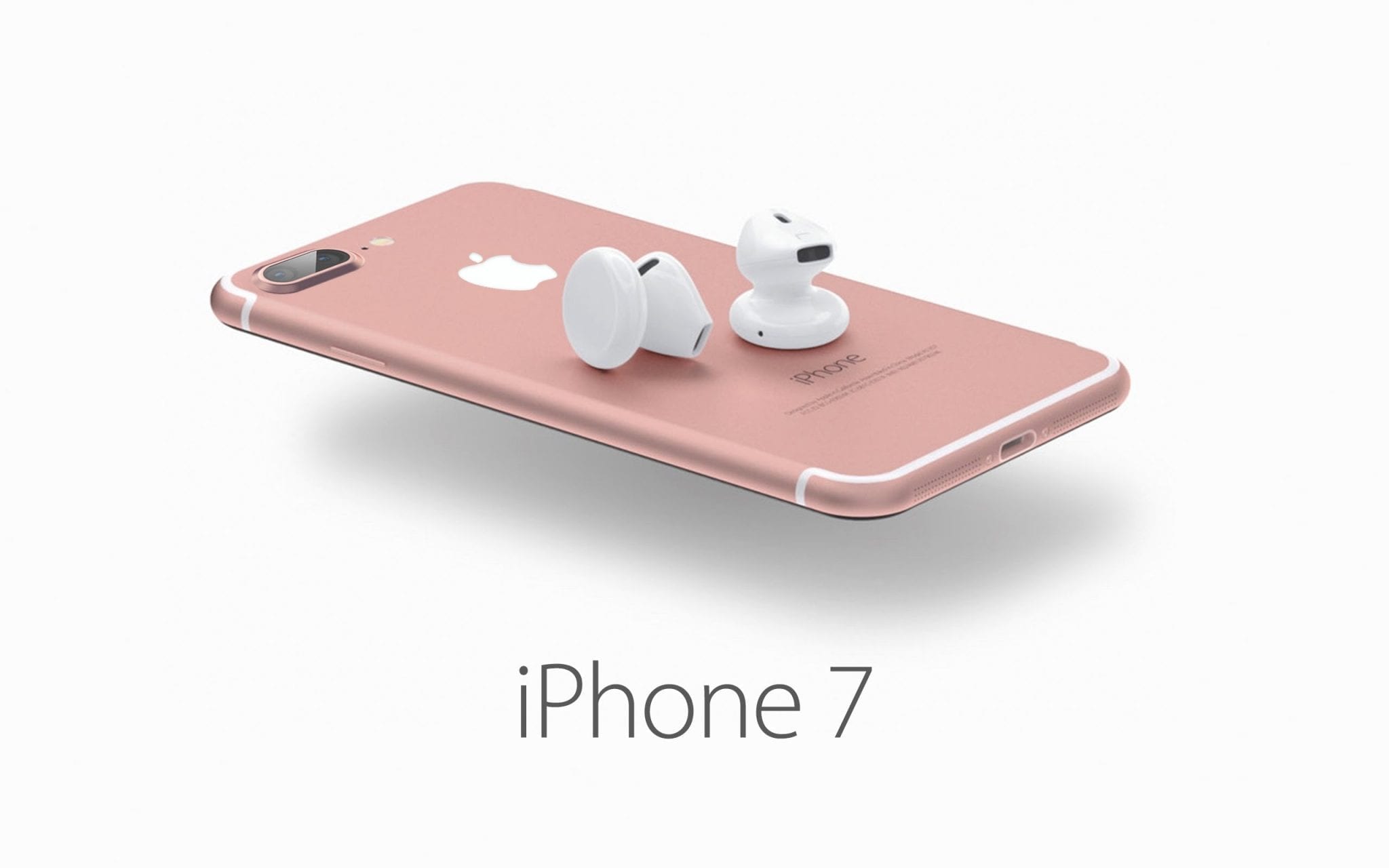
    Starting bright and early on Friday, September 16, you can get your hands on a brand new iPhone 7 or iPhone 7 Plus.

    Apple fans are finally laying their hands on the brand new iPhone 7 and iPhone 7 Plus.

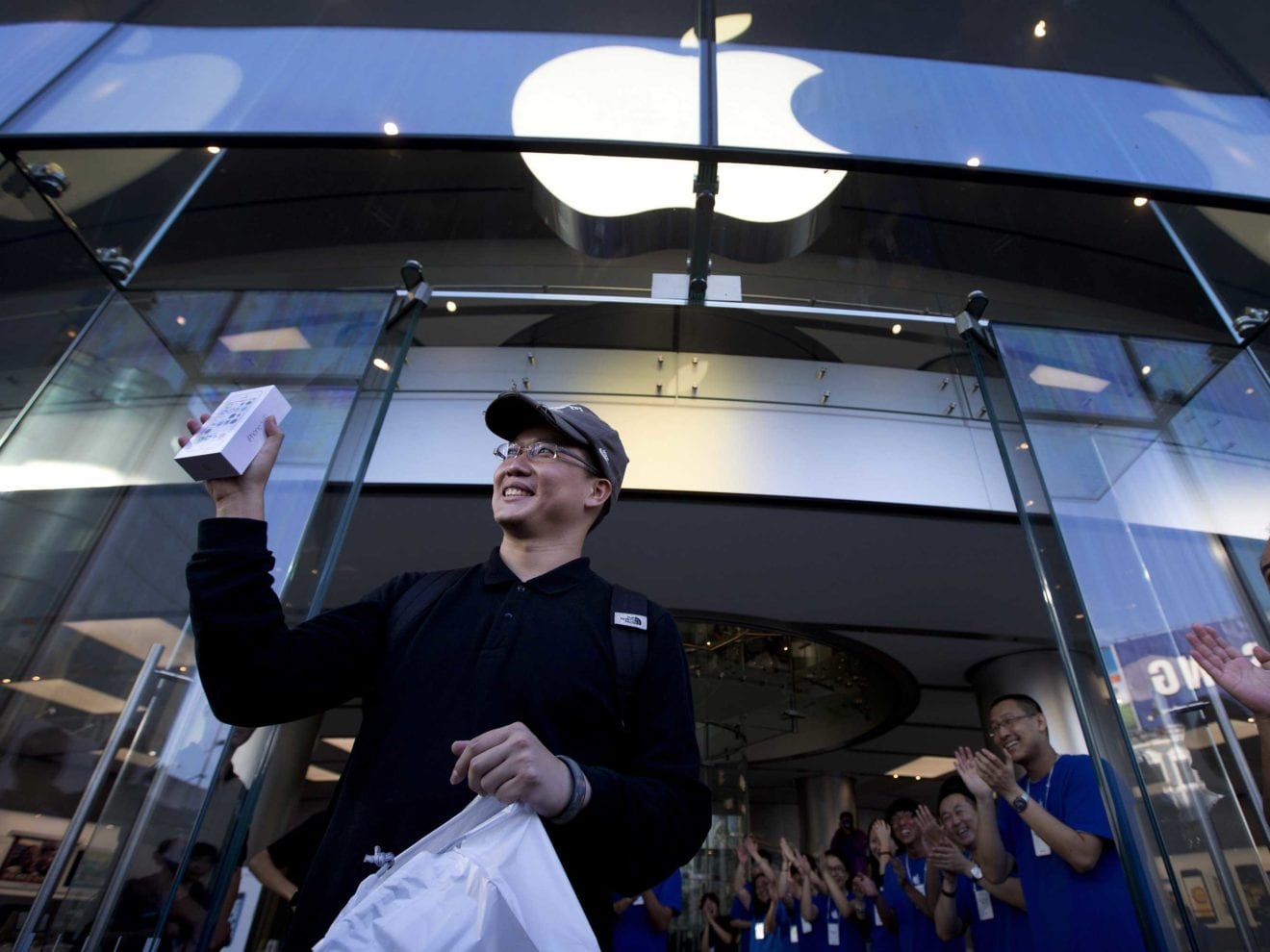
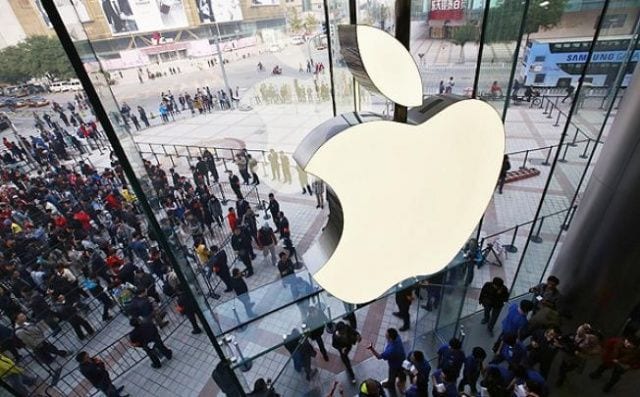
    Eager customers joined long lines in cities like Sydney, Hong Kong, London, New York, Boston and San Francisco on Friday as the new models went on sale, more than a week after they were unveiled.

    Apple is releasing the phones, which are water resistant and feature beefed-up cameras, in more than 25 countries around the world. But people who haven’t reserved one in advance won’t be able to be too picky about the color — or get the larger model. Apple said earlier this week that the iPhone 7 Plus is completely out of stock online.

    “During the online pre-order period, initial quantities of iPhone 7 Plus in all finishes and iPhone 7 in jet black sold out and will not be available for walk-in customers,” the company said in a statement.

    However, some consumers who thought carriers might have the larger model in stock were disappointed as the day progressed.

    “The iPhone 7 Plus is not available in stores this morning, so customers who wish to get iPhone 7 Plus should go [online] to place an order,” a Verizon spokeswoman said.

    Meanwhile, T-Mobile said its stores had “limited inventory at launch,” with shipping dates as far away as the end of November for black iPhone 7 Plus devices.

    Your best bet of finding an iPhone 7 Plus may be directly through Sprint. A spokesperson said “most of our retail stores have [the iPhone 7 Plus] going into [today].”

    An AT&T spokesperson has not yet responded to a request for comment.

    Many customers who couldn’t get a device aired their complaints on Twitter.

    If you’re not in a rush and don’t fancy spending your morning waiting on a sidewalk, you can order an iPhone 7 or 7 Plus online through Apple or a number of retailers.

    According to Apple’s website, the jet black version of the iPhone 7 Plus won’t ship until November in the U.S. All other colors, including matte black, will ship in two to three weeks if ordered online directly from Apple. Those wait times could change.

    The 4.7-inch iPhone 7 starts at $649 and the 5.5-inch iPhone 7 Plus starts at $769.

    Outside an Apple Store in Hong Kong, sports coach Kala Singh said he’d reserved his matte black iPhone 7 a week ago. “I always upgrade my phone when they change the number,” he said.

    Singh opted not to go for a jet black version because he said he’d heard it’s easy to get finger smudges on them.

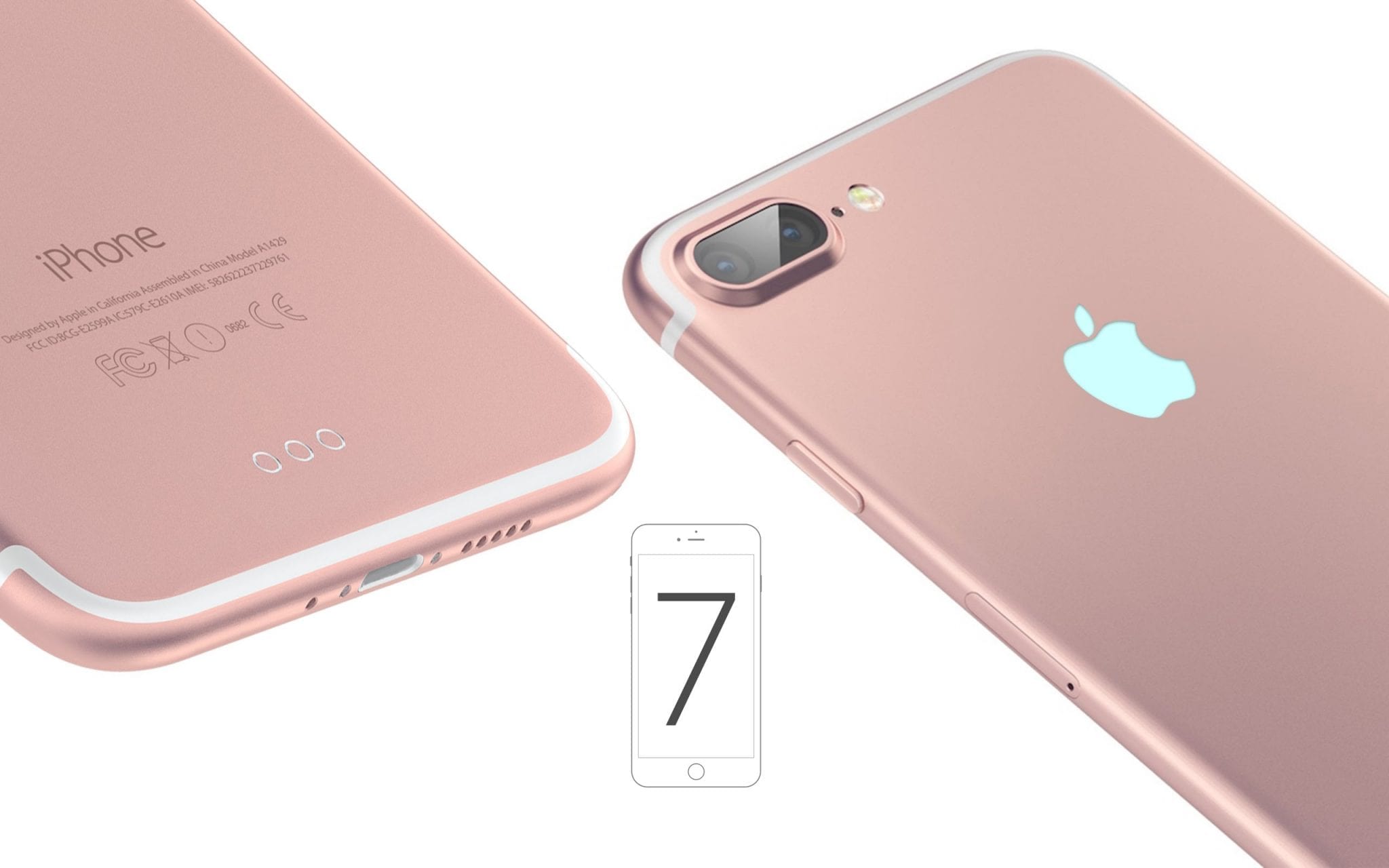
    But at the same store, Tsang Yan-yee said she was “a little bit upset” that she’d had to settle for a rose gold iPhone 7 instead of a jet black one. She also said she was disappointed with Apple’s controversial decision to remove the phone’s headphone jack.

  • Apple stops returns & exchanges for retail purchases in Hong Kong

    Apple stops returns & exchanges for retail purchases in Hong Kong

     In parallel with the iPhone 7 and 7 Plus launching in Hong Kong, Apple has simultaneously halted all returns and exchanges for Apple and Beats products bought at the company’s local retail stores.

    The change is noted on the company’s website. Previously, people were able to return or exchange products within 14 days, so long as they had their original receipt and packaging.

    Why Apple would clamp down the same day as a major product launch is unclear, but the decision might be related to China’s black and gray markets, which take advantage of Hong Kong’s lower import duties and taxes. Smuggling iPhones into mainland China can be lucrative, even though Apple has launched iPhones there simultaneously for several years.

    Hong Kong is likely to see a crush of iPhone sales in the next few weeks, in no small part because of scalpers and smugglers. By stopping returns and exchanges, it may be able to better manage the chaos involved and deter anyone from trying to commit fraud.

  • Vietnamese camp outside Singapore shops in wait of iPhone 7

    Vietnamese camp outside Singapore shops in wait of iPhone 7

    Demand among tech-geeks is soaring since Apple’s release of the iPhone 7 and 7 Plus last week, and unhinged Apple fans in Vietnam are no exception.

    Many are determined to be the first to buy the new device. However, Apple doesn’t have a direct retail presence in the country, so the eager fans have to go the extra mile to get their hands on a new phone.

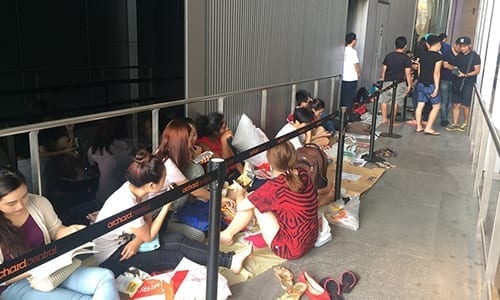
    Vietnamese dealers and resellers have quickly spotted a lucrative business opportunity here and are willing to pay line-sitters who may have to camp outside outlets in Singapore for a couple of days leading up to the iPhone’s launch there this Friday.

    Some Vietnamese living in Singapore have posted ads on Facebook asking for VND2 million ($90) to camp out overnight to be the first in line for the new phone.

    “It seems long to wait in line for 24 hours. But you will stay occupied playing card games, shooting the breeze with your fellows and even shopping in the mall,” a Facebook account named Son Le said in an advertising status.

    Any time that Apple launches a new product, there is an influx of such requests posted in the online technology community, and this time Apple’s true aficionados in Vietnam are still impatient to get those phones.

    “We will handle paying the bills. All you have to do is to be the first in line. And more importantly, you can get paid much higher for an iPhone 7 Plus in the new color Jet Black,” Thang, a reseller in Hanoi, told VnExpress.

    Quang, a dealer in Ho Chi Minh City, said the interest in line-sitters has been growing in the weeks leading up to the launch this weekend. He said due to the whopping demand, people will ask to be paid much more than than they were last time and securing a spot in the line is important, so Quang decided to fly his staff to Singapore.

    “This time we will probably have to wait in line for a couple days,” said Quang. “The business is also quite risky. The price could slump heavily by a few million dong. There is a chance we could make a loss on this,” he said.

    vietnamese-apple-fans-pay-people-in-singapore-to-buy-iphone-7s

    A group of Vietnamese camp outside a reseller store in Singapore during an iPhone launch in 2015.

    As many have witnessed during the last couple of iPhone launches, a growing number of resellers in Vietnam have been hiring line-sitters in Singapore to sell the phones on the domestic market.

    A retailer in Hanoi, after careful consideration, chose to turn to Vietnamese students in Singapore who want to make some cash to cover their tuition fees.

    “It costs much more to fly from here to Singapore,” said a Hanoi-based re-seller, adding that it is about $100 cheaper to take a direct flight from Ho Chi Minh City to Singapore than it is from Hanoi.

    “We have no choice but pay people who are currently living on the island to queue up and send just one person from here over with the money,” he explained, adding that he has five Vietnamese students working for him.

    In addition to camping out for the new iPhone, there are other opportunities to earn some money for anyone who is about to travel from Singapore to Vietnam next week. They can make a quick buck of about $25 for a phone just by taking it back with them on board.

    Shops in Hanoi are charging consumers double the price quoted by Apple for an iPhone 7 Plus 256 GB, with a promise that buyers will be the first Vietnamese to get their hands on a new iPhone.

  • Apple makes significant progress on its first retail store in Singapore

    Apple makes significant progress on its first retail store in Singapore

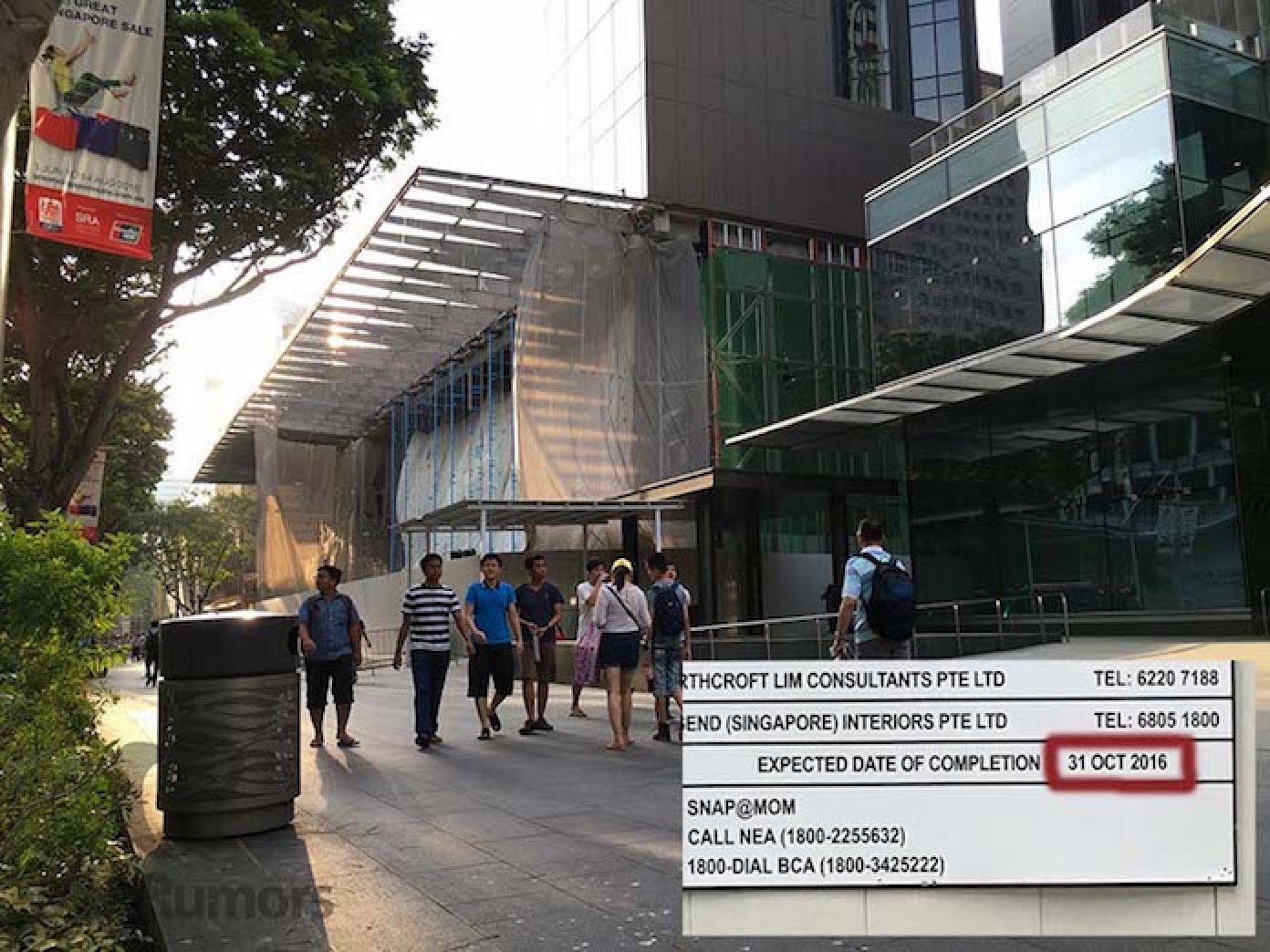
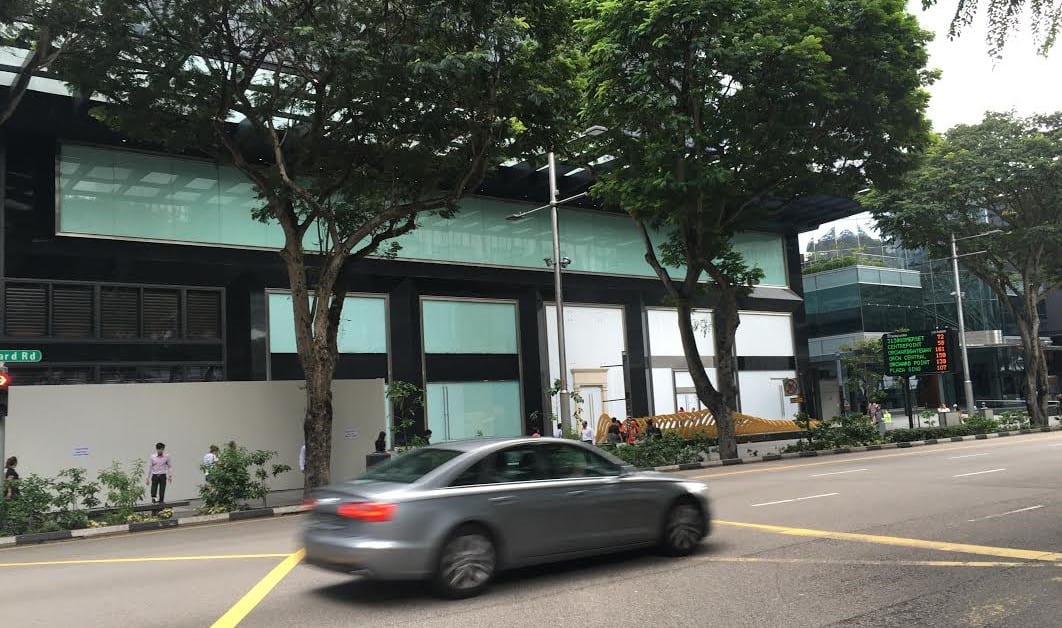
    Apple’s first retail store in Singapore appears to be progressing nicely, with new photos obtained by MacRumors proving that the construction of the store’s glass facade and canopy is now well underway. Apple confirmed in November 2015 that its first-ever store in the Southeast Asia city-state will be powered by hundred percent renewable energy, but did not provide a timeframe for the opening.

    The store location has been under renovation since earlier this year.

    Apple Store coming to Singapore

    The outlet is located in Singapore’s four-story Knightsbridge luxury shopping center.

    Fitness chain Pure Fitness and four other stores inside the Knightsbridge center are set to close next month to make way for an Apple store. In November 2015, Apple posted job listings seeking various positions for the Singaporean store as the company’s retail boss Angela Ahrendts told TechCrunch the following:

    We have more than 900 incredible employees working in our Singapore contact center and are thrilled to begin hiring the team that will open our first Apple Store in Singapore—an incredible international city and shopping destination. We can’t wait to deliver the service, education and entertainment that is loved by Apple customers around the world.

    “The project allegedly has an expected completion date of October 31, 2016, suggesting that the store could open as early as November,” notes the article.

    Apple store Singapore construction

    As per Reuters in November 2015, solar energy developer Sunseap Group will provide Apple with 100 percent renewable electricity from its solar energy systems built atop more than 800 buildings in Singapore, made possible through financing from Apple.

    “The deal will make Apple the first company in Singapore to run exclusively on renewable energy and marks a significant step in its bid to power 100 percent of its facilities and operations worldwide with clean fuel,” as per Reuters.

    Apple’s retail push in Latin America

    As reported, Apple’s retail push in Latin America has just begun with its first store in Mexico City’s Via Santa Fe now being constructed and additional outlets being planned in Guadalajara and Monterrey.

    Apple Stores may be also coming to Chile, Peru and Argentina, as per sources.

    Source: MacRumors

  • Macau’s first apple retail store launched

    Macau’s first apple retail store launched

    APPLE Inc. launched its first retail store in Macau on Saturday, expanding the brand’s presence in Greater China to 41 stores.

    Hundreds of Apple fans queued at the new store at Galaxy complex in Cotai district before the store opened at 10 a.m.

    Macau is an incredibly important region for Apple, Denny Tuza, senior director for Apple Retail Asia Pacific told Xinhua, noting that”Macau is a rich commercial and industrialized city with 600,000 residents and 32 million tourists annually. The city has a unique hybrid urban culture, representing a peculiar blend of Oriental and Western influences.”

    This new two-layer outlet includes sales space where over 150 Apple latest designs are displayed for customers to experience hands-on, and a gathering place for workshops.

    According to Tuza, Macau store has 149 employees who are mainly hired locally, speaking nine languages including Mandarin, Cantonese and English and Portuguese.

    Apple also brought two free camp designed to help spark the imagination of kids ages 8 to 12, teaching them to make movies and create interactive books complete with their own illustrations and sound effects.

  • Apple Closer to India Stores After Government Eases Retail Curbs

    Apple Closer to India Stores After Government Eases Retail Curbs

    Apple Inc. may be closer to opening stores in India after the government eased onerous local sourcing requirements on retailers.

    The world’s second-most populous country on Monday announced the easing as part of a raft of measures intended to boost foreign direct investment and expand the leeway afforded multinational corporations. It loosened policies that require retailers to source at least 30 percent of their components locally before they can set up shop.

     Apple is pushing to increase its share of the world’s fastest-growing major smartphone market as device sales slow elsewhere. Chief Executive Officer Tim Cook visited the country for the first time in May and met with Prime Minister Narendra Modi to outline his ambitions for the burgeoning arena.

    Under the new regime unveiled Monday, single-brand retailers have a three-year grace period in which they can operate stores, before they have to comply with the local sourcing requirement. Companies that can show they are selling state of the art or cutting edge technology can benefit from a relaxed local sourcing regime for “another five years.”

    The government hasn’t ruled on whether Apple meets the cutting edge criteria. Apple didn’t respond to an e-mail seeking comment on the government’s decision.

    Apple will now have to apply anew for permission to open its first stores in India, Commerce Minister Nirmala Sitharaman told reporters Monday. The Cupertino, California-based company has used flagship stores in New York, Tokyo and Shanghai to promote its products and boost sales, but in India it sells through partners such as Redington India Ltd. as well as the retail units of Indian conglomerates Tata Group and Reliance Industries Ltd.

     “The relaxed rules give Apple a window to build up a credible brand and gives the company a chance to build up internal capability and familiarity with the supply base,” said Devangshu Dutta, chief executive officer of Third Eyesight. “For branding, a certain consistency is critical and this can be done by having retail control.”

    India is a challenging market because of the iPhone’s premium pricing. It now has less than 2 percent of an Indian market in which four-fifths of phones cost less than $150. The iPhone maker had sought permission to become the first company allowed to import and sell cheaper refurbished phones into the country, but was said to have been rejected.

    Still, Apple’s sales there jumped 56 percent in the March quarter, indicating that demand for the brand is growing. Cook called out the country’s “incredibly exciting” prospects during his last earnings conference and said his company will devote more energy to that market. Apple’s stores have always played a key-role in attempts a convey a unique image and feel for its products.

    “It gives Apple more branding and positioning strength. Having a direct presence will help it gain more mindshare,” said Vishal Tripathi, an analyst at research firm Gartner. “It can help create a well-fashioned brand in the Indian market.”

  • Apple Retail Stores Headed To India Soon

    Apple Retail Stores Headed To India Soon

    Apple is working to open retail stores in India, now the world’s second-largest smartphone market. Although Apple has eyed the country for a while now, the company’s plans point to a quick and rapid expansion to help its iPhone sales.

    Apple is working to open its first retail stores in India, a country of 1.3 billion people that’s grown into the world’s second-largest smartphone market, behind China, and one that can help keep new customers coming to the iPhone.

    To get that process started, Apple submitted an application to receive government approval to open its first stores there, though it didn’t get the “format” quite right and has resubmitted the application, according to a Feb. 7 report from Bloomberg Business. An unnamed source told the publication that it’s not clear how many stores Apple aims to open, or in what time frame the application may be approved.

    During Apple’s Jan. 26 earning call with analysts, CEO Tim Cook pointed to India as an “incredibly exciting” market for growth and an example of Apple’s ability to find investment opportunities during times of economic uncertainty.

    “Some of the most important breakthrough products in Apple’s history were born as a result of investing through the downturn,” Cook said during the call. “We’ve also seen these times as opportunities to invest in new markets, just as we’re doing now in areas such as India.”

    As of the close of Apple’s quarter, 66% of its revenue was generated outside of the US. Despite economic softness, Cook said that Apple saw its best results ever in Greater China, with revenue growing 14% over last year and 47% sequentially.

    It currently has 28 stores in China and plans to have 40 by this summer.

    Highlighting the potential that India represents, Cook noted that while the median age in China is around 36 or 37, in India it’s 27.

    “Almost half the people in India are below 25,” Cook noted. “So I see the demographics there also being incredibly great for a consumer brand and for people that really want the best products.”

    Sales of iPhones in India grew 76% during the quarter.

    During the calendar third quarter of 2015, one in three smartphones shipped in India was 4G enabled, an almost threefold increase over the previous quarter

    Nearly half of the smartphones sold there during the quarter had 5-inch-plus displays and prices below $200. With sub-$150 LTE devices, Samsung currently dominates India’s budding smartphone market, with a 24% share, followed by Micromax, an Indian brand, with a 16.7% share.

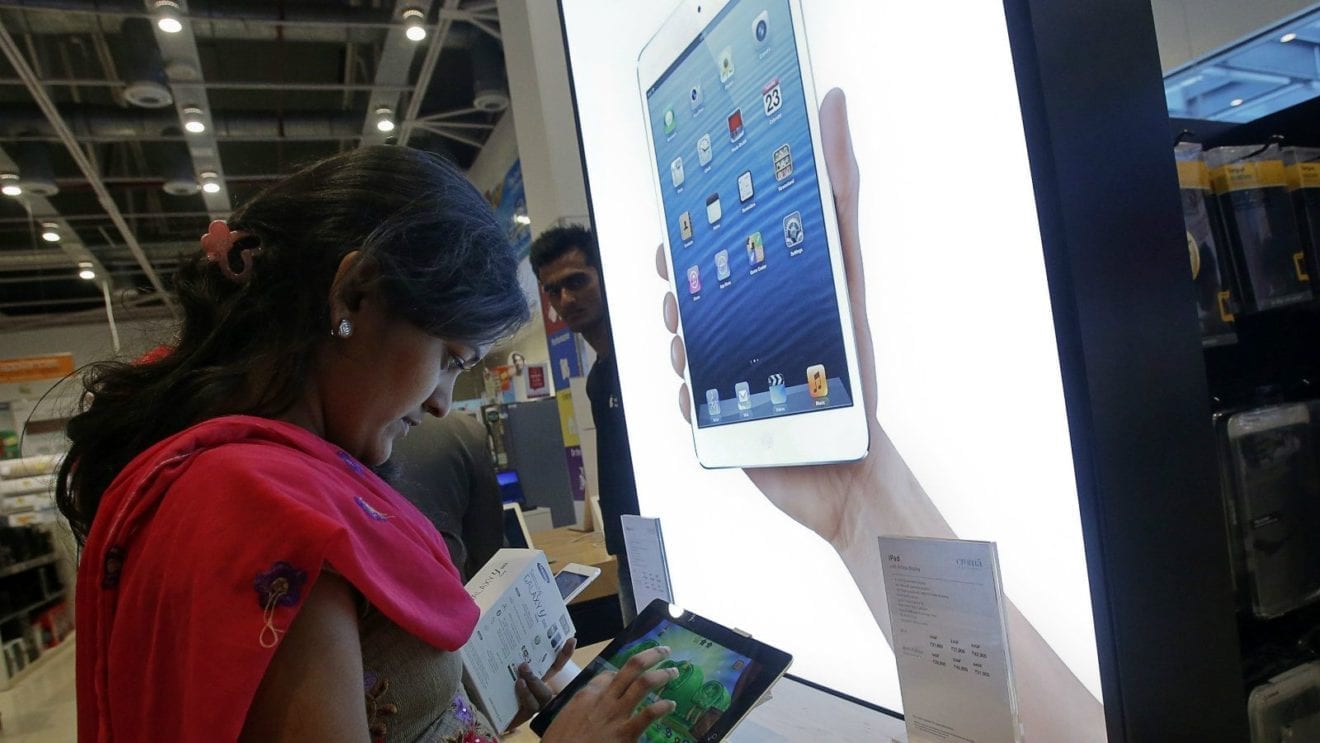
    Apple’s marketshare, by comparison, is around 2%, which analysts attribute, in part, to Indian consumers’ lack of an in-store experience and the relative high prices of the iPhone.

    Following Apple’s last earnings call, Jackdaw Research analyst Jan Dawson explained that while Apple continues to diversify its revenue streams, the size of its iPhone base “becomes ever more important to its revenue growth.”

    While Apple introduced the Apple Watch, Apple TV, Apple Music, and the iPad Pro in 2015 to spur growth and profitability, Dawson wrote, “almost all of these new products and services are tied to the iPhone in some way, and benefit greatly from the installed base of a half billion iPhone users.”

    While the iPhone itself will contribute less to Apple’s overall performance going forward, Dawson added, “it’s going to become ever more central to Apple’s future growth.”

    IDC analyst Kiran Kumar expects smartphone marketshare in India to finally outstrip feature phones in 2016, and for the country to see a “healthy double-digit growth rate” over the next few years.

    From the research of Counterpoint, “India smartphone user base grew to 220 million users by the end of 2015, surpassing [the United States] for the first time ever.”


  • Apple to Open a New Store in China’s Largest Luxury Shopping Mall

    Apple to Open a New Store in China’s Largest Luxury Shopping Mall

    Apple Inc.  announced on Saturday that it would soon open its 31st outlet in Qingdao, China. The retail outlet will be located in China’s biggest shopping complex, MixC luxury shopping mall, according to the reports. The new store is expected to open between 10AM to 10 PM local time on weekdays and weekends.

    China has always been a lucrative market for the tech giant and in recent years, Apple has aggressively expanded its franchise operation in the world’s largest smartphone market under the leadership of Angela Ahrendts, senior VP of retail and online stores at Apple.

    Previously, the tech giant has also effectively carried out its operations in the leading Chinese cities and provinces, which includes Chengdu, Beijing, Nanning, Shenyang, and Xiamen. As of now, there are five stores operating in Beijing.

    Apple is one of the leading foreign smartphone manufacturers operating in China, and generates billions of dollars in revenues from the country. In the last quarter, Apple’s sales in China, including Hong Kong and Taiwan surged 99% to $12.5 billion year-over-year (YoY), while iPhone sales in the region rose 120% YoY. Amid increasing demand, the tech giant also aims to open more than 40 stores in China in the next few years. China is the company’s fastest growing market in recent years, and it plans to take full advantage of the potential growth opportunities in it.

    In addition, the smartphone manufacturer is making continuous efforts to increase its market share in the world’s second largest economy. On the other hand, growing trend of online shopping has significantly increased demand for the mobile users in the mainland territory.

    china apple user

    Based on month-over-month results, the number of Chinese mobile consumers has increased tremendously in the past one year. This number is mainly attributed to the boom in the movie industry, resulting in the increasing online ticket booking. Similarly, the boom in the e-commerce industry also raised the number of smartphone users in recent years. According to a report, as traffic issues in the country prevails, an increasing portion of population is using their smartphones to book movie tickets or for online shopping.

    China is considered to be the second largest revenue-generating country for Apple after the US. The company’s sales have grown to $12.5 billion from $5.7 billion last year. If the growth continues at such an increasing rate, it is expected that China will surpass the US and becomes the company’s largest market by 2017.

    According to a claim made by 9to5Mac’s analyst Mark Gurman, the California-based company plans to come up with a new iPhone in March 2016. The new device will be called the “iPhone 5se.” In addition, Mr. Gurman also indicated that iPhone’s latest version will also contain an upgraded 8 megapixel rear camera, a curved glass design, and Live Photos feature. Given the previous track record, the product will likely become a success in China.

  • First Singapore Apple Store starts construction

    First Singapore Apple Store starts construction

    Singapore’s first Apple Store is taking shape on Orchard Road – not that anyone would notice.

    To keep the design a secret ahead of its grand opening later this year, the company is taking its usual security of measure of keeping the site under wraps, reports iphonehacks.com. There is no sign of the Apple logo.

    In the Knightsbridge retail centre, the store was previously the Pure Fitness gym, which vacated last month. Nearby stores include Tommy Hilfiger and Tangs.

    Despite its low-key approach, Apple has confirmed it will be opening its first retail store in Singapore. “We have more than 900 incredible employees working in our Singapore contact center and are thrilled to begin hiring the team that will open our first Apple Store in Singapore,” Apple retail guru Angela Ahrendts said in a statement last year.

    Iphonehack.com says the debut Singapore store may be powered by renewable energy, possibly solar power. Meanwhile, Apple has posted job vacancies on its website, including business manager, business specialist and Apple Store leader.

  • Apple Inc. Continues To Bet Big On China, To Open 29th Store

    Apple Inc. Continues To Bet Big On China, To Open 29th Store

    Apple Inc. continues to bet big on China. It did so last year, and is doing so this year also. The US firm will open its 29th retail store in Shenyang – capital city of Liaoning – on January 9. The store will be in the MixC shopping mall at 288 Qingnian Street in Shenyang’s Heping District.

    Apple is expanding its footprint in China at a very aggressive pace under retail chief Angela Ahrendts, and has opened new stores in Nanning on December 12, Beijing on November 28 and Chengdu on November 21. In 2015, the US firm also opened retail stores in Chongqing, Hangzhou, Hong Kong, Nanjing and Tianjin.

    Apple Inc's Apple Store NASDAQ:AAPL

    Apple’s new store will be open on all five days from Monday to Sunday between 10 a.m. and 9:30 p.m. local time, and will offer traditional Apple Store services. At the same time, it will include the Genius Bar, Workshops, JointVenture, events and seminars. This new store in Shenyang will be the company’s 25th retail store in mainland China, and it already operates four retail stores in Hong Kong.

    Magic fading in China?

    Apple Inc. has been generating huge revenue from China on YoY basis. In the past three years, China has contributed 23%, 41% and 53% to Apple’s total revenue. In fiscal 2015, China for the first time overtook Europe, in terms of revenue. Despite the impressive growth, there are many who believe economic slowdown in the region will impact the iPhone sales.

    However, CEO Tim Cook says there is no issue at all. A few months back, Cook gave reasons for his stance, saying, “if I were to shut off my web and shut off the TV and just look at how many customers are coming in our stores regardless of whether they’re buying, how many people are coming online, and in addition looking at our sales trends, I wouldn’t know there was any economic issue at all in China.”

    But, two indices suggests, that Apple sales in China may not witness the growth it has seen in the last few years. These two indices are – drop in quarter-on-quarter sales in Greater China and an erosion of Apple’s overall market share, said an earlier report from Bloomberg. In the last quarter of fiscal 2015, Apple witnessed a 5.4% drop in revenue versus the prior quarter.

    In the Q2 this year, Apple Inc.’s smartphone market share in the region dropped to 7.7% from 10.8% in the previous quarter, as per the data from Bloomberg Intelligence. This may suggest that Apple’s magic in China may be fading.

  • Apple executive seeks a touch of chic at retail stores

    Apple executive seeks a touch of chic at retail stores

    Apple’s stores typically spotlight the company’s devices, with the most expensive audio accessories topping out in the hundreds of dollars. The Phantom is the first high-end non-Apple gadget that Ms. Ahrendts, the former chief executive of the fashion house Burberry, has brought in since she took the job. It buttresses some of her other recent moves to create more of a luxury Apple retail experience, including initiating private try-on appointments for the most expensive Apple watches, reducing the numbers and types of accessories that are sold, and pushing manufacturers to make special packaging for gadgets carried in Apple’s stores.

    Ms. Ahrendts “is shaving off some rough edges and completing our sense that the Apple Store is a premium experience,” said Jan Dawson, an analyst at Jackdaw Research.

    Her role in bringing in the Phantom also gives a glimpse into how Ms. Ahrendts has been operating within the world’s biggest company. Since joining Apple, the 55-year-old executive has been relatively quiet publicly. But she moved swiftly and nearly unilaterally on the Phantom, showing how she can push for the products that will shape the store experience.

    The products that Apple stores carry are important because they make up the only customer experience that Apple can fully control, Mr. Dawson said. “The stores are the best physical manifestation of the brand,” he said. “Angela is bringing her sensibility to that experience.”

    Apple declined to comment and declined to make Ms. Ahrendts available for an interview. In a public appearance last month at the Fast Company Innovation Festival, Ms. Ahrendts said she had been working toward Apple’s stores becoming “sleeker and smarter,” as well as unifying Apple’s in-store and online shopping experiences.

    Apple has traditionally sold the most expensive accessories online only, like the $2,700 B&O BeoPlay A9 MKII speaker. “I asked Tim a very simple question: Why do we do it this way?” she said of her boss, Timothy D. Cook, Apple’s chief executive. Mr. Cook told her he didn’t know, she said.

    Ms. Ahrendts’s push will have implications for Apple’s growth. As of September, the company had 463 retail stores worldwide and was focused on expanding in China. The stores account for about 12 percent of Apple’s annual $234 billion in sales, Mr. Dawson estimated. Store revenue rose about 39 percent over the last 12 months, according to eMarketer, with Apple stores generating $5,775 a square foot, or more than any other retailer in the world, beating out Tiffany & Company, Coach and Movado.

    Ms. Ahrendts was known at Burberry for revitalizing the brand, pushing the fashion house into online retail ahead of other luxury apparel companies and forging alliances with tech companies like Apple, through which she outfitted Burberry’s corporate staff with iPads. Mr. Cook hired her in 2013 to make sure that Apple’s stores would evolve and expand.

    At the time, morale had fallen at Apple’s stores, the company’s executives have said. Ron Johnson, a former Target executive who became the first head of Apple’s retail stores, had departed the company in 2011. After a search, he was replaced by John Browett, who had run the British electronics retailer Dixons. Mr. Browett slashed hours and benefits for Apple Store employees.

    Since coming aboard, Ms. Ahrendts has asked for Apple’s 60,000 retail employees to air their grievances and send suggestions, and she sends them weekly three-minute video updates to improve communication. She has started a program so employees can move to other stores worldwide. Ms. Ahrendts has also overseen the opening of new Apple stores, including 14 in China and Hong Kong. For customers, she reduced Apple’s long lines by creating an online reservation system.

    By bringing the Phantom to Apple, Ms. Ahrendts is giving the technology crowd something to love as well. Phantom’s parent company, Devialet, is a brand used by tech executives including Tony Fadell, the chief executive of Nest; Andy Rubin, the co-founder of Android; and Marc Benioff, chief executive of Salesforce.com, said Mr. Sannié. He said Mr. Benioff recently introduced Ms. Ahrendts to him and encouraged her to hear the Phantom.

    For Devialet, moving the Phantom into Apple’s stores is significant. The Paris-based company is known for making amplifiers that can cost as much as $30,000. Until the Apple deal came along, its devices were carried in only a handful of exclusive retailers, including Colette in Paris, Harrods in London and the MoMA store in New York City.

    Since the initial meeting with Ms. Ahrendts, the process of getting the Phantom into Apple’s stores has been smooth, Mr. Sannié said. He and his team have visited almost all of the 14 stores where the speaker will initially be sold to look at display possibilities.

    “We don’t have other global distribution other than the Apple store,” Mr. Sannié said. “We don’t want to be in another chain because millions go to the Apple store looking for excellence, the very best products. This is the best exposure we could want.”

  • Apple’s Fifth Retail Store in Beijing Opens November 28

    Apple’s Fifth Retail Store in Beijing Opens November 28

    Apple has announced that its fifth retail store in Beijing, and 27th in China, opens Saturday, November 28 at 10 AM local time. The store will be located in the new Chaoyang Joy City shopping mall at 101 Chaoyang North Road in Beijing’s city proper Chaoyang District.

    The new store will be open 10 AM-10 PM local time everyday and offer traditional Apple Store services, including the Genius Bar, Workshops, JointVenture, events and seminars. Apple’s four other retail stores in Beijing are located at China Central Mall, Sanlitun, Wangfujing and Xidan Joy City.

    Apple has opened more than seven new retail stores in China this year, including locations in Chongqing, Dalian, Hangzhou, Hong Kong, Nanjing and Tianjin. The company is committed to expanding its footprint in China, an increasingly important market, under the leadership of retail chief Angela Ahrendts.

  • Solar-powered Apple Store to debut in Singapore

    Apple is poised to become the first company to open a fully solar-powered store in Singapore as part of its ongoing efforts to go green with renewable energy source.

    The Cupertino-based tech giant has signed a partnership deal with solar energy developer Sunseap Group for acquiring 100% renewable electricity, once the project goes live.

    Reuters reports that Apple plans to create 200 megawatt solar energy projects in China and work with the local suppliers to obtain more renewable energy. In addition, the company is committed to purchase more power from a California solar farm for its new Silicon Valley campus, which will use rooftops to harness power from the sun.

    Apple’s new retail store and neighbouring public-owned buildings in Singapore will use rooftop solar panels on 800 buildings to generate 50 megawatts (MW) of total renewable energy that can power up to 9,000 homes. The company’s new facility will burn around 33MW of the project’s capacity.

    There is still no word on the actual location and the launch date for the upcoming retail Apple Store in Singapore. However, Sunseap managing director Frank Phuan has sounded positive about globalising sustainable energy practices as more and more companies start embracing the new technology.