Tag: ATM

  • Bank operations smooth despite ATM problem

    Bank operations smooth despite ATM problem

    Senior deputy governor of Indonesias central bank Mirza Adityaswara assured here on Sunday that banking operations in the country remained smooth despite troubles at automatic teller machines since Friday afternoon due to a Telkom-1 satellie problem.

    “We as payment authorities assured that operations of banks have remained smooth and ATMs that have troubles will immediately have their channel shifted,” he said at a training event for journalists.

    He said Bank Indnesia as the countrys central bank has received reports from banks affected by the Telkom-satellite anomaly adding that not all ATMs have been affected.

    “Not all ATMs have troubles but only some of them because not all banks use VSAT network,” he said.

    Mirza said PT Telekomunikadi Indonesia Tbk. has already taken efforts to overcome the problem, adding that service of payment system remained as usual.

    “Telkom certainly has taken maximum efforts to shift the channel to the new satellite,” he said.

    He said Bank Indonesia kept monitoring the developmemt of the restoration and coordinating with banks and other agencies concerned with regard to the problem.

    To anticipate cash demand of the public he said Bank Indonesia continued supporting banks with cash supply.

    “There is no cash supply problem,” he assured.

    The executive director of the communication department of Bank Indonesia, Agusman, said that the banks that had trouble with their ATMs have been working jointly with PT Telkom to restore the situation.

    The restoration is done by moving the satellite connection that was affected to Telkom 3S satellite or others, he explained.

    Agusman said Bank Indonesia as payment system authorities and rupiah currency management is prepared to support banks to serve public fund transfers.

    “The Bank Indonesia Real Time Gross

    Settlement (BI-RTGS), the Bank Indonesia National Clearing System (SKNBI) and Bank Indonesia Scripless Sevurities Settiement Systen (BI-SSSS) still operate normally,” he said.

  • ATM services must run 24/7

    ATM services must run 24/7

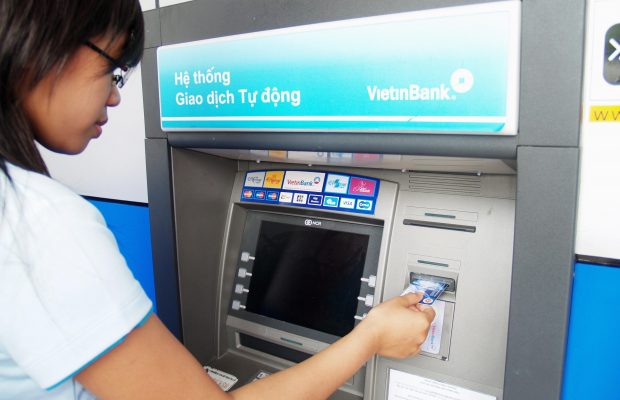
    Following recent complaints that several banks in Viet Nam have stopped providing ATM services at night, the State Bank of Viet Nam (SBV) has ordered all banks nationwide to provide ATM services 24/7.

    Local media reported that many ATMs on the outside of buildings and shopping malls were turned off when the venues shut, stopping customers using the service, the central bank said.

    The SBV has asked all banks and card payment service providers to review their entire ATM systems and ensure smooth operation of ATMs by adjusting ATM working hours.

    A Vietnam Bank for Agriculture and Rural Development (Agribank) representative told Tuoi Tre (Youth) newspaper that State Bank rules dictate that all ATMs operate 24/7. However, the central bank does allow banks to turn off ATMs as long as their opening times are listed at the facilities and on the banks’ websites, the representative said.

    Hoang Chi Mai, a resident of Thanh Xuan District in Ha Noi and Agribank customer said she often withdraws money at an ATM booth on Nguyen Trai Street near her house.

    “The security guard locks up the booth at 10:00 pm. I thought these ATM booths were open around the clock,” Mai said.

    According to Nguyen Hoang Minh, deputy director of the SBV’s HCM City branch, several banks have stopped providing ATM services at night to prevent criminals from stealing money from customers’ accounts.

    With thieves carrying out increasingly sophisticated activities, police have advised lenders to prepare measures to cope with the situation, Minh said.

    The central bank will check if local banks follow the correct protocol for this adjustment, he added.

    Tran Quang Thoai, an expert in this field, told Tuoi Tre (Youth) newspaper that although the banks’ decision aimed to ensure the security of customers’ assets, some methods of tackling card fraud have created problems.

    To gain understanding from customers, these adjustments should be publicised properly, Thoai said. “All changes should not be carried out too suddenly,” he added.

    Dozens of fees

    Many card users have complained about the recent hike in ATM fees, claiming that banks are making profits from ATM services through various fees imposed on their fast growing clientele base, but banks said that the fees are not enough to cover the costs of operating the machines.

    Local media reported that an ATM card holder is subject to dozens types of fees. For example, Agribank charges up to 25 types of fees at ATMs, BIDV collects 20 types of fees and Techcombank charges 13 types of fees.

    An Ninh Thu Do (Capital Security) newspaper quoted Nguyen Toan Thang, general secretary of the Viet Nam Bank Association as saying that the ATM service had developed for 20 years now and there were 53 card issuers nationwide with a total issuance volume of more than 100 million cards. The ATM network had been expanded with more than 17,000 ATMs machines nationwide.

    He added that to meet the increasing demand for transactions, banks have to invest in system maintenance, technology innovation, products and services diversification and the integration of value-added services like mobile banking, internet banking and SMS banking.

    While there may be many types of fees for card payment services listed, customers do not have to pay them all but only the services they use, Thang said.

    “It is lawful for banks to charge fees to offset their investment costs and cover huge expenses they have to pay to maintain the system,” Thang added.

    Recently, some commercial banks have asked the central bank for its approval on a roadmap to increase transaction fees at ATMs, aiming to cover part of the banks’ investment in the ATM systems.

    A representative from a big Vietnamese lender told Dan Tri (People’s Knowledge) newspaper that with banks investing large sums to set up the ATM systems, fees of VND7,000 to 10,000 per transaction is too little compared to the billions of dong spent to set up, maintain and upgrade ATMs annually.

    Not to mention that after each transaction, banks have to send a message announcing account balance to clients, which costs VND700-800 per message, 2 to 3 times above the charge rate for individual subscribers applied for a normal message, he said.
  • German tech firm opens in Myanmar

    German tech firm opens in Myanmar

    Neil Emerson, the firm’s senior vice president and managing director for Asia Pacific, said that its customers’ positive feedback and satisfaction drove them to establish an on-the-ground presence in Myanmar.

    Previously, the firm had been operating in Myanmar through third-party business partners, supporting local banks with their self-service technology needs for many years.

    “Our intention is to work with the Myanmar community and become a trusted partner. That is really important to us,” he said.

    “Our local office will enable us to build a closer relationship with our customers and serve them better. We continue to drive innovation in both banking and retail technology and services to meet Myanmar’s unique market requirements … Myanmar banks really aim to expand to support their customers. We are willing to support them by having our presence here.”

    Emerson said that the firm could cater to the growing needs of Myanmar banks as they expand their products and services in and beyond major cities. The firm also plans to help established or new retailers who wish to enter the Myanmar market with its automation, omni-channel and lifecycle management solutions.

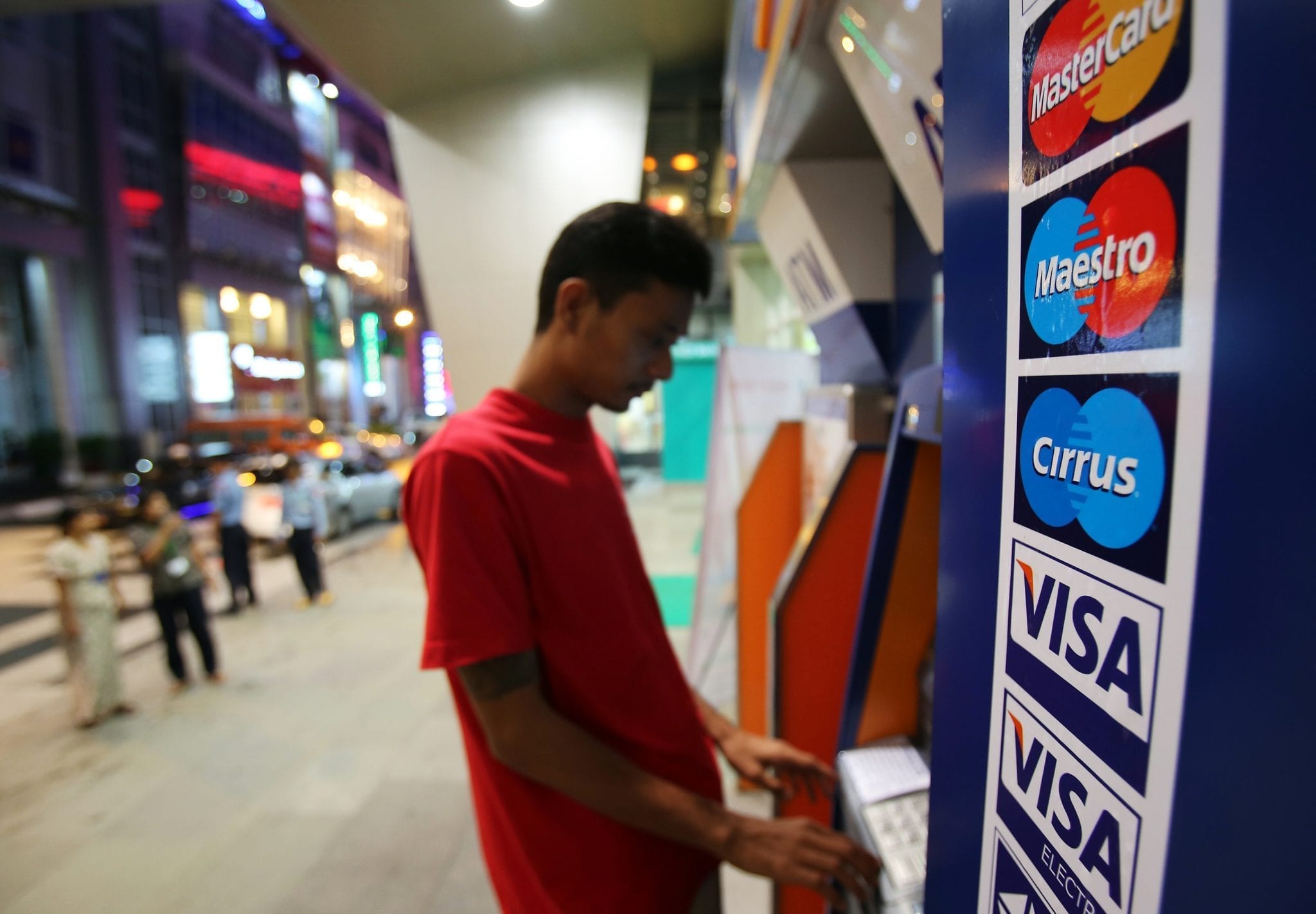
    Piers Leach, country manager for Myanmar, was proud to say that the firm is the market leader in Myanmar’s ATM (automated teller machine) network.

    To date, the firm has acquired 70 per cent market shares, providing its services to nearly 1,700 ATMs across the country. All the leading private banks including KBZ, Aya, CB, AGD and UAB have become its customers.

    Big contract

    Last month, CB bank signed an extensive contract with the firm for systems, software and services to expand its self-service cash offerings beyond Yangon. The bank operates one of the largest ATM networks in the country and aims to double its size of ATM network in 180 branches across the country. The bank will add 500 new ATMs and cash recyclers to its current network of 500 terminals supplied by the firm.

    Leach said that the firm aims at providing its technology to all the banks in Myanmar – private and state-owned.

    They are also looking at the retail sector including shopping malls, convenience stores, grocery shops and gas stations. The firm already has a team of 30 service staff in Myanmar, and will expand its workforce over time.

    “We have seen a significant growth in the banking industry in Myanmar over the last few years, and we have already been a long and established partner for most of the country’s leading commercial banks.

    “We are excited to more effectively grow our partnership with clients with a new, direct presence in the country,” he said.

    Leach does not consider Myanmar’s infrastructure as a challenge.

    “Network connection is improving over time in Myanmar. We have seen a lot of progress with regard to network connection. So, we do not see it as a problem,” he said.

    Biswajit Jha, vice president and managing director for Asean, shared a similar view.

    “It depends on how you look at it – whether it is a challenge or an opportunity. We see it as an |opportunity. Today, everybody has a smart phone in Myanmar, and infrastructure is developing very rapidly.

    You have to come across the learning phase for smooth transition to cashless society,” he said.

    “Everything is about convenience. If it is convenient to you, you would go for that,” added Jha.

    Sachin Handoo, senior director for Indochina and South Asia, said that a stable power supply should be provided to ensure that equipments are running properly.

  • AIS Partners with TNS to Strengthen ATM and Retail Network Offer

    AIS Partners with TNS to Strengthen ATM and Retail Network Offer

    Thailand’s leading mobile operator, Advanced Info Service (AIS), is partnering with Transaction Network Services (TNS) to enhance its product portfolio to address the specific PCI DSS needs of its merchant customers.

    The new ATM and retail store communications solution, called PCI DSS Certified Hybrid MPLS, is a fully managed service which uses AIS’ mobile 3G and fixed MPLS network, combined with TNSLink. In addition to connectivity to Thailand’s banks, AIS merchant customers will be able to utilise the TNSLink solution to reach more than 400 payments-specific endpoints, including the world’s major card schemes, banks, acquirers, processors and value added financial service suppliers, which are connected to TNS’ worldwide network.

    Weerachai Patcharopartwong, Senior Vice President Corporate Marketing and Sales at AIS said: “AIS’ vision is to create a digital service for customers and Thai people which helps them do more and live better, as well as creates new opportunities for corporate customers to use digital technology to support business operations.

    “We’re delighted to be partnering with TNS and offering its specialised TNSLink product portfolio to our customer base across Thailand. TNS’ long-standing PCI DSS credentials, feature-rich solution and reliable technology make it the premier payments solutions provider in Thailand and a natural choice for our business.

    “This agreement with TNS makes AIS the first and only mobile operator in Thailand to offer a solution providing a communication network with high standard PCI DSS system support and this demonstrates our determination to enhance customer data protection.”

    TNSLink is a fully managed, PCI DSS compliant solution that allows customer to reduce capital outlay, lower operating costs and increase revenue for ATMs and point-of-sale (POS) terminals. A near real-time web reporting portal, TNSOnline, ensures ATM and POS systems operate with maximum uptime. In March, TNS announced it had launched 4G LTE network support for its TNSLink suite of solutions.

    Lisa Shipley, Executive Vice President and Managing Director of TNS’ Payment Network Solutions, said: “Our agreement with AIS is an excellent example of how we partner with local market leaders, such as AIS, to empower their bank and retail customers with the highest level of security for ATM and branch network access. We look forward to helping AIS grow its business using its superior 3G coverage across Thailand.”

    TNS is a Level 1 PCI DSS certified service provider and its secure network is supported 24x7x365 by TNS’ Network Operating Centres around the world. With a strong payments heritage and more than 20 years of expertise, TNS now provides services in more than 60 countries across Europe, the Americas and the Asia Pacific region.

    ENDS

    About Transaction Network Services:

    Transaction Network Services (TNS) is a leading global provider of data communications and interoperability solutions. TNS offers a broad range of network and innovative value-added services that enable transactions and the exchange of information in diverse industries such as retail, banking, payment processing, telecommunications and the financial markets.

    Founded in 1990 in the United States, TNS has grown steadily and now provides services in over 60 countries across the Americas, Europe and the Asia Pacific region, with our reach extending to many more. TNS has designed and implemented multiple data networks that support a variety of widely accepted communications protocols and are designed to be scalable and accessible by multiple methods.