Retail News CRM

Tag: baidu

  • JD.com surprises with first profitable quarter

    JD.com surprises with first profitable quarter

    JD.com profit soared 50 per cent after a 39 per cent increase in sales during the Chinese online retailer’s latest quarter.

    Its unaudited results for the three months to the end of September show revenue of RMB83.7 billion (US$12.6 billion), with a record 50.3 per cent surge in gross profit to RMB13 billion. Non-GAAP gross profit was RMB12.8 billion, up 51.9 per cent.

    Active customer accounts increased by 34 per cent to 266.3 million in the 12 months to September 30.

    Chairman/CEO Richard Lio says the company is building robust product content and enhancing user engagement with innovative tools that enable brands to launch highly targeted online marketing programs.

    “The scale economies of our model are becoming clearer with every quarter,” says CFO Sidney Huang. “Looking ahead, we will continue to prioritise investments in technology and leading R&D talent as we execute on our vision to revolutionise China’s retail industry.”

    While releasing its third-quarter figures, JD.com also listed its latest business developments…

    In October, JD and Tencent expanded their partnership with the launch of a marketing initiative that integrates insights on consumer behaviour from Tencent’s social-media platforms with online and offline shopping data from JD and its brand partners. As well as enabling more precise target marketing, the move benefits consumers by offering them wider access to sales promotions and preferred discounts.

    Strategic partnerships

    During the past three months, JD.com also formed strategic partnerships with Baidu, iQIYI, NetEase, Sogou and Qihoo 360 with their big-data resources, massive user bases and AI algorithm technologies.

    JD also continued to strengthen its position among top-tier international brands, expanding its partnership with high-fashion brand Armani with the opening of official online stores for Armani Exchange and Emporio Armani.

    JD Worldwide also launched flagship stores for such companies as Reckitt Benckiser, Spectrum Brands and Tiger, while its new Toplife platform attracted marquee brands like Dyson, La Perla, Rimowa (LVMH) and Trussardi.

    During the quarter, JD Logistics test-launched an unmanned sorting centre, the first of its kind in the logistics industry. JD also signed agreements to lay the groundwork for the rollout of China’s largest drone network.

    In September, JD Logistics expanded its environmentally friendly logistics and packaging campaign, working with brands including  Johnson & Johnson, Kimberly-Clark, Lego, L’Oreal, P&G, Nestle, Unilever, Watsons and Wrigley. The aim is to minimise environmental impact by cutting back on packaging materials.

    Customer demand

    JD also enhanced its fresh product offerings during the quarter to meet customer demand. In July, it launched the Canadian Fresh Food Pavilion, the first country pavilion for fresh products on the JD.com platform. Live lobsters from Canada can now be delivered to customers’ doorsteps in China in as little as 48 hours. During JD’s Super Canadian Day, 140,000 lobsters were sold within 24 hours.

    In September, JD.com, JD Finance, Central Group and Provident Capital announced agreements to establish two JVs in Thailand covering e-commerce and fintech services, with an aggregate investment of $500 million. JD.com is providing its expertise in technology, e-commerce and logistics while Central Group is drawing on its retail store network, brand and merchant relationships, and retail behaviour insights from its loyalty program.

    In October, JD and Sam’s Club launched a promotion offering customers discounted bundled memberships for Sam’s Club and the JD Plus paid-for membership service.

    By the end of October, JD.com JV New Dada had partnered with 146 Walmart stores and 301 Yonghui stores, as well as many other supermarkets and grocery stores, to provide online fresh grocery shopping with one-hour home delivery.

    At the end of September, JD.com had 405 warehouses and provided scheduled delivery services in 250 Chinese cities. It had about 160,000 merchants on its online marketplace, and 137,975 full-time employees.

  • Chinese government clamping down on app stores

    Chinese government clamping down on app stores

    China’s government has issued an order for all app stores on the mainland to be registered.

    In a notice on its website, the Cyberspace Administration of China says its offices should ensure that records are kept on the country’s many app stores.

    “Many apps have been found to spread illegal information, violate user rights or contain security risks,” says the post.

    Unlike in the west, China’s app store market is very fragmented with as many as 150 vying for customers, including market leaders Google Play and Apple’s App Store.

    Registration is necessary, it says, to ensure it is clear who takes responsibility if apps, or app stores, are found to engage in illegal practices.

    Three weeks ago, Apple removed the English- and Chinese-language news apps of The New York Times from its China app store. The US tech giant says the government had told it the apps violated local regulations.

    Google’s store for apps using its Android operating system is blocked in China, with third-party stores taking its place. Most of China’s biggest app stores are controlled by internet and smartphone companies such as Alibaba, Baidu, Qihoo 360, Tencent and Xiaomi, as reported.

    It says Chinese laws are often intentionally broad and open-ended to allow regulators discretion in enforcing them. Concrete steps like the new order for registrations can indicate how laws will be carried out in practice.

  • Baidu joins OpenDaylight Project

    Baidu joins OpenDaylight Project

    The OpenDaylight Project, the open source platform for programmable, software-defined networks (SDN), said Chinese search engine Baidu has joined the project at the Silver level.

    This follows a recent announcement by Baidu to open source one of its key machine learning tools, PaddlePaddle, and demonstrates the company’s continued commitment to open source.

    Growing mobile markets in China over the past several years have connected more people to the internet and opened up tremendous opportunities and venues for new business platforms and channel strategies in the region.

    Baidu is advancing artificial intelligence as the next stage of the internet and is using deep learning to enable new technologies for autonomous driving and e-health services.

    The OpenDaylight platform will enable Baidu to optimize and automate their network.

    Liu Ning, system department deputy director at Baidu said SDN platform will enable the company to be a more nimble organization and rapidly deliver new services that meet the changing needs and diverse interests of our users and customers.

    Liu also joins the OpenDaylight advisory group to provide technical and strategic guidance to the OpenDaylight technical steering committee and OpenDaylight developer community based on the challenges of running a real-world network.

    In addition to Baidu, Chinese two major internet players – Alibaba and Tecent- have also joined the OpenDaylight project.

  • KFC launches first AI-enabled outlet in Beijing

    KFC launches first AI-enabled outlet in Beijing

    Kentucky Fried Chicken (KFC) has launched its first artificial intelligence-enabled store in the Chinese capital city and plans to further expand its layout of smart restaurants, creating more innovative and interesting dining experiences for customers.

    With the cooperation of Baidu Inc, China’s largest search engine, KFC started its first smart restaurant in the Financial Street area in Beijing.

    At the store, customers are able to take pictures with a machine, which will recognise the diner’s face, sex, age, mood and other features, then help to recommend suitable food and set meals and complete the ordering process.

    “If the consumer visits the store again and takes a picture with the machine, it will be able to recognise his or her face and show the previous purchase history, remember the customer’s dining habits, and help to place an order faster,” Wu Zhongqin, deputy director of the Institute of Deep Learning of Baidu Inc, which helped to develop the technology said.

    With another machine with an augmented reality, or AR function, customers are able to interact with the machine, change facial expressions by shaking their heads in front of the machine, take photos, and save them to their phones.

    In April, KFC, an affiliate of Yum China Holdings Inc, started its first Chinese smart restaurant in Shanghai.

    The outlet is equipped with intelligent robot ordering, debuting the use of artificial intelligence in chain restaurants, state-run China Daily reported.

    Zhao Li, general manager of Beijing KFC, said smart restaurants are not only about the cool hardware, but more about providing convenience to consumers.

    “Our innovations make use of the cutting-edge technologies and they will help to attract more young consumers who prefer fashionable new things. The digitalisation of the restaurant will also help to provide faster and easier services,” she said.

    “We believe that the restaurant dining experiences must continue to upgrade. With 5,000 stores in China, we plan to expand such services nationwide soon, to adapt to the digital age and enable more consumers to experience enjoyable ordering experiences.”

  • How to grow for Luxury brands

    How to grow for Luxury brands

    Luxury brands need to use new technologies and offer experiences for their customers, the second Luxury Society keynote event in Shanghai has been told.

    UCO Cosmetics CEO Arthur Zhang told the event that the early-stage eCommerce model of simply providing a platform for selling products online is dead.

    He said key technologies being experimented and improved upon in China include augmented reality, virtual reality and live-streaming.

    “The millennial generation in China, which already numbers about 300 million people, seeks experiences and emotional connection – they are not just bystanders,” DLG China partner/MD Pablo Mauron told the audience of more than 150 luxury-industry brand executives. “As a result, live-streaming has become a medium for them to express themselves.”

    He told how brands such as Maybelline, Montblanc and Swarovski are taking advantage of these new opportunities.

    Underlining the key message of the event that eCommerce is changing, CEO Thibault Villet of luxury fashion eCommerce platform Mei.com told how a live-streamed show in collaboration with TMall resulted in 65 per cent of the products featured quickly selling out.

    Meaningful data

    Social customer-relationship management (CRM) makes highly targeted messaging and engagement possible, the event was told by Four Seasons Hotels Asia Pacific director of marketing communications John Hamilton. He said the luxury hotel chain has been gaining meaningful data about its customers, which in turn has driven growth. In the past year, through trial-and-error and optimisation, the group has defined a CRM-led content strategy on WeChat.

    Celebrity and key-opinion-leader partnerships can make a big impact in China, said East Entertainment commercial director Qing Dai, who spoke of her experience of partnering luxury brands with appropriate celebrities. One of Easy Entertainment’s most successful was in linking up Cartier with singer/actor Lu Han.

    Baidu GM for East China Wan (Grace) Zhang said Cartier was the most-searched luxury watch brand among the generation born between 1990 and 2000, linked to Cartier’s collaboration with Lu Han.

    Other speakers at the event included Four Seasons Hotel Pudong (Shanghai) GM Arthur Ho, writer Casey Hall of Women’s Wear Daily, Digital Luxury Group founder/CEO David Sadigh and MD for China Pablo Mauron, Baidu senior project manager Di Fu and Sephora China digital manager Vanessa Qian.

    Attendees included representatives of Alexandre de Paris, Baume & Mercier, Bottega Veneta, Bulgari, Cartier, Chanel, Chaumet, Conde Nast, De Beers, Dior, Hublot, Loewe, LVMH, Marc Jacobs, Massimo Dutti, Michael Kors, Montblanc, Nars, Net-a-Porter, Nike, Sephora, Shiseido, Swarovski, TAG Heuer, Tiffany & Co and Vacheron Constantin.

    Luxury Society, published by Digital Luxury Group, is an online destination for luxury-brand executives covering digital and technology matters and with more than 40,000 members across 150 countries.

  • Boycott China? Dragon now angel for Indian startups

    Boycott China? Dragon now angel for Indian startups

    ‘Boycott China’ messages may have become routine on WhatsApp in India. But in the startup world, India and China are drawing closer.

    Chinese firms and funds have become big investors in Indian startups , and they are becoming particularly useful now as US funds slow down. Beijing Miteno Communication Technology, a Chinese tech conglomerate, made this year’s biggest acquisition in the technology startup space — the $900 million buyout of Media.net, a subsidiary of Mumbai-based Directi, founded by brothers Bhavin and Divyank Turakhia.

    Ecommerce giant Alibaba has made large investments in Paytm and Snapdeal. Didi Chuxing, the equivalent of Uber in China, has invested in Ola. Internet giant Tencent recently led a $175 million funding in messaging app Hike; prior to that, it led a $90 million round in healthcare solutions firm Practo and, through its joint venture with South Africa’s Naspers, invested in online travel firm Ibibo Group.

    “There are demographic similarities and both countries are seeing consumer growth for digital firms. Also, Chinese players have experience in market creation and running successful digital companies, so they can play a bigger role than being just financial investors,” says Ashish Kashyap, founder of Ibibo, which last month merged with rival MakeMyTrip. Alibaba, for instance, is seen to be actively helping Paytm in various aspects.

    Bhavin Turakhia says the Chinese understand the Indian market better than US companies do as the Indian market is on the same evolution path as that of China, but about 5 to 10 years behind.

    Chinese companies and funds have become big investors in Indian startups . Cheetah Mobile, which owns products like Clean Master, invested in fitness app GOQii late last year.

    Ctrip, one of China’s largest online travel companies, invested $180 million in MakeMyTrip in January. China-based investment firm Hillhouse Capital has invested in CarDekho. Smartphone maker Xiaomi led a $25-million funding round in content provider Hungama Digital Media Entertainment in April.

    Web services company Baidu has said it is scouting for investment opportunities in Indian startups.

    Even other Asian companies are nowhere close to investing as much as the Chinese in Indian startups. Japan’s SoftBank and Singapore’s Temasek are among the few non-Chinese ones that have made investments. Taiwan’s Foxconn has also made several investments, like in Qikpod, Hike and Snapdeal, but some see Foxconn as practically a Chinese company, given that much of its operations is in China.

    What’s pushing the Chinese tech companies to make large investments are two things: one, many of them are making big profits in their home market, thanks partly to the restrictions on foreign competition; and two, the Chinese economy is slowing down.

    So they want to use their surpluses to expand into what is potentially the world’s third largest digital market.

    “There are only two big growing markets where they can invest: India and the United States. Silicon Valley does not respect Chinese capital. So the Indian tech sector becomes attractive to them,” says Mohan Kumar, executive director at Norwest Ventures, a US-based venture fund that has operations in India. Kumar also notes that Chinese investors often value Indian startups at three to five times more than what other seasoned investors do. “So entrepreneurs naturally prefer them,” he says.

    Higher valuations mean the Chinese investors take lower stakes for the same amount of investment, and founders can hope for an even higher valuation in their next round of fund raising.

    Language and politics are a challenge. May be for that reason, the Chinese are for now preferring partnerships and not outright buys. Even investment firms are building partnerships. Chinese VC fund Incapital has tied up with Indian fund IvyCap Ventures to enable its partner investors to have a closer look at potential investment opportunities in Indian startups.

    China is showing interest in traditional industries too. In July, Chinese pharma company Shanghai Fosun Pharmaceutical Co acquired Indian injectables manufacturer Gland Pharma for $1.27 billion, and in August, Chinese conglomerate Jiangsu Longzhe Technology and Trade Development Co acquired Diamond Power Infrastructure, Vadodara-based manufacturer of cables, conductors, transformers and other power sector equipment, for $125 million. But digital technology looks to be where the biggest action is.

  • TravelersBox rolling out in Asia

    TravelersBox rolling out in Asia

    TravelersBox kiosks are being launched in Asian airports allowing travellers to deposit their leftover foreign coins into their preferred online accounts.

    More than 40 are expected to be service by the end of the year.

    TravelersBox is the first service allowing travellers to convert foreign currency into usable digital currency at airports. First rolled out at Manila airport in the Philippines, the latest kiosks have just come online in Narita International Airport in Japan.

    In parallel to the expansion, the company is also launching additional products and services in the kiosks tailored to the Asian market.

    Baidu wallet is the first offering, specifically aimed at the Chinese market, the largest travelling population in the world.

    “For the Asian market we’ve given specific attention to each traveller’s nationality,” says TravelersBox co-founder/CEO Tomer Zussman. “Services such as Nets FlashPlay Card for Singaporeans, Lazada for Southeast Asian travellers and more will soon be available in the TravelersBox around the world.”

    TravelersBox has more than 75 kiosks internationally where travellers can convert their leftover foreign change into digital money with options including iTunes, PayPal, Skype and gift cards such as Gap or Starbucks. There is also a donation button.

  • Baidu adopts Qlik Sense for self-service analytics

    Baidu adopts Qlik Sense for self-service analytics

    Baidu is Qlik Sense to improve its cloud services platform and provide an enhanced data analytics experience to its customers.

    Qlik Sense will be integrated into Baidu Palo to enable self-service visualization analytics on the Palo OLAP engine, giving Chinese enterprises the ability to achieve greater agility in aggregating data from various sources to make data driven business intelligence decisions.

    By incorporating Qlik into the Palo OLAP engine, Baidu aims to provide start-ups in China, especially those enterprises on Baidu Cloud, with greater support in driving data analytics among cloud or filed sources.

    “We are very excited to implement Qlik Sense into Palo OLAP to provide users in China with innovative self-service visual analytics,” said Yang Liu, General Manager, Baidu Open Cloud.

    “Qlik Sense has an open API and powerful features, and is suitable for enterprise level applications. The close cooperation and technical integration of the two companies has led to more powerful and flexible business intelligence solutions, which will greatly enhance the user experience.”

    “With the popularity of big data, cloud computing in BI, social networks, and mobile applications in China these past few years, integrating a powerful visual analytics solution into China’s largest search engine company will only lead to greater value for businesses,” said Toni Adams, senior vice president Partners and Alliances, Qlik.

    “Businesses of all sizes using Baidu’s Palo OLAP will now have the ability to take their analysis to a deeper level, leading to a better understanding of their business, as well as their customers.

  • Innovate or die: Singapore retailers advised to reinvent as brick and mortarshops lose luster

    Innovate or die: Singapore retailers advised to reinvent as brick and mortarshops lose luster

    Some brands are even advertising via Snapchat.

    In a fast-paced and technologically-savvy city-state such as Singapore, brick and mortar shops of retailers, however traditional, may not be adequate anymore.

    According to a report by Cushman and Wakefield, Italian luxury brand Prada, for example, has announced plans to advertise via Snapchat, and will be offering their range of goods online.

    Additionally, the Singapore Tourism Board is using WeChat and Baidu Connect, and other online travel services and social review sites to reach out to independent Chinese travelers.

    “Thus, it is essential for all major stakeholders to reinvent their operations to drive the retail scene forward,” the report noted, highlighting the inevitable paradigm shift.

    Meanwhile, to combat the surge of e-commerce, the report said retailers are increasing F&B components in shopping malls and department stores, as such experience-based concepts are irreplaceable by online retail.

    “For instance, Muji Café and Meal will be opening their second outlet in Raffles City, and a cluster of 16 restaurants will open in Wisma Atria’s Japan Food Town. In addition, Robinsons the Heeren welcomed Angela May Food Chapters in this quarter,” the report added.


  • KFC tests its robot orders

    KFC tests its robot orders

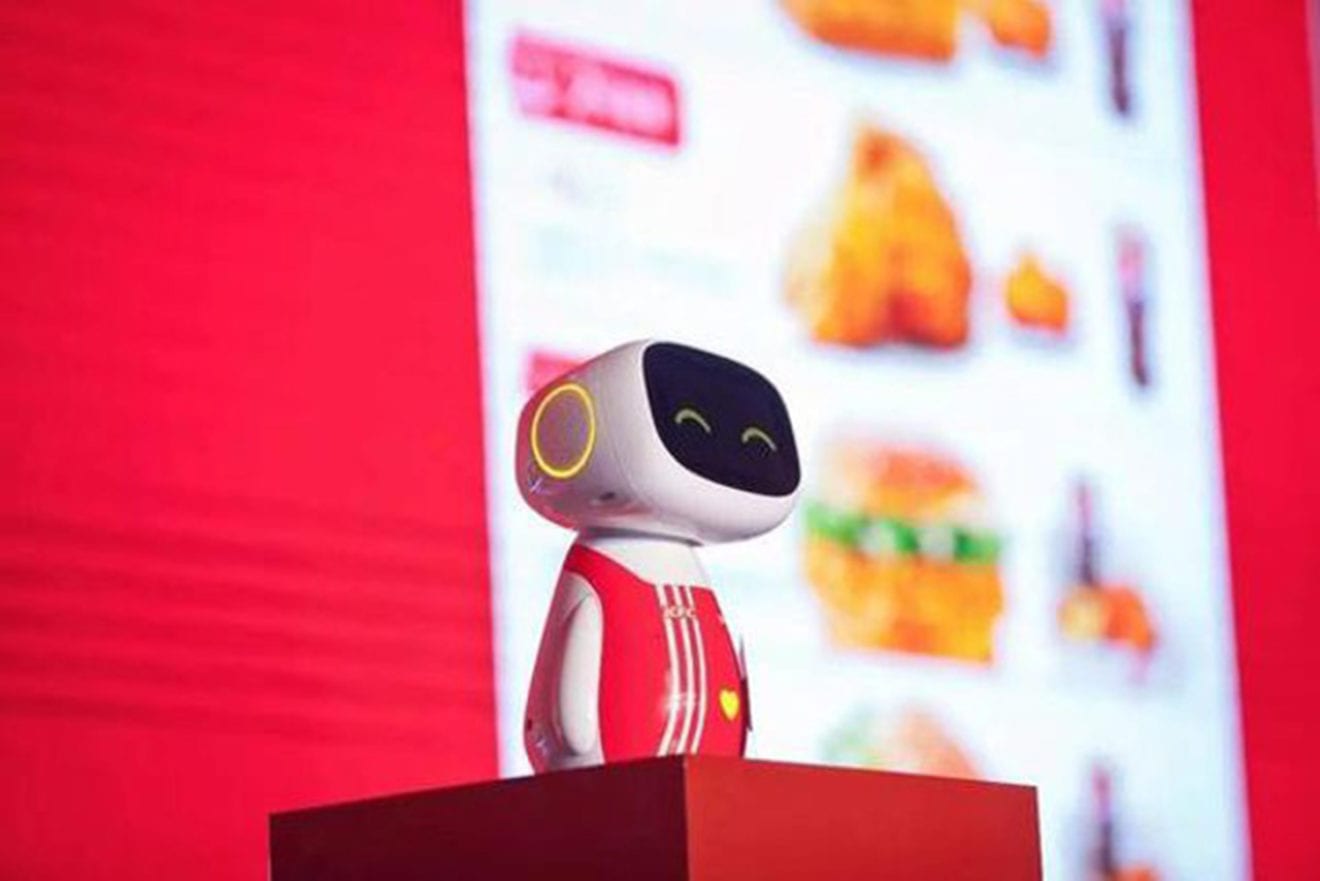
    Customers at a new digital KFC concept store in Shanghai give their orders to a voice-activated robot.

    Dumi the robot is sophisticated enough to handle changes and substitutions in orders.

    Dumi is the result of 10 years of research and development into artificial intelligence by Chinese web services company Baidu, which says the robot will appear soon in other real-world environments.

    Inside Shanghai’s National Exhibition and Convention Center, the KFC store has been designed to be completely digitalised. Called “Original+”, as a reference to the brand’s traditional recipe, it features wireless charging stations where customers can simultaneously stream music. They can also pay for their meals via mobile payment services including Alipay and Baidu Wallet.

    Introduced at last year’s Baidu World Congress 2015, Dumi integrates the company’s AI technologies such as voice recognition and intelligent search. The robot will use KFC’s customer behaviour data to gain a better understanding of users’ needs and improve business efficiency.

    As well as ordering and paying through Dumi, the customers can see how KFC dishes are made through the robot’s holographic imaging technology.

    Baidu VP Wang Haifeng says the robot may become a big part of the company’s application of more AI technology into fields that range from internet financing to driverless cars.

    There is only one problem with Dumi, admits Baidu: it has trouble distinguishing between certain dialects and accents. But then again, so might a human employee.

    Jason Yu, GM of the consumer research firm Kantar Worldpanel China, describes the Shanghai concept store as “a very interesting experiment”.

    “It is expected to generate increased customer experience, and raise efficiency for restaurants. And in turn it is expected to attract more young and middle class customers.”

  • China’s Retail Sector Emerged as a Bright Spot in Slowing Economy

    China’s Retail Sector Emerged as a Bright Spot in Slowing Economy

    China’s retail sector shines

    China is facing an economic downturn, but Chinese consumers are hopeful about its economy. According to Boston Consulting Group, China’s total retail sales are forecasted to grow by 50% to $6.5 trillion by 2020 with online transactions growing by nearly 25%.

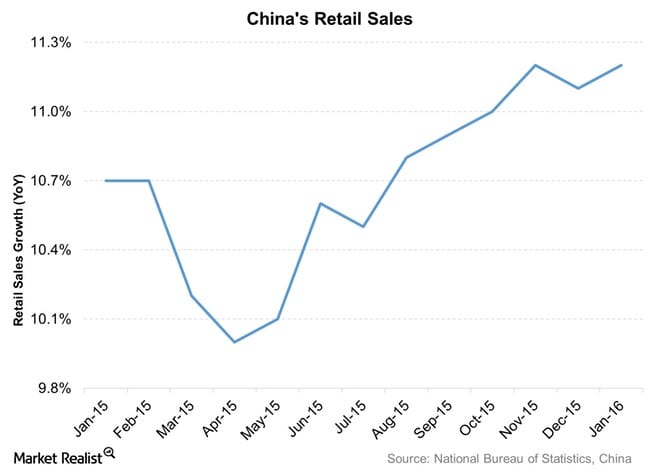
    Retail sales were up by 11.2% in January 2016 due to Lunar New Year holiday shopping. In 2015, retail sales grew by 10.7% YoY to 30.09 trillion yuan, slower than the 12.0% increase recorded in 2014. Urban retail sales of consumer goods were up by 10.5% YoY to 25.9 trillion yuan.

    Rural areas have become a major source of retail sales growth. Retailers are focusing on rural China to increase the penetration of e-commerce. In 2015, rural retail sales were up by 11.8% to 4.19 trillion yuan.

    Chinas Retail Sales 2016-02-28Enlarge Graph

    E-commerce played a major role in driving up retail sales. In 2015, the national online retail sales of goods and services grew 33.3% YoY to 3.88 trillion yuan, according to the National Bureau of Statistics of China. Some of the leading players in China’s e-commerce segment are Alibaba Group Holdings (BABA), Baidu (BIDU), JD.com (JD), NetEase (NTES), and 58.Com Inc. (WUBA).

    According to Fortune Character, a luxury product consulting firm, Chinese consumers accounted for 46% of global sales of luxury products in 2015.

    Transition from export-oriented economy to consumer-driven economy

    After a slowdown in demand and rising debt levels in the manufacturing sector and reduced dependence in the export business, China is shifting its focus to a consumption-driven economy. Although this transition would be painful in the near-term, it has the potential to deliver robust growth to China in the long term.

    Mutual funds such as the Templeton China World Fund (TCWAX) and the Fidelity Advisor China Region Fund – Class A (FHKAX) have exposures of 31.3% and 21.5%, respectively, to the consumer discretionary and consumer staples sector combined. These funds stand to gain immensely due to positive performance in the retail sector.

    After having a brief overview of China’s macroeconomic indicators, let’s begin our assessment of China-focused mutual funds.

  • Ele.me may go to Alibaba

    Ele.me may go to Alibaba

    As more people start using their smartphones or the internet to order food, China’s eCommerce leaders are in a battle for supremacy.

    Now a food-delivery startup backed by Tencent Holdings, Ele.me, is planning a fast funding round of at least $1.25 billion, in a deal led by competitor Alibaba Group Holding, reports Deal Street Asia. It is aiming to close the round next month.

    If it goes ahead, Alibaba will become Ele.me’s controlling shareholder. It values the service at about $4.5 billion, and the deal could be announced before the Lunar New Year holiday starting on February 8, according to an insider.

    Earlier merger talks between Ele.me and group-buying site Meituan.com fell through, and Caixinpreviously reported that Ele.me was in discussions with Alibaba to raise funds.

    Meanwhile, Tencent and Alibaba are battling with China’s largest search company Baidu for front position as the local-services industry gains traction with more people going online or using mobile technology to order food, schedule beauty treatments or hire domestic helpers. Users of these services are predicted to rise 29 per cent to 400 million by next year, with sales expected to reach 7.28 trillion yuan ($1.1 trillion).

    Chinese internet companies have been the subject of $91.6 billion in acquisitions and investments over the past 12 months, according to Bloomberg data. Meanwhile, Tencent shares have fallen 1.7 per cent in Hong Kong to HK$133.10 ($17.08) – the lowest in almost four months.

    Alibaba and its financial affiliate, Zhejiang Ant Small & Micro Financial Services Group, have formed a joint venture called Koubei, in which each has agreed to invest three billion yuan to help the company expand into neighbourhood services.

    Baidu last year said it would invest $3.2 billion over three years in its own provider of local services,Nuomi.

  • Amazon China and Baidu join hands

    Amazon China and Baidu join hands

    The two Internet giants in China, Baidu and Amazon have reached in an agreement to strengthen their respective positions in the strong Chinese market.. The two companies, digital heavyweights, formalized the agreement Thursday, December 3, 2015 in a press release.

    As an element of partnership Baidu search engines will be installed by default on Kindle ebook reader produced by Amazon, as well as the Fire tablets that are sold in China. In return, Amazon will be included into the mobile application store of Baidu. Amazon will also be incorporated in Baidu’s online video platform iQIYI. This announcement was made following the release of Youku Tudou by Alibaba, another heavyweight of the Chinese web.

    Baidu is growing in the music industry online with Baidu Music by merging its activities in this sector with Taihe Entertainment Group, covering China as well as Taiwan and Hong Kong. The company has a catalog of 10,000- 700,000 compositions and recordings. Baidu Music is attempting to enter into a direct competition with QQ Music (Tencent) and especially Apple, which offers Apple Music. The latter was launched in China in September 2015. Baidu has also signed a partnership with Ctrip and Qunar in October.

  • China’s Retail Sales Rose in October

    China’s Retail Sales Rose in October

    China’s total retail sales of consumer goods rose 11.0% year-over-year (or YoY) to 2.8 trillion yuan in October. The data indicated better-than-expected growth in retail sales and a slight improvement from September’s rise of 10.9%.On a year-to-date (or YTD) basis from January to October, the total retail sales of consumer goods reached 24.4 trillion yuan, up by 10.6% YoY.

    The sale of mobile phones, building materials, and household products led to the strong growth in retail sales.

    Chinas Retail Sales Continue to Rise 2015-11-17Enlarge Graph

    A rise in retail sales is a step toward the transition of the Chinese economy from an export-oriented to a consumer-driven economy. This is highly recommended because export orders are falling due to weak global demand. This is the aim of Chinese authorities as well. However, with the slowdown in Chinese local and foreign sales, an increase in retail sales comes as a surprise and a bright spot in the Chinese economy.

    E-commerce played a major role in driving up retail sales. From January to September, the national online retail sales of goods and services grew 34.6% YoY to 3.0 billion yuan, according to the National Bureau of Statistics of China.

    Some of the leading players in China’s e-commerce segment are Alibaba Group Holding, Baidu, JD.com, NetEase, and 58.com.
    Urban retail sales of consumer goods rose 10.8% YoY to 2.4 trillion yuan in October. On a YTD basis, urban retail sales rose 10.4% YoY to 21.0 trillion yuan.
    Rural areas have become a major source of retail sales growth. Retailers are focusing on rural China to increase the penetration of e-commerce. In October, rural retail sales rose 12.2% YoY to 0.38 trillion yuan. On a YTD basis, they rose 11.8% to 3.4 trillion yuan.

    The Clough China Class A ETF (CHNAX), the Guinness Atkinson China & Hong Kong ETF, and the Eaton Vance Greater China Growth Class A ETF (EVCGX) have more than 10% exposure to the consumer discretionary sector. So a rise in retail sales would benefit them the most.

    However, the John Hancock Greater China Opportunities Class A ETF (JCOAX) had only 6.4% of its assets invested in the consumer discretionary sector. So a rise in retail sales will have a lesser impact on the performance of that fund.

  • Shopping drives Baidu growth

    Shopping drives Baidu growth

    Chinese search engine Baidu is experiencing rapid growth as more and more Chinese shop online.

    Releasing its September quarter sales results, the US Nasdaq-listed business says Online to Offline is driving a massive growth in mobile users, gross merchandise value and mobile map usage.

    “With mobile accounting for nearly two-thirds of Baidu’s search traffic and China squarely in a mobile age, Baidu is pioneering and redefining the mobile experience for users in China,” said Robin Li, chairman and CEO of Baidu.

    “We further extended the reach of our platform by deeply integrating and connecting search and maps with transaction services,” he said.

    Jennifer Li, Baidu’s CFO, said the momentum in transaction services gives the company confidence to continue investing.

    Mobile search monthly active users (MAUs) were 643 million for the month of September 2015, an increase of 26 per cent year on year. Mobile maps MAUs were 326 million for the month of September 2015, an increase of 34 per cent.

    And Gross merchandise value (GMV) for transaction services totalled RMB60.2 billion (US$9.5 billion) for the third quarter of 2015, an increase of 119 per cent year on year.

    The company’s payment service, Baidu Wallet reported a 520 per cent increase in activated accounts to reach 45 million at the end of September.

    Total revenues in the third quarter of 2015 were RMB 18.383 billion (US$2.892 billion), a 36 per cent increase from the corresponding period in 2014. Mobile revenue represented 54 per cent of total revenues for the third quarter of 2015, compared to 37 per cent for the corresponding period in 2014.

    Operating profit in the third quarter of 2015 was RMB2.512 billion ($395.2 million), a 35.9 per cent decrease from the corresponding period in 2014.