Tag: cable

  • Hawaiki Cable deployment nearly complete

    Hawaiki Cable deployment nearly complete

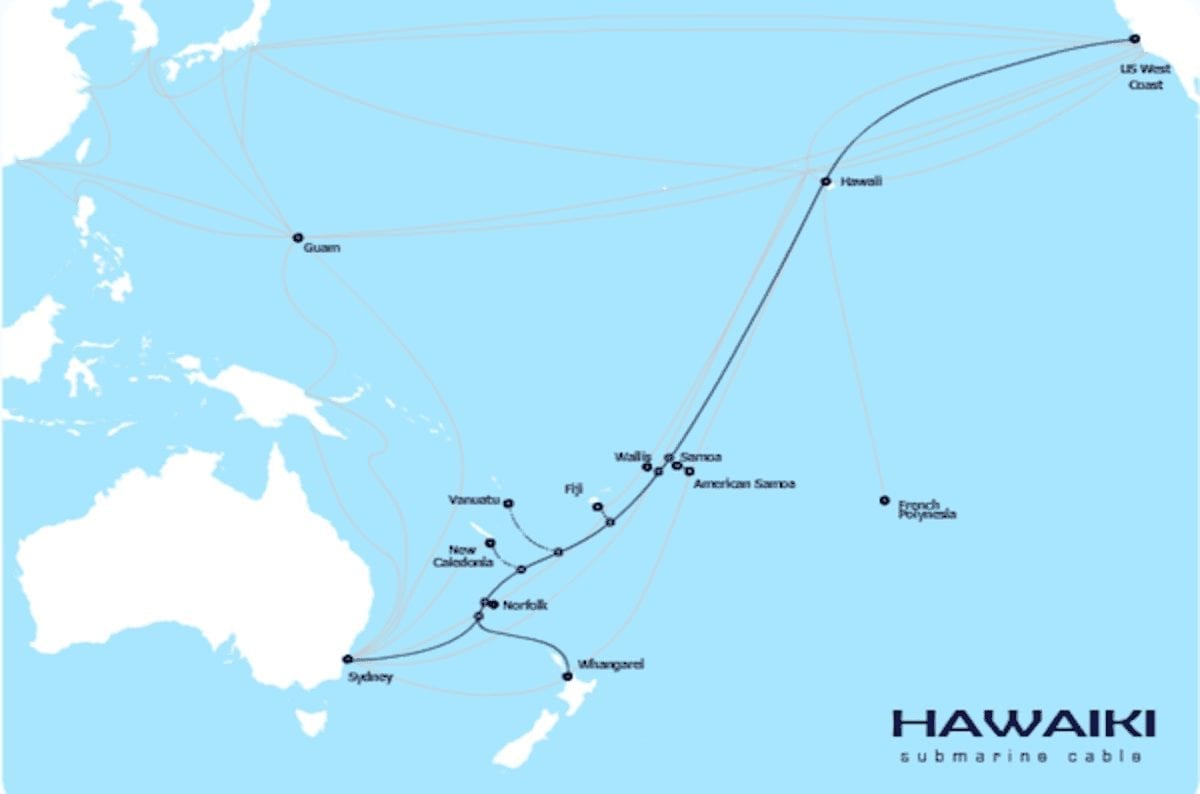
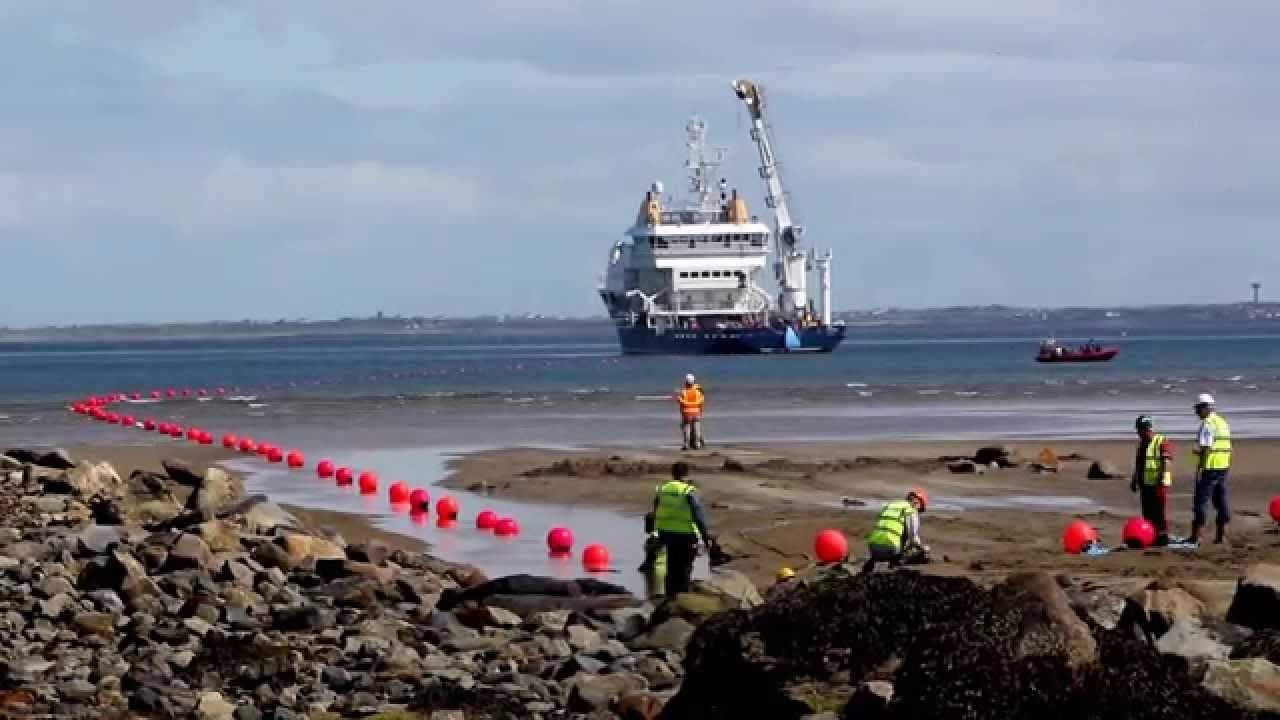
    The Hawaiki cable is nearly complete, according to the company and TE Subcom. Each of the cable landings is complete, the final splice has been made, and final testing will begin shortly. That puts them on track to officially bring the cable online next month.

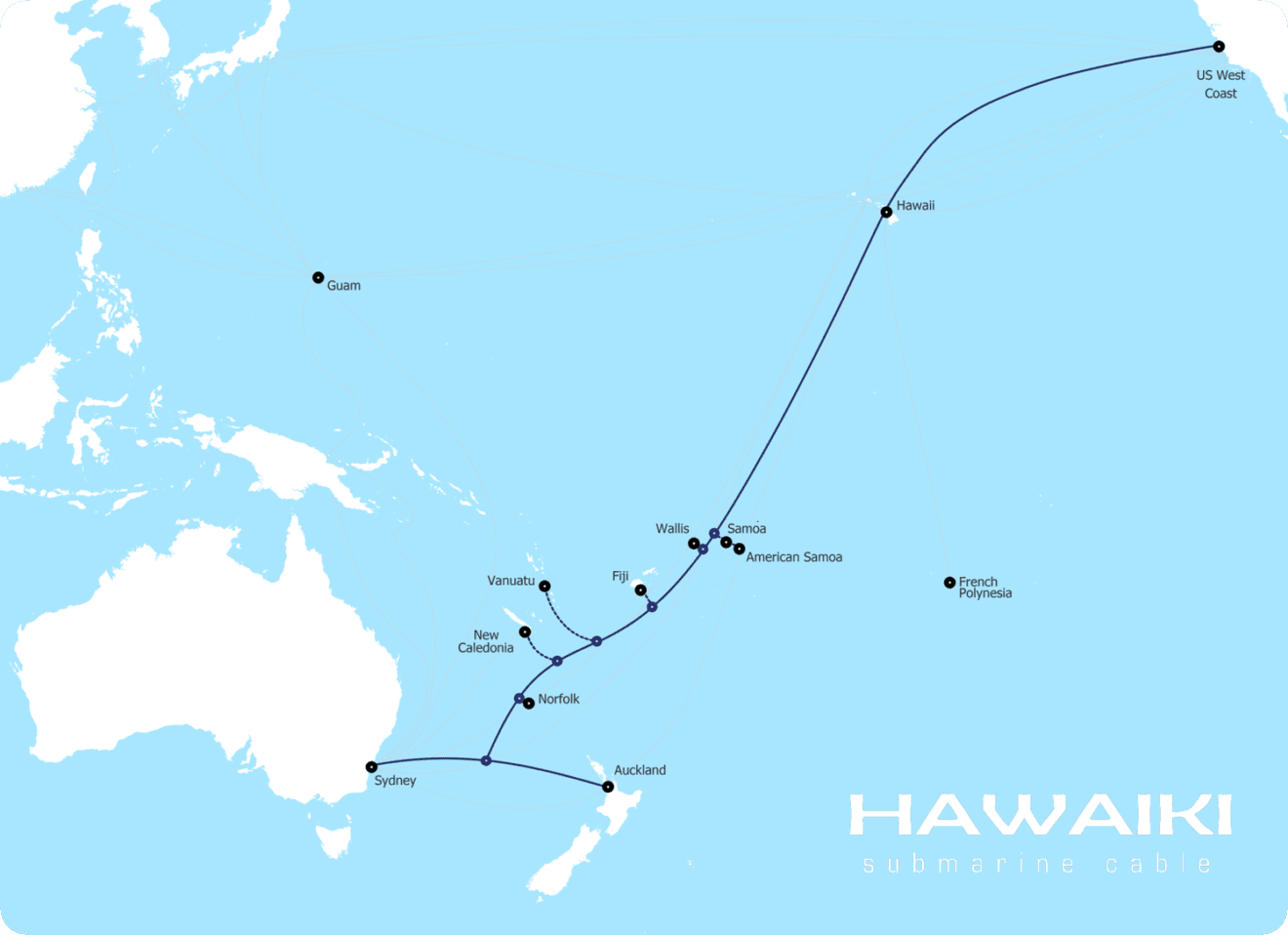
    The 15,000km Hawaiki cable Cable System will connect Oregon with Australia and New Zealand, making stops in American Samoa and Hawaii along the way. There are also stubbed branch units for New Caledonia, Fiji, and Tonga for the future.

    The system’s theoretical capacity is 43Tbps, which will add significantly to that which is available on the direct route down under. It has taken many years and iterations by those involved to make it happen.
     

  • Construction begins on Japan-Guam-Australia cable

    Construction begins on Japan-Guam-Australia cable

    A consortium led by RTI Connectivity has commenced construction of a new subsea cable linking Japan, Australia and the US territory of Guam.

    The Japan-Guam-Australia Cable System (JGA) is being built by a consortium consisting of RTI Connectivity, Australia’s Academic and Research Network (AARNet) and Google. It is being supplied by Alcatel Submarine Networks and NEC.

    The 9,500km subsea cable system will have a design capacity of over 36Tbps. It is expected to be ready for service in the fourth quarter of next year.

    At Guam, the JGA will interconnect to the SEA-US cable, which is operated by a consortium that includes RTI Connectivity, as well as the upcoming HK-G Hong Kong-Guam.

    The JGA will contribute to the expansion of communications networks from Japan and Australia to Asia and the US and expand onboard connectivity options in Guam.

    The cable is being built in two sections also linking in Guam, with JGA South being funded by AARNet, Google and RTI Connectivity, while JGA North will be wholly-owned by RTI Connectivity.

    “Hyperscale cloud providers and enterprise companies are fuelling exponential data-growth between Asia, Australia, and the United States. These customers require alternative paths, enhanced quality of service, and cost-effective bandwidth solutions,” RTI Connectivity CEO Russ Matulich said.

    “By adding JGA to our existing cable investments, RTI is well positioned to serve these massive data-growth needs. JGA’s unique design will also improve latency between Tokyo-Sydney, while greatly reducing provisioning timeframes.”

  • Hawaiki commissions cable landing station in New Zealand

    Hawaiki commissions cable landing station in New Zealand

    Hawaiki Submarine Cable, the company building a subsea cable between Australia, New Zealand, Hawaii and the mainland US, has commissioned the construction of the New Zealand cable landing station.

    New Zealand electrical engineering and construction company McKay has been commissioned to construct a landing station at Mangawhai Heads on New Zealand’s North Island.

    The multi-million dollar contract covers the complete civil, building and electrical work, including standby generation and uninterruptible power supply systems.

    “This contract represents a key step forward for Hawaiki system deployment in New Zealand,” Hawaiki CEO Remi Galasso said.

    “We are proud to participate to the economic development of the Northland region and are confident that McKay will deliver this critical piece of infrastructure in the most efficient and timely manner.”

    The Hawaiki cable is scheduled to be ready for service by June next year. As well as the main route, the cable will have options to branch to several islands in the South Pacific, including Fiji, Tonga, New Caledonia and American Samoa.

    The cable will have a design capacity of 42Tbps, making it the highest cross-sectional capacity link between Australia, New Zealand and the US.

    In May, Hawaiki announced that manufacturing of the 14,000km cable is nearing completion.

  • Asia-Africa-Europe 1 cable system launches

    Asia-Africa-Europe 1 cable system launches

    The consortium behind the Asia-Africa-Europe 1 (AAE-1) subsea cable system has announced the launch of the new cable, with services commencing from Europe to far east Asia.

    The 40Tbps, five fiber pair cable system is the first cable to link all major Asian, African, Middle Eastern and European regions, combining both subsea and terrestrial routes.

    It spans 19 nations and territories – Hong Kong, Vietnam, Cambodia, Thailand, Malaysia, Singapore, Myanmar, India, Pakistan, Oman, UAE, Qatar, Yemen, Djibouti, Saudi Arabia, Egypt, Greece, Italy and France.

    The AAE-1 provides termination with Telecom House in Hong Kong and Equinix and Global Switch in Singapore, as well as three termination options in Europe.

    The system has been designed from the outset with 100Gbps technology and is upgradeable in the future to meet growing demand. The consortium said the AAE-1 is the largest subsea cable system to launch in more than a decade.

    Members of the AAE-1 consortium include China Unicom, CIL, Djibouti Telecom, Etisalat, GT5L, Mobily, Omantel, Ooredoo, OTEG, PCCW, PTCL, Reliance Jio, Retelit, Telecom Egypt, TeleYemen, TOT, Viettel, VNPT and VTC

  • Undersea internet cable out of action for another three weeks in Vietnam

    Undersea internet cable out of action for another three weeks in Vietnam

    Repair work on the broken international cable won’t start until July 3 and will take at least 10 days to complete. International internet connections in Vietnam are likely to remain slow for another three weeks with repair work to a major internet cable which broke off central Vietnam last week expected to take until July 14, a service provider said.

    The source told us that repair work on the Asia Pacific Gateway won’t start until July 3 and is expected to take 10 days. The cable should be fully reconnected by July 14, depending on the extent of the problem, said the representative.

    The cable snapped on Tuesday afternoon about 125 kilometers off the coast of Da Nang.

    Service providers such as Viettel and VNPT said they have prepared contingency routes to minimize downtime.

    No announcement on the cause of the problem has been made.

    The cable was officially launched on January 3, but was quickly hit by a technical problem that took two weeks to fix.

    The cable cost $450 million and has a capacity of more than 54 Tbps, promising to double internet speeds in Vietnam and ease reliance on the notorious Asia America Gateway, which has ruptured or been shut down for maintenance on numerous occasions since 2011.

    The new system took four years to build, and links Japan with Hong Kong, mainland China, Malaysia, Singapore, South Korea, Taiwan, Thailand and Vietnam.

    Nearly 49 million people in Vietnam, or more than half of the country’s population, are online.

  • Hawaiki Cable manufacturing nearing completion

    Hawaiki Cable manufacturing nearing completion

    The first cable load for the Hawaiki Cable – the subsea cable that will link Australia and New Zealand to the continental US, Hawaii and America Samoa – will commence next month.

    Hawaiki Submarine Cable and TE SubCom announced that construction of the cable remains on schedule, with more than 13,000km of the 14,000km transpacific cable now manufactured. The initial cable load will include 7,000km of this cable.

    Installation permits for Australia, New Zealand and Oregon in the US have also been procured, and horizontal directional drilling for the cable landing of Pacific City in Oregon have commenced.

    In Sydney, more than half of the conduits for the land duct route have meanwhile been installed, and drilling operations will start early next month.

    Once complete in mid-2018, Hawaiki is expected to be the highest cross-sectional capacity link between the US and Australia and New Zealand. The carrier-neutral cable system will have options to expand to several South Pacific islands, including Tonga, Fiji and New Caledonia.

    “We’re very close to completing the manufacturing stage of Hawaiki and are preparing to launch installation in just a matter of months,” Hawaiki CEO Remi Galasso said.

    “Once live, this cable system will help eliminate the distance between all Pacific communities and provide an economic boost to a region consistently starved for broadband access.”

  • NEC sets long-haul subsea cable record

    NEC sets long-haul subsea cable record

    Japan’s NEC has announced it has become the first vendor to achieve a transmission capacity of over 50Tbps over a distance greater than 10,000km using a single optical fiber.

    The new development could pave the way for significantly faster subsea cables spanning trans-Pacific distances, helping the industry meet surging traffic demands in the APAC region.

    NEC has demonstrated a speed of 50.9Tbps over a more than 11,000km span of cable using new C+L band erbium-doped fiber amplifier (EDFA) technology. The company said the performance translated to a record-breaking capacity of 570 petabits per second per kilometer.

    To push the capacity of the cable to close to the Shannon Limit – the spectral efficiency limit of optical communications, NEC researchers developed a new multilevel, linear and nonlinear constellation optimization algorithm.

    With this algorithm, NEC has achieved an optimized 32 quadrature amplitude modulation (32QAM) constellation with a higher nonlinear capacity limit and an unprecedented spectral efficiency over a trans-Pacific distance.

    In addition, NEC researchers developed a new bi-directional amplifier design to help maximize the capacity per fiber pair by reducing effective noise and device complexity.

  • Malaysia-Cambodia-Thailand subsea cable launches

    Malaysia-Cambodia-Thailand subsea cable launches

    A new subsea cable connecting Malaysia, Cambodia and Thailand has been launched in Cambodia, adding at least 30Tbps of regional capacity.

    The Malaysia-Cambodia-Thailand (MCT) cable system was designed and deployed by Huawei Marine for Cambodia’s EZECOM, Telekom Malaysia and Symphony Communication of Thailand.

    The 1,300km cable system uses 100Gbps technology, and will connect to other submarie cable systems, including the Asia-America Gateway (AAG).

    Speaking at the launch of the system, EZECOM CEO Paul Blanche-Horgan said the launch is the culmination of six years of work. He said the launch of the cable will improve the security of Cambodia’s connection to the internet.

    “With this cable, we are now directly connected POP to POP, which means a much more secure connection for Cambodia. This is of great importance, as [Cambodian deputy prime minister and minister of interior] Samdech Krolahom does understand, for the context of national security as well as certain key sectors like banking.”

    Samdech Krolahom himself said that with the new cable, “Cambodia now has faster, more reliable, more affordable and, most importantly, a more secure internet connection for all.”

  • Prysmian group claims record for densest subsea cable

    Prysmian group claims record for densest subsea cable

    Cable manufacturer Prysmian Group has supplied what it says is the densest and highest fiber count subsea cable ever made.

    The company has delivered a FlexTube cable containing 1,728 optical fibers for Australia’s Superloop for the TKO Express project.

    TKO Express is a project to provide broadband connectivity between the aras of SiuSai Wan on Hong Kong Island and the Tseung Kwan O Industrial Estate data center hub on the mainland.

    The company’s and industry’s previous record was a subsea FlexTube cable with just 720 fibers from 2014.

    Prysmian Australia CEO Frererick Persson said the construction was a major logistics and engineering challenge.

    The base cable was manufactured in France, then airlifted in Australia to apply moisture barriers and aluminum tape as well as double armoring layers of wrapped steel wires to ensure the cable could withstand being buried up to five meters into Hong Kong’s sea bed.

    “It was a logistics challenge indeed. Airfreighting a drum weighing 15 tons was something that we have never done before. But we mastered it and the drum was successfully delivered to the TKO Port three days before the promised date. It has been definitely great success for both companies,” he said.

  • Vietnam’s notorious internet cable AAG finally back up to full speed

    Vietnam’s notorious internet cable AAG finally back up to full speed

    Out of the three undersea internet cables that crashed in January, one still remains adrift. The repair work on the notorious Asia America Gateway (AAG) undersea cable system was completed on Thursday, quoting service provider CMC Telecom.

    The same day, another service provider VNPT Telecom confirmed that the rupture-prone AAG is back up to 100 percent of its capacity, just in time before the Lunar New Year holiday.

    In early January, the AAG and two other internet cables, the Intra Asia (IA) and the newly launched Asia Pacific Gateway (APG), all experienced problems and were subsequently shut down.

    The APG was fully recovered on January 23 while the other is expected to be fixed by February 5.

    The AAG is well known to internet users in Vietnam for its frequent ruptures, which even inspired internet memes blaming the issues on “sharks.”

    In 2016 alone, it ruptured three times – in March, June and August – heavily affecting outbound traffic.

    Vietnam has five submarine cable systems. The AAG was connected in November 2009 with a length of over 20,000 kilometers and a design capacity of 2 terabit/second, directly connecting Southeast Asia with America.

    The latest addition is the recently broken and now fixed APG Submarine Cable. It began operations in late December and was officially launched on January 3. The cable cost $450 million and has a design capacity of more than 54 Tbps.

    In addition to submarine cable systems, Vietnam has a land-based system with a capacity of 120 gigabit/second that goes through China, and there are plans to build another one.

  • Hawaiki completes route survey for subsea cable

    Hawaiki completes route survey for subsea cable

    Hawaki Submarine Cable and TE SubCom have completed the route survey for the 14,000km Hawaiki transpacific cable system linking Australia and New Zealand with mainland US.

    With the successful completion of the survey, the companies remain on track to complete the deployment of the cable in mid-2018.

    Once complete, the carrier-neutral cable system will be the highest cross-sectional capacity link between the US and Australia/New Zealand. It will also link to Hawaii and American Samoa, with options to expand to several other South Pacific islands including New Caledonia, Fiji and Tonga.

    TE SubCom meanwhile continues to manufacture the cable, with more than 4,500km of cable and over 25 repeaters completed.

    “The start of 2017 finds the Hawaiki cable system closer and closer to ready for service,” Hakaiki CEO and co-founder Remi Galasso said.

    “The information garnered from the recently completed deep water route survey will be instrumental in ensuring the long-term viability of the cable system, and we are thrilled with the progress on the cable and repeater manufacturing efforts. Installation will begin later in 2017 and a fully lit system that should positively impact the entire region is soon to follow.”

  • Google, Facebook to build LA-HK cable

    Google, Facebook to build LA-HK cable

    The internet giants Google and Facebook apparently agree on at least one thing this month: that the world’s infrastructure is in need of another trans-Pacific cable system. They are teaming up with privately held Pacific Light Data Communication and TE Subcom to build the Pacific Light Cable Network, or PLCN.

    The new cable system will be a direct link between Los Angeles and Hong Kong. It will span some 12,800km between the two cities, potentially offering one of the lowest latencies available.

    PLCN will also incorporate the latest optical technologies, which means the total theoretical capacity will be the largest transpacific route so far – up to 120Tbps in all. It is expected to be launched commercially in the summer of 2018.

    It was just a few months or so since the that the FASTER cable, also backed by Google, came online between Japan and Oregon. The PLCN cable system will give them some diversity both by route and by landing station.

    For Facebook, this is the most public position on a transpacific cable they have taken. But in the Atlantic they are part of the group building the Marea cable system between Bilbao and Virginia Beach.

    TE Subcom will be doing the actual laying of the cable, of course. But I wonder who is behind the privately held PLDC over in Hong Kong.

  • ASN, Bell Labs set 65Tbps subsea cable speed record

    ASN, Bell Labs set 65Tbps subsea cable speed record

    Alcatel-Lucent Submarine Networks and Nokia Bell Labs have set a new transmission record over a 6,600km single mode fiber for transoceanic cable systems.

    The lab trial achieved a total transmission speed of 65Tbps using submarine grade dual band erbium doped fiber amplifiers.

    The trial used Bell Labs’ new probabilistic constellation shaping (PCS) modulation technology. PCS is designed to maximize the distance and capacity of high-speed transmission in optical networks, by using non-uniform transmission of constellation symbols to increase resilience to noise and other impairments.

    “The future digital existence where everyone, everything and every system and process is connected will require a massive increase in network capacity and the ability to dynamically optimize this capacity,” Nokia CTO and Bell Labs president Marcus Weldon said.

    “Probabilistic constellation shaping extends the limits of current optical transmission by utilizing novel modulation techniques to dramatically improve the performance and capacity needed for the new digital era that will be enabled by the Future X Network.”

    The same technology was used in September to achieve speeds of 1Tbps per channel https://www.telecomasia.net/content/bell-labs-achieves-1tbps-over-fiberover Deutsche Telekom’s terrestrial optical network during trials with the operator’s T-Labs and the Technical University of Munich.

    A capacity of 65Tbps is 13,000 times the capacity of the first subsea amplified transatlantic system in 1995.

  • Hawaiki picks US landing partner for subsea cable

    Hawaiki picks US landing partner for subsea cable

    Hawaiki Submarine Cable, the New Zealand based company building a cable between Australia, New Zealand, Hawaii and the continental US, has selected its landing and operating partner in the US state of Oregon.

    Hawaiki has signed a landing party agreement with Alaska Communications after completing the maritime survey of the 4,000km segment between Oregon’s Pacific City and Honolulu.

    The completed cable will span 14,000km and deliver more than 30Tbps of total capacity, making it the largest link between the US and Australia/New Zealand.

    “Oregon is probably the best state on the US West Coast to land a submarine cable. The

    coast is relatively safe, the state permitting process is efficient and most importantly, our

    customers like Oregon’s diversity and easy access to US networks and data centers,” Hawaiki SVP for Noth America Gina Bohreer said.

    “As part of the US permitting process for international submarine cable, Hawaiki has

    subsequently submitted its application to the Federal Communication Commission.”

    The company has already signed on anchor customers including AWS  and major Australian fixed-line ISP group TPG Telecom.

    Construction of the Hawaiki cable is expected to be complete in mid-2018.

  • Malaysia-Singapore-Indonesia cable commissioned

    Malaysia-Singapore-Indonesia cable commissioned

    A new subsea cable company has contracted Huawei Marine Networks to deploy a 250km cable system connecting Malaysia, Singapore and Indonesia.

    Super Sea Cable Networks (SEAX) has commissioned construction of its SEAX-1 cable, which will connect Mersing on the eastern seaboard of Peninsular Malaysia with Singapore’s Changi and Indonesia’s Batam.

    Construction of the 24-fiber-pair system is expected to be complete by the end of next year. SEAX’s market focus will be wholesale operators in emerging markets, including Tier 1, Tier 2 and Tier 3 carriers who want to own but not operate cable systems.

    SEAX’s five-year plan is to target, Thailand, the Philippines, Cambodia, Vietnam and Myanmar in addition to Malaysia and Indonesia.

    The company has a facilities-based operator license in Singapore, an affiliate company in Indonesia and is partnered with telecoms infrastructure provider SACOFA in Malaysia.

    “SEAX-1 passes through one of the busiest region in the Asia Pacific region, where bandwidth demands are increasing exponentially,” SEAX CEO Joseph Lim said.

    “We believe this new submarine cable system will relieve bandwidth pressures on existing infrastructure and continue to provide this region with high-speed, reliable connectivity that will fast-track its growth.”

    Indonesia’s PT Telkom last week contracted NEC to build a subsea cable system connecting six large Indonesian islands with Singapore.