Tag: designer brand

  • The 15 hottest online luxury brands in 2018

    The 15 hottest online luxury brands in 2018

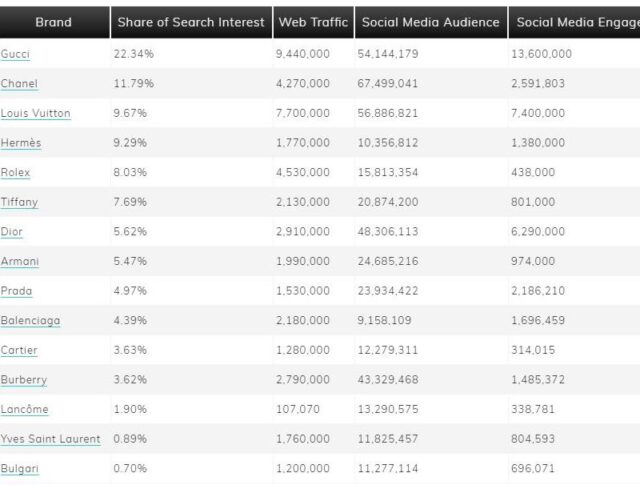
    Some brands have embraced digital better than others, as evidenced by their popularity online. According to a new report by Luxe Digital, the top 15 most popular luxury brands online are particularly successful at building online awareness but also at forging deep emotional connections with their audience—particularly young affluent consumers.

    The ranking provides a good gauge of the sales potential of the brands for this coming year-end.

    It’s also a great source of inspiration and best practices for luxury leaders. By exploring how the top high-end brands are performing online, one can understand the reasons for their popularity and how their approach could be replicated.

    Gucci is leading the 2018 ranking, followed by French houses Chanel and Louis Vuitton.

    Interestingly, it is Italian fashion brand Balenciaga that saw the most impressive growth thanks to its fresh take on luxury streetwear.

    The Direct-to-Consumer approach emerges as a winning strategy for luxury

    The ranking is largely dominated by fashion brands, although Rolex and Tiffany made it to the top 10.

    It is worth noticing that Lancôme is the only beauty brand to appear in the list, finishing at the 13th position.

    A noticeable trend is the Direct-to-Consumer retail model which is increasingly more adopted by luxury brands. The DTC approach emerges as a great way for high-end brands to control their brand identity online and own their customers’ data.

    Influencer marketing is also playing a key role in 2018. Virtually every brand in the top 15 has collaborated with social media influencers to shape the conversations online and drive brand discovery amongst untapped audiences.

    For luxury fashion specifically, high-end streetwear is clearly making the buzz this year.

    Other noticeable trends for 2018 include more interest in sustainable practices and social causes. Natural cosmetics, natural and vegan beauty products, in particular, are also generating a lot of online interest.

    The rising share of affluent Millennials and Gen Z consumers

    These trends are mainly driven by the growing portion of more socially-conscious, affluent Millennials and Generation Z consumers.

    This shift in consumers’ values and preferences combined with the disruptive impact of new technologies are challenging the traditional notions of luxury.

    As the sophisticated younger generations become important luxury shoppers, modern luxury brands are evolving their offerings to appeal to their specific tastes.
    Luxury brands are also adapting their marketing strategy to offer a seamless shopping experience both online and offline in line with the younger affluent consumers’ growing expectations.

    Conscious of the essential role that new technologies play in driving their narrative, luxury leaders are finally embracing digital technologies.

    For brands, it is clear that the ability or inability to pivot to this new reality will continue to widen the gap between the successfully agile luxury brands and the slow adopters.
  • Icicle Fashion Group buys the Parisian fashion label

    Icicle Fashion Group buys the Parisian fashion label

    Icicle Fashion Group has beaten out a phalanx of bidders to buy out French fashion brand Carven. The financial terms of the deal were not disclosed. Despite Carven’s difficulty carving out a place in the modern fashion firmament, Icicle founder Shouzeng Ye said that the label offers considerable value to Icicle as a vehicle for global expansion, access to European design expertise and international luxury brand credibility.

    “Our strategy is to expand internationally,” he said. “We started in 2013 by opening our design centre in Paris. We are going to open our first international flagship store in Paris next Autumn 2019. Carven is our third large-scale international investment. It helps us to accelerate Icicle Group’s expansion and development.”

    Hung Huang, a long-time fashion identity in China, who last year wrote a book marking Icicle’s 20-year anniversary, sees overwhelmingly positive outcomes for both investor and investee as a result of the deal.

    “So many Chinese companies are buying luxury brands from overseas, but this is the most promising of these acquisitions. Because Icicle is already a successful fashion brand in China, they have a deep understanding of manufacturing and operating in the Chinese market,” she explains, adding that Carven will benefit from the fact that Icicle is not acquiring the brand purely as an investment project, but has value beyond the monetary injection to offer the French brand.

    Little known outside China, Icicle, known as Zhi He in its homeland, was founded by Shouzeng Ye and Shawna Tao in 1997 and has been a leading proponent of sustainable fashion in the country for more than two decades.

    Turning over more than 1.6 billion RMB (a little over $231 million) annually through its network of 200 stores in Mainland China and e-commerce operations, the privately-owned Icicle is headquartered in Shanghai and has a workforce of more than 2,000 in China, but also opened a design centre in Paris back in 2012, where its top-tier collection is conceived.

    On the other hand, according to Brock Silvers, managing director of Kaiyuan Capital, a China-based multi-asset advisory, a multitude of questions remain as to whether the partnership will indeed be a win-win for Icicle and Carven, especially given the premium price Icicle is paying and its reported promise to keep key Carven structures and people in place as part of the deal.

    “Is China ready to manage French fashion? Is Icicle prepared to expand beyond its eco-friendly mandate? A successful bid may not translate into an easy victory and Icicle management may soon be put to the test,” Silvers says.

    Icicle is among several peers from China ramping up their fashion portfolios through overseas acquisitions. Conglomerate Fosun Group purchased a majority stake in French brand Lanvin and textile giant Ruyi Group owns Bally, Aquascutum and Gieves & Hawkes.

    “[This] will continue because the Chinese consumer is fuelling the growth of the luxury sector. Therefore, Chinese companies can acquire an international brand and extract its potential in China, leveraging knowledge of successful approaches to marketing, pricing and distribution in the domestic market,” says Mario Ortelli, managing partner of luxury advisors Ortelli & Co.

    The Boston Consulting Group (BCG) estimates Chinese consumers already make up 32 percent of the global luxury market – a number predicted to rise to 40 percent by 2024. Data from McKinsey & Co. shows revenue growth in China’s luxury segment was around 15-20 percent for the first half of this year.

    Another major factor is the urging of China’s government for corporate leaders to help push China’s economy towards a consumption model, away from its traditional manufacturing base, which continues to weaken due to lower-cost competitors elsewhere in Asia, rising wages, and more recently, pressure from China’s trade conflict with the US.