Tag: esprit

  • Newest Esprit stores reveals new concept

    Newest Esprit stores reveals new concept

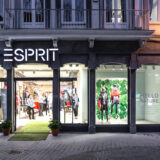
    Two new Esprit stores opened in Europe this month give an insight into the new direction of the embattled brand as it rebuilds. In the historic centre of Liege in Belgium a new 400sqm boutique stocks only womenswear. According to an understated news release issued in Germany, the “modern and bright store design creates a pleasant and warm atmosphere”.

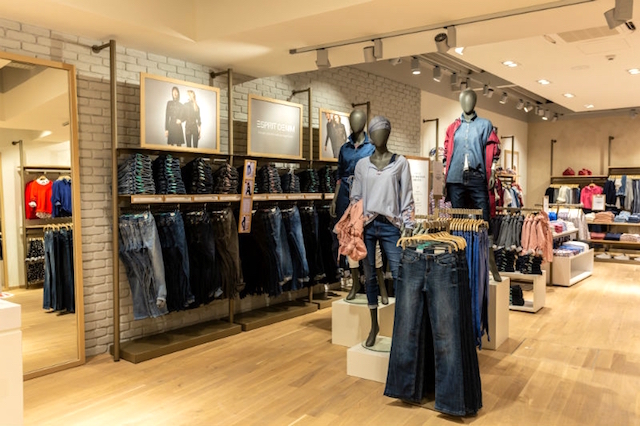
    A standout feature is a denim wall standing in front of a brick wall painted in light grey. The floor comprises terrazzo tiles and oak parquet.

    The new store also reflects a growing focus on Esprit’s e-commerce offer, with a click & collect area for customers to pick up items they have ordered online.

    The second of the Esprit stores to open in Europe this month is an outlet store at Wolfsburg in Germany.

    The 400sqm store is described by Esprit as “an important location” in its outlet portfolio. It offers both women’s and men’s apparel.

    Michael Ernst, centre manager of Designer Outlets Wolfsburg, says customers have been asking for an Esprit store at the centre for several years.

    “We are delighted to be able to fulfil this wish now. The new store offers an attractive range of fashion at excellent value.”

    Designer Outlets Wolfsburg is the first inner-city outlet centre in Germany, home to more than 70 designer and lifestyle brands.

    After ongoing losses, Esprit last year launched a massive overhaul of its business with a new management team at the helm, promising changes to product, its retail network and its e-commerce offer.

    The company is due to release its interim results this week.

  • Esprit appointed new chief product and brand officer

    Esprit appointed new chief product and brand officer

    Struggling fashion retailer Esprit has tapped a former Burberry and Tommy Hilfiger executive to become its chief product and brand officer. Mia Ouakim will take up the new role – a crucial post in the brand’s turnaround plan – in February, reporting to the group CEO.  She will be responsible for managing the product creation and design of all product divisions, as well as the consistent execution of the brand strategy across all product divisions and consumer touch points, according to Esprit in a stock exchange filing.

    Ouakim’s experience spans corporate strategy, product design, merchandising, planning and development, brand and communication, and distribution gained from luxury and premium fashion brands. Her most recent role was senior VP of Tommy Hilfiger menswear and tailored, overseeing the brand’s menswear division globally. Prior to that, she served as VP at Tommy Jeans, formerly known as Hilfiger Denim (Women & Men) between 2014 and

    2017 where she had full business responsibility of the denim division globally.

    Before joining Tommy Hilfiger, Ouakim held various roles with Burberry, working in product, merchandising and design roles for childrenswear between 2006 and 2014. Before that, she was with Children Worldwide Fashion in the UK, responsible for brand, communication and public relations of various luxury and premium brands, including Burberry, Timberland, Kenzo, Nike, Elle and DKNY childrenswear.

  • Esprit revamp to sacrifice staffs, stores

    Esprit revamp to sacrifice staffs, stores

    Esprit plans to axe 40 per cent of its non-store workforce as part of a radical restructure repositioning the brand for future growth. The embattled Hong Kong-listed fashion retailer is set to incur up to US$217 million in one-off charges as it shutters stores, revamps its stock range and embarks on a new marketing campaign, with a heavy accent on social media.

    The bold Esprit revamp plans were laid out in an investor presentation which revealed a new positioning statement for the company. It has trademarked the phrase “radical positivity” but describes it as “a mindset, not a slogan”.

    Senior management has led by example, the executive team already culled from 13 to just six, although the company is recruiting two more: a chief product officer and a CEO for Europe and the Americas.

    Those remaining executives, including Group CEO Anders Kristiansen, executive chairman Raymond Or, head of marketing Simon Heckscher and CEO for Asia Jan Olsen told investors that Esprit plans to eliminate overlapping functions and reduce hierarchy to become more lean and efficient and allow faster decision making. It will merge five offices at headquarters into one and reduce the size of the office in Hong Kong.

    The Esprit revamp will come at a cost with breakeven expected only in two to three years. But the result of running a leaner and more customer-focused business will drive profitable top-line growth in three to five years. The company is targeting an EBIT margin of between 5 per cent and 7 per cent, starting year five.

    In the current year, Esprit forecasts a further decline in sales in the “low double digits” resulting from store closures and a continuing decline in customer traffic. It forecasts a one-off bill of HK$1.5 to 1.7 billion in one-off restructuring costs.

    Next year it anticipates a return to revenue growth. “We have a clear plan with bold changes. We will return to sustainable growth and profitability,” the management team said.

    Store closures

    The current store portfolio is being reviewed to evaluate which will be closed, in a phased approach which has already begun and will continue into next year. The company has already shuttered 18 stores in Asia and another 28 in Europe have been closed, downsized or had their rents renegotiated.

    From mid-next year the company will start opening new outlets, targeting 220 in China by 2023 and another 78 stores in other Asian markets.

    The company wants to reduce personnel costs from 20 per cent of store operating expenses now to between 12 and 14 per cent, and occupancy costs from 37 per cent to between 25 and 27 per cent.

    Online, the company wants to reduce its dependency on Tmall by opening on other marketplaces around Asia and revamping its own e-commerce site.

    Elsewhere in Asia, the company wants to focus on India (where it opened its first brick and mortar store on November 16), Thailand and the Philippines.

    It also plans to revamp its wholesaling business with a new ‘best-in-class’ business model in place by next September.

    New model for the future

    Esprit says it is building “a new model for the future” – a powerful organisation with a restructured cost base and the executive team has delivered a detailed outline of how it will reconnect with customers.

    They were honest about the current state of the business: “Esprit has changed – maybe too much. Our brand identity is inconsistent and we don’t know what we stand for. We’ve lost touch with our audience due to lack of customer focus. Our product, quality and fitting must be improved. Bold changes are needed to return to sustainable growth and profitability.”

    But they said there are positive sides to the story: according to a Brand Health Tracker survey in July, Esprit enjoys 87 per cent brand awareness in Germany, one of its core markets, and it is the third favourite fashion retailer there.

    And they say the brand knows what it stands for. “We are not fast fashion and we are not a discounter.

    We are a brand with a purpose. We will know our consumers by heart, provide clear brand value and strong product proposition and shape a consistent end-to-end consumer experience. We stand for radical positivity, loving our customer and quality, always. This is about more than branding. This is about changing our entire mindset. This is about who we are. .. what we do … how we do it.

    “There will always be a customer base that wants well-designed, good-quality and affordable clothes, that last beyond one season.”

    The Esprit shopping experience

    The company plans to change the Esprit shopping experience online, on app and in store. The online store will be updated and enriched with storytelling and live streaming. It will improve packaging and by the end of this year, promises 90 per cent of EU online orders will be shipped using services which are carbon neutral or commit to reduced emission programs.

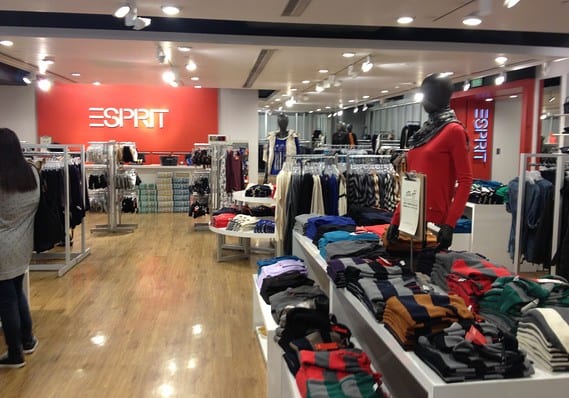
    A new store concept launched in August features improved customer service, visual merchandising that elevates the product, and “music that lifts the spirit”. Merchandising will be simple, surprising, fresh and playful and storytelling will employed with signage such as “These jeans will change your life. You won’t have to change.”

    Esprit also plans a heavy focus on Instagram where it currently has 313,000 followers. Social branding will increase featuring real-time content and happenings in the world. The target is to grow followers to 1 million within 18 months.

    Range revamp

    Meanwhile, the company has already started revamping its range, addressing fabric quality, fit and the balance of products.

    It will reduce the number of SKUs, reduce so-called ‘kick colours’ and strengthen neutrals.

    “We looked at sell-through rates and consumer data per colour. Our market survey shows our competitors offer 30-40 per cent black, while Esprit has 15 per cent,” the team explained. So Esprit will strengthen its offer of neutrals like black, white, grey and beige.

    From June next year the number of stock options will be reduced by between 20 and 30 per cent. The company believes having too many items leads to higher development costs and complex stock management, which dilutes the brand message.

    It will change the balance of basic, core and highlight lines from a dominance of highlight to a more even disbursement, as shown below.
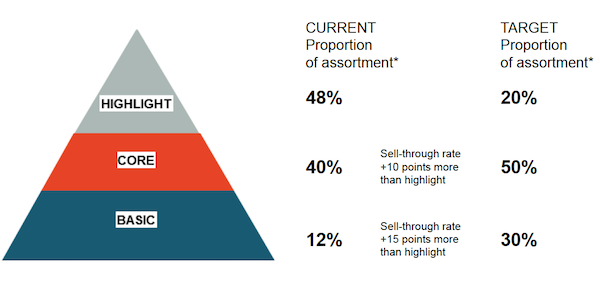
    Esprit management has identified the rise of quality basic brands, body diversity, athleisure, casualisation and conspicuous consumption as among trends shaping the fashion industry and driving consumer preferences. In response, it plans to offer a more commercial assortment of clothing, improve the quality and fit, develop signature product classes and establish “a unique Esprit handwriting”.

    Quality will be enhanced through innovation, functionality, collaboration – such as a winter range featuring 3M insulation – and by looking for opportunities for storytelling online and in stores. The company believes this will boost the sell-through rate to 75 per cent at full price. It will use sustainable denim made from organic cotton and recycled, fibres.

    Pants, t-shirts and sweaters comprise more than 50 per cent of Esprit’s current range and those are the staples it wants to be known for in the future.

    At the heart of the “handwriting” Esprit refers to is a hub of internal designers which has been created to establish guidelines and directions. It will use information gathered from market trends, competitors and data from its Esprit Friends client base to shape future designs and collections. That work is already starting and will influence collections set for release in fall next year.

    China potential

    With plans for more than 220 new stores in China over the next five years, Esprit is mindful of first addressing shortcomings in that market.

    It admits Chinese consumers perceive Esprit as in line with lower-positioned brands and that they find stores tired and uninteresting. It acknowledges it is missing “basic retail operational focus” in China, has a complicated business structure there with too many layers and its sales associate incentive schemes are not aligned with normal market practice.

    Esprit says to recover ground in China it needs to refine the fit of its clothes for Asians, improve quality, adjust deliveries to seasons, improve colour proportions and reduce product options to suit store sizes.

    In future, about 70 per cent of the brand’s mainline international collection will be adapted for Asia with amended fitting and 30 per cent will be designed specifically for Asia.

    The company plans to launch a two-phase strategic marketing approach starting in January. First, discounting will be reduced, but a “deal feel” will remain in stores and staff will be incentivised to push full-price sales. In phase 2, starting September, markdowns will be restricted, targeted discounts will be offered via email and WeChat notifications, and a new marketing campaign launched to attract new customers.

  • Esprit sales continues to dive

    Esprit sales continues to dive

    Esprit sales slumped further in the first quarter as the embattled fashion brand’s store network continued to shrink. In a stock exchange filing on Friday, Esprit said group revenue for the quarter to September 30 slumped 16.2 per cent year on year in local currency while its own offline store sales area reduced by 10.6 per cent, to HK$3.34 billion (US$425.8 million). The company’s own-managed stores, which account for 37 per cent of the company’s total turnover, fell by 17.8 per cent.

    “The decline was due to a reduction in net sales area of 11.5 per cent year on year, a result of continued rationalisation of our distribution footprint, including the closure of the Australia and New Zealand markets and a decline in comparable retail store sales (excluding e-shop) of 14.1 per cent … mainly due to declining customer traffic to our stores and extended warm summer temperature in Europe which impacted sales of our autumn merchandise,” the company said.

    Offline same-store sales in Asia Pacific grew by 0.3 per cent, mainly due to promotional activities. But online sales, which accounted for 24.9 per cent of the company’s revenue, fell by 14.9 per cent globally.

    Eshop, almost entirely in Europe and representing 24.9 per cent of group revenue, recorded a decrease of 14.9 per cent. Online sales in Asia Pacific, which account for a mere 2.6 per cent of total e-shop sales, plummeted 36.7 per cent, largely blamed on the closure of the Australia-New Zealand business.

    Wholesale revenue, almost entirely from Europe, fell 15.5 per cent.

    The company reiterated comments made after its dire full-year results were released last month, which included a US$325.5 million loss in the year to June 30: “Corrective measures are in place to reignite sales momentum.”

    A strategy plan will be released on November 26 outlining how the company plans to sharpen its brand identity, putting the customer at the centre of everything it does; improve product offering and brand positioning; reduce complexity and improve accountability in the organisation; become a leaner organisation; and eliminate loss-making parts of the business.

  • Esprit confirms to experience heavy loss

    Esprit confirms to experience heavy loss

    Struggling fashion label Esprit is looking to a new CEO and incoming chairman to turn the business around after a horror year.

    The Hong Kong-listed company posted a loss of HK$2.554 billion (US$325.5 million) for the year to June 30, pretty much in line with a profit warning issued early last month.

    On the plus side, the result included a raft of write-downs, including costs of exiting the Australia and New Zealand markets, cancelling leases for non-performing stores and many other one-offs, leaving the new management team with a clean slate to commence a turnaround.

    With widespread store closures, total group revenue fell 11.1 per cent to $15.455 billion, yet overheads were trimmed just 3.3 per cent, widening the business’ operating loss. New executive chairman Dr Raymond Or Ching Fai, said in a stock exchange filing the sales decline was higher than expected with falling customer traffic at both online and offline stores.

    He said Esprit had been affected during the year by “the rapidly evolving retail industry, fueled by the continuous growth of e-commerce leading to changes in consumer consumption patterns, and the intensification of price competition driven by both pure digital players and fully vertical retailers”. To be fair, the same factors are affecting every fast-fashion and mid-tier fashion brand, yet few of them are performing as badly as Esprit.

    By region, in Germany, Esprit’s largest market accounting for about half of total sales, revenue of $7.79 billion was down 10.9 per cent on last year.

    For the rest of Europe, America and the Middle East, sales fell 9.8 per cent and in Asia Pacific, which accounts for just 12.3 per cent of total revenue, sales fell 15.2 per cent. Offline sales in Asia-Pacific fell 17.1 per cent and online sales fell 5.3 per cent.

    ‘Far from satisfactory’

    Or said the company recognises the results are “far from satisfactory” and the situation has challenged both the board and the management team.

    “We believe the fundamentals of the strategic initiatives as presented in our last annual report (namely brand rejuvenation, product elevation, channels next generation, markets rightsizing and expansion, and cost reduction) remain sound and are necessary to recharge the potential of the group. However, we concede that the progress to date has yet to reignite sales momentum or translate into a positive financial performance.”

    He said that despite the operating loss, the company remained in a healthy financial position, debt-free and with a net cash balance of $4.5 billion, $700,000 less than at the end of the previous year. Some of that cash – $237 million – was used to repurchase about 2.9 per cent of the company’s shares.

    New group CEO Anders Kristiansen, who took the helm on June 1, Is leading what Or describes as a “vigorous” update of the strategic plan, scheduled to be finalised within three months.

    “In our drive to support growth, we must sharpen the brand identity, create an inspiring omnichannel shopping experience for our customers, and launch stylish and geographically adapted collections to improve sales per square meter productivity. We will continue to leverage on the newly installed dual product engines organisation, whereby the main line focuses on catering to existing customers in our core markets, and the fast-to-market line aims to introduce trendier products for the online and Asia markets, particularly China,” he said.

    “These efforts will work in tandem with data generated from extensive consumer research to ensure that our brand, products and channels properly resonate with Esprit’s target customers. We will bring our customers and what Esprit stands for as a brand to the centre of everything we do in order to become more relevant to our customers again and provide them with a strong brand experience.

    “While we certainly have a lot of work in front of us, I am convinced that by aligning the execution of our Plan, the better days of Esprit are ahead of us.”

    However the company has warned shareholders of a further drop in sales for the current financial year in the “low double-digit percentage” range year on year, mainly due to the continuing rationalisation of its distribution footprint and further decline in customer traffic amid Esprit’s execution of a plan to rebuild store visitor numbers.

    This year marks the 50th anniversary of Esprit, and its 25th anniversary of listing on the Hong Kong stock exchange.

  • Esprit shares shrinks after earning decrease

    Esprit shares shrinks after earning decrease

    After another profit warning, the Esprit share price tanked to just US 25 cents yesterday.

    The ever-shrinking, one-time fashion giant has delivered more bad news to beleaguered shareholders with an “update on profit warning” foretelling even greater losses this year.

    In June, Esprit said it expected a loss of HK$2.2 billion (US$280 million) based on write-downs, market exit costs – and a continuation of falling sales as customers turned their back on its overpriced product and off-point designs.

    Now the company says a preliminary review of accounts shows a loss before interest and tax of about HK$2.25 billion – loosely in line with its June projection – and a further HK$328 million write-down relating to taxation in Germany as a result of continually declining sales. That takes the projected loss out to $2.55 billion, (US$324.9 million).

    The news further battered the ailing retailer’s share price in Hong Kong trading this morning. It fell to just $1.99, a far cry from 52-week peak of $4.93, let alone the $15.86  of five years ago. The company’s market capitalisation now is just $3.9 billion (US$496.9 million).

    Final audited results for this year will be released next month.

    In June, Esprit said just over half of its projected loss results from non-cash items and one-off costs due to store closures, including the axing of its Australia-New Zealand business. It expected to post an operating loss as high as $950 million due to plummeting sales, commenting that a “decline of customer traffic” to its brick-and-mortar stores was higher than it expected.

  • Nike to fill former Esprit flagship space

    Sportswear brand Nike will take over a 7000sqft shop in the Leighton Centre for a monthly rental of HK$1.5 million (US$190,000).

    The space formerly housed an Esprit flagship, with the local fast-fashion brand reportedly paying rent of HK$2 million (US$255,000). Esprit vacated the space, located in one of the world’s busiest and priciest shopping districts, at the end of June. Esprit’s departure comes at a time when many Hong Kong retailers are abandoning or renegotiating prime streetfront locations.

    The 26,000sqft Esprit flagship at Tsim Sha Tsui was also vacated earlier this year before being taken over by a shoe retailer.

    The company took a net loss of HK$954 million (US$121.5 million) in the second half of 2017. It is currently poised to close more than 40 European stores.

  • Alibaba Says Its AI Copywriting Tool Passed the Turing Test

    Alibaba Says Its AI Copywriting Tool Passed the Turing Test

    Alibaba’s digital marketing arm Alimama has unveiled an artificial intelligence-powered copywriting tool.

    Tapping the huge pool of content on Alibaba’s e-commerce sites Tmall and Taobao, the AI copywriter uses deep learning and natural language-processing technologies learn from millions of top-quality existing samples to generate copy for products. Brands and advertisers can insert a link to any product page, and click the “Produce Smart Copy” button to see multiple copy ideas.

    Currently, the AI copywriter technology has passed the ‘Turing test’ and is capable of producing 20,000 lines of copy in a second, said Alimama. Brands using the new tool, such as Hong Kong-listed fashion chain Esprit and Texas-born clothing brand Dickies, can adjust the length and tone of their copy, such as dictating whether they want the tone to be “promotional, functional, fun, poetic or heartwarming.”

    The tool is used on average nearly a million times per day, by merchants and marketers on Alibaba-owned sites such as Taobao, Tmall, Mei.com (a fashion flash sale website) and 1688.com (Alibaba’s Chinese-language wholesale buying site).

    “For merchants, from today onwards, AI can take care of a portion of their copywriting needs. And it significantly changes the way [copywriters] work: They will shift from thinking up copy – one line at a time – to choosing the best out of many machine-generated options, largely improving efficiency,” Alimama said in a statement.

    As with design, copywriting involves a certain degree of repetitive, low-value work that can be made made more efficient, Alimama added. A single product might require up to 10 versions of copy for different ad formats, like posters, web banners, product pages and other special event pages.

    “All the content produced by the AI Copywriter is the result of applying deep learning models, trained with large volumes of quality content created by humans. Human creativity is the cornerstone for the machine, which isn’t able to replace the creativity of people,” said Christina Lu, GM of Alimama marketing. “AI for marketing… allows people to devote more energy to richly creative work.”

    “The AI copywriter is a really amazing tool,” said Shaozhang Ding, head of e-commerce for the Asia Pacific market at Esprit. “Based on a massive database of existing copy and advanced AI technologies, the tool can reduce the repetitive and tedious copywriting workload for our teams.

    The AI Copywriter is the latest in a suite of technologies Alimama has developed to assist small to mid-sized businesses on Alibaba’s e-commerce platforms, including a “smart banner designer” released in April that can resize and reformat promotional website banners with the slide of a mouse (drag a corner of the banner to change the shape of the box, and the system automatically reproportions the images and copy to fit the new format). In the same vein, Alibaba released an AI-powered video-editing tool for brands to generate – in less than a minute – 20-second videos to use for promotion on Taobao.

  • New phase of Sands Cotai Central opens with Apple anchor

    New phase of Sands Cotai Central opens with Apple anchor

    Sands Cotai Central has opened phase four of its retail offer, adding almost 100,000sqft of retail space and 25 retailers.

    At the heart of the expansion is an Apple store, which opens today.

    The new space is home to several brands new to Macao: Calvin Klein Performance and Razzle. Other stores to open are MLB, Esprit, Guess, Watson’s, Noble Mart, Levi’s, Florsheim, Timberland, The North Face, Boy London, Zaxy and Bauhaus.

    Later this year, several restaurants will be added to the line-up, including Chiado, a modern yet authentic Portuguese concept developed in partnership with celebrity chef Henrique Sa Pessoa, and Crystal Jade La Mian Xiao Long Bao, which brings a contemporary twist to classic Beijing, Szechuan and Shanghai cuisine.

    “The addition of these new stores, especially the introduction of an iconic Apple Store, continues to ensure we provide our customers with more new-to-market brands, more choice and more amazing experiences,” said David Sylvester, executive VP of global retail at Las Vegas Sands Corp.

    Sands Cotai Central, which celebrated its sixth anniversary in April, has been the focal point of a wide range of products, offerings and experiences on the Cotai Strip, with access to four hotels since it opened in 2012.

    Earlier this year Sands China revealed plans to transform Sands Cotai Central into The Londoner Macao, which will feature new attractions including some of London’s most-recognisable landmarks.

  • Esprit HK suffers a huge loss

    Esprit HK suffers a huge loss

    Distressed fashion chain Esprit has warned of a massive HK$2.2 billion (US$280 million) loss based on write-downs, exit costs – and a continuation of falling sales.

    The Hong Kong-listed company filed a profit warning with the Hong Kong Stock Exchange in which it said, based on the first 11 months figures for the year – it expected a loss before interest and taxes of between $2.170 billion and $2.270 billion for the full financial year to June 30. Last year, Esprit lost $102 million.

    A just over half the Esprit loss results from non-cash items and one-off costs due to store closures, the company says it expects to post an operating loss as high as $950 million due to plummeting sales. It reported a “decline of customer traffic” to its brick-and-mortar stores, higher than it projected.

    The one-off costs listed were:

    • A full impairment and write-down of the value of the China business, of HK$ 794 million before taxation.
    • The divestment of its stores in Australia and New Zealand, which will cost between $180 million and $200 million in provision for store closures and impairments.
      • Additional provisions and impairments due to the weaker than expected sales performance of directly managed retail stores for the year, including provisions for store closures and onerous leases, ($175 million to $185 million) and impairment of fixed assets of directly managed retail stores, ($11 million to $16 million).
    • A write-down in the value of inventory of between $80 million and $90 million arising from a change in the way it estimates the value of aged inventory.
    • Impairment of between $30 million and $35 million associated with obsolete SAP applications.

    The company said it would present final results for the year in September.

    Esprit has been struggling to achieve profit for the several years. In late April it warned shareholders its third-quarter performance was “well below expectation” and announced it would not renew the lease on its Causeway Bay flagship store.

    In March, it announced Jose Manuel Martínez Gutierrez would step down as group CEO and executive director of the company on June 1. Anders Kristiansen has since officially taken over the role.

  • Esprit to close down Australia and New Zealand stores

    Esprit to close down Australia and New Zealand stores

    Esprit is to close its Australian and New Zealand stores after years of mounting losses. The Esprit Australia and New Zealand network comprises 67 directly managed retail stores, including 38 concessions in department stores and 13 discount outlets.

    The announcement came just a few hours after the embattled fast-fashion retailer warned shareholders its third-quarter performance was “well below expectation” and several days after it announced it would not renew the lease on its Causeway Bay flagship store.

    In a statement to the Hong Kong Stock Exchange, Florence Ng Wai Yin, Esprit’s company secretary, said divesting the ANZ operations will allow management to concentrate efforts and resources in developing other markets in Asia, singling out China, Hong Kong, Taiwan, Singapore and Malaysia, “with profitable growth opportunities for the future” and avoid incurring further losses in Australasia.

    In the year to June 30 last year, Esprit Australia and New Zealand reported sales of HK$297 million, (US$37.8 million) which works out at a weekly per-store average of just US$10,850.

    It accounted for less than 2 per cent of the group’s total global revenue.

    Esprit says closing the stores down will cost between HK$150 million and HK$200 million.

    Executive director and group CFO of Esprit Holdings in Hong Kong, Thomas Tang, said the company had undertaken “intensive efforts” in past years to turn the Esprit Australasia business around, to no avail.

    Stephen Newnham, director of Esprit Australia and New Zealand described the group’s decision as “unfortunate but unavoidable”.

    The company expects to close all of its stores by the end of the year and will continue to honour gift cards until then.

    Strategy to be sped up

    The closure marks just one step in a promised acceleration of a strategic plan to improve top-line sales and reduce running expenses.

    “Given the challenging sales performance in the first nine months of the fiscal year, the group remains cautious about its expectations for the rest of the year,” said company secretary Florence Ng Wai Yin in a stock exchange filing.

    Group-wide sales in the nine months to March 31 were down 10.9 per cent year on year, to HK$11.8 billion (US$1.5 billion). The retail selling space was rationalised by 9.2 per cent over the same period.

    More worryingly, Esprit’s sales fell 13.8 per cent in the three months to March 31.

    Offline retail sales totalled HK$1.404 billion during the quarter, down 17.1 per cent, while online sales fell 11.4 per cent to $1.09 billion.

    Yin said the offline sales drop was the result of fewer sales points and unseasonably cold weather in Europe which aggravated the decline in customer traffic to stores.

    Online revenue in Asia Pacific declined due to management’s decision to reduce discounting in order to enhance profitability.

  • Esprit to quit Causeway Bay flagship Store

    Esprit to quit Causeway Bay flagship Store

    Hong Kong-listed fashion brand Esprit Holdings will not renew the lease for its flagship store in Causeway Bay, local media reports.

    Expiring in June, the lease for the 7000sqft (650sqm) store in Leighton Centre has cost Esprit about HK$2 million (US$254,862) a month since 2014.

    Esprit chairman Raymond Or says cost saving is not the sole reason for the move. The company also considers location and size as factors. “A large store might not bring about good results,” he told Apple Daily.

    JLL national director of research Cathie Chung says Esprit may be shifting its location strategy to be more mall-focused with a smaller shop size, reports Mingtiandi. “Compared to street shops, shopping malls tend to have a more balanced trade mix and guaranteed foot traffic, so it is more likely for Esprit to enjoy spillover benefit from complementary tenants. Promotion activities by malls can also attract shoppers.”

    Hysan, which owns the commercial complex where Esprit has been leasing two units, has been marketing the property to potential tenants at the same rate, reports say.

    Shop rents in Causeway Bay in the past quarter have dropped 53 per cent from their peak in the fourth quarter of 2014, says Chung who describes the owners’ stance as “rather soft”, allowing for rent negotiations.

    Fashion brand Twist last month leased a two-storey shop in East Point Road in Causeway Bay for 56 per cent less than the $1.1 million monthly rent the previous tenant had been paying, while Russell Street, once the most expensive retail destination in the world, has also seen rent cuts. Swatch Group last week, for example, was able to renew its lease for a street-front shop at a rate about a third lower than the $1 million a month specified when it first signed three years ago.

    Meanwhile, Esprit had a net loss of $954 million in the second half of last year. CEO Jose Manuel Martinez said the results were below expectation because of weaker sales at its stores because of a drop in customer traffic.

  • Esprit Holdings to announce new leader

    Esprit Holdings to announce new leader

    Leadership changes have been announced by apparel brand Esprit Holdings in Hong Kong.

    Jose Manuel Martínez Gutierrez will step down as group CEO and executive director of the company on June 1, with Anders Kristiansen appointed as his successor.

    As a precursor to the change of CEO, chairman Dr Raymond Or Ching Fai will assume the role of executive director on April 1, to play a more active role in the next phase of the group’s strategy, including an ambitious expansion plan for China, the company said in a regulatory filing.

    “We very much regret losing Mr Martinez, as his contribution has been most valuable to Esprit,” said Or.

    Over the past five years Martinez had reversed a severe decline in the group’s results by stabilising procedures, restructuring and improving overall profitability.

    “After this phase of bottomline recovery, the group enjoys a sound financial position, with no debt and net cash of HK$4.5 billion.”

    Martinez, whose resignation is for personal reasons, said he was leaving the group “strong and well equipped” and he believes the new leadership will bring a positive impulse to take on the challenges ahead.

    “I will stay on to support a smooth transition into the new scheme.”

    Or says incoming CEO Kristiansen is a well-rounded and seasoned executive in the fashion industry with extensive experience in business development both in Europe and Asia, especially China.

    “Our objective will be to recapture market share and ultimately return the company to growth,” said Kristiansen.

    Or, 68, was appointed as independent non-executive director in March 1996 and became chairman in June 2012.

    Or is also a director of Chow Tai Fook Jewellery Group, Industrial and Commercial Bank of China, Regina Miracle International (Holdings) and Television Broadcasts. He has entered into a service contract with Esprit, which may be terminated by either party on 12 months’ notice.

    Kristiansen, 51, is an industrial advisor for a global private equity fund Permira. He was previously CEO and director of New Look, a global fast-fashion apparel company based in London. Before this, he held senior executive roles in the Bestseller Fashion Group China, Staples China, and Lyreco, an office supplies company.

    Kristiansen has also entered into an employment contract with Esprit subject to 12 months’ notice of termination by either party.

  • More challenging situation for Esprit Holdings

    More challenging situation for Esprit Holdings

    Trading conditions have continued to be challenging for clothing company Esprit Holdings.

    With the industry changing rapidly, the company says it has had fewer customers in its brick-and-mortar retail stores as well as increased competition in the e-commerce channel. As a result, the group’s first-half performance to the end of December was below management expectations.

    Esprit says it has experienced a significant decline in its China business in recent years.

    While gross profit margin improved by 0.4 points, the group had a net loss of HK$954 million (US$121.8 million) for the half-year, following a net profit of $61 million for the same period a year earlier.

    First-half revenue was $8 billion, a year-on-year decline of 9.6 per cent.

    Esprit says rationalising its distribution footprint by closing unprofitable stores and non-performing wholesale spaces continues to be paramount. During the six months to the end of December, the group reduced total controlled space by 21,766sqm. This, with the 24,122sqm reduction in the previous six months, added up to a year-on-year reduction of 7.4 per cent.

    Revenue for the first quarter fell 7.4 per cent in local currency, while in the second quarter the decrease was 11.7 per cent, larger than expected primarily because of weak sales in its brick-and-mortar stores.

    Representing 12 per cent of total group revenue, Asia Pacific (mainly China, Australia and New Zealand, Singapore, Hong Kong, Taiwan, Malaysia and Macau) saw revenue fall 17 per cent to $966 million.

    In terms of distribution channels, retail contributed 82.4 per cent of the region’s revenue with the e-shop contributing 11 per cent.

    Asia Pacific represented 9.9 per cent of total group revenue, down by 18.4 per cent year on year, and down 20.3 per cent in the first quarter and 17.1 per cent in the second quarter.

    There was a 10.2 per cent reduction in net sales area under the company’s restructure of its store network. “Sales performance was visibly dragged by the underperformance of concession counters in department stores in China.”

    E-commerce accounted for 26 per cent of total group revenue, up from 24 per cent. The channel generated $2 billion in revenue, a 2.5 per cent dip.

    This is Esprit’s 50th-anniversary year, and it has been listed for half that time.

  • Esprit posts H1 net loss of 954 mn Hong Kong dollars on weak sales

    Esprit posts H1 net loss of 954 mn Hong Kong dollars on weak sales

    Esprit Holdings swung to a net loss in the first half, hit by weak sales at its brick-and-mortar retail stores and goodwill impairment due to a decline in its China business.

    The fashion group is in the midst of an ambitious multi-year revamp that has included store closures, price adjustments, and technology and distribution improvements.

    “Given the weaker-than-expected sales performance in 1H FY17/18, we remain cautious about the expectations for the second half of this financial year,” the company said in a filing to the Hong Kong stock exchange.

    The Europe-focused retailer on Wednesday reported a net loss of HK$954 million ($121.85 million) for the six months ended December, compared with a profit of HK$61 million in the year-ago period.

    Revenue slid to HK$8.04 billion from HK$8.32 billion.

    Esprit had in January flagged a net loss of up to HK$980 million for the July-December period.

    Bigger rival Sweden’s H&M, the world’s second-largest clothes retailer behind Zara owner Inditex , has seen sales growth stall in recent years as it has struggled to adapt to the shift online and fend off increased competition from other budget brands.