Large international e-commerce firms such as Amazon and Alibaba only began making profits after 10 first years of operation. The big losses of Vietnam’s e-commerce firms were foreseeable.
Before it was taken over by Alibaba in 2016, Lazada Group reported loss of $334 million in 2015, twice as much as the loss the year before. VNG’s latest financial report showed the company has incurred a VND100 billion loss since it began injecting money into Tiki.vn in 2016.
Analysts pointed out that orders from clients must be dealt with through tens of different stages before goods can reach clients, and each stage can gobble up one part of investors’ earnings.
Investors, for example, have to spend big money on storehouses. It is estimated that Lazada and Tiki have to spend no less than VND1 billion just to run one storehouse in HCMC. As such, with three operational storehouses, they have to spend no less than VND48 billion a year.
With tens of thousands of orders each day, e-commerce firms will need high numbers of deliverymen, thus bearing high financial cost. Both Lazada and Tiki have to employ deliverymen and outsource the service.
Lazada Vietnam has 200 workers in Lazada Express, but it still has to join forces with Giaohangnhanh, VNPost and Viettel Post to fulfill orders.
Besides, the expenses on marketing are also enormous which eat up investors’ profits. Lazada Vietnam had to spend big money on ads in the first years of operation to lure more customers. Some sources said the firm once spent up to $2 million a month on ad campaigns.
Chotot.vn also reportedly spent billions of dong on the ad clips with the play of comic actors. Meanwhile, Shopee.vn offers free delivery to clients nationwide applied to orders with bills of VND150,000 and higher. With more than 10,000 orders a day, Shopee.vn had to pay nearly VND1 billion on the program.
E-commerce firms not only have to pay high for input costs and marketing campaigns, but also have to cut selling prices to compete with others. A branding expert who asked to be anonymous said some firms accept to sell goods at a loss of 10-20 percent in order to lure customers. In peak promotion season, the figure could be up to 50 percent.
The highest risk for e-commerce firms is that they may lose orders because of the COD (cash on delivery) payment method. Customers can cancel orders at the last minute, though firms have to pay expenses to deal with the orders.
Cross-border e-commerce is now the fastest growing segment in the retail market, according to a report published by DHL Express.
Cross-border sales volumes are predicted to increase at an annual average rate of 25% – from $300 billion to $900 billion – between 2015 and 2020. This is twice the pace of domestic e-commerce growth, DHL Express said.
The study found that online retailers are boosting sales by 10-15% on average simply by extending their offering to international customers.
By including premium service offering such as faster shipping options, retailers and manufacturers also grew 1.6 times their online stores faster on average than other players.
“Shipping cross-border is much, much easier than many retailers believe, and we see every day the positive impact that selling to international markets can have on our customers’ business growth,” DHL Express CEO Ken Allen said.
In Asia (Singapore, Hong Kong, and India) and Europe (Italy, Spain, France, Germany), key markets for high-value purchases are being expanded — with growth rates up to two or three times higher than the global average driven by rising consumer education and e-tailer awareness of opportunity.
The report also noted that the $30 billion market of high-basket value transactions is evenly divided between Asia, Europe, and North America.
Allen added that DHL Express sees that virtually every product category has the potential to upgrade to premium, both by developing higher quality luxury editions and by offering superior levels of service quality to meet the demands of less price-sensitive customers.
“The opportunity to ‘go global’ and ‘go premium’ is there for many retailers in all markets,” he said.
The main challenges highlighted by consumers to cross-border purchases relate to logistics, trust, price, and customer experience.
While its direct-selling model echoes brands like Avon and Tupperware, Indonesia’s MindStores gives the approach a modern twist—with augmented reality.
Recognized as the first partnership store network to use augmented and virtual reality, MindStores equips its store owners with their own unique partner cards which customers use to access the stores virtually. The whole process is relatively simple, and takes place in-person only.
A store owner, who can be located anywhere—from their living room to a public coffee shop—shows a customer their partner card. Using a dedicated app on their own smartphone, that customer scans the card to see a 3D retail store appear on their screen. From there, the customer enters that partner’s virtual store and can browse and purchase merchandise to have shipped to them. The store owner then gets a cut of the sale.
Slingshot, the Indonesian technology and media company that operates MindStores, announced this week that the store network has opened more than 7,000 stores in Indonesia since its launch last June. They estimate that they will have more than 150,000 active stores by the second quarter of 2017, with the potential to open more than 4 million new stores in the country over the next two years.
As part of the pilot program, MindStores partnered with Alfamart, a large Indonesian convenience store chain, to have their wares sold through branded Alfamind virtual stores by individual store owners. However, augmented reality gives MindStores the potential to expand their retail partnerships to other companies, with many stores appearing side by side on each scanned store owner card.
“The future will be an augmented reality city that is working flawlessly with people, with stores, with consumers,” said Daniel Surya, CEO of Slingshot and its parent company, WIR Group, in an interview with NextReality. “Now is just the first phase. We’re looking at a data-driven city using augmented reality.”
Surya noted that MindStores already has an agreement with one of the largest insurance companies in Indonesia, Astra Life, in collaboration with UK-based Aviva, as their next retail partner. Eventually, MindStores will also give its store owners the ability to sell their own merchandise and crafts—not just partner brands—like on Etsy.
The company expects to expand to China and India by the end of the year, Latin America and Africa next year and, eventually, the United States. Each expansion will require recruiting partners that resonate with consumers in those markets.
Working in emerging markets presents challenges in rendering AR and VR animations, since most consumers are equipped with lower-end phones running on processors two or three generations old.
The stores are designed to render smoothly through its Android or iOS app. To ensure consistent operation, the company built the stores on their own engine, which is compatible with more modest hardware. For instance, minimum requirements to run on Android include OS version 4.2 Jelly Bean, quad-core 1.8 GHz CPU, and 2 GB RAM.
“We need to be able to present this technology on the simplest, most modest phone available on the market,” said Surya. The app is also optimized to compensate for available connectivity in the emerging markets. According to a spokesperson, the app is designed to allow for offline browsing, though an internet connection is required to place an order.
Nonetheless, they are also testing the experience with smart glasses, namely Vuzix and HoloLens, and their research and development team maintains relationships with the leading hardware makers so that they are familiar with the next wave of devices.
Empowering Women Through Community-Based Selling
Along with the eye-catching AR and VR aspects, community-based selling has been a significant component of the company’s success.
The direct selling model appeals to mothers of single-income families as supplemental income, according to Surya. Since brand loyalty is low in Indonesia, the ability to offer goods at a discount to friends and neighbors gives store owners and their partner retailers an advantage.
Through Mindstores we’ve used innovative technology to create something as equally innovative as it is meaningful, through its proven ability to make a positive impact to empower women worldwide. Slingshot will continue enhancing the Mindstores experience, for the benefit and futures of an often-overlooked population: women in less developed regions of the world.
Compared to the cost of opening a brick-and-mortar store or securing a franchise license, the start-up cost for MindStores is relatively modest. Store owners invest a minimum fee (the equivalent of about $100) to serve as capital to purchase inventory credit from Alfamart, the partner retailer.
Their customers order products through the store and pay the customer in cash. The retailer applies the purchase towards the inventory credit and ships to the customer. Customers pay the store owners directly in cash. Store owners can purchase additional credits once the initial investment is exhausted.
The store owners receive about 15% of each sale for most of Alfamart’s product categories, such as fashion and household goods, which have 30-40% margins. MindStores takes a 2% cut, with the remainder of the proceeds going to Alfamart. Slingshot reports that participants average $900–$1,200 per month in sales.
Next Stop: SXSW
Slingshot is one of five Indonesian companies appointed by BEKRAF (Indonesian Government Agency for Creative Economy) to attend the South by Southwest (SXSW) Conference and Festival, taking place March 10–19 in Austin, Texas. The companies will exhibit in the Indonesian section named Archipelageek.
“It is a tremendous honor to represent our Country at such a prestigious event,” said Surya. “We’re proud to showcase the creative and innovative technological achievements from Indonesia, which we believe are highly relevant in today’s worldwide marketplace.”
In addition to its MindStores business unit, Slingshot also operates AR&Co., which specializes in augmented reality content development, and DÄV, an AR media placement company. Founded seven years ago as the AR Group, Slingshot has offices in New York, Los Angeles, Silicon Valley, Jakarta, Singapore, Barcelona, and Malta.
Slingshot has completed more than 500 projects in 20 countries, working with brands such as Disney, Cartoon Network, Samsung, LG, Intel, Lenovo, and Sony, to name a few.
Among their notable campaigns include AR-enabled ads for the successful Nigerian presidential campaign of Muhammadu Buhari, holographic Star Trek collectible pins, and the first AR children’s books in Spain.
“We’ve always been excited about the possibilities of augmented reality and the power it has as an engaging and immersive platform,” said Surya.
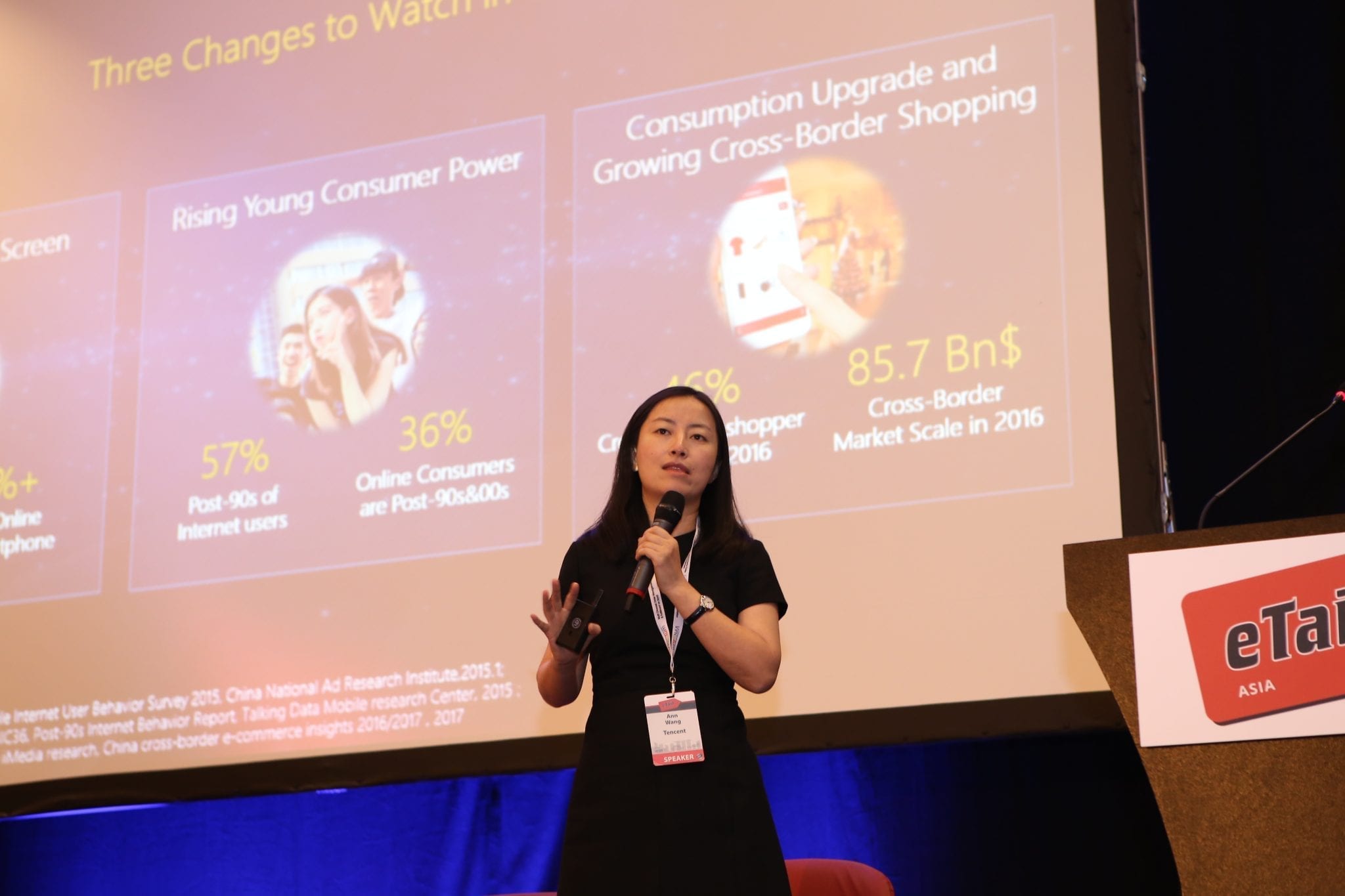
Speaking today at eTail Asia 2017, a leading platform to help online retailers in Asia build a successful ecommerce business, Ann Wang, General Manager of Performance Advertising Solution, Online Media Group, Tencent, shared insights into China’s unique Internet market environment and consumer behaviors. Wang revealed the Tencent platform’s strength and offered three pieces of advice to help ecommerce companies win in China as the country shifts toward a consumption upgrade.
In China, 90% of Internet users access the Internet via smartphone, and more than 75% shop online via smartphone. The ongoing consumption upgrade is further stimulating the development of China’s ecommerce market, particularly overseas online shopping. According to statistics, the total volume of cross-border online shopping in China reached US$85.7 billion in 2016, while the number of cross-border online shoppers grew 46% in the same year. The growth of ecommerce in the post-1990s and early 2000s is the main force behind the huge rise in overseas online shopping.
According to Mary Meeker’s Internet Trends 2016, Chinese mobile users spend more than 55% of their online time on Tencent platforms, including QQ, Qzone, WeChat, v.qq.com and Tencent News. With its focus on social interactions and content, Tencent has built a self-sustained ecosystem, powerful data capabilities and holistic scenarios for quality communications among its users.
According to Wang, Tencent provides more open, connected data, which links ad exposure to brand attitudes, consumer behavior and sales. Tencent’s algorithms also help marketers engage consumers across scenarios, and elevate pertinence by dynamic and contextual messages, allowing them to reach the broadest coverage of Chinese netizens.
In her speech, Wang offered three valuable tips for marketers, which she believes can help global brands build a successful business in the increasingly dynamic China market:
Build a mobile-first ecosystem: Use all the tools available, including online ecommerce platform solutions, payment services and customer management to set up a mobile-oriented business ecosystem.
Go with an integrated marketing approach. Wang suggests marketers partner with a fully integrated platform to get the best of both brand advertising and performance advertising. One good example is Tencent’s co-creation of blockbuster IP with a popular cosmetics brand. The brand’s target audience loves to watch super-realism dramas and movies, worships movie stars, and are willing to consume and spend. Partnering with Penguin Pictures’ self-produced series “Revive,” the cosmetics brand made the leading actress its endorser and incorporated the brand appeal where appropriate. At the same time, it encouraged fans to try out its product used by celebs in the series. What’s more, it hosted offline celebrity meet-up sessions, thus winning the hearts of many fans. After only seven episodes, its Tmall store’s daily sales volume increased 400%.
Use the power of online marketing to boost traffic in offline stores. When a luxury automotive brand opened new stores in Hangzhou, it launched geo-targeted ads through WeChat Moment. Both the number of customer information acquisitions and store visits increased significantly as a result of the campaign.
eTail Asia is the region’s premier event for senior eCommerce and Multichannel Directors of leading retailers. Each year, Asia’s biggest names attend to network and get a 360° perspective on the most pressing challenges and opportunities in digital retail. Also speaking at the event this year were representatives from Google, L’Oreal, Adidas, and Philips, to name just a few.
Local consumers say global giants like Amazon and eBay offer a wider range of products and better return policies. Vietnamese online shoppers spend significantly more on overseas purchases than they do domestically as they believe international e-commerce platforms offer better products and service quality, a new report has said.
The report, from the Vietnam E-commerce Association or VECOM, said that many global retailers like Amazon and eBay have made it easier for Vietnamese consumers to buy online.
“Meanwhile, a majority of Vietnamese e-businesses, especially small- and medium-sized companies, have yet to make significant investments in market research catering to consumers,” said the report.
Local online shopping sites are less competitive in terms of product diversity and quality, return policy, and order placement costs, the report highlighted.
“I shop on both eBay and Amazon,” Quoc Hung, areader said in a comment. “I can just send a product back if I don’t like it.”
Most Vietnamese online businesses don’t offer free delivery and free return, another reader pointed out.
Chinese online retail giant Alibaba is also attracting more Vietnamese customers. Internet company OSB, Alibaba’s authorized agent in Vietnam, said the company’s customer base in Vietnam has expanded to 500,000 after sharp increases over the past three years.
The online shopping trend is growing rapidly in Vietnam, where 30 percent of the population will be buying goods and services over the internet by 2020, according to the Vietnam E-Commerce and Information Technology Agency.
The agency, run by the Ministry of Industry and Trade, said revenue from online retail is expected to account for 5 percent of the country’s retail market in 2020, up from only 2.8 percent in 2015.
Vietnam’s e-commerce market, which has one of the world’s fastest growth rates, jumped 37 percent in 2015 to around $4 billion, based on government statistics.
The growth rate is about 2.5 times faster than that in Japan, based on some estimates by industry experts.
Southeast Asia-focused eCommerce startup Lazada, which Alibaba purchased a controlling stake in last year, may soon face some stiff competition from eCommerce giant Amazon.
For now, eMarketer pointed out, Lazada Group dominates the eCommerce activity and web traffic in the markets it serves, which includes mainly in Indonesia, Malaysia, the Philippines, Singapore, Thailand and Vietnam.
Last December, Lazada’S online properties attracted the largest number of page views among B2C retail sites in Thailand, Indonesia, Singapore, Malaysia and Vietnam, data from SimilarWeb confirmed.
However, eCommerce estimates point to an expected growth by double digits for online B2C spending in Southeast Asia through 2020, which is sure to attract more competitors for Lazada.
Amazon is reportedly considering a launch in Southwest Asia sometime this year, eMarketer stated, starting with Singapore.
Chinese companies are also setting their sights on Southeast Asia as a new market for growth, especially considering the region is home to nearly 620 million people.
According to a report last year, companies like Alibaba, Tencent, Didi Chuxing and JD.com, are expanding in Southeast Asia, moving beyond the slowing economy in China.
WSJ noted Alibaba and Tencent have led deals with a value of $1 billion combined to expand their businesses in Southeast Asia, which is the third-largest region for technology mergers and acquisitions by Chinese technology companies in 2016. The deal values combined were $1.9 billion compared to $193 million in the year earlier, WSJ reported, citing data from Dealogic. What’s more, industry watchers said in the report they think that investments on the part of Chinese tech companies will accelerate next year.
“What we have learned in China, we can apply the fastest in Southeast Asia,” Poshu Yeung, Tencent’s vice president of its international business, said in the report. “Everything in Southeast Asia, particularly in Indonesia, you will experience a pretty good growth rate.”
EMarketer is projecting that the number of smartphone users will surpass 257 million by 2020, presenting a big opportunity for companies. What’s more, the incomes in the region are growing at the same time smartphone ownership is, noted the report.
Zalora Group CEO, Parker Gundersen, has denied rumour that says the company is selling its Indonesia operation to local firm Mitra Adiperkasa (MAP Group)
Last week, there was a speculation that Zalora was withdrawing from Indonesia following a share acquisition of Zalora Philippines by Ayala Group.
“The rumour that we are selling off our business in Indonesia is certainly not the case. And we announced a deal that’s actually very exciting – an investment from Ayala Corp into Zalora Philippines – which is in no way a signal of a retreat from the country, but more of a commitment,” Gundersen told this portal.
But why did the rumour surface in the first place? Had there been actual talks about possible investments from MAP Group?
Gundersen declined to comment. Right now, he said, discussions with MAP are only related to how Zalora could continue adding more brands from MAP’s large portfolio. The two companies have been working together with MAP as a supplier.
“We are not retreating from Indonesia nor the Philippines,” stressed Gundersen.
In 2016, Zalora sold its businesses in Thailand and Vietnam to conglomerate Central Group. When news about stake sale in Zalora Philippines and rumour on Indonesia exit emerged, it led to a speculation that Zalora had continued its retreat from the region. Gundersen denies this narrative, saying that the Philippines share sale was very different to what it had done in Thailand and Vietnam.
“Our investors looked at the operations in Thailand and Vietnam (like they always do, regularly), and decided that it did not have the best outlook. Whereas in the Philippines is very different because we remain the majority. It just made sense to us to have a local partner in the Philippines,” he explained.
Will Zalora implement the same partnership strategy in Indonesia, as it has now with Ayala? It is always a possibility that the company would always explore, Gundersen said.
Indonesia, in particular, is a massive market for e-commerce, with high social media and smartphones usage, coupled with growing income. Gundersen reiterated that Zalora is committed to bring more brands – local, international, and in-house – that are more relevant for its Indonesian customers.
The company is also on the lookout for ways to improve its services, particularly in payments, a sector which Gundersen called “very interesting” to watch.
“Definitely the space that we want to watch – anything that can help make it easier for our customers to make a purchase we want to be involved. It’s still early days but definitely we want to monitor close,” Gundersen said, when asked about a possibility to partner with local fintech companies.
Indonesian e-commerce industry has grown in two-digits annually over the past five years, according to a number of reports. This year, e-commerce transactions in the country are expected to reach $45 billion from an estimated $30 billion in 2016. While the opportunities are abundant, the competition is fierce.
A few months earlier, local firms Berrybenka and SaleStock were reported to have laid off hundreds of their employees. While smaller firms are gasping for breath, giants like MatahariMall.com and Lazada are steadily marching forward. Last year both companies received major funding from global investors, with MatahariMall snatching $100 million from Mitsui (and at least another $25 million from Matahari Department Store) and Lazada pocketing $1 billion from Alibaba.
Experts have projected that competition will start to sharpen even further – especially if US giant Amazon decides to enter Indonesia – and will force smaller firms to consolidate.
“The size of Vietnam’s e-commerce market may reach $10 billion within the next five years,” he added.
Ms. Dang Thuy Ha, Chief Representative at market researcher Nielsen in Hanoi, said the e-commerce market was worth up to $4 billion last year.
Of Vietnam’s 91 million people, she said, 45 per cent access the internet and 28 per cent use e-commerce.
Each person spends $160 a year on shopping via e-commerce platforms. Therefore, growth in e-commerce is 22 per cent, according to Nielsen’s report.
The report also notes that the number of people using smartphones has increased sharply, giving a boost to e-commerce.
Thirty-two per cent of enterprises have set up business relations with foreign partners through online channels and 11 per cent have participated in electronic trade floor and website activities, according to a VECOM report.
Ms. Tran Thi Phuong Lan, Vice Director of Hanoi Industrial and Trade, said that retail revenue via e-commerce in the capital stood at VND30 trillion ($1.3 billion) last year, representing 6 per cent of total retail revenue and up 15 per cent against 2015. More than 5,600 e-commerce websites are registered in Hanoi.
VOBF 2017 had five sessions: Overview, Cloud Technology and Mobile Phones with E-commerce, Omni Channel, Cross Border E-commerce, and Online Startups. The Vietnam E-commerce Index 2017 was also released.
This is the first time the Forum has been held. Speakers included representatives from the Vietnam E-commerce and Information Technology Agency, Nielsen, Google, Facebook, Vietnam Post, Verisign, and Lazada.
Attendees had the chance to meet with representatives from Z.com, VeriSign, Matbao, Bizweb, Gimasys, TrustPay, Interspace, Netnam, and iNet. The special features of startups in the sector was also discussed.
VOBF 2017 will be held in Ho Chi Minh City on March 3.
Southeast Asian fashion ecommerce company, Zalora, has been in the process of shutting shop in a few Asian countries. The company had retreated from Thailand and Vietnam last year, and is pulling out from Philippines and Indonesia.
Launched in 2012, the Rocket Internet backed online shopping company was functioning in Malaysia, Singapore, Brunei, Hong Kong, Taiwan, Philippines, Vietnam, Thailand, Indonesia, Australia, and New Zealand, managed by Global Fashion Group, which was developed by Rocket Internet to handle all its online fashion businesses across the world.
In Philippines, 49% of Zalora’s parent company, BF Jade E-Services was bought by one of the oldest real-estate companies, Ayala Group, and the remaining stays with Rocket Internet. BF Jade E-Services owned and operated Zalora in Philippines and the deal is currently subjected to approval from the Philippine Competition Commission.
e27 also states that the fashion ecommerce company is in talks with retail giant MAP Group for a similar acquisition or investment in Indonesia. MAP group operates more than 1,900 retail outlets in Indonesia and has been experimenting with e-commerce as it launched its MAP e-Mall last year. A merger or acquisition with Zalora could mean that it gets access to the online fashion giant’s ecommerce expertise, as per media speculations.
Romain Voog, CEO, Global Fashion Group said in a statement, “We are proud of how Zalora Philippines contributed to the development of e-commerce and fashion in the Philippines. This partnership with Ayala will allow us to further strengthen the leadership position of Zalora Philippines, as we invest more into delivering the best online fashion shopping experience for Filipino consumers.”
In April last year Zalora sold its Thailand and Vietnam businesses to fashion retailer Central Group which also had been wanting to foray into the online ecommerce business. As reported by Forbes, the move was made to streamline its services in light of slowing output and the high cost of customer acquisition in Southeast Asia.
Jaime Augusto Zobel de Ayala, Chairman and CEO, Ayala Corporation also added, “We see the potential of e-commerce in the country and believe that the Ayala group can benefit and add tremendous value to Zalora. With resources in banking, real estate and telecommunications, the investment presents new opportunities for Ayala to generate synergies throughout the e-commerce value chain.”
Manhattan Associates today announced that Castlery, the Singapore-based online furniture retailer, has selected Manhattan SCALE as a key component of a business transformation programme to build a world-class order fulfilment capability that will ensure a seamless service experience for customers and drive ongoing business growth.
Launched in 2013 with a mission to make designer furniture accessible to everyone, Castlery has quickly established itself as a leading furniture and homewares designer in Southeast Asia. In order to meet its target of over 100 percent year-on-year growth, Castlery recognised it needed to invest in an order fulfilment technology that would scale in line with its business growth, ensure service level improvements for customers and drive future sales and margin expansion.
Castlery selected Manhattan SCALE for its ability to handle the unique logistical challenges associated with furniture retailing and distribution and its proven track record supporting ecommerce and omni-channel operations around the world. With a pressing need to be set up before the peak sales season, Castlery needed the Manhattan fulfilment platform to be live and ready for one of its busiest times of the year. Working closely with the Manhattan team, Castlery successfully completed the solution deployment at its Mapletree Logistics Hub in Toh Guan, Singapore, in under three months, remarkably fast for a first implementation.
Zhou Zhiwei, Chief Technology Officer at Castlery, commented: “As the leader in the Gartner Magic Quadrant for Warehouse Management Systems (WMS) and with many companies we admire already using SCALE, Manhattan ticked many boxes. Their experience with solving problems like ours, high calibre teams, and flexible solutions made picking Manhattan as our partner an easy decision.”
Travers Tan, Chief Operating Officer at Castlery, added: “Since the solution has been deployed, process execution has improved across our entire distribution operation. We’ve hit 99.99 percent inventory accuracy and seen a 23 percent month-on-month increase in order transactions. We now have a complete view of inventory across the distribution network whilst our order-to-delivery cycle times are compressed significantly. Also, the solution is fully integrated with our ERP system, giving us a “live” picture of available inventory for sale and enabling accurate lead-times to be reflected on our website. Because the system can support multiple DCs, it is perfectly suited to our future plans for expansion into overseas markets. The Manhattan solution’s capabilities support our vision to become the leading furniture e-retailer globally.”
Richard Wright, Managing Director, Southeast Asia, at Manhattan Associates, commented, “Manhattan provides the expertise and technology to help clients deliver on their brand promise. We’re delighted to see Manhattan SCALE already driving order volume growth for Castlery and are confident that Castlery will continue reaping the rewards from our constantly evolving solutions for many years to come.”
FedEx will expand its global e-commerce business in an effort to compete for the growing number of packages shipped to consumers from China and Japan, executives said Monday.
The company, which in 2014 acquired Bongo International, a company that helps shoppers purchase goods from foreign retailers by automatically adjusting currencies, and customs and shipping costs, by location, is rebranding the business as FedEx CrossBorder. The company plans to expand its services to merchants in China and Japan by next June, said Chip Hull, vice president of the newly named division. The company already consolidates shipments for global e-commerce retailers in the U.S., Europe and Peru.
Asia “is the second-largest region from an export perspective in the cross-border space, on par with Europe, and is growing at a faster rate,” Hull said. As global e-commerce grows at double-digit rates around the world, “Asia is certainly the 800-pound gorilla in the room.”
FedEx’s international e-commerce efforts have come as other companies are investing in helping retailers with international online-shopping services. United Parcel Service acquired i-Parcel around the same time that FedEx bought Bongo, and Pitney Bowes acquired Borderfree last year. Deutsche Post AG’s DHL also offers international e-commerce services.
Last Mile Fulfilment Asia (LMFAsia), the region’s premier trade show for the retail, ecommerce, logistics and parcel industries, returns with the third edition on 2 to 3 March 2017. Themed “Go Global, Deliver Local”, the event aims to drive and strengthen a borderless fulfilment process, where in-market industry players fortify their business locally whilst expanding their foothold in the region through perfecting the last mile beyond borders.
Amidst a backdrop of economic uncertainties today, Southeast Asia ecommerce market continues to grow to 16 times and will reach $88 billion by 2025 . The two-day conference and exhibition, organised by SingEx Exhibitions will deep-dive into the need to tap on the potential growth of ecommerce, and optimise the cross border fulfilment and delivery processes.
The multi-track conference component of the trade show will focus on evolutionary topics such as turning fulfilment challenges into opportunities, designing cross-border fulfilment solutions across Asia. In recognising that the last mile of the fulfilment process costs almost 28 per cent of total cost of moving goods , achieving cost efficiency through innovative logistics solutions will be key to amplify the ecommerce market that is already expanding at rapid speed in the region. According to Frost & Sullivan, the global B2B ecommerce market alone will reach US$6.7 trillion by 2020. The 2017 conference will feature a new track “The Future of ecommerce is B2B ecommerce”, in which industry speakers from renowned retail, ecommerce and logistics leaders will share keynotes, highlighting the potential wins of adapting a successful B2C model into the B2B segment to conduct ecommerce business in a similar fashion.
Separately, the exhibition component of Last Mile Fulfilment Asia will offer a convenient business matching platform for innovative companies to meet potential business partners, and showcase products and technologies that add value in the delivery chain. There will be three thematic zones dedicated to specific solution categories ranging from last mile, fulfilment centres, warehousing to automation.
Adrian Sng, general manager of SingEx Exhibitions said, “Industry giants from China and US are pursuing significant ecommerce market shares in Asia and it will be a challenging year with headwinds affecting many in the fulfilment business. In order for companies to gain a competitive edge, there is a need to leverage technology to advance and conquer the last mile. This year’s overarching objective will be to bring this to the forefront. Through our focused strategy of curating trade events in emerging markets and industries with high-growth potential, Last Mile Fulfilment Asia will be a driving force for change that will see ecommerce and the fulfilment business playing a much more significant role in the region.”
Charles Brewer, chief executive officer of DHL eCommerce, who will be sharing during the conference on leveraging opportunities presented in cross-border ecommerce, acknowledges the game-changing benefits last mile fulfilment will bring. “Perfecting logistics is the key to delivering the best ecommerce experience and a great chance to deliver a smile in the last mile. I am looking forward to sharing and connecting with other ecommerce players at the conference to discuss latest trends in this very exciting industry.”
Joseph Yuen, board chairman of the Hong Kong federation of ecommerce and managing director of China Post Trade Development Company Limited, will also be speaking during the conference on paving the way into doing business in China through “11.11” case study. “Technology brings businesses closer to each other and around the world, but successful cross border ecommerce does need a mastery in the difference in culture, trade practices, government policy and others. On this note, Last Mile Fulfilment Asia 2017 provides a great opportunity for industry stakeholders to catch up with the latest trends and solutions in cross-border ecommerce.”
The online retail market in China is booming, as are sales of perishables. Ahead of the curve is Tmall (part of the Alibaba Group) which, through Tmall Fresh and Mr. Fresh, has created some of the first B2C platforms that caters for fresh produce online sales and delivery.
Alibaba’s Tmall is the biggest domestic online B2C retailer. It is a platform for international and Chinese brands to sell goods directly to consumers in Mainland China, Hong Kong, Macau and Taiwan, and has a reach of millions of consumers. Tmall Fresh is the organisation’s new portal for perishable products.
Usually, due to high subscription costs, only large brands have online ‘flagship stores’ on Tmall and Tmall Fresh. Tmall Fresh currently only hosts Chinese online stores. Most of the existing flagship stores are importers or large distributors, that have been selling products on Tmall in the past before switching to Tmall Fresh.
Tmall Fresh and Mr. Fresh
“Tmall Fresh has been launched to meet the growing demand for fresh produce. It is becoming the online sales channel for perishables in China. Products include seafood, meat, dairy and, increasingly, fresh fruits,” says He Chunlei, CEO of Tmall Fresh.
To assist rookie foreign fresh produce exporters in overcoming difficulties that come with market entry, Mr. Fresh was introduced alongside Tmall Fresh.
Mr. Fresh is an online flagship store for foreign products on Tmall Fresh, entirely run by the Tmall Fresh Team. It aims to support foreign brands entering China. Mr. Fresh takes care of customers, marketing, sales, logistics and customer services. As such, it provides foreign suppliers with a low-cost entry to the Chinese market, whilst also avoiding the investment costs it takes to open a store on Tmall.
Supporting foreign exporters
“For foreign fruit exporters, Tmall offers two solutions. Foreign exporters can either cooperate with Chinese flagship stores, and sell their products through these existing portals on Tmall Fresh. Or, the second option, is that foreign exporters can join Mr. Fresh. Through cooperation with Mr. Fresh, foreign fruits can easily be sold into the Chinese market. We introduced the concept to solve trade barriers that foreign companies are facing entering China as a new market. The idea is that, after having sold their products on Mr. Fresh for a couple of years, foreign exporters are well positioned to open a flagship store on Tmall Fresh,” according to He Chunlei.
“Mr. Fresh is designed to meet both the needs of the supplier and the consumer. Fruit varieties that are currently sold are New Zealand kiwifruit, Thai durian, Chilean cherries and Vietnamese mangoes. Our mission is to help foreign companies enter the B2C market in China by providing them with a complete solution package. At the same time, we provide the consumer with product and company information. We use our sales data and marketing information to help our suppliers understand the needs and preferences of Chinese consumers. The market for online fresh produce sales is growing at 7% a year. So far, fruits make up a small share of total sales of perishables, but we see huge potential.”
PMA Fresh Connections China
From March 15 to 17, the PMA Produce Marketing Association (PMA) is organising Fresh Connections China, a yearly summit taking place in Shanghai. He Chunlei, CEO of Tmall Fresh, will be one of the speakers at the conference organised on the second day.
Automakers have been dabbling in the ride-sharing industry, but Uber remains the titan to beat. In true “Power Rangers” fashion, two automakers are reportedly forming a Megazord of ride-sharing in order to bring the fight to Uber’s doorstep.
BMW and Daimler may combine their ride-sharing efforts to better compete with Uber, citing sources speaking to Germany’s Manager Magazin. BMW operates DriveNow (called ReachNow in the US), and Daimler runs Car2Go, both of which have achieved some success in the US, but not enough to tackle Uber.
In addition to that pairing, the companies are reportedly considering adding other mobility services into the fold. Back in July, Daimler merged its Mytaxi service with Hailo, another cab-hailing startup. Daimler also operates Moovel, which includes a booking and payment system for various mobility services. BMW also operates ParkNow and ChargeNow. It’s reasonable that many of these operations could be lumped together under the same name.
Neither BMW nor Daimler immediately responded to a request for comment.
Uber has been on a tear lately. It finally worked with cities to get ride-sharing pick-ups and drop-offs at certain airports. It’s also dabbling in autonomy, most recently rolling out some self-driving Volvos in San Francisco, but the legality of that arrangement is still up in the air. But it’s not all flowers and gentle breezes with the ride-sharing titan, which constantly finds itself the subject of some gnarly lawsuits.
Last year, e-commerce revenues increased to $5 billion, accounting for about three per cent of the total retail trade and services revenue.
It has become an indispensable extension for businesses as a rapidly growing country with growing Internet connectivity deepens its global integration process.
The development of multi-channel businesses that combines physical stores with an online presence has become an inevitable trend.
Viet Nam has a gross domestic product (GDP) growth rate of more than six per cent per year. Internet connectivity is growing by 50 per cent plus every year. Online marketing revenues in the country increased from US$26 million to nearly $330 million in the 2010-2015 period.
It is not surprising that with these advantages, the nation’s e-commerce market has witnessed the entrance of large players in the last few years.
The Vingroup officially stepped into e-commerce in 2015 with its Adayroi trading floor. Earlier, several savvy entrepreneurs had launched online shopping websites that became popular, like sendo.vn, nguyenkim.com, tiki.vn, zalora.vn and lazada.vn.
The South Korean Lotte Group also entered e-commerce market in Viet Nam last year with its lotte.vn website. It was followed soon by Japan’s largest retailer Aeon, which launched aeoneshop.com at the beginning of this month.
Given their brand prominence and their large story systems, aeoneshop.com and lotte.vn are expected to offer stiff competition to sites like lazada.vn and tiki.vn that currently dominate the domestic market.
Tran Trong Tuyen, general secretary of the Viet Nam E-commerce Association, told the Hai Quan (Customs) online newspaper recently that in the past, it was important for businesses to open their stores at a good location, but the situation has changed with 40 million Internet users having the option to buy things online.
“If retail companies do not invest properly in e-commerce, they will gradually lose customers,” Tuyen said.
The newspaper also quoted Trinh Van Hoa, director of the Nguyen Kim E-commerce Centre, as saying that the centre studied customer’s shopping habits and understood that they were looking for multi-business shopping facilities.
Its focus on providing the most convenient shopping solutions for customers has seen the company grow rapidly in recent years, she said.
The growth of the company, accordingly, also increased several times compared to the previous years, she said.
Impressive figures
E-commerce revenues in Viet Nam reached $4.07 billion in 2015, a 37 per cent year-on-year increase. It also accounted for about 2.8 per cent of total retail trade and services revenue.
Last year, e-commerce revenues increased to $5 billion, accounting for about three per cent of the total retail trade and services revenue.
The popularity of Online Friday, a mega sales event held every December, has soared, with last year’s sales of VND664 billion, triple that of the previous year.
These figures show that the nation is well placed to meet its e-commerce targets. The 2016-2020 e-commerce master plan envisages $10 billion in business-to-consumner (B2C) turnover by 2020, accounting for five per cent the country’s total retail sales.
Despite the rapid growth and enormous potential, the e-commerce market share of Vietnamese enterprises was still modest, Tuyen remarked.
He said that even though famous names like Tiki and Sendo had millions of users and tens of thousands of orders per day, they were limited to the national scale, and although e-commerce revenue in 2015 was five times that of 2012, the Vietnamese market, had yet to match world leaders.
In the US, e-commerce transactions accounted for five per cent of total retail sales, and it was 9-10 per cent in China, and about three per cent in Viet Nam.
Shopping trends
Market research firm Nielsen recently released the results of an online survey covering 63 countries
It found more than six out of ten (64 per cent) Vietnamese consumers purchased fashion products online.
More than half the Vietnamese respondents said they purchased books, music and stationery products (51 per cent) and 47 per cent said they bought travel products or services online.
Four in 10 respondents (40 per cent) said they purchased personal-care and beauty products online.
About one-fourth (26 per cent) said they placed online orders for babies and infants; an equal number ordered meal-kits or restaurant deliveries and one-fifth ordered packaged groceries online.