Tag: Fonterra

  • Fonterras Positive Momentum Continues with $1.5B Q3 Operating Profits Despite Global Uncertainties

    Fonterras Positive Momentum Continues with $1.5B Q3 Operating Profits Despite Global Uncertainties

    New Zealand-based dairy cooperative, Fonterra, is exuding optimism about its future performance amid global uncertainties. The company’s third quarter results showed a promising $1.5 billion in operating profits, marking an impressive year-on-year increase of $85 million.

    Fonterra’s Stellar Performance

    Richard Allen, Fonterra’s CEO, proudly announced this significant achievement, describing the results as another demonstration of their strength. Despite the disruption of global supply chains, the company has seen a substantial rise in milk production this season. The organization’s sales book is well contracted, and its shipping volumes have been robust, recording the highest third-quarter shipment volumes in the past decade.

    Allen became the CEO succeeding a 25-year veteran, Miles Hurrell, who declared his retirement in December. Looking forward, Allen expects the company’s high milk collections to persist, much like the current season.

    “Our in-market sales teams foresee robust demand from across all regions amid possible fluctuations. This expectation is mirrored in our opening forecast range,” Allen stated.

    Resilience Amid Challenges

    Despite the approaching final quarter of the financial year, Allen expresses confidence in the company’s ability to maintain its momentum. He acknowledges the uncertainty prompted by the ongoing conflict in the Middle East and other global challenges, such as cost inflation and shipping disruptions.

    “Like our farmers and many others worldwide, we are navigating these challenges. However, we are confident that our deep relationships with customers and logistics partners will continue to assist us in overcoming these obstacles,” he commented.

    Questions & Answers

    What is Fonterra’s latest operating profit?
    Fonterra reported a $1.5 billion operating profit for its third fiscal quarter, growing its profits by $85 million year-on-year.

    What challenges is Fonterra facing?
    Fonterra is dealing with global challenges such as cost inflation, shipping disruptions, and uncertainties caused by the ongoing conflict in the Middle East.

    Despite the challenges, how does Fonterra view its future performance?
    Fonterra is optimistic about its future performance. The company expects to maintain its strong momentum, anchored by high milk collections and robust demand from all regions. They also express confidence in their deep relationships with customers and logistics partners that will help them navigate the current global challenges.

  • From MyMilk Founder to Fonterra CEO: Richard Allen to Guide Dairy Giant Towards Strategic Transition

    From MyMilk Founder to Fonterra CEO: Richard Allen to Guide Dairy Giant Towards Strategic Transition

    Fonterra, the world’s foremost dairy exporter, has concluded its internal hunt for a new Chief Executive Officer (CEO) by naming the veteran employee, Richard Allen, as successor.

    Richard Allen: The New CEO of Fonterra

    Richard Allen, who started his career path at Fonterra as a graduate in 2008, has recently held the position of president of global ingredients. His promotion comes in the aftermath of Miles Hurrell’s resignation in December of the previous year.

    Peter McBride, the Chairman of Fonterra, expressed the board’s satisfaction with the appointment. He emphasised that Allen is primed to steer Fonterra into the next stage of its strategic execution.

    During his tenure at Fonterra, Allen has accumulated a diverse portfolio of experiences. He managed Farm Source, the company’s farmer-oriented business, for five years and operated in China as the vice president of the food service sector. Further, Allen was the initial CEO of MyMilk, and more recently, he functioned as the president of Atlantic, located in Chicago. In this role, Allen was responsible for managing relationships with several of Fonterra’s crucial global clients.

    Transition and Future Plans

    On May 1, Allen will assume his new role as CEO. Hurrell will remain with Fonterra as an advisor until September, ensuring a smooth transition.

    Allen expressed his anticipation for his new appointment, acknowledging the significant impact Fonterra has not only on farmers in New Zealand but also on its international customer base. He pledged his commitment to maintaining the positive trajectory in company performance, the focused execution of strategy, and the financial discipline fostered over recent years.

    Questions & Answers

    When did Richard Allen start his career at Fonterra?
    Richard Allen joined Fonterra in 2008 as a graduate.

    What are some of the roles Richard Allen has held at Fonterra?
    Allen has held various positions during his tenure at Fonterra, including leading the farmer-facing business Farm Source, serving as vice president of the foodservice business in China, being the founding CEO of MyMilk, and most recently, acting as president of Atlantic in Chicago.

    When will Richard Allen officially assume his new role as CEO of Fonterra?
    Richard Allen will commence his role as the CEO of Fonterra on May 1.

  • End of an Era: Fonterra’s CEO Miles Hurrell Set to Bid Adieu After 25-Year Tenure

    End of an Era: Fonterra’s CEO Miles Hurrell Set to Bid Adieu After 25-Year Tenure

    Miles Hurrell, the Chief Executive Officer of Fonterra, will be ending his tenure in December after serving the corporation for 25 years.

    Hurrell’s Journey in Fonterra

    Mr. Hurrell was appointed as the co-operative’s CEO in 2018, a period that marked a significant revamp in the organization’s financial performance and the rebuilding of trust with its farmer partners. His strategic focus was primarily on New Zealand-sourced milk, a shift from Fonterra’s previous international expansion approach.

    Under the stewardship of Hurrell, the team accomplished more than what was expected. According to Fonterra’s Chairman, Peter McBride, Hurrell’s leadership played a vital role in aligning the team with a common objective and enhancing the overall business performance, thereby laying a solid foundation for Fonterra’s future endeavours.

    Leadership Transition

    Mr. McBride stated that Hurrell had given a notice period of six months, allowing sufficient time for a well-planned transition of leadership. He mentioned that the discussion of succession is a regular part of board and management meetings, reflecting good governance practices.

    McBride also expressed confidence in the board’s ability to carry out a fair and rigorous selection process to appoint the new CEO in the forthcoming months.

    Fonterra’s Recent Business Ventures

    In other recent developments, Fonterra announced last week that the sale of its Mainland consumer business is on track to be finalized within the month as the deal has now become unconditional.

    Questions & Answers

    What has been the focus of Miles Hurrell’s strategy as CEO of Fonterra?

    Hurrell’s strategy was primarily focused on promoting New Zealand-sourced milk, deviating from Fonterra’s past focus on international expansion.

    What is the process for selecting the new CEO of Fonterra?

    The selection of the new CEO will be carried out through a robust and rigorous selection process by the board and management in the coming months.

    What is the recent business venture of Fonterra?

    Fonterra recently announced that the sale of its Mainland consumer business is set to be completed within the current month.

  • Final Countdown for Fonterra’s Multi-Billion Dollar Mainland Sale to Lactalis: Unconditional Deal Set for Imminent Closure

    Final Countdown for Fonterra’s Multi-Billion Dollar Mainland Sale to Lactalis: Unconditional Deal Set for Imminent Closure

    Fonterra, the New Zealand-based co-operative, has announced that it is on the cusp of finalising the sale of its Mainland consumer business. As of now, the deal has met all the necessary conditions and is set to conclude within the current month.

    Regulatory Approvals Secured

    Fonterra has assured that all mandatory regulatory approvals have been obtained, paving the way for the successful separation of the business. The company initially disclosed plans to sell its global consumer and associated businesses, collectively known as the Mainland Group, to French dairy giant Lactalis in August of last year.

    The Mainland Group encompasses a range of popular brands, including Mainland, Anchor, Perfect Italiano, and Anmum.

    Price Adjustment

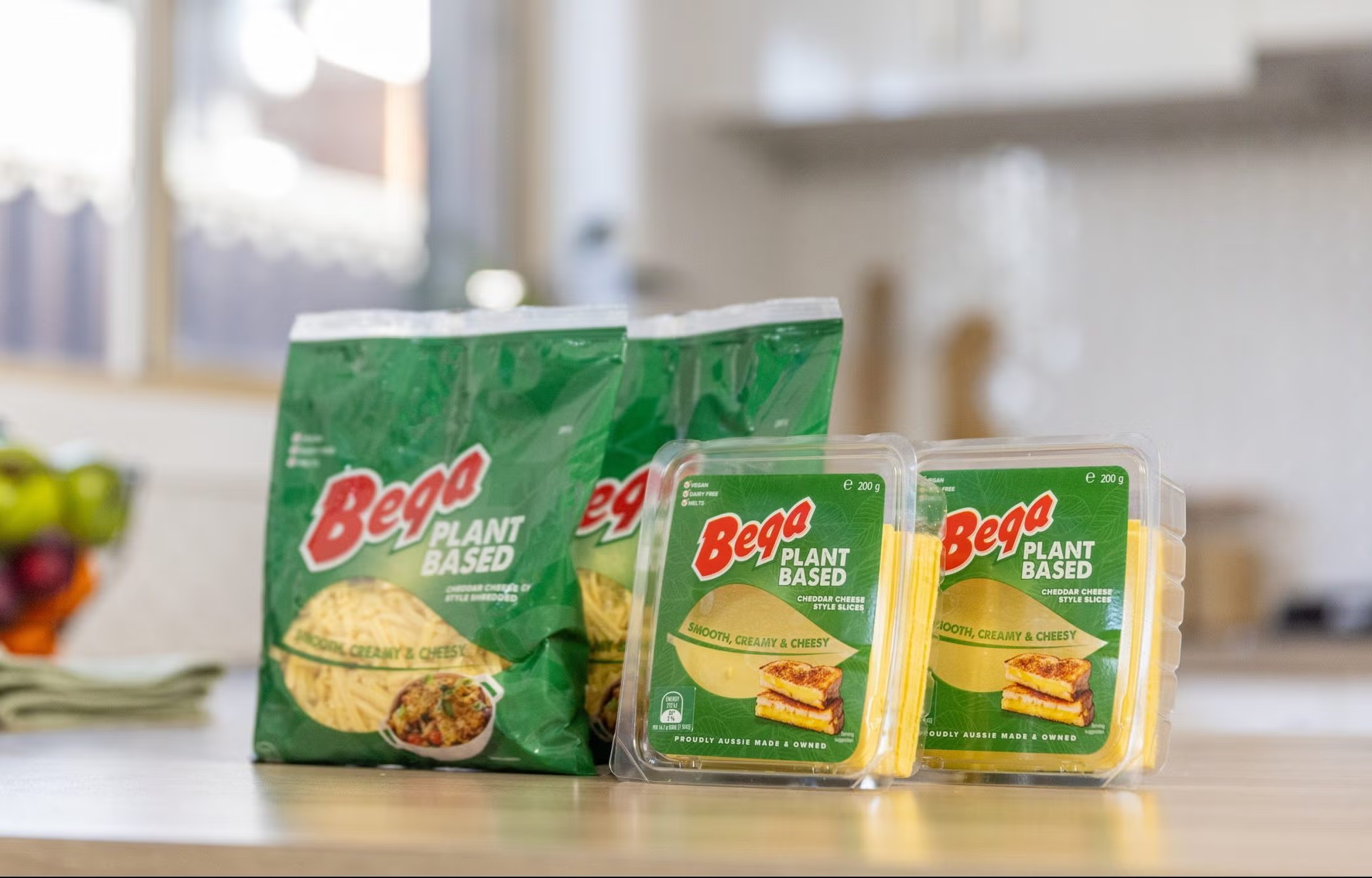
    Originally, the deal was valued at NZ$3.845 billion, but an agreement with the Bega Group to incorporate the Bega licences into the divestment process led to an increase in the price to $4.22 billion.

    The proposal met with approval from Fonterra’s farmer shareholders, who voted in favor of the transaction last October.

    Transaction Conclusion

    “With all terms of the sale fulfilled, Fonterra and Lactalis are set to finalise the transaction,” stated Fonterra. It anticipates the completion of the transaction by the end of the current month, with the record date for the capital return expected on April 9 and the payment date slated for April 14.

    Questions & Answers

    What is the Mainland Group?
    The Mainland Group refers to Fonterra’s global consumer and associated businesses. It includes brands such as Mainland, Anchor, Perfect Italiano, and Anmum.

    What led to the increase in the deal price from NZ$3.845 billion to $4.22 billion?
    The price of the deal was increased following an agreement with the Bega Group to include the Bega licences in the divestment, leading to a rise in the overall value of the transaction.

    When is the transaction expected to be finalised?
    Fonterra anticipates the completion of the transaction by the end of the current month. The record date for the capital return is expected to be April 9, followed by the payment date on April 14.

  • Fonterra Farmer Shareholders Green-Light $4.22 Billion Consumer Division Sale to Lactalis

    Fonterra Farmer Shareholders Green-Light $4.22 Billion Consumer Division Sale to Lactalis

    Fonterra’s farmer shareholders have granted approval for the company’s proposal to divest its consumer products division. The Mainland Group and its associated businesses are set to be sold to Lactalis for a sum of $4.22 billion.

    High Support for Divestment

    A resounding 88.47% of farmer shareholders voted in support of this divestment decision in a special virtual meeting. The company asserts that this level of shareholder support exemplifies one of the core principles that sets Fonterra apart from other processors in the market.

    Fonterra Chairman Peter McBride voiced his appreciation for the active participation of the farmer shareholders throughout the decision-making process. Since the exploration of divestment options was initiated in May of the previous year, and especially over the past few weeks when the full details were made available, there has been a significant uptick in discussion and engagement from the farmers.

    McBride commented on the strategic implications of the divestment, stating, “We have thoroughly examined our strategic context, our strengths, and the way we create value for our farmer owners as a cooperative. This divestment will result in a more simplified and focused business, the value of which cannot be overstated.”

    To approve the sale, Fonterra required more than half of the total votes, a condition that was met with ease due to the high percentage of votes supporting the divestment.

    Final Steps and Future Investments

    The divestment process of Mainland Group’s business from Fonterra is now pending regulatory approvals. These approvals are currently underway, and the completion of the transaction is expected to occur in the first half of the coming year.

    In addition, Fonterra has revealed plans to make a significant investment in its dairy operations. The company intends to allot NZ$75 million ($66 million) towards expanding butter production at its Clandeboye site located in South Canterbury.

    Questions & Answers

    What percentage of Fonterra’s farmer shareholders voted in favour of the divestment?
    Approximately 88.47% of Fonterra’s farmer shareholders voted in favour of the divestment.

    What will the divestment result in for Fonterra?
    The divestment will lead to a more simplified and focused business for Fonterra.

    What significant investment has Fonterra planned following the divestment?
    Fonterra has planned to invest NZ$75 million ($66 million) in expanding butter production at its Clandeboye site in South Canterbury.

  • Fonterra Sells Global Consumer Business To Lactalis In $3.48 Billion Deal

    Fonterra Sells Global Consumer Business To Lactalis In $3.48 Billion Deal

    Fonterra, a leading dairy company, has announced it is selling its global Consumer and associated businesses to French dairy enterprise, Lactalis. The transaction is valued at NZ$3.845 billion ($3.48 billion).

    Details of the Sale

    The sale incorporates Fonterra’s global consumer business (excluding Greater China) and a range of consumer brands such as Mainland, Anchor, Perfect Italiano, and Anmum. Also included are the integrated foodservice and ingredient operations in Oceania, Sri Lanka, the Middle East and Africa.

    Another element of the transaction that could potentially increase the total sale price by another NZ$375 million is the license for Bega Cheese-branded products. Currently held by Fonterra’s Australian business, the inclusion of this license in the sale depends on the resolution of a dispute with Bega Cheese Limited.

    Despite this sale, Fonterra plans to continue providing the divested businesses with milk and other products via long-term agreements. This ensures that dairy brands like Anchor and Mainland will continue to incorporate New Zealand farmers’ milk in their products.

    Justification for the Sale

    Fonterra chairman Peter McBride affirmed the board’s confidence in the transaction, stating that after an extremely competitive sale process involving multiple bidders, they believe the sale to Lactalis offers the highest value option for the cooperative. This decision was influenced not only by the strong valuation of the businesses being sold, but also by the opportunity for a full divestment of the assets and a quicker return of capital to the co-op’s owners, compared to an Initial Public Offering (IPO).

    Several bidders, including Japan’s Meiji and a consortium of the ASX-listed Bega Group and Dutch dairy cooperative FrieslandCampina, had previously shown interest in the businesses.

    Lactalis, an owner of popular brands such as Pauls, Vaalia, Oak and President, received clearance from the Australian Consumer and Competition Commission (ACCC) for the deal last month. Lactalis CEO Emmanuel Besnier expressed that this acquisition will strengthen the company’s strategy across Oceania, Southeast Asia, and the Middle East.

    Finalizing the Sale

    The sale is anticipated to be finalized in the first half of next year, subject to the satisfaction of all conditions. Fonterra will hold a special meeting in late October or early November to seek farmer shareholder approval for the deal.

    Fonterra’s earnings guidance for FY25 remains unchanged, despite the sale.

    Questions & Answers

    What businesses are included in the sale?
    The sale includes Fonterra’s global consumer business (excluding Greater China), several consumer brands and integrated foodservice and ingredient operations in Oceania, Sri Lanka, the Middle East and Africa.

    Will Fonterra continue to supply milk to the divested businesses?
    Yes, Fonterra plans to continue providing the divested businesses with milk and other products via long-term agreements.

    When is the sale expected to be finalized?
    The sale is expected to be completed in the first half of next year, subject to the satisfaction of all conditions.

  • Fonterra Settles Dispute With Bega Group, Proceeds With Nz$4.22 Billion Divestment To Lactalis

    Fonterra Settles Dispute With Bega Group, Proceeds With Nz$4.22 Billion Divestment To Lactalis

    Fonterra has successfully settled its disagreement with the Bega Group over Bega licenses in Australia. This settlement followed Fonterra’s decision to divest its consumer business to Lactalis, a French dairy conglomerate.

    Fonterra’s Divestment to Lactalis

    Just last week, Fonterra, headquartered in New Zealand, decided to offload its consumer and related businesses to Lactalis in a deal worth NZ$3.845 billion ($3.46 billion). These businesses house popular brands like Mainland, Anchor, and Perfect Italiano, and they currently hold the licenses for Bega Cheese-branded products within Australia.

    Fonterra had originally planned to include the Bega licenses in its divestment. However, this necessitated the resolution of an ongoing legal dispute with the Bega Group.

    Resolution of Bega-Fonterra Dispute

    In a recent development, both parties reached a consensus that the deal would not have any impact on the terms of their license agreements. They also agreed to put an end to the legal proceedings.

    Fonterra clarified in a statement that the “sale to Lactalis of Fonterra’s global consumer and related businesses does not constitute a change of control under the Bega licenses.”

    Bega reciprocated in its own statement, “Fonterra intends to structure the sale to Lactalis in a way which will not affect the operation of the Trade Mark License Agreements or trigger the change of control clauses within those agreements.”

    Bega Group also asserted its anticipation for collaboration with Fonterra and Lactalis during the transition period and beyond. It confirmed that the sale to Lactalis would not modify the current contractual arrangements linked with the Bega brand or the benefits the Bega Group gains from such arrangements.

    As a consequence of the resolution, the Bega licenses held by Fonterra’s Australian business will be incorporated into the divestment.

    Financial Details of the Deal

    As previously declared, Lactalis will provide Fonterra an extra NZ$375 million for the licenses on top of the NZ$3.845 billion base enterprise value. This pushes the total proceeds from the sale to NZ$4.22 billion.

    In earlier developments, Bega had presented a bid for Fonterra’s consumer business as part of a consortium with Dutch dairy cooperative FrieslandCampina. Japan’s Meiji was also a contender in the auction.

    Questions & Answers

    What was the dispute between Fonterra and Bega about?
    The dispute was regarding Bega licenses in Australia that Fonterra intended to include in its divestment to Lactalis.

    What resolution was reached between Fonterra and Bega?
    Both companies agreed that the sale of Fonterra’s businesses to Lactalis would not affect their existing license agreements.

    What is the financial value of the Fonterra-Lactalis deal?
    Lactalis will pay Fonterra a total of NZ$4.22 billion, which includes the base enterprise value of NZ$3.845 billion and an additional NZ$375 million for the Bega licenses.

  • Bega Cheese Eyes Acquisition Of Fonterra Oceania: A Potential Boost For Australia’s Dairy Industry

    Bega Cheese Eyes Acquisition Of Fonterra Oceania: A Potential Boost For Australia’s Dairy Industry

    Bega Cheese, an Australian dairy company, has indicated its intention to file an application with the Australia Competition and Consumer Commission (ACCC) seeking authorisation for its planned acquisition of Fonterra Oceania.

    Enhancing Outcomes through Acquisition

    Bega Cheese believes that the prospective acquisition would greatly improve the company’s performance and efficiency, and it would also have substantial benefits for the broader dairy industry. The company argues that combining its resources with those of Fonterra Oceania would result in improved efficiencies and outcomes for Australian dairy farmers, customers, and consumers.

    Bega Cheese is of the view that it is the most suitable acquirer of Fonterra’s Oceania businesses and is keenly interested in pursuing this opportunity. The company is hopeful of engaging in productive discussions with Fonterra Group on the sale of its Oceania businesses.

    Domestic Acquisition not Subject to Foreign Review

    As Bega Cheese is an Australian business, it expects that the potential acquisition will not require the approval of the Foreign Investment Review Board (FIRB).

    Fonterra’s Divestiture Strategy

    In November, Fonterra revealed its plans to divest by pursuing a trade sale and an initial public offering of its global consumer business, as well as its integrated businesses Fonterra Oceania and Fonterra Sri Lanka. The company believes that this divestment will allow it to concentrate its resources on the ingredients and foodservice businesses, thereby maximising value.

    Fonterra’s consumer business includes the operations and marketing of a variety of brands, such as Mainland, Anchor, Kapiti, and Anlene.

    Questions & Answers

    Why is Bega Cheese planning to acquire Fonterra Oceania?
    Bega Cheese believes that the acquisition of Fonterra Oceania would greatly improve its own business efficiencies and performance.

    Who needs to approve the acquisition?
    The Australia Competition and Consumer Commission (ACCC) needs to approve the acquisition.

    What is Fonterra’s rationale behind its divestiture strategy?
    Fonterra believes that by divesting, it will be able to concentrate its resources on the ingredients and foodservice businesses, thereby maximising value.

  • Fonterra Commits $65 Million to Ditch Coal and Embrace Renewable Energy

    Fonterra Commits $65 Million to Ditch Coal and Embrace Renewable Energy

    Fonterra has taken a major step toward its decarbonisation goals with the commissioning of its first electrode boiler at its Edendale site in Southland, New Zealand. This move marks a significant shift away from coal usage in the dairy cooperative’s operations.

    NZ$70 Million Investment for Further Transition

    The company has pledged an additional NZ$70 million (approximately A$65 million) to install two more electrode boilers. This initiative is part of Fonterra’s broader strategy to transition to renewable energy across its operations.

    Ensuring Long-Term Operational Resilience

    Fonterra Chief Operating Officer Anna Palairet emphasised the importance of energy reliability, stating:

    “Investing in renewable energy solutions, such as electrode boilers, will help ensure we can continue to process milk efficiently now and in the future. This investment will help future-proof Edendale for years to come.”

    The new boilers will replace two coal-fired units and support the site’s expansion, including a new UHT (ultra-high temperature) processing plant currently under development.

    Significant Emissions Reductions

    The switch to electrode boilers is expected to cut around 72,800 tonnes of carbon emissions annually—comparable to removing more than 30,000 cars from New Zealand’s roads.

    Boost for the Local Economy

    Andrew Johns, Fonterra’s General Manager for Operations in the Lower South Island, highlighted the local impact:

    “The investment is also great news for the local economy. Where possible, we will be engaging with local contractors, and we expect more than 400 people from Southland and wider New Zealand to be part of the team on site delivering this investment.”

    Government Partnership Supports Project

    The project is being co-funded in partnership with the Energy Efficiency and Conservation Authority (EECA), a government body focused on promoting energy efficiency and reducing carbon emissions.

    Timeline for Completion

    Construction of the new boilers is expected to begin this year, with the upgraded energy systems anticipated to be operational by August 2027.

    Questions & Answers

    1. What is the main purpose of Fonterra’s investment in electrode boilers? To replace coal-fired boilers with renewable energy solutions, ensuring sustainable milk processing and reducing carbon emissions.

    2. How much carbon emission reduction is expected from this transition? Approximately 72,800 tonnes of carbon emissions will be reduced annually, equivalent to taking over 30,000 cars off the road.

    3. When will the new boilers be fully operational? The new electrode boilers are scheduled to be operational by August 2027.

  • Fonterra to close milk powder packaging facility in New Zealand

    Fonterra to close milk powder packaging facility in New Zealand

    Fonterra will shut its Canpac packaging facility in New Zealand in July, impacting approximately 120 employees. The site primarily blends and packages milk powders. 

    Its closure forms part of Fonterra’s plan to divest its consumer business, which includes brands such as Anchor, Anlene, Chesdale, and Mainland.

    The consumer division accounts for about A$3.1 billion (NZ$3.4 billion) of the group’s invested capital.

    Canpac currently packs up to 4,000 mt of powder products annually, equivalent to less than 1 percent of Fonterra’s total product volume.

    COO Anna Palairet said the move follows ongoing economic challenges, including low product volumes and increased production complexities.

    “It’s been a tough day for all the team at the site,” she expressed. “Making decisions like this is never easy.”

    Palairet explained that the company will pivot towards higher-value ingredients, such as advanced proteins and medical nutrition.

    “Our strategy is about creating end-to-end value and growing total returns for our farmer shareholders,” she continued.

    “We believe the best way to achieve this is to focus on our strengths and scale in ingredients and food service, and we are prioritising our investment on the parts of our operations that are better suited to this.”

    The dairy cooperative will begin a consultation process to explore potential redeployment opportunities for affected staff as it winds down operations.

  • Fonterra profits increase despite volatile market conditions

    Fonterra profits increase despite volatile market conditions

    Fonterra Co-operative Group Ltd today released its 2023 Interim Results which show the Co-op has delivered a half year Profit After Tax of $546 million, an earnings per share of 33 cents, and a decision to pay an interim dividend of 10 cents per share alongside a forecast Farmgate Milk Price range of $8.20 – $8.80 per kgMS.

    The Co-op also upgraded its full-year forecast normalized earnings from 50-70 cents per share to 55-75 cents per share and announced a proposed tax-free capital return to farmer-owners and unit holders of around 50 cents per share, subject to completion of the sale of its Chilean Soprole business.

    Fonterra CEO Miles Hurrell says the results for the year’s first half show the Co-op is performing well, with profit up 50 per cent, against a backdrop of ongoing market volatility.

    “Our Co-op’s scale and diversification across channels and markets has enabled us to navigate through disruption and make the most of favorable market conditions in a number of areas.

    “While milk powder prices have softened recently, impacting our forecast Farmgate Milk Price range, protein prices have been high, and this is reflected in the lift in earnings we’re reporting today.

    “Our improved earnings and strong balance sheet have enabled us to pay an interim dividend of 10 cents per share which is positive news for our farmer owners and unit holders. We also expect to be able to pay a strong full year dividend, in addition to our proposed capital return.

    “The outlook for high quality sustainable New Zealand dairy remains positive. We have a clear strategy and are well-positioned to take advantage of this demand,” says Mr Hurrell.

    The Co-op has delivered a Profit After Tax of $546 million, up $182 million compared to the same time last year, and a Return on Capital for the last 12 months of 8.6%, up from 6.1% in the comparable period.

    “This lift in earnings is thanks to our Co-op’s scale and ability to move our farmer owners’ milk into products and markets with favorable prices.

    “With whole milk powder prices down, we moved more milk into skim milk powder and cream products to optimize our Farmgate Milk Price.

    “We also made the most of favorable margins in our cheese and protein portfolios by moving a higher proportion of current season milk into these products which has benefited our earnings.

    “Our ability to capture these higher margins is reflected in our Ingredients channel performance, with normalized EBIT up $494 million, or 118%, on the same time last year to $911 million.

    “Our Consumer and Foodservice channels benefited from improved in-market prices, with Foodservice normalized EBIT up $81 million, or 95%, to $166 million. However, higher input costs and ongoing pressure on margins have impacted overall Consumer channel performance.

    “Our domestic consumer business, Fonterra Brands New Zealand (FBNZ), has been under margin pressure for some time and is not improving as fast as planned. Performance of our Asia consumer brands has been impacted by weakening currency in the markets they operate, higher interest rates and a declining economic environment in some South East Asian markets.

    “For these reasons, we have revised down the valuation of FBNZ by $92 million and our Asia consumer brands Anlene, Chesdale and Anmum by $70 million.

    “As a result of market conditions and the impact of impairments, our overall Consumer channel normalised EBIT is down $177 million to a loss of $94 million.

    “This year our reportable segments have been updated to reflect an organisational change to better support our strategy. Group Operations is shown as a separate segment and the previous results of the AMENA and Asia Pacific segments are now combined into the new Global Markets segment.

    “Group Operations represents the business activities that collect and process New Zealand milk through to selling the products to our customer-facing regional business units, Global Markets and Greater China.

    “Group Operations normalised EBIT increased $412 million to $501 million, due to higher Ingredient prices, in particular proteins and cheese, relative to the products portfolio that informs the Farmgate Milk Price.

    “Looking at our customer-facing regional business units, Global Markets normalised EBIT was down 4% to $267 million. Global Markets’ Ingredients channel in-market earnings increased by $145 million, mainly due to higher sales volumes and improved pricing. However, this was offset by the impairments and increased operating costs in its Consumer channel.

    “Greater China normalised EBIT decreased 1% to $215 million, with the Foodservice channel showing resilience to market disruption from COVID-19. However, this was offset by the Consumer channel, which included a proportion of the Anlene brand impairment.

    “We continue to exercise financial discipline with a focus on delivering returns, while managing higher costs and ongoing market disruption.

    “Our Total Group normalised operating expenses are up from $1.1 billion to $1.4 billion due to the New Zealand consumer business and Asia brands impairments, increased costs including inflation and foreign exchange, and last year having a one-off favourable item.

    “Since year end we have improved our net debt and working capital position through improved earnings and clearing the higher year-end inventory.

    “Severe storms and flooding across the North Island in January and February temporarily delayed some product getting onto ships. We remain focussed on inventory management, which seasonally peaks through February and March.

    “Our improved earnings and strong balance sheet put us in a position to pay an interim dividend of 10 cents per share,” says Mr Hurrell.
  • Fonterra reports strong sales, eyes higher earnings

    Fonterra reports strong sales, eyes higher earnings

    The company attributed its strong earnings growth to the performance of its protein portfolio, particularly in medical nutrition. It has forecast farmgate milk price of between $8.50 to $9.50 per kg of milk solids, with a midpoint of $9.

    Mike Hurrell, Fonterra CEO, said it was a positive start for the company given the current global situation.

    “We continue to feel the impact of geopolitical and macroeconomic events, with higher costs at every point in our supply chain,” he said. “It’s a similar story behind the farm gate with our farmer shareholders managing significantly higher input costs.”

    Hurrell explained that milk supply from key exporting regions – Europe, Australia, and the US – has been down over the past year and production in New Zealand is down 2.9 per cent against the same point of last season.

    In China, market volatility has prompted a “softening of demand” for whole milk powder.

    “We’ve seen increased participation from other regions, which has partially offset the drop in demand from Greater China,” he added. “While it’s still early in the financial year, we are happy with our sales contract rate.”

    Hurrell said the ingredients segment of the company continues to see strong margins in its protein portfolio – particularly for casein and caseinate – used in medical nutrition. Underlying earnings were up 94 per cent to $368 million versus last year, while normalised profit after tax rose 84 per cent to $214 million.

    “The sustained strong margins in our protein portfolio give us the confidence to upgrade our earnings guidance, although the wider range reflects the volatility in the market, which we expect to continue in the short to medium term.

    “If these conditions continue for extended periods, it could have an additional positive impact on forecast earnings.”

    The dairy cooperative’s performance in the food service channel was said to have improved versus the same period last year. Still, the high milk costs continue to put significant pressure on margins in both consumer and food service channels.

    Hurrel said the company had made progress on shipping the additional inventory at the end of the company’s fiscal year, and the stock has returned to normal levels.

    “There’s no doubt we’re in a period of increased global uncertainty. Inflationary pressures are being felt both on-farm and across our business, but looking further out, the fundamentals for dairy remain positive,” he concluded.

  • Fonterra reports strong sales, eyes higher earnings

    Fonterra reports strong sales, eyes higher earnings

    Fonterra’s first-quarter profit jumped 84% as it benefits from strong margins in its protein and cheese products.

    The country’s largest dairy processor said normalized after-tax profit increased to $214 million in the three months to October 31, from $116m last year. Sales rose 32% to $5.79 billion.

    Under chief executive Miles Hurrell’s leadership, Fonterra has been selling overseas assets, pulling the co-operative’s focus back to New Zealand where he is looking to eke out more value from the milk produced by its 9,000 farmer shareholders.

    Hurrell said Fonterra was making good progress, and the long-term outlook for dairy remained strong. Fonterra raised its forecast for full-year earnings to 50-70 cents per share from 45-60cps.

    “It’s a very strong upgrade to guidance,” said Jeremy Sullivan, an investment adviser at Hamilton Hindin Greene. “They’re making progress, and it’s flowing through into a very strong operational performance for the first quarter.”

    In the latest quarter, Fonterra’s ingredients business benefited from favorable margins in its protein portfolio, particularly for casein and caseinate products used in medical nutrition, and whey protein concentrate used in products such as high-protein beverages.

    “The sustained strong margins in our protein portfolio give us the confidence to upgrade our earnings guidance, although the wider range reflects the volatility in the market, which we expect to continue in short to medium term,” Hurrell said.

    “If these conditions continue for extended periods, it could have an additional positive impact on forecast earnings.”

    Units in the Fonterra Shareholders’ Fund, which gives investors outside the co-operative access to its dividends, jumped 4.3% to $3.13 in midday trading on the NZX on Thursday.

    The co-operative’s food service business improved relative to the same period last year, but the high milk price put significant pressure on margins in both its food service and consumer divisions, Hurrell said.

    While higher milk prices benefit farmers, they can squeeze profit margins for milk processors like Fonterra unless they can also sell their products at higher prices.

    The group’s profit margin lifted to 16.3% from 15.1% due to strong product prices, partially offset by higher milk prices to farmers.

    The co-operative lowered and narrowed its farmgate milk price forecast for the 2022/23 season to $8.50 to $9.50 per kilogram of milk solids, from its previous forecast of $8.50 to $10 per kgMS. That suggests a payment of $9 per kgMS for the season, down from last season’s record $9.30 per kgMS payment.

    “Global market volatility has prompted some softening of demand for whole milk powder, particularly in Greater China and this is reflected in our forecast farmgate milk price range,” Hurrell said.

    “We continue to feel the impact of geopolitical and macroeconomic events, with higher costs at every point in our supply chain,” he said. “It’s a similar story behind the farm gate with our farmer shareholders managing significantly higher input costs.”

    In the first quarter, Fonterra’s operating expenses increased 13% to $581m.

    Hurrell noted global milk supply from key exporting regions had fallen over the past year, to 268 billion litres in the year to September, from 271 billion litres the previous year.

    In New Zealand, milk supply so far this season was down 2.9% compared with the same point last season.

  • Fonterra to retain Australia business, shares long-term strategies

    Fonterra to retain Australia business, shares long-term strategies

    New Zealand dairy giant Fonterra has decided to retain full ownership of its Australian business after a 12-month review, with chief executive Miles Hurrell saying the Australian consumer brands are important in the company’s strategy of moving higher up the value chain.

    Fonterra’s Australian business includes consumer brands Western Star butter, Perfect Italiano, and Mainland cheese. It also operates the Bega cheese brand under a long-standing license arrangement even though Bega Cheese is a rival dairy and food company.

    Mr Hurrell said in an investor briefing on Thursday that Fonterra did not get to the point of putting a value on its Australian business in the review after deciding that retaining full ownership was the best way of driving future growth and value creation.“We can do that on our own,” he said. “We looked at a raft of options.”

    Fonterra, a co-operative which is owned by 10,000 farmer shareholders, began the review a year ago. Among the options was a potential public float of the business or a sale of a partial stake. Analysts suggested the IPO could have been worth between $1 billion and $1.2 billion.

    It still intends to make a capital return to its shareholders by 2024, but it may not be as high as the previously foreshadowed return of about $NZ1 billion ($585 million).

    Fonterra is selling its Chilean business Soprole after an ill-timed expansion and has redirected its focus to being a big exporter from NZ.

    Mr Hurrell said the Australian operations were an important part of the group’s overall consumer brands strategy as it sought to move higher up the value chain. “The business is going well, and it will play a key role in helping us reach our 2030 strategic targets,” he said.

    Fonterra on Thursday reported its full-year results for the 12 months ended July 31, with normalized net profit up 1 percent to $NZ591 million. Total revenues were up 11 percent to $NZ23.4 billion.

    Mr Hurrell said inflationary pressures curbed profits. Fonterra paid out a record milk price to its farmers of $NZ9.30 per kilogram of milk solids. He said $NZ13.7 billion was injected into the NZ economy from milk price payments.

    The company has made a farmgate milk price forecast for 2022-23 of $NZ8.50 to $NZ10, with a mid-point of $NZ9.25. Mr Hurrell said milk prices appeared to have stabilised for now. “We’ve seen a little bit of stability,” he said

    In 2001, Fonterra Australia and Bega Cheese signed a 25-year exclusive trademark licensing agreement. Fonterra was able to use Bega’s name on natural and processed cheddar cheese, string cheese and butter products sold in Australia. In return, it paid Bega Cheese royalties based on retail sales of these products.

    The licence’s initial term ends in May 2026, but Fonterra has the right to renew as long as it sticks by the contractual rights, which include elements such as managing the Bega Cheese brand responsibly.

    Rich Lister and iron ore billionaire Andrew Forrest’s private family investment unit Tattarang in late July lifted its stake in Vegemite owner Bega Cheese to 11.5 per cent after buying an additional $15 million of shares.

  • Fonterra to retain Australia business, shares long-term strategies

    Fonterra to retain Australia business, shares long-term strategies

    New Zealand dairy giant Fonterra has decided to retain full ownership of its Australian business after a 12-month review, with chief executive Miles Hurrell saying the Australian consumer brands are important in the company’s strategy of moving higher up the value chain.

    Fonterra’s Australian business includes consumer brands Western Star butter, Perfect Italiano, and Mainland cheese. It also operates the Bega cheese brand under a long-standing license arrangement even though Bega Cheese is a rival dairy and food company.

    Mr Hurrell said in an investor briefing on Thursday that Fonterra did not get to the point of putting a value on its Australian business in the review after deciding that retaining full ownership was the best way of driving future growth and value creation.

    “We can do that on our own,” he said. “We looked at a raft of options.”

    Fonterra, a co-operative which is owned by 10,000 farmer shareholders, began the review a year ago. Among the options was a potential public float of the business or a sale of a partial stake. Analysts suggested the IPO could have been worth between $1 billion and $1.2 billion.

    It still intends to make a capital return to its shareholders by 2024, but it may not be as high as the previously foreshadowed return of about $NZ1 billion ($585 million).

    Fonterra is selling its Chilean business Soprole after an ill-timed expansion and has redirected its focus to being a big exporter from NZ.

    Mr Hurrell said the Australian operations were an important part of the group’s overall consumer brands strategy as it sought to move higher up the value chain.

    “The business is going well, and it will play a key role in helping us reach our 2030 strategic targets,” he said.

    Fonterra on Thursday reported its full-year results for the 12 months ended July 31, with normalized net profit up 1 percent to $NZ591 million. Total revenues were up 11 percent to $NZ23.4 billion.

    Mr Hurrell said inflationary pressures curbed profits. Fonterra paid out a record milk price to its farmers of $NZ9.30 per kilogram of milk solids. He said $NZ13.7 billion was injected into the NZ economy from milk price payments.

    The company has made a farmgate milk price forecast for 2022-23 of $NZ8.50 to $NZ10, with a mid-point of $NZ9.25. Mr Hurrell said milk prices appeared to have stabilised for now. “We’ve seen a little bit of stability,” he said

    In 2001, Fonterra Australia and Bega Cheese signed a 25-year exclusive trademark licensing agreement. Fonterra was able to use Bega’s name on natural and processed cheddar cheese, string cheese and butter products sold in Australia. In return, it paid Bega Cheese royalties based on retail sales of these products.

    The licence’s initial term ends in May 2026, but Fonterra has the right to renew as long as it sticks by the contractual rights, which include elements such as managing the Bega Cheese brand responsibly.

    Rich Lister and iron ore billionaire Andrew Forrest’s private family investment unit Tattarang in late July lifted its stake in Vegemite owner Bega Cheese to 11.5 per cent after buying an additional $15 million of shares.