Tag: forecast

  • Telenor Pakistan Collaborates with LMKT to Provide IBM’s Accurate Weather Forecast to Local Farmers

    Telenor Pakistan Collaborates with LMKT to Provide IBM’s Accurate Weather Forecast to Local Farmers

    Telenor Pakistan, continuing its efforts to transform the Pakistani agriculture sector which is the primary source of livelihood for millions of Pakistani households, has partnered with LMKT, an IBM partner, to provide farmers across the country with localized and accurate weather forecasting data. The move aims to advance agricultural practices in Pakistan and educate farmers to help them improve their yields by making informed decisions based on latest weather conditions.

    Under the agreement, LMKT will be supporting Telenor Pakistan’s goals by implementing an accurate weather forecasting solution that will provide daily and hourly weather forecast at a resolution of 1 sq km from globally recognized platforms. It’s important to note that LMKT uses IBM’s state-of-the-art technology for its weather forecast services. The partnership will enable Telenor Pakistan to drive various agronomic advisory services to stakeholders in the agriculture sector through multiple channels including mobile devices. This will empower more than 5 million Khushaal Zamindaar users across Pakistan and farmers being supported by the CAPP (Connected Agriculture Platform Punjab) program in collaboration with Government of Punjab.

    “Being Pakistan’s primary digital lifestyle partners with a strong rural presence, and movers of many industry-first initiatives aimed at transformation of Pakistani agricultural sector, we at Telenor Pakistan know what the sector’s challenges are and how to resolve them effectively,” said Durdana Achakzai, Chief Digital Officer at Telenor Pakistan. “We are pleased to have partnered with LMKT, a leading technology company specializing in geographic information systems, to deliver hyper localized weather advisory to millions of farmers across Pakistan. These advisories are critical for the success of farmers and support our ongoing efforts to empower the Pakistani kissan and modernize our agricultural practices.”

    “This agreement with Pakistan’s top telecom and digital services provider, Telenor Pakistan, underpins LMKT’s continuous efforts towards establishing a highly accurate and standardized weather forecasting system in Pakistan,” said Muhammad Haroon Sharif, Vice President GIS, Research & Development LMKT. “We are working closely with different stakeholders including Pakistan Meteorological Department and independent research groups to help various industries that rely on accurate weather forecasting data such as agriculture, renewable energy production and utilities.”

    Telenor Pakistan has been working closely with the local governments in Pakistan to empower the country’s farmers through a number of digital advisory services. In December 2015, Telenor launched Khushal Zamindar, a user-friendly Robocall, IVR and SMS content based mobile agriculture service for small-scale farmers. Following its success and the ratio of female farmers using it, Telenor Pakistan launched its women-specific version called Khushaal Aangan in December 2017. In March 2018, Telenor collaborated with the Punjab Agriculture Department to launch Connected Agriculture Platform Punjab (CAPP) to improve farmers’ access to information, financial resources, and market.

    LMKT has recently launched real-time, location-based weather information for farmers as part of a digital farming initiative with Government of Punjab’s Department of Agriculture. The initiative aims to improve farming practices in the province by communicating relevant agronomic advisories to farmers.



  • China $1.1T eCommerce Market On Horizon

    China $1.1T eCommerce Market On Horizon

    According to a recent report from Forrester, total eCommerce revenue for China, Japan, South Korea, India and Australia is projected to nearly double in the next five years, from $733 billion in 2014 to $1.4 trillion by 2020. That same report goes on to detail how these five Asian online economies have already outpaced the combined online retail markets in the U.S. and all of Western Europe, with China and India ranking as the two largest and fastest-growing markets worldwide.

    It goes on to point out that the Chinese market already surpassed that of the U.S. in 2015, and China remains the world’s largest eCommerce market, despite seeing its overall economic growth dip below 7 percent for the first time since 2009.

    “While the days of staggering year-over-year eCommerce growth in China are gone,” wrote Lily Varon, lead author of the Forrester report and analyst for eBusiness and channel strategy, “current growth rates are solid and more consistent with other mature markets in the region, like Japan and South Korea.”

    Varon also went on to project that China would continue to lead the region’s market growth, expanding to be nine times larger than Japan’s $122 billion market in 2020 and 17 times larger than South Korea’s $65 billion.

    India is also projected to see online sales expand by five times, fueled by a rapidly increasing number of online shoppers entering the market and per capita online spend continuing to increase. However, in the case of India, Varon noted that the country’s underdeveloped logistics, “challenging” connectivity, as well as a traditionally cash-based culture, would pose significant challenges to online retailers looking to grow the online India market.

    The Forrester report goes on to note an important and defining trend across the region: the dominance of Web-only retailers, such as Rakuten and Amazon in Japan; Taobao, Tmall and Jingdon in China; and Flipkart and Snapdeal in India.

    “Consumers have flocked to online pure-plays rather than their traditional retail counterparts,” Varon wrote. “In very few markets in the region do traditional retailers hold any dominant position or even come close to competing with the Web-only giants.”

    Having noted the significance of Web-only players, Varon shared that omnichannel functionality had not been as robust in Asian markets as it had in the U.S. or U.K. This, though, was starting to shift, as more traditional retailers start to make the move towards eCommerce in Asia. Australian retailers have been forced to play catch-up, with omnichannel offerings, such as click-and-collect, being adopted by global players, like TopShop and Zara, and helping to bring omnichannel services to the local market.

  • Singapore forecasts 0-3% visitor arrivals in 2016

    Singapore forecasts 0-3% visitor arrivals in 2016


    The Singapore Tourism Board (STB) is forecasting a 0-2% rise in the range of S$22bn to $22.4bn ($15.6bn to $15.9bn) in tourism receipts in 2016 and international visitor arrivals in the range of 15.2m to 15.7m (0 – 3%).

    This follows what the STB describes as the ‘mixed tourism sector performance in 2015 in the face of global headwinds’, as visitor arrivals grew by 0.9% to 15.2m and tourism receipts declined by -6.8% to S$22bn.

    LESS MICE CAUSED MOST OF THE DECLINE

    The STB said that the decline was largely due to a fall in BTMICE (meetings, incentives, conventions and exhibitions) visitor arrivals and spending. This mixed performance came on the back of various headwinds, such as an uncertain global economic outlook and weak currencies in some of Singapore’s top source markets in 2015.

    “As the average BTMICE visitor spends about two times more than the average leisure visitor, the fall in BTMICE visitor arrivals and spending due to companies cutting back on both travel and trip budgets has had a significant impact on our tourism receipts,” he added.STB CEO Lionel Yeo commented: “We are encouraged by the upturn in visitor arrivals from May onwards that led to a positive growth for the whole of 2015. Of particular note is the 2% growth in leisure visitor arrivals in 2015, which helped offset the decline in BTMICE visitor arrivals. This shows that Singapore remains attractive as a leisure destination.

    Singapore Tourism 2015-2016
    In terms of market highlights, the top growth-markets for 2015 tourism receipts were Japan (+6%) and the UK (+4%). Tourism receipts from Japan rose due to greater BTMICE traffic, while more leisure visitors from UK also spent more.

    The STB said that the decline in tourism receipts was most keenly felt in Indonesia (-21%), Australia (-10%) and Malaysia (-26%) with all these markets facing their own economic challenges and currency devaluations.

    Turning to international arrivals by market, China led the way (+22%), followed by India (+7%), South Korea (+7%) and Taiwan (+12%). Notably, there were more visitor arrivals from both tier 1 and secondary cities in China and India, where STB has intensified its marketing and channel development efforts.

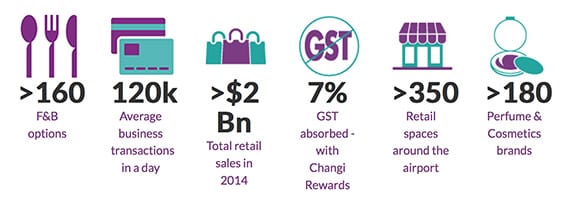
    Changi factfile 2014

    These key numbers relate to Changi Airport in 2014.

    The largest declines were noted from Indonesia (-10%), Malaysia (-5%), Australia (-3%) and Japan (-4%) where the STB reasons that macroeconomic factors, including currency depreciation and an uncertain economic outlook, depressed market demand.

    KEY HIGHLIGHTS

    More positively the key highlights in 2015 included intensified marketing efforts linked to the international attention Singapore attracted during its Golden Jubilee year. STB tried to capitalise on this by collaborating in a joint marketing effort with tourism industry stakeholders to launch a S$20m ($14.2m) campaign in seven key markets.

    The Board also put in place strategic partnerships with Changi Airport Group, Singapore Airlines and TripAdvisor to promote Singapore as the destination of choice.

    Key growth areas identified in  2015 included cruise and business events, with the former noting a year-on-year cruise passenger rise of 14% to 1m in 2015 and nine calls that were new to both Singapore and Southeast Asia.

    Singapore Tourism Board 2015
    The STB also supported more than 350 business events in 2015, representing a 27% year-on-year growth. These events generated 287,000 visitor arrivals and S$478m ($341m) in tourism receipts.

    LOOKING FORWARD…

    The STB is now forecasting that tourism receipts will be in the range of S$22bn to $22.4bn (0 – 2%) and international visitor arrivals in the range of 15.2m to 15.7m (0 – 3%) this year.

    In a statement it said: “Global economic growth may be hampered by the slower growth momentum of the Chinese and US economies, as well as uncertainties such as ongoing reforms in China and the impact of the normalisation of the US monetary conditions.

    “Increasing regional competition will also pose challenges to Singapore’s tourism sector. At the same time, Singapore remains poised to benefit from the projected growth in outbound travel in the Asia Pacific region. The pipeline for business events also continues to be strong.”

  • CITS forecasts Thai wholesale and retail markets to grow by one percent

    CITS forecasts Thai wholesale and retail markets to grow by one percent

    The Center for International Trade Studies (CITS) has predicted that the wholesale and retail markets in Indonesia and the Philippines will score the highest growths among the ASEAN countries in 2020.

    Indonesia and Vietnam will have higher growth rates than all other countries due to a relatively large number of foreign investments and an increased income per head, the center forecast.

    Meanwhile, Thailand’s wholesale and retail markets are expected to grow by just one percent this year and 10 percent in the next five years, according to CITS. However, that will largely depend on the people’s incomes and domestic consumption. Thailand’s modern-day trading is expected to grow while traditional retail trading will be gradually closed down like in other countries.


  • What to expect in 2016 as Singapore economy hits slowest growth since 2009

    What to expect in 2016 as Singapore economy hits slowest growth since 2009

    GDP is seen to likely remain stuck in the 2-3% yoy range. The 4Q15 GDP growth flash estimate was a breathtaking +2.0% yoy (+5.7% qoq saar), which beat market consensus forecast marked a sweet end to 2015. OCBC Bank notes that the surprise factor came from construction which doubled to 2.2% yoy (+7.0% qoq saar) in its strongest showing since 2Q15 due to public sector construction activities, and supported by the still resilient services sector which expanded 3.2% yoy (+6.5% qoq saar) in 4Q15 on the back of wholesale & retail trade and finance & insurance sectors. Manufacturing remained the main drag, contracting for the 5th straight quarter and actually deteriorating further from the 5.9% decline in 3Q15 to -6.0% in 4Q15.

    But 2015 GDP growth is still the lowest since 2009’s -0.6% performance.

    The 4Q2015 GDP figure brought the full year growth to 2.1% which is close to the official growth forecast of “close to 2 percent” but is nevertheless a moderation from the 2.9% growth registered in 2014.

    Here’s what analysts had to say:

    Selina Ling, analyst, OCBC Treasury Research

    Notably, this data set reinforced that growth has likely stabilized since 3Q15 after avoiding a technical recession earlier in the year. The 2015 outperformer remained services which accelerated from 3.2% growth in 2014 to 3.6% last year, followed by construction at 1.1% (2014: 3.0%), whereas the 4.8% drop in manufacturing was the worst since 2001 (-11.6%).

    Looking ahead, 2016 growth will likely remain stuck in the 2-3% yoy range.

    Headline GDP growth may not deviate from the 2+% yoy range in the near-term. We expect that manufacturing may continue to be in the doldrums and shrink 0.2% yoy in 1Q16 and constrain overall GDP growth to 2.4% yoy. Note the latest SME business surveys suggest greater caution for the first half of this year. Our full-year 2016 GDP growth forecast remains at 2-3%, which is at the upper end of the official 1-3% forecast. The downside risks remain the ongoing deceleration and policy risks in China, as well as the sustained US monetary policy normalization (given market perception continues to differ significantly from the median dots graph). It is interesting that the two-track growth trajectory in China, with the service PMI outperforming the manufacturing PMI, heralds a trend towards servitization that could be also apparent for the rest of the region.

    Inflation could remain subdued in 2016, with core inflation picking up slightly. Headline CPI prints may stay deflationary in 1H16 but edge back to positive territory before the year is out. That said, headline CPI inflation may remain flat in 2016 as asset price deflation in housing (especially with private residential prices having fallen for nine straight quarters and official rhetoric hinting at no lifting of cooling measures in the near-term) and private road transport sustains, and the pass-through from the tight labour market into the broader cost environment has been fairly limited. Given the benign crude oil price environment, the CPI basket components that would contribute positively to inflation are likely to be food (due to La Nina), healthcare and education costs. At this juncture, we do not see any game-changers that warrant a third monetary policy easing this year as the 4Q15 flash GDP growth estimate is “water under the bridge” so to speak.

    Policy settings will remain within comfort zones for now. The 3-month SIBOR has been relatively stable post-Oct15 MPS, but the SOR have tracked higher as the US FOMC initiated lift-off with a 25bp rate hike to 0.5% in mid-Dec15. The spread between the 3-month SOR-SIBOR has widened to more than 50bps, which is the largest since March 2009, but we anticipate that the gap will narrow to around 30bps as the SIBOR plays catch-up to SOR. Our end-2016 forecasts for 3-month SIBOR and SOR are 2.03% and 2.05% respectively, assuming that the FOMC continues to hike at a benign pace of 100bps next year.

    Francis Tan, analyst, UOB

    The main support in 4Q came from the robust services sector which grew 3.2% y/y, as the wholesale & retail trade and finance & insurance sectors maintained healthy growth paths. The construction sector also expanded 2.2% y/y, compared to the 1.1% y/y growth in 3Q.

    Singapore’s manufacturing engine remained weak as the sector contracted for the fifth consecutive quarter to register a decline of 6.0% y/y due to the decline in output from the electronics, transport engineering and precision engineering clusters.

    Although Singapore’s manufacturing sector is not out of the doldrums yet, we remain optimistic that there could be some pickup in manufacturing growth in2016 and we are projecting the manufacturing sector to grow by a modest 2.5%, compared to the 4.8% decline in 2015.

    The services sector will continue to be a bright spot, although growth for 2016 may slow to 2.7%, from 3.6% in 2015. This is due to the higher base effects for the wholesale & retail trade to hurdle past; While the finance & insurance sector may grow at a slower pace, resulting from the US interest rate normalization that could impact on the overall loans demand in 2016.

    With this, we maintain our forecast for Singapore’s 2016 GDP to grow 2.7%.

    Regarding monetary policy, we hold to our view that the Monetary Authority of Singapore (MAS) will likely leave the current policy of the “modest and gradual appreciation” of the SGD NEER unchanged at our estimated 0.5% pa rate.

    The monetary policy divergence between the US and Singapore will likely see the USD/SGD continue on a weaker path to reach 1.46/USD by the middle of this year. However, the increased trade and investment flows from a stronger US economy will probably see a direction reversal by 2H 2016, where we forecast the USD/SGD to end 2016 at 1.42/USD.