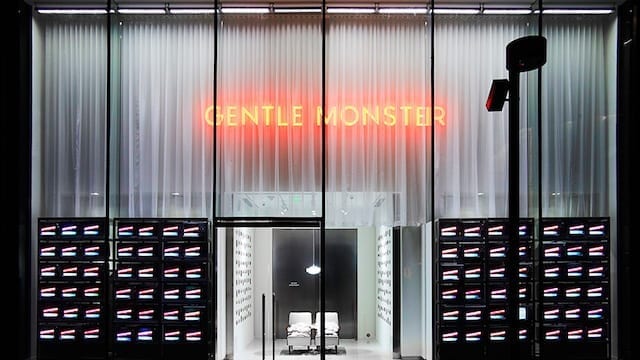
Korean eyewear brand Gentle Monster has opened its fifth flagship store for China, in Guangzhou.
It has set up in two adjacent units at the Taikoo Hui mall, which is known for its luxury boutiques.
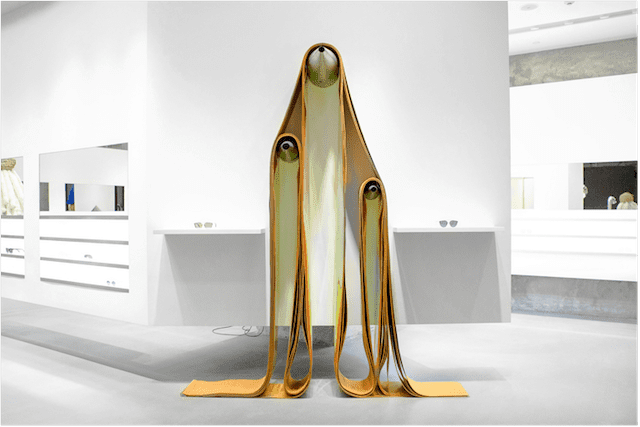
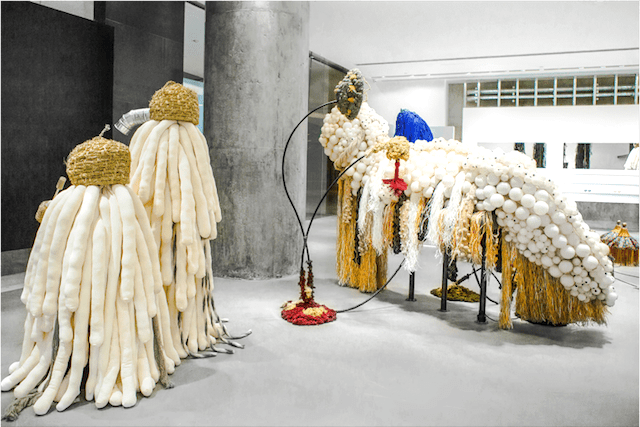
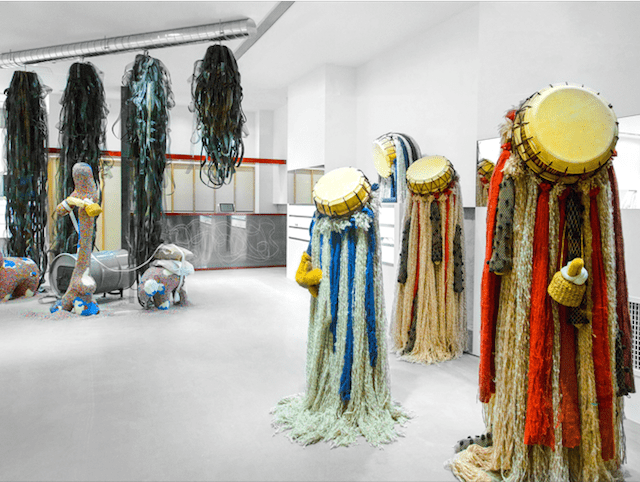
Like other Gentle Monster flagships, the store has a themed interior design, this time with cues taken from the realm of old folk tales. It specifically zooms in on the purifying process in which spirits transcend into deities.
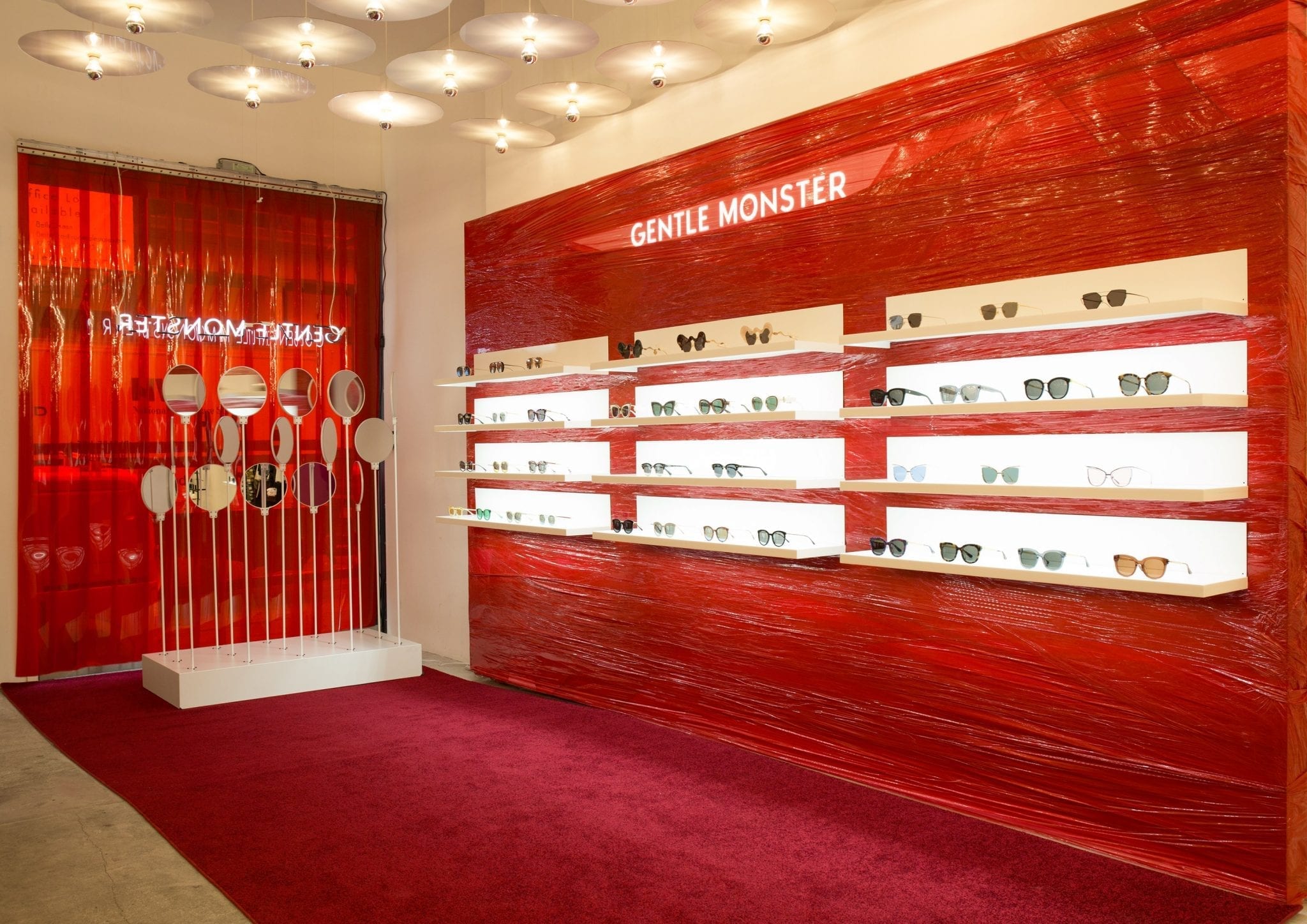
The space is dotted with intricate objects. Some move or make sounds, but all look colourful and exotic. White walls, ceiling and wall-mounted panelling form a neutral backdrop for the creations, while Gentle Monster’s merchandise is showcased on shelving attached to the wall panels.
A documentary movie has inspired the theme for Korean luxury eyewear brand Gentle Monster Singapore’s new store at Ion Orchard.
By US director Ron Fricke, Samsara explores spirituality and the human experience. Key symbols from the 2011 film, a camel, lion and child, feature throughout the shop in intricate art installations, offering an immersive experience for customers.
As they enter the store, shoppers are greeted by the camel, an installation comprising a futuristic spinning wheel with multiple threads and a camel-shaped prop that moves up and down.
They then enter a darkened space featuring the lion, a sculpture made of tresses of hair surrounded by wall-mounted lion tails.
In the final room is a platoon of rotating dolls and a throne in a lit setting of faux arches.
Gentle Monster says the store explores the core philosophy of salvation introduced in Friedrich Nietzsche’s Thus Spoke Zarathustra 2, in which the German philosopher writes that salvation can be achieved only through overcoming one’s self. He describes the three transformations of the spirit as obedience, symbolised by the camel, with the lion for governance and child for complete freedom.
Korean eyewear retailer Gentle Monster is creating jaw-dropping retail executions across Asia and beyond.
The images accompanying this story are of the equally unique Beijing flagship store, located in the Sanlitun retail precinct.
Each Gentle Monster flagship features a completely different design format, inspiration and execution – it is the utmost opposite to traditional retail chains’ cookie-cutter store design approach as is possible.
“I wanted the products to look as if they were being exhibited,” explains Hankook Kim, founder and CEO of Gentle Monster. And so the in-store concepts have become something of a calling card for the brand.
As Australian retail consultant Brian Walker observes in a column on disruptive retailing, every retail store in their ecosystem is completely different; from ‘Platform’ in Hong Kong; designed like a train carriage, to ‘L’Artisan’ in Shanghai and ‘Secret Apartment’ in Beijing.
“Each store is a three-dimensional still life, with its own back-themed story.”
Gentle Monster was founded in 2012 after a chance meeting between Kim and Korean serial entrepreneur Jae W Oh at an English summer camp in Seoul a year earlier. Oh took a liking to Kim and invited him to come up with a concept worthy of his cash.
“When I first began looking into eyewear and researching the market, I found that it was a very union-controlled industry that was not explored as an artistic form,” Kim said in a recent interview with The Business of Fashion.
And so a brand was born. Kim identified an opportunity to create oversize spectacles for Asian consumers, for whom having a small face is a compliment. “There were no competitors for oversize glasses, which make heads look smaller.” Asians also require eyewear with a low bridge. “Eyewear was all about the Western facial structure.”
He found a factory in Daegu abandoned by Luxottica who shifted production to China, and another plant in China where he could produce acetate frames (illegal to manufacture in Korea).
Gentle Monster’s rise has been swift. In 2014 the brand achieved revenues of US$40 million, predominantly in Korea and China. That figure grew four-fold to $160 million the following year, with figures for 2016 not yet revealed.
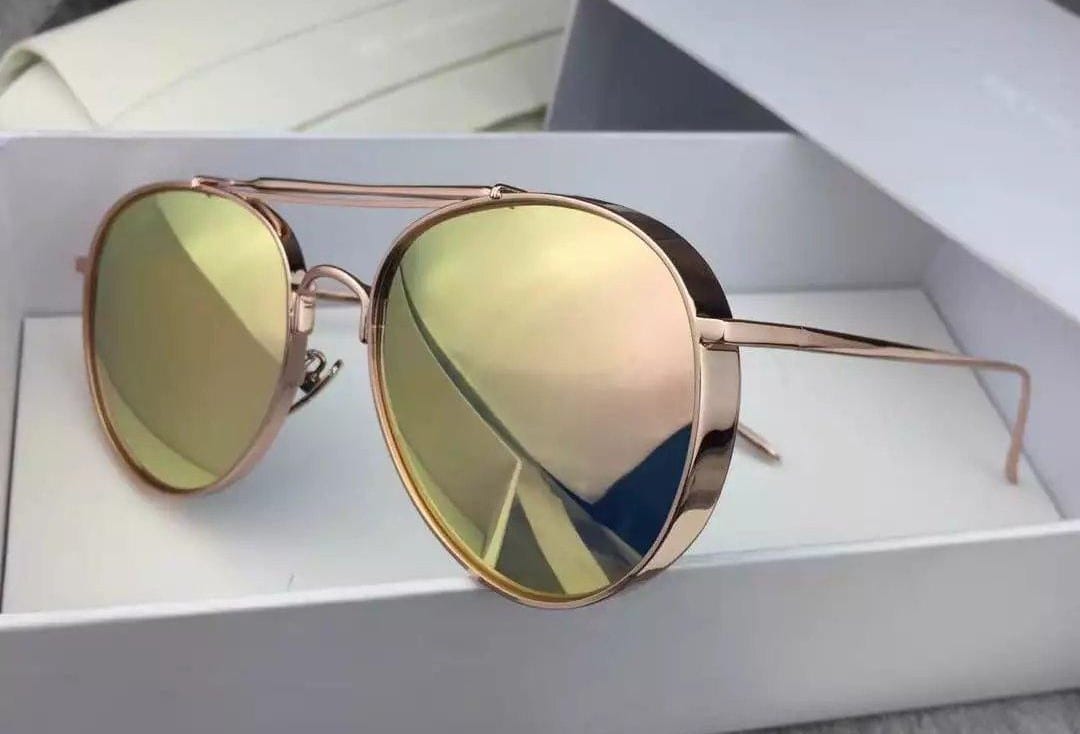
The brand’s frames range in price from a little over $200 for an entry-level pair, to $500+ for something more exotic. Like its stores, its frame designs are often unusual – or even “strange” as The Business of Fashion observed.
Flush with success of its eyewear range, Gentle Monster is now deciding which other categories to expand into.
“Gentle Monster started out as an optical company, but the goal is to make it a creatively disruptive corporation,” says Kim. “Brand really is the genuine tool.”
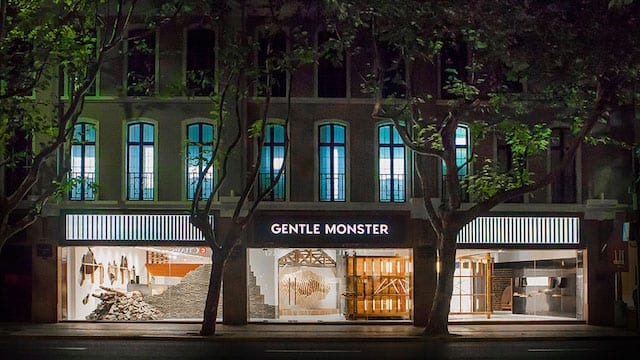
Luxury eyewear brand Gentle Monster from South Korea has opened a flagship store, The Artisan, in Shanghai.
It is on a tree-lined stretch of Huaihai Zhong Lu, an artery road in the former French Concession.
Gentle Monster has opened several flagship stores in the past two years, in Seoul, Beijing, Hong Kong and New York City.
Supervised by creative director Hankook Kim, the design concept for the store is loosely inspired by an artisan’s workshop, and features several rooms each with a distinctly different design. The settings are either functional or experiential, but always feature specially designed fixtures and furnishings to give each flagship store an individual touch.
Looking more like an art gallery than an eyewear shop, it includes kinetic art that produces sound, with a multi-layered entrance.
A feature is a motorised installment of wood and metal, appropriately named Sound Wave, that produces a repetitive dull sound with its flowing movement.
With a distressed wall, the Carpenter Artisan space holds a tree trunk on its side, its top resting on a pile of bricks from a broken wall. It is dissected by metal boxes, and expresses the process of crafting via a gradual transition from tree to lumbar. Other features include a fanned “stairway” of plans, a table full of wood shavings and timber “artworks”.
Behind the entrance ceiling light is a triangular wooden roof structure, formerly supported by the bricks that now lay under the tree in the wooden artisan space. It expresses the passion of artisans and their willingness to deconstruct and tear down in order to create something new.
With two circular rooms, the Metal Atelier of Artisan space features lines flowing in from the stairs and the black walls, expressing the processing of metal. The larger room shows raw metal with repetitive images of pipes, while the smaller room displays polished and machined metal.
To highlight the contrast between metal and wood, an installation inspired by the intangible sounds on the first floor features vertical boards on a stairway, indicating crafts flowing through the corridors and representing the resting mind of a troubled artisan.
Amid all this, the Shanghai store displays the brand’s full range of prescription eyewear and sunglasses, as well as collaboration models with brands such as Hood by Air, Opening Ceremony and Six Lee.
Chinese travellers have emerged as one of the few bright spots for Korean department stores suffering from dull domestic consumption.
The arrival of a new demographic of consumers has prompted an all-out fight to attract deep-pocketed clients, industry officials told Yonhap.
Sales at department stores inched down 0.4 per cent on-year to 29.22 trillion won (US$23.69 billion) in 2015, Statistics Korea showed, mostly attributable to the Middle East Respiratory Syndrome (Mers) outbreak and rapidly rising online marketplaces.
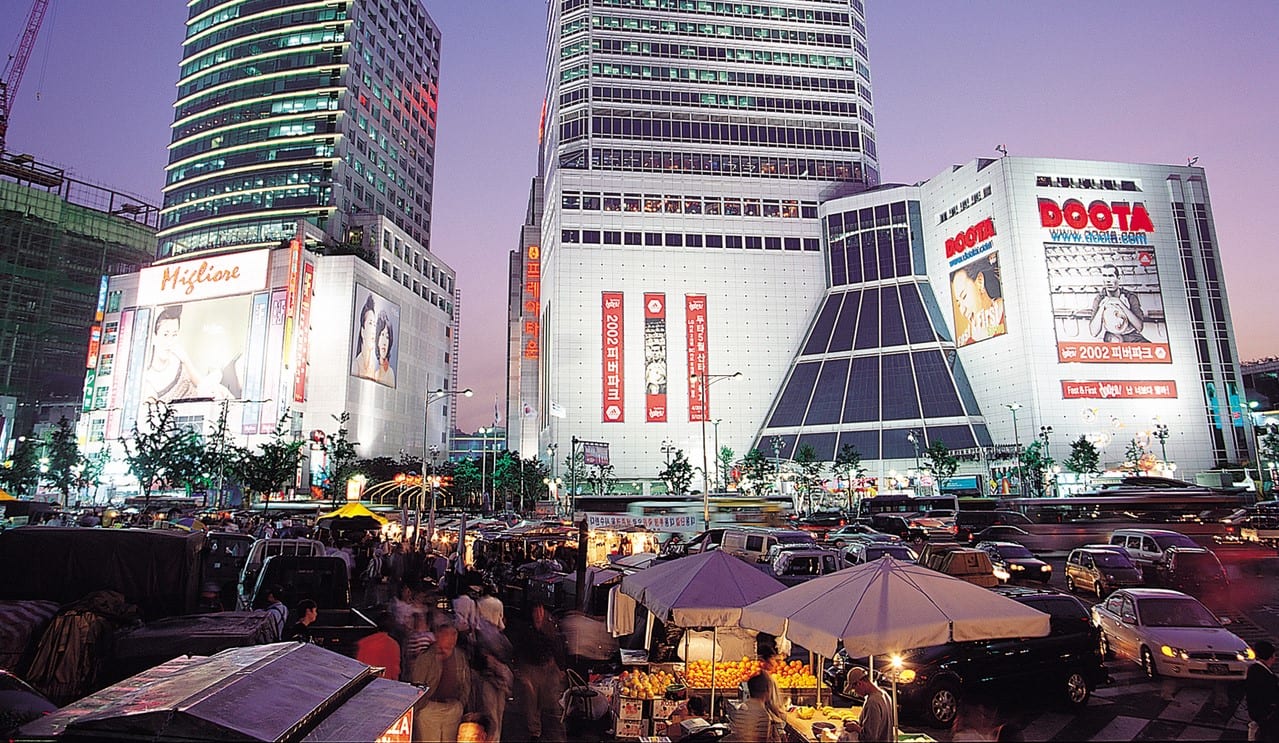
While consumption among locals has steadily slowed over the past years, major department stores in downtown Seoul saw growing sales among Chinese nationals.
At Lotte Department Store in the famous shopping district of Myeongdong, sales by Chinese customers accounted for 18.1 per cent of the total, rising 6.8 per cent from a year ago.
At the nearby Shinsegae Department Store, sales by Chinese customers rose 21.8 per cent in 2015 from a year ago, though the pace slowed from 131 per cent in 2014 and 87 per cent in 2013 in the wake of the Mers outbreak. The store did not release exact sales figures.
Foreign luxury watch and jewellery brands topped their shopping list, while leading Korean fashion and cosmetic brands were also picked up by Chinese travellers.
Among them, the Seoul-based luxury bag manufacturer MCM was the second-most selling brand by the Chinese, while sunglass brand Gentle Monster and Amore Pacific’s high-end cosmetic lineSulhwasoo were named as popular items.
“While the Chinese mostly preferred foreign luxury brands and local cosmetic brands, a wider range of Korean products have been selling among Chinese customers,” said Park Young-hwan, a marketing official at Lotte Department Store.
In response to the changing consumption trends, Korean department stores have launched a variety of promotional events through social networking services and invited China’s popular bloggers to embrace rich Chinese customers.
Some stores have even assigned assistants for VIP customers to provide guidance while they shop. Others have offered limousines and pick-up services.