Tag: Hyundai motor

  • SUVs are selling more in Korea

    SUVs are selling more in Korea

    Korea’s domestic car market moved in two different directions this year. The rising popularity of large sedans and sport utility vehicles (SUVs) stood in sharp contrast to weaker demand for smaller vehicles, industry data showed Sunday. In the January-November period, Hyundai Motor, Kia Motors, GM Korea, Renault Samsung Motors and SsangYong Motor sold a combined 698,326 units, up 0.3 percent from 696,403 cars sold a year earlier, the data showed.

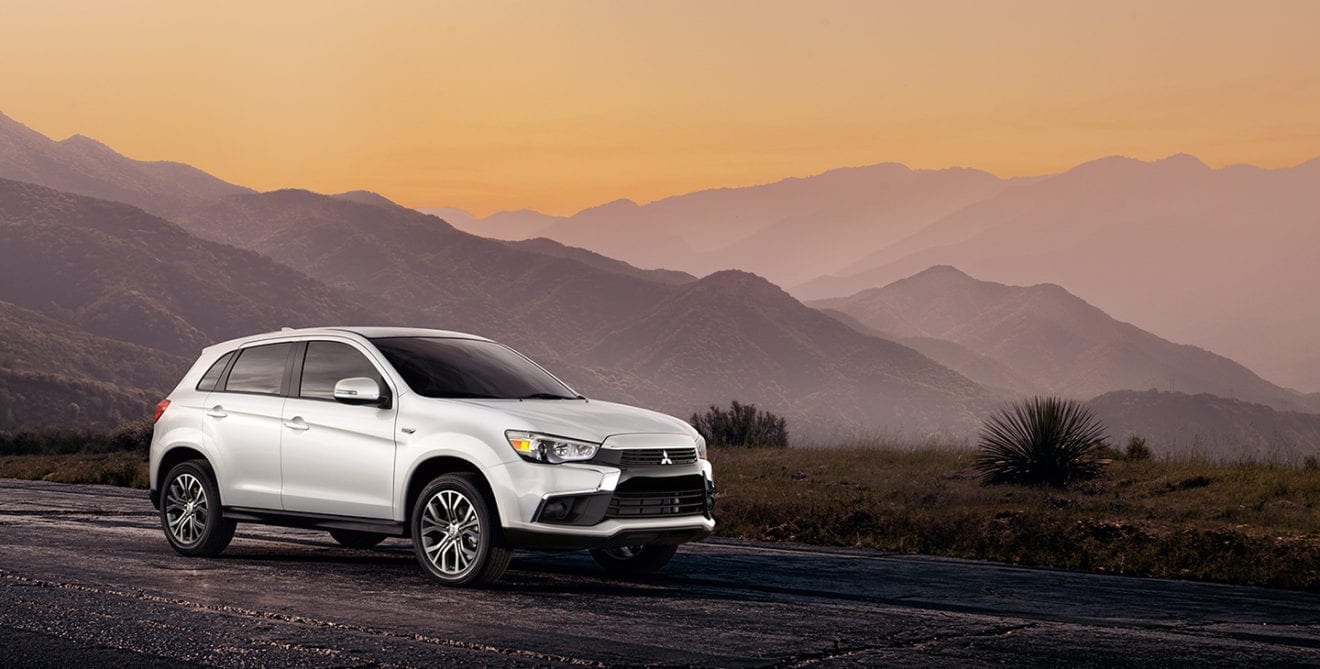
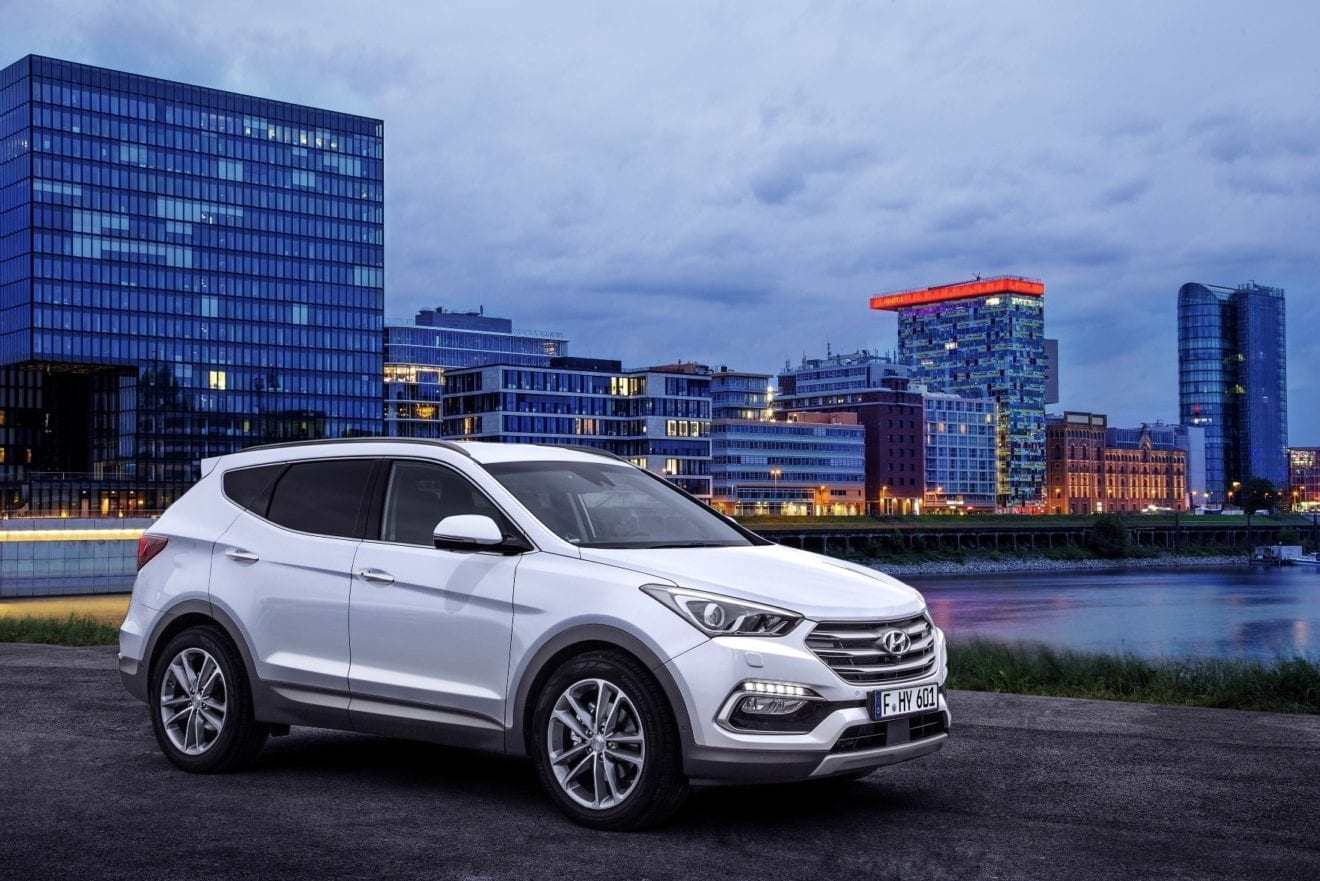
    Demand for medium SUVs, such as Hyundai’s all new Santa Fe, reached 207,269 units, up a sharp 29.5 percent from the same 11 months in 2017.

    The total so far is expected to push medium-sized SUVs to become the country’s top-selling vehicle type on an annual basis in 2018. This will mark the first time such crossovers have taken the top spot in Asia’s fourth-largest economy, where car buyers generally tended to favor mid- to large-size sedans.

    In regard to larger crossovers, the popularity of SsangYong’s G4 Rexton caused sales of such cars to jump 12.9 percent on year to 46,734 units, further pushing up overall SUV numbers.

    Industry watchers said the release of Hyundai’s three-row Palisade and a longer version of SsangYong’s G4 will further fuel sales going into 2019, with numbers likely to get a further boost once Kia releases its own large SUV that is expected to get the Telluride name.

    Besides SUVs, sales of large sedans, centered on Kia’s K9 luxury sedan, caused total numbers to rise a respectable 5.7 percent to 52,945 units up till November despite drop in demand for Hyundai’s luxury Genesis EQ900 falling off compared to the year before.

    On the other hand, sales of midsize and smaller vehicles dipped 0.9 percent on year to 481,542 units, with demand for small city cars dropping 7.5 percent to 115,647 units.

    “Vehicles like the Sante Fe clearly bolstered demand this year, with this trend likely to continue with the release of the Palisade and new versions of the G90 and G80 to further contribute to sales growth for bigger cars going into 2019,” an industry source said.

  • Korea’s car take top safety awards

    Korea’s car take top safety awards

    Vehicles from Hyundai Motor and Kia Motors were awarded three top safety prizes in the Ministry of Land, Infrastructure and Transport’s 2018 Korean New Car Assessment Program (Kncap) on Wednesday in a ceremony held at the InterContinental Seoul Coex in southern Seoul.

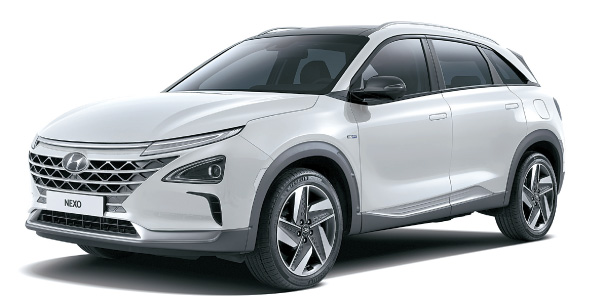
    Hyundai Motor’s hydrogen-powered sport-utility vehicle (SUV) Nexo, mid-sized sedan Genesis G70 and Kia Motors’ large-sized sedan, the K9, were awarded top Kncap prizes in their size segments.

    Vehicles were tested in three key areas – collision, pedestrian and accident prevention safety. The program assessed 11 vehicles this year, including four imported models.

    Hyundai’s eco-friendly vehicle, the Nexo, received perfect scores in front and side collision safety, pedestrian leg protection and advanced driver assistance system to not only win the top safety prize in its segment but also to win two other special awards: the top safety eco-friendly vehicle award and the top children’s safety award.

    Hyundai Motor said that the automaker conducted a variety of tests on the hydrogen-powered Nexo to ensure the safety of its high-pressure hydrogen tank such as shooting it with a bullet along with other fire-safety tests.

    Kia Motors’ flagship large-sized sedan, the K9, also scored top marks to receive a special award in top accident prevention on top of its top award for segment size.

    Meanwhile, the Genesis G70, awarded the top prize in the mid-sized sedan segment, ensures pedestrian safety with an active hood system that automatically lifts the hood of the vehicle if it collides with a pedestrian.

  • Hyundai forms joint venture for Algerian assembly plant

    Hyundai forms joint venture for Algerian assembly plant

    Hyundai Motor and Algerian car maker Global Group signed a deal on Monday to establish a joint venture to produce commercial cars in Algeria. The joint venture will operate a factory that assembles knock down kits in Batna, Algeria. The assembly facility is scheduled to start operations in 2020.

    In the early stage, the factory will assemble 6,500 cars a year and gradually increase production. Medium and large trucks like the Mighty and Xcient, as well as the Hyundai County bus, will be assembled at the facility.

    According to the Korean automaker, the commercial vehicle market in Algeria has been expanding. Last year demand for commercial cars in the country was around 8,000 units, but that has increased to 12,000 units this year. By 2025, the automaker projects demand will reach 22,000.

  • Yamaha to invest $150 million in Grab Vietnam

    Yamaha to invest $150 million in Grab Vietnam

    Yamaha Motors has announced a $150 million investment in Grab to collaborate on motorcycle ride-haling. The collaboration will be for Southeast Asia in general and Indonesia in particular. Through this partnership, Yamaha Motors and Grab aim to “develop next-generation mobility services by implementing solutions and innovations,” Grab said in a press release issued Thursday.

    The two companies aim to leverage Yamaha Motor’s technology and knowhow to boost safety as well as make it easier for Grab’s driver partners to buy motorbikes.

    Yamaha Motors also aims to leverage Grab’s customer base in Southeast Asia and knowledge of the motorcycle ride-hailing business for future product development.

    The Southeast Asian ride-hailing firm is teaming up with global investors to expand its reach after forcing Uber out of Southeast Asia earlier this year.

    Toyota Motor Corp. had said in June it was investing $1 billion in Grab, and Hyundai Motor Co. last month agreed to put an additional $250 million into the company as well as sell Grab a fleet of electronic vehicles.

    The focus on Indonesia may mean that Grab is intensifying its push against local ride-hailing platform Go-Jek. Both companies now compete in the Vietnamese market after the Jakarta-based start-up commenced operations in Vietnam under the name Go-Viet some months ago.

    Grab entered Vietnam early in 2014, but is currently under an antitrust investigation after acquiring Uber’s services in March.

  • Hyundai Motor bets 6.7 billion dollars on hydrogen cells

    Hyundai Motor bets 6.7 billion dollars on hydrogen cells

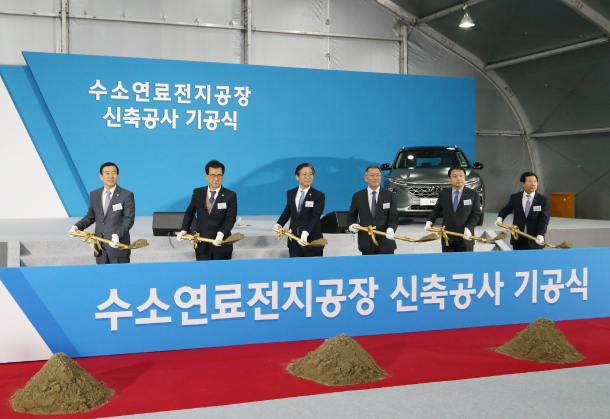
    Hyundai Motor Group said it will invest 7.6 trillion won ($6.7 billion) in fuel-cell electric vehicles (FCEV) by 2030, betting big on hydrogen as the energy source for the future. The group announced what it called its “FCEV Vision 2030” on Tuesday, promising to build production capacity of 500,000 FCEVs yearly by 2030 to take the lead in the fledgling industry. It added that the investment will generate some 51,000 new jobs by 2030.

    As a first step, Hyundai Mobis, the auto parts and software affiliate of Hyundai Motor, held a groundbreaking ceremony for its second fuel cell stack factory in Chungju, North Chungcheong, on Tuesday.

    If the factory is completed in 2022, Hyundai Motor Group’s production capacity for fuel cell stack will expand from its current 3,000 units per year to 40,000 units.

    “Hyundai Motor Group will become the first mover in the new hydrogen society that will arrive soon,” said Chung Eui-sun, Hyundai Motor Group’s executive vice chairman, in a speech at the ceremony in Chungju on Tuesday.

    “The group plans to expand the fuel cell stack production capacity to 700,000 units by 2030, including for the 500,000 FCEVs we plan to make by that year.”

    The ceremony was attended by Minister of Trade, Industry and Energy Sung Yung-mo, Hyundai Motor President Chung Jin-haeng and Hyundai Mobis President Lim Young-deuk.

    Hyundai Mobis’ Chungju plant is focused on producing parts for eco-friendly vehicles like hybrid and electric cars.

    Last year, it constructed a new section dedicated to making fuel cell stacks with a capacity of 3,000 units per year.

    The carmaker forecasts that hydrogen will be used as an energy source in shipbuilding, railways and forklifts in the future and said it would start a business supplying fuel cell modules to other companies. The additional 200,000 units of FCEV modules that are not used in Hyundai Motor’s own FCEVs by 2030 will be sold elsewhere, the carmaker said.

    Executive Vice Chairman Chung said the FCEV industry will become a new growth engine for Korea.

    “Ninety-nine percent of auto parts in FCEVs are made domestically,” Chung said, “which is why its growth will have big ripple effects on other companies related to the industry. Through co-investment with partner companies, [Hyundai Motor] will try to build new growth engine for Korea’s future car industry.”

    Currently, some 130 partner companies are providing parts for fuel cell stacks made by Hyundai Mobis.

    Hyundai Motor has been making hefty investments in FCEVs along with rival Toyota. It was the first carmaker in the world to make a mass-produced FCEV model in 2013 called the Tucson ix35. It launched a hydrogen-powered Nexo SUV early this year.

    Since last year, the carmaker has been chairing the Hydrogen Council, a global lobbying group. Other companies represented on the council include Daimler, BMW and Air Liquide.

    The Korean government plans to supply 16,000 FCEVs and build 310 FCEV charging stations by 2022. There are currently only around 10 stations available to the public in Korea.

    China plans to supply 1 million FCEVs by 2030 and construct 1,000 charging stations. Japan plans to supply 40,000 FCEVs by 2020 and build 160 charging stations.

  • Hyundai opens center for innovation in Israel

    Hyundai opens center for innovation in Israel

    Hyundai Motor opened an innovation center in Tel Aviv and invested in an Israeli artificial intelligence start-up through the center, the automaker said Tuesday. Hyundai Cradle Tel Aviv is the third such initiative established by the Korean carmaker’s investment arm, the others in Korea and Silicon Valley. The Israel-based center, which officially started operations at the end of last month, is dedicated to finding start-ups with expertise in artificial intelligence and computer vision.

    The Tel Aviv center said Tuesday it invested in allegro.ai, a start-up specializing in deep learning-based computer vision. The automaker said the partnership will improve the quality of Hyundai’s products and speed up its deployment of AI technology.

    “Deep learning-based computer vision is one of the core technologies that can be applied to autonomous driving, to navigate roads and make quick decisions in real time,” said Ruby Chen, head of investment at Hyundai Cradle Tel Aviv. “allegro.ai is clearly an innovation leader in that field.”

    The technologies produced by the Israeli start-up make it easy for companies developing autonomous vehicles and drones to manage and control their data sets safely, said Nir Bar-lev CEO and co-founder of allegro.ai in a statement Tuesday.

    Korea’s largest automaker is planning to establish two more centers, in Berlin and Beijing.

    Selecting China as one of its global bases is a strategic move, as the automaker is seeking ways to expand in the world’s most populous consumer market. Hyundai is considering launching its N brand cars in China.

    On Tuesday, Thomas Schemera, head of the product planning and strategy division at Hyundai Motor, said the company is mulling which of its high-performance branded cars to introduce to the Chinese market during the first China International Import Expo, being held at the National Convention and Exhibition Center in Shanghai.

    Hyundai introduced its fuel-cell vehicle NEXO at the expo with an aim to bolster its presence in the growing eco-friendly car market in China.

    The expo is being held for the first time by the Chinese government to help foreign companies introduce their products and find opportunities for business cooperation.

  • Hyundai to set up $100 million hydrogen fund in China

    Hyundai to set up $100 million hydrogen fund in China

    Hyundai Motor has partnered with a Chinese institute to set up a $100 million fund for local investments in hydrogen technologies and related industrial infrastructure, the company said Monday. Hyundai Motor and the Beijing-Tsinghua Industrial R&D Institute have kicked off the Hydrogen Energy Fund, with venture capitalists from Asia, Europe and the United States expected to join as investors, Korea’s largest carmaker said in a statement.

    “The fund, once fully set up, will be used in the infrastructure needed for the hydrogen industry and venture startups with core hydrogen technologies,” the statement said.

    Yield Capital, an investment organization under the Chinese institute, will be responsible for raising funds and managing them, it said.

    Hyundai has expanded investments in hydrogen fuel-cell electric vehicles, such as Nexo, while expanding partnerships with global companies to gain a share in the next-generation car markets.

  • Hyundai Motor net profit plummets 67%

    Hyundai Motor net profit plummets 67%

    Hyundai Motor’s operating profit plummeted 76 percent on-year in the third quarter as a recall in the U.S. and sluggish growth in major markets hurt the automaker’s bottom line. Korea’s No. 1 carmaker by sales announced Thursday that it posted 289 billion won in operating profit in the July-Sept. period.

    Its net profit was 306 billion won, down 67.4 percent on-year.

    “To fortify quality control, Hyundai Motor rolled out a recall related to airbags and engines which resulted in a 500 billion won one-time cost realized in the Q3 report,” said a Hyundai Motor official.

    Operating costs totaled 3.4 trillion won in the third quarter, according to the carmaker, which is 8.6 percent more than during the same period last year.

    Despite good sales in Europe and emerging markets like Brazil and Russia, low demand in the U.S. and China dragged down overall sales. It sold 1.12 million units globally in the third quarter, 0.5 percent less than during the same period last year.

    The domestic market got a bost from the new Santa Fe SUV, but a decreased number of operating days at dealerships resulted in Hyundai Motor selling just 171,443 units, a 1.4 percent drop compared to last year. Chinese sales dropped by 3.7 percent on-year, selling 181,000 units. Sales in the U.S. dropped by 4.1 percent on-year to 302,000 units.

    Hyundai Motor expects profitability to improve in the fourth quarter and going into next year with the launch of new SUV models and a reduction in costs.

    “In the fourth quarter, the new Santa Fe SUV and an upgraded Tucson SUV will launch in the U.S.,” said a Hyundai Motor official.

    “The implementation of a new platform starting next year will help reduce costs and raise efficiency as well.”

    Hyundai Motor shares fell by 5.98 percent to 110,000 won on Thursday as of press time.

  • Hyundai Motor hydrogen trucks are going to Europe

    Hyundai Motor hydrogen trucks are going to Europe

    Hyundai Motor’s hydrogen-powered truck will take to the streets of Europe, where the hydrogen infrastructure is better than in Korea and subsidies for hydrogen cars more generous.

    The nation’s No.1 carmaker announced Thursday that it signed a memorandum of understanding with Swiss hydrogen energy company H2 Energy to supply 1,000 large hydrogen trucks from 2019 to 2023.

    They will include both refrigerated and unrefrigerated cargo trucks. H2 Energy will lease the trucks to local gas station companies and grocery franchises.

    Under the partnership, Hyundai Motor and H2 Energy will try to expand the use of hydrogen-powered trucks not only in Switzerland but all over Europe.

    “The MOU with H2 Energy allowed Hyundai Motor’s hydrogen trucks to advance into the European eco-friendly commercial vehicle market,” said Lee In-cheol, executive vice president of Hyundai Motor’s commercial car team.

    The hydrogen-powered trucks being sent to Europe from next year are based on Hyundai Motor’s flagship large-sized Xcient truck. The development is near completion, Hyundai Motor says, to meet local transportation regulations.

    The trucks will have 190 kW fuel-cell batteries.

    They are expected to have a range of 400 kilometers (259 miles) per charge, which will take about 7 minutes.

    In terms of safety features, they will have forward collision avoidance and lane departure warning systems.

    Hyundai Motor explained that it is initiating its hydrogen truck business in Europe rather than Korea due to better infrastructure and state support as well as rising demand.

    State support comes in various ways in European countries. Germany, for example, offers subsidies, while the Netherlands and Norway give tax incentives to people who purchase eco-friendly vehicles.

    Switzerland, the first market for Hyundai Motor’s hydrogen-powered Xcients, has eliminated tolls on 3.5-ton or heavier trucks that run on eco-friendly engines. Trucks powered by diesel engines, in contrast, have to pay heavy tolls.

    The carmaker plans to launch a midsized truck fueled by hydrogen in the near future that could be used for road cleaning or collecting garbage.

  • Seoul shares close slightly lower on geopolitical concerns

    Seoul shares close slightly lower on geopolitical concerns

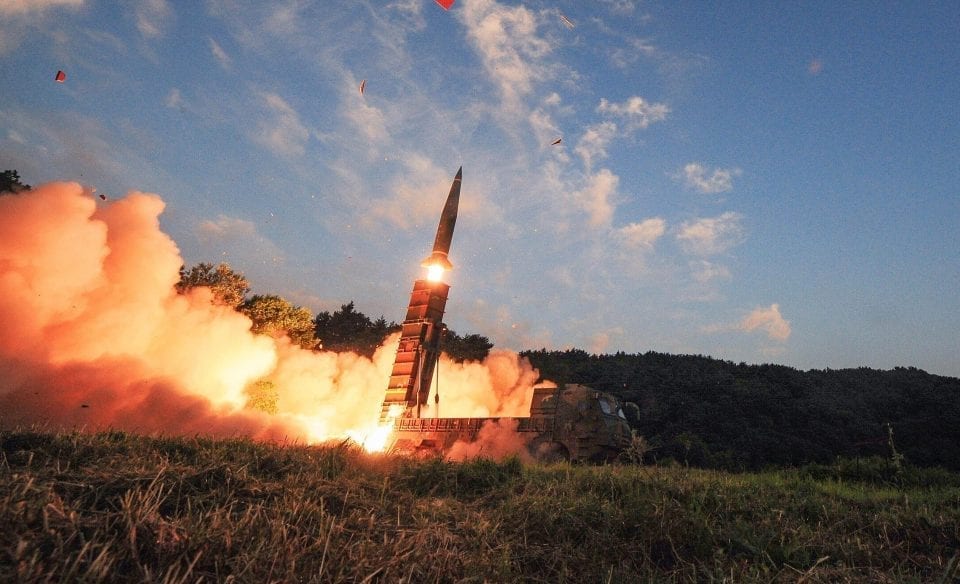
    South Korean stocks closed 0.13 percent lower Tuesday on concerns over North Korea’s nuclear provocations, but the decline slowed compared to previous sessions as investors engaged in bargain hunting, analysts said. The Korean won sharply fell against the US dollar.

    The benchmark Korea Composite Stock Price Index dropped 3.03 points, or 0.13 percent, to 2,326.62. Trade volume was moderate at 317 million shares worth 4.81 trillion won ($4.25 billion), with losers outnumbering gainers at 569 to 239.

    On Monday, the main bourse sank more than 1 percent as retail investors dumped local shares after North Korea claimed a day earlier that it successfully tested a hydrogen bomb that can be mounted on an intercontinental ballistic missile.

    While the main bourse continued to lose ground on Tuesday, analysts said the downward pressure was limited as institutions scooped up underappreciated shares.

    Based on past examples, foreigners and institutions tend to consider the North Korean risk an opportunity to purchase bargain shares,” said Byun Joon-ho, a researcher from Hyundai Motor Investment & Securities Co.

    Institutions scooped up a net 242 billion won, while individual investors offloaded a net 65.5 billion won. Foreigners sold more shares than they bought at 213 billion won.

    Tech shares closed bullish, with Samsung Electronics moving up 1.56 percent to 2,338,000 won. Leading chipmaker SK hynix shot up 2.64 percent to 69,900 won. LG Electronics also jumped a whopping 4.59 percent to 86,500 won.

    Carmakers closed mixed, with Hyundai Motor backtracking 1.43 percent to 138,000 won while its auto parts arm Hyundai Mobis closed unchanged at 238,500 won. Kia Motors, the country’s second largest automaker shed 2.29 percent to 34,100 won.

    No. 1 steelmaker POSCO shed 0.72 percent to 342,500 won, while Korea Zinc climbed 1.37 percent to 517,000 won. Hyundai Steel moved down 1.55 percent to 57,000 won.

    The local currency closed at 1,131.10 won against the US dollar, up 1.90 won from the previous session’s close.

    Bond prices, which move inversely to yields, ended higher. The yield on three-year Treasurys shed 0.2 basis point at 1.780 percent and the return on the benchmark five-year government bonds also lost 0.5 basis point to 1.996 percent.

  • Nation’s consumers, companies finding themselves on thin ice in South Korea

    Nation’s consumers, companies finding themselves on thin ice in South Korea

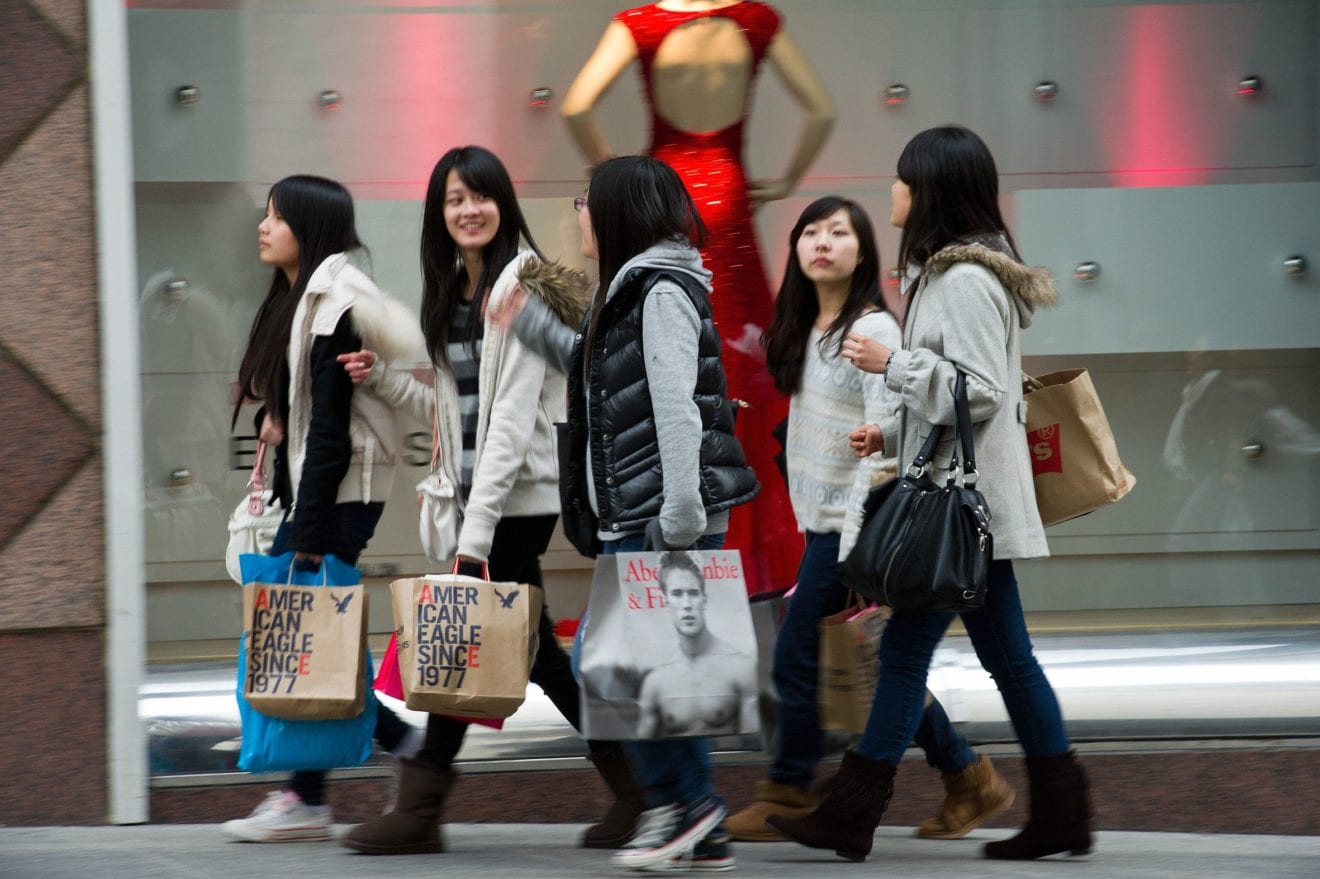
    Every floor of the NC Department Store in Jamsil-dong, southern Seoul, was packed with customers frantically digging through piles of clothes and shoes on March 1.

    The moment an employee set out pairs of Nike sneakers at 50 percent off the retail price, men and women alike snatched them off the shelves. There was even a scuffle when several buyers grabbed the same item simultaneously.

    “We ran out of boxed tissues by 3 p.m.,” a saleswoman said. “As they were crazy cheap, people took several boxes at once.”

    On the Internet communities for Jamsil residents, members warned the neighborhood had turned into a mad house and said it would take at least an hour just to find parking.

    The chaotic scene has been happening every Independence Movement Day since the retailer started its event several years ago, offering everything from food to fashion at discounts of up to 80 percent.

    While the rest of the country took the day off to remember the independence movement during the Japanese colonial period, NC Department Store was packed with shoppers elbowing each other out of the way to snag the best bargain.

    But this year, shoppers seemed a little more desperate to save money.

    “I’m not really a person who is attracted to sales, but recently, I’ve been changing the way I’ve been spending because the economic situation is becoming more uncertain,” said Song, 42, who was digging through a steeply discounted pile of Nautica outdoors pants. “My wife and I both work so we’re better off than some other households. But even with our income, after paying the interest on our loans, living expenses and for our kids’ education, there’s hardly any left for saving.”

    The average household today is jittery and increasingly less confident about the path of the Korean economy, particularly as various indicators including exports, industrial output, unemployment and household loans have been alarming.

    The frozen stock and real estate markets are causing household income to shrink just as ever-growing household loans, which reached more than 1,200 trillion won ($996 billion) by the end of last year, are applying more pressure on Korean families.

    With less income and more uncertainty about the nation’s economy, many consumers are shopping online rather than at discount stores like E-Mart or Lotte Mart.

    According to Statistics Korea, while overall retail sales grew 4.1 percent in January compared to the same period last year, online sales grew 21 percent.

    Online shopping is currently a 5 trillion won market, accounting for 17.2 percent of overall retail sales, at 30 trillion won. That’s 2.4 percent larger than a year ago.

    Why is online shopping growing so fast? One reason is because it offers products at lower prices while being more convenient.

    More shoppers are buying their groceries online, with sales of agricultural and marine products surging 57.6 percent in just a year. Online sales of processed food and beverages have seen exceptional growth of 43.2 percent.

    But consumers are also heading online because living conditions for the average household have worsened over the last few years.

    According to a recent study by Statistics Korea, the gap between the monthly paychecks of people working for small and midsize companies and those working at conglomerates is wider than it has ever been.

    The average paycheck received by employees at companies with more than 300 employees, categorized as a conglomerate, reached 5.01 million won last year, an increase of 3.9 percent year on year.

    Over the same period, the average paycheck taken home by people at small and medium-size companies (between five and 299 employees) grew 3.4 percent to 3.11 million won. That’s just 62.3 percent of the salary received by their conglomerate counterparts.

    “This year, it is difficult to expect the domestic market to recover from policy implementation,” said Lee Geun-tae, senior analyst at LG Economic Research Institute.

    “Since the second half of last year, household spending has been falling to all-time lows as uncertainties over the economic future have gone up.”

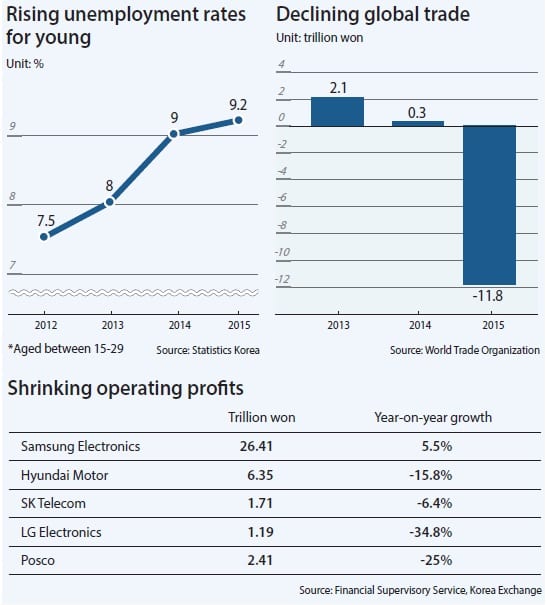
    Lee added that the frozen property market, in which many older people have invested to sustain their life after retirement, as well as low interest returns on financial assets have dampened spending confidence. Growing unemployment faced by young people is also contributing to further cutbacks on spending.

    Even the nation’s top companies are feeling a squeeze. Last year, Hyundai Motor recorded its highest-ever annual revenue at nearly 92 trillion won. But the company was only able to earn 6.35 trillion won in operating profit, which is the smallest since 2010 and 15.8 percent less than the previous year. It was the third consecutive year that operating profit has shrunk.

    The situation at other companies is similar. Samsung Electronics enjoyed an annual operating profit increase of 5.5 percent to 26.4 trillion won. But when looking solely at the fourth quarter, operating profit actually declined compared to the third quarter.

    Market experts are particularly worried by the fact that leading manufacturers, which should be leading the country out of the gloom, are themselves struggling.

    Furthermore, Korea’s leading companies are also major exporters, and the continuing decline in outbound shipments since January 2015 will likely lead to disappointing performances, in turn worsening consumer confidence and finally impacting the domestic market.

    The current situation is unlikely to improve anytime soon as China, which accounts for one quarter of Korea’s economy, has already seen its growth fall below 7 percent.

    “New government stimulus efforts are likely to take effect starting in the second quarter, but their impact is not expected to be strong enough to offset the slowdown in exports,” said Suh Dae-il, an analyst at Daewoo Securities. “In particular, tighter control on bank lending is anticipated to erode the impact of any stimulus. February readings of the consumer sentiment index and the business sentiment index suggest that consumers’ expectations for housing price growth are sliding sharply, and that corporate financial conditions have deteriorated from the levels seen in the second half of 2015.

    “As the Korean economy is expected to continue to slow down in first half of this year, we believe that additional stimulus measures, including a base rate cut, will be needed going forward.”

    Finance Minister Yoo Il-ho, who celebrated his 50th day in office last week, brushed off the growing concerns.

    “There are concerns that the uncertainties [shrinking exports, consumption and even investment] regarding the local economy could result in contraction,” Yoo said during a meeting of economic ministers held at the government complex in central Seoul on Thursday. “[However] when you exclude automobile sales, overall sales are increasing, and as the lowering of the individual consumption tax was back in February, the situation will gradually improve.

    “Exports also fell less in February than in January and actually rose by volume.”

    The minister said that although he is aware of the growing concerns, he does not see the need yet to consider measures like a supplementary budget.