Tag: imports

  • Saudi Arabia to temporarily suspend Vietnamese fish imports

    Saudi Arabia to temporarily suspend Vietnamese fish imports

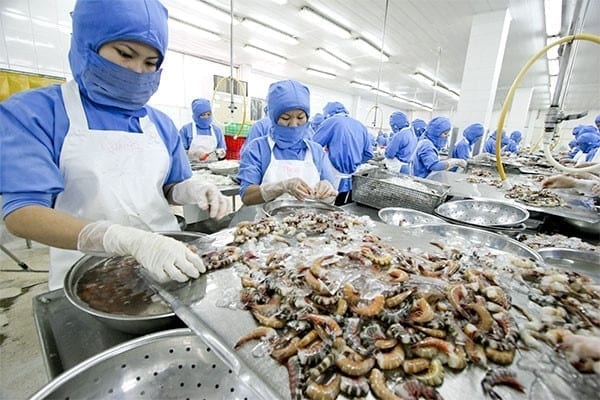
    Saudi Food and Drug Authority (SFDA) has decided to temporarily suspend the import of fish and shrimps from Việt Nam.

    The ban, effective from March 1, is in accordance with the regulatory procedure for fish and other aquaculture export establishments of SFDA, according to a note published on the Saudi Aquaculture Society’s website.

    The decision came after a delegation of several regulators, including SFDA, Ministry of Environment, Water and Agriculture and Saudi Aquaculture Society conducted an inspection tour last month to 24 Vietnamese facilities that exported to Saudi Arabia.

    The delegation found that only nine facilities met the hygiene requirements of Saudia Arabia.

    The suspension will be in place until the facilities complied to Saudi Arabia’s requirements.

    This is one of the most serious actions by Saudi Arabia against Vietnamese exporting firms.

    The Việt Nam Sanitary and Phytosanitary Notification Authority and Enquiry Point under the Ministry of Agriculture and Rural Development on January 30 also announced the SFDA’s notice about the temporary ban.

    The notice said that Saudi Arabia was instituting the emergency measure to prevent the introduction of white sport disease and acute hepatopancreatic necrosis disease into the country.

    The Việt Nam Sanitary and Phytosanitary Notification Authority and Enquiry Point urged relevant agencies to raise appropriate measures to tackle this problem.

    SFDA has also temporarily suspended the import of aquaculture products from Bangladesh and Myanmar and farmed fish from India, according to Saudi Aquaculture Society.

     

  • China authorises 22 Vietnamese rice exporters

    China authorises 22 Vietnamese rice exporters

    China has authorised 22 Vietnamese businesses to export rice into its market, Việt Nam’s Ministry of Agricultural and Rural Development (MARD) announced.

    China’s General Administration of Quality Supervision, Inspection and Quarantine (AQSIQ) has given only 22 firms permission to start exporting rice and rice products starting January 1, counting from the date of departure from the Vietnamese border.

    Any businesses not listed by AQSIQ will be banned from exporting to the Chinese market from January 1, the ministry’s Plant Protection Department (PPD), which received the related documents from AQSIQ on December 23, said.

    The PPD has notified the Vietnam Food Association, sterilisation companies for exported rice and the 22 listed businesses, and published the list online at www.ppd.gov.vn

    The PPD has ordered the 22 companies to comply strictly with the regulations on food safety and plant quarantine set by both Việt Nam and China. It has also urged sterilisation companies authorised by the AQSIQ to work with rice exporters to maintain the quality of the rice and ensure there are no storage pests.

    The AQSIQ has issued the list after carefully considering numerous Vietnamese businesses that had applied for permission to export. A group of Chinese experts had travelled to Việt Nam to inspect 31 enterprises that had previously applied to the local ministry for export rights to China.

    Among the several countries that import Vietnamese rice, China tops the list with 35.4 per cent of market share in the first three quarters of 2016, according to MARD.

    The total rice export turnover into the Chinese market touched 1.35 million tonnes amounting to $613.4 million, down 23 per cent in terms of quantity and 13.9 per cent in terms of value as compared to the same period in 2015.

  • Government to take firm action against illegal textile imports

    Government to take firm action against illegal textile imports

    The government plans to take firm action against illegal imports of textile and textile products as these have been hindering business and impacting ind ustrial growth in the manufacturing sector.

    “We will take firm action against importers who have so far misused facilities to avoid official levies by the government,” Finance Minister Sri Mulyani said at a press conference here on Thursday.

    She stated that strengthening the textile industry and the textile products sector was very important as this sector has been asked to increase production to boost national exports.

    Smuggling of used clothes into several regions of the country to meet the increasing demand for cheap clothes has been disrupting growth of textile and textile products sector.

    Certain people were illegally importing products. These people held import licenses to transfer goods to other parties. Businessmen dealing in textile and textile products exploited these licensed importers.

    “We will enforce the law. We have invited police officers to a meeting attended by the chief of the crime investigation department to take a stronger and more consistent action against illegal imports,” she assured.

    Sri Mulyani informed that she would also invite other ministries to review regulations relating to textile and textile products imports. Some of these regulations overlap and run against the needs of the public, trade and industry.

    The TPT (textile and textile products) is a labor intensive industry that can absorb a lot of workers and even create new jobs in the distribution and trade sectors, she added.

    In 2016, Indonesias TPT exports contributed 9.61 percent to the total non-oil and gas exports, which is the second highest after palm oil exports, recorded at 10.3 percent.

    Based on national law enforcement data in 2015, 162 cases of smuggling were aborted by the Directorate of Customs and Excise of the Ministry of Finance. Until October this year, 151 cases of TPT smuggling cases had come to light.

    The Directorate of Customs and Excise would tighten coordination and supervision in cooperation with the Corruption Eradication Commission, the Indonesia Police, the Ministry of Trade as well as the Ministry of Industry to solve the TPT import problem.

    With improved TPT import policies and their implementation, the national manufacturing industry is expected to grow while domestic prices of TPT would be more stable and state revenues more optimal.

  • No more rice imports this year

    No more rice imports this year

    President Joko Widodo (Jokowi) has assured that Indonesia will not import rice at the end of this year because the countrys rice stock is adequate until May 2017.

    Rice production has increased dramatically from some 1,030,000 tons during September to October 2015, to 1,990,000 tons in October 2016.

    The increase was merely thanks to prime paddy seed utilization and adequate rainfall.

    The government will focus on increasing the rice stocks before deciding to export rice later, he said, after witnessing a grand harvesting of Super Jajaran Legowo-type paddy in Trayu village, Banyudono sub-district, Boyolali.

    Boyolali is also a pilot project for Inpari 32 paddy variety.

    “Later, if it is successful, we will expand it and multiply it in order to significantly increase the national rice production,” the president said.

    At noon, President Jokowi and First Lady Iriana were scheduled to observe the 36th anniversary of World Food Day to be held at the Boyolali square.

    Boyolali is known as a region which has successfully implemented the food production diversification program. The district produces among other things Tongkol 2 Prolific hybrid maize and Jajar Legowo-type paddy.

    Home Affairs Minister Tjahjo Kumolo and Head of the Presidential Staff Teten Masduki joined the presidential entourage.

    FAO celebrates World Food Day each year on October 16 to commemorate the founding of the Organization in 1945.

    Events are organized in over 150 countries across the world, making it one of the most celebrated days of the United Nations (UN) calendar.

    These events promote worldwide awareness and action for those who suffer from hunger and for the need to ensure food security and nutritious diets for all.

    FAOs global message for World Food Day 2016 is “Climate is changing. Food and agriculture must too.”

    It resonates with the crucial time in which the day will be observed, just before the next UN Climate Change Conference, COP 22, from November 7 to 18, 2016 in Marrakech, Morocco.

  • Imports in September down 8.78 percent

    Imports in September down 8.78 percent

    The value of imports in September, which amounted to US$11.30 billion, has dropped by 8.78 percent compared with the previous month, which was US$12.38 billion, the Central Bureau of Statistics (BPS) has said.

    “Indonesias imports in September 2016 amount to US$11.30 billion, down 8.78 percent from August, or down 2.26 percent if compared to September 2015,” BPS chief Suhariyanto said at a press conference in Jakarta on Monday.

    Suhariyanto said non-oil-gas imports in September were valued at US$9.55 billion, down 9.77 percent compared to the previous month. Compared to September 2015, these imports dropped by 0.95 percent.

    Oil and gas imports in September stood at US$ US$1.74 billion, down 2.97 percent compared to the previous month, and down 8.88 percent compared to last September.

    In September, cereal commodities such as wheat touched the highest value in import items at US$39.0 million, or 19.17 percent, while the steepest drop was in the machinery and mechanical equipment category, whose value was US$98.9 million or 5.17 percent.

    The cumulative value of imports from January to September crossed US$98.69 billion, down 8.61 percent compared to the same period last year. The cumulative value of oil and gas imports was US$13.74 billion, down 29.19 percent; non-oil imports were valued at US$84.95 billion, down 4.10 percent.

    The top three countries for non-oil imports in the January-September period were China with a value of US$21.99 billion, or 25.88 percent; Japan with US$9.48 billion, or 11.16 percent; and Thailand with US$6.64 billion or 7.81 percent. “Non-oil imports from ASEAN countries touched 21.82 percent, while from the European Union it was 9.17 percent,” Suhariyanto said.

    The import values of auxiliary raw materials from January to September decreased by 9.8 percent and capital goods by 12.66 percent. However, imported consumer goods shot up by 12.80 percent.