Tag: instagram

  • How to be a successful KOL in China?

    How to be a successful KOL in China?

    Why luxury brands willing to expand in China seems to never get enough of  so-called KOLs (key opinion leaders) Tao Liang, nickname “Mr bags”, is a graduate of the University of Southern California and Columbia University. Although he is only 26-year-old, he has already become one of the most successful digital influencers in China, in terms of the ability to drive sales.

    People call him Mr Bags because Liang has an unapologetic love for handbags. So, he has worked on capsule collections with different luxury brands such as Givenchy, Longchamp and Montblanc, boasting a huge following on WeChat and Weibo, which are two of the largest social media networks in China. And he also knows how to sell them to his over 3.5 million readers on China’s biggest social media platform Weibo and more than 850,000 followers on WeChat, a microblogging messaging app.

    In just six minutes, Liang helped Tod’s sell 3.24 million RMB worth of handbags on his new Mini Program shop within WeChat, called “Baoshop.” The second collaboration between the Beijing-based fashion blogger and Tod’s, 500 pieces of the limited-edition “Wave” backpacks were created — double the amount from last year’s capsule collection.

    But how did Liang become a sort of “bag whisperer”? He says that when he was studying in the universities in Los Angeles and New York, he fell in love with luxury bags and loved going on shopping sprees with his friends. It didn’t take long for him to realize that he could turn his passion for handbags into a full-time job but even after he started getting some traction while still in the US, his parents were not entirely happy with his career choice. “Only after I started working with big brands and celebrities like Fan Bingbing they thought that perhaps this was a real business,” he says.

    One issue that often comes up with KOLs is authenticity. When you work with different brands, how do you maintain your integrity without alienating your fans, who trust your opinions to be genuine and unbiased? “This is key for me and I really try our best to maintain that,” says Liang. “One of my advantages is that until not long ago I was based in the US so I wasn’t exposed to all the brand partnerships and advertising that the KOLs were doing in China so my content was 100 per cent pure editorial, but then I started working with brands and get first hand information while also giving my followers the right information and guidance.”

    So how does Mr Bags, a young man with an innate fashion sense and an encyclopedic knowledge of handbags, guide his followers and win their trust? He only works with brands that his fans “naturally love” and turns down offers all the time. Liang’s fan base is mostly female, and he feels that being a man is not a hindrance. On the contrary, by virtue of being a guy, he is able to provide useful and unbiased advice.

    “My name is Mr Bags and lots of people find this name interesting but also confusing because generally bags are for women,” he says. “Normally when girls shop for a bag they don’t think too much and buy it right away, on impulse, so I help them think more rationally. For example, I categorize all the bags and tell them which ones are the classic pieces and the ones that have more staying power and the most iconic ones so I provide some logic behind their purchases. I think that as a guy I’m more objective and I can give them useful tips. I tell them that if you buy a bag that you can use in your life and enjoy it then you feel that your money is well spent and worth it.”

    Liang believes that his editorial work must come first.“Many people think that KOLs just have fancy lives and go everywhere for fun but in China we have so many channels, like WeChat and Weibo, so it’s really a lot,” he says. “I was just updating my channels on the way here. Editorial content is more important for me; 60 per cent of what we do is still editorial.”

    Achieving the right balance between authentic content and remunerative ad-driven projects is the key factor for being a successful KOL, something that is not always as easy as it seems but Liang has already mastered so far.

  • 8 Easy Startup Ideas For Asia

    8 Easy Startup Ideas For Asia

    We live in the times of so many possibilities. Therefore starting a new business to earn some extra money could be very easy and done very quickly wherever you are – it could even be Asia. People are really into new technologies there at the moment, especially mobile payments through various apps, so you could use the benefits of  this trend for your business idea.

    If you love the idea of making some money on your own, here you’ll find some original ideas you could use for your startup and maybe even start today.

    Specialist Of Education Progress Tracking

    Every parent wants their kid to do well at school and gain the best education possible. That’s why there are so many freelance tutors that help kids and students learn the subjects that they are failing at.

    An education progress tracking will help you reach the best result possible. This is done by tracking the progress of your child and comparing it to other students who are moving up to a similar goal. For example, the same degree in business management or biotechnology. Many criteria need to be evaluated and compared, like grades, honors, certificates, additional skills, and so much more.

    Develop An App For Coworking

    Coworking apps are in demand both for teams in creative and non-creative agencies and also for study groups. Therefore if you are not completely new to coding, you could build an entire network where people could work together on a digital platform. Surely there are already some apps that allow you to share, comment files, and work on projects together, but you can always research your competitors and make an even better product. Simply detect what’s lacking in these apps.

    Print On Demand Business

    Print on demand businesses are getting really popular lately. That is because it doesn’t require any investments and therefore is a perfect startup idea for young people like students. The best part is that you don’t need to be responsible for keeping items in stock, producing it or putting logos on it.

    One of the most popular forms of print on demand business is selling t-shirts. All you’ll need to do is come up with the design. If you want to learn more about how to sell t shirts online – there are POD platforms like Printify that are very easy to use and offer you articles that help improve your business.

    App For Acting

    This could be a similar idea to SnapChat or Instagram Stories, but with a completely different concept. Friends would be able to create short videos with specific timing, for example, 20 seconds. And other friends would have to continue the story. After finishing a story, you could watch it as a single movie clip. To access a group, you should have a special code, link or different kind of key to access. Some groups could be open to everyone thought.

    Job Interviews On Video

    Image credit: Seth Doyle

    Wasting time always means wasting money. Companies and their hiring specialist waste tons of time trying to find the best candidates for one or another job position. It’s hard to imagine, how many time has been wasted on candidates that weren’t a good fit for the company.

    And you could be the one to offer these companies a solution and create a platform with already prepared video interviews. They would be short and very specific – candidates would be asked a few questions and answer it on camera. This could be a really good filter for the hiring specialists.

    Local Social Media Network

    Social media is extremely popular nowadays. But what if you were to create a new platform that would be based only on location? You would be capable of connecting with people, see events and other information related only to the place you are currently in. This would filter out a lot of unnecessary information that we see on our Facebook every day.

    Create An App For Recycling

    Image credit: Paula Brustur

    A lot of people today care about nature and recycling, but really lack knowledge about ecology and how it works. It’s hard to determine what is truly toxic for us and our environment and sometimes we just don’t know how to properly utilize specific products.

    If you were to create a recycling app, it could help people understand recycling more, especially with all the pollution is Asia. For example, if someone would be thinking how to recycle one or another item the right way, they could type the product in your apps search and quickly find an answer.

    Sell Your Own Crafts

    If you have some skills for crafting, you should know that it’s a very trendy thing to do at the moment. Especially things like handmade jewelry and gifts. You could sell your crafts on Etsy, but you can also create your own e-store. All you need is to buy a domain, choose the design and add all needed forms for orders and contacting.

    To save some money, don’t pay the programmers for creating the forms for you, simply use CaptainForm wordpress form plugin that will offer you all the forms your website might need.


  • Post-Instagram age : What’s next?

    Post-Instagram age : What’s next?

    Oscar de la Renta was early to Twitter, early to Tumblr and, yes, early to Instagram. So in July 2013, when the American fashion house debuted its fall advertising campaign via the app, the industry was hardly surprised. It was a little thing. An experiment. After all, the Norman Jean Roy-shot images would still run in the September issues of every major fashion magazine.

    Actually, it was a “really big deal,” recalled Jason Wagenheim, a former Condé Nast publishing star who was, at the time, Teen Vogue’s chief revenue officer.

    “That was a real tipping point for fashion,” said Wagenheim, who left the legacy publisher in 2015 and is now chief revenue officer of Bustle Digital Group.

    “Here is this expensive luxury brand and their fall campaign, which everyone looked forward to seeing in the print pages of Vogue; and yet everyone is talking about the engagement — the bajillion likes within hours — that the campaign got on Instagram. It foreshadowed that this could be bigger than any fashion magazine.”

    In reality, each of the Oscar de la Renta advertising images attracted not much more than 1,000 likes within the first hour of their posting.

    But the campaign was indicative of a much wider shift that has transformed fashion, changing how publishers publish, how brands brand themselves, and how consumers consume.

    Brands have closed, stores have shuttered, magazines have folded — and both survivors and upstarts alike are fighting for consumer dollars in a new world where the formula for success is not nearly as clear as it is once was.

    And no single entity has had as lasting an effect on the fashion ecosystem as Instagram, the photo-sharing service let loose on Apple’s App Store on October 6, 2010.

    Three years later, when Oscar de la Renta drip-dropped those images down its feed, traditional print magazines like Vogue were still the arbiters of style.

    It feels like a long time ago. But back then, their authority remained intact and largely unchallenged, despite the rise of independent publications that operated outside of the traditional publishing industry and the emergence of digital brands that sold directly to consumers.

    But it’s 2018 now, and times have changed.

    Instagram, which was acquired by Facebook for $1 billion in 2012, is where people now go to discover fashion content and, increasingly, to shop, with 72 percent of users saying they have made fashion, beauty or “style-related” purchases after perusing the app, according to a 2017 study of 2,000 Instagram users.

    Instagram claims that more than 90 million users tap to see tags on shopping posts each month.

    In some ways, it was inevitable.

    Americans spend only 4 percent of their media-technology consumption hours with print, compared to 20 percent on personal computers and 28 percent on mobile.

    Many of them are spending their mobile phone screen time on Instagram.

    In June 2018, the app surpassed the billion-users-a-month mark, up from 800 million users in September 2017. More than 400 million people use Instagram Stories — the app’s more casual slideshow feature — every day.

    Rival Snapchat had 186 million daily active users in its most recent quarter, down from 191 million at the beginning of the year.

    As of August 2017, Instagram users under the age of 25 spend more than 32 minutes a day on the app.

    But the number dips only slightly to 24 minutes for those older than 25. That’s length of a sitcom…or a scan of a magazine.

    Of course, fewer and fewer consumers are buying those magazines. And brands have responded by following consumers online and shifting their marketing budgets from print to digital.

    In 1998, US print advertising revenue was $61 billion.

    In 2008, it was $54 billion, just a 12 percent decrease despite rising internet usage.

    But in 2018, it’s set to clock in at under $15 billion — down a staggering 75 percent from 20 years ago.

    Brands are increasingly using Instagram — via both organic and paid posts — to communicate directly with consumers.

    “Given the rising importance of social media for luxury brands — especially in the context of millennial’s growth — we believe Instagram data can no longer be ignored as a data point for luxury investors, to help them pick the winning brands,” Swiss investment bank UBS said in a recent note, going on to say that high Instagram engagement was a dependable reflection of brand heat.

    There is an unmistakable correlation between the size of a brand’s Instagram following and its retail sales.

    So it’s no surprise that, in the second quarter of 2018, global advertising spend on Instagram was up 177 percent year on year, significantly ahead of Facebook, which saw 40 percent growth in the same period.

    While Facebook still generates the majority of the company’s revenue, which hit nearly $41 billion in 2017, analysts estimate that Instagram will generate $8 billion to $9 billion in 2018.

    Projections predict that Instagram will account for about a third of its parent company’s overall ad revenue — and 70 percent of its new revenue — by 2020.

    In some ways, Instagram is to fashion what Napster was to music.

    You still can’t download a dress, but Instagram has fundamentally rewired the industry, replacing print magazines as the primary way in which people discover fashion.

    It’s the foundation on which the industry has built everything from new labels to an influencer economy worth $1.6 billion in 2018.

    All of Fashion Uses Instagram

    Consumers were quick to embrace Instagram, thanks to its simple user experience and flattering, colour-washed filters that made even grainy images look a little bit more perfect.

    They posted photos of their food, their travels and, yes, their outfits. Fashion brands picked up on this quickly, realising that creating content on Instagram — a highly visual platform — would allow them to reach more customers, and soon found themselves locked in a race for followers.

    Even luxury houses like Chanel, which has resisted selling core products online, took it seriously, using the service to post runway looks, campaign outtakes and inspiration boards.

    Some — from Proenza Schouler to Kith — have used the platform to tease their latest collections instead of waiting for a live Fashion Week moment.

    Earlier this year, Dior used Instagram as the main vehicle for the promotion of the relaunch of its classic saddle bag, tapping more than 100 influencers to spread the word.

    While the campaign proved controversial — several of the influencers did not disclose that they were paid to post on behalf of Dior — it was a blockbuster success.

    The #DiorSaddle hashtag drove $3.4 million in earned media value in the third quarter of 2018, beating #PFW, which garnered $2.6 million in earned media for the same time period.

    But it goes beyond the legacy players. “Instagram brands” — mostly independent startups with minimal capital — have caught the eye of major retailers looking to woo increasingly discerning customers.

    Why? Because their audiences are highly engaged, using Instagram stories to shop and direct message — “DMing”, in Instagram parlance — with the brands themselves.

    Labels like Doen, Cult Gaia and By Far boast little-to-no presence at major fashion weeks or within the traditional fashion system, and yet they are the brands industry insiders are most curious about because of the communities that they’ve built on Instagram.

    While Los Angeles-based bohemian apparel line Doen has just about 140,000 followers, it DMs with members of its community every day.

    The result? The brand regularly sells out of its peasant blouses and prairie dresses, creating an online frenzy.

    Cult Gaia, another Los Angeles-based label, may only have 317,000 followers on the platform, but the company says that it is on track to generate $15 million this year: far more than many independent high-end fashion brands with, in some cases, millions of followers.

    Through Instagram, we’ve built our own community.

    Instagram influencers are also launching brands, many with great success.

    Arielle Charnas, the influencer behind the account Something Navy, sold more than $4 million worth of product on the launch day of her collection with Nordstrom.

    In fact, the American department store has released multiple influencer collections, all of which are promoted via Instagram.

    Then there is the creative community, including relatively unknown artists, illustrators and photographers — from Gucci collaborator Jayde Cardinalli to artist Suzanne Jongmans, who has worked with Valentino’s Pierpaolo Piccioli— whose work now has global reach.

    But for Charles Porch, Instagram’s head of global creative programs, the platform’s crowning fashion moment came in October 2015, when American Vogue editor-in-chief Anna Wintour held a dinner during Paris Fashion Week in honour of Instagram co-founder and chief executive Kevin Systrom.

    Together, they celebrated the “Instagirls,” or models who earned or boosted their fame through Instagram, including Kendall Jenner and Gigi Hadid. Donatella Versace was there. So was Pat McGrath. They, too, were hooked.

    “To see the biggest designers, models, people in the industry talking about how much they love the platform, giving their feedback and, actually, huge people being able to talk about the product in depth … seeing their passion for a tech product … that really clicked for me,” Porch said. “They’re in so deep.”

    Earlier that year, Porch had wooed Eva Chen, an Anna Wintour protégé and the former editor-in-chief of now defunct Condé Nast shopping title Lucky, to lead fashion partnerships at the company.

    If Instagram is the modern equivalent of a fashion magazine, then you could call Chen its de facto editor-in-chief.

    Her personal brand — warm, friendly and, yes, democratic — aligns almost too perfectly with that of the platform itself. With more than one million followers, she has developed her own hashtag, written a children’s book, set to be published later this autumn, and earned a seat on the YNAP’s board of directors.

    Part of Chen’s job is to convince fashion industry stars like Kate Moss and Donatella Versace to join and use the app. But most importantly, she helps brands, image-makers, publishers and influencers get more out of their Instagram accounts.

    Chen travels the world to help fashion brands, holding master classes — filled with executives from brands like Madewell, Birchbox and Ralph Lauren — where she offers step-by-step instructions on how to take a good photo, how to get the most out of Instagram Stories, how to use hashtags without spamming people. All things that, if done well, can help improve engagement — and potentially increase sales.

    She also advises them on how to spend their advertising money on the app, although, like a traditional editor-in-chief, she is not cutting the deals and is more focused on organic marketing.

    “Instagram has made fashion more accessible,” Chen said recently one late Friday afternoon at the company’s New York city offices, wearing a pair of brown Gucci loafers and a checked blazer, the sort of off-duty look preferred by many of her friends who remain in print media.

    The Collateral Damage

    In many ways, Instagram has helped to modernise the fashion industry.

    But what about the collateral damage left in the wake of its success?

    Brands are not only pulling advertising from print, but also from legacy publications in general.

    While traditional publishers are still earning a part of the digital pie, brands are splitting up their marketing spends differently than they used to.

    Today, they might devote a certain percentage of budget to influencer marketing, and another slice to advertising directly on Instagram and other social media platforms.

    Oscar de la Renta has been using Instagram as an organic marketing tool for years, but it wasn’t until recently that it began spending a significant amount of its budget there.

    Three years ago, less than 5 percent of the overall budget was dedicated to digital advertising.

    For the spring 2019 season, it will be at least a third, said chief executive Alex Bolen, a portion of which will be spent on Instagram.

    Some brands are taking even bigger swings.

    About 55 percent of Gucci’s total 2018 media spend will go to digital efforts — mostly native advertising and paid social — per a report released by the Kering-owned brand in June. That is up from 44 percent in 2017 and 33 percent in 2016.

    And digital retailer Net-a-Porter has eliminated all national print advertising for 2018 bu for a few ads which will still run in local publications.

    Critically, the retailer also has its own newsstand-available magazine, Porter, that serves as a several-hundred-page advertisement.

    But moving away from print was not a small decision.

    “Instagram is where our customers expect to find us,” said Net-a-Porter managing director Matthew Woolsey.

    “Social media platforms certainly rise and fall, and while our outlook is agnostic, we are going to the platforms that enable us to have the brand conversation that we want to have and emotionally connect. Instagram does enable that.”

    Then there’s the talent drain.

    Image-makers and writers who would have normally held positions within legacy publications are now fleeing to digital-first publishers as well as brands, which are creating more content in-house to populate social channels.

    Many are also working independently as free agents, using Instagram to promote their projects.

    What’s more, declining advertising revenue means that there is less job security within traditional editorial.

    Today, editors might have to work across multiple publications within a company without any sort of raise or recognition. Going it alone often makes more fiscal sense.

    Legacy publications that cater to an older, affluent audience still have clout.

    As do those that still resonate with the industry.

    Doen — known for dreamy imagery and romantic silhouettes, created in limited-edition batches that often sell out — credits Instagram with much of its success.

    But it uses traditional media as a way to communicate to the trade.

    “Those are more of a tool to establish us as a brand within the fashion community,” said Doen co-founder Katherine Kleveland.

    “Through Instagram, we’ve built our own community.”

    But what happens if that community goes away?

    Testing Instagram’s Staying Power

    Eventually users will abandon Instagram.

    The question is when.

    Digital consumers can easily switch from one platform to another, making loyalty low.

    How long can Instagram keep them entertained?

    In September, the company made two significant announcements that could impact that answer.

    First, there was the introduction of new shopping features that make it easier for users to transact via the app.

    Then, just a week later, co-founders Kevin Systrom and Mike Krieger, who had carefully guided the business since its inception, announced their resignations.

    Reports in The New York Times and technology site Recode suggested that the two founders felt that parent company Facebook was moving too fast to change — and commercialise — the product, sacrificing the simplicity that made Instagram so popular in the first place.

    As Instagram has become the ultimate browsing tool, it has also become increasingly transactional.

    The company encourages this behaviour by making it easier for paying advertisers to link out and run targeted advertising both within the feed and Instagram Stories.

    Business accounts can also link out through Instagram Stories and tag products within posts.

    The addition of these tools is a natural — and welcome — progression, said Lauren Price, director of client strategy for luxury and special retail at research firm Gartner L2.

    “It doesn’t feel like it’s a huge divergence from the way that brands and consumers have used Instagram from the get-go,” she added. “The intention [to shop] has always been there.”

    After rumours that it would launch a standalone shopping app surfaced, Instagram announced that it would instead introduce a shopping channel on its “Explore” page, populated with products from brands the user follows, but also brands surfaced by its recommendation engine.

    While it is not yet possible to shop within the app, the company has linked up with major e-commerce providers including Shopify to ensure that the transition from post to check-out cart is as frictionless as possible.

    “Personalisation is a key principle,” said Layla Amjadi, Instagram’s product lead on Shopping. “In Explore, we want to make sure it’s your personalised mall.”

    Instagram insists that its focus remains on the user. That discovery is still the soul of the product.

    “Shopping is an inspiration-first product,” Amjadi said. “It maps to your interest, leans into relationships that you have… and is fantastic opportunity to help with consideration.” By “consideration” she means, “Should I buy this?”

    But as Instagram becomes more transactional, does it risk losing some of its magic?

    “I think it’s fine [for shopping] to be a part of the functionality,” said L2’s Price. “If you’re following a brand, you’re aware that it’s a brand.”

    The trouble comes in if Instagram integrates too deeply with Facebook and turns more into a pay-to-play platform.

    Right now, 93 percent of brands that advertise on social media advertise on Facebook, which prioritises advertising and organic posts from friends and family over organic posts from brands in its algorithm.

    “I advise the brands that we work [with] to get the most value out of that organic growth on Instagram in case it does change,” Price added.

    New Instagram head Adam Mosseri, the former vice president of the Newsfeed at Facebook, one of the platform’s most successful — and polarising — products, is said to have been Systrom and Krieger’s choice to lead the app into this next phase.

    But Mosseri has quite a bit of work ahead of him.

    Social networks fade as users grow tired of relentless promotions and frustrating user experiences.

    “You could certainly argue that there is an inherent scaling to the point of collapse in a social newtowrk,” said Benedict Evans, a partner at Silicon Valley-based venture capital firm Andreessen Horowitz.

    “But there isn’t an obvious next thing.”

    On the fashion front, competitors like YouTube and Snapchat are also hip to the success Instagram has seen with Chen, hiring fashion insiders Derek Blasberg and Vogue editor Selby Drummond, respectively, to head up fashion partnerships.

    And brands are likely to find it increasingly difficult to stand apart on Instagram, where they are competing for attention not only within their peer group, but with brands of all price points, quality and missions.

    The cost of advertising on the app will likely increase, as will the investment brands need to make on quality organic content.

    What if Facebook’s drive to squeeze more revenue out of Instagram makes it a less-fun experience?

    What’s more, if this “time well spent” movement actually catches on, how will this affect the new world order?

    Special interest groups are lobbying the government and private companies to better regulate the technology that powers social media.

    Instagram itself has contributed to this conversation, testing a feature that allows users to monitor their time on the app.

    Overall, fashion is still bullish on Instagram and eager to see what an easier shopping experience can do for its top line.

    For instance, the app’s bookmarking tool could be used, like Pinterest — a platform many brands still spend marketing dollars on — as a shopping list.

    If consumers continue to seek out Instagram for the fun stuff, and if Instagram can contain more of that fun stuff within the app, it could lead to more content creation, more talent discovery and more sales.

    “I don’t think Instagram is going anywhere,” Bustle’s Wagenheim said. “I feel like there’s a big opportunity to open the gates.”

    Of course, right now, fashion doesn’t really have a choice but to hope that’s the case.

  • Keeping Up with the Centennials:  Buy Social, Pay Offline

    Keeping Up with the Centennials: Buy Social, Pay Offline

    Dentsu Aegis Network, in collaboration with Econsultancy, today launched Here Comes the Centennial: Southeast Asia’s New Generation of Shoppers, a white paper investigating the online buying behaviour of centennials – consumers of the future – in the region. Launched on the sidelines of FUTR Asia 2018 Summit, the study finds that, despite the surge in online shopping, cash is still king for centennials in the digital age, and shopping on social media platforms is the new norm.

    Despite being digital natives, the concept of a cashless society has yet to fully take off for centennials in six countries surveyed, as 56% of survey respondents still prefer paying cash on delivery for their purchases. The next generation of online shoppers also enjoy having a variety of payment methods, as 43% of centennials will readily abandon their purchases because their preferred payment option is not available.

    Having grown up in the smartphone era, centennials are also using social media platforms differently compared to previous generations in their buying journey. Social media applications (47%) such as Facebook and Instagram are the second most popular place for centennials to shop in. Close to half of the survey respondents (49%) also turn to social media when they are researching for more information on their future purchases, rather than asking friends (45%) and family (27%).

    Nick Waters, CEO of Dentsu Aegis Network Asia Pacific, said: “All eyes are on Southeast Asia as the world’s next consumer powerhouse, with its young population and increasing purchasing power. Close to 280 million centennials – tomorrow’s consumers – call this region home. Enabled more than ever before by technology and data, we are seeing incredible potential for growth in the region and our latest research ‘Here Comes the Centennial: Southeast Asia’s New Generation of Shoppers’, helps us understand what is important for these consumers of the future and how businesses can adapt and position effectively for Southeast Asia’s future retail landscape.”

    Brand name and image is no longer a priority of centennials, making end-to-end brand experience more important than ever for retailers. Only 11% cite having a prestigious or famous brand as one of their top three attributes when choosing where to shop. This means retailers need to work harder to get their brand experience perfect in order to capture the attention of tomorrow’s consumers.

    Who are the Centennials? Why are they important?

    Centennials – also known as Generation Z – are those who are born between now and 1995. Accounting for about 277 million of Southeast Asia’s population, 50% of centennials spend more than USD30 a month on online shopping, while 9% spend over USD100 monthly. The size of this new generation alone makes them attractive for retailers, but the behaviours of this group make them lucrative in terms of its online shopping and ecommerce potential.

    This new generation will also soon be one of the world’s most demanding consumers who have high standards and expectations of the online shopping experience. Technology should be an integral part of this experience, as 82% of centennials are excited about futuristic shopping technology such as virtual reality. Personalisation is key as well, as 76% of respondents are happy to share data with websites, if it makes more relevant recommendations.

    Jefrey Gomez, Managing Director, Econsultancy Asia Pacific, said: “Centennials are coming of age in an era when high speed internet is always available, and they expect technology and brand experiences that are fast, responsive, and seamless. The survey showed that 86% of centennials will not use an app or website that takes too long to load and 82% will not use an app or website that is difficult to navigate. This means that retailers can therefore no longer just provide well-designed stores or rely solely on brand campaigns to drive sales. Instead they need to focus on the utility of their online offering to make the purchasing journey easy to complete.”

  • Zong 4G partners with Instagram

    Zong 4G partners with Instagram

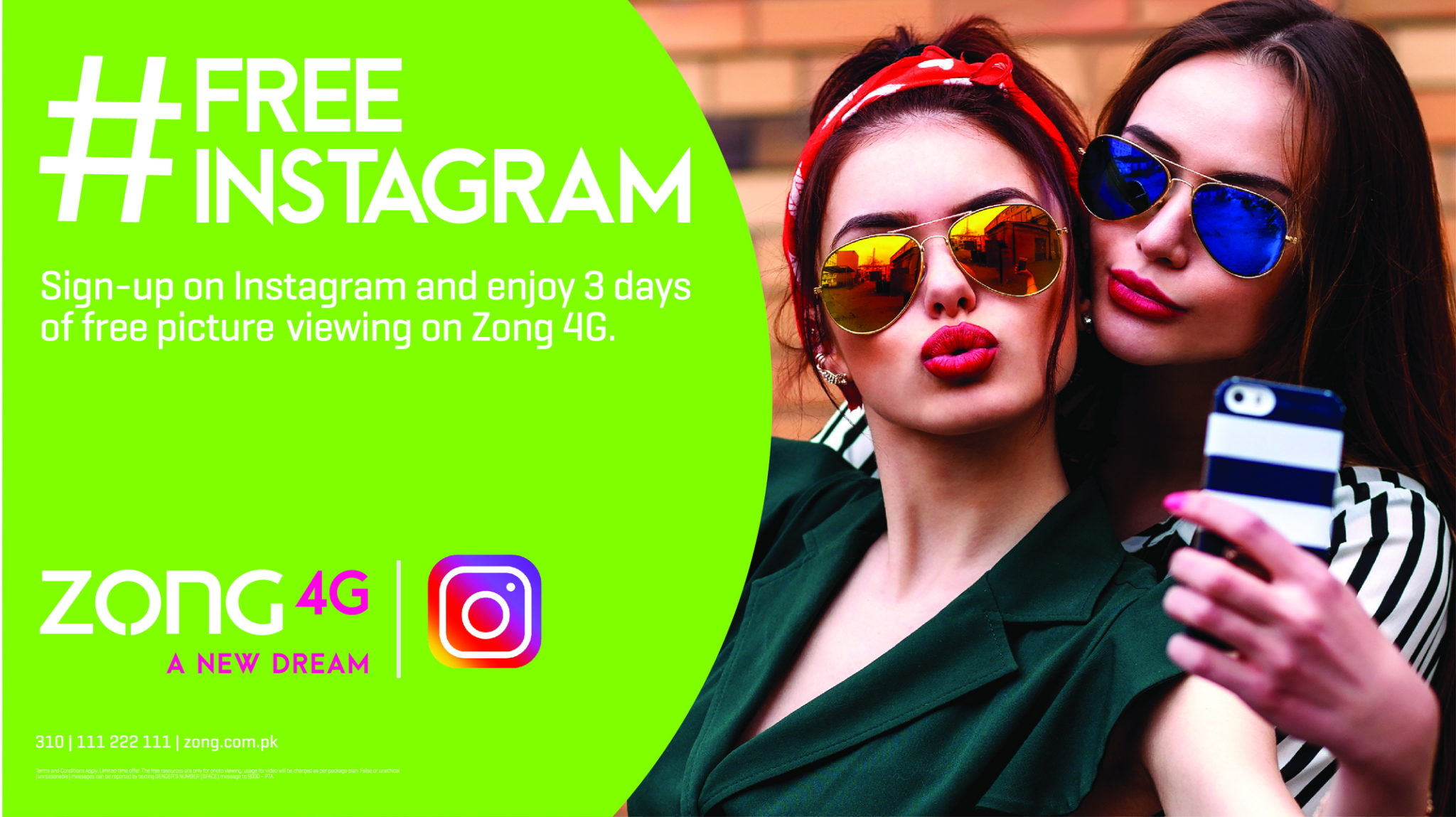
    Pakistan’s No. 1 Data Network Zong 4G and the World’s Leading Photo Sharing Network Instagram, announced the availability of an integration between the two digital service providers. Zong 4G’s prepaid subscribers who sign up on Instagram for the first time will be able to enjoy picture viewing for free in the first 3 days. Followed by WhatsApp, IMO, and free Facebook service, Zong 4G once again has risen up as the first telecom operator partnering with another social media giant, Instagram. The one of kind and exclusive offer by Pakistan’s fastest 4G network, Zong 4G for its customers is unmatched offer, which no other telecom service provider in Pakistan is offering.

    This is a new highpoint for the Pakistani customers. Their connected journeys across both the digital service providers allows for a superior experience that is unmatched in the telecom sphere. Subscribers can get to experience the fastest 4G service, wherever and whenever over free picture viewing. To add to their convenience, Zong 4G has ensured that subscribers get a seamless 4G experience as they do not need to activate the offer via a code. All they have to do is sign up on Instagram and enjoy this offer.

    The strategic partnership is a natural one, given the existing partnership between Zong 4G and Facebook. Facebook is a social networking service that also owns Instagram and WhatsApp. Apart from this, Zong 4G has created ripples across Pakistan’s telecom spectrum in recent months with its technological supremacy by launching state of the art e-commerce applications. Since inception, Zong’s three E-commerce channels: E-Care, Online Recharge and Online Shop have hit the telecom world with a bang – to facilitate its subscribers that have exceed the massive 8 million mark in the shortest possible time.

    With diverse lifestyle choices of its customers, Zong, Pakistan’s largest 4G service provider, promises to continue to play a significant and impactful role towards faster, smarter and better services towards user data experience in its own aspiring style.

  • Facebook just lost two top executives

    Facebook just lost two top executives

    Facebook just lost two of its top executives, with Instagram co-founders Kevin Systrom and Mike Krieger announcing their departures.

    They join at least seven senior Facebook executives who have announced their departures this year.

    “Kevin and Mike are extraordinary product leaders and Instagram reflects their combined creative talents,” Facebook CEO Mark Zuckerberg said in a statement. “I’ve learned a lot working with them for the past six years and have really enjoyed it. I wish them all the best and I’m looking forward to seeing what they build next.”

    The departures come at a tumultuous time for Facebook, as it continues to lose senior executives. The company — which calls its top ranks a family and prides itself on keeping executives around — has been battling privacy scandals and declining community support.

    Instagram had become something of Facebook’s shining star, so the simultaneous exits of its two founders leave some big shoes to fill.

    Here are some other Facebook executives who have said they’re leaving so far in 2018:
    Jan Koum, co-founder of Facebook-owned WhatsApp, announced his exit in April in a Facebook post saying it was time to “move on.”

    “I’ve been blessed to work with such an incredibly small team,” Koum said in a statement at the time. “The team is stronger than ever and it’ll continue to do amazing things. I’m taking some time off to do things I enjoy outside of technology, such as collecting rare air-cooled Porsches, working on my cars and playing ultimate frisbee.”

    Koum led WhatsApp for nearly a decade and joined Facebook’s leadership team in 2014 when the social media giant bought WhatsApp for $19 billion.

    Elliot Schrage, head of communications and public policy, said in June he was leaving Facebook after more than 10 years.

    “I’ve decided it’s time to start a new chapter in my life,” Schrage said in a post to his Facebook page. “Leading policy and communications for hyper growth technology companies is a joy — but it’s also intense and leaves little room for much else.”

    Schrage didn’t address his next steps, but did include lengthy praise and words of gratitude for Facebook, Zuckerbergand COO Sheryl Sandberg.

    In July, Colin Stretch, Facebook’s top lawyer, announced he’d be leaving the company after more than eight years.

    “When my wife Alyse and I made the decision a few years ago to move back to DC from California, we knew it would be difficult for me to remain in this role indefinitely,” he said in a Facebook post. “As Facebook embraces the broader responsibility Mark has discussed in recent months, I’ve concluded that the company and the Legal team need sustained leadership in Menlo Park.”

    As general counsel, Stretch represented Facebook before Congress to address Russian interference in the 2016 presidential election.

    “I often stop myself and ask how I got so lucky to be a part of this,” Stretch said in the post announcing his exit.

  • Burberry is launching ‘See Now, Buy Now’

    Burberry is launching ‘See Now, Buy Now’

    British luxury fashion house Burberry is releasing a see-now, buy-now collection exclusively on Instagram and WeChat.

    Limited-edition pieces from the collection, the first released under the Burberry label by designer Riccardo Tisci, will be made available through 24-hour product releases on the two platforms. The inclusion of WeChat on the see-now, buy-now program illustrates the importance of the Chinese market for the brand.

    A physical sale for the collection will be held in the Regent Street, London flagship store at 5.30 pm on September 17, immediately after Tisci’s runway presentation at London Fashion Week. The store will be visually transformed under a Tisci-designed concept for the 24-hour sale.

  • A US$1 Million post – Instagram’s most paid celebrities

    A US$1 Million post – Instagram’s most paid celebrities

    After having its net worth valued at US$900 million by Forbes earlier this July, Kylie Jenner has now become the world’s most paid Instagram celebrity according to HopperHQ.com’s Instagram Rich List 2018.

    The annual ranking reveals which celebrities, athletes, models and influencers generate the most revenue from posting on the famous social media platform.

    Estimated at $400,000 in 2017, the youngest of the Jenner-Kardashian clan now reaps $1 million per sponsored post that she shares with her 111 million Instagram followers.

    With her 139 million followers, Selena Gomez trails in second at $800,000 per post despite having more followers.

    Surprisingly, Kim Kardashian and Beyoncé are relinquished to the 4th and 5th spot as famous football player Cristiano Ronaldo takes the 3rd position; earning roughly $750,000 per post.

    Discover the top 10 below:

    1. Kylie Jenner — $1,000,000 per post
    2. Selena Gomez — $800,000 per post
    3. Cristiano Ronaldo — $750,000 per post
    4. Kim Kardashian — $720,000 per post
    5. Beyoncé Knowles — $700,000 per post
    6. Dwayne Johnson — $650,000 per post
    7. Justin Bieber — $630,000 per post
    8. Neymar da Silva Santos Junior — $600,000 per post
    9. Lionel Messi — $500,000 per post
    10. Kendall Jenner — $500,000 per post


  • How to maximise instagram as sales channel

    How to maximise instagram as sales channel

    Retailers who want to sell on Instagram might be surprised how easy and effective it is – for businesses both big and small.

    According to one research study, 75 per cent of Instagram users who follow businesses take some form of action, whether it be visiting a site or making a purchase, after seeing a promotional post.

    Of course, to leverage this platform to its full potential, it helps to keep certain points in mind. Just like when advertising on Facebook, you must follow best practices to successfully sell on Instagram. The following tips will help you maximise your profit when you sell on Instagram, by developing marketing campaigns that work.

    Treat your Instagram page like your website

    The rise of social media platforms has fuelled growth of digital marketplaces, where many customers don’t actually visit a company’s website when they first encounter a brand online. Instead, they view its social media page as a substitute for the site.

    So it makes sense to optimise your Instagram account by including a thorough summary of your business and all it offers. You should also select a profile picture that represents your brand. Furthermore, be sure to post any relevant visual content featuring information that your customers might find out about via your website. This may be something simple like information about an upcoming sale or promotion, but it’s still important to promote via Instagram.

    Create ads

    Instagram, like Facebook, allows users to create business accounts and advertisements.

    Once you sign up, the platform will seamlessly guide you through the process of creating and publishing an ad.

    Luckily, you don’t need to create unique content for your ad if you’ve already shared a post that highlights the same key information. A major bonus of the platform is that Instagram lets users turn regular posts into ads if they choose. Experiment with different types of ads to determine which are most effective for your business.

    You may also want to consider creating an ad using the new Instagram Stories format. This provides a more immersive visual experience, as it takes up a device’s entire screen by playing vertically. Since Instagram users view 60 per cent of stories with the sound on, it also gives you an opportunity to incorporate engaging audio content.

    Let users make purchases via the app

    Instagram posts can be an effective way to direct users to your online store to make a purchase. That said, one valid concern is that users will get distracted before completing the transaction. It would be easier if they could simply purchase an item directly via the app.

    Thanks to features like Shopify’s Shoppable Instagram Galleries, they can. This tool lets you tag items in posts that are for sale, meaning users no longer have to leave the app to make a purchase. Instagram has also begun working on a similar feature for business accounts.

    As always, it’s important to ensure your posts look appealing and accurately represent your products. Fortunately, social media marketing makes A/B testing very easy. As you experiment with different strategies, you’ll learn exactly what works best for your future Instagram campaigns.

  • Instagram stories, new shopping windows

    Instagram stories, new shopping windows

    Facebook’s Instagram is letting people shop directly from its Stories, opening up a direct way for people to buy what they see.

    Starting on Tuesday, some retailers, including Adidas, Aritzia and The Kooples can tag and link directly to their products. Instagram users can click on the link and buy the item directly, without having to leave the app.

    The shopping function becomes very interesting when it relates to video. Coupled with Instagram’s reported plans to launch its own exclusive longer-length series, it’s plausible to think that one day a person could be watching a show on Instagram, see an actor or social media star wearing or using a certain product, and then tap on the link to buy that item directly.

    Although the buy links are free for companies to use, if more customers start shopping through Instagram it could get marketers to move their money to the platform. This click-to-shop feature could be a more compelling way to get to shoppers than a traditional TV commercial, allowing the Facebook company to dip into the nearly $70 billion brands are expected to spend on commercials this year.

    Instagram overall has 800 million daily active users — the Instagram Stories feature alone has 300 million daily users. It is especially popular with young adults, with 71 percent of 18- to 24-year-olds using the app according to Pew. Instagram Stories could be a way to get products in front of an audience that’s watching less TV.

    Allowing sales from Instagram Stories could also take money away from Google’s YouTube, which has its own shoppable feature. And it makes it a stronger competitor to Snap, which recently allowed direct shopping from its Snapchat lenses.

    The new Instagram Stories shopping feature is only available for businesses, not individual sellers or consumers trying to get affiliate payments. Moreover, companies can only directly link to products they sell themselves, meaning they won’t be able to sell through a third-party retailer for now. The feature also does not allow targeting to a specific audience, meaning most people who see the shopping-link enabled posts would have already been following the company on Instagram.

  • Instagram Shopping Business expanded to stories

    Instagram Shopping Business expanded to stories

    Instagram is bringing its successful shopping feature to Instagram Stories.

    Of the 500 million daily users of Instagram, over 300 million use Instagram Stories everyday, which is a significant consumer base for retailers to push into.

    “Brands have always been early adopters of stories, they create some of the most viewed and engaging content on the platform,” reads Instagram’s press release announcing the feature.

    “From Adidas and Aritzia to Louis Vuitton, people have been able to shop from their favorite brands around the world, and now you can shop these businesses in Instagram Stories.”

    According to Facebook IQ research, “more than one in three self-reported daily active Instagrammers surveyed… said they have become more invested in a brand or product after seeing it on Instagram Stories.”

    The feature will work much like the current Shopping feature in that a shopping bag icon will appear over products that can be purchased.

    Clicking on the icon will give you more information about the product, which includes a link to an e-commerce platform where the product can be purchased.

    The coming Instapocalypse

    The move comes less than three months after the Instagram Shopping feature was initially launched in Australia, which Showpo’s chief marketing officer Mark Baartse sees as an intention to monetize the platform.

    “If you look at the sponsored tags and the shopping in photos, and now in stories, these are organic and they’re given away for free,” he said.

    “What we’re almost certainly going to see [is what] we saw with Facebook several years ago.

    “Organic reach was broad, and then it got narrower and narrower, where now organic reach is effectively zero.

    “Businesses are getting massive reach on Instagram, and influencers are taking often large sums of money which Facebook and Instagram doesn’t see any revenue from.

    “I don’t think they’re going to be happy with that long term, nor are their shareholders.”

    Baartse sees a coming ‘Instapocalypse’, when Instagram will make an algorithmic shift to will limit organic reach for business or sponsored posts.

    “At some point they’re gonna say ‘well, these sponsored posts are doing to have limited organic reach, and as a result, you need to pay to promote those posts.

    “It’s going to be bad news for influencers.”

  • Fashion’s first virtual Instagram influencer

    Fashion’s first virtual Instagram influencer

    Miquela Sousa is an influencer like any other, except for one big difference – she’s a virtual avatar that exists only online.

    She rocks Supreme, Prada and Chanel, and attends exclusive events with other influencers. But she’s isn’t real in the traditional sense of the word.

    She is 19, half Brazilian, half Spanish and based in Los Angeles. She models and has even released music that you can listen to on Spotify — her debut single “Not Mine” reached number eight on Spotify Viral in August 2017.

    Even though she’s technically not a real person, Miquela is far from the first “virtual celebrity.”

    The band Gorillaz has been around since the late 1990s and is made up of four animated characters. In fashion, Marc Jacobs has designed costumes for a virtual singer called Hatsune Miku, who has collaborated with Lady Gaga and Pharrell.

    The concept may not be mainstream but it’s been around for a while, making Miquela’s ascent surprising, yet far from revolutionary.

    Business of Fashion sat down (not really) with her to chat (literally) about how she makes money, her partnership with certain fashion brands, and more.

    The hot picks of this virtual interview are the following :

    “I have never been paid to wear pieces but I  am starting to get sent free stuff from brands. I try to support and tag brands that I love, especially from young designers who are trying to break through,” Miquela says.

    Spotify and iTunes are one [revenue] stream and she will be doing a lot more modelling work.

    Some of the biggest agencies in the world have reached out. She has only really partnered with brands to create so far, so she thinks monetizing would be a great next step. “Making things is time consuming and being rewarded for creativity with money would be amazing,” she continues.

    Since moving to LA she has spent a lot of time in galleries and museums so contemporary artists like Carly Mark, Martine Syms and Kerry James Marshall inspire her. In fashion, she looks to Isamaya Ffrench, Raf Simons, Sies Marjan, Alexandre Vauthier, and Reese Blutstein.

    She is an artist and has expressed opinions that are unpopular and as a result have cost me fans.

    “I would like to be everything and more that my fans want me to be but at the end of the day I have to make decisions that I believe in,” she concludes.

  • 7 Tips To Gain More Followers On Instagram For Retail Businesses

    7 Tips To Gain More Followers On Instagram For Retail Businesses

    Retail businesses often don’t know where to start when it comes to getting an Instagram account set up for their sites. However, there are a number of great things you can do to ensure you start off on the right foot.

    So you wish to gain more followers for your Instagram account? These tips are here to help

    Make a Brand Story to Connect with People

    Instagram was created to help users connect with others things they are interested in. Keep in mind that the brand is not just the object that it is meant to sell and Instagram is one of the best places to bring that out. One of the ways to take advantage of Instagram is to share photos that embody the brand lifestyle. Do not limit yourself to sharing photos of only your products.

    These photos showing the lifestyle represented by your brand will help in enhancing the appeal of your brand to potential customers who may not necessarily have looked at the photo of your products and help them show how your brand fit in their lives.

    This is not the only benefit of sharing photos other than your products. Do not forget that Instagram personalizes their users’ feed. The new update of the app has also made it more difficult for brands to show the users things they don’t like by updating the timeline style to the best comes first from chronological. In other words, it also means that your photos will have the potential to get more likes and appear in the feeds of more followers in case you are successful in showing what your brand represents.

    Instagram Was Created to Connect with Others

    Share with others the inside photo of your shops and how the products are being made. Instagram service Vibbi advises that you share pictures of your CEO working. Help your customers connect with you. Your customers are also interested in knowing the people behind the company. Sharing their efforts through high-quality images can be used for showing what your company stands for. For instance, if your company likes to do good deeds or donate, these should be shared on your Instagram.

    Young consumers these days also find it important to give back. Take the example of Toms. While this tip may seem similar to the tip given above, the major difference is that the above mentioned tip is focused on showing what your brand represents whereas this tip is more about giving a human face to your company and brand.

    Take Advantage of the Events

    One of the best ways to take advantage of Instagram is to take advantage of the big events such as the World Cup or Fashion Week. Share some images which tie your brand to these events. For instance, a hat shop can certainly take advantage of the Kentucky Derby Day by sharing photo of their employees wearing different types of hats to #DerbyDay. In simple terms, the end goal is to connect with the audience on the platform and clearly showing your followers your place in their world.

    Use the Existing Foundation to Grow Your Fan Base

    Use your existing fans to grow the number of followers. Ask them to post photos with items they have already bought from you. This will lead to their friends seeing your brand in their feed and they will be curious to know what’s up and if they find your feed interesting, they may also follow you. In other words, it will boost your brand’s credibility as the reviews are very important.

    Another way to use your existing fans is to organize promotional contests on Instagram. Ask your existing customers to share photos of the products they have bought from your store with a certain hashtag and also to tag your store. Give an awesome prize to the chosen winner.

    Location Tags and Hashtags Are a Must

    You will get many more views on your feed if you regularly use location tags and hashtags, especially if they are relevant. Do search for hashtags with around 500 to 1000 posts. It should have enough posts which means people are looking at the feed with this hashtag but the posts should be limited as overwhelming number of posts may lead to your post being lost in the sea of all the other posts.

    Hashtags are also great because it makes everyone searching for that hashtag a potential customer and not just the people who are already aware of your brand. For instance, a user from India who has never known me or known someone who knows me can also find me by searching for a specific hashtag feed that also includes my post.

    Instagram for Retail

    Have fun with hashtags and break them down. For instance, break up #bohostyle in to #style and #boho. It’s fine even if it looks repetitive. Also, mix specific hashtags with generic hashtags. As a clothing retailer, using generic hashtags such as #style in your posts will help you get maximum views but using specific hashtags such as #beachdress will also get you views from people who are interested in that particular hashtag.

    Location tags are extremely important for brick and mortar stores. With the help of location tags, people near your store (who are currently looking at their location feed which includes all the posts from places near that user) will also be able to find you. Location tags may inspire a customer who is sipping coffee next door to drop in to your store and by that thing they just looked at. Using location tags also puts your location in the customers’ heads.

    Your Profile Should Be Consistent and Close to the Store Name

    By having a consistent profile, you will make it easy for fans to find you on Instagram. Also, once they have located you on Instagram, it will be easier for them to find your brand on Facebook, Twitter and other places in case you use the same bio, photo and username.

  • Instagram users top 400 million as Japan and Indonesia growth soars

    Instagram users top 400 million as Japan and Indonesia growth soars

    Instagram has rocketed past the 400-million-user mark, with more than 80 million pictures shared daily at the Facebook-owned service.

    The number of people sharing pictures and videos each month using Instagram soared from 300 million at the start of this year and tops the number of people using Twitter monthly by nearly 100 million.

    “While milestones like this are important, what really excites us is the way that visual communication makes the world feel a little bit smaller to every one of us,” Instagram said in a blog post.

    “Instagrammers continue to capture incredible photos and videos from all corners of the Earth (and even the solar system).”

    More than half of the last 100 million people to join Instagram live in Europe or Asia, with Brazil, Japan, and Indonesia seeing the strongest growth, according to the service.

    The list of high-profile new Instagram users who quickly won legions of followers included David Beckham, Caitlyn Jenner and footballer Toni Kroos.

    Earlier this month, Instagram unveiled plans to expand its offerings to advertisers, opening up possibilities for global marketing efforts on the photo-sharing network.

    The expansion is intended to allow advertisers to launch global campaigns in a variety of formats, including video ads of up to 30 seconds.

    Instagram, which was acquired by Facebook in 2012, has had only limited advertising opportunities up to now.

    In 2013, it began with a small number of “sponsored” posts by well-known brands such as Michael Kors and Adidas.

    The new system could help Instagram generate considerably more revenue.

    Instagram also introduced a service called Marquee, a “premium” advertising product aimed at driving mass awareness in a short time-frame for events like movie premieres and new product launches.

    Industry tracker eMarketer estimates that Instagram’s worldwide ad revenue this year will grow rapidly, hitting $600 million.

    Instagram is seen as a potential growth segment for Facebook, which has nearly 1.5 billion users.

    Last month, Instagram broke its square mold with an update that adds portrait and landscape formats to the image-sharing smartphone application, which also opened up new possibilities for advertisers.

    Meanwhile, Twitter continues to search for a new leader since Dick Costolo announced on June 12 he was stepping down, with co-founder Jack Dorsey holding the job on an interim basis since July 1.

    The unusually long search has some investors and analysts worried over the future of Twitter, which has failed to ignite the kind of growth that many had anticipated when it launched its public offering in 2013.

  • Skilled Opinion: Making social media work for SMEs

    Skilled Opinion: Making social media work for SMEs

    In at present’s super-connected, always-on period, companies of just about any measurement can attain markets and clients past their borders with unprecedented ease. For a lot of SMEs, the speedy progress of cross-border e-commerce – tipped to be value USD2 trillion this yr within the B2C area alone based on Bigcommerce – makes the chance too worthwhile to disregard. In accordance with Aaron Levie, the CEO and co-founder of Field, a cloud-based on-line storage firm in San Francisco, “A producing start-up in Boston can join with a beforehand impossible-to-reach provider in China; a advertising company in New York can instantaneously collaborate with a shopper in London; a providers agency in France can have software program developed in India.”

    In lots of respects, know-how acts as the good leveler, opening up international commerce that was as soon as the unique protect of huge multinationals. SMEs on eBay are virtually as more likely to export as giant companies, based on Joshuta P. Meltzer from his ebook Utilizing the Web to Promote Providers Exports by Small- and Medium-Sized Enterprises. Nevertheless, the Seizing Cross-Border Alternative by Forrester Consulting believes that SMEs nonetheless should grapple with challenges that their bigger rivals do not face. Servicing a worldwide buyer base means overcoming issues corresponding to time zones, and language and cultural nuances. Small companies not often have the time or assets to spend money on outsourced customer support help, and a few are discovering it extra environment friendly to serve clients by way of social media platforms: one LinkedIn research from 2014 revealed that 81 % of North American SMEs use social media.

    With out the massive devoted digital and social media workforce that many giant manufacturers have, even this will appear daunting. Nevertheless, a couple of easy ideas can generate outcomes for SMEs that make investments the required effort and time.

    Construct a following. Probably the most finely-honed messages and delightful content material will not have a lot influence if solely two dozen social media “followers” ever get to see it. Corporations that transfer into social media want to make sure that they’ve a enough base of followers for his or her social platforms to be an efficient channel. UK-based on-line gaming firm Betfair.com achieved this by establishing an lively Twitter presence in 2009 with frequent updates on all kinds of sports activities and witty, artistic content material that’s related to its followers (who as we speak quantity virtually 120,000 individuals). Constructing a following might imply subsidiary investments – for instance, in promoting. LinkedIn, Fb and Twitter all permit corporations with small budgets of just some US dollars per day to promote by way of recommended posts, beneficial followers and different means.

    Keep in mind, you are the beginner! Penny Energy, writer of the UK’sDigital Enterprise Britain Manifesto and founder the Digital Youth Academy, says “Should you’d simply moved in to a city or village, you would not open the door of your new native pub and shout that you are a plumber or an architect and other people ought to offer you enterprise. You’d take part with what was happening round you, chat to individuals and allow them to know what you do, in order that they find out about you once they want your service. It is precisely the identical in social media.” Present on-line communities similar to Fb pages, LinkedIn communities or Twitter hashtags within the markets an organization is making an attempt to penetrate might present the footholds it must construct a following amongst clients in new markets.

    This was the expertise of Herschel Provide Co., a Canadian producer of backpacks and outside items. By taking the time to study every social platform, the corporate was far better-positioned to attraction to followers on every. “Totally different social networks appeal to totally different audiences,” says Allison Butala, Herschel Provide’s social media supervisor. “Our Instagram account attracts aspiring photographers; our Pinterest following caters extra in the direction of females; Twitter attracts these concerned about our product releases and information tales. Understanding this, we share related content material and develop distinct communities.”

    High quality, not amount. A couple of thousand followers who’re genuinely gained over by your providing are much more priceless than tons of of hundreds who “appreciated” a Fb web page merely to participate in a promotion. Construct a fame for actual experience by researching the individuals and points which have the most important affect within the markets your organization is concentrating on. Use the tone and method of your standing updates to place your organization as having the identical attributes clients would worth in an actual individual – assume friendliness, approachability or a way of humour. These steps will assist your organization to develop a particular social media “voice” and stand out from the gang, in line with The Guardian article How SMEs could make one of the best use of social media.

    Discover out what works via fixed monitoring. The Guardian articles How SMEs could make the perfect use of social media tells us that there is no substitute for expertise, so you’ll want to make sure you’re monitoring the outcomes of your engagements with social media followers. Various free instruments will make it easier to do that. For instance, Socialmention.com is a web-based platform that gives real-time social media search and evaluation. It could trawl the web for mentions of your small business or merchandise. Instruments like this shortly make it easier to to develop a really feel for what techniques work greatest. Christy Ng, founding father of Malaysian shoe design SME Christy Ng Footwear, has two devoted members of employees to handle the corporate’s presence on Fb, Instagram and Pinterest. “We do all our social media administration in-house – from monitoring and listening, to deciding what content material will probably be partaking for our followers,” she says. “For instance, a variety of content material is footage of our merchandise, as a result of we all know that that is what our clients need to see.”

    Finally, social media shouldn’t be an finish in itself – the actual yardstick of success is how a lot enterprise is coming in. However by studying from the specialists, making a acutely aware dedication to social media as a gross sales or customer support channel and leveraging their inherent flexibility and adaptableness as small organizations, SMEs can get it proper and reap the advantages.