Tag: L’occitane

  • L’Occitane opens New York flagship

    L’Occitane opens New York flagship

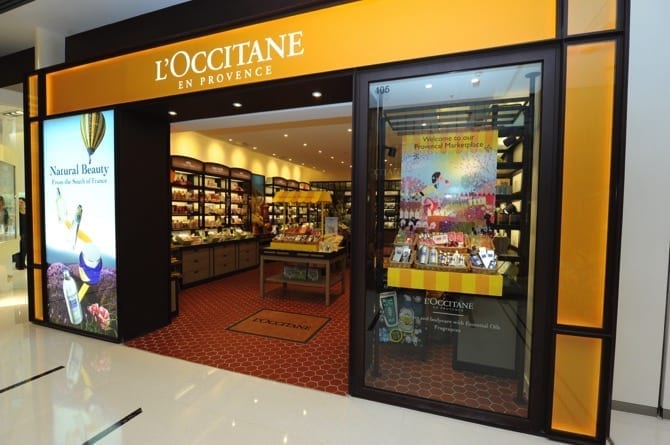
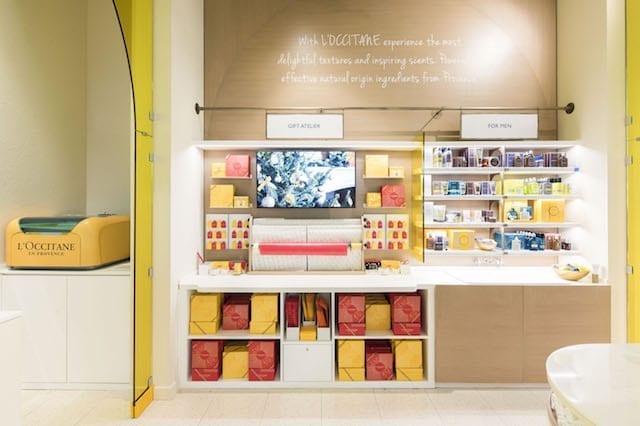
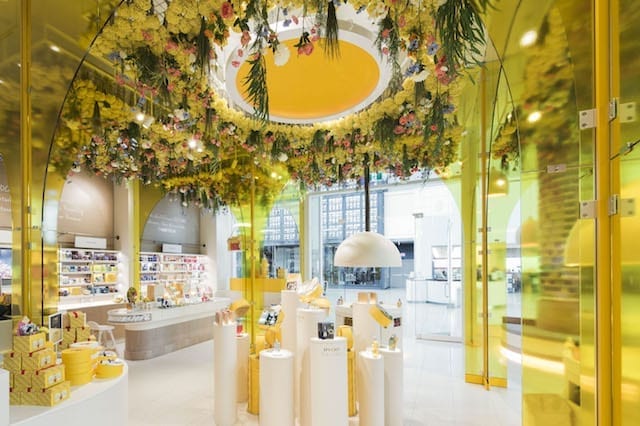
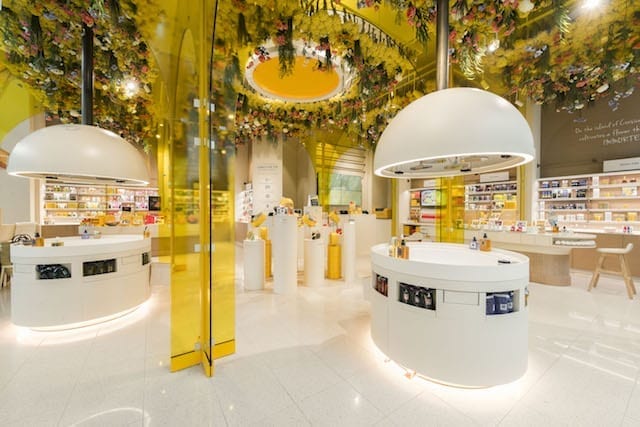
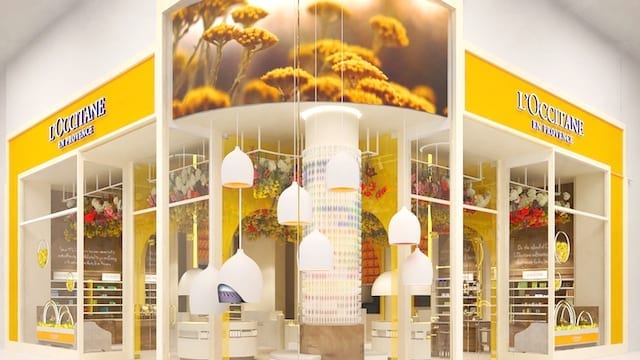
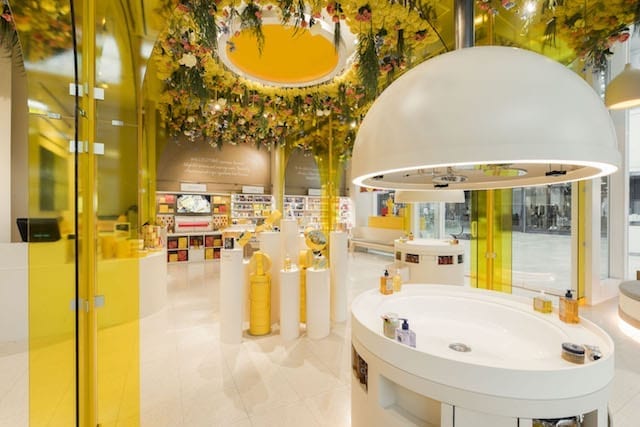
    Beauty products retailer L’Occitane has opened a New York flagship on Fifth Avenue which it describes as “a unique immersive destination”.

    The 1870sqft store at 555 Fifth Avenue was designed by L’Occitane’s Daniel Contorni, international artistic director, and Paul Blackburn, VP concept design, construction & merchandising with the Hong Kong-listed, French-styled retailer.

    “To adapt to differing consumer preferences across the world, L’Occitane has adopted a ‘glocal’ approach, developing creative experiences especially adapted for local clientele,” the company said in a statement.

    Recent examples of this strategy include new flagships in Brazil, China, London and Toronto, each with exclusive styles and services mix; a concept store in Paris (86Champs) in partnership with French pastry chef Pierre Herme; a pop-up cafe in Singapore with Asian pastry chef Janice Wong (a protege of Herme); and L’OcciTruck, the brand’s first travelling shop experience encapsulated on wheels, currently touring North America.

    The L’Occitane Fifth Avenue store features a range of interactive customer touchpoints. Whilst the existing L’Occitane experiential boutique in the city’s Flatiron district continues to offer a more traditional L’Occitane retail experience, the Fifth Avenue store will be more disruptive, geared to attracting new customers, encourage engagement and produce user-generated content for social media, the company said.

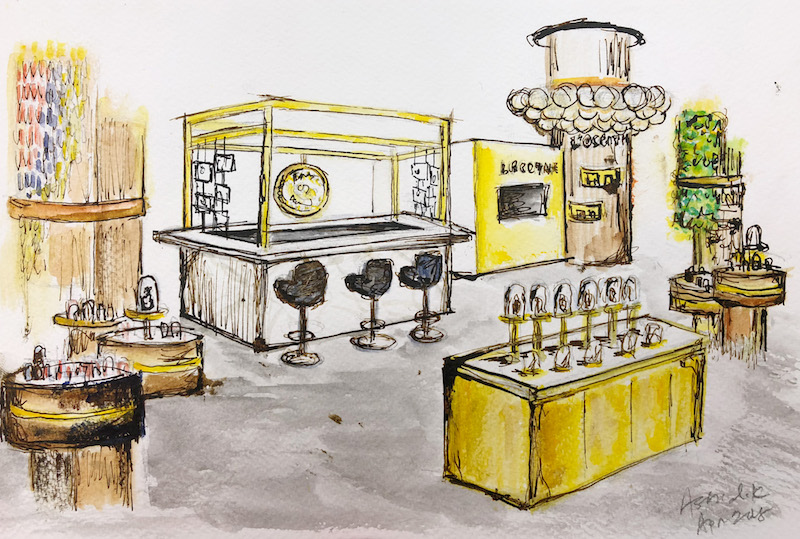
    The store includes a “rain-shower” sink, an interactive skincare consultation area, a curved communal bench beneath a Mediterranean olive tree, and an enhanced fulfilment services “comptoir”.

    L’Occitane says it is pursuing “a robust customer-first retail strategy, seeking to surprise consumers and surpass their expectations by providing an unforgettable in-store experience”.

    “In today’s digital world, customers rarely enter a L’Occitane store purely out of need; they expect to be pampered and entertained and want to indulge in the experience.”

    The L’Occitane Fifth Avenue store features several environment-first initiatives, including a recycling program in partnership with TerraCycle that incentivises customers to drop off all brands of empty personal care and cosmetics packaging at participating L’Occitane retail locations.
  • L’Occitane Hong Kong sales rises

    L’Occitane Hong Kong sales rises

    L’Occitane sales rose to HK$2.7 billion (US$344 million) over the last three months.

    The French headquartered, Hong Kong-listed retailer’s as-yet unaudited trading update for the three months ended June 30, shows a rise of 6.2 per cent (reported rates) and 12.3 per cent (constant rates) year-on-year for the three month period.

    The market showing the highest sales growth was the US at 73.7 per cent, attributed to the resurgence of the L’Occitane en Provence brand and LimeLife. Same-store sales grew 0.6 percent year on year.

    Local currency sales in Hong Kong were shown to have risen 25.5 per cent with same-store sales growth as high as 11.1 per cent.

    Detailed financials are expected to appear in the firm’s annual report due at the end of the 2019 financial year.

  • China, Hong Kong boost up L’Occitane sales

    China, Hong Kong boost up L’Occitane sales

    China and Hong Kong were among the key contributing markets to overall growth in L’Occitane sales for its year to the end of March.

    The Hong Kong-listed, French fragrance group’s net sales were €1.31 billion, up 4.6 per cent at constant exchange rates and a slight decrease of 0.3 per cent at reported rates. Gross margin remained high at 83.3 per cent.

    Operating profit and net profit were €141 million and €96.5 million respectively, both down on last year thanks to unfavourable foreign-currency translation rates and tax reform in the US. However, the operating margin was strong at 10.7 per cent.

    Net sales in sell-out and sell-in segments (representing 74.9 and 25.1 per cent of total net sales respectively) increased by 4.8 and 4 per cent.

    The company increased the total number of retail locations by 8.2 per cent to 3285 as at March 31. It grew its own retail stores to 1555, up 2.7 per cent.

    During the year, the company added 41 own stores, including 10 in Japan (seven of them Melvita stores). China had five closings (including three Melvita stores) because of lease end and underperformance. There were four net closings in Taiwan.

    Marketplace driver

    The sell-out segment contributed 78.4 per cent to overall growth, mainly driven by the marketplace platforms in China and Korea. Web channels (including own e-commerce and marketplaces) grew 19.2 per cent at constant exchange rates.

    The group’s same-store sales growth was mainly driven by the strong market in China together with stabilisation of same-store sales in Hong Kong.

    The sell-in business segment, at €331.6 million, was primarily driven by dynamic growth in travel retail, B2B, web-partner and distributor channels.

    Japan’s net sales, at €218.9 million, were down 8.3 per cent, impacted by a sluggish retail market in the second half of the financial year, plus the closing of two large underperforming stores.

    Japan also closed its mail-order business, which was more than offset by double-digit growth in web sell-out channels.

    Hong Kong’s net sales were up 8.3 per cent at constant exchange rates, reaching €124.6 million and contributing 17 per cent to overall growth. Sell-in sales grew by 15.6 per cent at constant exchange rates, driven by the region’s dynamic travel retail business.

    China’s net sales at €159.1 million grew 14.5 per cent, or 20.5 per cent at constant exchange rates, contributing 46.6 per cent to overall growth. Sell-out sales growth was 21.6 per cent at constant exchange rates, with same-store sales growth at 15.1 per cent and marketplace growth at 75 per cent.

    At the end of the period there were 197 stores, five fewer than 12 months earlier.

    Taiwan’s net sales fell 5.1 per cent to €39.4 million against the backdrop of a challenging and competitive retail market. Four stores were closed during the year.

    However, says the company, Taiwan is one of the markets with highest repurchase rates in the group.

  • L’Occitane to open Singapore-based pop-up café

    L’Occitane to open Singapore-based pop-up café

    French fragrance retailer L’Occitane plans to open a pop-up cafe, named A Journey in Every Sense, at Ion Orchard between July 3 and 16.

    Launching in collaboration with dessert specialist Janice Wong, it will feature her creations with such ingredients as cherry blossom, verbena, bergamot, rose and almond. Being promoted as a Province experience, the cafe also feature a skincare and bodycare texture bar allowing consumers to sample products, as well as 360deg VR exploration of the French region.

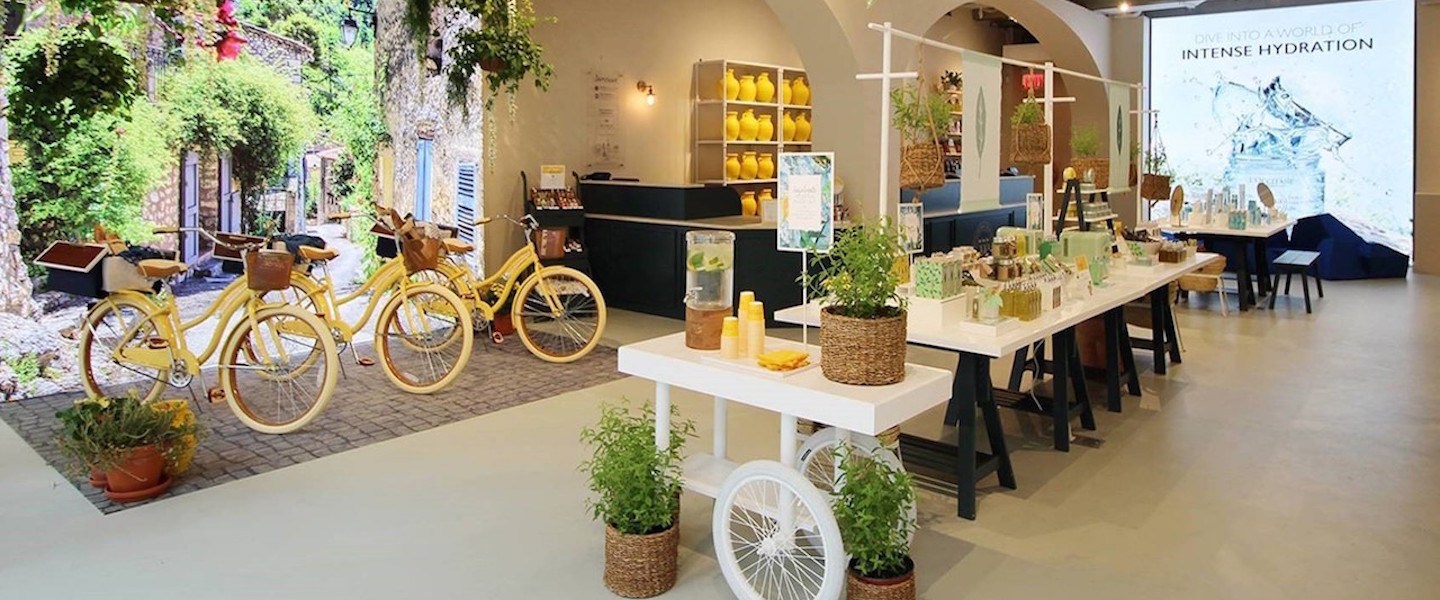
    At home in France, L’Occitane lately created a lifestyle pop-up concept including an essential oils distillery, restaurant, coffee and cocktail bar.

    To see more, browse the gallery below :

  • China performs best for L’Occitane International

    China performs best for L’Occitane International

    China continued to outperform for fragrance group L’Occitane International during the year ended 31 March, its unaudited trading figures show.

    Along with Brazil, Hong Kong and the US it showed the highest sales growth in local currencies.

    China’s sales growth was 20.5 per cent in local currency with same-store sales growth of 15.1 per cent as it maintained strong momentum online and offline.

    The group’s net sales reached €1.3 billion (US$1.5 billion), growing 4.6 per cent at constant rates. Unfavourable foreign-exchange rates saw net sales at reported rates ease by 0.3 per cent over last year.

    During the 12 months, the company disposed of Le Couvent des Minimes while LimeLife became a subsidiary in January. Excluding Le Couvent des Minimes, LimeLife and a one-off deal for L’Occitane au Bresil in September 2016, the group’s sales growth at reported rates and constant rates were -1 and 3.7 per cent respectively.

    Emerging brands Melvita, Erborian and L’Occitane au Bresil (excluding the one-off deal) continued double-digit growth.

    The group opened 41 stores and renovated 153 during the year, compared with 51 openings and 104 renovations the previous year.

  • China leads for L’Occitane International

    China leads for L’Occitane International

    China and Hong Kong, along with Brazil, had the highest sales growth in local currencies for French cosmetics company L’Occitane International for the nine months to the end of December.

    China sales grew 23.4 per cent in local currency, with same-store sales up 17.4 per cent.

    Hong Kong had 9.7 per cent growth at constant exchange rates, thanks to strong travel-retail sales in Asia, particularly Greater China, Korea and Japan.

    The group’s net sales reached €1 billion (US$1.2 billion), or 3 per cent growth at constant rates for the period. Unfavourable foreign-exchange rates knocked down sales at reported rates by 0.6 per cent.

    Same-store sales growth for the nine months further improved to 1.4 per cent from a 0.1 per cent drop for the six months to September 30. The improvement was mainly contributed by holiday offerings in the third quarter that fueled same-store sales growth in China, Hong Kong, Taiwan, Russia and other key markets.

    Sell-out sales accounted for 74.1 per cent of net sales, amounting to €741.9 million, down 1.4 per cent at reported rates but up 2.5 per cent at constant rates. This growth was primarily from positive same-store growth as well as non-comparable stores and other sales, including new and renovated stores, marketplaces and spa businesses.

    Web sell-out channels (own e-commerce and marketplaces) delivered encouraging growth of 21.2 per cent to reach 14.3 per cent of total sell-out sales.

    Sell-in sales accounted for 25.9 per cent of the group’s total sales, amounting to €259 million and an increase of 4.4 per cent at constant exchange rates. Like-for-like growth was 8.2 per cent.

    The increase was primarily driven by travel retail, distribution, B2B and web-partner channels of the L’Occitane en Provence brand. The emerging brands Erborian and Melvita continued double-digit growth.

    The group opened 16 stores and renovated 118 during the nine months, compared to 56 store openings and 79 renovations for the same period a year earlier.

  • New Concept for L’Occitane Flagship store

    New Concept for L’Occitane Flagship store

    French-headquartered, Hong Kong-listed L’Occitane en Provence, opens a world-first concept store in Canada  which it says offers an immersive digital experience and connected shopping model.

    Two new L’Occitane flagships based on the concept will open in London’s Regent Street and on the Champs Elysee in Paris later this month, with the format to be rolled out globally from next year.

    The skincare, body care and fragrance retailer has completely redesigned its 1600sqft (150sqm) Canadian store, located in the Yorkdale Shopping Centre in Toronto.

    Inspired by the land and culture of Provence, guests are invited to take a multi-sensory journey, setting what the company describes as “a new standard for the L’Occitane in-store customer experience”.

    “Visiting this store will be an experience like no other. Upon entering, guests will feel a sense of wonderment – they will be transported to the lavender fields of Provence, learn about L’Occitane’s expertise in the art of extraction, and visit the land of Corsica, home of the powerful Immortelle flower,” said Paul Blackburn, North American VP of concept design, construction & merchandising.

    “Behind the striking external glass facade, a curved video wall immediately attracts the attention of passersby. Below this eye-catching feature is an immersive digital experience inside a pair of suspended capsules. Within each capsule, a true story unfolds before your eyes combining imagery, scent, light and sound for a truly sensorial experience.”

    L’Occitane says the Toronto redesign is part of a larger expansion and refocus of store concept innovation from the brand. The company will pursue a ‘glocal’ retail strategy, in which it will tailor the customer experience with innovative and personalised services across the globe, while adapting the concepts according to local market specifications.

    The Regent Street store will be the largest L’Occitane store in the world, covering 6450sqft (600sqm), with specialised features to evoke all five human senses and a ‘test and play’ experience.

    “A visceral experience”

    L’Occitane commissioned brand creative and experience agency School House to create the new design.

    “Journeying through Provence is a visceral experience that changes something within you,” says Christopher Skinner, founder and principal of School House. “In 1976, Oliver Baussan experienced a connection to Provence’s land and culture, which he distilled from lavender and rosemary into essential oils. In the same way, we approached Yorkdale as an artistic expression of Provence, served through tactile and digital brand experiences that spark a sense of wonderment.”

    Described as “a celebration of wonderment and discovery,” the Yorkdale boutique has multiple unique features for an immersive and connected shopping experience. An exterior facade stretching nearly seven metres hosts a curved video wall two metres high, drawing guests in-store. Upon entering, they are greeted by yellow glass archways, inspired by Provencal architecture. Key features include an interactive ‘skincare bistro’, and large hand-cream column wrapped in communal seating.

    “Provence is brought to life through an elevated shopping experience that channels the elements of earth, fire, air and water,” the company’s Canadian spokespeople say in a statement. “The elements are expressed through creative design features, heightening the senses and inviting exploration.

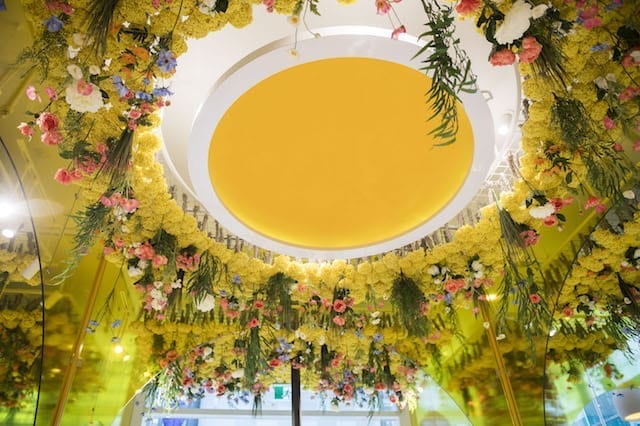
    “Earth is cultivated with a flooring of natural stone and a botanical ceiling installation of a ‘land reversed’. Water is cultivated with automated rain shower sinks, encouraging test-and-play with products beneath showers from hanging illuminated arched domes. Fire is channelled through a radiating sun installation set within the ceiling plane above. Lastly, air is cultivated into fragrance clouds, creating a unique testing experience for fragrances.”

    L’Occitane - new concept 10

    The L’Occitane team has also worked to ensure the store positively impacts the environment. All lighting will be 100 per cent LED, and, for the first time in North America, an in-store bottling recycling program in partnership with Terracycle will be offered. The stone flooring and countertops are made of recycled natural stone aggregates and contain pre-consumer recycled content. The yellow arches are made from co-polyester resin, incorporating 40 per cent pre-consumer recycled content, compatible with one of the largest post-consumer recycle streams.

    L’Occitane Yorkdale, opens on December 7, 2018.

  • L’Occitane growth and China’s contribution

    L’Occitane growth and China’s contribution

    China was among the fastest-growing markets for cosmetics and wellbeing products group L’Occitane International for the six months to September 30.

    Along with Japan and Hong Kong, it was among the key contributing countries to overall growth.

    China’s net sales rose 18.2 per cent year on year to €60 million (US$70 million), the group’s interim results show. At constant exchange rates, the growth was 22.7 per cent, driven mainly by same-store sales growth of 15.8 per cent. As well as the recovery of China’s retail market, the company says a marketing campaign featuring Chinese artist Lu Han continued to draw traffic both online and offline.

    T-mall sales continued to grow at triple digits and were ahead of plan, and B2B also delivered an excellent performance thanks to growing orders from independent hotels and the Shangri-La chain, says L’Occitane.

    In Hong Kong, net sales edged up 0.4 per cent to €51.1 million (2.6 per cent at constant exchange rates), growth being driven mainly by the travel retail channel. As well as duty free, this included airlines in China and Japan.

    The retail market was still sluggish, and two underperforming stores were closed. There were also some temporary closures for renovations.

    Hit by typhoons

    Typhoons forced store closures in Japan, where net sales fell 4.8 per cent (1.8 per cent at constant exchange rates) to €99.4 million. Same-store sales growth was 1.4 per cent. However, e-commerce showed low double-digit growth. Melvita remained the growth engine in Japan with new stores. At the end of September, Japan had 30 Melvita outlets.

    Same-store sales deteriorated by 7.9 per cent from the first quarter for Taiwan, where net sales for the six months dropped 3.6 per cent (71 per cent at constant exchange rates) to €15.3 million.

    “Retail sales were hindered by the less-generous summer promotion offered by department stores, a couple of mediocre launches and the timing difference in anniversary sales in department stores,” says L’Occitane.

    Nonetheless, sales of skincare products stayed strong, in particular the Immortelle and Reine Blanche ranges.

    Overall, despite a challenging retail backdrop, group net sales were €548.2 million, down 0.6 per cent (up 1.1 per cent at constant exchange rates), with like-for-like sales growth 2.3 per cent.

    Gross profit margin reached 82.8 per cent, 0.6 points higher, while operating margin fell by one point, mainly because of currency exchange headwinds. Profit for the period ended at €10.7 million.

    During the year the company disposed of Le Couvent des Minimes, and excluding this and a one-off deal for L’Occitane au Brésil in September last year, the group’s sales grew by 2.3 per cent at constant rates and 0.5 per cent at reported rates.

    Retail locations increased from 3037 at the end of March to 3104 as at September 30, while the group increased its own retail stores from 1514 to 1519.

  • L’Occitane ‘bullish’ on China

    L’Occitane ‘bullish’ on China

    L’Occitane International, the French cosmetics and personal-care products company, said it was optimistic on its outlook for mainland China, despite what it called a “challenging” global retail environment.

    “We are still very bullish on China,” Andre Hoffmann, vice chairman and managing director, said at a press conference in Hong Kong.

    “Today, China is the No. 3 market globally for the L’Occitane group,” Hoffman said. “We expect by the end of the fiscal year it could reach the No. 2 market status after Japan,” surpassing the U.S.

    The comments came as the Hong Kong-listed company reported a drop in fiscal first-half net income for the period ended 30 September 2017.

    Net sales in China for the first half were 60 million euros ($70.7 million), up 18.2% from a year earlier, boosted primarily by a 15.8% increase in same-store sales, the company said in a statement, adding that a marketing campaign featuring Chinese singer Lu Han “continued to draw traffic both online and offline.”

    While the company maintains its own e-commerce website in China, Hoffmann noted that “it really cannot compete in terms of traffic and awareness with the major marketplaces like [Alibaba Group Holding’s] Tmall.”

    “It is better that we focus our energy and investments to build up the brand through Tmall,” he said.

    L’Occitane said first-half net profit fell 59.4% to 10.7 million euros compared with 26.4 million euros in the same period a year earlier.

    Thomas Levilion, executive director and group deputy general manager of finance and administration, attributed the drop to unfavorable exchange rates, one-off costs and seasonal effects.

    Those included expenses related to the opening of two new flagship stores in London and Paris, marketing and promotional costs in preparation for the important Christmas shopping season, and a tax credit of 6.5 million euros in the year-earlier period.

  • Hong Kong retail start recovering

    Hong Kong retail start recovering

    A “steady if cautious” Hong Kong retail recovery is clearly underway, according to a report from Savills released today.

    “The retail sector is slowly coming to life after four years of painful adjustment which has seen the emergence of a ‘tenant’s market’, a rare occurrence in Hong Kong’s landlord-dominated retail scene,” observed Simon Smith, head of research and consultancy with Savills.

    Over recent months, he said, retailers have been taking the opportunity to upgrade for little or no extra cost and examples include Pandora which moved within IFC Mall and Hourglass, which runs Patek Philippe, relocating within Tsim Sha Tsui from the Imperial Hotel to a better site in the Holiday Inn.

    In further evidence of upgrade demand, Harry Winston has taken the space previously occupied by Ferragamo in the Mandarin Hotel and will open in early 2018. Alternatively, retailers are cutting overheads as they find that renewal negotiations are yielding significant savings as landlords discover a new pragmatism.As reported, Topshop has renewed the lease on its Queen’s Road Central store at a discount of about 50 per cent.

    While landlords of high street shops remain on the back foot, larger shopping centres, such as  Harbour City, IFC Mall and New Town Plaza, are proving relatively immune to the downtown, says Smith.

    In IFC Mall, Italian menswear brand Boggi opened recently while Brunello Cucinelli has launched a new flagship in the same mall.

    “As street-shop rents have fallen heavily while centre rents have only seen a minor adjustment, the gap between the two has narrowed considerably and tenants are now finding that a prime street front pitch can be a viable alternative to taking space in a nearby mall. This is the narrowest the gap has been since 2009 and represents a return to the norm after seven years of major gains in street shop rents.”

    Strength in regions

    Savills also notes that regional and district malls such as Popcorn in Tseung Kwan O and Tuen Mun Town Plaza are doing relatively well.

    “Hong Kong’s tight geography, excellent transport infrastructure and dense retail environment has helped this type of mall defend against the threat from online. The appeal of air conditioned spaces in the summer months and the lure of enhanced F&B offerings have also helped boost the appeal of local malls. We have also seen landlords putting more effort into marketing campaigns with better events, more pop-up stores and creative TV and online advertising,” said Smith.

    “Most malls now have a very well-established cyber-presence via websites and apps. Click-and-collect is making some limited headway locally, with brands such as Zara, Burberry, L’Occitane, Watson’s Wine, Chow Sang Sang and Starbucks all offering the service.

    “In a mixed market some trade categories are performing well and pharmacies in particular are expanding aggressively at the moment. Not every landlord wants them but they are often prepared to pay above-market rents. F&B is also out-performing, driven in part by a richly valued stock market and rising wages.”

    Nick Bradstreet, head of retail with Savills, said luxury fashion is turning around in Hong Kong even though brands have been closing stores in Macau and Mainland China over the past year or so. Luxury sales in China have actually surged over the past six to nine months.

    “Cosmetics retailers are reporting fairly stable business, but after a period of rapid expansion, many brands are still culling store numbers. Electrical goods retailers are consolidating in what is a very competitive marketplace,” he said.

    Savills prime street shop rental indices remained flat over the third quarter while rents in prime malls continued to drift off marginally. The latest September retail sales figures from government recorded a seventh consecutive month of rises attributable in part to a strong inbound tourist numbers. Jewellery, watches, clocks and valuable gift sales outperformed, rising by 14.7 per cent year-on-year, with strong growth also noted for medicines, cosmetics and Chinese drugs.

  • China star performer for L’Occitane International

    China star performer for L’Occitane International

    With 26.9 per cent growth in sales, China led the charge for wellbeing company L’Occitane International for the three months to the end of June.

    China had same-store sales growth of 14.7 per cent, with “staggering” 250 per cent first-quarter growth for marketplaces, says the company. A marketing campaign with Chinese artist Lu Han launched in May drew traffic online and offline.

    In Japan, sales growth remained healthy at 4 per cent in local currency, with same-store sales growth of 2.4 per cent. The company’s e-commerce channel performed well, helped by new Line promotion campaigns and “encouraging” growth by emerging brand Melvita.

    Travel-retail and distribution channels were the main props for Hong Kong’s sales growth of 2.9 per cent.

    Overall group net sales grew to €279.5 million (US$325.7 million) by 4.1 per cent at reported rates and 2.7 per cent at constant rates, both rates an improvement from the financial year ended March 31.

    Web sell-out channels (own e-commerce and marketplaces) delivered “encouraging” growth of 27.3 per cent to reach 13.2 per cent of total sell-out sales.

    During the first quarter, sell-out sales accounted for 73.8 per cent of net sales, amounting to €206.4 million. This was growth of 3 per cent at reported rates or 1.5 per cent at constant rates. Major growth drivers were new and renovated stores, marketplaces, and its cafe and spa businesses.

    Same-store sales for the period eased by 0.6 per cent, an improvement from the 1.3 per cent drop for the same period last year, thanks to double-digit same-store growth in China.

    Sell-in sales at €73.2 million accounted for 26.2 per cent of total sales, an increase of 6.2 per cent at constant exchange rates. The company says this was primarily driven by dynamic growth in distribution, travel retail, B2B and web-partner channels of the L’Occitane brand. Emerging brands also drove overall sales growth.

    The group maintained its selective global retail expansion with four store openings during the quarter, compared with 23 for the same period last year. Twenty stores were refurbished (13 during the same period last year).

  • Bolloré Logistics Singapore launches new hub to support l’Occitane

    Bolloré Logistics Singapore launches new hub to support l’Occitane

    Bolloré Logistics Singapore is expanding its regional footprint in Singapore by launching a new Regional Distribution Center in order to support the development of its longtime partner L’Occitane en Provence.

    Kicked-off on June 1st, 2017, Bolloré Logistics’ new hub is providing L’Occitane en Provence a one-stop-solution covering freight import & export on the Asian markets, warehousing, kitting and labeling operations. As a second phase, L’Occitane en Provence has also entrusted Bolloré Logistics to handle their National Distribution Center in China, with a go-live in August.

    These facilities will allow L’Occitane to cater for the needs of their future growth. The opening of the new regional platform with a capacity of over 10,000-sqm marks the launch of the 8th Hub for Bolloré Logistics Singapore confirming its leading market expertise in logistics and freight management for the cosmetics industry. This state-of the-art facility is set to deliver operations with excellent efficiency.

    The new Regional Distribution Center will provide an agile, productive and cost effective solution enabling L’Occitane en Provence to meet a constantly
    evolving and demanding time to market.

    “Customer satisfaction has always been top priority for L’Occitane en Provence. In an effort to come even closer to our customers in Asia-Pacific, we have launched a Regional Distribution Center to overtake the central distribution model,” says Mr. Lorenzo Giacomoni – VP Group Operations at L’Occitane en Provence.

    “We have been developing this project with L‘Occitane for many years. This Regional Distribution Center – as well as the forthcoming opening of the 5,000-sqm National Distribution Center for the Chinese market in Shanghai – both mark a new era for our long term partnership. We are thrilled and proud to accompany L’Occitane and address their future supply chain requirements,” mentions Mr. Yves Laforgue, Chief Operating Officer at Bolloré Logistics Asia Pacific.

    Mr. Fabien Giordano, Managing Director at Bolloré Logistics Singapore, adds: “We are pleased to have established a reference model in the cosmetics industry thanks to our innovative solutions coupled with our matured – yet continuously improving – operational practices, to make our customers’ supply chains more responsive, agile and cost efficient.”

  • L’Occitane announces fiscal year 2017 annual results

    L’Occitane announces fiscal year 2017 annual results

    L’Occitane International, a global, natural ingredient-based cosmetics and well-being products company with true stories from Provence, France and around the world, today announces its annual results for the year ended 31 March 2017 (“FY2017”).

    The Group recorded net sales of €1,323.2 million for FY2017, an improvement of 1.7% at constant rates and 3.2% at actual rates compared to FY2016. The improvement in net sales was mostly attributable to the Group’s new stores and newly renovated stores, the good performance of its web channels and own E-commerce business, and double-digit growth in the Group’s emerging brands.

    Gross profit rose 3.9% to €1,102.4 million in FY2017, which was mainly attributable to more efficient supply chain management, better price and product mix and favourable FX effects. Gross profit margin expanded by 0.5 points to 83.3% in FY2017.

    The Group recorded an operating profit of €168.3 million for FY2017; an increase of 0.2% with operating profit margin decreasing 0.4 points to 12.7%, due mostly to continuous investments in R&D, brand awareness and emerging brands. Net profit rose by 16.6% to €132.4 million – the Group’s highest ever profit since its listing – reflecting the management’s ability to expand sales despite the challenging operating environment, the absence of a one-off, non-cash foreign currency loss that was recorded during last year, favourable FX effects and a lower effective tax rate.

    Sell-out sales accounted for 75.0% of the Group’s total sales in FY2017, amounting to €992.5 million, an increase of 1.3% at constant exchange rates. This growth was primarily driven by new stores and newly renovated stores, as well as the growth and development of the Group’s E-commerce channels, especially marketplaces. Under its selective omni-channel expansion strategy, the Group’s global own retail store network grew to a total of 1,514 stores during the year, while its E-commerce presence continued to expand.

    Sell-in sales accounted for 25.0% of the Group’s total sales in FY2017, amounting to €330.7 million, an increase of 3.1% at constant exchange rates. This growth was driven by dynamic growth in web partners, wholesale, distribution and B2B channels and in the emerging brands – L’Occitane au Brésil, Melvita and Erborian.

    Brazil and Japan registered the largest growth at actual rates, with sales growing 30.0% and 15.5% (due to the stronger Brazilian Real and Japanese Yen) respectively. Local currency sales in Brazil also grew by 18.4%, which was driven by both the L’Occitane en Provence and L’Occitane au Brésil brands. Sales in Japan benefited from a well-received TV advertising campaigns and improving sales growth in the Group’s own E-commerce business and web-partners.

    In terms of local currency sales, China was also stand out market for the Group in FY2017, with sales growing 11.0% compared to FY2016, as a result of accelerated growth at its physical and online stores (such as its flagship on TMall) and B2B, particularly in the last quarter of FY2017. Much of this great result was driven by a highly successful brand ambassador campaign that took place in the second half of the year.

    As part of its omni-channel sales strategy, the Group continued to significantly invest in its self-owned E-commerce websites, mobile sites, third-party marketplaces and social media platforms to drive traffic, conversion, sales and growth to its online platforms and physical stores. It also continued to push forward marketing initiatives and gifting strategies to safeguard its performance in markets with a more uncertain economic situation, including the United States, United Kingdom and other European countries.

    As part of its multi-brand strategy, the Group recently invested US$128 million in a 40% stake in LimeLight by Alcone, a fast-growing US-based natural skincare and personalized makeup company selling through “social commerce”, with the objective to develop its business model worldwide, and to speed up the Group’s expansion into the colour cosmetics sector. It will also seek to expand into other product streams to cater for a wider customer audience, including millennials.

    The Group’s balance sheet remained healthy during the year under review, with its net cash position amounting to €379.7 million as at 31 March 2017. L’Occitane is pleased to propose a final dividend of €0.0316 per share, representing a dividend pay-out ratio of 35.0% in FY2017.

  • L’Occitane International profit jumps

    L’Occitane International profit jumps

    French skincare brand L’Occitane International’s interim net profit has jumped 33.9 per cent for its latest six months.

    Earnings for the period to September 30 climbed to €25.99 million (US$27.5 million) from €19.41 million year-on-year, while net sales edged up by 1.3 per cent to €551.7 million.

    Emerging economies Brazil, China and Russia were singled out as the top performing markets for the Provence-based company.

    “We are seeing accelerating store traffic in China and a tremendous growth in our sales on the Tmall market platform,” says L’Occitane Asia-Pacific president Andre Hoffmann.

    The mainland has become the company’s second-largest market after the US in terms of the number of outlets. Eight locations were launched in China in the first nine months of the year – the largest number across the brand’s nine major markets.

    Total sales from the mainland gained 5.4 per cent to €50.8 million from a year ago, accounting for 9.2 per cent of L’Occitane’s net revenue.

    More shops were opened in Japan and South Korea, but in Hong Kong sales plunged by as much as 11.2 per cent.

    Same-store sales overall fell 2.5 per cent, which the company blames on global economic political uncertainties. However, more positive signs included a strong performance on Tmall, as well as in the Black Friday sale, says CFO Thomas Levilion.

    L’Occitane eCommerce business grew by 6.8 per cent during the first half, making up 10 per cent of global retail sales.

  • Sales fall 19pc for L’Occitane International

    Sales fall 19pc for L’Occitane International

    A 19.8 per cent drop in sales in Hong Kong and Macau has been recorded by French skincare retailer L’Occitane International for its first fiscal quarter.

    This amounts to €22.8 million (MOP175.3 million/US$21.9 million), according to its filing with the Hong Kong Stock Exchange.

    Its same-store sales in the two regions for the three months ended June 30 dropped by 11.7 per cent year-on-year. The company had 33 stores in Hong Kong and three in Macau at the end of June.

    Total net sales reached €268.5 million for the period, down 2.2 per cent. Of the total, sell-out sales brought in €200.4 million.

    L’Occitane says the soft performance was because of “lower sales to travel retail operations in the Asia region” as well as the global economic downturn and overall unfavourable foreign exchange impact.

    Meanwhile, the company’s sales on the mainland decreased 5.3 per cent during the quarter to €24 million. Same-store sales, however, eased by only 0.4 per cent year-on-year.
    The company had 195 stores on the mainland at the end of June, eight more than at the same time last year.