Retail News CRM

Tag: Lotte group

  • 20 Lotte affiliates meet IPO requirements

    20 Lotte affiliates meet IPO requirements

    The conglomerate has pledged to simplify its governance structure and boost its managerial transparency through a set of measures, including initial public offerings (IPOs), after a bitter family feud over control of the retail conglomerate. Currently, Lotte has eight publicly traded affiliates here, with the key units being linked through unlisted Japanese units.

    According to the data compiled by the Korea Exchange, a total of 20 out of 73 Lotte subsidiaries are eligible for IPOs in the country. The candidates include Hotel Lotte, Lotte Card Co., Lotteria and Lotte Capital.

    Under local regulations, a firm seeking to be listed is required to have a capital base of more than 30 billion won (US$26.5 million), average annual sales exceeding 70 billion won for the previous three consecutive years and a return on equity surpassing 5 percent.

    After the squabble over control of the sprawling business empire, which has a cobweb-like governance structure, Lotte chairman Shin Dong-bin in August expressed his desire to push for the listing of Hotel Lotte, a key affiliate, as part of its reform plan.

    The listing on the local stock market requires stricter regulatory filings while allowing it to seek capital increases, issue more non-voting stocks and reap other benefits that translate into greater business opportunities.

    “As a South Korean company, we will have more of our affiliates go public with a strong will to contribute to the Korean economy,” a Lotte official said.


  • Lotte chief unseated from group’s virtual holding firm

    Lotte chief unseated from group’s virtual holding firm

    In a hastily arranged shareholder meeting in Japan, Lotte Group Chairman Shin Dong-bin lost his seat on the board of Kojunsha, which is at the apex of the group’s entire governance structure, with a 28 percent stake in Lotte Holdings, the group’s holding firm, according to his elder brother Shin Dong-joo, who owns a 50 percent stake in the Japanese package manufacturing firm.

    The group’s business spans from luxury hotels to amusement parks, mostly located in South Korea and Japan.

    Dong-bin has a 38.8 percent stake in Kojunsha, and their father and group founder Shin Kyuck-ho owns 0.8 percent.

    But Lotte Group said earlier even if its chairman were to be removed from Kojunsha’s board, it would have little impact on the group management.

    Lotte Holdings is 28 percent owned by employees, 20 percent by affiliates and 11 percent by special investment vehicles.

    Lotte, a retail giant, has been mired in the family squabble involving the founder and his two sons, who are sparring to bolster their grip on the group.

    In August, Dong-bin bagged a landslide win at a shareholders meeting for Lotte Holdings, in what was thought to be the end of the family squabble.

    Last week, Dong-joo said he will lodge suits against his younger brother to regain the helm of the group.


  • Lotte Group head issues apology for feud, vows reform

    Lotte Group head issues apology for feud, vows reform

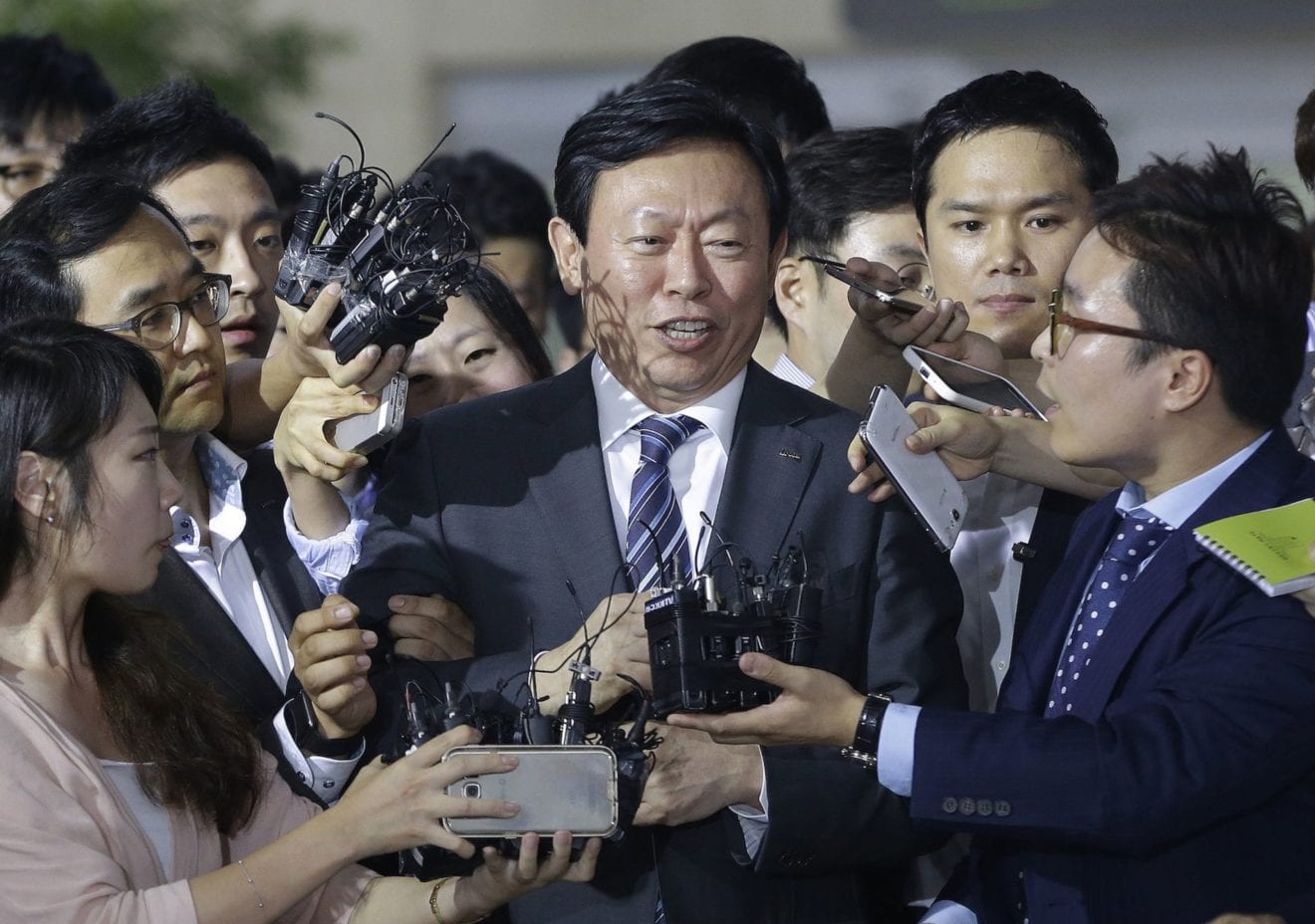
    The head of South Korea’s Lotte Group yesterday vowed a new era of corporate governance and transparency as he apologized for the family feud engulfing the beleaguered retail giant.

    In an address broadcast live on TV, group chairman Shin Dong-bin also sought to deflect growing anti-Japanese sentiment surrounding Lotte, which was founded in Japan, but does 80 percent of its business in South Korea.

    Talking in accented Korean, the native Japanese speaker twice bowed deeply before the cameras in a show of contrition for the bitter and very public battle for corporate control that has pitted him against his father and elder brother.

    “The current dispute has occurred as we have failed to make efforts to improve corporate governance and enhance transparency,” Shin said.

    “We will be bold in reform in order to address concerns held by the people of Korea, our shareholders, contractors and employees,” he added.

    At stake in the Lotte feud is control of a sprawling conglomerate with 80 units across South Korea — spanning retail, amusement parks, hotels and chemicals — and total combined assets of about US$90 billion.

    Among other reforms, Shin said he would push for the public listing of the conglomerate, which effectively controls the South Korean business, while also streamlining the group’s complicated web of cross-holdings to enhance transparency.

    “Lotte belongs to Korea,” the chairman said, stressing that the group’s South Korean interests dwarfed the Japanese-based side of the business in terms of employee numbers and sales.

    “There has been little flight of capital back to Japan,” Shin said, adding that earnings made in South Korea had been plowed back into the domestic business.

    Lotte was founded in Japan in 1948 by Shin Dong-bin’s father — South Korean-born Shin Kyuk-ho, now 92 — and grew from a seller of chewing gum to a confectionary giant. It expanded to South Korea after Tokyo and Seoul normalized relations in 1965.

    The row within the Shin family has fanned the embers of the anti-Japanese public sentiment the group has long contended with in South Korea — largely due to the family members’ awkwardness with the Korean language.

    The battle for control of the conglomerate has pitted Shin Dong-bin against his father and his elder brother, Shin Dong-ju, with accusations of dirty tricks and attempted boardroom coups.

  • Lotte China loses a trillion

    Lotte China loses a trillion

    Reports from Korea suggest Lotte Group has lost more than 1 trillion won (US$853 million) in China in just three years.

    Data assembled by CEO Score shows Lotte China made heavy losses between 2011 and 2014 as South Korea’s fifth largest company struggled to understand the Chinese consumer and build market share.

    Last month, Lotte said it would close four loss-making stores in its Mainland China network – all in in East China’s Shandong Province.

    Lotte is said to be losing market share in Mainland China unable to differentiate itself in the middle ground between local retail chains and the growing power of online retailers such as Alibaba and JD.com.

    CEO Score’s data shows the losses are growing, not narrowing. It started with 92.7 billion won in 2011, reached 250.8 billion won in 2012 and a massive 580.8 billion won in 2014.

    Lotte Mart has 120 stores in China, 116 in Korea, 39 in Indonesia and 10 in Vietnam.

    The company is family owned with the leadership locked in a bitter power struggle and two brothers compete to take control from their 93 year old father.

  • Lotte Group Founder Loses Japan CEO Title Amid Succession Battle

    Lotte Group Founder Loses Japan CEO Title Amid Succession Battle

    Turmoil has erupted atop South Korea’s largest retail giant Lotte Group, shining a spotlight on one of the biggest family feuds the country has seen.

    The week began with 92-year-old Lotte founder Shin Kyuk Ho and his eldest son flying to Japan to fire a group of senior managers at a key unit, a maneuver that backfired and left the patriarch sidelined the next day. By Wednesday, Shin Dong Bin had successfully fended off his elder brother’s attempt to derail him from taking over control of the group.

    At stake is leadership over a conglomerate with 80 units across Korea, operating everything from department stores, amusements parks to hotels with 112 trillion won ($97 billion) of assets. Though the country saw sibling rivalries tear up Hyundai Group more than a decade ago, power struggles at businesses of Lotte’s size are rarely displayed in public in a corporate landscape dominated by family-run businesses, known locally as the chaebol.

    “It was an unexpected move as everyone had assumed that the founder had already selected Shin Dong Bin as his heir,” said Chae Yi Bai, an analyst at corporate watchdog Center for Good Corporate Governance. “This puts Lotte’s succession plans back in debate.”

    The drama at Lotte Group comes at a time when concerns over dynastic succession is fresh in people’s memories. Less than two weeks ago, Samsung Group narrowly defeated billionaire activist investor Paul Elliott Singer in a hotly-contested proxy fight, paving the way for the founding Lee family to tighten its grip over the nation’s largest conglomerate.

    Back at Lotte, co-chairman Shin Dong Bin apologized to employees on Wednesday for the turmoil brought by the dispute and urged them to put faith in him.

    “I am very sorry for causing uncertainties and turmoil to you all — the corporate value that Lotte has held up for a long time should not be rattled simply by an individual’s family issues,” 60-year-old Shin said in a note to employees, a copy of which was distributed to the media.

    The founder’s act to support elder son Shin Dong Joo, 61, had been unexpected as the younger Shin had been heir-apparent after executive titles including the vice chairman role at the parent group were stripped from Dong Joo in January.

    Lotte declined to make Shin Kyuk Ho or Shin Dong Joo available for comment.

    Shares Spike

    Shares of Lotte’s listed South Korea affiliates spiked on speculation the contesting Shin brothers would snap up the shares to solidify their control, Kim Tae Hong, an analyst at Yuanta Securities Korea Co. said by phone.

    Lotte Shopping Co. rose for a second straight session to end 6.6 percent higher by the close of trading in Seoul, the largest gain since 2010. Lotte Confectionery Co. closed up 4.7 percent, after jumping as much as 16 percent. The benchmark Kospi index ended little changed.

    In an earlier statement sent to media Wednesday, Lotte Group said the older son and his father’s July 27 act to fire executives at the closely held Japan unit Lotte Holdings Co. didn’t follow legal procedures.

    Tokyo-based Lotte Holdings’ board of directors held a meeting a day after to nullify the dismissals, and decided to move the founder into an honorary chairman role, according to the statement. Such a role typically carries no specific duties or voting rights.

    The older Shin brother’s attempt to gain influence over the Japan unit is aimed ultimately at capturing control over the entire group, due to the conglomerate’s shareholding structure, according to Chae.

    Attack Blocked

    “Whoever holds Lotte’s holding companies in Japan pretty much holds the entire group because of how the group’s corporate governance structure is designed,” Chae said. “It’s too early to say who won the crown, but Shin Dong Bin seems to have successfully blocked the attack this time around.”

    The founder holds a 28 percent stake in Lotte Holdings Co., Dong Joo holds 20 percent and Dong Bin has 19.1 percent, while a company called Kwang Yoon Sa holds 27.65 percent, according to data compiled by Bloomberg. Kwang Yoon Sa, a packaging company also based in Tokyo, is said to be owned by the founder, according to the Korea Economic Daily.

    Lotte Holdings spokeswoman Ruka Mizuno declined to comment on the governance structure of Lotte Holdings and Kwang Yoon Sa. when reached by phone, saying the companies aren’t listed.

    Shin Kyuk Ho, born in Ulsan, South Korea in 1922, started Lotte in Japan in 1948 after completing his university studies there. The company started off selling chewing gum in postwar Japan and quickly grew into a major confectionery company.

    When diplomatic relations normalized between Korea and Japan in 1965, Shin began investing in his home country and established Lotte Confectionery Co. in 1967, according to the Seoul-based Center for Good Corporate Governance.