Retail News CRM

Tag: Markets

  • Limited Editions Thrive in Secondhand Markets

    Limited Editions Thrive in Secondhand Markets

    The latest hype in Korea has been over the Adidas Yeezy Boost 350 v2 “Zebra,” co-designed by American rapper and producer Kanye West. This extremely limited edition pair of shoes sold for a retail price of 289,000 won ($255.75), but they now cost somewhere around 1.5 million won on secondhand platforms online. 

    Similarly, the pair’s predecessor Yeezy Boost “Bred” (black + red) with the same retail price now sell for at about 600,000 won on secondhand markets, which isn’t as impressive but still double the original amount. 

    Such popularity, and the subsequent resale of limited or special edition shoes is nothing new. 

    The Nike Air Max 95s, launched in August 2015 to celebrate their 20th anniversary, sold out in Korea in less than two hours, and were later resold at prices roughly 100,000 won higher than their retail price of 189,000 won. 

    Nike’s Air Jordans, likewise, have long been popular among shoe fanatics with every new release. The Air Jordan 1 Bred (2016), for instance, peaked at 600,000 won on secondhand platforms after selling for 199,000 won at shoe stores. The shoes are still traded at a little over 400,000 won.

    Overseas collectors share the same enthusiasm. The most notable is perhaps Kanye’s Air Yeezy 2 “Red October,” which the rapper co-designed with Nike before he teamed up with Adidas. A pair of the shoes, which were produced in a limited run of only 1,000 pairs, was traded for $93,000 on eBay at one point in 2012, and they still cost thousands of dollars for anyone trying to add them to their collection. 

    Some resellers have even decided to take this business model to a professional level. 

    For example, Yeezy Mafia, a group of some 50 individuals from countries around the world, provides shoe collectors with early information on new Adidas releases (often before official announcements) and resells them to those with a Yeezy Mafia membership. Sneaker resellers Allen Kuo and Benjamin Kickz are also big players in the market. 

    Of course, shoes are not the only items that attract devotees.

    Starbucks’ special edition merchandise usually sells out quickly in Korea, and items are later traded online for higher prices, while clothes by specialty retailers or private label manufacturers co-designed with other designers are also frequently found on secondhand markets. 

    H&M’s collaboration products – which the company releases each year with world-class designers such as Balmain, Isabel Marant, Alexander Wang, and Maison Margiela – are particularly popular. In 2015, hundreds camped out at an H&M outlet in Myeongdong for days to get their hands on the newest Balmain x H&M collection. 

    One of the dresses, which rose to prominence after Suzy of idol group Miss A was seen wearing one on a local TV show, was going for roughly 250,000 won, up from its retail price of 159,000 won.

  • BT connects world’s five top forex markets

    BT connects world’s five top forex markets

    BT is linking up the world’s five main foreign exchange locations to help boost the competitiveness of its global financial industry customers.

    The company is now offering BT Radianz FX express, which provides dedicated high-speed links between financial hubs in Singapore, Japan, Hong Kong, the UK and the US. The five hubs are involved in almost 77% of the world’s forex trading, according to the 2016 BIS Triennial Central Bank Survey.

    The new Radianz FX express service claims to offer low-latency and cost-effective, fully managed connectivity that will give traders faster access to market data across the five locations, while making it easier for them to execute trades.

    Radianz FX express links directly into the five key third-party global data centers in the forex trading world. These data centers were selected because each of the locations hosts the IT infrastructure of significant clusters of the forex trading community.

    “Foreign exchange is the largest asset class by value traded globally.  An average of US $5.1 trillion is traded on FX markets every day,” BT VP of global industry practices Hubertus von Roenne said.

    “We’ve created managed BT Radianz FX express routes to boost the competitiveness of our financial services customers. With dedicated links within and between the world’s five biggest FX trading locations, BT can help FX firms lower costs while creating opportunities for international growth.”

  • Money transfer firm WorldRemit eyes new markets, growth

    Money transfer firm WorldRemit eyes new markets, growth

    WorldRemit, an online service for overseas money transfers, is looking to expand into new markets and add services like direct payments for bills and school fees, its president said on Friday.

    The UK-based financial technology start-up, which has raised $192.7 million since its founding in 2010, also wants to grow in Canada and is open to taking the company public, Andrew Lee said in an interview.
    “We think about it, we think about other options as well,” he said. “It’s not on the radar at the moment. We’ve got plenty to do before we worry about that.”

    WorldRemit, which caters to migrants and people with no bank accounts, allows money transfers to over 100 countries. Growth is fastest in mobile transfers, though bank deposit and cash pick-up options are also available.
    Online payment service providers are shaking up the remittance industry and retail-based operations like Western Union Co by offering fast, secure service with lower fees, saving recipients travel time to pick up deposits.

    Over 2 billion people in the world do not use banks or are unlikely to have access to retail banking, said Lee, but the vast majority have mobile phones, allowing them to receive and store money, or pay bills.
    WorldRemit, which has partnerships with 34 mobile companies in 26 countries, also lets senders add air time to the prepaid phones of family members, for example.

    WorldRemit is seeking to add domestic transfers and primary banking, Lee said, and is applying for licenses in areas like Singapore, where foreign workers send a lot of money to their home countries.
    WorldRemit expects in the coming months to secure licenses for a few U.S. states that it does not already serve, Lee said. The United States is WorldRemit’s fastest growing market, and is soon expected to account for at least 10 percent of its revenue, he added.

    Canada, with 20 percent of its population born overseas, is WorldRemit’s third-largest market after Australia and Britain. That proportion is the highest among the Group of Eight industrialized countries, according to Statistics Canada.
    Canada has great growth potential, Richard Meseko, the company’s Canadian director, said in the joint interview. About 60,000 WorldRemit overseas transfers are made from Canada each month, but the 55,000 users over the last 12 months is a small number for the size of the immigrant population, he noted.

  • StarHub launches data roaming to 9 APAC markets

    StarHub launches data roaming to 9 APAC markets

    Singapore’s StarHub has launched a new flat rate multi-destination monthly mobile data roaming plan covering all mobile networks in nine APAC markets.

    The DataTravel plan offers 2GB of data for 30 days when roaming to Australia, Hong Kong, Indonesia, Malaysia, New Zealand, South Korea, Taiwan, Thailand and The Philippines for a flat S$15 ($10.50), or 3GB for S$20.

    While roaming, customers will not need to manually search for specific networks and can instead leave their phones to connect to the strongest available signals.

    “With DataTravel, we are happy to free our customers from the common constraints of overseas data usage, that are cost and accessibility,” StarHub head of product and marketing Wang Li-Na said.

    StarHub will also send SMS notifications before a plan expires and depletes, and customers will be able to top up with additional 2GB or 3GB DataTravel plans. Any unused data will be carried forward for another 30 days when a new plan is activated.

    The operator’s move comes shortly after rival Singtel expanded its ReadyRoam mobile data roaming service to cover multi-destination roaming across 26 countries, including 11 Asian markets.

    In comparison to StarHub, Singtel’s base ReadyRoam service provides 1GB of data for 30 days’ roaming in the 11 Asian markets for S20.

  • Indonesian markets panic over Trump’s policies

    Indonesian markets panic over Trump’s policies

    Panic hit domestic financial markets on Friday as investors showed concern over the anticipated policies of US president-elect Donald Trump that may negatively affect Indonesia’s economy.

    The Jakarta Composite Index (JCI) — the benchmark of the Indonesia Stock Exchange (IDX) — ended in the red on Friday after falling 4 percent to 5,231.97 points, its lowest level in the past two months.

    Almost all sectors ended in negative territory, as investors sold a net of Rp 2.46 trillion (US$184.27 million) worth of securities throughout the trading day.

    Net sales jumped more than eightfold from the previous day, when investors ditched less than Rp 300 billion worth of securities.

    The situation was just as bad in the foreign exchange (forex) market, with the rupiah sinking as low as Rp 13,865 per US dollar, the lowest point since June 24. Market intervention by Bank Indonesia (BI) propped up the currency, enabling it to end at Rp 13,383 to the greenback.

    Friday’s development sent the government, financial authorities and analysts rushing to calm panicked investors.

    They attributed the market rout to speculation that Trump might push up fiscal spending after taking office.

    Higher spending may translate into higher inflation and interest rates in the US, which is not good news for Indonesia and other emerging markets that rely heavily on foreign funds, as some of those funds would return to the US.

    “Up to this day, the developments of the rupiah, the JCI and securities are greatly affected by regional and global sentiment impacted by the US political situation,” Finance Minister Sri Mulyani Indrawati said Friday.

    “It is natural to see that every decision made in the US, as the world’s largest economy, even in the form of a statement, can have a significant impact.”

    She said investors, including those holding government debt papers (SUN), did not have to be worried, as Indonesia had a low debt risk with a relatively long maturity profile and a relatively small state budget deficit.

    Moreover, with various fiscal measures to control the state budget deficit, spending and tax revenues, government debt papers had a very low risk profile.

    “There is no need to be trapped in groundless fear,” she stated.

    The IDX and the Financial Services Authority (OJK) also tried to calm investors, saying any impact of Trump’s policies would be temporary.

    BI senior deputy governor Mirza Adityaswara admitted the central bank had intervened in local forex and sovereign bond markets to stabilize the rupiah.

    Selling by forex traders, particularly in non-deliverable forward (NDF) derivative contracts, he went on, had triggered the market volatility.

    NDF contracts, unlike forex forwards, are settled in dollars determined by reference to a daily fixing, which in some jurisdictions is set by a survey of lenders.

    “The NDF market weakened and affected traders without considering Indonesia’s economic fundamentals. That’s why the rupiah was traded at Rp 13,400 [per US dollar] during opening, because the market followed what occurred in Mexico, Brazil and other places,” he said.

    Mirza emphasized that the country’s fundamentals remained strong, with economic growth of 5.02 percent in the third quarter, higher than in most of Indonesia’s Southeast Asian peers.

    Meanwhile, stock market analysts deemed investors’ reaction exaggerated and urged a more cautious manner. They said the market should actually have priced in the expectation of a December rate increase in the US, with further increases in 2017 and 2018.

    Separately, Trade Minister Enggartiasto Lukita said investors should wait until Trump formed his team. He expressed optimism that economic relations between the two countries would remain positive, despite Trump’s seemingly protectionist stance.

    “But we also need to keep our market strong. With a population of 250 million people, we have enough bargaining power,” he said.

    We’ll push local industries here, so that money circulation will happen much more domestically,” he added.

  • Mobile financial services booming in emerging markets

    Mobile financial services booming in emerging markets

    The total transaction value of mobile financial services in emerging markets will reach $500 billion in 2021, up from $198 billion in 2016, Juniper Research estimates.

    The estimates include revenue from domestic money transfers, deposits on loans, insurance products, and savings accounts.

    The research argues that by introducing insurance offerings, operators had the opportunity to substantially reduce churn levels.

    It cited the example of Telenor Suraksha life insurance scheme in India, which has seen nearly 50% of its 45 million user base sign up since its December 2015 launch.

    “The model underpinning the Surakhsa scheme – requiring consumers to top-up airtime on a monthly basis to receive the insurance cover – should be widely replicated. It enables operators to maintain average revenue levels within low-income, low-ARPU prepaid environments and allows consumers to reap the benefits of micro-insurance cover,” said Lauren Foye, research analyst, Juniper Research.

    However, the research cautioned that a key challenge would be tailoring financial service products to the needs of individual markets. It cited the case of several early implementations of mobile financial services in markets such as India, the Philippines and Nigeria achieving limited adoption where products were often ill-suited to their target audience.

    Opportunity in New Markets

    The research also highlighted the Asia-Pacific as a region which, while currently under-served due in part to the complexity of national regulations, has strong potential for future product launches.

    Whilst restrictions have been in place previously, largely due to cultural beliefs, Juniper found that attitudes are changing in under-served regions, with Indonesia acquiring its first ever microloans product Kashmi in 2017.

    Additionally, specialized products have been launched to address religious requirements, such as Achuwat in Pakistan which provides interest free loans to meet Sharia requirements.

  • South Korea among G20’s top IoT-ready markets

    South Korea among G20’s top IoT-ready markets

    The United States, South Korea, and the United Kingdom ranked as the three countries in the G20 most ready to contribute to and benefit from the IoT, according to IDC.

    The research firm said  the US scored particularly well on measures such as ease of doing business, government effectiveness, innovation, and cloud infrastructure, as well as technology spending as a percent of GDP.

    Meanwhile, South Korea scored extremely well on IoT-specific spending and has a business environment that fosters innovation and promotes attractive investment opportunities.

    Similarly, the UK scored very highly on measures of ease of doing business, government effectiveness, regulatory quality, start-up procedures, innovation, and broadband penetration.

    The standout country in the ranking, however, proved to be Australia, which, despite its relatively small GDP, scored exceptionally high on ease of doing business and start-up procedures, government effectiveness and regulatory quality, and innovation and education.

    The original index was first published in 2013 but the updated index is now comprised of 13 criteria that IDC views as necessary for sustained development of the IoT and reflects each nation’s economic stature, technological preparedness, and business readiness to benefit from the efficiencies linked to IoT solutions.

    “Countries are keen to become or maintain a competitive advantage and, as such, are looking to the Internet of Things as one of those initiatives,” said Vernon Turner, senior vice president, Enterprise Systems and IDC fellow for the IoT.

    “Knowing where a country stands in the IoT Index will help global and local IT vendors know what opportunities lie ahead of them as they line up their strategies at federal, local, and enterprise levels.”

  • Government to revitalize 1,000 traditional market centers in 2017

    Government to revitalize 1,000 traditional market centers in 2017

    The government will build and revitalize 1,000 traditional market centers in 2017 at a total cost of Rp3.7 trillion Fund.

    The Trade Ministry would build and revitalize 272 of the markets with the Aid Task Fund and 52 carry over project from 2016, Trade Minister Enggartiasto Lukita said.

    The remaining 728 units would be built and revitalized with the Special Allocation Fund (DAK) and fund from the Ministry of Cooperatives and Small and Medium Enterprises..

    Enggartiasto said the trade ministry had carry over projects to be implemented in 2017 was as a result of the cut in the budget for all ministries and government agencies including the trade ministry.

    “We will give priority to development of small traditional markets . The development and revitalization program would follow standardization of market and system of management,” he said.

    With the system the markets would be well maintained, he added.

    “Currently the traders pay fee but there is no accountability of the fee from the market management. The market management charges fee but the fund is not used to improve the service and for the maintenance of the market,” the minister said.

    In 2015, the government plans to build and revitalize 1,017 traditional market centers, including 182 units to be financed with TP fund, 770 units with DAK and 65 units with fund from the the Ministry of Cooperatives and Small and Medium Enterprises.

    Implementation of the plan in 2016 reached 99 percent with 1,002 units of market built and revitalized.

    In 2016, development of traditional markets with TP fund, 168 units with a budget of Rp1.46 trillion and 710 units within DAK of Rp1.006 trillion.

  • Ericsson, HomeSend team for remittance in emerging markets

    Ericsson, HomeSend team for remittance in emerging markets

    HomeSend and Ericsson have teamed up to accelerate the adoption of international remittances via mobile across emerging markets.

    With the partnership, 50 million Ericsson-powered mobile wallet users are expected to benefit from access to international payment services via HomeSend’s network of money transfer operators (MTOs).

    The Ericsson Wallet Platform is now certified by HomeSend, a joint venture between Mastercard, eServGlobal and BICS that aims to bridge the gap between financial institutions, non-financial entities and mobile network operators.

    The HomeSend-Ericsson partnership aims to give financial service providers a low-cost, simple and fast way to connect the HomeSend global money transfer hub with Ericsson’s mobile money offering around the world. With this, mobile money users are expected to be able to enjoy new levels of flexibility, choice and value.

    Ericsson’s Mobile Financial Services solutions now also include Ericsson interconnect, the company’s cloud-based financial transactions switching and mediation service, which aims to extend reach to Financial Services providers using any wallet or mobile banking platform.

    “The partnership represents HomeSend’s continuing commitment to displace cash and facilitate electronic payments, advancing financial inclusion in the new global economy,” said Stephen Doyle, CEO, HomeSend. “Millions of new unbanked consumers will gain improved access to digital inflows from friends and relatives, as we continue to advance toward a fully open ecosystem for global mobile money remittances.”

    In 2016, the World Bank expects remittances to reach over $600 billion, with more than $440 billion being sent to developing countries. The partnership aims to bridge the gap between finance and telecommunication service providers, enabling mobile wallet users to send and receive money from their family abroad through their mobile phones, while enabling financial institutions to offer their customers the convenience of digital money transfers regardless of their location or that of the recipient.

    “By enabling fast, secure integrations to HomeSend’s remittance hub, we are providing growth opportunities for our customers,” said Peter Heuman, head of Ericsson Mobile Financial Services.

    “Integration with the HomeSend Hub connects Ericsson mobile wallet powered financial service providers, and potentially other financial service providers, to a global network of financial institutions and MTOs. This represents a major advance in helping to grow mobile financial services ecosystems whilst supporting financial inclusion.”

  • Indonesian Retailers Prepares for ASEAN Market

    Indonesian Retailers Prepares for ASEAN Market

    Deputy Chairman of the Indonesian Retailers Association (Aprindo) Tutum Rahanta, said that the Association is currently aiming for the ASEAN market, specifically countries like Vietnam, the Philippines, Laos, Myanmar, and Cambodia.

    Tutum predicted that hundreds of millions can be gained if Indonesian retailers can tap into international markets. “I think if we can penetrate the market, it would be like serving 600 million people, and it is three times bigger than Indonesian market,” Tutum said on Monday, September 26, 2016.

    Tutum said that Indonesian retailer has plenty of open chances and opportunities to tap into the ASEAN market, especially in terms of expansion costs, which according to Tutum, would be similar to expanding their business in Indonesia. In addition, Indonesian retailers would have better chances at expanding in ASEAN with the recent establishment of the ASEAN Economic Community.

    “It would be much different if retailers wanted to expand to Japan, opening one outlet there equals opening 30 outlets [in Indonesia], it doesn’t make sense,” Tutum said.

    Tutum added that despite retailers’ readiness to expand to ASEAN, Aprindo expected the government to show support by facilitating bureaucratic affairs and adapting regulations.

    “The government can lobby the foreign country’s government to see if there are any obstructing regulations, then they can inform retailers,” Tutum said.

  • Firms switching strategies in slower market

    Mr Chow Khai Cheng remembers when customers used to splurge over $1,000 on a kilogram or two of sea cucumbers at his dried goods store in Chinatown a few years ago.

    Now, such high-spending customers are a rare breed.

    “Times are bad. Customers tell me they were retrenched, changed to a lower-salary job or had lower bonuses,” said Mr Chow, 59, the second-generation owner of the 49-year-old Teck Yin Soon Chinese Medical Hall in Temple Street.

    “Now, even when they buy dried mushrooms, they opt for the China ones instead of the pricier Japanese ones.”

    Takings in the month before the recent Chinese New Year – the busiest period of the year for his shop – fell 10 per cent year-on-year, as consumers trimmed their reunion dinner budgets in anticipation of a tougher year ahead.

    Across the retail sector, from independent neighbourhood shops and department stores to luxury brands, companies are bracing themselves for a quiet year as consumer sentiment dips.

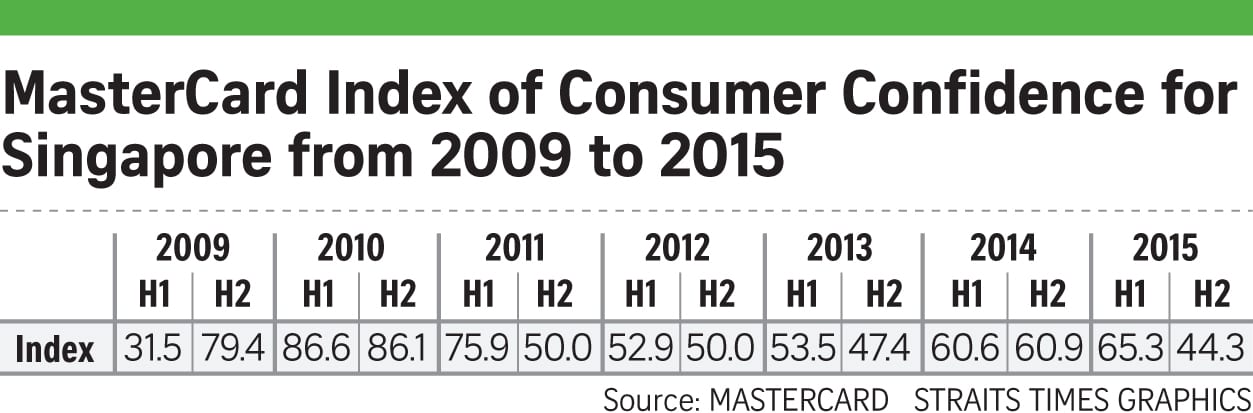
    A MasterCard survey of 447 people here found that Singaporeans went from being optimistic about the near future to being merely neutral about it in the second half of last year.

    Separately, consumer research firm Nielsen surveyed 500 people and found that consumer confidence in Singapore fell below the global average in the three months of last year. The pessimistic outlook came on the back of rising concerns about job security and a lacklustre economy.

    Financial analyst Adeline Toi, 27, has seen her friends in the banking sector get retrenched and now fears for her own job.

    With consumers tightening their belts, there are emptier malls and lower bottom lines for retailers.

    “Customers will come in, look one round, then leave without buying anything,” said Ms Irene Tan, 43, a sales assistant at clothing store VRG at the Wisma Atria shopping mall.

    Sales were down during the recent year-end festivities. Excluding motor vehicle sales, retail sales fell 2.1 per cent and 3.6 per cent last November and December respectively, compared with the same period a year ago, according to the Department of Statistics.

    Despite the gloomy outlook and the less than favourable sales during the Christmas season, retailers remain “cautiously optimistic” as they expect a boost in tourist arrivals from China this year, said Mr Anthony Gan, executive director of the Singapore Retailers Association.

    Despite the fall in visitor arrivals to Singapore last year, the number of Chinese visitors grew 22 per cent year-on-year. They were also the biggest spenders, and nearly half of their expenditure was on shopping.

    He added: ” The government forecast may have revised growth downward but, even at 1 per cent, it is still growth which many developed countries aspire to.”

    But retailers continue to be plagued by the perennial problems of high operating costs and a shortage of manpower. This could lead to further attrition and more shops closing down.

    The increasingly difficult business environment has already claimed several high-profile casualties.

    Last year, Czech shoe company Bata closed eight shops here that were either underperforming or whose leases had expired, and redeployed those employees affected. It is opening three stores this year.

    Bata managing director Pierluigi Pontecorvo said the company is not expecting to grow much this year, but does not intend to cut staff or bonuses.

    Instead, it is offering higher cash incentives and bonuses – about 10 per cent to 15 per cent more compared with last year – for staff who meet key performance indicators.

    Employees of the Bata store with the best customer service will also win a free vacation at the end of the year.

    Just last month, furniture and home accessories retailer iwannagohome said it was shutting its two stores here at the end of May.

    The victims of the slowdown also include online players such as Japan’s Rakuten – its website went offline earlier this month.

    Other companies are switching strategies in a bid to continue driving sales.

    One industry veteran, electronics retailer Challenger, is putting more resources into its online space. The company is launching its revamped online store, Hachi.sg, next month.

    The website, which will offer over 50,000 products, will be optimised for browsing on mobile phones and tablets, and customers can choose to have their purchases delivered to their homes or pick them up at six store locations, instead of the current one.

    The slower market has pushed Challenger to change the way it sells products, said its chief marketing officer, Ms Loo Pei Fen. The company’s retail revenue in Singapore last year fell marginally – 1.6 per cent – over 2014 due to weaker consumer buying power.

    “Despite tightened purse strings, customers still have the desire to buy, but in a way that’s relevant to them and allowing them to stretch their dollar,” Ms Loo added.

    Over at the Robinsons Group of stores, sales have slowed compared with last year. But it remains positive, said Mr Christophe Cann, its group chief executive for Asia.

    Instead of giving up the fight, it is doubling down and pushing ahead with plans to renovate its Robinsons department store at Raffles City, upgrade its Marks & Spencer stores here and introduce new brands to Singapore, he added.

    The good news for retailers, especially those looking to set up a brick-and-mortar shop here, is that rents are on a downward trend.

    Property consultancy R’ST Research estimates that rents in Orchard Road fell 5 per cent last year and is expected to fall by another 5 per cent this year.

    “It’s a good opportunity for retailers to bargain for lower rentals, or ask for a better location if there are vacant spaces within the same mall,” said its director, Mr Ong Kah Seng.

    The cheaper spaces, however, are not in the key malls in the Orchard Road belt, said Mr R. Dhinakaran, managing director of Jay Gee Melwani Group, which manages brands including Levi’s, Aldo and Converse.

    He added: “Rentals are going down only in the malls that are further away and are not doing as well.”


     

  • Paris attacks seen causing short-term global markets drop

    Paris attacks seen causing short-term global markets drop

    Stocks in major markets are set for a short-term sell-off on Monday after suspected Islamist militants launched coordinated attacks across Paris that killed more than 130 people, but few strategists expect a prolonged economic impact or change in prevailing market directions.

    If anything, any initial damage to economic confidence, tourism and trade within Europe will likely reinforce the European Central Banks resolve to ease monetary policy further next month, they reckon. That will keep pressure on the euro exchange rate and support other European asset markets.

    French financial markets will be open as usual on Monday, stock and derivatives exchange Euronext said on Saturday.

    With many Parisian restaurants and shops shut on Saturday and Sunday, some local analysts expected any French equity reaction to be more visible than after Januarys attacks against the Charlie Hebdo satirical magazine and a Kosher supermarket.

    “Stocks that are angled towards consumer goods or tourism, notably the luxury industry with the Christmas season, could be affected,” said IG France analyst Alexandre Baradez.

    “The January (attacks) were different, they were more targeted. Here they were aiming at an entire population,” he added. “There may also be a purely psychological effect that pushes investors to stay on the sidelines until more clarity emerges.”

    Equity futures moved lower at the open on Sunday night in New York time, adding to losses posted as the attacks unfolded after markets closed on Friday. They soon pared some of those Sunday losses.

    The Nikkei stock index fell 0.8 percent after having fallen as much as 1.8 percent earlier in the Monday session.

    Mohamed El-Erian, chief economic adviser at Allianz, said: “With the horrible tragedy leading to some short-term restraint to French GDP, equity markets are likely to open lower with both government yields and the euro falling.”

    Concern about similar attacks beyond France and tensions surrounding a stepped-up Western military response to the actions of Islamic State point to some ripple effect around world markets.

    “These Paris terrorist attacks and the larger scale of this attack could have a meaningful negative impact on the travel and tourism sector,” said Robert T. Lutts, chief investment officer at Cabot Wealth Management in Salem, Massachusetts.

    France has the largest number of tourists in the world and the sector accounts for almost 7.5 percent of GDP.

    If increased national security causes trade friction, longer-term commercial effects also “bode ill for the euro,” said Brian Battle, director of trading at Performance Trust Capital Partners in Chicago.

    “France closed the borders. For how long and what degree will determine the effects,” he said. “The question is will other countries follow this policy, maybe as a political cover to impede immigration.”

    Outside France, few expect a jolt as significant as the hiatus after 2001s attacks that destroyed the World Trade Centre in New York City.

    In foreign exchange markets trading in Asia, the euro was slightly lower against the dollar and yen. Markets in the Middle East, which trade on Sunday, were hit hard, although part of that decline was due to recent falls in oil prices.

    Analysts trying to put the event in some historical context say prior events like this in Europe over the past 15 years tended not to have any durable market or economic effects.

    “As horrific as these events are – and this is truly awful – economic activity does tend to be pretty resilient,” said Howard Archer, chief UK and European economist at IHS Global Insight.

    He noted that the UK, Spain and France have all seen their economies “little damaged by terrorist atrocities in the past.”

    One sector that could see a boost: defense. The sector is already doing better than U.S. equities as a whole, and “the prospect of more military action in Syria may help this group in the week ahead,” said Nicholas Colas, chief market strategist at the ConvergEx Group in New York.

    “While the attack was in Europe, stocks all around the world will see pressure on Monday,” he said. “The typical “risk off” trade is out of global stocks, and into global sovereign debt and the U.S. dollar.”

    Traditional safety plays into assets such as U.S. Treasury bonds would also go against the prevailing market trend of discounting an interest rate rise from the Federal Reserve next month. With few expecting the fallout from the attack to be big enough to affect Fed decision making, any Monday move will likely be short lived.

    The benchmark U.S. Treasury futures contract rose on Sunday to hit its highest since Nov. 6.

    U.S. 10-year Treasuries notes yielded 2.273 percent at Fridays close. The euro was 0.5 percent lower against the greenback at $1.0718.

    One reason for a possible volatile move into Treasuries is because the Fed rate hike anticipation has prompted heavy short positions in the 10-year Treasury. That could exacerbate any move into safe-have government debt.

    Analysts at Citi say just the initial shock of the attacks may challenge extremely leveraged plays – such as heavy short positions in the euro or oil futures. But there was little reason to view that unwind as anything other than temporary.

    “The market is heavily short euro and concerns are high any risk will trigger a short squeeze,” Citi analysts told clients.

    “We dont think it will – and would sell into one if it appears.

    The attacks do not undermine the initial reasons for being short euro – or reduce the possibility of (ECB) action.”

    While news of the attacks hit after markets closed on Friday, S&P 500 Index futures were still trading and shed about 1 percent in light volume.

    “If this had happened during market trading hours there could have been a panic but markets had a weekend to digest all the information,” said Eiji Kinouchi, chief technical analyst at Daiwa Securities in Tokyo.

  • India’s Big Bazaar opens 100th store

    India’s Big Bazaar opens 100th store

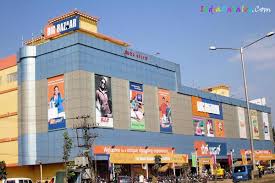
    India’s Big Bazaar is now present in more than 100 cities in India. The last store to be opened by the retail chain last December was the Rourkelo store in Orissa.

    In the last three months prior to the opening of its newest store, Big Bazaar also opened 17 new stores across the country, in cities like Jharsugda, Bhopal, Varanasi, and Bokaro.

    To celebrate its 100th city milestone, Big Bazaar held the “100 cities Celebration” last month in all Big Bazaar outlets, offering as much as 50 percent discounts in various product categories like kitchenware, home furnishings, fashion apparels, and electronics.

    “Our strategy has been to understand the art of doing business in India, while putting in the best practices in Science of retailing. This has helped us customize a complete experience for our customers,” Sadashiv Nayak, CEO Big Bazaar, said in a news release.

    Big Bazaar said it has a loyal customer base of over 2.5 crore (25 million). These customers are part of its various loyalty programs like, Payback, T24 Mobile and Big Bazaar.

    The retail chain is the flagship hypermarket retail chain from Future Group, with  has over 184 stores across the country.

  • TCC opens megamarket in Nong Khai

    TCC opens megamarket in Nong Khai

    TCC Logistics and Warehouse, a subsidiary of TCC Group, has opened the MM Mega Market in Nong Khai province to cash in on growing consumption spurred by increasing border trade with neighbouring countries.

    The company has leased space at Asawann Shopping Complex II for 30 years to open the MM Mega Market, which has a new concept blending a hypermarket and wholesale store under the same roof. Customers can but products either in bulk or just one piece.

    The market, covering 10,000 square metres, is 4.4 kilometres from the Thai-Lao Friendship Bridge, enabling it to attract customers from Laos.

  • After Delhi-NCR, Snapdeal to offer home services in other metros

    After Delhi-NCR, Snapdeal to offer home services in other metros

    E-commerce giant Amazon.com might be planning to launch local handymen services in the Indian market after having done it in the US a few months ago, but Snapdeal.com has already started providing plumbing, electrical and other household services in some cities.

    The Gurgaon-based company, the second largest online marketplace in the country, is betting big on the growing needs of consumers for such services.

    After a pilot project in Delhi and NCR in October, the company has started offering the services in Bengaluru last month, and will go live with Mumbai, Hyderabad, Chennai and Pune in January. By March next year, it plans to target about 10 more cities, where people can call for a plumber, electrician, hardware professionals, carpenters and home cleaning services online.