Tag: mercedes benz

  • Mercedes-benz Unveils Vision Iconic Concept: A Blend Of Classic Elegance And Cutting-edge Technology

    Mercedes-benz Unveils Vision Iconic Concept: A Blend Of Classic Elegance And Cutting-edge Technology

    Unveiling the Mercedes-Benz Vision Iconic Concept: A Fusion of Retro Design and Modern Technology

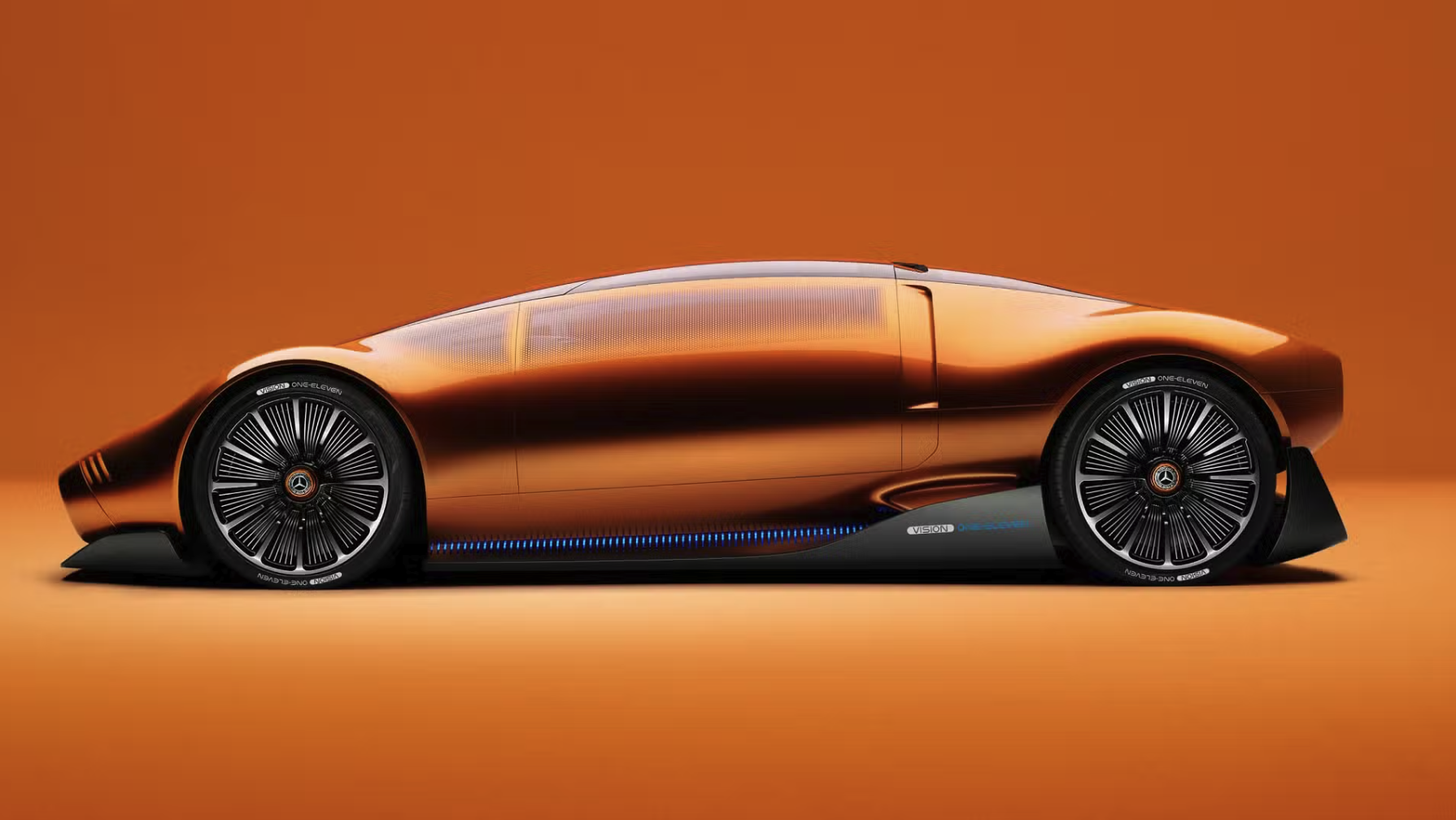
    Mercedes-Benz has recently revealed its Vision Iconic Concept, a luxurious spectacle of automotive engineering, at its design house located in Shanghai, China. The brand asserts that the new concept vehicle draws heavily from the golden age of car design, specifically the 1930s. The Vision Iconic Concept is said to encapsulate the quintessence of what makes a Mercedes-Benz vehicle.

    Inspiration and Innovation

    The Concept maintains design elements reminiscent of classic cars, yet also incorporates a range of advanced technological features. The vehicle’s visually striking design includes an upright radiator grille similar to the one found on the 1956 300Sc model. This grille, however, is accentuated with radiant, illuminated elements. The car’s sloping roofline and elongated bonnet might bring to mind the Mercedes 300 SL. The iconic Mercedes logo adorns the front of the vehicle, while the illuminated star motif on the headlights adds a contemporary, luxurious touch.

    Blending Classic and Modern Interior Design

    The interior decor upholds the design of Mercedes’ vintage cars, but with a fresh twist. New elements have been introduced to enhance modern aesthetics and practicality. The Mercedes-Benz Vision Iconic Concept boasts a unique, floating glass dashboard centerpiece aptly named the ‘Zeppelin’. This feature combines analogue components with digital displays, creating a seamless blend of past and future. A continuous bench seat and an elegantly designed rear section recall memories of the legendary 300 SL. The car’s 4-spoke steering wheel, complete with a Mercedes logo encased in a glass sphere, adds to the luxurious feel of the vehicle.

    Advanced Features

    Beyond its visual appeal, the Mercedes-Benz Vision Iconic Concept is packed with an array of advanced features. It includes steer-by-wire technology, providing quicker maneuvering and precise control. Other notable features in the prototype include Level 2 Advanced Driver-Assistance Systems (ADAS). Mercedes-Benz is also contemplating the development of Level 4 autonomous driving for the vehicle.

    Questions & Answers

    What is the design inspiration behind the Mercedes-Benz Vision Iconic Concept?
    The design of the Vision Iconic Concept is primarily inspired by the golden era of automotive design in the 1930s. It incorporates elements from classic Mercedes-Benz models like the 1956 300Sc and the Mercedes 300 SL.

    What unique interior features does the Vision Iconic Concept have?
    The car’s interior features a unique floating glass dashboard centerpiece called the ‘Zeppelin’. The design also includes a continuous bench seat and an elegantly designed rear reminiscent of the legendary 300 SL.

    What advanced features does the Mercedes-Benz Vision Iconic Concept offer?
    The vehicle is equipped with advanced features such as steer-by-wire technology and Level 2 Advanced Driver-Assistance Systems (ADAS). Mercedes-Benz is also considering the development of Level 4 autonomous driving for the vehicle.
  • Mercedes-Benz Unveils New MBUX-Based In-Car Payment Tech

    Mercedes-Benz Unveils New MBUX-Based In-Car Payment Tech

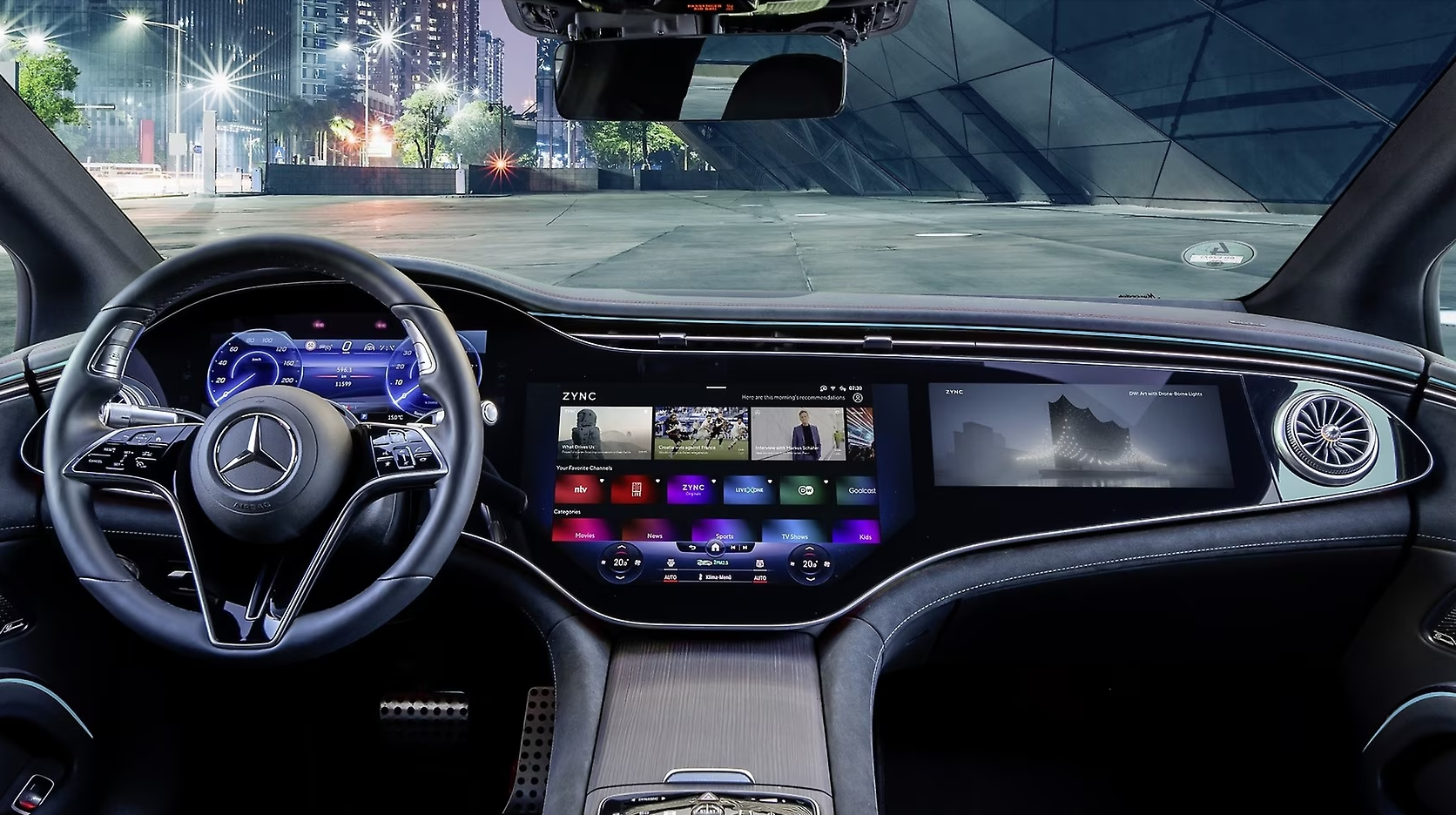
    Mercedes-Benz has introduced a new feature in Germany that allows customers to initiate digital payments via the MBUX system using fingerprint authentication. The company has tied up with Mastercard to offer the embedded payment service which for now will be useable across 3,600 service stations in the country. The tech uses a dedicated Mercedes Pay+ app to offer the service and uses the fingerprint sensor built into the MBUX system to authenticate payments.

    When a driver arrives at a connected service station and turns off the engine, the Mercedes me Fuel & Pay service will automatically activate on the MBUX infotainment system where the driver can then select the appropriate gas pump. Before refueling, the system calculates the maximum total amount based on the current fuel price and the tank’s current fuel level.

    Upon refueling, the driver can view the amount of fuel added and the invoice amount on the MBUX display. Payment is automatically processed, allowing the driver to leave the gas station without visiting the checkout area. The invoice is subsequently sent to the customer via email.

    “With Mercedes pay+, we are making everyday life easier for our customers. From now on, they can pay their fuel bill directly from their car using their fingerprint –, securely, and conveniently,” said Franz Reiner, Chairman of the Board of Mercedes-Benz Mobility AG.

    Customers with Mastercard and Visa credit or debit cards issued in Germany can utilise native in-car payments by registering their card in the Mercedes me user account and activating Mercedes pay+ via the MBUX infotainment system. The use of fingerprint payments from the car is expected to expand to other vehicle-related services and European markets in the near future.

  • Mercedes-Benz India To Consider Accelerating Localisation And Launch Plans Of EVs

    Mercedes-Benz India To Consider Accelerating Localisation And Launch Plans Of EVs

    On August 25, Mercedes-Benz India recorded 2,46,000 views on its Twitter handle for the Mercedes-AMG EQS 4 MATIC+ launch live stream. And ever since it stepped in the Indian luxury EV space with the EQC electric SUV, the brand has observed a steady rise in interest around its electric models through its customer-engaging activities. Now that is confidence-inspiring for the German brand to expedite its plans for launching new electric vehicles in India and considering their local production. It is planning to introduce them as completely knocked down (CKD) products in a bid to keep their ex-showroom prices in check.

    The response that the EQS got shows that the public in ready to be interested in the vehicle and it shows that there is potential in the market. Not every one of the 2,46,000 viewers on Twitter that we had during our live launch will purchase the car, but it shows that the time is right. It’s ready to move into the electric vehicle space, and it gives us a lot of confidence going forward, also with the locally produced car which we’re launching now. The story of EVs is a story of accelerations and deceleration not only in India, but it has also happened globally. We think that things will happen in a couple of years, but they will happen faster than the original plans were. In that sense, I am very confident based on the pipeline Mercedes has built globally. And we’ll also relook on what to do in India based on based on the feedback we’re getting. The EQC gave us good feedback and the EQS is a very strong local product, the EQB which will come later in the year will also see a very different segment. From what we see, what will happen in the next six months will certainly influence our outlook in terms of localization and in terms of products.”

    The next Mercedes-Benz launch in the Indian EV space will be the locally manufactured EQS electric sedan which will roll out of the Chakan plant on September 30. By the end of this year, the German carmaker will also introduce the EQB electric SUV in our market, which is likely to take the CKD route as well. So by 2023 Mercedes will already have four electric offerings in our market across multiple segments. We also know that models like the Vision EQXX and G-Wagon based EQG electric concepts are under development at the Stuttgart headquarters. So if the company continues to observe a growing interest in its electric offerings, it is likely that it will consider introducing these models sooner and as locally manufactured products.

    Well, the overall luxury car market is still roughly around 1.8 per cent in India with EVs having an even miniscule share. But according to a Mordor Intelligence study, the Indian luxury car market is expected to reach a value of over $ 1.54 billion from $ 1.06 billion by 2027 with a CAGR of more than 6.4 per cent during the forecast period 2022-2027. The study further states that with majority luxury car brands aggressively balancing their line-up with EV models, the electric segment is likely to dominate the luxury car space which is reassuring.

  • Mercedes-Benz Expects Supply Chain Constraints To Continue In 2022

    Mercedes-Benz Expects Supply Chain Constraints To Continue In 2022

    Mercedes-Benz is still feeling the effects of the global semiconductor shortage that hit the auto industry as well as supply chain constraints. As per a report by PTI, the carmaker is not expecting the situation to improve in 2022 while also saying that it was hard to predict how it would change in the future.

    Speaking to PTI, Martin Schwenk, Managing Director and CEO of Mercedes-Benz India said that the company was dealing with not just semiconductor shortages but also with congestion in shipping. He added that the company was facing significant supply constraints placing a limit on the number of cars it could produce and deliver causing longer waiting period for its customers. Schwenk also revealed that the global economic uncertainties and go-political tensions seemed to have worsened over the past few months with a lot of questions being raised across markets regarding the economic situations in the short-to-medium terms.

    Schwenk however said that while the brand was facing uncertainty over its production levels, the global economic uncertainties and geopolitical crisis was yet to affect consumer sentiment in India. The carmaker said that it has over 5,000 pending orders on its hands currently in the country with the number of bookings continuing to increase.

    He however said that the company in the past few months had been forced to hiked prices on several occasions owing to rising input costs and the company was continuing to monitor topics such as inflation and pricing.

    Mercedes has some big launches lined up for India in the coming months including its all-electric flagship, the EQS luxury sedan and the EQB electric SUV. The carmaker at the start of the year had revealed its plans to launch 10 new models in India in 2022 which has till now included the new Mercedes-Maybach S-Class and the new-gen C-Class.

  • Self-Driving Sensor Maker Luminar Shares Rally On Mercedes-Benz Tie-Up

    Self-Driving Sensor Maker Luminar Shares Rally On Mercedes-Benz Tie-Up

    Luxury carmaker Mercedes-Benz will partner with self-driving sensor maker Luminar Technologies Inc to enable fully automated driving on highways for its next-generation vehicles, Luminar’s founder said.

    Luminar shares surged 18% at $15.89 on Thursday. Luminar said Mercedes-Benz will have 1.5 million shares in Luminar, which will vest over time when certain milestones are met.

    Vehicle autonomy “is really going mainstream with Mercedes,” Luminar CEO Austin Russell told Reuters on Wednesday, without disclosing a timeframe for putting the technology in Mercedes’ vehicles.

    He said the two would develop “true” autonomy capabilities to keep drivers out of the loop, while improving safety capabilities such as automatic braking.

    Automakers from Tesla to General Motors Co and Volvo have set their eyes on introducing autonomous vehicles for consumers, although regulatory and technological challenges remain.

    Luminar said Mercedes-Benz will have 1.5 million shares in Luminar, which will vest over time when certain milestones are met.

    Tech firms such as Alphabet’s Waymo and Cruise also are developing self-driving taxis or trucks for commercial use such as ride-hailing and delivery services.

    General Motors is working with its majority-owned Cruise self-driving unit to introduce a personal autonomous vehicle by as early as mid-decade, Chief Executive Mary Barra said this month.

    “If you want to be able to get to truly autonomous capabilities in a consumer vehicle, and you have to industrialize hardware, software, all of these systems that come into play. That by the way, is completely different than the work that the robo-taxi companies have been working on,” Russell said.

    He said it is a challenge to mass-produce lidars and make sure they are robust enough to meet stringent requirements from automakers.

    “It is a completely different kind of business of going from a science and technology business to an automotive corporation.”

    Tech firms such as Alphabet’s Waymo and Cruise also are developing self-driving taxis or trucks for commercial use such as ride-hailing and delivery services.

    Lidars, which use laser light pulses to measure the distance between the sensor and the target object, are widely seen as essential to achieving full autonomous driving. But Tesla has shunned the sensor, saying it is expensive and unnecessary.

    Volvo Cars and Luminar said earlier this month that they will put a hands-free driving system in an upcoming electric sport utility vehicle.

  • Mercedes dealer reports record loss in Q3

    Mercedes dealer reports record loss in Q3

    Hang Xanh Motors Service JSC (Haxaco), a major Mercedes-Benz dealer in Vietnam, reported a record loss, more than VND33 billion ($1.4 million) in Q3, due to social distancing orders.

    Revenue in Q3 was VND700 billion, down 59 percent compared to the same period last year.

    Social distancing measures applied in Hanoi, Ho Chi Minh City and other localities in this quarter have seriously affected Haxaco and the automobile industry. The company’s two branches in HCMC had to temporarily close in Q3 while another in Hanoi was closed until Sept. 12.

    “This has caused a decline in our sales and services during this period,” the company noted.

    Between January and September, the auto dealer’s revenue was VND3.4 trillion, down 9 percent over the same period, equivalent to 35 percent of this year’s business plan.

    However, profit dropped by 45 percent to VND44 billion.

    Despite the revenue decline, the company retains a positive forecast for the last quarter of this year. It has thoroughly prepared to resume operations in the new normalcy, with all employees fully vaccinated to ensure operational safety.

    Previously, in the annual meeting at the beginning of the year, the company set a business plan for 2021 with a net profit of VND126 billion.

  • Mercedes-Benz Vietnam recalls 1,700 cars

    Mercedes-Benz Vietnam recalls 1,700 cars

    Mercedes-Benz Vietnam is recalling more than 1,700 C200 cars locally assembled from 2014 -2018 to remove a generator-related software bug.

    The recalled cars were produced between Dec. 2014 to Feb. 2018. Short-circuited diodes in their generator were making coils overheat, leading to fire risks, the carmaker said. The recall will run from Sept. 25, 2021 to Dec. 31, 2025.

    The solution is to update the engine control software to optimize generator operation. The free update would take about 30 minutes at authorized Mercedes-Benz dealers in Vietnam.

    These vehicles were manufactured from Nov. 2016 to Feb. 2017. The solution is to replace the entire steering shaft, a procedure lasting about 1.5 hours.The German carmaker also made two other recalls in Vietnam from Oct. 1-7. These relate to several different models, including 49 A-class cars, CLA, and the imported GLA that have an error in the steering shaft mechanism.

    Mercedes-Benz sold 2,558 units in Vietnam in 2020.

  • Mercedes-Benzs Global Sales Up By 25.1% In First Half Of 2021

    Mercedes-Benzs Global Sales Up By 25.1% In First Half Of 2021

    Mercedes-Benz delivered 1,182,724 passenger cars to customers worldwide in the first half of 2021. The company recorded a growth of 25.1 percent compared to the same period last year. In China, Mercedes-Benz set two new records: The highest deliveries in the second quarter (219,059 units, +5.8%) and in the first half of a year (441,579 units, +27.6%). The company achieved double-digit sales growth in Q2 in Germany (+26.3%) and the USA (+38.6%).

    Deliveries of plug-in hybrids and all-electric cars more than quadrupled in just six months, reaching 121,500 units (+305.0%). In total, the xEVs made up 10.3 percent of total Mercedes-Benz sales in the first half of 2021. Around 39,000 all-electric vehicles were delivered from January to June (+291.4%), including more than 19,000 units (+469.4%) of the EQA, EQC and EQV models

    Sales of Mercedes-Benz cars in the Asia-Pacific region rose from January to June by 26.1 percent. In the Europe region, the recovery of many markets and an improved COVID-19 situation led to a sales growth of 53.7 percent in the second quarter. Mercedes-Benz sold in Germany a total of 107,269 cars from January to June, achieving a sales level slightly above last year (+1.0%).

  • Mercedes-Benz India Has No Plans To Launch The EQS Or Any Other EV This Year

    Mercedes-Benz India Has No Plans To Launch The EQS Or Any Other EV This Year

    Despite the challenges caused by the second wave of the COVID-19 pandemic, Mercedes-Benz India has been among the select few carmakers that have stayed on course with regard to product launches. The Stuttgart-based luxury carmaker has confirmed that it will launch 15 new models in India this year, however, that will not include any electric vehicles. When asked about the launch timeline for the EQS, during the post-launch interaction for the Maybach GLS 600, Santosh Iyer, VP – Sales & Marketing, Mercedes-Benz India confirmed that the company has no plans to launch the EQS or any other EV at least for next one year.

    Talking about the company’s product plan with regards to the EQS and other electric vehicles, Iyer said, “The EV portfolio for Mercedes-Benz is strong. You already saw the EQA, the EQB, there are many products that are getting launched. So, we’ll pick up the right products and definitely, surely introduce them in India. But, for now, the EQC remains our key driver when it comes to the volumes here. Again, we are struggling with the availability of EQC so no point in again launching more EVs and putting some confusion in the market at this stage. Also, EQS is available for sale only in the last part of the year, even worldwide. So, nothing in the next one year at least as far as the EQS or anything else goes.”

    Iyer pointed out that a lot of these electric vehicles introduced globally are high on demand worldwide, and they will make it other markets gradually. Assuring that India is a priority market for the brand, he said that there is no point in launching a product and not being able to cater to the demand. Right now, it’s even struggling with the demand for the EQC. So, before bringing a high-value product like the EQS electric sedan, the carmaker wants to get some volume and certain clarity.

    Having said that, Mercedes-Benz India has already listed its flagship electric vehicle – the EQS on its official website. When asked what that means for the Indian market, Iyer said, “For us electric is not an option. It is something that the automotive industry will transform, and we take pride that in India we were the first to start, and we’ll now continue to bring in new products. As regards that EQS, I think that a statement in terms of our brand, in terms of our commitment to electric.” He further added, “I think the EQS transforms, it makes a paradigm shift into the technology scape, into the luxury space apart from being a very good EV in terms of driving, in terms of battery charging, and some of the other dynamics. So, it was natural for us when there is a global unveil of such a product, which is now our flagship when it comes to the EV story to be there on our website.”

    The Mercedes-Benz EQS is the company’s flagship electric vehicle, and it was just in April 2021 that the sedan version of the EV made its debut. Mercedes also plans to introduce an SUV version of the EQS, which is likely to make its global debut in late 2022. The EQS sedan comes with a 107.8 kWh Lithium-Ion battery, promising a 770 km WLTP cycle certified drive range on a full charge. However, the carmaker has not provided detailed variant-wise range options. The car comes with a standard onboard charger of 11 kW with an optional 22 kW charger. The EQS can be charged from 10 to 80 percent in 35 minutes using a 110 kW DC fast charging, while a 240-volt household wall charger will take 11 hours for the same range.

  • Mercedes-Benz India Extends Warranty And Service Plans To Support Customers languagedropdown

    Mercedes-Benz India Extends Warranty And Service Plans To Support Customers languagedropdown

    Mercedes-Benz India has announced a host of warranty and service initiatives to support its customers during the COVID-19 pandemic. Given the ongoing lockdown, the carmaker is offering an extension on timelines to honor warranty claims and warranty protection against lapsed service. This means Mercedes-Benz car owners, whose warranty or free service plans have or will expire between April 15 and May 31, 2021, will now get an extension on these benefits until June 30, 2021. The announcement comes just a day after rival Audi India announced a similar initiative.

    These benefits are for Mercedes-Benz car owners, whose warranty or free service plans have or will expire between April 15 and May 31, 2021

    In addition to the extension on standard warranty package and protection against lapsed service, Mercedes-Benz India will also support claims related to extended warranty and motor vehicle insurance (Daimler Financial Services Insurance), until June 30, 2021. This is for customers whose extended warranty or motor insurance has lapsed between April 15 and May 31, 2021. Also, if the vehicle’s standard warranty is expiring during the aforementioned dates and the customers wish to purchase an extended warranty, they will get an extension till June 30. Mercedes-Benz India says that it will also continue to support its customers with the Road-Side Assistance program with special permissions, wherever required.

    Talking about the initiative, Martin Schwenk, MD & CEO, Mercedes-Benz India, commented, “In the current challenging situation it remains our endeavor to assure our customers of complete peace of mind when it comes to their vehicles. Through these specially crafted service initiatives along with our service teams’ ongoing support working remotely, our customers will continue to enjoy a hassle-free vehicle ownership.”

  • Mercedes-Benz EQS Listed On India Website Ahead Of Launch

    Mercedes-Benz EQS Listed On India Website Ahead Of Launch

    The all-new Mercedes-Benz EQS made its global debut earlier this month. Interestingly, the electric sedan now has been listed on the official website with the ‘Coming Soon’ title, which suggests that it could be launched in the Indian market this year. The model page listing has also revealed several key details and specifications of the electric vehicle ahead of its launch. It will be the second all-electric model from Stuttgart-based luxury carmaker, after the EQC electric SUV that was launched last year.

    As per the listing on the official website, the luxury electric sedan will be available in two trims – EQS 450+ and EQS 580 4MATIC. The EQS 450+ is the base variant that features a single electric motor on the rear axle for a total of 328 bhp and 568 Nm of peak torque. The EQS 580 4MATIC is an all-wheel-drive (AWD) range-topping trim and gets an electric motor on both front and rear axles. Total output in combination here is 516 bhp and a whopping 855 Nm of peak torque, good for a 4.1 seconds sprint to 100 kmph from a standstill.

    The S-Class of electric sedans is based on the EQS Vision concept which was showcased by the carmaker in 2019. It will be placed at the top in Mercedes-Benz’s EQ line-up, which currently includes EQC, EQA, and the EQB globally.

    Aesthetically, the electric sedan comes with all characteristics of the S-Class sporting LED headlamps with integrated LED DRLs, connected by an LED strip, and LED taillights, again connected by an LED strip. On the inside, it showcases the new 56-inch MBUX Hyperscreen which is essentially a massive glass dashboard incorporating three individual information displays – an instrument cluster, a center infotainment system, and an auxiliary passenger-side touchscreen.

    The Mercedes-Benz EQS comes with a 107.8 kWh Lithium-Ion battery, promising a 770 km WLTP cycle certified drive range on a full charge. However, the carmaker has not provided detailed variant-wise range options. The car comes with a standard onboard charger of 11 kW with an optional 22 kW charger. The EQS can be charged from 10 to 80 percent in 35 minutes using a 110 kW DC fast charging, while a 240-volt household wall charger will take 11 hours for the same range.

  • Mercedes-Benz Global Sales Up By 22.3% In Q1 2021

    Mercedes-Benz Global Sales Up By 22.3% In Q1 2021

    Mercedes-Benz cars sold 590,999 passenger cars globally in the first quarter of 2021 driven by China and US retail sales as well as strong demand for plug-in hybrids and all-electric vehicles. This marks a jump of 22.3 percent in sales globally compared to the same period last year. In Europe, one in four cars sold by Mercedes-Benz and smart was an xEV.

    Globally, plug-in hybrids and all-electric cars made up about 10 percent of overall sales, with approximately 59,000 units and thereof more than 16,000 all-electric vehicles sold. The EQA too has been well received after it was launched in January this year. The company already has 20,000 orders for the EQA. Given the strong start, the company is looking to bring in 3 new models the EQS, EQB, and the EQE this year.

    The current worldwide shortage of supply in certain semiconductor components affected deliveries in the first quarter and will continue to affect sales in Q2. The company monitors the situation closely and is in constant contact with the suppliers.

    Sales of Mercedes-Benz in the Asia-Pacific region rose 46.6 percent due to the continuing strong sales development in China: where a new record was achieved with 222,520 cars delivered in Q1. In January, sales in China almost reached the milestone of 100,000 vehicles within a single month. In the Europe region, brand deliveries were despite ongoing lockdown measures in many markets at the beginning of the year slightly above Q1 2020. In Germany, Mercedes-Benz sold a total of 54,446 cars down by 15.4 percent while sales in the North America region totaled 88,318 units showing strong growth of 12.5 percent.

    In India, the company recorded a growth of 34 percent over Q1 202

  • Mercedes-Benz To Purchase Electricity From Renewable Energy Sources From 2022

    Mercedes-Benz To Purchase Electricity From Renewable Energy Sources From 2022

    Mercedes-Benz has entered into a green power supply contract with energy supplier Enovos and the Norwegian energy producer Statkraft. This means that from 2022 onwards, the company will purchase electricity in Germany which comes exclusively from renewable sources. A green power supply contract ensures the purchase of electricity from renewable energy sources at all times.

    The CO2-free electricity from solar, wind and hydro sources is generated in various power plants, most of which are located in Germany. These include a part of a solar park with the size of 60 football pitches near Ingolstadt and 24 wind farms with a total of more than 200 wind turbines. The electricity generated from this is roughly equivalent to the amount consumed by 65,000 households annually. The intelligent mix is supplemented by electricity from flexible hydropower plants.

    Generation of green electricity is synchronized to follow patterns of consumption so that a supply from the grid with green electricity can be guaranteed on a quarter hourly basis. In many previous green power contracts, feed-in to the grid takes place purely on an annual balance basis. In 2018, Mercedes-Benz was the first major industrial customer in Germany to secure the long-term continued operation of six wind farms in northern Germany after the end of the EEG subsidy through a similar concept. The first Mercedes-Benz locations are already being supplied with this CO2-free electricity.

    In Germany, green electricity procurement is ensured not only for the passenger car production plants but for all Daimler locations. This also includes the German van, truck and bus plants as well as the central and administrative units – more than 100 locations in total. The company is thus making a significant contribution to the expansion of renewable energy in Germany and to the energy transition.

    With Ambition 2039, Mercedes-Benz is pursuing the goal of a fully connected and CO2 neutral vehicle fleet in 2039 – eleven years earlier than required by EU legislation. The company envisages that more than 50 percent of its passenger car unit sales will be accounted for by plug-in hybrids or all-electric vehicles by 2030.

  • Mercedes-Benz To Increase Its Share In Aston Martin

    Mercedes-Benz To Increase Its Share In Aston Martin

    Aston Martin is a celebrated British car manufacturer and the company is not in great shape financially. But in order to make the going easier, Aston Martin has announced that Mercedes-Benz will increase its stake in the company to 20 percent. In return, Mercedes-Benz will grant Aston Martin access to its latest technologies. These also include Mercedes’ technology for plug-in hybrid and fully electric vehicles. What this essentially means is that Aston Martin will reduce the cost and risk of developing its own technology for electrified vehicles and will focus on investment in other areas and expand its model portfolio.

    Lawrence Stroll, Executive Chairman of Aston Martin Lagonda, said “Today, we take another major step forward as our long-term partnership with Mercedes-Benz AG moves to another level with them becoming one of the Company’s largest shareholders. Through this newly expanded agreement, we secure access to world-class technologies to support our long-term product expansion plans, including electric and hybrid powertrains and this partnership underpins our confidence in the future.”

    Mercedes-Benz will provide technology (including powertrain architecture for a conventional, plug-in hybrid, and electric vehicles) for all product launches through 2027. Aston Martin has plans to reach 10,000 unit sales per annum by 2024/25 although there is still a long way to go, with the British company delivering just 2,752 cars so far in 2020, which is a drop of 39 percent over 2019. But a part of that can be attributed to the global corona pandemic as well. Aston Martin’s operating losses for 2020 so far stands at £229m. The company aims to have a net income of £500m with interest, taxes, depreciation, and amortization added back by the mid part of the decade.

    In its recently released financial statement, Aston Martin says that the company has a plan to update its entire front-engined sports car line-up, introduce a new SUV model which will sit along-side the DBX, and launch a new range of mid-engine cars.

  • Audi Dealership Destroyed In The Beirut Explosion

    Audi Dealership Destroyed In The Beirut Explosion

    It’s been over a week since the explosion at the Beirut port in Lebanon, and the damage to the people, economy and the city at large is insurmountable. The extent of the destruction is devastatingly visible in the form of this Audi dealership that’s been reduced to rubble in the aftermath. The image shared by Hildegard Wortmann – Member of the Board of Management of Audi AG for Marketing and Sales, shows the completely destroyed dealership surrounded by towers on either side with shattered glass. She further revealed that while the employees at the dealership are safe, many of them have lost their homes. Not just Audi but most auto dealerships and other businesses in areas close to the port have been destroyed due to the blast.

    In a post on social media, Hildegard Wortmann wrote, “It is with great sorrow that I wish to express my deepest sympathy to our Audi team in Beirut and to everybody there who is suffering from this unbelievable tragedy. I have been in contact with Nabil Kettaneh, who is our Audi importer and partner in Beirut, immediately the morning after and so grateful to hear that everybody is safe while our dealership has been completely destroyed. Many of our team have lost their homes and their families have been impacted. Your grief is the grief of the whole Audi family worldwide. Our thoughts and compassion are with you and the victims’ families. May strength and confidence be with you!”

    In fact, images and videos which emerged on the internet further show massive destruction to homes and cars. A video of what appears to be a dealership parking lot in the city shows damaged Audi vehicles that were ready to be delivered to customers, adding millions to the overall damage. Not just Audi, but other automakers have suffered equal levels of destruction. Carmakers including Mercedes-Benz, Jaguar, Suzuki, Ford, Seat among others took to social media to show support for the city.

    The extent of damages as a result of the explosion has been estimated at about $10 billion so far and the number is only expected to go higher, according to a report by Bloomberg. As of August 11, the blast resulted in over 200 fatalities and 110 people are missing, with over 6000 injured. The explosion has also rendered over 200,000 people homeless or living with homes with shattered windows and doors. Beirut was also home to several refugees in the Middle-East that have once again been rendered homeless amidst the massive crisis.