Tag: NVIDIA

  • Telkomsel to adopt Kinetica analytics platform

    Telkomsel to adopt Kinetica analytics platform

    Indonesia’s Telkomsel has arranged to adopt the Kinetica advanced analytics platform to help it transform the customer experience for its users.

    The operator will use the Kinetica engine and NVIDIA graphics processing units (GPUs) to enable real-time analytics, location-based visualization and AI capabilities.

    Telkomsel plans to use thee capabilities to deliver data-driven customer experiences and to enable real-time financial and business reporting.

    “The rapid growth in mobile devices, digital users, and the micro-services nature of prepaid across the Indonesian market has led to exponentially more data generated than ever before,” Telkomsel CIO Montgomery Hong said.

    “This influx of extreme data presents a massive opportunity to develop new, personalized, digital lifestyle experiences for Indonesian consumers. Unlike traditional database solutions, the Kinetica engine is purpose-built for extreme data and provides real-time data analysis and location intelligence across our business, from prepaid and postpaid mobile, to digital lifestyle services (video, gaming, music), to mobile financial services, and digital advertising for starters.”
  • Nvidia says Toyota will use its AI technology for self-driving cars

    Nvidia says Toyota will use its AI technology for self-driving cars

    Nvidia announced a partnership with Toyota Motor Corp on Wednesday, saying the Japanese car maker would use Nvidia’s artificial intelligence technology to develop self-driving vehicle systems planned for the next few years.

    Toyota will use Nvidia’s Drive PX artificial intelligence platform for its autonomous vehicles planned for market introduction, Nvidia Chief Executive Jensen Huang said in his opening keynote at the company’s GPU Technology Conference in San Jose.

    Nvidia came to prominence in the gaming industry for designing graphics processing chips, but in recent years has been a key player in the automotive sector for providing the so-called “brain” of the autonomous vehicle.

    Nvidia, which also has partnerships with Audi and Mercedes, is among the more popular technology partners in the self-driving car race. Its partnership with Toyota is the latest in a string of alliances between tech companies, automakers and suppliers in the fast-growing sector.

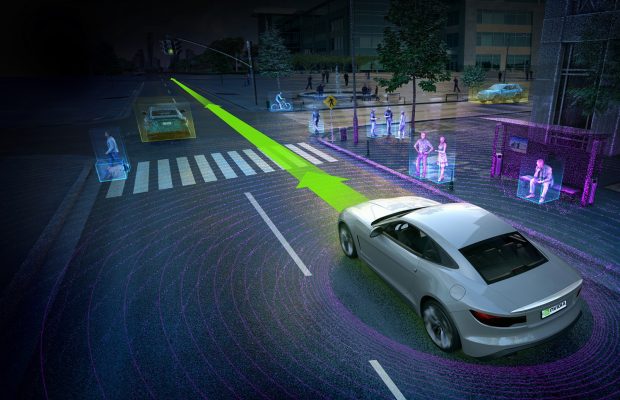
    Nvidia’s Drive PX supercomputer fuses incoming data from the car’s hardware such as cameras and radar and uses artificial intelligence to help the car understand and react to its environment.

    “We’re talking about not just development now but the introduction of vehicles into the market,” said Danny Shapiro, Nvidia’s senior director of automotive. “Now we have the biggest (automaker) in Japan using our Drive PX platform.”

    In January, Nvidia and Audi (VOWG_p.DE) said the German automaker would use the Drive PX to help it put autonomous vehicle on the road starting in 2020. Nvidia is also co-developing with Mercedes a project to come to market within the next 12 months, both companies said in January.

    Toyota, which last year set up a U.S.-based Toyota Research Institute (TRI) to focus on AI and robotics, envisions a dual-track development of autonomous technology. It is simultaneously developing full self-driving cars while also working on what it calls “guardian angel” partially autonomous technology that may still require involvement from drivers.

  • NVIDIA, Facebook team up on AI

    NVIDIA, Facebook team up on AI

    NVIDIA and Facebook are working together to advance artificial intelligence with Caffe2, a new AI deep learning framework contributed by Facebook to the open-source community.

    Facebook is developing new AI systems to help manage this information so people can better understand the world and more effectively communicate, even as the volume of information increases.

    Caffe2 allows developers and researchers to create large-scale distributed training scenarios and build machine learning applications for edge devices.

    Increasingly, the processing of lightning-fast AI services requires GPU-accelerated computing, such as that offered by Facebook’s Big Basin servers, as well as highly optimized deep learning software that can leverage the full capability of the accelerated hardware.

    “NVIDIA and Facebook are delivering AI acceleration through our work on the Caffe2 deep learning framework,” said Kristin Bryson, PR director for the data center business at NVIDIA.

    “Thanks to our joint engineering, we’ve fine-tuned Caffe2 from the ground up to take full advantage of the NVIDIA GPU deep learning platform,” said Bryson.

    Caffe2 uses the latest NVIDIA Deep Learning SDK libraries — cuDNN, cuBLAS and NCCL — to deliver high-performance, multi-GPU accelerated training and inference.

    Bryson said Caffe2 is designed to be a fast, scalable and portable deep learning framework. It delivers near-linear scaling of deep learning training with 57x throughput acceleration on eight networked Facebook Big Basin AI servers with 64 NVIDIA Tesla P100 GPU accelerators. This means developers can train and iterate AI models faster than ever.

    As part of the two companies’ collaboration, the NVIDIA DGX-1 AI supercomputer will be the first AI system to offer Caffe2 within the optimized software stack for deep learning. Together, DGX-1 and Caffe2 deliver high performance and fast training.

    “Through NVIDIA’s Deep Learning Institute, we’ve helped more than 10,000 developers worldwide learn to use frameworks to design, train and deploy neural network-powered machine learning for a variety intelligent applications and services,” said Bryson.

  • Nvidia launches AI-focused incubator in India

    Nvidia launches AI-focused incubator in India

    American graphics processing unit (GPU) technology giant Nvidia has launched the Nvidia Inception program in India, in recognition of the country’s budding innovation ecosystem surrounding Artificial Intelligence (AI).

    Inception is a virtual incubator program to support startups with revolutionary ideas in AI. Members will receive a custom set of benefits, from hardware grants and marketing support to access to the latest Nvidia deep learning technologies and training with deep learning experts.

    The Inception Program was launched in India at the inaugural Nvidia Emerging Companies Summit India, part of the GPU Technology Conference (GTCx).

    The momentum around AI among Indian innovators is so significant that, at launch, the Inception Program already has close to 100 Indian startups as members.

    “Artificial Intelligence has gone from science fiction to reality thanks to a new computing model: GPU-accelerated deep learning,” Nvidia MD for South Asia Vishal Dhupar said.

    “We believe the next generation of breakthroughs in technology and business will be driven by the AI startup community. Young India’s aspirations, ideas and potential are global in scale, and we are excited to amplify the imagination and intelligence of the country’s brightest minds.”

  • Baidu, NVIDIA enter self-driving car alliance

    Baidu, NVIDIA enter self-driving car alliance

    Chinese internet giant Baidu and GPU maker NVIDIA have teamed up to use artificial intelligence in the creation of a cloud-to-car autonomous car platform for local Chinese and global car makers.

    The partnership combines Baidu’s cloud platform and mapping technology with NVIDIA’s self-driving computing platform to develop solutions for HD maps, Level 3 autonomous vehicle control and automated parking.

    “We’re going to bring together the technical capabilities and the expertise in AI and the scale of two world-class AI companies to build the self-driving car architecture from end-to-end, from top-to-bottom, from the cloud to the car,” NVIDIA CEO Jen-Hsun Huang said.

    NVIDIA and Baidu have a long history of working together on AI. Using GPUs, Baidu researchers such as Andrew Ng have achieved some of the key breakthroughs that have made the modern AI boom possible, spawning hundreds of startups over the past few years.

    Amidst the growing excitement over the future of AI, Baidu and NVIDIA continue to share a common goal of using AI for the good of society.

    “We can start applying these capabilities to solve the grand challenges of AI, one of which is intelligent machines. One of the intelligent machines we would like to build in the future is the self-driving car,” said Huang.

    He said that meant making driving safer, significantly reducing the number of traffic fatalities, while making transportation accessible to all — including the disabled, elderly and children.

    Developing a fully autonomous car is an end-to-end systems problem — from the in-car supercomputer, to AI algorithms, to an always-updated 3D map in the cloud, said Huang.

    The solution is expected to be available to local Chinese automakers as well as global brands.