Tag: Phones

  • Microsoft to bring its best car racing game to Phones

    Microsoft to bring its best car racing game to Phones

    Microsoft has just announced that its best car racing franchise will make its debut on mobile later this year. The game is called Forza Street and seems to be part of Microsoft’s best-selling racing franchise, and, more importantly, will be free-to-play.

    As a matter of fact, Microsoft confirmed Forza Street is now available as a free-to-play title for Windows 10 users, so if you don’t want to wait for the mobile version, you can start playing right away after you download it from the Microsoft Store.

    Forza Street takes players to the streets of Miami where they can enter the ultimate street racing scene to win the car collection of their dreams. Simply pick an event, choose your car, and race for fame.The game allows players to collect and upgrade iconic cars, from classic to modern sport and retro supercars. Microsoft promises “streamlined controls,” but the best thing about Forza Street is that you’ll be able to race anytime, anywhere, assuming you have an Internet connection. You can even squeeze in a quick one-minute race while waiting for your bus, or get immersed in an endless story with multiple ways of achieving victory.

    It’s quite interesting to see Microsoft giving a damn about mobile gaming, not to mention that the Forza series includes some of the best arcade racing games of all time. Hopefully, Forza Street will follow in the footsteps of its predecessors – Forza Motorsport and Forza Horizon, and provide an immersive car racing experience.

  • LTE device ecosystem grew 26% in the last year

    LTE device ecosystem grew 26% in the last year

    The LTE device ecosystem has expanded by 26% over the past year to reach 13,700 devices, according to the Global Mobile Suppliers’ Association (GSA).

    The LTE Ecosystem report published by the industry body found that devices have been launched by 705 manufacturers, including devices supporting the FDD LTE and TD-LTE standards and the LTE-related cellular IoT standards LTE Cat-M1 and narrowband IoT.

    Meanwhile the nascent 5G device ecosystem is taking shape. As of mid-March, the GSA had identified 34 announced devices – including regional variants, including 11 smartphones.

    This is an improvement on the 22 5G devices identified by mobile industry consultancy Hadden Telecoms in a report issued earlier in the month

    According to the GSA, devices have been announced across seven form factors – phones, hotspots, indoor customer premises equipment, outdoor customer premises equipment, modules, dongles or adapters, and USB terminals.

    The industry body said it expects the global 5G device ecosystem to grow rapidly as more commercial 5G services are launched.

  • Korean iPhone owners claim low trade-in prices

    Korean iPhone owners claim low trade-in prices

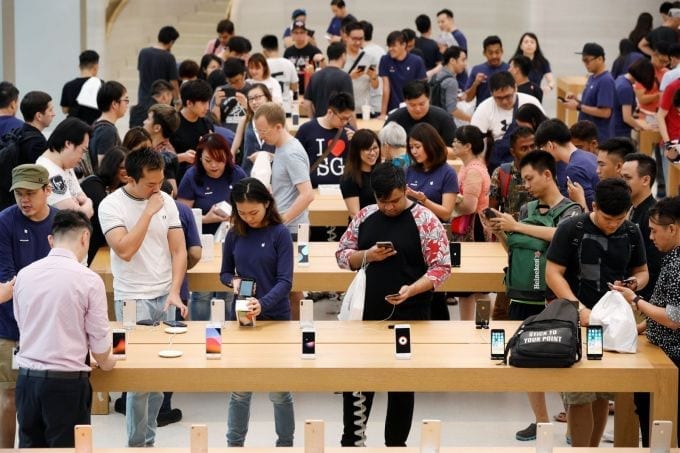
    iPhone users are accusing Apple of paying Korean customers less for their trade-ins than the devices are worth, while noting differences between promotions in other countries and those in Korea.  If an iPhone owner wants to return an older model when buying a new device, iPhone Korea said it will offer up to a 300,000-won ($268.56) discount on the latest smartphones, the iPhone XS and iPhone XR. Korean customers are outraged.

    They claim that the deal has been made available to them a full month later than in other countries. In the United States, Japan and China, trade-in opportunities started in late November. The amount in compensation is also said to be too low.

    Apple Korea announced on Dec. 24 that it is taking iPhone trade-ins at its retail store in Garosugil, Seoul, and will continue to do so until late January next year.

    If the user returns an older model, it is possible for them to buy the 990,000 won iPhone XR for 690,000 won and the 1.37 million won iPhone XS for 1.07 million won.

    Internet community Clien exploded with comments on Dec. 25, the day after the announcement. “I might as well sell it at the Gangbyeon Electronics Mart rather than returning it to Apple,” said one. Another added: “It is disrespecting the customers.”

    While iPhone Korea only compensates up to 300,000 won for an iPhone 7+ released two years ago, the price for an iPhone 7+ in the second-hand market near Gangbyeon and Sindorim is around 380,000 won, according to mobile community Cetizen.

    If the product is an S class with almost no cracks, the price goes up to 450,000 won.

    After typing in the serial number for a black iPhone 7 with 128 gigabytes into the trade-in page on Apple Korea’s website, a reporter received a quote of 174,000 won. In the second-hand market, users can sell the phone for at least at 289,000 won. Apple is offering 115,000 won less for the device.

    Lee Doo-hee, a programmer who enjoys using Apple products said, “I can get more money if I sell directly, so I do not feel any need to go to the Apple store in person and exchange my iPhone.”

    Apple U.S. announced that it is offering trade-ins of about $300 for those buying an iPhone XR and iPhone XS. This is about 10 percent more than in the Korean market.

    NTT Docomo, Japan’s No. 1 mobile company, is offering the iPhone XR for 25,920 yen ($235.05), around 260,000 won, for those signing a two-year contract. No similar discounts are offered in Korea.

    “For Apple, Korea is the home turf for Samsung Electronics, Apple’s old enemy,” according to a source in the sector.

    “Apple only has to get a fair amount of earnings from hard-core iPhone fans, which possibly account for 15 percent of all mobile communications users in Korea. That is why it is pursuing unfavorable policies, like excluding certain countries from promotions.”

    It is believed that the current promotion from Apple Korea is due to the slump in sales of recent iPhones. High prices are seen as the main cause of the recent slowing of sales growth.

    Kuo Ming-chi, a Taiwanese Apple expert as well as an analyst at TF International Securities, has revised his first-quarter 2019 sales volume estimate for iPhones from a 47 million to 52 million range to a 38 million to 42 million range.

    A report written by Kuo was titled: “Shipments of iPhones in 2019 could be below 190 million.”

    The market value of Apple exceeded one trillion dollars in September last year. It is now around $700 billion.

  • Mobile phone market saturated, phone distributor sells perfume

    Mobile phone market saturated, phone distributor sells perfume

    Phone distribution chains are selling many other products together with mobile phones to earn extra money. On its website, in addition to mobile phone and laptop models, Hnam Mobile displays 30 perfume products of different brands, priced at between hundreds of thousands of dong and several million of dong per bottle.

    Hoang Phu Nam, the founder of Hnam Mobile, confirmed that the mobile phone distribution chain now sells perfume as well.

    Nam said the chain’s managers, after thorough consideration, have decided to sell perfume to take full advantage of the existing large network, fame and management technology.

    However, Hnam Mobile only sells perfume products via internet, while the products are not available at shops. Nam expressed his concern that it may be unreasonable to display perfume next to technology products.

    “We hoped to sell 100 bottles in the first three months. However, at present, we sell several bottles a day,” he said.

    “If everything goes smoothly, we will think of selling liquor and milk,” he said.

    “Selling perfume is quite different from selling mobile phones,” he said. “Though we have high number of outlet, we have to learn things from the very beginning to sell perfume.”

    The businessman admitted that the mobile phone sales have been decreasing, so it’s time to think of expanding business to increase revenue.

    Confirming that the mobile phone market has become saturated, Mai Trieu Nguyen, the owner of Mai Nguyen chain, said selling additional products was inevitable for mobile phone distributors.

    Mai Nguyen has also been selling non-mobile phone products such as flashlights, multifunction knives, TVs and binoculars.

    Nguyen Lac Huy, a representative of CellphoneS, the mobile phone distribution chain with 19 shops in Hanoi and HCMC, said the growth of the mobile phone market has slowed down and mobile phone distribution chains have to diversify products and services.

    CellphoneS has tried to do this by opening phone repair shops, called Dien Thoai Vui. In the coming time, one shop in Hanoi and one in HCMC will open.

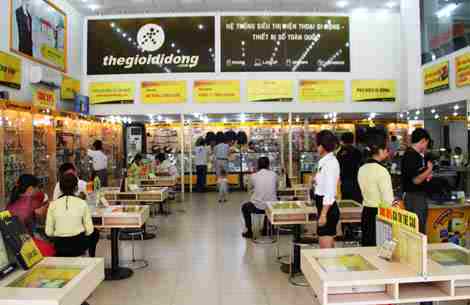
    The Gioi Di Dong, the largest mobile phone distributor, is now promoting the sale of home appliances with Dien May Xanh brand, while FPT Shop has announced cooperation with Vinamilk to sell dairy products.

    A report of GfK showed that 6.2 million smartphones were sold in 2013, and a 40 percent growth rate was reported in 2014.

    However, the growth rate has slowed down in recent years. It is expected that 23.6 million smartphones would be sold this year, an increase of 19 percent over 2016. However, the revenue would increase by 7 percent only, from VND73.3 trillion to VND78.6 trillion.

  • Myanmar smartphone shipments up to 26% YoY

    Myanmar smartphone shipments up to 26% YoY

    According to the latest International Data Corporation’s (IDC) Asia/Pacific Quarterly Mobile Phone Tracker, a total of 2.5 million smartphones were shipped to Myanmar in 2016Q3, reflecting a 26% (year-on-year) YoY growth, IDC said in a statement on 25 December. This has been the strongest YoY growth seen in Myanmar’s budding smartphone market since 2015Q3. Sequentially, shipments declined 10% from 2.7 million in 2016Q2 as soft retail sales and the typhoon season negatively impacted smartphone buying in the country.

    “Despite years of hypergrowth in Myanmar’s emerging smartphone market, channels are now starting to lament about a looming slowdown as retail sales show signs of softening, causing inventory buildup across the board,” says Jerome Dominguez, Market Analyst for Mobile Devices, IDC Asia/Pacific.

    IDC maintains a positive outlook for Myanmar’s smartphone market in 2017, although growth is expected to be tamer compared to previous years.

    “IDC expects Myanmar’s smartphone market to grow by 9% this 2017 off the back of relatively low smartphone penetration rate and rising disposable income. This is already a lowered forecast to account for the slower consumer market and political instability in some parts of Myanmar,” adds Dominguez.

    Myanmar’s projected growth for smartphones in 2017 still stands higher than the 6% growth expected in the whole ASEAN region for next year.

    Myanmar Smartphone Vendor and Market Highlights, 2016Q3

    Samsung continued to keep its lead, owing it largely to the good reception of its budget-friendly J-series. Huawei came in at 2nd place and while finishing with a flat quarter, its sales and distribution were still going strong across Myanmar. Vivo spiked last quarter, coming in at 3rd place as it further penetrated tier 2 and tier 3 cities. Xiaomi dropped to the 4th spot although its volume remained high and consumer response stayed positive as it continued to offer smartphones perceived as good value for money. OPPO held the 5th place, maintaining its stronghold in the urban sites of Yangon and Mandalay although its overall shipments dropped quarter-on quarter (QoQ) due to inventory build-up.

    As with many developing countries, low-cost smartphones continue to thrive in Myanmar. In 2016Q3, 89% of smartphone shipments to the country fall below US$225. “Smartphones priced at US$50<US$150 still holds the sweet spot among Myanmar consumers. However, handsets in the US$150<US$250 price band are also on a growth track due to the influx of mid-range handsets from Chinese vendor Vivo,” adds Dominguez.

    Despite being a budget market for devices, Myanmar’s feature phone market remains very small, unlike other emerging markets, accounting for only 20% of total mobile phone shipments in 2016Q3. “Channels in Myanmar are not expecting the feature phone market to pick up anytime soon based on the rather progressive device adoption in the country, where most consumers would typically opt for a smartphone as their first mobile phone,” states Dominguez.

    In terms of screen size preference, smartphones in the <4.5“segment are now starting to diminish as Myanmar consumers go for larger screen sizes. 5” <5.5” handsets continue to gain traction, growing 44% YoY. Phablets (5.5” <6.99”) also saw a huge annual growth of 160% last 2016Q3, particularly driven by the rise in the 5.5”<6” segment. Huawei and Vivo lead the 5” <5.5” band while Xiaomi and Samsung reign supreme in the phablet category. “Myanmar’s increasing appetite for bigger screens is driven by the rising popularity of content consumption on social media, particularly on Facebook,” says Dominguez.

    4G LTE has just been recently introduced to Myanmar but as of October 2016, all 3 telcos have already been able to roll out 4G LTE services. Concurrently, 4G-capable devices have also shown a spike in 2016Q3, growing 41% QoQ, with market leaders Samsung, Huawei, and Xiaomi leading the wave. “IDC has raised its 4G smartphone shipment forecast in Myanmar for 2017 to account for the positive uptake of 4G smartphones in the country and vendor direction to focus on this air interface moving forward,” says Dominguez.

  • India to become handset component hub

    India to become handset component hub

    India is on track to manufacture $80 billion worth of mobile phone components over the next five years, new research suggests.

    This will help India become a global manufacturing hub, the study conducted by IIM Bangalore and market research firm Counterpoint Research has revealed.

    This presents a significant opportunity from the domestic demand perspective to manufacture mobile phones in the country and source local components, driving the government’s Make in India initiative and reduce dependency on imports.

    “India can potentially be the world leader in mobile phone manufacturing ecosystem and this has to be done in a phased manner,” said Aruna Sundararajan, secretary, ministry of electronics and IT, government of India, at an event here where the study findings were released.

    India has beaten the US to become the second largest global smartphone market in terms of users in early 2016 and is on track to cross half a billion smartphone users mark within the next five years.

    The contribution of domestically manufactured mobile phones has increased from 14% in 2014 to 67% in 2016 and is further estimated to reach 96% by 2020. However, 67% of the handsets manufactured in India contribute to just six per cent of the true local value addition with most of the OEMs still importing Semi Knocked Down components (SKDs).

    “Out of 50 facilities from original equipment manufacturers to original design manufacturers and electronics manufacturing services to component suppliers involved in manufacturing of mobile phones in India, almost three-fourth are Indian manufacturers, followed by Taiwanese with 10% and Chinese with 10 %,” the study revealed.

    “Under the proposed plan, we estimate that more than $15 billion worth components will be sourced locally over the period of five years through 2020 creating over a million direct and indirect jobs in India.”

  • BlackBerry Phones Will Live On for Die-Hard Fans in Indonesia

    BlackBerry Phones Will Live On for Die-Hard Fans in Indonesia

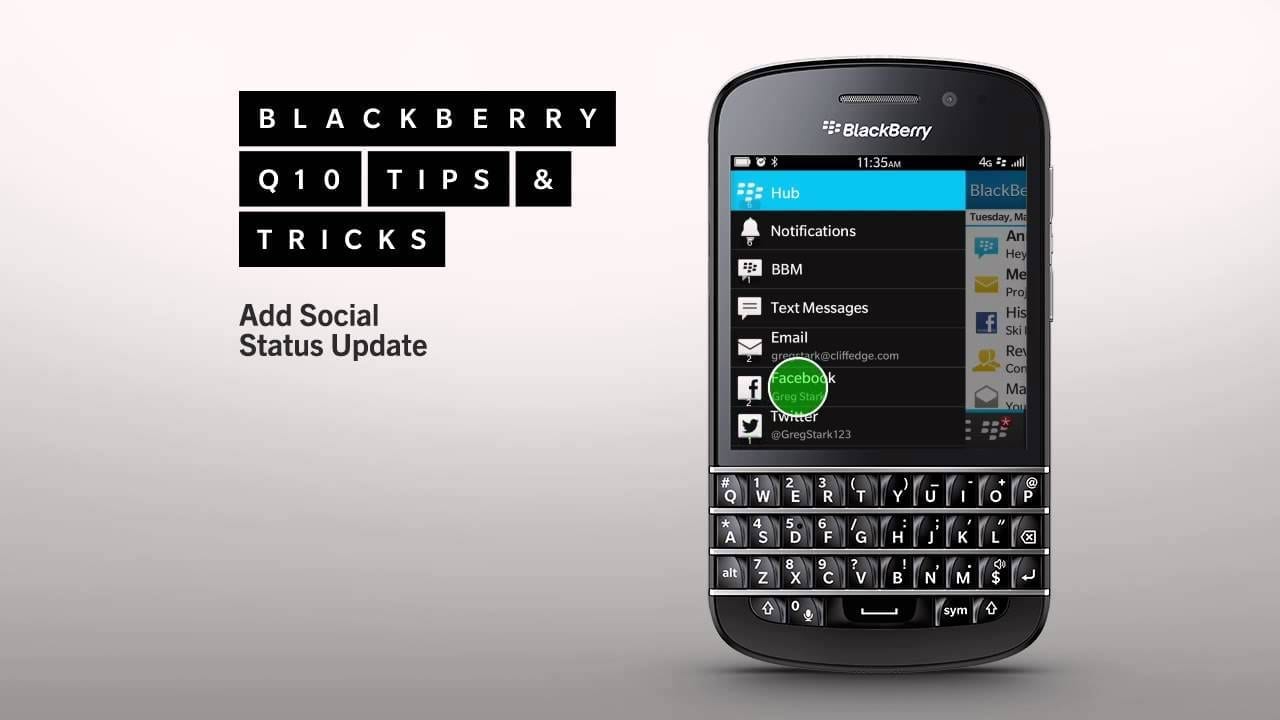
    BlackBerry Ltd. may have decided to stop making its iconic handsets, but that doesn’t mean the gadgets will disappear, especially in places where they’re still popular. Case in point: an Indonesian wireless company is already hatching plans to introduce its own version of the keyboard-equipped smartphone for those who can’t live without the device.

    PT Tiphone Mobile Indonesia Tbk, an affiliate of operator PT Telekomunikasi Indonesia Persero Tbk, has struck the first deal with BlackBerry to form a local joint venture called PT BB Merah Putih to make its devices in Indonesia. While the Canadian company is shifting its focus to software, Indonesia remains one of BlackBerry’s biggest markets. BlackBerry in the past launched dedicated phones and apps for the Indonesian market, home to 240 million people.

    Under the preliminary deal, Blackberry phones will be manufactured at a factory owned by a subsidiary of Tiphone Mobile for domestic sales, said Tan Lie Pin, Tiphone’s chief executive officer. Another local company is in talks to join the venture and details are being negotiated, she said in an interview.

    “More than six million people still use BlackBerry in Indonesia and we believe that BlackBerry can still grow in the Indonesian market,” Tan said. “We are very optimistic and excited.”

    BlackBerry CEO John Chen said this week the company would stop making phones and focus its attention on the more profitable and growing software business. The company plans to negotiate manufacturing agreements with multiple overseas partners. While Tan said Tiphone will manufacture phones for the Indonesian market, discussions on the venture are continuing with BlackBerry.

    BlackBerry’s popularity in Indonesia stems from its hugely popular instant-messaging app, BlackBerry Messenger, known as BBM. Many Indonesians still stick to BBM in order to connect with their curated groups of friends and family, even though some of them no longer use BlackBerry devices.

    BBM for iOS and Android devices ranked No. 1 in terms of downloads among chat apps in Indonesia in August, ahead of rival WhatsApp and Line, according to market researcher App Annie. Emtek Group, one of Indonesia’s biggest media and technology companies, signed a licensing agreement with BlackBerry in June in order to bring video content onto BBM and begin developing new applications and services for the messaging app.

  • The smartphone boon and bane

    The smartphone boon and bane

    Feature phones are on their last days, if not their last breath. Consumers’ massive shift in preference for smartphones have decimated feature phone sales.

    The upward mobility of smartphones contrasted with the downward spiral of feature phones has been an intriguing trend to observe. After all, it was only a decade ago when feature phones were enjoying its peak in popularity.

    The upheaval of the mobile industry arrived when Steve Jobs introduced the iPhone to the world in 2007. Steve Ballmer, Microsoft’s chief executive back then, claimed it was the most expensive phone in the world.

    Nowadays, feature phones are not ubiquitous anymore as new players from China, led by Xiaomi, continue to enter the market. These new upstarts not only produce smartphones with industry standard software and applications, but also price them very affordably.

    Asia-Pacific smartphone prices are predicted to drop to an average of $215, making it the region with the lowest price. APAC will be the region with the largest increase in smartphone usage from 2013 to 2019 with approximately 2 billion new smartphone users, where Singapore ranks the highest globally in smartphone users penetration.

    According to a recent survey, 90% of respondents in Singapore say they have access to smartphones. Factors which help facilitate this rapid adoption are fast connectivity and the availability of real-time information access at users’ fingertips.

    As smartphones become increasingly affordable, businesses become more complex specifically the IT infrastructure. Apart from individual and personal use, businesses also encourage employees to use their own devices for work with initiatives such as “bring your own device” (BYOD).

    Enterprises have gained a significant advantage with the modern development of mobile, but these positives also come with new challenges.

    When it comes to devices for businesses, applications play a big role. More and more enterprises are deploying business applications on smartphones and adopting cloud-based business models.

    This enables increased mobility and productivity, making businesses more efficient than ever. Unfortunately, now with various applications installed on smartphones and critical data being so easily accessible, businesses are more prone to virtual threats.

    In 2014, 16 million mobile devices have been contaminated by scams, and hackers are increasingly targeting mobile applications. It has been said that mobile apps are considered “low-hanging fruit” since it is rather fast and easy to exploit the vulnerability of apps as apps exist in an unregulated ecosystem.

    In Singapore alone, mobile security threats have affected 70% of companies. The majority of organizations saying “yes” to employees using their mobile phones for business without giving proper education on BYOD policies also contributed to this number. This trend will cease any time soon as the hackers are expected to continue focusing on mobile devices.

    Given the changes of this behavior and the advancement of technology on smartphones, organizations and governments will need to be able to serve this increasing number of mobile customers and employees while delivering applications and services seamlessly and securely.

    Businesses have always demanded agility and availability without worrying about the security of critical data. That mindset must shift — application security needs to be a top priority for businesses.

    With the rise of smartphones and mobile devices usage for business, the risk of enterprises’ critical data is increasing as well. Business flexibility provided by smartphones comes with a greater responsibility that requires enterprises to step up to secure and manage the applications to keep preforming.

    This generation will see the end of “dumb” phones, and the next might even see them in museums. With such rapid changes in the technology scene, it will be no surprise if the next big thing comes faster than the shift of feature phones to smartphones.

    Asia Pacific holds the biggest stake for smartphones companies, and any respectable industry player must look to the East whenever there is a shift in the mobile telecom enterprise industry.

  • Vietnam’s largest mobile phone retail chain Mobile World’s profits up

    Vietnam’s largest mobile phone retail chain Mobile World’s profits up

    The Gioi Di Dong (Mobile World) Joint Stock Company, Vietnam’s largest mobile phone retail chain, has reached a post-tax profit of VND609 billion (USD29 million) after 11 months, 140 percent of the annual target, the company has announced.

    The revenue during this period was more than VND14 trillion (USD666 million), as much as 108 percent of the annual target.

    The company also announced that it will reach the target to open 350 outlets nationwide by the end of the month.