Retail News CRM

Tag: retail rents

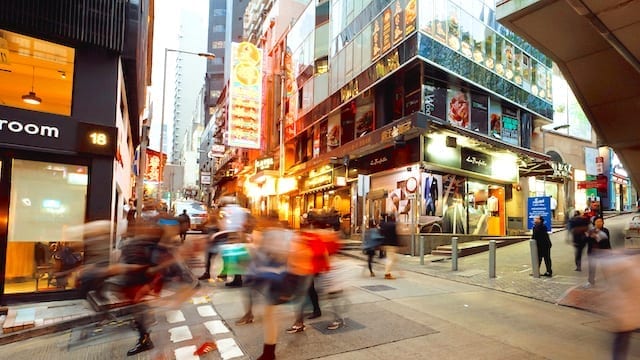
  • Hong Kong high-street retail rents ease

    Hong Kong high-street retail rents ease

    Vacancy rates in tier 1 streets in the four core retail districts edged up by 0.2 percentage points from 3.6 per cent in the third quarter to 3.8 per cent in the last quarter. However, the full-year vacancy rate fell by 0.3 percentage points to 3.8 per cent compared to 4.1 per cent a year earlier.

    CBRE said market sentiment weakened in the fourth quarter, impacted by the US-China trade conflict and volatility in the stock market.

    While retail sales rose by 6 per cent year on year in October, growth slowed to just 1.4 per cent in November – the slowest monthly increase since June 2017.

    “Visitor arrivals remained solid, recording 15.9 per cent growth year on year in October and November combined, the strongest quarterly growth last year,” said CBRE’s report.

    “This ensured continued strong leasing demand from health, personal care and cosmetics retailers.”

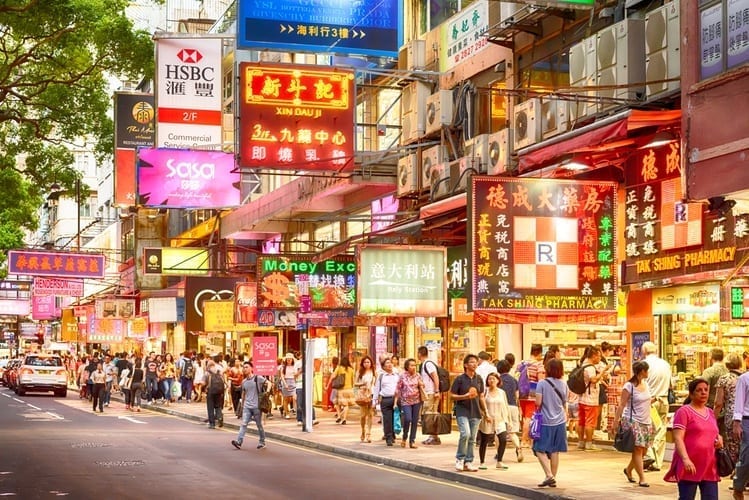
  • Retail rents in Causeway Bay are the world’s most expensive

    Retail rents in Causeway Bay are the world’s most expensive

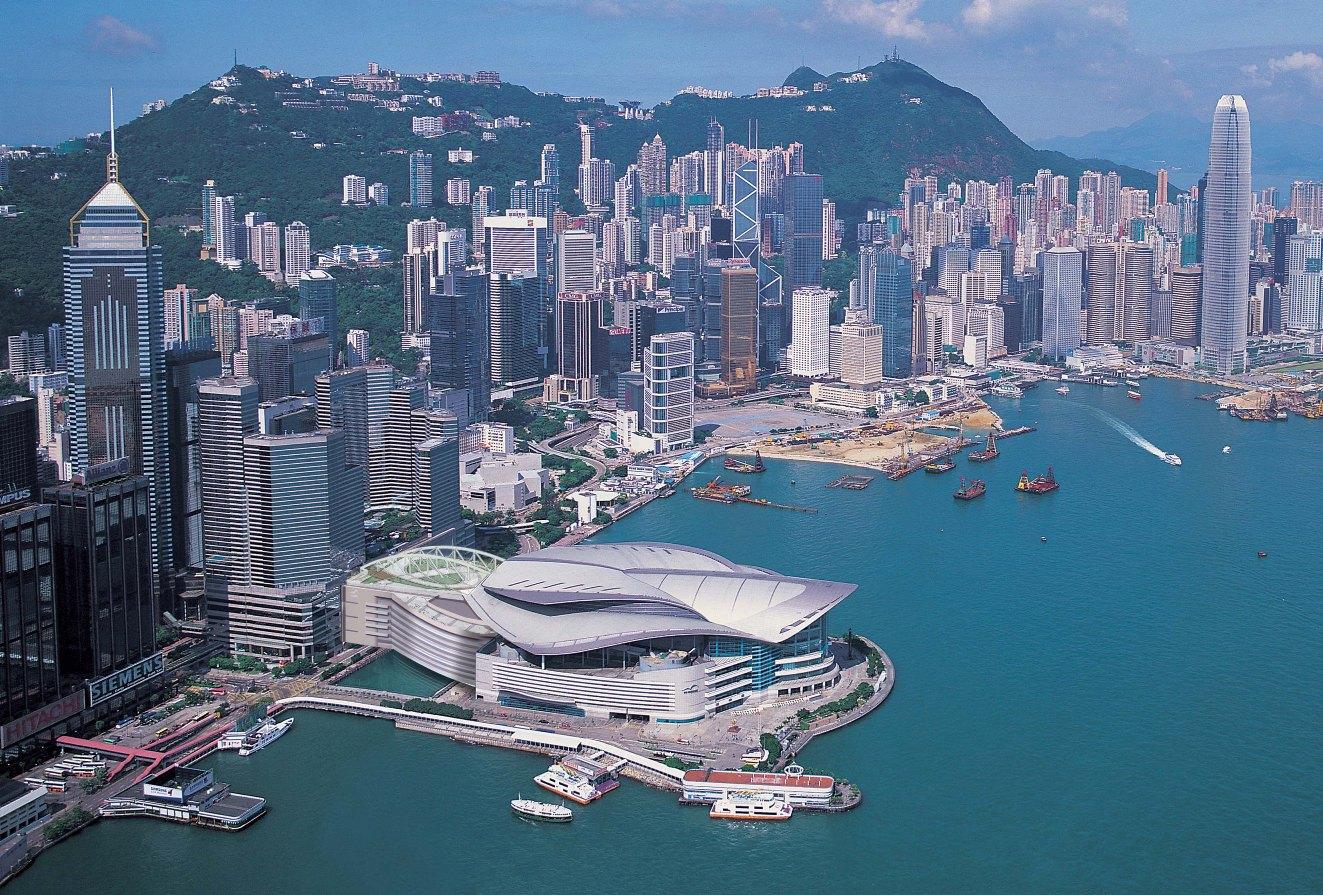
    Causeway Bay in Hong Kong is now home to the world’s most expensive retail space. According to the annual Cushman & Wakefield survey of high-street retail rents, Causeway Bay has overtaken New York’s Fifth Avenue for the top spot, with rents of US$2671 per sqft per year, or €24,606 per sqm per year.

    The calculations were completed during the second quarter of this year.

    What makes Causeway Bay’s performance on the list even more remarkable is that it was achieved as the retail rent market bottomed out after some three years of pressure from falling retail sales in the city. While that decline has turned around into positive growth over the past year, most property industry sources have said retail rents have not yet begun to climb again.

    Third place on the list of the world’s most expensive retail space – and the most expensive strip in Europe – is London’s New Bond Street.

    Of the Asia-Pacific locations, Japan’s Ginza takes sixth place this year, Sydney’s Pitt Street Mall seventh and Seoul’s Myeongdong district eighth. Those places are the same as last year. The only other change in the top 10 was Avenue des Champs Elysees in Paris overtaking Milan’s Via Montenapoleone into fourth place.

    The annual Main Streets Across The World report, celebrating its 30th anniversary, tracks 446 of the top retail streets around the globe and ranks the most expensive in 65 countries by prime rental value using Cushman & Wakefield’s proprietary data.


  • India mall space leasing saw a rise of 77 percent Y-o-Y in H1 2018

    India mall space leasing saw a rise of 77 percent Y-o-Y in H1 2018

    JLL, one India’s largest professional real estate services firm, in their half yearly update note that net absorption in H1 2018 for retail space has seen a rise of over 75 percent year–on–year (y-o-y) recording a total absorption of 1.9 million square feet (msf) in the first half of 2018.

    In the same time new completions saw a decline of about 25 percent year–on–year with total completion of new mall space recorded at approximately 2.1 msf in H1 2018 over 2.8 msf in H1 2017.

    The retail market, which has been experiencing a new lease of life with investment interest returning to the market, has also see a growth in leasing activities from both international and domestic brands.

    RETAIL REAL ESTATE PERFORMANCE (H1 2018)

    City New Completion (‘000) Net Absorption (‘000)
    H1 2017 H1 2018 H1 2017 H1 2018
    Mumbai 800 120 652 118
    Delhi 2,005 385 726 325
    Bangalore 2
    Chennai 988 8 957
    Hyderabad 500 -104 358
    Kolkata 75 150 169 154
    Pune -355 33
    TOTAL 2,880 2,143 1,098 1,945


    The total net absorption for H1 2018 was recorded at close to 2 msf in top seven cities[1] of India of which Chennai saw the highest absorption at 950,000 square feet (sf). Chennai saw the completion of a major retail project which attracted many brands to set up and start operations.

    Delhi (325,000) and Hyderabad (358,000) also saw healthy leasing activities, though, Delhi saw a slowdown owing to reduced new completion in the period under study.

    Mumbai, saw total new leasing of 118,000 sf in H1 2018. The trends of retail supply and absorption are linked as malls usually are reticent in starting operations without complete or near complete absorption of malls. Only in very limited cases, do malls start with noticeable vacancies.

    The new supply for retail mall space was estimated to be 2.1 msf in H1 2018 which was lower by approximately 25 percent over the same time last year. However, with robust leasing activities, the reduced supply will help the rentals remain stable and even firm up over a period of time.

    Development companies have been aiming at creating products that match the requirements of retail companies in terms of location, quality of development, as well as design and other relevant aspects to ensure sustained sales velocity.

    Chennai saw the highest volume of retail mall supply in H1 2018 which was close to 1 msf. While Hyderabad recorded new supply of 500,000 sf in the same period. Both these cities had not witnessed any new supply in the comparable period last year.

    Ramesh Nair, CEO & Country Head, JLL India said: “The retail scenario in India has started to show signs of maturity now, by concentrating on malls that will have longevity, sustainable business and have scope of refurbishment and renovations in the future. As Indian consumer becomes more discerning, the physical asset surrounding retail has become important in creating the right experience. Therefore, developer companies are now creating retail destinations rather than mere shopping centres. In the next few years, we will see a concentration of large format malls that will allow shoppers a variety of experience beyond purchase.”

    JLL’s estimation for next 6 months of 2018 (July – December) to see fresh supplies of 3.7 msf in the top 7 cities of the country. Of the total, Hyderabad will see the highest volume of 1.8 msf. Delhi at 715,000 sf will see the next highest volume of mall space supply followed by Chennai (511,000 sf) and Bangalore (500,000 sf). Pune is expected to be the only market which will not see any new addition of retail mall space in 2018.

  • JLL : 83% of retailers plan to open new stores over the next 12 months

    JLL : 83% of retailers plan to open new stores over the next 12 months

    A recent survey by JLL found that 83% of international and local retailers have plans to open new stores in Hong Kong over the next 12 months, a significant jump from 62% as recorded a year ago.

    More retailers planned to expand as retail sales in the first half have increased noticeably and are expected to grow further.JLL surveyed 40 retailers and retail landlords in June and found that more than 90% of the respondents stated their retail sales in the first half of 2018 fared better than those in the previous year.

    They also envisioned the like-for-like sales will grow by more than 10% in the second half. The resilient retail sales have encouraged 83% of the retailers to have plans for more store openings in Hong Kong in the coming 12 months.

    Hong Kong’s retail sector has been taking a broad upturn after bottoming out late last year. The latest government figures showed that the value of total retail sales gained strong momentum for the first five months of 2018, surging by 13.7% year-on-year, with all categories recording positive growth.

    An visible increase in visitor arrivals particularly those from mainland China, and a robust wealth effect led by strength in the city’s stock and property markets, coupled with an improvement in the overall local consumer sentiment, all contributed to the solid performance of the retail sector.

    In May 2018, the value of total retail sales increased by 12.9% year-on-year to a provisional estimate of HK$40.5 billion. A breakdown of retail sales by category revealed that the value of sales of jewellery, watches and clocks, and valuable gifts continued to lead the sector’s recovery, posting an impressive growth of 23.8% year-on-year. This was followed by medicines and cosmetics at 18.7%. Department stores and supermarkets also saw higher commodity sales.

    James Assersohn, Director of Asia Pacific Retail at JLL, said: “There is a great deal of positivity in the market at the moment. Retailers from almost all sectors are seeing strong and sustained growth in their sales which will lead to them investing more into the market. The luxury sector is currently the biggest winner, led predominantly by the Mainland Chinese tourists, but we also see locals increase spending which provides a deeper and more sustainable growth trajectory for retail businesses here”.

    “While the resuming demand for luxury goods would propel further recovery, it is worth noting that changing consumption patterns and shopper profiles fueled by millennials and generation Z have also led to greater demand for mass and mid-market brands, serving as a significant boost to local spending. The presence of the affordable brands of the kind are growing in major shopping districts at a swift pace. They will remain one of the main sources of leasing demand this year and onwards” he continued.

    Terence Chan, Head of Retail at JLL in Hong Kong, added: “The number of inbound visitors has increased remarkably in recent months, which helped lift retail sales to a considerable extent. Retailers are set to look for retail spaces in the major four shopping districts for expansion. However, given that the bulk of leasing demand continues to be from retailers with lower rental budgets, we believe a v-shaped recovery in retail rents is unlikely happen in the short term. We expect the rents of high street shops and prime shopping centres to grow in the range of 0-5% for the full year.”

  • Bangkok retail rents shows bright outlook

    Bangkok retail rents shows bright outlook

    Bangkok retail rents rose in prime downtown locations in the second quarter, yet there was a decline in midtown locations, despite retailers migrating there.

    According to research from real estate specialist Edmund Tie & Company, occupancy rates in both downtown and midtown remain strong as supply in the downtown area was limited.  While tenants started to take space in newly launched retail malls in midtown areas, rents dropped to THB1610 (US$47.82) per square metre per month in the midtown area. They remained stable downtown, up 1.15 per cent year on year at THB2630 per sqm (US$78.60).

    However, retail occupancy rates decreased to 94 per cent in downtown and 89.8 per cent in midtown during the quarter.

    Three upcoming retail developments are scheduled for completion in midtown this year: IconSiam (51,500sqm), the adjacent Takashimaya Department Store (36,000sqm) and Ari Hills on Pahonyothin Road, (1500sqm).

    Edmund Tie & Company said developers have been more cautious in recent years in the downtown market, partly because many Thais have put spending on hold in light of household debt.

    “Tourism continues not to be a significant source of customers for many retailers beyond prime downtown locations. Although several downtown developments have been delayed previously, there has been some progress recently. EmSphere established a projected deadline of 2020 as the site has been cleared for construction.”

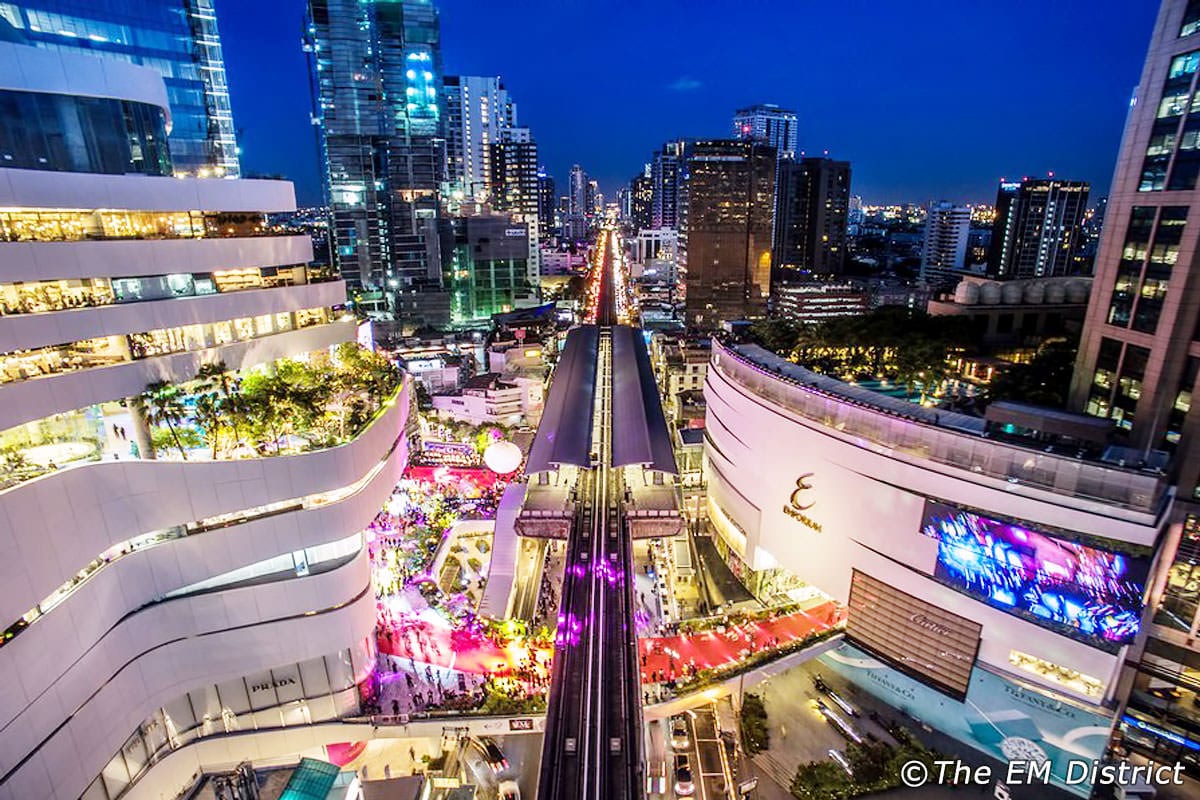
    EmSphere is adjacent to the Emporium and EmQuartier shopping centres on Sukhumvit Road, interlinked with the Phrom Phong Skytrain station.

    “The downtown retail market in Bangkok is dominated by a small number of landlords but with a growing number of mixed-use developments with key retail components, the number of retail landlords will increase,” concluded the report. “Food and beverage tenants remain keen to expand in the Thailand market and there is increasing competition for choice units in new mixed-use developments.”

  • Turning point for Hong Kong retail space

    Turning point for Hong Kong retail space

    For the first time in five years, the demand for retail space in Hong Kong has not declined.

    Results from the RICS (Royal Institution of Chartered Surveyors) Hong Kong Commercial Property Monitor for this year’s first quarter indicate that the demand for retail space has not changed from last year’s fourth quarter.

    The Occupier Sentiment Index (OSI) increased modestly to 14 from 10 the previous quarter, while the Investment Sentiment Index (ISI) grew six points to 19.

    There was a moderate increase in the number of retail properties available or rent, with respondents reporting an increase in landlord incentives for retail space.

    “Occupier demand continued to rise at a headline level for the first quarter,” says RICS Hong Kong external affairs committee member Frank Wong.

    There was a minor decrease in foreign demand for retail properties.

  • Hong Kong retail rents prepare to move into ‘early upswing’

    Hong Kong retail rents prepare to move into ‘early upswing’

    Hong Kong retail rents are expected to move into an “early upswing cycle” this year according to a regional real estate market briefing prepared by Savills.

    The report details commercial and residential property leasing trends across major Asian markets and as the accompanying tables show, compares occupancy costs of space as well.

    It groups major cities by upswing and downswing, late and early, showing that Hong Kong is at the end of its downswing in retail rental rates. Cities currently in early upswing are Manila, Guangzhou, Jakarta and Singapore. Hong Kong is grouped with Taipei, Hanoi, Ho Chi Minh City and Seoul, suggesting all those markets are about to turn.

    Savills says regional prime retail rents moved by between a decline of 1.8 per cent in Beijing and an increase of 5.9 per cent in Guangzhou last year.

    “Strong local retail consumption growth of 9.5 per cent year on year in the second half of the year following 10.5 per cent in the first half of the year supported the Guangzhou leasing market, while prime shopping malls began to re-position and upgrade, focusing more on entertainment and food & beverage,” said Savills in a brief commentary.

    “Again, Hong Kong’s prime shopping mall rents are considerably ahead of all other Asia-Pacific markets and are expected to move into an ‘early upswing’ cycle this year.”

    Savills says economic growth across Asia-Pacific continued to picked-up moderately in the second half of last year and the International Monetary Fund estimates that the “Emerging and Developing Asia” economies grew by 6.5 per cent over the year as a whole while China grew by 6.8 per cent and Japan’s economy grew by 1.8 per cent last year, from 0.9 per cent in 2016.

    “The improving global economic outlook and an accommodative monetary policy created momentum for business expansion,” said Savills.

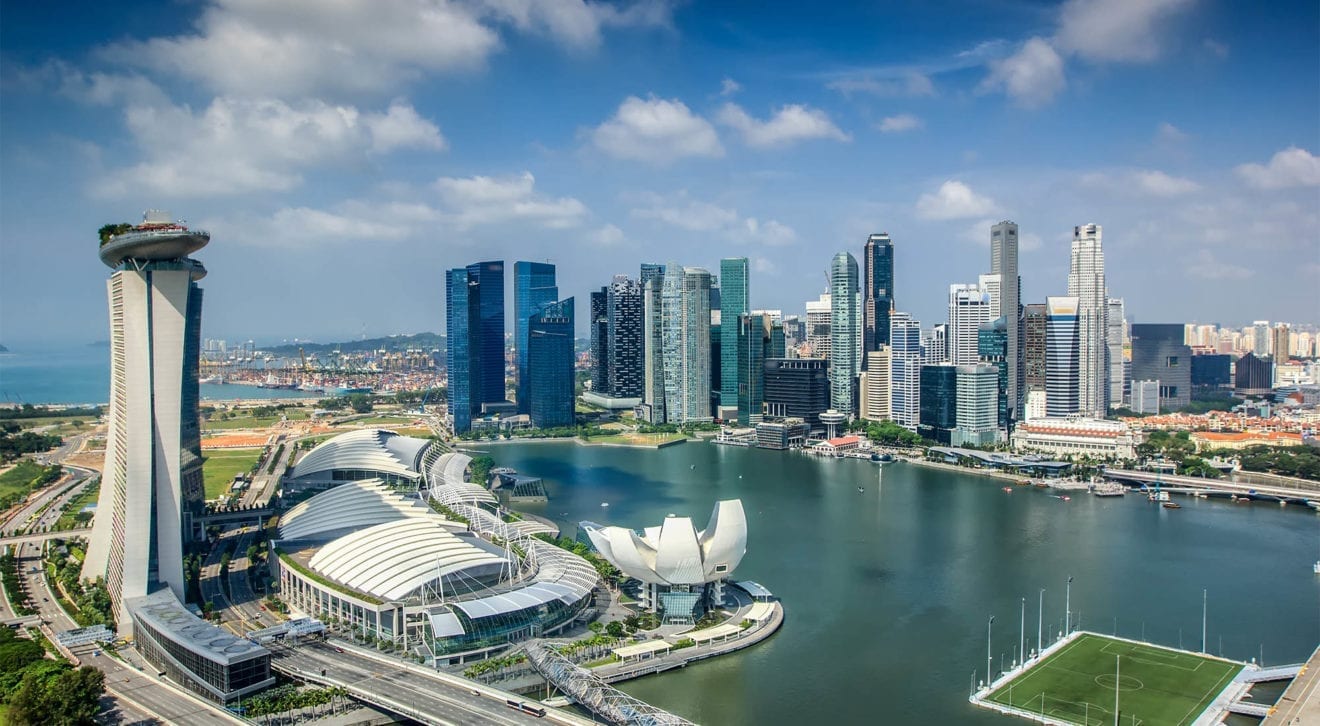
  • Prime retail rents Singapore to stagnate at $35 per sqft

    Prime retail rents Singapore to stagnate at $35 per sqft

    Structural headwinds from e-commerce are blamed for retailers woes.

    Despite economic growth in Singapore, prime rents and yields, which reached $35 psf per month and 4.3% respectively, are expected to stay flat, Savills Investment Manager said.

    According to its 2018 outlook, despite a broader recovery in Singapore’s economy, the country’s increasing interest rate environment, elevated household debt and rising inflation mean consumers are likely to spend cautiously. “Structural headwinds from e-commerce, foreign labour restrictions and high operating costs are forcing retailers to re-examine their strategies and close underperforming stores, driving up vacancy rates. Occupier demand, however, should remain, especially for well-managed regional shopping centres near or integrated with subway stations,” the firm said.

    Savills IM noted that shopping centres in secondary locations and strata-titled shopping centres – where ownership is divided into individual units – will likely continue to suffer, underpinning further rental declines in 2018. “Be cautious of prime retail in Singapore, as leasing demand will be tempered by stagnant consumption growth, structural challenges from e-commerce and supply risks through 2019.”

    As a resolve, Savills IM said that retail market focus should be on neighbourhood regional shopping centres that are near major transportation nodes and are more defensive due to their non-discretionary trade.

    The retail rents problem is also present outside prime properties. The growth of online shopping led to rising vacancy rates and lower retail rents in the past few years. The vacancy rate of island-wide retail space has gradually risen from 4.5% in 4Q13 to 8.1% in Q2.

    The bleak rentals for Singapore’s retail sector are expected to remain weak until 2021. Retailers also face margin pressures from the combined challenges of weaker retail spending and labour costs.

    On a positive note, according to the Singapore Tourism Board, tourism growth helped boost retail sales in H1 2017.

  • Singapore retail rents show signs of stabilisation

    Singapore retail rents show signs of stabilisation

    Singapore retail rents stabilised island-wide in the last quarter of last year, according to real estate specialists Edmund Tie & Company.

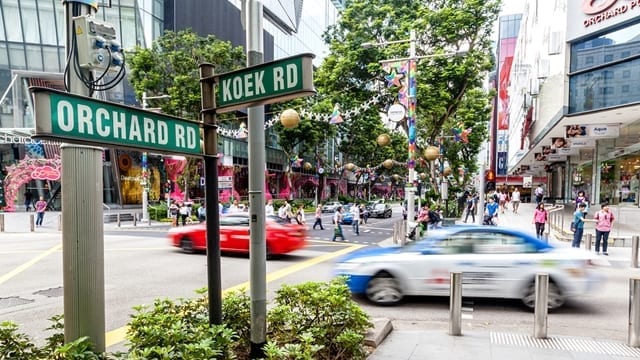
    In the company’s quarterly Real Estate Times research report, ETC said monthly rents of ground-floor space in the Orchard/Scotts Road precinct were the most resilient of the year, staying firm at $37.20 per sqft, compared to a decline of 2.2 per cent in 2016. Improving tourist numbers were a large contributor to the trend, along with a limited pipeline of new space coming on stream.

    And the arrival of overseas brands such as Apple, Pablo and Don Quijote into the area attracted more crowds and reinforced Orchard Road’s position as a retail destination, said ETC.

    Gross rents of prime first-storey retail space in the other city areas and suburban areas fell slightly by 0.6 per cent and 0.5 per cent last year to about $19.75 and $30.45 per sq ft per month respectively.

    Monthly gross rents of prime first-storey retail space island-wide remained unchanged for the second consecutive quarter in the final three months of last year, bringing about a slight decline of 0.3 per cent for the full 12 months. That compares well to a 4.3 per cent decrease in 2016.

    The authors of the report said the moderation in the decline in rents was due to the recovery in the city state’s retail sales, resulting in an increase in occupancy rates. Occupancy increased by 0.4 percentage points to 91 per cent in the third quarter of last year.

    Outlook for 2018

    Brick-and-mortar retailers face challenges as more consumers turn to e-commerce platforms in the coming year, said the report.

    “However, e-commerce will likely come under the local tax regime… This will mean having e-commerce players registering for GST in Singapore or customers having to pay tax on the goods and services purchased online. This may act as an additional factor for the online retailers to go for physical space, if the prices between the goods bought online and offline narrow,” said the authors.

    ETC suspects the upcoming new supply of retail space in suburban and other city areas may exert downward pressure on rents of retail spaces in both subzones.

    “From Q1 to Q3 2017, about 621,000 sqft of retail space was completed island-wide, with another 432,000 sqft expected to complete in Q4 2017. This will mainly emanate from Northpoint City (318,000 sqft). Subsequently, there will be around 1.1 million sqft of space completing this year and next year, respectively. The other city areas will be faced with the largest pressure, with the supply in both years exceeding the 10-year annual average absorption (2007 to 2016) of 239,000 sqft.

  • Hong Kong shopping centre rents predicted to rise

    Hong Kong shopping centre rents predicted to rise

    Hong Kong retail rents are expected to inch up in 2018 according to projections by Savills.

    In a media briefing on Tuesday, Savills senior director of research and consultancy, Simon Smith, predicted a rise in prime retail shop rents of up to 3 per cent, following a decline of 2 per cent this year.

    “The domestic economy is supporting demand as unemployment is low and consumer confidence is high as incomes grow and house prices hit new records,” Smith said.

    “Retail sales are beginning to show signs of life while mainland demand is also returning after two to three years of downward adjustment.”

    At the end of last year, Smith forecast a prime street retail rent decline of between 5 per cent and 10 per cent, but despite some high-profile rent renegotiations, they held up.

    Smith’s data is based on ‘spot’ rents which are different to the headline-grabbing rent reductions achieved by some retail groups in Central and Causeway Bay during this year.

    “When you read about a 50 per cent rent cut, that is usually the renewal of a three-year lease. My rents are ‘spot’ rents and the 2 per cent is this year alone.”

    However, Smith expects shopping mall rents to slip over the next year, giving the narrowing gap with strip-shops. After a decline of just 1 per cent this year, he is tipping a fall of up to 5 per cent next year.

    In terms of sales of retail real estate, Smith predicts an increase in prices of up to 5 per cent next year following a decline of 4 per cent this year, which was well below the 5 to 10 per cent he expected in late 2016.

  • Prime retail rents in Hong Kong still top Asian rankings

    Prime retail rents in Hong Kong still top Asian rankings

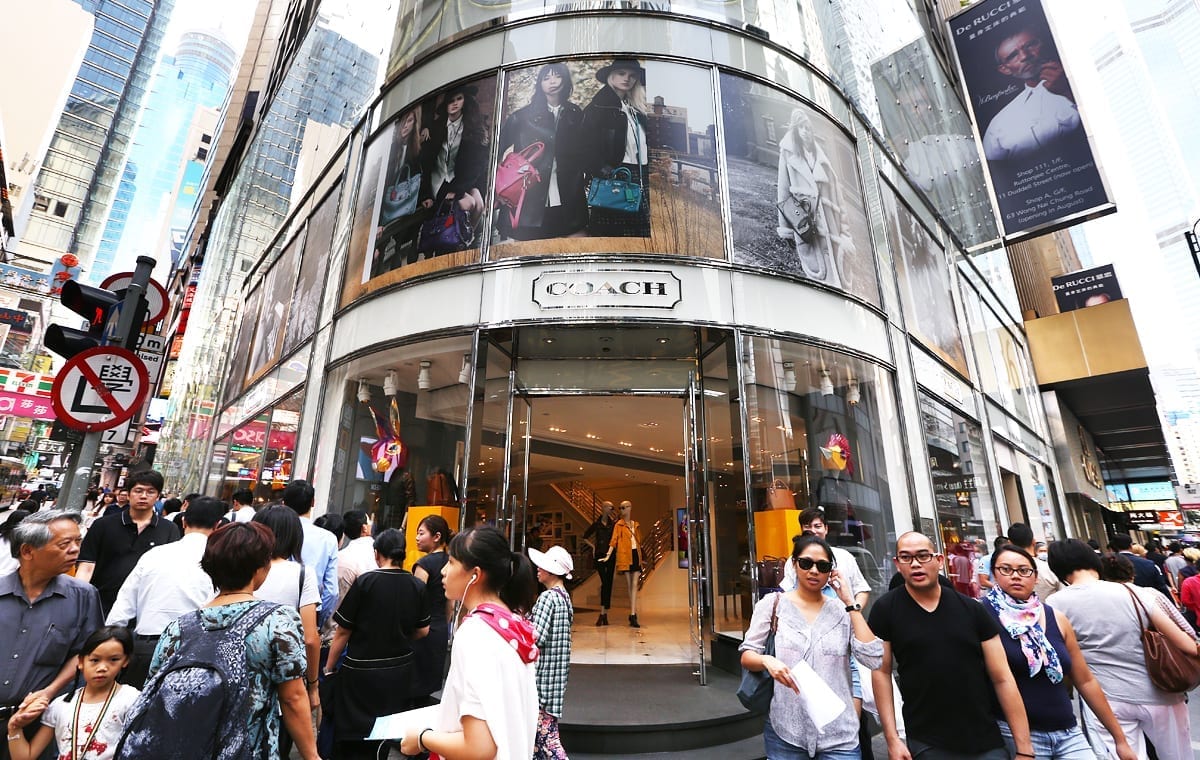
    Despite plummeting retail rents in Hong Kong, Causeway Bay has retained its ranking as Asia’s most expensive retail strip – and the world’s second, behind Upper 5th Avenue in Manhattan, New York.

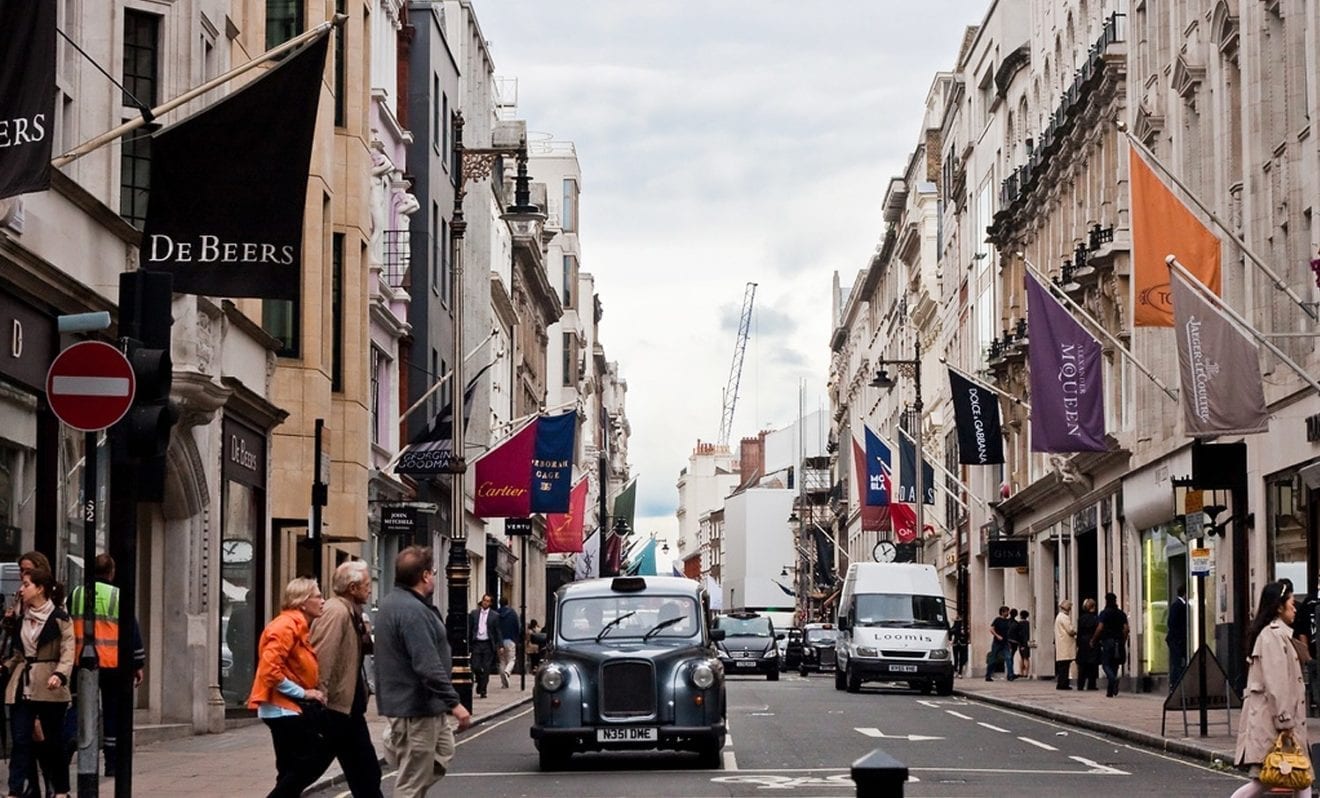
    Soaring London rents have seen New Bond Street rise to become the world’s third most expensive retail street, according to an annual survey by Cushman & Wakefield.

    The annual Main Streets Across The World report, now in its 29th edition, tracks 451 of the top retail streets around the globe and ranks the most expensive in 68 countries and regions by prime rental value using Cushman & Wakefield’s proprietary data.

    Only three Asian cities feature in the top 10 globally, with Tokyo’s Ginza in sixth place, down one place from last year, and Myeongdong in Seoul eighth, its same ranking as before.

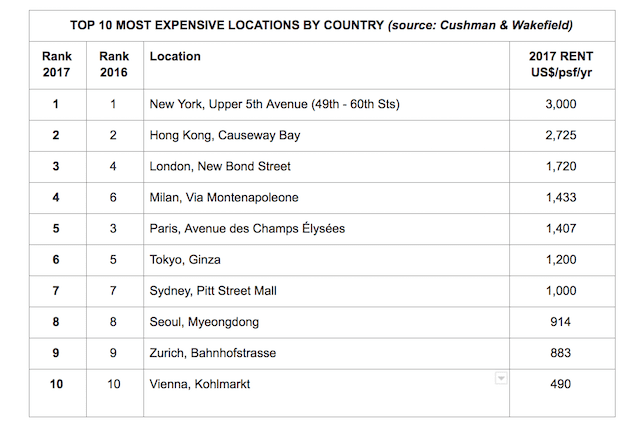
    The Top 10 list is as follows:

    Average annual rents on Upper 5th Avenue stayed the same as last year at  US$3000 (HK$23,400) per square foot. Despite a 4.7 per cent fall to US$2725 (HK$21,255) psf/yr, Hong Kong’s Causeway Bay retained its second place and Cushman & Wakefield observed the rental correction in the district “is almost complete” nearing the year’s end.

    London’s New Bond Street leapt into third place as rents increased by more than a third (in local currency) on the previous year to US$1720 psf/yr.

    Report author Darren Yates, head of EMEA retail research with Cushman & Wakefield, said that despite a lot of negative headlines, global retail remains as dynamic and vibrant as ever in response to technological and demographic change across the world.

    “Premium retail destinations, including Upper Fifth Avenue, Causeway Bay and New Bond Street, are highly sought after by international brands seeking to create engaging retail experiences that offer something new and exciting. The most innovative retailers are combining their online and physical platforms to create a seamless omni-channel experience for the customer, but profile and location play such a crucial role in the premium retail experience,” he said.

    Rents “will be better”

    Kevin Lam, Cushman & Wakefield’s executive director, head of retail services in Hong Kong , said that while rents eased in causeway Bay during this year, the pace of decline has slowed in the second half and the correction is expected to finish towards year-end.

    “Rents in Causeway Bay will be in a better position next year, although there will still be some distance between the rents of Causeway Bay and of Upper 5th Avenue in New York,” he said.

    “Ranking at second place globally reflected a softening of high street rents in Causeway Bay, but the plus side is this healthy correction has driven greater diversification in trade mix on the high street. Apart from the luxury trades which have always been dominant in Causeway Bay, there are more lifestyle merchandise, food and beverage and Mainland China brands entering the district, which would enhance the shopping experience for customers.

    “As cases of duplex and triplex leasing become rarer, we expect the number of varieties of shops will increase.”

    Meanwhile, Mainland China’s retail market continues to evolve as a rapidly growing consumer base of savvy, brand-aware shoppers seek out new and sophisticated retail experiences. Beijing’s Wangfujing is ranked 11th in the global table, with annual rents at $477 psf/yr. The city’s online retail market has experienced exceptionally strong growth and internet sales now account for about 18 per cent of the total, although 12.4 million sqft of new space is expected to become available in the Fengtai and Tongzhou districts in 2018 as new developments complete.

  • New entry in the top highest rents globally

    New entry in the top highest rents globally

    Bond Street in London is the new entry in the podium of the highest rents globally, after overtaking the Champs Elysées in Paris.

    Property firm Cushman & Wakefield released the new list this week and said that Upper Fifth Avenue in New York stays top ($3,000 per square foot) with Hong Kong’s Causeway Bay next ($2,725). After Bond Street ($1,720) is Milan’s Via Montenapoleone, with the Champs Elysées now in fifth place.

    Bond Street rents raced ahead by almost 40% in the year 2017 to June as demand stayed strong despite fears over Brexit. In fact, the Brexit effect could have been partly responsible for the rise with a tourist surge as international visitors took advantage of the weak pound after the Brexit vote.

    Report author Darren Yates of Cushman & Wakefield’s Darren Yates said: “London’s major thoroughfares are some of the most desirable and expensive streets in the world. Although there was a pause in activity in London in the initial aftermath of the EU referendum, the start of 2017 brought a resurgence in leasing deals.”

    There had been fears this summer that some luxury brands would quite the area as it had become so expensive with Colliers International telling The Guardian that a number of Bond Street leases were being “quietly marketed”.

    Dolce & Gabbana, Hugo Boss, De Beers and DKNY were among the big names said to be looking at a move.

    But Yates said he hasn’t seen any signs of big brands wanting to move, although he added that with the property market slowing, they are probably less likely now to want to hand over million of pounds to encourage an existing tenant to move as they have done in the past.

    A new report from Savills earlier this year showed that Bond Street is evolving into a home for ultra-luxury brands with fewer affordable luxury or premium labels occupying stores there.

    Super-luxury retailers now occupy 73.9% of its retail space, up from 62.8% over the last five years, and following the launch of the report, Savills said it would see a further 12 new stores by year-end, a high number and on a level with the peak reached in 2012.

    The newcomers include several ultra-luxury names (Alaïa, Delvaux and Officine Panerai).

  • The Hong Kong shopping experience is never the same anymore

    The Hong Kong shopping experience is never the same anymore

    To gauge how much the Hong Kong shopping experience is changing, take a walk through Pacific Place mall.

    Burberry Group Plc has shrunk its store and the space now also houses a Pure yoga studio and juice bar. Coach Inc. has been replaced by a tea company. Some of Louis Vuitton’s space has given way to a Southern California-style bar and restaurant.

    Gone are the days when Chinese would queue up to get inside Prada, Gucci and Tiffany, and leave laden with luxury handbags and watches.

    The wealthiest now travel further afield, and even those who visit Hong Kong are cutting back. Average spending per overnight visitor, of whom three quarters come from China, dropped 8.8 percent in the island city in 2016.

    Luxury goods have been the hardest hit, with August 2017 sales less than a third of their April peak in 2013 before China cracked down on conspicuous consumption.

    Buying habits of Chinese shoppers have also evolved, as they have become more comfortable buying luxury brands at home, or online, and have become more price sensitive when shopping abroad. This is having an impact on the $390 billion global luxury goods market and nowhere is it being felt more than at Hong Kong’s malls.

    Since the downturn, Pacific Place owner Swire Properties Ltd. has refreshed its tenant mix to cater to changing spending habits and woo new visitors. It has signed 30 new tenants and doubled the number of food and beverage outlets in the past 18 months.

    Other landlords, including Wharf Holdings Ltd. and Hysan Development Co., are also including more lifestyle and food outlets.

    Still, as visitor arrivals and retail sales start to rebound, there’s limited upside for Hong Kong’s landlords, said Patrick Wong, Bloomberg Intelligence property analyst in Hong Kong. “Receipts might be stable and resilient, but if things turn better, they may not be able to capture the growth there,” he said.

    For mall owners, broadening their mix of tenants is helping blunt the negative impact of lower retail sales, although a return to the heady times looks unlikely.

    No matter how many cups of cold brew Starbucks sells, or shoes Nike flogs, they won’t be enough to offset the drop in sales of $10,000 handbags and glittering diamond necklaces. Landlords earn less through the portion of receipts tenants must share with them, and they’ve had to drop base rents for new tenants as well.

    In the first half, retail revenue for Swire dropped 0.2 percent and Hysan’s fell 0.1 percent, said Wong. Meanwhile Wharf, Hong Kong’s biggest retail landlord, saw sales growth of three percent because its mammoth Harbour City mall is less reliant on luxury sales.

    Swire says things would have been worse if it had left things as they were. “The revamp of our tenant mix has put us in a strong position for 2017, especially with sales at our mall improving since mid-2016, even amidst a very challenging retail market,” Fiona Shiu, general manager of Pacific Place said in an email.

    Pacific Place mall has posted sales growth in the first two quarters of 2017. Traffic has been encouraging, with increased car park use, it said. “We are confident that this positive trend will continue,” said Shiu.

    While Burberry, Diane von Furstenburg Studio LP and LVMH Moet Hennessy Louis Vuitton have decreased the size of their stores in Pacific Place, they aren’t pulling out altogether. Coach, which no longer has an outlet in the mall, said it is investing to renovate its Hong Kong locations and remains committed to the market.

    “It’s a cycle, luxury brands won’t abandon Hong Kong, they will reduce the number of their stores,” said Nicholas Bradstreet, a managing director at Savills Plc in Hong Kong. “Hong Kong has always been very resilient, but there is a caveat, it is not going to bounce back to the heyday of 2013.”

    In 2016, the average Chinese tourist traveling overseas spent about 17 percent less on shopping, but more on leisure and entertainment, according to the consultancy Oliver Wyman.

    Hong Kong isn’t the only Asian city where things are evolving. Mall operators in Singapore have turned to unique lifestyle or dining concepts to stand out in a competitive landscape.

    The proportion of food and beverage tenants in Singapore malls has doubled to 40 percent in the last 10 years, according to Desmond Sim, head of research for Singapore and Southeast Asia at real-estate services firm CBRE Ltd.

    Burberry has renegotiated leases and is keeping a tight control on all operating expenses, the company’s then chief executive officer Christopher Bailey said in November 2016.

    For Pure, whose owners are said to be seeking to sell a controlling stake in the gym chain, the new high-profile location in Hong Kong is a bonus.

    “Having Pure Yoga Pacific Place in the prime space of Hong Kong’s premium lifestyle and shopping destination, alongside luxury brands such as Prada, Hermes and Louis Vuitton, is testament to the increased significance of health and wellness in the city,” the company said.
  • Singapore retail rents set to stabilise in 2017

    Singapore retail rents set to stabilise in 2017

    Singapore retail rents slipped by 4.2 per cent in 2016 – an improvement on the 5.7 per cent decline of 2015, according to data from Edmund Tie & Company research.

    And they should remain resilient in the year ahead.

    The islandwide average monthly retail gross rent fell to about $29.25 per sq ft last year in what Edmund Tie describes as a “moderate decline”.

    Stabilising rents in the Orchard Road-Scotts Road precinct helped pare back the slide. While rents in Orchard/Scotts Road eased by 2.2 per cent in the first half of 2016, rents remained unchanged at $37.20 per sq ft per month in the second half.

    “The resilience in rents was attributed to limited supply in the prime shopping district, with only about 90,000 sq ft of retail net lettable area (NLA) expected to be completed over the next four years,” said Edmund Tie in a statement. “Moreover, there was strong demand for retail units in Orchard/Scotts Road, especially for those with a visible street frontage, as evidenced by the recent opening of several flagship stores and new-to-market brands.”

    During the third quarter of 2016, retailers absorbed some 112,000 sqft of new space in the precinct, a reversal from the negative net absorption of 99,000 sqft in the second quarter.

    “Hence, barring any unforeseen economic shocks, rents are anticipated to remain resilient in 2017.”

    Rents in the suburban areas were also stabilising, remaining unchanged quarter-on-quarter at $30.60 per sqft per month in the fourth quarter, after falling by 3.5 per cent during the first three quarters.

    Edmund Tie says rents are unlikely to decrease in 2017 as much as they did last year, with upcoming suburban malls reporting healthy pre-commitment rates.

    “In the third quarter, a positive net absorption of 314,000 sqft was recorded in the suburban areas, the highest in almost two years.”

    On the contrary, rents in the other city areas remained under pressure, falling by 1 per cent quarter-on-quarter to about $19.90 per sqft per month in the final three months. “This was the seventh consecutive quarter of decline and it took the total rental decline in the other city areas to 8.7 per cent in 2016.

    In addition, negative net absorption extended to -376,000 sqft in the third quarter from 25,000 sqft in the second. “Amid the impending supply of approximately 430,000 sqft of retail NLA in 2017, rents are likely to ease further in the first half of 2017, given a lack of crowds during the weekends due to the limited residential catchment. Nevertheless, the fall is likely to be transitory as retail demand will be supported by residents or guests of the residential, serviced apartment and/or hotel component in upcoming mixed-use developments such as DUO, OUE Downtown and Marina One.”

    2017 outlook

    “Overall, the decline in islandwide average rent is expected to moderate further in 2017,” predicted Edmund Tie. “To overcome competition from eCommerce and manpower constraints, more retailers are beginning to embrace technology, including NTUC FairPrice and Kopitiam. NTUC FairPrice currently offers the click-and-collect option for online shoppers, and self- checkout counters that are equipped to accept cash – which reduces its reliance on cashiers. Likewise, Kopitiam at the upcoming Hillion Mall will introduce the iCashbox payment system, as well as self-orderings kiosks and a rewards programme to encourage diners to “Return Tray for Reward”.”

    Dr Lee Nai Jia, Edmund Tie & Company’s Southeast Asia (SEA) head of research, noted: “Looking forward, it is possible that malls in the future will become fulfilment centres, where buyers go to the malls to collect their goods, or exhibition venues, where retailers attract buyers and deliver their purchases to their homes. Retail rents will not only reflect the location, but also the experiential effect of the mall.”

  • Hong Kong high street retail rents decline should ease

    Hong Kong high street retail rents decline should ease

    After falling 12 per cent in 2016, the pace of decline in Hong Kong high street retail rents should ease in the year ahead, predicts CBRE.

    Last year’s decline followed a 17 per cent fall in 2015. That represents a full 27 per cent fall since rents were at their peak in 2014.

    But this year, says CBRE Hong Kong in a research note, expect a fall of a more modest 5 per cent.

    In contrast, shopping centre rents were broadly flat in 2016.

    “In 2017, slower economic growth in China and depreciation of the Renminbi are set to undermine mainland tourist spending in Hong Kong,” said Joe Lin, executive director, advisory & transaction services – retail, with CBRE Hong Kong. “However, the fall in high street shop rents is not expected to exceed 5 per cent in 2017, and by the middle of the year, most leases that were signed during the market peak of 2014 will have expired, meaning that rents are expected to stabilise from then on. Leasing momentum is expected to gradually improve from 2016,” Lin concluded.

    In investment terms, CBRE predicts a 5 to 10 per cent decline in prices for street shops in core locations in 2017, coming off a 10.6 per cent decline last year.