Tag: rupiah

  • KoinWorks Indonesia Announces Investment From Quona Capital

    KoinWorks Indonesia Announces Investment From Quona Capital

    Indonesian peer-to-peer lending platform KoinWorks said in a statement on Monday that it has received an investment from US-based venture capital firm Quona Capital. “We’re very happy we could collaborate with Quona as one of our investors,” said Benedicto Haryono, chief executive and co-founder of KoinWorks. “With the inclusion of Quona among our line of investors, it will further help develop KoinWorks in becoming a responsible peer-to-peer lending firm and continue to innovate and provide a positive impact for society,” Benedicto added.

    Quona Capital focuses on investment in financial technology companies it deems to have potential in facilitating access to financial products. The Washington-based company provides financial access in various regions, including Latin America, Africa, Britain and Asia.

    KoinWorks said in the statement that the collaboration between itself and Quona Capital is based on a mutual understanding that technology has a strong role in improving quality and access to financial access for those beyond the reach of traditional banks.

    The Jakarta-based fintech company, which has 100,000 investors on its platform, is one of the first fintech companies in the country to have obtained a license from the Financial Services Authority (OJK).

    KoinWorks bridges the gap between investors and investees through its online platform and provides unbanked individuals with access to financial services.

    The company focuses on business and educational loans. It won Bisnis Indonesia’s Most Innovative Fintech of the Year award in 2017.

  • Weakening Rupiah Sees Calls for Gov’t to Scrap Palm Oil Export Tax

    Weakening Rupiah Sees Calls for Gov’t to Scrap Palm Oil Export Tax

    A lawmaker and an industry analyst have called on the government to scrap its export tax on crude palm oil to help improve the competitiveness of the sector and boost exports, amid a weakening rupiah.

    Since 2015, the  Indonesian Oil Palm Estate Fund (BPDPKS), which is tasked with strengthening and promoting sustainable practices in the industry, has been imposing a $50 per ton export levy on crude palm oil and $30 per ton levy on crude palm oil derivative products when prices drop below $750.

    The levies were imposed to encourage local producers to sell more of their products at home and to incentivize local biodiesel producers. However, palm oil producers have complained about this policy since the start, as it burdens those seeking to export their products, which is more beneficial during a stronger dollar.

    “Under this condition, the government needs to be flexible in imposing some policies. It should consider scrapping the export tax … to help us to achieve a trade surplus,” said Eriko Sotarduga, a member of House of Representatives Commission VI, which oversees trade, industry and business competition.

    The rupiah strengthened to 14,825 to the dollar on Friday from 14,840 previously, according to data. It has fallen by 8.5 percent so far this year. Indonesia’s trade balance returned to a $1.72 billion surplus in August after recording its first deficit in 19 months in July.

    Eriko said amid the current low price of crude palm oil, scrapping export levies could help producers to expand the market, because they have been struggling to compete with other vegetable oils.

    Meanwhile, Bungaran Saragih, an advisor at the Palm Oil Agribusiness Strategic Policy Institute, said the government must provide the industry with its full support, given the fact that the industry sustains millions of people, with about 40 percent of the country’s production coming from smallholders.

    “Nowadays, palm oil is the best commodity” to support the nation’s economy and currency. Therefore, it deserves some incentives, he said.

    The government has been very careful in dealing with the sector as the commodity is the biggest foreign-exchange contributor.

    Palm oil exports reached their highest value ever last year at $23 billion, which was a 26 percent increase from 2016.

    However, the current administration is also cautious about issuing new permits to producers. President Joko “Jokowi” Widodo ordered a review of existing permits on Wednesday, amid growing concern over deforestation in the country.

    As reported earlier this week, environmental activist group Greenpeace International accused 25 palm oil producers, supplying some of the world’s most renowned brands, of contributing to massive forest destruction.

  • Indonesia’s Dollar Supply Increases as Investors Return

    Indonesia’s Dollar Supply Increases as Investors Return

    The value of the rupiah has stabilized in recent days as the domestic supply of dollars has increased due to inflows from returning investors and more exporters converting their earnings, Bank Indonesia Governor Perry Warjiyo said on Friday (21/09).

    “The rupiah has stabilized and it tends to strengthen,” Perry said. “Many fund managers have begun to invest and allocate their portfolios to emerging markets. So what was going out has begun to return.”

    The rupiah traded at 14,815 to the dollar at 1.05 p.m. in Jakarta on Friday, marginally stronger than Thursday’s closing.

    Perry also said inflation is expected to stay benign this year despite the rupiah’s fall, saying the rate is seen near the lower end of Bank Indonesia’s 2.5 percent to 4.5 percent target range. The annual inflation rate stood at 3.20 percent in August.

    Bank Indonesia has raised interest rates four times since mid-May to defend the rupiah, which fell to its weakest in 20 years amid wider emerging market selloffs. It will meet again next week to review monetary policy.

  • Indonesia’s Forex Reserves Decline Around $400m in August

    Indonesia’s Forex Reserves Decline Around $400m in August

    Indonesia’s foreign exchange reserves slipped around $400 million in August to $117.9 billion, Bank Indonesia said last Friday, partly because of the central bank’s intervention to defend the rupiah.

    The rupiah has lost around 9 percent of its value so far this year. The currency was trading around its weakest levels in 20 years this week, closing at 14,815 per dollar on Friday.

    The end-August reserves level, sufficient to meet 6.8 months of imports, “remained adequate as they will be supported by our confidence in stability, better economic prospect and positive export performance,” the central bank said in a statement.

    From February until August, the reserves had declined $14.1 billion.

  • Indonesia Braces for Prolonged Pressure as Rupiah Slides

    Indonesia Braces for Prolonged Pressure as Rupiah Slides

    Indonesia is bracing for prolonged pressure on the rupiah amid souring emerging market sentiment exacerbated by Argentina’s economic woes, Finance Minister Sri Mulyani Indrawati said on Monday (03/09), as the local currency plumbed its weakest levels since 1998.

    The rupiah hit 14,825 per dollar on Monday, the weakest since the Asian financial crisis two decades ago, before closing at 14,810. It has lost nearly 9 percent this year.

    The central bank intervened again on Monday in the foreign exchange and bond markets as foreign investors continued to sell Indonesian assets spurred by rising US interest rates and fears of contagion from crises in Turkey and Argentina.

    “We are monitoring global dynamics and need to be vigilant because the dynamics caused by the sentiment on Argentina is very high. The situation there is not yet finished, so we’re anticipating these dynamics will continue,” Sri Mulyani told reporters after a meeting with President Joko “Jokowi” Widodo and the central bank governor.

    Jokowi had called a meeting with his economic ministers and the central bank governor to stress the importance of communicating to the people what was being done to stabilise the exchange rate, Coordinating Minister for Economic Affairs Darmin Nasution said.

    “The president said ‘don’t let it be that you’ve done something, but the people said you have not,’” Darmin said.

    The government has forced a wider use of biodiesel starting Sept. 1 to reduce oil import bill. Officials have also announced plans to raise import tariffs on some consumer goods, though the list of affected items has not been made public yet.

    Sri Mulyani said authorities will monitor “in detail the behavior of market players” and take steps to prevent speculation.

    Bank Indonesia has raised its benchmark interest rate four times since mid-May, by 125 basis points. It has also spent billions of foreign exchange reserves to intervene in the currency and bond markets.

    International credit rating agency Fitch Ratings has forecast Indonesia’s policy interest rate could rise by 100 basis points through 2020.

    Bank Central Asia chief executive Jahja Setiaatmadja said he saw no sign of the sort of panic-selling seen during the crisis two decades ago, but added that the central bank could have to raise interest rates by at least 200 basis points more by 2019.

    Indonesia’s 10-year bond yield rose to 8.266 percent on Monday, the highest since November 2016, while the main stock index slipped 0.9 percent.

    The cost of insuring exposure to Indonesia’s sovereign debt hit an eight-week high, with the country’s five-year credit default swaps jumping 5 basis points from Friday’s close to 131 bps, according to data from IHS Markit.

    “With an external situation like the one we face now, we must assume that we need to continue to strengthen our fundamentals,” Sri Mulyani said. “We are looking directly at our foundation and looking at where there are factors that are considered sources of weakness.”

  • Indonesia VP Says Stronger Measures Needed to Keep Export Earnings in Indonesia for Longer

    Indonesia VP Says Stronger Measures Needed to Keep Export Earnings in Indonesia for Longer

    Vice President Jusuf Kalla said Indonesia must impose stricter measures to ensure that dollars earned from exports remain in the country for longer, amid the continuous depreciation of the rupiah, which has been among the worst performers in Asia this year.

    The currency has weakened by 6.21 percent against the dollar so far this year, amid a global sell-off of emerging-market assets, triggered by higher US interest rates and a stronger greenback. A weaker rupiah has many negative effects on the nation’s economy, as it increases the cost of imports, while raising the interest burden on public- and private-sector foreign debt.

    In a discussion in Jakarta on Thursday (02/08), Kalla criticized Indonesia’s existing free-floating foreign-exchange regime, which has made the country highly dependent on capital inflows, particularly in the short run. He highlighted the fact that under current laws, regulators are powerless to force exporters to keep their earnings onshore for longer.

    “There needs to be stronger measures so that foreign-exchange earnings from exports can stay [in the country],” he said, adding that Indonesia adopted very loose foreign-exchange controls, especially in the aftermath of the 1998 Asian financial crisis.

    The vice president cited as an example Thailand, which has implemented a strict foreign-exchange regime that requires export proceeds to stay in the country’s financial system for at least six months. He believes such a policy could help boost Indonesia’s supply of foreign exchange.

    However, Bank Indonesia Governor Perry Warjiyo made it clear last month that the central bank has no intention to impose tougher regulations that would force exporters to keep their dollars in the country for longer. Under current laws, the monetary authority is independent from the executive.

    The central bank has been using a mix of policies aimed at tightening its monetary policy. This includes raising its benchmark policy rate three times since mid-May to 5.25 percent and introducing new a benchmark interest rate in the country’s overnight interbank money market to boost the reliability of reference rates.

    Biodiesel

    Indonesia has been susceptible to capital outflows as it is one of a few emerging markets in Asia that run current-account deficits. The country’s financial markets are also still very shallow and lack product diversity, while on the other hand, the government runs a budget deficit, which adds to a greater reliance on foreign funds to help stimulate the economy.

    The government has taken various measures within its jurisdiction to reduce the current-account deficit, including a policy that will make the use of biodiesel-blended fuels mandatory for vehicles and heavy machinery from Sept. 1. This program is expected could save billions of dollars in diesel imports.

    Kalla also highlighted the government’s efforts to improve exports and reduce imports. He said the palm oil industry received particularly close scrutiny because it is the country’s greatest source of foreign exchange.

    The European Parliament agreed in June to extend its deadline on phasing out the use of palm oil as biodiesel in the bloc to 2030 from 2021. This means biofuels from Indonesia, the world’s largest palm oil producer, will still enter the European market for the next 12 years, instead of three years as was the case under the previous deadline.

    “We were forced to threaten European countries by saying we would stop buying Airbus. After that, their ambassadors came to clarify, so their policy to stop the use of palm oil is delayed until 2030,” Kalla said.

    Lion Air, Indonesia’s largest low-cost carrier, ordered 234 aircraft worth $23.8 billion from France-based Airbus in 2013 – the biggest order in the aircraft producer’s history.

  • After Sprinting to Aid Rupiah, Bank Indonesia Could Struggle in a Marathon

    After Sprinting to Aid Rupiah, Bank Indonesia Could Struggle in a Marathon

    Bank Indonesia has done more than any Asian peer to defend its currency amid a global rout in emerging markets, but the fact that the rupiah has kept slipping suggests the central bank would struggle to maintain the pace in a prolonged battle.

    Like many developing markets with current account or trade deficits, Southeast Asia’s largest economy is hostage to forces outside its control, including rising US interest rates, higher oil prices and the Washington-Beijing trade conflict.

    And the difficult position Indonesia authorities face “may not end quickly,” Bank Central Asia chief executive Jahja Setiaatmadja told reporters on Thursday (26/07). “This is truly a marathon.”

    What differentiates Indonesia is how strongly the central bank has come out of the blocks.

    Bank Indonesia (BI) has lifted rates 100 basis points, twice what the Philippines has done, and has drawn more heavily on its foreign reserves than other Asian nations have.

    Still, the rupiah is down more than 6 percent in 2018, nearly as much as the peso and Indian rupee. Bond yields went down after Indonesia’s 50 bps June rate hike – which BI said reflected a “pre-emptive, front-loading and ahead-of-the-curve” policy – as investors gave their thumbs-up, but the reprieve proved temporary.

    An Open Economy

    For sure, economists do not perceive the lackluster results in stabilizing the market as a failure. Much is due to the fact Indonesia’s economy is more open than India’s or the Philippines’ and its financial markets have larger foreign investor participation.

    But limited results raise concerns about BI’s firepower in case the Sino-US trade conflict escalates and lasts for years, or US heads into recession.

    In such an environment, BI’s traditional tools won’t be enough. Further hiking rates at this pace will choke growth and add to pressure on the currency. And foreign exchange reserves are only $20 billion above the $100 billion mark at which some economists expect BI to turn less interventionist.

    Given policy constraints, the economy “may not be able to able to handle more rate hikes,” Paul Mackel, HSBC head of global emerging markets FX research in Hong Kong, said in a note.

    Mackel said Indonesia might consider temporarily requiring exporters to sell some FX proceeds and curb importers’ FX purchases, similar to what Malaysia did in 2016.

    President Joko “Jokowi” Widodo on Thursday pleaded with exporters to bring home earnings they currently keep offshore to help manage the rupiah from falling further, Finance Minister Sri Mulyani Indrawati said on Friday.

    Indonesian authorities, who know they need a multi-pronged approach, have revived an old tool and created a new one they hope will help the rupiah.

    To give foreign investors more instrument choices, they auctioned nine- and 12-month Bank Indonesia Certificates (SBI) for the first time since 2016, raising Rp 6 trillion ($412.51 million). The instruments, which foreigners can buy in secondary markets, help bring more capital in and let BI mop up the dollars investors sell to purchase the bonds and rebuild reserves.

    Next week, BI launches a new benchmark for overnight inter bank money markets, called Indonia, mirroring euro zone’s and Britain’s Eonia and Sonia. It aims to improve the transmission of BI rate moves to the financial sector.

    Beyond reserves, the central bank “has at its disposal a number of measures” to counter FX volatility, said Roland Mieth, emerging markets portfolio manager at PIMCO in Singapore.

    Finding Dollars 

    The finance ministry is also reducing rupiah bond issuance, hoping to meet some financing needs with additional foreign-currency loans from lenders such as the World Bank and the Asia Development Bank.

    “We are getting many offers, but we are only taking what is needed to cover the shortfall in our rupiah bond issuance,” Scenaider Siahaan, finance ministry director of borrowing strategy told Reuters.

    Foreigners, who hold more than one-third of Indonesia’s government bonds, sold nearly Rp 29 trillion ($2 billion) of local currency bonds in April to June. Following BI’s 50 bps benchmark hike, this month has seen 5 trillion rupiah returning.

    While the central bank has been “very much” proactive, that doesn’t mean Indonesia is out of trouble, said Rohit Garg, emerging market fixed-income and foreign exchange strategist at Bank of America Merrill Lynch in Singapore.

    “If trade tensions do increase … there is only so much that BI can do to make sure that rupiah weakness is limited,” he said.

  • Indonesia Tries to Get Companies to Hold More Rupiah to Stem Weakness

    Indonesia Tries to Get Companies to Hold More Rupiah to Stem Weakness

    Over the past couple of decades, Indonesian companies have developed a tried and tested strategy to cope with the periodic plunges in the rupiah: retain dollars to protect their profits.

    But their behavior can add to downward pressure on the currency, exacerbating problems for policymakers in southeast Asia’s biggest economy, especially given its relatively open nature compared to neighbors with more restrictive currency regimes.

    The rupiah has been one of Asia’s worst performing currencies this year and hit its lowest level since late 2015 at one point last week after being caught up in an emerging market selloff.

    Bank Indonesia (BI), the nation’s central bank, has taken various measures to try to boost rupiah use and it is once again prodding firms to sell dollars, but companies surveyed are maintaining US currency holdings and only meeting minimum hedging requirements.

    Many companies say that with a lot of their costs in dollars and their revenue largely in rupiah they can’t risk getting caught by a slide in the local currency. They also point out that hedging can be very expensive.

    Vidjongtius, the president director of Indonesia’s biggest pharmaceutical company, Kalbe Farma, said that every percentage of rupiah depreciation raised its production costs by 0.35 percent.

    Having “cash on hand” dollars has been a strategy for Kalbe for a long time because “hedging with a banking product is relatively more complex and sometimes hard to monitor, plus there is a cost for that,” he said.

    The pharmaceutical industry is particularly exposed to exchange rate risks as its raw materials are mostly imported and it only exports a small part of its production.

    Capital Outflows 

    New BI governor Perry Warjiyo told a media gathering last Wednesday that forcing exporters to keep earnings onshore for longer or making companies convert dollar holdings was not currently an option under Indonesia’s laws.

    That is in contrast to tougher foreign exchange systems in existence in places like Malaysia, which since 2016 has made exporters convert 75 percent of their earnings into ringgit.

    Indonesia is also vulnerable because unlike some countries in the region, it runs a current account deficit. In addition, foreigners own nearly 40 percent of the government’s bonds, so its currency can be hit by outflows from the bond market.

    Warjiyo said there was a misperception among some companies about the cost of hedging and some alarmism over how low the rupiah might go.

    He has pledged to communicate more on hedging and to provide “a rational expectation” of where the rupiah is heading after he cited market talk suggesting it could pass 16,000 per dollar. It currently trades around 13,900.

    Some market participants have began to urge policymakers to reconsider Indonesia’s liberal rules on capital movement.

    In a parliamentary hearing this week, Kartika Wirjoatmodjo, chief executive of Bank Mandiri, one of the largest banks in the country, suggested that after the period of volatility passes, the rules be changed to accommodate some sort of capital management.

    “A softer approach would be to give exporters an incentive. So if they convert [earnings in dollars] to rupiah, maybe the tax on their deposit can be reduced,” he said.

    If BI goes down that kind of road it would be the latest in a series of incremental steps it has taken in recent years to try to pressure companies into embracing the rupiah.

    In 2012, it ordered exporters to receive their payments through local banks, in the hope that some of the money would stay in the country and be converted into rupiah.

    Two years later, the central bank made it mandatory for companies with liabilities in foreign currencies to hedge a quarter of their short-term foreign currency exposure.

    And in 2015, BI moved to enforce rules that mean all domestic transactions should be in rupiah, outlawing, for example, landlords charging rents in dollars.

    But this all clearly isn’t enough to make a big difference.

    And company executives say that hedging doesn’t always make sense.

    Dendy Kurniawan, chief executive of Indonesia AirAsia, which gets about half its revenue in rupiah and half in dollars, said if, for example, the rupiah fell 5 percent and it cost 6 percent to hedge it was pointless to hedge. “It does make more sense if the rupiah falls really deeply,” he said.

    Jahja Setiaatmadja, president director of Indonesia’s Bank Central Asia, said banks typically only took 20 to 25 basis points of profit margin for a simple foreign exchange hedging product, but because it was priced off the rupiah interbank market it could carry a 5.95 percent rate for a one-year contract.

    It’s not only exporters, but also companies with little or no dollar earnings that hold onto the American currency.

    Animal feed company Charoen Pokphand Indonesia, which mainly sells domestically but imports some raw materials, has sought to limit its dollar exposure by buying local corn and limiting its foreign debt, director Ong Mei Sian said.

    The company holds dollar cash in addition to hedging short-term interest payments, though does not fully hedge principal debt and long-term dollar needs, he said.

  • Bank of Indonesia Hikes Key Interest Rate to Boost Fragile Rupiah

    Bank of Indonesia Hikes Key Interest Rate to Boost Fragile Rupiah

    Indonesia’s central bank on Thursday (17/05) hiked its benchmark interest rate for the first time since November 2014, as expected, in a bid to bolster the fragile rupiah.

    Bank of Indonesia (BI) raised the 7-day reverse repurchase rate by 25 basis points to 4.50 percent. In 2016 and 2017 combined, BI cut the key by 200 bps to try to spur lending and faster economic growth.

    In a Reuters poll, 13 of 21 economists had predicted a rate at Thursday’s meeting, the last for Governor Agus Martowardojo.

    The governor, who will be succeeded by Perry Warjiyo later this month, said the hike was in response to rising global financial uncertainty amid tighter US dollar liquidity.

    “BI will continue to monitor economic developments and is ready to take firmer actions to ensure macroeconomic stability,” Agus said.

    In the month since BI last met on April 19 and said it would be an “overkill or counterproductive” to be raising rates, consensus expectations swiftly turned to see a rate rise as needed to put a floor under the falling rupiah.

    Southeast Asia’s largest economy is one of the region’s worst affected by the combination of rising US yields and higher oil prices, and has seen about $4 billion leave its markets over the past month as foreign investors review their exposure to higher-yielding emerging markets.

    The rupiah has fallen more than 5 percent to past 14,000 per dollar in four months as Indonesian 10-year bond yields jumped more than a percentage point over that period, and the stock market is down 8 percent this year.

    On Thursday, BI maintained its 2018 economic growth outlook at 5.1-5.5 percent and said that annual inflation would remain within its target range of 2.5-4.5 percent.

  • Bank of Indonesia Expects Rupiah to Strengthen

    Bank of Indonesia Expects Rupiah to Strengthen

    Bank Indonesia expects the rupiah to continue to strengthen and currency market volatility to subside as market price in expected US Federal Reserve’s interest rate hikes, a senior official said on Wednesday (14/03).

    “The fundamental level of an exchange rate is not a fix level, but I can say that the current level is not [the rupiah’s] fundamental and it should be stronger than now,” said Doddy Zulverdi, who heads the monetary management department at Bank Indonesia (BI) and is also one of the candidates to become a member of BI’s board of governors.

    Doddy reiterated BI’s commitment to intervene in the market to guard the rupiah against volatility. He said the recent weakness has had limited impact on exports, but has likely had a bigger effect on holding back imports.

    The rupiah touched a two year low of 13,800 a dollar earlier this month. It was trading at 13,731 per dollar on 0400 GMT Wednesday.

  • Rupiah Climbs on Forex Reserves Increase

    Rupiah Climbs on Forex Reserves Increase

    The rupiah climbed 20 bps this morning at the Jakarta Interbank Spot Dollar Rate. The rupiah now trades for Rp13,278 per US dollar, from what analysts said to be the impact of Indonesia’s foreign exchange (forex) reserves’ increase.

    Samuel Sekuritas economist Rangga Cipta said on Friday, June 9, that the forex reserve increase in May to US$124.95 billion helped the rupiah strengthened. But the gain is relatively limited as the US dollar is also on an uptrend over speculations that the Federal Open Meeting Committee will result in a Fed Fund Rate hike.

    Meanwhile, money market observer from Bank Woori Saudara Indonesia, Rully Nova, said the forex increase is expected to help maintain the rupiah stability on the long run.

    “With stable fluctuations, the domestic economic activities will be able to increase, and eventually provide investors’ with comfort and security when making investments,”

  • Rupiah Weakens with Asian Currencies

    Rupiah Weakens with Asian Currencies

    The rupiah exchange rate at the Jakarta Interbank Spot Dollar Rate this morning fell by 8.0bps to trade for Rp13,332 per US dollar. The rupiah is corrected along with most Asian currencies.

    “Rupiah weakens along with Asian currencies depreciation against the US dollar,” Samuel Sekuritas economist Rangga Cipta said in Jakarta, May 18.

    However, Rangga said the rupiah correction is relatively limited as the Indonesian state bonds (SUN) yields improve amid prospects of inflation ahead of the Ramadan, raising expectations that of a possible credit ratings upgrade by Standard & Poor’s (S&P).

    “Increasing optimism in the bond market and expectation of commodity price improvement can secure the rupiah from plunging too deep,” he said.

    Binaartha Sekuritas analyst Reza Priyambada said the rupiah and other Asian currencies weaken because of an increasing interest among market players to invest in safe havens.

    Reza hopes that Indonesia’s well-guarded economic fundamentals and the government’s infrastructure projects will be responded well by the market, allowing the rupiah to rebound.

  • Bank Indonesia Issues Regulation on Carrying Foreign Banknotes of at Least IDR1 Bln

    Bank Indonesia Issues Regulation on Carrying Foreign Banknotes of at Least IDR1 Bln

    There is a new regulation issued by Bank Indonesia (BI) on the carrying of foreign banknotes into and outside the country. This regulation is set forth in Bank Indonesia Regulation (PBI) No 197/7 / PBI / 2017 dated May 5, 2017.

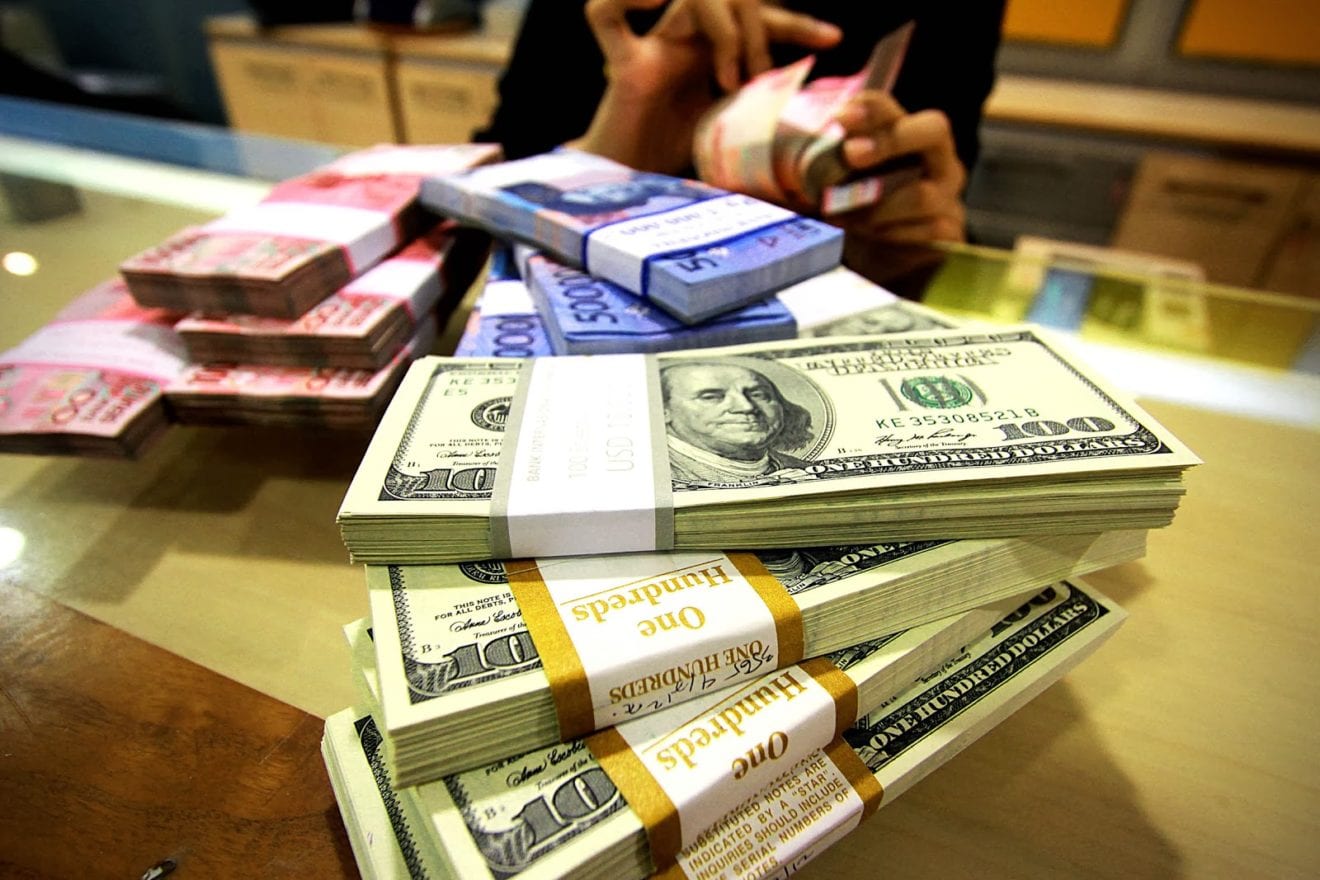
    This regulation arranges that foreign banknote carriages within and outside the country of at least equivalent to IDR1 billion is only permitted by licensed entities, including banks and non-bank Foreign Exchange Business Activities that have obtained permits and approval from BI to carry foreign banknotes.

    In addition, a qualified Rupiah Money Processing Service Company (PJPUR) listed in BI may carry foreign banknotes across borders, but only as transporter.

    “The release of this regulation is in line with BI’s efforts to achieve and maintain the stability of the rupiah,” said Executive Director of BI’s Department of Foreign Exchange Management, Budianto at Thamrin Building, BI, Central Jakarta, Monday.

    The BI regulation is effective on March 5, 2018, but the imposition of new violation sanctions will be applied on May 7, 2018 or two months after the enactment of the PBI.

    The grace period for enforcement of the regulation to strengthen socialization aspects to the community before it is implemented.

    “This BI regulation is valid since March 5, 2018, the imposition of new sanctions will be effective on May 7, 2018. There is still a transition period of 10 months ahead,” said Budianto.

    This provision also relates to Law Number 8 Year 2010 concerning the Prevention and Eradication of Money Laundering Crime and Government Regulation No. 99 of 2016 concerning Cash Advance issued by the Financial Transaction Reporting and Analysis Center (PPATK). With the issuance of the new regulation, it will also strengthen the foreign banknotes cross country.

    As for sanctions provided if a party violates, ie prevention of the total number of foreign notes brought.

  • Rupiah May Extend Gain

    Rupiah May Extend Gain

    Reza Priyambada, a senior analyst of PT Binaartha Sekuritas, predicts that the rupiah will extend its gain. The rupiah is expected to move to around a support level of Rp13,385 and resistance level of Rp13,327.

    “Recent strengthening of the rupiah may open the opportunity for a rebound in the rupiah to extend its gain,” Reza said in a written statement on Tuesday, March 7, 2017.

    Rupiah moved in the positive zone yesterday. It strengthened by 33 points or 2.5 percent to Rp13,350 per US dollar. Raza said that stronger rupiah was due to weaker US dollar as Asian currencies got stronger.

    Rupiah has also strengthened as the Indian Ocean Rim Association (IORA) Summit takes place. The summit is expected to stimulate increase in foreign investment in Indonesia which may trigger economic growth and bolster foreign exchange reserves.

    Rupiah remained strong despite negative sentiment over China who has cut its growth target for 2017, from 6.5-7.0 percent to 6.5 percent.

  • Bank Indonesia Keeps Benchmark Rate

    Bank Indonesia Keeps Benchmark Rate

    Bank Indonesia (BI) has kept its 7-days reverse repo rate at 4.75 percent. Other monetary benchmark rates such as deposit facility rate and lending facility rate have also been kept at 4 and 5.5 percent. “The decision was made by BI to preserve domestic macroeconomic stability,” Bank Indonesia spokesman Tirta Segara said yesterday.

    As such, the BI has maintained its benchmark rate since October 2016. Tirta did not deny that economic policy uncertainty in the United States future following Donald Trump’s victory in the US presidential election in November have also come into play. However, he said that domestic inflation rate is positive at around 3.02 percent.

    Indonesian economy will also be affected by China’s economy. The United States and China are Indonesia’s major trade partner. “BI and the government will continue to collaborate to monitor every development,” Tirta said.

    Finance Minister Sri Mulyani Indarwati said global economic outlook may not improve this year. “Economic growth in developed countries, such as the United States, Japan and European countries, may not be as rapid as expected,” Minister Sri said.

    Sri said the United States is the only developed country that may recover from the economic downturn. However, at the same time, the US economic recovery may pose new problems to the global economy. The Fed, according to Sri, may increase interest rates should the US manages to achieve economic growth.

    The Fed itself had said that it plans to increase interest rates. However, it would await Trump’s policy on tax cuts and increased infrastructure and defense spending that may lead to increase in inflation.