Retail News CRM

Tag: Shiseido

  • Beijing Liyuan Shakes Up Beauty Industry: Eyes Exit from Shiseido China Venture

    Beijing Liyuan Shakes Up Beauty Industry: Eyes Exit from Shiseido China Venture

    Beijing Liyuan is said to be planning a sale of its 35% stake in its longstanding cosmetics joint venture with Japanese beauty firm Shiseido. This decision would conclude a partnership that has spanned more than thirty years.

    According to information available on the China Beijing Equity Exchange, Beijing Liyuan is looking for a minimum of RMB199.5 million (US$29.3 million) for its stake in Shiseido Liyuan Cosmetics.

    Details of the Proposed Sale

    Shiseido China Investment, which owns the remaining 65% of the joint venture, has confirmed the planned sale. However, they haven’t specified if they plan on acquiring the stake.

    Shiseido Liyuan Cosmetics was established in 1991 with a focus on developing products specifically for Chinese customers.

    Their leading brand, Aupres, was exclusively designed for the Chinese market. Over the years, this brand became a significant part of Shiseido’s local strategy as the company expanded its operations throughout the country.

    The proposed sale is still in progress and remains subject to completion. Both Beijing Liyuan and Shiseido have refrained from disclosing any additional details about the transaction.

    Questions & Answers

    What is the proposed sale price for Beijing Liyuan’s 35% stake in Shiseido Liyuan Cosmetics?
    Beijing Liyuan is seeking at least RMB199.5 million (US$29.3 million) for its stake in Shiseido Liyuan Cosmetics.

    Who owns the majority stake in Shiseido Liyuan Cosmetics?
    Shiseido China Investment owns the majority stake, holding 65% of the joint venture.

    What is the significance of the Aupres brand in Shiseido’s strategy?
    The Aupres brand, which was exclusively created for the Chinese market, became a cornerstone of Shiseido’s local business strategy as the company expanded its presence across China.

  • Shiseido Announces Major Organizational Restructure for 2026: Embracing Sustainability, Creativity, and Digital Transformation

    Shiseido Announces Major Organizational Restructure for 2026: Embracing Sustainability, Creativity, and Digital Transformation

    Shiseido, the multinational personal care company, has recently revealed significant organizational and personnel changes which will come into effect at the start of the new year.

    Organizational Changes

    Shiseido plans to streamline its operations by introducing new business units to consolidate areas related to sustainability, creation, and digital operations. The company is set to establish the Sustainability Strategy Acceleration Office within its corporate transformation acceleration department. This new office will integrate all functions related to sustainability, including the DE&I group, which will result in the dissolution of both the Sustainability Strategy Acceleration Department and the DE&I Department.

    A new division, the Art and Creation Division, will also be established by merging functions from the Beauty Creation Center, Shiseido Creative, and the Art & Heritage Department. Shiseido Creative’s functions will be transferred to the newly formed Creation Department, while the Art & Heritage Department will be restructured as the Corporate Value Creation Office.

    Digital Operations Consolidation

    In a move towards digitalization, Shiseido will establish the Global Digital Division and the Global Business Engagement Department. These new entities will streamline resources by merging digital and IT functions under a single, unified platform. Existing IT capabilities, currently dispersed across various units, will be consolidated into the Global Digital Division.

    Following the completion of the core system FOCUS rollout, the Business Transformation Department will be dissolved. It will be replaced by two new teams: the Global Business Engagement Department and the Global Enterprise Application Department.

    The Digital Transformation Office will also be restructured and will be known as the Global Digital Platform Department henceforth.

    Leadership Appointments

    Alongside these structural changes, Shiseido has also announced its associated leadership appointments. The newly appointed leaders include Naoko Hase, Maki Yamamoto, Atsushi Yasuda, Venkatesh Somasundaram, Yuki Mikita, Keiko Sakurai, Takuma Kurahashi, and Yuu Miura. They will take the reins across various functions such as risk management, digital governance, global process management, creation, and product value development.

    Questions & Answers

    What are the significant organizational changes announced by Shiseido?
    Shiseido is set to introduce new units for the consolidation of functions related to sustainability, creation, and digital operations. Also, several existing departments will be restructured or dissolved accordingly.

    What is the aim of Shiseido’s digital operations consolidation?
    The aim is to streamline resources by merging digital and IT functions under a unified platform. Existing IT capabilities, currently dispersed, will be consolidated into the newly formed Global Digital Division.

    Who are the newly appointed leaders at Shiseido?
    The newly appointed leaders include Naoko Hase, Maki Yamamoto, Atsushi Yasuda, Venkatesh Somasundaram, Yuki Mikita, Keiko Sakurai, Takuma Kurahashi, and Yuu Miura, who will oversee various functions such as risk management, digital governance, global process management, creation, and product value development.

  • Shiseido Plans to Trim 300 U.S. Jobs Amid Challenges with Acquired Skin-Care Brand

    Shiseido Plans to Trim 300 U.S. Jobs Amid Challenges with Acquired Skin-Care Brand

    In a promising turn of events, Shiseido reported an uptick in net profits for the first half of the year, crediting proactive restructuring moves in Japan and China. Yet, while the Japanese cosmetics powerhouse shows signs of recovery, turbulence within its U.S. subsidiary has prompted a reevaluation of strategies, including potential job cuts to streamline operations.

    This dual narrative of recovery and challenge unfolded during Shiseido’s latest financial briefing, where executives revealed their contrasting fortunes across global markets. Though the company has successfully revitalized its operations in Asia, the American segment remains a troublesome spot, leading to uncertainty regarding its growth trajectory.

    Despite achieving growth milestones domestically, the question of how to conquer the U.S. market looms large, akin to trying to win a game of chess with the opponent always a step ahead. Shiseido must now navigate this complex landscape to redefine its American presence—an endeavor both urgent and fraught with risk.

    As the company looks to the future, industry insiders are awaiting clearer signals about its strategic direction, particularly in the wake of significant restructuring. Will Shiseido find the right moves to flourish in a demanding market, or will this shake-up lead to a sidestep rather than a leap forward? Only time will tell.

    Questions & Answers

    What factors contributed to Shiseido’s improved net profit?
    Shiseido’s net profit for January to June improved due to successful restructuring efforts in Japan and China.

    What challenges is Shiseido facing in the U.S. market?
    The U.S. subsidiary continues to struggle, leading the company to consider significant restructuring measures, including potential job cuts.

    What does the future hold for Shiseido in terms of growth?
    While the company shows positive signs in Asia, uncertainty persists regarding its growth strategy in the U.S. market, leaving many questions about its next steps.

  • Shiseido cites China slump for mid-year operating loss

    Shiseido cites China slump for mid-year operating loss

    Japanese cosmetics powerhouse Shiseido fell by its daily limit in Tokyo trading on Thursday following midyear earnings that were hit by restructuring costs and slumping demand in China.

    Shiseido becomes the latest casualty among luxury brands, including Cartier-owner Richemont and Gucci’s Kering, to be stung by slowing growth and consumer confidence in the world’s second-biggest economy.

    The company said on Wednesday it fell to an operating loss of US$18.44 million in the six months through June, from profit of 13.6 billion the previous year.

    The shares plunged by their daily limit of $4.77, down 15.5 per cent from the previous session close.

    In addition to a slump in sales to China due to changes in purchasing behaviour, the recording of $139.155 million in structural reform costs also affected results.

    Domestic sales were a bright spot, however, benefiting from a tourism boom in Japan fuelled by the weak yen. Some tourists, particularly Chinese, appear to be holding off on buying designer goods at home and splurging in Japan where they are cheaper.

  • Shiseido sees ‘turning point’ ahead in tourism sales

    Shiseido sees ‘turning point’ ahead in tourism sales

    The chief executive of Japanese cosmetics giant Shiseido Co believes inbound tourism will return next year as the pandemic abates, beginning a gradual recovery in sales of high-end goods to travelers.

    A halt in tourism amid the COVID-19 pandemic has cut off sales to Chinese visitors, a critical segment in years past. China may start to ease travel curbs after hosting the Winter Games in Beijing, and a reciprocal opening in Japan would start a “welcome back” of tourist shoppers, Chief Executive Masahiko Uotani said.

    “Next summer will be a turning point,” he said in an interview.

    Like other companies in the luxury sector, Shiseido has been hit hard by COVID-19 related lockdowns that shuttered department stores and airport shops. Operating profit plunged 87% to 15 billion yen ($131.7 million) in the year through December 2020. The company is expecting a partial recovery to 27 billion yen this year.

    Shiseido is aiming to reach 15% operating margin by 2023 and become the global leader in skincare by 2030. To get there, the company is divesting of some lower-priced brands.

    In February, it announced the sale of skincare and shampoo brands to private equity firm CVC Capital Partners for 160 billion yen. Shiseido said in August it would sell three make-up brands for $700 billion to U.S.-based investor Advent International.

    “When we made the plan last year, no one thought that the corona situation in Japan would last this long,” Uotani said. “If economic activity in Japan reaches the level of Europe and the U.S., I think the cosmetics industry will recover all at once.”

    “What I’m hoping for is the spring of next year,” he added.

    On mainland China, there are signs of economic slowdown and concerns of tighter regulation, but the market remains an attractive overseas market.

  • Shiseido to sell beauty brands BareMinerals, Buxom, Laura Mercier

    Shiseido to sell beauty brands BareMinerals, Buxom, Laura Mercier

    Shiseido Americas is selling cosmetics brands, BareMinerals, Buxom, and Laura Mercier to AI Beauty Holdings Ltd, a newly-formed affiliate of private equity investment firm, Advent International. The terms of the deal were not disclosed.

    Upon completion of the transaction, Pascal Houdayer, the former chief executive of NAOS (Bioderma, Esthederm, Etat Pur) will serve as CEO of the standalone business.

    Launched in 1995, BareMinerals is a leader in mineral-based cosmetics; Buxom, created in 2007, is a colour cosmetics brand ranked among the top five US brands across various lip categories. Prestige makeup brand Laura Mercier was founded in 1996.

    “We are strong believers in the BareMinerals, Buxom, and Laura Mercier brands,” said Tricia Glynn, a managing director at Advent. “They are clear leaders in prestige beauty and are widely recognised for their quality, authenticity, and innovation, with differentiated products and devoted customers.”

  • Shiseido confirms sale of consumer business for US$1.5 billion

    Shiseido confirms sale of consumer business for US$1.5 billion

    Japanese beauty company Shiseido said it plans to sell its personal-care business, which includes its lower-priced hair care and skin care products, to private equity firm CVC Capital Partners for 160 billion yen (US$1.5 billion).

    Shiseido’s personal-care unit includes popular brands like Senka face wash and Tsubaki shampoo.

    Under this deal, the assets will be transferred in July to a new company. Private equity fund CVC Asia V will acquire a 65% stake in the venture and Shiseido will hold a 35% stake.

    “We see significant potential for growth by investing further in employees, brands, and R&D, as well as by driving digitalization and accelerating overseas expansion, with the possibility of going public in the future,” said Yukinori Sugiyama, partner and co-head of CVC Japan, in a statement.

    Founded in Tokyo in 1872, Shiseido is focused on its premium beauty brands such as NARS Cosmetics, Bare Escentuals, and its namesake Shiseido line. As part of this strategy, the company is planning.

  • Shiseido plans sale of consumer product lines for over $1.45 billion

    Shiseido plans sale of consumer product lines for over $1.45 billion

    Japanese cosmetics firm Shiseido Co Ltd said on Friday it was in talks to sell its lower-priced skincare and shampoo lines to private equity firm CVC Capital Partners in a deal reported to be valued at over $1.45 billion.

    Shiseido said it was in talks to sell its “personal care” business in the first half of the year to CVC but that no decision had been made.

    The business includes its Tsubaki shampoo and Sea Breeze deodorant brands which are sold at drugstores and convenience stores throughout Asia.

    The talks were first reported by Bloomberg News, which put the value of the deal at between 150 billion to 200 billion yen ($1.45 billion-$1.93 billion).

    Shiseido said it was considering taking a stake in the business and remaining involved in its development.

    The talks come as Shiseido has been eyeing possible asset sales to focus on premium cosmetics, including its namesake line and brands such as Cle de Peau and NARS sold at department store counters.

    Global private equity firms such as CVC and Carlyle Group have recently been looking to expand in Japan, taking advantage of large Japanese companies coming under pressure to sell non-core assets and improve returns to shareholders.

    CVC last year raised $4.5 billion for its fifth Asia Pacific fund.

    Like other companies in the luxury sector, Shiseido was hit hard by the coronavirus as people shopped less and wore less make-up. A halt in tourism has been particularly painful as the company depended heavily on Chinese visitors.

    The company said in November that it expects a net loss of 30 billion yen in 2020, worse than a previous forecast loss of 22 billion yen.

    Shiseido shares rose 4% in morning trade on the Tokyo Stock Exchange. A CVC representative declined to comment.

  • Shiseido selects transgender Hunter Schafer as global ambassador

    Shiseido selects transgender Hunter Schafer as global ambassador

    Japanese beauty label Shiseido has appointed Hunter Schafer as its global brand ambassador, a move aimed at broadening its appeal to new, younger generations of customers.

    The 21-year-old transgender actress made her acting debut last year in HBO American drama Euphoria. Besides acting career, Hunter has also modeled for fashion houses, including Dior, Miu Miu, Calvin Klein, and Versus Versace.

    In a statement, Shiseido described Schafer as “a multifaceted Generation Z” who “inspires, ignites change and transcends boundaries by celebrating individuality on and off the screen”.

    “Hunter Schafer really represents the current zeitgeist of beauty in that there are no rules, no boundaries, and no restrictions,” said James Boehmer, global artistic director for Shiseido Makeup.

    “Similar to Shiseido, she is both modern and timeless, continues to write her own narrative, which is what we encourage people to do with makeup.”

    With Schafer as a global brand ambassador, the brand aims to empower customers by helping them push their own unique beauty further, according to Yoshiaki Okabe, chief brand officer at Shiseido.

    “Nobody embodies this concept better than American actress and artist Hunter Schafer,” the company said in a statement.

  • Shiseido looks to China’s online model for post-Covit 19 growth

    Shiseido looks to China’s online model for post-Covit 19 growth

    Shiseido Co is pumping up its e-commerce presence amid a “deep crisis” in the beauty business, with the Japanese company looking to its China strategy as a post-pandemic model for growth.

    The 148-year-old beauty giant sees its online proportion of overall sales growing to 30 percent in two or three years if current conditions continue, from about a fifth right now, according to CEO Masahiko Uotani.

    “From a business standpoint, we’ve been trying to come up with solutions to the current situation and use this as an opportunity to go at a faster pace with some reforms,” Uotani said in an interview in Tokyo.

    The reforms for Shiseido, which has relied heavily on department-store sales, involve training beauty consultants to use live streaming and social media, working more closely with retailers on the tech-enabled shopping experience, and investing in new marketing content for online, Uotani said. All strategies the company has implemented in China.

    “We need to merge online and offline to get people to buy more. Beauty products are different from others in that a human touch is very important, so we need to think about a structure that allows that,” he said. “There’s a lot we can learn from what’s going on in China.”

    Uotani’s focus comes as the beauty industry faces unexpected challenges because of the global pandemic that is different from previous downturns. Measures to control the spread of the coronavirus have melted away social norms like putting on makeup in the morning or spritzing on perfume before a night out. As people stay home, the need for beauty care has become a lower priority, making it difficult for businesses to bounce back quickly.

    The situation has also been complicated as department stores and beauty salons have closed during lockdowns, sending consumers to seek cheaper cosmetics brands online.

    Shiseido’s sales fell 17 percent in the first quarter and operating profit plunged 83 percent, mostly due to clampdowns on movement in China, where it does a fifth of its business, and a hit to tax-free sales to Chinese tourists in Japan. The company withdrew its annual forecast, acknowledging it would be unable to hit its mid-term goal of more than US$11 billion in sales by this year. For the second quarter, analysts are expecting Shiseido to swing to a loss.

    “The near-term earnings outlook will be difficult,” said Ritsuko Tsunoda, an analyst at JPMorgan Chase & Co. “But I think Uotani will leverage that for any material structural change that he couldn’t have implemented otherwise.”

    Mini-influencers

    Transitioning beauty-product sales online isn’t an easy step for an industry built on consumer preferences and dominated by the image of rows of samples at physical retailers that encourage trying and buying on the spot.

    Shiseido is training its sales staff in Japan to follow the example of Chinese employees, turning beauty counter ladies into mini-influencers. In China, department store consultants have taken to social media to stream the newest products that have arrived. Interested customers are then directed to the website of the department store to purchase the products.

    China has developed a booming culture for live video merchandising, and companies are beginning to catch on to the trend.

    Uotani sees China’s e-commerce sales hitting 40 percent of revenue from the region this year, jumping from 30 percent currently. He said China’s fast recovery — sales of high-priced prestige brands in April, after the strictest lockdowns ended, were at levels before the coronavirus hit — could bode well for other regions.

    Drunk elephant

    The focus in the short-term will be prioritizing its high-end beauty brands that can generate cash flow to invest in e-commerce, according to Uotani. The company, which owns Nars and Laura Mercier makeup, is looking to speed up the expansion of its Drunk Elephant brand, which it bought in an $845 million deal last year, as prestige skincare products have been resilient during the pandemic.

    Dealmaking, such as selling off non-core assets or buying businesses that can support the focus on prestige and e-commerce, is also part of the equation, Uotani added.

    “It’s a very deep crisis for our business, and we need to protect employees and the company,” he said.

    At stake is the legacy of Uotani’s tenure. When he took the helm of Shiseido in 2014 following stints at companies including Coca-Cola Japan, it was a rare instance of an outside executive joining the C-suite in the island nation, where managers are typically elevated through decades of service to one firm.

    Analysts and investors have praised Uotani’s efforts at Shiseido, whose value more than quadrupled during his tenure before the coronavirus hit. After such success, the current crisis is shaping up to be his biggest test.

    “In my 40 or so years working in business,” he said, “the unexpected and uncontrollable impact from the global pandemic is the biggest I’ve dealt with in my career yet.

  • Shiseido Beauty Square concept store starts in Tokyo

    Shiseido Beauty Square concept store starts in Tokyo

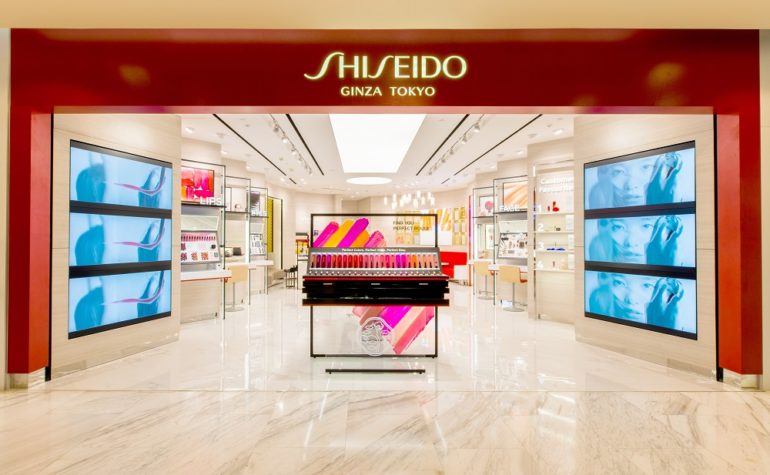
    Shiseido opens its new concept store Beauty Square in Tokyo’s Harajuku district today.

    Located on the first floor of the With Harajuku commercial complex, the 793sqm Shiseido Beauty Square will offer digital experience-based features and a salon, besides its cosmetics ranges.

    Shiseido describes the new retail space as “a spot offering experience and communication to discover, enjoy, and share beauty”.

    Beauty Square is divided into four zones – Go-live, Brand, Installation, and Salon.

    Located at the entrance, the Go-live Zone features a large LED display and signage showing live streaming, video programs, and promotional content.

    The Brand Zone ranges a variety of Shiseido products, covering makeup, skincare and hairstyling.  Brands on sale include IPSA, Cle de Peau Beaute, The Ginza, Shiseido Professional, Dolce&Gabbana Beauty, Nars, BareMinerals, and Laura Mercier.

    A large 4×4 meter LED screen and moving headlights are installed at the Installation Zone which will host events, including digital content and pop-up stores.

    Colorful spheres and motifs “represent the diversity of beauty, constantly change in light and image in sync with body movement and time,” the company explains.

    Here, customers can experience virtual avatar content using Zepeto, an app developed by Naver which allows users to create 3D avatars. There are more than 15 million users of Zepeto in Japan, who at Shiseido Beauty Square can customize their avatars with their favorite makeup and fashion.

    In the Installation Zone, customers go through a virtual experience projecting their avatar character in the store’s special virtual space, taking pictures with friends and avatars of famous brand ambassadors.

    Zepeto actively launches various features and new content, starting from the virtual space, and will provide users with new experiences daily.

    The Salon Zone (above) offers personalized makeup and hairstyling with Shiseido’s beauty artists

    In addition to Beauty Square, the With Harajuku complex also houses a restaurant called Shiseido Parlour The Harajuku on the 8th floor and a beauty academy Sabfa on the second floor.

    Sabfa conducts training for beauty professionals who have a cosmetology license, but in the new stores, training will be expanded to those without a license as a means to nurture more leaders in the profession.

    The new Shiseido parlour restaurant overlooks the forest surrounding the Meiji Shrine. The interior was supervised by Kazuya Ura and the menu features a mixture of French and Japanese cuisine.

  • Shiseido kicked off Baum retail brand

    Shiseido kicked off Baum retail brand

    Japanese cosmetics label Shiseido has released a new skincare brand, called Baum.

    In response to consumers placing greater importance on companies’ and brands’ attitudes toward social responsibility and environmental considerations, Baum focuses on sustainability. It features a range of 27 products to be released on May 30 via Shiseido’s Prestige business category.

    The products are formulated to support healthy skin regardless of age or gender, with a focus on three key characteristics found in trees – water storage, growth, and environmental defense. The brand is positioning itself as focusing on the “power of trees, gracefully harmonizing with environmental changes and living for hundreds of years”. It ascribes to a sense of coexistence with nature that it asserts has been “valued by Japanese people for centuries”.

    Production of the Baum range is particularly attentive to sustainability concerns, with the use of upcycled wood in product packaging; actively offering to refill products; using bio-based plastics and recycled glass and participating in forest conservation activities – with plans to plant and grow oak trees scheduled to begin next year.

  • Shiseido Empowers Marginalised Young Women inAsia Pacific

    Shiseido Empowers Marginalised Young Women inAsia Pacific

    Shiseido Asia Pacific, in partnership with The Asia Foundation, officially announces the launch of the Girls Learning & Leading Program (GLL), which aims to equalise access to education, opportunity and mentorship for marginalised women in Southeast Asia.

    Greater access to education is one proven way to ensure that young women can lift themselves and their families out of poverty and better contribute to the development of their communities and their country. Cambodia is the program’s inaugural location – a rapidly changing nation, where education is a key component of its development goals. Building on the Foundation’s two decades of on-the-ground experience in Cambodia, the program’s pilot phase runs from May to December 2019, and provides scholarships to female students – giving them access to secondary education, mentorship, and career pathways.

    Equalising access in Cambodia

    While Cambodia has made strides in offering equal access to education for boys and girls, a substantial gender disparity remains. The literacy rate is 70.9% for adult females and 85.1% for adult males in Cambodia. Females make up more than half the population but represent a minority of university graduates. Proactive measures in combatting poverty, cultural norms, and access to schools in rural Cambodia are necessary to keep girls in secondary school.

    Shiseido Girls Learning & Leading Program

    The pilot phase of the GLL Program kicks off in Cambodia in 2019 and is designed to improve retention and completion of girls’ secondary education – a critical time when young women are most likely to drop out of school to find paying jobs. Guided by Shiseido’s global corporate mission of Beauty Innovations for a Better World, the company continues to take concrete actions to drive social change in areas such as women’s empowerment – a crucial philosophy underlying the business and management of Shiseido.

    This year, Shiseido and The Asia Foundation will provide scholarships to 102 female students from the ages of 16 to 19 studying in grades 10 – 12 at Norodom Secondary School in rural Prey Veng province, a 2.5-hour drive from the capital, through this program. Designed as a comprehensive support system for the young female scholars, the program focuses on four key pillars:

    • Material support: Students receive material support for their basic, practical needs including books, stationery, and rice for their families, which help lift an often-daunting economic burden.
    • Soft-skills development: Training of critical soft skills, such as leadership, communication skills, critical thinking, problem solving, and team building, as well as mentoring support for tertiary education & career pathways. The scholars then apply these skills in short, impactful action projects.
    • Academic support: English language training, extracurricular classes in STEM subjects such as mathematics and science.
    • Mentorship: Shiseido and local Cambodian mentors serve as positive role models and a support network for the scholars, inspiring and providing them a safe space to share their challenges, experiences and ideas.

    Jean-Philippe Charrier, President & CEO, Shiseido Asia Pacific, said, “Women are the heart and soul of Shiseido’s business. I firmly believe that beauty can change the world; and that we as a company are well-placed to make a lasting, positive impact that equalises the opportunities for young women and empowers them through learning and mentorship. Through our strong partnership with The Asia Foundation, I hope the Girls Learning & Leading Program will enable our young Cambodian scholars to successfully obtain a higher education, learn critical leadership and soft skills that will secure a better future for them and their families.”

    Meloney Lindberg, Cambodia country representative, The Asia Foundation, also added, “Cambodia’s decade-long path of private sector-driven growth has yielded important but uneven development benefits for citizens. Women and poor communities remain especially vulnerable. With Shiseido’s crucial support, together we are seeing a vital shift in the girls’ school retention and academic performance, and are equipping themselves with the skills and self-confidence to transform their lives.”

  • Shiseido takes over Drunk Elephant

    Shiseido takes over Drunk Elephant

    Cosmetics giant Shiseido is to buy Drunk Elephant, a fast-growing prestige skincare brand recognized for clean product development.

    Drunk Elephant, founded in 2012 by Tiffany Masterson as a “solutions-oriented, cross-generational brand for all skin types”, has since grown exponentially across a range of consumer demographics including Gen Z and Millennials. The brand’s curated range features biocompatible ingredients to benefit the skin’s health and support the products’ formulations.

    The brand will leverage Shiseido’s global platform and resources to expand into new and existing markets both in the Americas and internationally including Europe and Asia.

    “This transaction is squarely aligned with Shiseido’s Vision 2020 goal of accelerating growth and creating value through strategic partnerships,” said Shiseido president and CEO Masahiko Uotani.

    “Drunk Elephant’s approach strongly resonates with its highly engaged and loyal consumers, who value the integrity and effectiveness of Drunk Elephant’s formulations combined with a fun, curious approach.”

    “This new and incredibly exciting partnership builds on Shiseido’s significant momentum and successful track record of acquiring distinctive, best-in-class brands,” said Shiseido Americas CEO and chief growth officer Marc Rey. “Drunk Elephant is changing the way people understand and experience beauty by offering products that are effective and clean compatible.

    “Drunk Elephant is built on a strong brand foundation and a unique philosophy that fits perfectly with Shiseido’s values and skincare heritage. Our innovative and people-first cultures are well aligned, and we share an unwavering commitment to our consumers. I also believe the brand will contribute to the business performance of Shiseido Americas. We are thrilled to welcome Tiffany and the Drunk Elephant team to the Shiseido family and I know they will feel at home from day one.”

    “I started this business as an industry outsider, and from the beginning, I did things a little differently,” said Drunk Elephant founding partner and chief creative officer Tiffany Masterson. “To join with a powerhouse beauty company such as Shiseido that leads the industry in innovation and global excellence is a dream come true for me and for Drunk Elephant. We share similar values, most importantly an unwavering commitment to the consumer. I chose a partner who will let the brand continue to be itself, with the same formulations and the same team.”

    The transaction was led by Shiseido Americas and the New York-based Shiseido Global M&A team, in close coordination with the company’s headquarters. Upon closing, Drunk Elephant will operate within Shiseido Americas, and Tiffany Masterson will continue in her role as chief creative officer and assume the additional role of president, reporting directly to Marc Rey. The transaction, in which Shiseido engaged Jeffries, is subject to customary regulatory approvals and closing conditions and is expected to close before year-end.

  • Shiseido Philippines JV launched

    Shiseido Philippines JV launched

    Beauty-products retailer Shiseido has commenced operations in the Philippines through the newly-established Shiseido Philippines Corporation, a joint venture in partnership with Luxasia Partners.

    Shiseido is Japan’s largest beauty company with a presence in over 120 countries, including the Philippines, which is Southeast Asia’s third-largest cosmetics market representing close to US$3 billion in annual sales.

    This expansion opens new distribution channels in the Philippines and enables Shiseido to expand its current brand and product range in the market. In addition to trusted Shiseido and Shiseido Men skincare products, Shiseido Philippines will officially launch other key brands from its Prestige, Fragrance and Cosmetics & Personal Care portfolios – such as Nars and Laura Mercier; a line-up of fragrances such as Dolce & Gabbana, Issey Miyake, and Narciso Rodriguez; and Senka facial cleansers, which have already established a strong following in Asian markets.

    “We are proud of what we have accomplished with the brand to date and are extremely delighted to move our business forward with the launch of the Shiseido Philippines in partnership with Luxasia,” said Shiseido Philippines MD Koji Nakata. “We remain committed to our customers and I look forward to engaging with our customers in the Philippines as we bring them limitless beauty with our expanded line-up of high-quality cosmetics and skincare products.”

    “The Philippines is an important and strategic market for Shiseido in Southeast Asia, and it is an exciting time to be a part of the country’s booming beauty industry,” said Shiseido Asia Pacific president & CEO Jean-Philippe Charrier. “I hope that Shiseido’s entry to the Philippines will enable more Filipinos to have access to a wider range of beauty brands and products – with the uncompromising quality, innovation and spirit of omotenashi, or Japanese hospitality – that only Shiseido can provide.”