Retail News CRM

Tag: shopper

  • China’s web shoppers want more

    China’s web shoppers want more

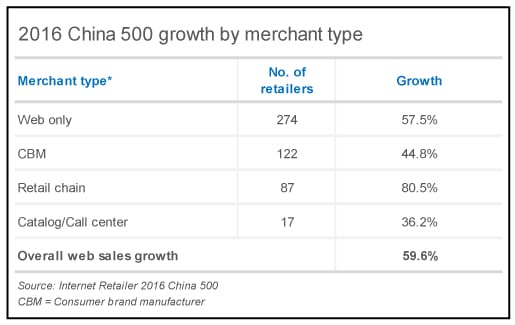
    China’s growing middle class craves imported goods and that’s driving big opportunities for overseas brands and retailers. China’s 500 largest web retailers grew combined sales by 60% in 2015, according to the all-new Internet Retailer 2016 China 500, which ranks the 500 leaders of the world’s largest and fastest-growing e-commerce market

    China’s slowdown to only 6.9% growth in gross domestic product in 2015, one of the lowest increases in decades, has been blamed for hurting the economies of trading partners in other countries. But China’s growing middle class keeps buying more online, and its thirst for foreign goods creates a big opportunity for overseas retailers and brands.

    Chinese consumers purchased $589.61 billion worth of goods online in 2015, an increase of 33.3% from a year earlier, according to the National Bureau of Statistics in China. By comparison, U.S. online retail sales grew roughly 15% per year from 2011 to 2014 to $304.9 billion, according to the U.S. Commerce Department.

    China’s 500 largest e-retailers grew their combined online sales by a stunning 60% in 2015 to $198 billion, according to the all-new Internet Retailer 2016 China 500, which ranks and provides a wealth of financial and operating data on the 500 leaders of the world’s largest and fastest-growing e-commerce market. And the data contained in Internet Retailer’s newest research report on e-commerce in China shows that the world’s biggest online market is rapidly consolidating, with the 500 largest competitors now controlling 33.6% of China’s e-retail market, up from 28% just one year ago.

    Retailers and brands based outside of China shared in that growth. The 52 U.S.-based retailers ranked in the China 500, for example, grew online sales 24.3% to $17.77 billion last year—the bulk of that coming from Chinese customers. The 79 retailers based outside China, including those in the U.S., grew sales by 24.0%, to $21.31 billion in 2015.

    The growing online retail sales for brands and retailers based outside of China is not surprising given the strong demand among middle-class Chinese for foreign goods, from Apple Inc. iPhones to food and household goods from Wal-Mart Stores Inc. Alibaba Group reported that 33% of Chinese consumers bought items from international brands during the 24-hour Singles’ Day event Nov. 11, with U.S. goods in the top spot. Singles’ Day is a marketing initiative that Alibaba created to spur single consumers to buy goods online for themselves, as opposed to other marketing days where consumers buy gifts for loved ones.
    Among the factors driving online sales growth are increasing sales from consumers in China’s villages, and the steady growth in the number of Chinese shoppers who can access the web through mobile phones.

    “In China, the major market drivers in the past year have been cross-border e-commerce, mobile shopping, omnichannel and e-commerce in villages,” China E-commerce Research Center senior analyst Zhang Zhouping says.

    There were 668 million Internet users in China by June 2015, and about 89%, roughly 594 million consumers, could access the web through mobile devices, according to China Internet Network Information Center. During Alibaba’s Singles’ Day sale, Chinese consumers purchased $14 billion worth of products, and 70% of sales were generated on mobile devices, according to Alibaba.

    Rural areas, where there are few bricks-and-mortar stores, also present huge potential for online merchants. There were 186 million Internet users living outside of cities as of June 2015, and 60% of them had never bought products online, according to China’s Ministry of Commerce. To encourage rural shoppers to order online, e-commerce firms are rapidly improving their facilities in those areas. Alibaba, whose big marketplaces Taobao and Tmall account for about 75% of China’s online retail sales, has helped about 14,000 merchants with small stores in rural China sell their wares on Taobao, the company says. Alibaba is aiming to establish up to 100,000 such service centers among about 570,000 villages in rural areas of China.

     

  • China’s Consumers Spend Up On Spas, Travel and Entertainment

    China’s Consumers Spend Up On Spas, Travel and Entertainment

    China’s consumers are ignoring the bears.

    Consultancy McKinsey & Co. is tipping that China’s shoppers will increase their spending by 10 percent per year through the end of the decade as incomes rise. Some 55 percent of consumers expect a significant wage increase over the next five years.

    It’s not just staple goods that will be filling the shopping trolleys. Consumers are spending more on luxury items like spa visits, travel and entertainment.

    The shift is just another sign of China’s economy changing away from one that is fueled by heavy industry and exports and towards one where consumers and services drive growth.

    The chart below shows how shoppers plan to spend more on leisure and travel.

    Here’s another sign of the burgeoning market: consumers are adopting new products, services and retail experiences at rates unseen in developed markets. Mobile payment in China went from zero in 2011 to 25 percent of the population in 2015.

    “Gone are the days of indiscriminate spending on products,” according to McKinsey. “The focus is shifting to purchasing more premium products, and living a more balanced, healthy, and family-centric life.”

    China’s leadership have prioritized economic growth of between 6.5 percent and 7 percent this year and have promised to ensure the economy, which grew by its slowest in 25 years in 2015, will avoid a hard landing.

    While China’s retail sales slowed in the first two months of the year, they remain in a double-digit growth range.  Annual sales of cinema tickets could overtake the U.S. as early as 2017 and outbound tourist trips is on course to reach 200 million by 2020, according to CLSA Ltd.

    Still, for foreign competitors hoping to capture greater market share, the outlook is mixed. While foreign brands dominate the premium segment, local companies are increasing their market share in the mass segment of the market.

    “While scale, speed, and simplicity proved advantageous during the past 15 to 20 years, the changing shape of Chinese consumption is set to topple some giants of the past, and elevate new champions,” McKinsey said.

    McKinsey surveyed 10,000 shoppers aged between 18 and 65 in 44 cities across China.

  • China’s 500m middle class consumers

    China’s 500m middle class consumers

    Within the next ten to twenty years there will be 500m middle class consumers in China, according to Jack Ma, and there will be huge opportunities for smaller Western brands to gain a foothold in this market.

    “In the last 20 years China was focused on exporting, in the next 10-20 years China will focus on importing,” the founder of ecommerce giant Alibaba told a business gathering in London. “We’re coming here to help small businesses in the UK, in Europe, to sell to China.”

    To this end the company has made its London office a regional hub and opened offices in Italy, France and Germany.

    Some 5,000 overseas brands from 25 countries are expected to take part in Singles Day, Alibaba’s annual online shopping extravaganza on November 11, which this year will feature 6m products from more than 40,000 merchants and 30,000 brands.

    Last year shoppers from 175 countries placed orders on Alibaba’s platforms during the first 40 minutes, as the company upgraded the event into a global online shopping carnival by helping Chinese shoppers purchase overseas products and overseas buyers acquire goods from China.

    The ecommerce business has announced it will this year be “merging bricks with clicks”. Jeff Zhang, president/China retail marketplaces, explained this was a theme of the 2015 event and “marks the first step in achieving the full integration of the digital economy and physical commerce”.

    Some 180,000 stores in 330 cities across China are using a variety of omnichannel strategies to make shopping more convenient and rewarding.

    So, for example, customers entering one of these stores will get text notifications from their Taobao mobile app and can then scan an event barcode to win discounted e-coupons to redeem on the 11.11 shopping day.

    Leading retail brands – including Suning, Intime and Haier – will have special in-store experience zones where consumers can try out displayed products before scanning the barcodes and purchasing them at the discounted prices reserved for sales on 11 November.

  • Chinese shoppers still spending on luxury goods

    Chinese shoppers still spending on luxury goods

    China’s share market plunge and currency devaluation have not resulted in Chinese shoppers cutting back their spending on luxury goods as had been feared, a top-ranked HSBC analyst said this week.

    Mr Erwan Rambourg, HSBC Global’s co-head of consumer and retail, said the declines in stock prices and in the yuan need to be put in context.

    “The Shanghai composite index has been down roughly 40 per cent since its peak. On a 12-month view, if you had invested 12 months ago, you would still be up about 30 per cent,” he said.

    And while the yuan’s devaluation of about 2 per cent last month instantly made everything more expensive for travelling Chinese shoppers, the currency is still up in value relative to the euro compared with last year, he noted.

    “Purchasing power of the Chinese in Europe is still a lot stronger today than it was just 12 months ago,” said the Hong Kong-based Mr Rambourg, who has been covering the luxury and sporting goods sectors for 10 years.

    “The reason we look at euro-yuan and not (the US) dollar-yuan is because Chinese consumption abroad is mostly taking place in continental Europe, places like France and Italy. So obviously I don’t see that as a big negative.”

    It is the appreciation of the euro that could be a bigger issue than the decline in Chinese equity markets, Mr Rambourg said.

    He said the recent correction of the equity markets in Asia “has had a much bigger impact on Hong Kong than it has had on mainland China”.

    Reuters reported last month that Hong Kong retail turnover fell for the fifth straight month in July, as a slowdown in tourist arrivals further battered sales of big-ticket items such as jewellery and watches, while a plunge in the stock market hurt consumer sentiment.

    Mr Rambourg believes that luxury sales fell in Hong Kong because Chinese spenders have moved to more “fashionable” destinations such as Japan, South Korea and Taiwan.

    HSBC Global Research’s latest report estimated about 70 per cent of luxury revenue in Hong Kong comes from Chinese consumers.

    One of the issues in Hong Kong and Macau is the lack of diversity – Hong Kong is all about shopping, Macau is all about gaming, and there is not a lot that is offered beyond that, said Mr Rambourg.

    But when Chinese tourists go to Japan, they return home to tell people about the culture, creating a snowball effect which goes beyond just the price arbitrage, where some destinations become fashionable and other destinations become less fashionable.

    About 10 per cent of luxury revenue in Japan now comes from Chinese tourists and Mr Rambourg believes this figure will rise as it did in South Korea, which saw an increase from 10 per cent to 30 per cent.

    About 25 per cent of luxury revenue in Singapore comes from Chinese tourists.

    Mr Rambourg suggested that Singapore should look at providing more diversity in terms of the brands represented here in order to draw in more Chinese shoppers.

    While there will be ups and downs, he foresees Chinese consumers becoming dominant over the next decade.

    About 35 per cent of today’s luxury consumers come from China and the figure could double over the next 10 years, he said.

  • Singapore’s Orchard Rd hasn’t lost its gloss

    Singapore’s Orchard Rd hasn’t lost its gloss

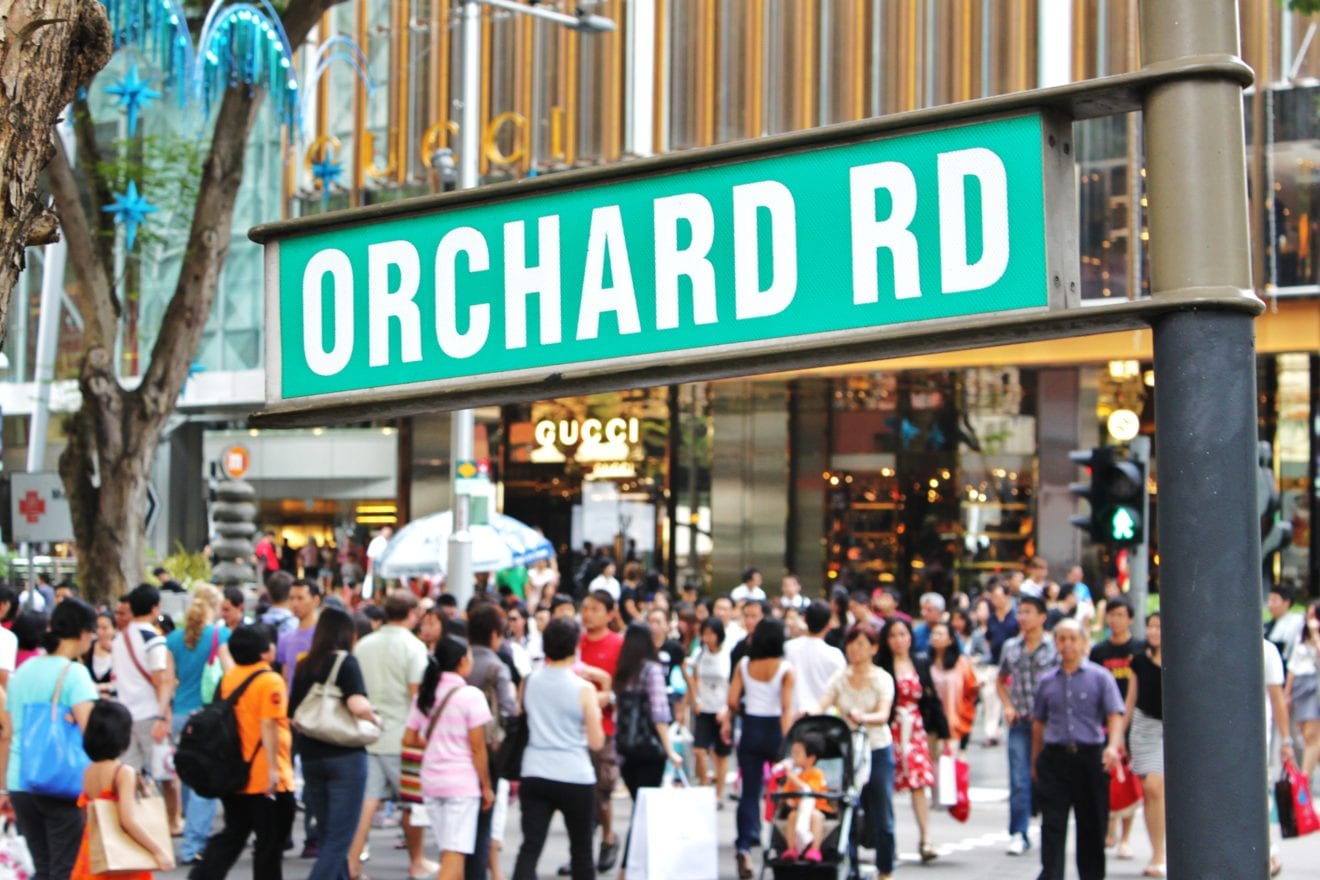
    Orchard Road remains the top destination for shoppers during the recent Great Singapore Sale, according to a new report, debunking calls that Singapore’s prime shopping belt may be losing its shine.

    The premier retail strip attracted the highest footfall during the city-state’s annual shopping promotion, held from May 29 to June 28 this year, a new report by location intelligence company AdNear said. The study analyzed the foot traffic data from 192,000 respondents in six retail locations, including Bugis Junction, Marina Square, Novena Square, Orchard Road, Raffles City and Suntec City, for the month of June.

    “The busy shopping district [of Orchard Road] had almost 2.5 times more foot traffic, definitely in line with the fact that it has an array of malls [compared to] Suntec City, Raffles City and Bugis Junction,” the report said.

    Long regarded as one of Asia’s best shopping streets, Orchard Road has been struggling to keep up with a competitive retail environment brought about by a confluence of factors including fewer tourist arrivals from China andincreased competition from suburban malls and online retailers.

    Reflecting slowing sales at major department stores, average monthly gross rents of prime retail space on Orchard Road slipped 1 percent in the second quarter to a four-year low of $37.79 Singapore dollars per square foot, according to data provided by property consultancy Cushman and Wakefield.

    With its position as a top shopping destination at stake, events such as the Pedestrian Night where a section of Orchard Road goes car-free once a month, have been unveiled; while a $40 million worth of facelift is on the cards to rejuvenate Singapore’s premier shopping street.

    Who likes Orchard Road more?

    To be sure, shoppers are not ditching Orchard Road just yet.

    Among consumers surveyed, the tree-lined shopping belt is ranked among the top three retail locations for the affluent group, homemakers, professionals and travelers. Only the student category gave the shopping precinct a thumbs-down, ranking Orchard Road as the second least-preferred place for retail therapy.

    Orchard Road is also the go-to destination for females, but shunned by male shoppers who ranked it as the least desirable shopping destination. Interestingly, the top choice for male shoppers – Marina Square – was ranked last by female consumers.

    The report showed Sunday as the favorite day for a shopping spree among females, whilst the men favored a mid-week splurge, with footfall at its highest on Tuesdays. Despite the preference for different days, both genders like to shop between 5pm and 9pm.