Retail News CRM

Tag: trend

  • Singapore Retail Sales Continue Upward Trend, Albeit at a Slower Pace in May

    Singapore Retail Sales Continue Upward Trend, Albeit at a Slower Pace in May

    Singapore’s retail sector experienced continued growth in May, albeit at a slower pace than in April. Statistics from the Department of Statistics indicate that retail sales, excluding motor vehicles, parts, and accessories, rose by 3.7% in May. This increase represents a slight slowdown when compared to April’s 4.5% growth. Nevertheless, this marks the continued progression of the positive trend that started in February.

    The total value of retail sales in May was estimated at SG$3.8 billion (US$2.9 billion). Interestingly, online sales made up 17.7% of the total. However, on a seasonally adjusted basis, retail sales decreased by 1.8% compared to the previous month.

    Trends by Category

    Examining the growth by category, recreational goods and watches and jewelry saw the most significant increases, with sales jumping 23.6% and 11.7% year-on-year, respectively. A 9.5% increase in sales was also noted at petrol service stations, primarily due to rising petrol prices.

    Other categories that noted sales boosts between 4.5% and 7.7% include cosmetics, optical goods and books, furniture, and telecommunications equipment.

    On the other hand, food and alcohol retailers and department stores experienced declines, reporting decreases of 3.7% and 3.3%, respectively. The sector of food and beverage services maintained a steady level in May, showing no significant increase when compared to the 0.1% growth in April.

    Questions & Answers

    Which retail categories experienced the most growth in May?
    Recreational goods and watches and jewelry saw the most significant growth, with sales increasing by 23.6% and 11.7% year-on-year, respectively.

    What percentage of total retail sales were made online?
    In May, online sales constituted 17.7% of the total retail sales.

    Did all retail categories see an increase in sales?
    No, not all categories saw an increase. Food and alcohol retailers and department stores reported declines in sales of 3.7% and 3.3%, respectively.

  • Dollar Rises for Third Consecutive Day Against Dong, Marking Ongoing Currency Trend

    Dollar Rises for Third Consecutive Day Against Dong, Marking Ongoing Currency Trend

    The U.S. dollar continued its upward trend against the Vietnamese dong on Thursday, marking the third consecutive day of gains as global rates surged.

    Dollar Exchange Rates on the Rise

    At Vietcombank, the dollar was listed at VND 26,210, reflecting a 0.23% increase. Meanwhile, the State Bank of Vietnam adjusted its reference rate up by 0.06% to VND 24,962. In parallel, at unofficial exchange points, the dollar climbed 0.08% to VND 26,360.

    This rally comes in the wake of a court ruling that blocked former President Donald Trump from implementing import tariffs on various countries, a decision that created ripples in the currency market. Analysts suggest that this unexpected turn could provide the beleaguered dollar with some much-needed relief amid ongoing trade uncertainties.

    “It’s difficult to predict whether the tariffs will be fully reversed, but if they are, we can certainly expect to see the dollar appreciate,” noted Yunosuke Ikeda, head of macro research at Nomura in Tokyo. He further added that the existing tariffs pose stagflation risks to the U.S. economy, so their potential reversal would bode well for the dollar’s strength.

    In a world where currency fluctuations can feel as unpredictable as a game of chance, one can’t help but wonder what other surprises lie in the global financial arena.

    Questions & Answers

    Why is the U.S. dollar rising against the Vietnamese dong?
    The U.S. dollar has been appreciating due to a surge in global rates and a recent court decision blocking tariffs proposed by Donald Trump, resulting in a more favorable outlook for the dollar.

    What are the new exchange rates for the dollar?
    As of Thursday, the dollar was listed at VND 26,210 at Vietcombank and VND 26,360 at unofficial exchange points.

    What impact do tariffs have on the dollar’s strength?
    Trump’s tariffs have added stagflation pressures to the U.S. economy. A potential reversal of these tariffs could lead to an appreciation of the dollar.

  • Fendi opens first flagship boutique in South Korea

    Fendi opens first flagship boutique in South Korea

    Fendi has opened the doors to its first flagship boutique in Seoul, South Korea. Dubbed “Palazzo Fendi Seoul,” the 715 square meter (approximately 7,696 square feet) store is located in the Cheongdam-dong neighborhood of the city and houses the brand’s women’s and men’s ready-to-wear and fur collections, shoes, accessories, leather goods, and home accessories across four levels.

    The impressive façade combines geometric diagonals in stainless steel finishing and central glass windows that converge towards the corner of the building, through a modern and urban reinterpretation of classic Roman patterns.

    The façade is emphasized by LED arches, Fendi signature element recalling those of Palazzo della Civiltà Italiana – Fendi’s Rome headquarters.

  • Pomelo, Senreve explain how to maximise sales conversions via social media

    Pomelo, Senreve explain how to maximise sales conversions via social media

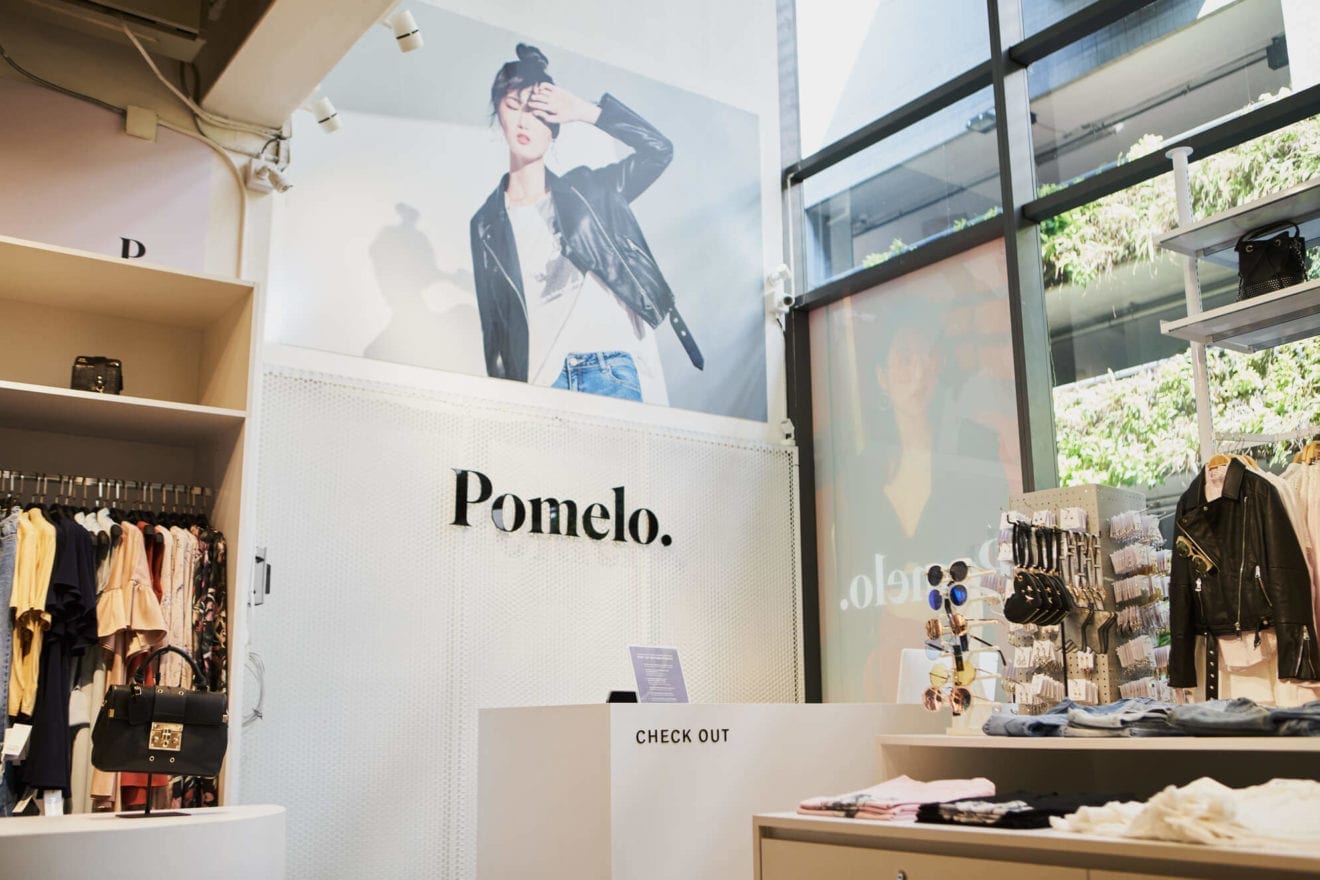
    Online retailers who follow their consumers along the customer journey can see where buyers trail off without completing a purchase. Worldwide, the online shopping abandoned cart rate is about 70%—representing a key challenge and opportunity for marketers. At leading fashion eCommerce brand Pomelo Fashion, which produces a range of stylish, affordable clothes for the digitally native female consumer, finding a way to meet that challenge was a major marketing priority, one they decided to address by leveraging Braze.

    Founded in 2013 in Bangkok, Pomelo Fashion has disrupted the fast fashion industry by providing a seamless shopping experience both online and offline. Pomelo has a strong presence in Asia, with over 4 million monthly visits to their website and a 60 million monthly reach on their social media pages. As a result of being a leading fashion brand in the region, styles frequently run out of stock as customers race to buy their favorite items.

    Customers take advantage of the purchase options Pomelo Fashion gives them, such as the ability to buy from specific store inventory and the ability to buy online and pick up in-store. Buying online and picking up in-store is so popular amongst customers that Pomelo has multiple pick-up only locations amongst its rapidly expanding retail portfolio. As a customer-centric company, Pomelo wanted to give customers a heads up when items they’re interested in are running low on stock. 90% of sales come from the Pomelo Fashion app, so communicating with push notifications and News Feed cards made the most sense.

    You’re reading Perspectives magazine, our new monthly hub for industry-shaking news and strategy—plus interactive experiences and refreshers to make the most of our platform. Want to see the whole story?

    At Pomelo Fashion, they knew that speaking to their customers as individuals was the key to encouraging users to re-engage after abandoning a cart. Pomelo Fashion utilized Canvas—the Braze lifecycle engagement tool—to target consumers based on their personal preferences and recently viewed items, as well as where they stopped along their purchase journey. The “Browsed Category” level and the “Added Item to Cart” level were the two stages where users were targeted for follow-up communications.

    At the “Browsed Category” level, the goal was to encourage users to return to the category and view a product. Push notifications and News Feed Cards mentioned the category of clothing that a user viewed, focusing on the scarcity of products within that category. This campaign saw a 5% increase in sessions, an 84% increase in conversion rate, and a 235% increase in revenue when compared to users who didn’t receive targeted messages.

    The campaign that targeted app users at the “Added Item to Cart” level also saw very successful results. The goal of this campaign was to nudge users to come back to the app to complete their order. Pomelo Fashion tested generic push notifications against hyper-personalized push that included a user’s name and an image of the low stock item that a customer had recently viewed, which was pulled into the message using the Braze platform’s Connected Connect dynamic personalization feature. This campaign drove a 126% increase in sessions and a 66% increase in conversions when compared to their generic push notifications.

    A user’s News Feed on the Pomelo Fashion app was leveraged by the brand to showcase relevant promotional content for each individual. By segmenting users based on whether they were new customers, existing customers or lapsing users, Pomelo was able to display different coupon codes in the News Feed based on user type, supporting a more targeted experience.

    Geo-triggered push notifications were also used by Pomelo to send out promotional messages. When target customers were close to brick-and-mortar locations, they received notifications triggered using Braze Geofence support. These notifications highlighted new collections and offers in stores that were relevant to users based on their preferences. Other notifications alerted users about items they had recently viewed in the app and items on users’ wishlists. By leveraging Braze APIs and Connected Content, Pomelo Fashion’s notifications were able to notify users when items were newly available in a given user’s size.

    Pomelo Fashion tackled one of the most entrenched problems ecommerce retailers face—namely, customers failing to complete a purchase after beginning the process. By skillfully utilizing data highlighting product scarcity, Pomelo sent out targeted notifications based on an app user’s viewed items that moved the needle for their engagement efforts. The success of these personalized push notifications and News Feed Cards shows how powerful testing campaigns against a control group can be.

  • Calvin Klein Announces Decision to Bring In-House Footwear Collections in Europe and Asia

    Calvin Klein Announces Decision to Bring In-House Footwear Collections in Europe and Asia

    Calvin Klein, a wholly-owned subsidiary of PVH, announced today that it will be bringing in-house its footwear collections offered in Europe and Asia.

    This development comes after a successful and fruitful partnership with Jimlar Corporation, a division of Global Brands Group. Jimlar Corporation currently holds the footwear license agreements for the CALVIN KLEIN JEANS, Calvin Klein and CK Calvin Klein lines, which will expire at the end of 2020. Beginning in 2021, Calvin Klein Europe and Calvin Klein Asia will operate the footwear category internally, allowing for more control over product design and development. This strategic initiative will create an opportunity to build on the existing footwear business by leveraging the Calvin Klein businesses’ established infrastructure and distribution networks in each region.

    “Jimlar has been a best-in-class licensee for over ten years and we’d like to thank them for contributing to the successful development of our footwear business,” said John Van Glahn, President of Global Licensing at Calvin Klein, Inc.  “We are excited to continue the momentum by bringing the category in-house in Europe and Asia, leveraging PVH’s operations and expertise to take the business to the next level.”

    Calvin Klein Europe and Calvin Klein Asia will establish dedicated teams that will be responsible for design, production, and distribution of Calvin Klein footwear in the regions.

  • 8 trends set to shape Southeast Asian e-commerce

    8 trends set to shape Southeast Asian e-commerce

    Southeast Asia’s e-commerce market is set to exceed US$102 billion by 2025, according to a study by Google and Singapore’s Temasek. As more and more consumers are attracted to shopping online for convenience and they build trust in the channel, investors in the e-commerce industry are gaining confidence and seeking opportunities. That helped startups raise and estimated $9.1 billion in the first half of last year, almost as much as for the whole of 2017.

    If last year was dubbed ‘The Year of E-commerce’ for Southeast Asia, what can the industry expect this year? We speak to industry leaders to discover the anticipated trends for online retailers and brands in Southeast Asia.

    1. Brands shift their focus from data gathering to data use

    The biggest differentiator between online and offline retail is the ability to track, collect, monitor, and manage information, all in real time. Through online channels, brands are able to access customer data through chats, social media, and their own websites. This information can be used to devise online strategies. Globally, 73 per cent of brands plan to allocate their e-commerce budget on data and analytics services this year.

    However, despite general agreement of its importance, many brands have no concept of how to use data to their advantage.

    “Even today, not all retailers have embraced data fully to the point where they think of themselves as data companies, and this might be why many companies are suffering,” observes Harvard Business School Professor Srikant M Datar.

    Data collection is easy but having and optimising the analytics capability to use it is a completely different ball game.

    A survey by ecommerceIQ identified data analysis as one of the most difficult skills to find among the digital talents in Southeast Asia. Brands are constantly searching for data aggregators to consolidate information into one place for convenient retrieval and use to target, retarget, and personalise products and services.

    Reagan Chai, head of regional business intelligence and business development at Shopee said that data acquisition enables the company to map out and optimise buyer and seller user experience while pre-empting customer demand and anticipating future potential. The company has seen an increase of website traffic in the past year that even surpasses the other regional players.

    In China, Alibaba and JD have taken this a step further by using the data gathered online to improve inventories and experiences at their physical stores. Alibaba chief marketing officer Chris Tung said the company wants to help brands find the right consumers by tracking them throughout Alibaba’s system.

    “We’re finding all data that has to do with people, their behaviour, what they like, what they buy and binding this online data to real people,” concluded ChrisTung.

    Last year, the region’s leading brand ecommerce enabler, aCommerce, launched a data analytics platform BrandIQ to enhance their capabilities as a data partner to help brands centralise their customer data and offer customised products or services to each target group.

    This leaves brands with two options: find an economical way to use the data or continue looking for a needle in a haystack.

    1. Social-commerce channels are brands’ new sales outlets  

    Social commerce in this region boomed before the rise of e-commerce as we know now. Facebook groups have long established as an online space where people connect to buy and sell goods, even before the launch of Facebook’s Marketplace feature. The rapid growth in Southeast Asia is propelled by the mobile adoption and smartphone, where 90 per cent of the online population access the internet via smartphones. For some, Facebook even defines the internet itself.

    With multitudes of potential customers gathered via social media platforms, brands naturally saw alternative sales channels. Following Facebook’s footsteps, social platforms like Instagram and Pinterest have also developed their own shoppable features.

    “Brands will miss out if they don’t have a social media presence. The best way to get feedback from consumers is by having a direct conversation,” Deb Liu, VP at Facebook Marketplace in an interview with Forbes.

    Line recently acquired social-commerce management startup Sellsuki in Thailand, where it has the second-biggest user base, to build a strong foundation for its e-commerce business. The company has also formed a joint venture with three local banks to offer personalised loans to SMEs.

    A few big brands like L’Oreal have already equipped their social media page with ‘Shop’ feature that allows consumers to purchase the order directly on the page and it is only a matter of time before more brands activate the platforms as one their sales channels and remove another layer between them and the consumers.

    1.  E-marketplaces launch new services to differentiate

    Looking at the successful existing e-commerce players in more developed markets, one thing they have in common is full control over their supply chain.

    JD’s investment to the development of its own supply chain allows it to scale its technology and offer a Retail-as-a-Service proposition to help other retailers or brands sell online. Alibaba is unrivalled for its extensive ecosystem beyond commerce, including its logistics network Cainiao and payment firm Ant Financial, not to mention its recent foray into the entertainment industry.

    The same practice has infiltrated down to Southeast Asia where Alibaba subsidiary Lazada has strengthened its logistics arm FBL (Fulfilled by Lazada) post-acquisition, and although no concrete plans have been disclosed, Shopee has expressed an intention to build its own logistics network.

    More e-marketplaces are coming up with new services to get more sellers onboard. Singapore’s Qoo10 is set to launch its blockchain-based ecommerce site QuuBee this year, using blockchain technology to eliminate the transaction and listing fee which in turn increase the retailers’ profit margin and make a more sustainable commerce approach.

    In Indonesia, Tokopedia is set to offer “Infrastructure-As-a-Service” with a fresh funds injection of $1.1 billion. It also plans to use AI for customer-care services and to run credit checks on merchants seeking loans to expand their businesses.

    Facebook is also showing more intention to jump onto the region’s e-commerce bandwagon. The social network has launched Marketplace feature in Thailand and Singapore without much fanfare, but its recent partnership with Kasikorn Bank in Thailand to allow in-app payments might be the start of the company’s effort to bulk up its commerce capabilities and cater to those that use the platform for their business.

    The practice is not exclusively done by the general e-marketplaces. Fashion e-marketplace Zilingo scored $226 million in funding due to its focus on building a fashion supply chain network that any merchant – small or large – can tap into.

    “It is imperative for us to build products that introduce machine learning and data science effectively to SMEs while also being easy to use, get adopted and scale quickly,” said Zilingo CTO Dhruv Kapoor in an interview with TechCrunch.. “We’re rewiring the entire supply chain with that lens so that we can add most value.”

    In a bid to recruit more brands to sell on their platforms, we anticipate that e-marketplaces will continue to go head-to-head with each other through new services, acquisitions, and partnerships. But are the e-marketplaces ready to burn more cash to win in this battle?

    1. Brands to reinforce reviews and fund user-generated content to win e-commerce consumers

    E-marketplaces in Southeast Asia have been upscaling and building add-ons which provide consumers with the utmost convenience. The search for better technology and assistance for the consumers is constant and never-ending.

    Online consumers begin their online purchasing journeys by searching for product information or reading reviews, usually on e-marketplace platforms, before making their purchase decision. They are looking for real opinions and user-generated reviews to validate the products.

    The habit of leaving product reviews on an e-commerce platform is not as common in Southeast Asia as it is in the US where Amazon even has a dedicated page for its most prolific reviewers. When they do, the reviewers usually left little information about the product and more about the other aspect of the purchase (for example, comments about the delivery time or packaging).

    Platforms like ReviewIQ are used by brands to increase their ratings and reviews engagement on their e-marketplace listings to help consumers make their decision. While the use of chatbots is an increasingly popular solution to help smooth the online customer experience, it is more suitable for generic questions such as “where is my order?” or “is this product available?” instead of personalised questions such as “will this lipstick look good on a yellow-undertone skin?”.

    Community-crowd models like one popular with travel platforms such as Airbnb might also be suitable for e-commerce in the region, to help consumers overcome their apprehension about online shopping. This is something that Edouard Steinert, aCommerce Thailand’s director of channel management, is investigating to help the company’s clients as this model has proved to save time, increase results, and keep costs low.

    “Consumers today want to hear genuine feedback and reviews about a product and they are becoming more averse to hard-sell methods. User-generated reviews, especially from people who share the same passion with them, drive better conversion for the brand,” he adds.

    1. Brands use direct-to-consumer strategies to acquire direct consumer data

    Some 89 per cent of companies are now competing mostly on a customer-experience playing field. The direct-to-consumer (DTC) approach is becoming more important for these brands because it allows them to gain insights into their end users and anticipate their needs.

    One trend observed among brands to promote DTC is e-commerce subscriptions. From a consumer perspective, subscriptions offer a convenient, personalised, and often cheaper way to buy what they need. For brands, it is a subtle method to create customer loyalty in the digital landscape.

    One brand adopting subscription e-commerce in the region is Nescafe Dolce Gusto, which offers free coffee machines in exchange for a minimum 12-month subscription of coffee. Besides witnessing sales growth, Nescafe Dolce Gusto also noticed that consumers continued to purchase goods from its brand despite dropping out of the subscription plan.

    “They may have dropped out of the subscription, but not the brand,” says Bhuree Ackarapolpanich, brand director & digital expert at Nescafe Dolce Gusto. “They still buy capsules from different channels: e-commerce websites, online marketplaces and supermarkets. A subscription strategy is not just a long-term consumption enabler but also a consumer acquisition channel for the whole brand,” he says.

    Acommerce’s regional director of project management, Mandy Arbilo said e-sampling is a popular strategy used by brands to evaluate demand, especially for e-commerce.

    While normal sampling techniques used by offline retailers are expensive, e-sampling saves brands up to 40 per cent as well as providing essential customer data.

    As DTC becomes widely adopted, consumers will see brands coming up with attractive gimmicks using digital tools to gain insights and entice consumers to spend more on their brands.

    1. This year will finally see regulation of e-commerce across the region

    E-commerce has remained largely unregulated across the region until now, but as the industry grows, it is only a matter of time until governments step in to tax this fast-growing segment, levelling the playing field for foreign companies to offer digital services and goods locally.

    Discussion of the implementation of e-commerce tax regulations in Southeast Asian countries has been noticeable since the beginning of last year but nothing concrete has yet materialised.

    Late last year, economic ministers from ASEAN signed an agreement to facilitate cross-border e-commerce transactions within the region.

    While nothing has yet been written in stone, predictions abound concerning the impacts of an e-commerce tax on goods imported into the region. In Indonesia and Thailand, e-commerce tax is predicted to bolster the growth of social commerce because, unlike marketplaces, they are uncontrolled.

    “If tax regulations restrict e-commerce platforms, making selling in Bukalapak complicated, there will be an exodus of people who prefer selling on Instagram and Facebook,” said Bukalapak co-founder and CFO Muhamad Fajrin Rasyid. “These platforms are uncontrolled and not chased for tax because they sell through the back door.”

    Singapore might also see a decrease in cross-border shopping as prices increase with the introduction of GST)on goods and services bought online from overseas. Currently, 89 per cent of all cross-border transactions in Asia Pacific are conducted by Singaporeans.

    Another e-commerce market with strong potential, India is to introduce new e-marketplace laws that indicate the prohibition of marketplace “owners” to sell products on their own marketplace through vendor entities in which they have an equity interest. It also prevents marketplaces from making deals with sellers that grant the marketplace exclusive rights to the product. Could we see such laws be applied in Southeast Asia?

    Regardless, brands will have very little influence on how the new tax policies take root but they will be behoven to anticipate the ruling and adjust online strategy accordingly to mitigate the impact of a shift in customer behaviour. This ASEAN agreement will encourage more local entrepreneurs to create new products and venture online to access a larger and more diverse market. Brands will now need to be nimble and innovative to adapt to local nuances and preferences.

    1. Grab and Go-Jek challenge logistics providers to capture e-commerce and online food delivery

    Since Uber’s Southeast Asian exit last March, Grab has inherited a monopoly in countries like Thailand, the Philippines and Malaysia, leading to complaints about falling service standards and increasing prices.

    But with the recent regional expansion of Indonesia’s Go-Jek, the competition between the two will only get more fierce. Go-Jek has successfully carved niches in Vietnam, Singapore and Thailand last year alone. In addition, Grab’s competitor in Malaysia, Dacsee, has also hinted at  expanding into Thailand.

    Neither company is racing to be the best ride-hailing provider; they are aiming for something much bigger: superapps. Go-Jek has secured $1 billion in funds from Google, Tencent and JD, already halfway towards its goal of raising $2 billion for the venture. Meanwhile, Grab recently secured a $200 million investment from Thailand’s Central Group, boosting its valuation to $11 billion to date.

    This year, these two competitors will steer towards the same goal of food and e-commerce delivery, which Google and Temasek predicts will grow 73 per cent on a CAGR basis this year. By 2025, they predict online food delivery growth of 36 per cent CAGR with online transport only growing by only 23 per cent.

    “We will be expanding our GrabFood and delivery business and deepening our relationships with restaurant merchants and key partners in some markets,” said Grab’s head of regional operations Russell Cohen.

    Same-day delivery providers can expect more competition during the next year. The impact of Grab and Go-Jek on market vibes will definitely raise the bar for the logistics and delivery sector.

    1. Brands and retailers will double down on omnichannel as Southeast Asians prefer pure-play e-commerce

    The omnichannel shopping experience is not a new concept, but companies do have diverse interpretations of the concept. Headlines reveal that online retail behemoths such as Amazon and Alibaba are moving into physical retail.

    Alibaba’s decision to venture offline reflects its determination to solve core problems of the shopping experience, such as scattered operations and lack of payment transparency.

    JD, meanwhile, pipped Alibaba in Indonesia by opening the first unmanned convenience store in the region. Its goal was to use and refine its enormous database by offering beneficial insights to brands such as the best products to stock and advertise. Through their joint venture with Central Group in Thailand, JD Central is planning a similar concept there this year.

    Pure-play e-commerce retailers and brands recognise drawbacks in online marketing channels with fragmented infrastructure and a limited pool of shoppers. That is why they began to promote offline as an attractive option to push sales growth.

    Elsewhere in Southeast Asia, companies are slowly but surely adopting this strategy across all categories. E-commerce fashion players like Thailand’s Pomelo and Singapore’s Love, Bonito have opened physical stores in their respective countries.

    Last year, Pomelo opened five new outlets, initially away from Bangkok’s prime shopping areas before moving into CBD locations like Asoke and residential areas like Bangna, once it refined the model. Love, Bonito has 17 retail outlets spread across Singapore, Malaysia, Indonesia and Cambodia.

    Rachel Lim, co-founder of Love, Bonito said, “Data can tell you what’s selling but being on the ground tells you why something is not selling and what the customer is looking for.”

    Visiting shopping malls is a popular social activity in Southeast Asia and this trend is not set to disappear anytime soon.

    Brands should take advantage of dual physical and online presence.
  • Asia-Pacific the key market for global smartphone sales

    Asia-Pacific the key market for global smartphone sales

    Global smartphone sales grew 5 per cent to hit US$522 billion last year, with Asia-Pacific accounting for nearly half of those. According to a recent Consumer Life Study by GfK, smartphones, feature phones and wearables accounted for a 44 per cent share of the global $1.2 trillion technical consumer goods (TCG) market. But it warned smartphone sales are expected to grow by just 1 per cent this year.

    Apac the key driver

    More than 732 million smartphone devices were sold last year. Despite a slight decline in demand, overall consumer spend increased by 5 per cent.

    China accounted for 60 per cent of the Apac region’s market value and 54 per cent market volume, making it the largest contributing country to the global smartphone market.

    “The Chinese market consumes the majority of the global smartphone production, as well as being the home of local brands that are becoming increasingly global,” observed Alexander Dehmel, GfK regional senior market insights manager.

    “Some 40 per cent of the Chinese brands’ smartphone production in 2018 was purchased outside of China, up from 31 per cent in 2016.”

    In second position, India bucked the global demand downtrend, reporting growth in both sales volume and value in 2018, by 19 and 21 per cent respectively. More than 161 million smartphones worth more than $28.5 billion were sold last year.

    “In Asia’s emerging markets such as India, a country where feature-phone sales still exceeds half of the total handset market, smartphone market rapid growth is fuelled by the high adoption rate of first-time smartphone users, in addition to the fast replacement cycle and upgrading of existing smartphone users,” said Dehmel.

    Premium models and Chinese brands fuel growth

    Globally, 12 per cent (up from 9 per cent in 2017) of smartphones sold were priced at more than $800 last year. The $150-400 segment continues to be an important competitive battleground accounting for 46 per cent of smartphones sold globally (up 2 per cent from 44 per cent in 2017).

    Within Asia, developed markets drove the take up of high-end smartphones. Last year, every other device (53 per cent) sold in these countries cost more than $800. On the other hand, the most affordable phones priced below $150 accounted for half the total market.

    “Chinese brands have been significantly increasing their presence worldwide, and specifically in emerging Asian markets, their popularity have been largely driven by their affordability and faster model refresh cycles with improved specs,” commented Dehmel.

    “Take the region’s third largest smartphone market of Indonesia for instance; Chinese brands accounted for more than two in every five (42 per cent) smartphones sold in the country in 2018.”

    Looking ahead

    The study shows that consumer trends are changing when it comes to possessions. Not only do consumers “prefer to own fewer but higher quality items” that they will pay premium prices for, but they also “value experiences more than possessions”. If larger memory or screen size and multiple high-megapixel cameras can enhance their overall usage experience, such innovations will likely help ignite consumers’ imagination and stimulate greater demand.

    With rapidly evolving technology, the later part of last year saw new launches in the market which offered consumers features such as larger screen sizes, higher resolutions for both the front and back cameras, along with increased number of camera lens, and more-advanced AI functionalities.

    One of the key observations for last year was the continued popularity of larger screen sized smartphones – a trend consistently reflected across every single Apac market. China and Korea were the top two markets where almost nine in 10 smartphones sold had 5.5 inch or larger screen sizes.

    “From the trends that emerged in the second half of last year, we anticipate the growth of larger display smartphones with high screen-to-body ratios (i.e. slim bezels) to continue developing this year, as well as rising demand for models with stronger camera offerings in both resolutions (megapixels) and the number of lenses, powered by more advanced AI capable chipsets,” concluded Dehmel.

  • Lifestyle deploys new retail technologies

    Lifestyle deploys new retail technologies

    A part of Dubai-based retail and hospitality conglomerate Landmark Group, Lifestyle has been enhancing its Omnichannel experience for its customers at a very fast pace in the recent years. With 75 stores at present, Lifestyle is now also available online through www.lifestylestores.com where customers can shop from the convenience of their home.

    Offering men’s, women’s and kids’ apparel, footwear, handbags, fashion accessories, beauty products and much more, all under the same roof, the fashion retailer has added features such as ‘Self-Checkout Kiosk’, ‘Mobile POS’, Fitting Room Assistance’, etc., to augment its in-store experience.

    “Lifestyle has always endeavored to provide its customers the best-in-class shopping experience. With technological advancements, the shopping experience has evolved and we, as a progressive retailer, have embraced many of these technological advancements to further enhance the shopping experience we off er our customers,” says Vasanth Kumar, Managing Director, Lifestyle International.

    New Tech-Advancements

    Lifestyle has introduced ‘Self- Checkout Kiosk’ in a few key stores, a facility that allows customers to bill their merchandise and complete the payment transaction in a few simple steps on their own with no or very little intervention from the staff thereby greatly solving the long queue by enabling quicker checkouts. Another initiative to further ease checkouts is the ‘Mobile POS’, which was introduced for billing products such as watches, fragrances or cosmetics.

    Using insights from customer shopping behavior, the retailer has also launched ‘Fitting Room Assistance’ program that allows for size retrieval with the help of technology where the store assistants are alerted on the size and style required in the fitting room. “This initiative has helped in enhancing our conversions and is now being scaled up across key stores,” Kumar says.

    “Several of our initiatives are technological solutions to real customer problems which we discovered through our interaction with customers as well as staff . Using this feedback, we have created simple yet impactful solutions leveraging technology. These have led to positive impact on our overall customer experience and helped increase engagement with the brand,” he further adds.

    At the same time, with features like ‘Click & Collect’ and ‘In-store Endless Aisle’, Lifestyle is offering a true Omnichannel experience to its customers. An Omnichannel initiative, ‘Click & Collect’ allows customers to order online and collect merchandise from a Lifestyle store of their choice. ‘In-store Endless Aisle’ helps customers find missing in-store sizes on the e-commerce channel. Also, the retailer has introduced visual search and enabled voice-based search for its mobile applications which has helped in creating a more personalised and convenient shopping experience. Lifestyle has also implemented the ‘Put-to-Light’ system for effective storing and distribution at its warehouses. It has enabled single view of inventory for its e-commerce portal, www.lifestylestores.com, making the entire inventory across all warehouses accessible to the online customers thereby enhancing the merchandise availability and online conversion.

    “We are continuously evolving our stores with new technologies. To fully enable our customers to enjoy these new introductions, it is important for our sales personnel to understand, communicate and comfortably operate all new innovations. Before implementing any new technology or introducing product innovation, our entire store team goes through an extensive knowledge session, which enables them to understand the product/technology being introduced,” says Kumar.

    Lifestyle regularly tracks consumer satisfaction through NPS (Net Promoter Score) in store, by the virtue of offering, staff interactions, store ambience and consistently deliver an overall delightful shopping experience thereby winning customer trust and loyalty.

  • SKT brings 5G workplace to life

    SKT brings 5G workplace to life

    ID cards, laptops and business trips will no longer be necessary, according to SK Telecom, when the 5G network-based smart office environment becomes an industry norm. The mobile carrier showcased its smart office technology test bed in Jongno District, central Seoul, Wednesday. Currently, about 300 SK Telecom employees are working at the space set up roughly a month ago by renting out three floors in the Centropolis building.

    At the entrance to the office, SK Telecom has facial recognition technology manning the security desk. Due to privacy issues, only employees who have agreed to register their biometric information can pass through the gate without an ID card.

    Inside the office, a display panel shows seat reservations. The screen shows all available seats inside the office, similar to the systems seen in university libraries and also shows who is in which seat. When designing the smart office, SK Telecom made it into an open space so employees can freely move around. The display even shows how many toilet cubicles are available for immediate use, although in this case employee names aren’t shown.

    The carrier said it used roughly 2,300 sensors, including on the ceilings, CCTV and even doorknobs in the bathrooms that track relevant data on employees’ work patterns inside the office. The data collected will be used to develop smart office solutions packages for enterprise customers.

    The desks in the office come with desktop computers connected to mobile routers that convert 5G signals into super-fast Wi-Fi. Beside the computer monitor is a docking station for smartphones. The so-called virtual desktop infrastructure enables employees to bring up what they were working on with their personal computers on the desktop computer using the cloud. Unlike simply mirroring a smartphone display, the phones become an authorization medium that allow the computer to verify which work files are downloaded from the cloud.

    At one side of the office is a space for so-called telemeetings that could cut down the need for frequent business trips. SK Telecom said it used its “T real telepresence” technology to invite multiple users into a virtual space where participants can have meetings while watching videos or 3-D designs of game characters and buildings together.

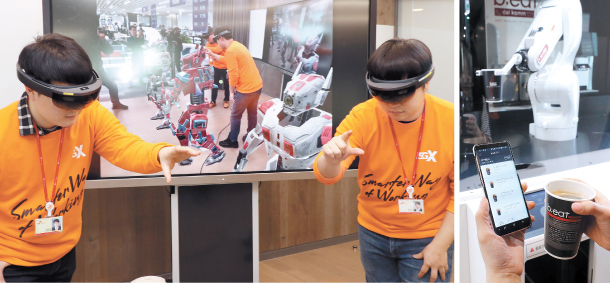
    After donning Microsoft’s HoloLens, this reporter was invited to a telemeeting to discuss the design of a game character.

    Within the virtual meeting, attendees were able to see and walk around a moving 3-D game character while interacting with the avatars of other people in the meeting.

    The experience wasn’t perfect – the field of view was small and constantly looking around was necessary in order to follow everything that was going on, but the potential of the technology to greatly reduce the need for business trips was evident.

    Other technologies already being used in the office included a barista robot and artificial intelligence-based autonomous vending machine, which can track employee purchases with camera sensors.

    Would any of these innovations be possible without 5G network?

    According to SK Telecom, yes. But, while all of these technologies are possible on the existing 4G LTE network, the new high-speed network, touted to be 20 times faster when fully commercialized, offers faster and more stable internet connection even when a million devices are connected at once.

    In essence, 5G ensures that all these systems work seamlessly without their huge data usage interrupting networks or slowing down work.

    “Dependency on landline internet will be reduced and high-capacity data will be delivered fast enough for real-time telemeetings with 5G,” said Shin Seung-ho, a manager from SK Telecom’s media lab under ICT center.

  • Blockchain in the business of fashion

    Blockchain in the business of fashion

    Fashion brands are finally beginning to take note of the rising consumer awareness on traceability and sustainability particularly driven by the millenniums. These evolving consumers are deep diving into knowing the history of the apparels before they buy – the story behind each garment and where and how are they manufactured.

    Moreover, mere claims or information is not enough to be trustworthy unless backed by detailed sequence of data on the complete value chain necessitated in wake of some or other global brand getting exposed of unethical sourcing or not being sustainable.

    This is making fashion companies to attempt towards transforming their business models focused on delivering transparency of data – both in backend and frontend by employing the emerging technologies.

    There has been a global buzz around new technologies like Artificial Intelligence, Augmented Reality, Virtual Reality and Blockchain for some time now and the global Fashion industry has also moved in the last few years to adopt some of these in ways it firmly resisted for a long time. However, blockchain applications haven’t really seen much adoption by fashion organisations.

    So, What is Blockchain?

    According to Digital Trends, blockchain is a database that’s validated by a wider community, rather than a central authority. It’s a collection of records that a crowd oversees and maintains, rather than relying on a single entity, like a bank or government, which most likely hosts data on a particular server.

    Each ‘block’ represents a number of transactional records, and the ‘chain’ component links them all together with a hash function. As records are created, they are confirmed by a distributed network of computers and paired up with the previous entry in the chain, thereby creating a chain of blocks, or a blockchain.

    Blockchain is the technology behind digital currencies like Bitcoin and involve cryptography while in a usability sense they are just shared database or digital ledgers that publicly show a record of transactions having happened. Every time a product changes hands, that information on change in custody is recorded by the user in the ledger and entry becomes linked to every other entry (or Block) and every other copy of the ledger is automatically synchronised via internet. The interconnection among all the blocks forms a chain and the complete application becomes the blockchain. The chain of custody on blockchain provides a record of the last party to gain custody of the product. So, blockchain means decentralised structure that provides security and transparency and thus making data trustworthy.

    In broader sense, blockchain is not just technology, its impact goes beyond the industry or the society for creating a fair, safe and more transparent fashion industry.

    Applicability into Fashion Business

    Blockchain applications are not only for tracking virtual payments and financial transactions but have wider applications in securely distributing other product and supply chain information including complete database at SKU level. In other words, blockchains may be understood as indexes of standardised information or in simple sense, these are community generated data maps by brand and product.

    Most promising application of blockchain in fashion industry could be in supply chain and inventory management. What blockchain technology can enable in the fashion business is uniform real-time access to updated product information supplied by brands, a universal pathway for retailers to immediately report back to suppliers on aspects like stock levels and customer feedback, the final consumer details and many more might come along once something like this new basic building block structure is in play. Distributed nature of blockchain technology makes it superior to other tracking technologies as here the records can’t be altered, destroyed or lost.

    Blockchains have merely begun transforming apparel supply chains through technology such as track-and trace and inventory management. But as other technologies like 3D printing and AI continue to advance, the fashion apparel industry may very well see much more dramatic changes in years to come.

    Greater transparency in fashion supply chains will create new incentives for companies to change the way they do business and even how they view themselves as an organisation. If so, adoption of blockchain is only the beginning as the fashion industry may be entering a new era with vastly different forms of production and consumption.

    Advantages of Blockchain in Fashion

    • Nowadays, one of the major trends in the fashion industry is sustainability and circular economy. Today’s consumers believe in fair trade practices and hence increasingly demanding transparency and want to know where the product is coming from not only in food but also in fashion.
    • Blockchain enables fashion companies to securely communicate to the public the complete product story (DNA) for each and every fashion garment. This includes comprehensive details on all stages of product life cycle starting from design inspiration, raw materials, manufacturing and distribution to the stores and also providing visibility of all stakeholders involved in the value chain to create traceability and transparency in true sense.
    • Blockchain applications allow customers to scan the tag and discover the history of every garment and thus help in improving the customer experience.
    • Global companies like Patagonia and Everlane have been successfully betting on sustainability and supply chain transparency as a distinct selling proposition enabling customers to identify their suppliers.
    • Authenticity of branded products can be verified by both retailers and consumers since branded garments pass through the blockchain steps and hence can be tracked. This could help reducing the counterfeiting and diverting out of authentic products. Every time a fashion item moves from one place to other, its tag or code gets scanned thus recording its location with the time stamp. Consumers would be able to scanthe item and trace its journey from raw material stage to their home and would be able to ascertain if the product is real or a counterfeit. Blockchain applications can help provide protection against the counterfeiting.
    • Blockchain applications also can help fashion companies who license their trademarks or designs in tracking the sales and working out the royalty payments. Similarly, it enables design houses to document design process steps and thus having the organic evidence of ownership on the designs.

    Blockchain helps create peer-to-peer and decentralised network that connects all stakeholders in the value chain (design houses, farmers, raw material suppliers, manufacturers, transporters, distributors, retail outlets, banks, consumers and other parties of the complete supply chain). Using decentralised system, all communication between these parties will be direct and will not pass through a specific central entity. Due to its decentralised nature, the blockchain platform will not have any single point of failure and will not rely on any single entity.

    Through this technology, there could be a possibility wherein everyone from the farmer to the textile mill to the garmenting factory can communicate directly with the brand that buys from them. And, even the consumer can interact directly with the brand/design house for co-creation or customisation of the garments, influencing pricing and even co-investing in the concept.

    Given all the advantages, blockchain clearly seems to be the future for fashion, however, to speed up the application, a single and comprehensive blockchain standard adopted by the fashion industry has to come in fast.

  • India’s Zomato to convert 40 pc of delivery fleet into power-assisted bikes in 2 years

    India’s Zomato to convert 40 pc of delivery fleet into power-assisted bikes in 2 years

    Online restaurant guide and food ordering firm Zomato Monday said it is planning to convert 40 percent of its delivery fleet into power-assisted bikes in two years. Currently, the company has over 5,000 cyclists operating across 12 cities in India, with the majority of the fleet being in Delhi-NCR, Zomato said in a statement. The company provides food delivery services in 150 cities across the country with a last-mile delivery fleet of 1.5 lakh partners, it added.

    “We are working closely with our vendor partners to raise the scale of e-cycle adoption and aim to convert 40 percent of our fleet to power-assisted bikes within the next two years,” Mohit Gupta, CEO – Food Delivery Business, Zomato said.

    The company aims to build a future that creates more tangible value and leaves a lesser carbon footprint, he added.

  • Grab-Uber deal comes under fresh antitrust scrutiny in Vietnam

    Grab-Uber deal comes under fresh antitrust scrutiny in Vietnam

    Vietnamese authorities are set to further investigate the merger between Grab and Uber last year for possible violation of antitrust regulations. The Competition Council said after a thorough examination of documents and arguments furnished by both parties it has discovered a number of new details related to possible violation of competition laws by ride-hailing platform Grab’s acquisition of Uber’s business operations last March.

    It has returned the case dossiers to the Ministry of Industry and Trade’s competition and consumer protection department for further investigation. The investigation is expected to go on until April this year.

    Last year Singapore-based Grab acquired Uber in Southeast Asia in return for a 27.5 percent stake.

    Vietnam’s Competition Law requires any merger or acquisition that results in a company gaining a 30 percent market share to be reported to competition authorities.

    If a company gains a 50 percent market share from the deal, it can only be carried out with express permission from the authorities.

    The department’s preliminary investigation found Grab’s market share had exceeded 50 percent since the acquisition.

    But Grab insists it had acted legally and that the competition authorities have misinterpreted the scope of relevant markets when calculating the market share.

    Last October the Philippines’s competition watchdog fined the two companies a cumulative 16 million pesos ($296,873) saying they had completed the deal too soon and that the quality of service had dipped.

    Singapore’s competition authority fined them a total of S$13 million ($9.5 million) and announced other measures to address competition concerns arising from the merger.

  • Mobile phone ads gain greater purchase during Tet in Vietnam

    Mobile phone ads gain greater purchase during Tet in Vietnam

    Vietnam recorded the fourth highest mobile in-app ad revenues (eCPM) in the Asia-Pacific region during Tet 2018. It ranked behind China, Singapore and the Philippines, according to a report recently released by Vietnamese digital advertising service company Adsota.

    The report also showed that app downloads were the highest 10 days prior to Tet in 2017, while downloads peaked on the first day of the 2018 Tet, showing that the Lunar New Year holiday was a highly effective period to execute user acquisition campaigns for app developers.

    The number of mobile app ad requests (the number of ads displayed in apps) rose by 32 percent in Vietnam during this holiday compared to other days in January and February, said the report.

    Many Vietnamese mobile app developers have gone global and succeeded in the U.S. or Australia by targeting foreign holidays like Black Friday and Christmas. Overall, the highest downloads of Vietnamese-developed apps came from India and the U.S. at 13 and 11 percent respectively, followed by Brazil and Indonesia at 8 percent and 6 percent respectively.

    In terms of revenue, profits from the U.S. market contribute around 20 percent of overseas revenue generated by Vietnamese applications, followed by other developed markets like Australia at five percent; and Germany, Japan and Korea at three percent each.

    Of some 95 million people in Vietnam, 73 percent use mobile phones, 42 percent use smartphones and 50 million people use mobile social media, according to the report.

  • Dapper Dan is holding Gucci accountable for controversial “blackface sweater”

    Dapper Dan is holding Gucci accountable for controversial “blackface sweater”

    Renowned Harlem fashion designer and tailor Dapper Dan’s relationship with Gucci through the years has been a rocky road. After gaining notoriety for knocking off the Italian house’s logo in his designs throughout the ’80s and ’90s, the tables turned in 2017, when Alessandro Michele was taken to task for knocking off one of Dap’s designs in his Cruise 2018 collection.

    However, all’s well that ends well: Both parties made peace and began working together. Not only did Dapper Dan collaborate with Gucci on a vintage hip-hop-inspired capsule collection and lookbook, the Kering-owned luxury label underwrote his brand new studio and atelier in Harlem, also making him the face of a special tailoring campaign.

    As lovely of a story as this is, it might not wind up with a happy ending. Just last week, Gucci apologized for (and pulled from shelves) an $890 sweater that resembled blackface. After several days of impassioned conversation among fans on social media, the brand released a statement, saying: “Gucci deeply apologizes for the offense caused by the wool balaclava jumper … We consider diversity to be a fundamental value to be fully upheld, respected and at the forefront of every decision we make. We are fully committed to increasing diversity throughout our organization and turning this incident into a powerful learning moment for the Gucci team and beyond.”

    While acknowledging the misstep and the need to prioritize diversity is a step in the right direction, the situation did not sit well with Dapper Dan. On Sunday, he posted a statement of his own on Instagram, insinuating that his partnership with Gucci may be on thin ice. “I am a Black man before I am a brand,” he wrote. “Another fashion house has gotten it outrageously wrong. There is no excuse nor apology that can erase this kind of insult. The CEO of Gucci has agreed to come from Italy to Harlem this week to meet with me, along with members of the community and other industry leaders. There cannot be inclusivity without accountability. I will hold everyone accountable.”

    Gucci made a concerted effort to make things right with Dap — and, seemingly, to educate themselves about both his neighborhood and his culture — the last time they were at odds, but this understandably hits very close to home, and could certainly cause major issues within their business partnership.

    Whatever the outcome, this case only underscores the dire need for more inclusion and diversity in the industry, as the frequency with which fashion brands slip up in regards to racism only gets higher by the day. It’s a change that needs to be implemented immediately, and hopefully Gucci will set an example for its industry peers, as it’s already been known to do in other areas.

  • Walmart bets on India despite change in FDI norms

    Walmart bets on India despite change in FDI norms

    American retail giant Walmart and its Indian e-tail major Flipkart are betting big on India despite the revised norms for Foreign Direct Investment (FDI) in e-commerce, the companies said. “Walmart’s and Flipkart’s commitment to India is deep and long term. Despite the recent changes in regulations, we remain optimistic about the country,” the regional Chief Executive Officer of Walmart Asia and Canada Dirk Van den Berghe told IANS in a statement in New Delhi.

    The companies will continue to focus on creating “sustained economic growth and bringing sustainable benefits to India, including employment generation, supporting small businesses and farmers, and growing Indian exports to Walmart’s global markets”, added Berghe, who is also the retail giant’s Executive Vice President.

    Walmart’s assertion on the company’s commitment to India came after American investment bank Morgan Stanley in a report on Monday said the former might exit the country after the new FDI norms in e-commerce came into force on February 1.

    “An exit is likely, not completely out of the question, with the Indian e-commerce market becoming more complicated,” the New York-based financial services firm said in its report titled “Assessing Flipkart Risk to Walmart EPS (earnings per share)”.

    In May last year, Walmart bought 77 percent equity stake in Flipkart for a whopping US$ 16 billion (Rs 1,16,256 crore).

    The revised FDI norms in e-commerce, however, have tightened the noose around the businesses of the country’s leading e-tailers – Walmart-owned Flipkart and Indian arm of American e-commerce giant Amazon.

    The policy revisions, issued by the Ministry of Commerce and Industry on December 26, 2018, barred e-commerce platforms providing a marketplace from exercising control or ownership over the inventory and forbids any company to sell its products exclusively on an e-commerce platforms alone.

    The e-tail companies are now working towards changing the ownership of their inventory, so as to comply with the norms.