Retail News CRM

Tag: wearables

  • Alibaba Takes on Global AI Wearables with Quark Glasses: A New Contender in the Meta-Dominated Market

    Alibaba Takes on Global AI Wearables with Quark Glasses: A New Contender in the Meta-Dominated Market

    On Thursday, Alibaba announced the release of its Quark artificial intelligence (AI) glasses in China, signalling the tech giant’s entry into the AI wearables market that is currently led by Meta.

    The headset, priced starting from 1899 yuan (equivalent to US$268.25), is powered by Alibaba’s Qwen AI model and app. This device, unlike many other headsets, is designed to resemble regular eyeglasses with a black plastic frame. Alibaba shared that these glasses will be fully compatible with its suite of applications, including Alipay and the e-commerce platform, Taobao. Users of the Quark glasses will be able to perform tasks like translating languages on the go and recognizing prices instantly.

    Beijing-based electronics industry expert, Li Chengdong, noted that Alibaba’s core competencies lie in shopping, payments, and navigation. Therefore, the AI glasses are more of a life assistant. This move into AI wearables comes as Alibaba is trying to gain ground in the consumer AI market where it has traditionally faced strong competition. Its pursuits in this space included a significant upgrade to its AI chatbot earlier this month.

    Li explained that Alibaba’s approach to AI glasses is primarily about securing future online traffic in the face of fierce competition in China’s e-commerce industry. He added, “Alibaba’s hopes for AI are tied to cementing its position in the next wave of digital commerce.”

    Available on leading Chinese e-commerce platforms including Tmall, JD, and Douyin, the Quark AI glasses are Alibaba’s latest product in the race for the next generation of AI-powered entertainment and computing devices. This race is currently led by the likes of Meta, which controls approximately 80% of the virtual reality headset industry, Apple with its Vision Pro headset, and Samsung Electronics with its Galaxy XR extended reality headset that utilizes AI technologies from Google.

    Alibaba isn’t alone among Chinese tech companies in exploring AI-powered eyewear. Xiaomi introduced a similar product in June, while Baidu also has an AI eyewear product on the market.

    Questions & Answers

    What is the cost of Alibaba’s Quark AI glasses?
    The glasses are priced starting from 1899 yuan, or approximately US$268.25.

    What are some of the features of the Quark AI glasses?
    The glasses, which look like regular eyewear, are powered by Alibaba’s Qwen AI model and app. Users can perform tasks such as on-the-go translation and instant price recognition directly from the glasses.

    Which other tech companies have released similar AI-powered glasses?
    Other Chinese tech companies, including Xiaomi and Baidu, have also released similar AI-powered glasses.

  • Google is still being unclear on support for the new Wear OS

    Google is still being unclear on support for the new Wear OS

    It became clear how uncertain the future of current smartwatches is with the new Wear OS by Google and Samsung. We initially thought that the wearables we have now are not equipped with the horsepower to support the update.

    In a recent report from Qualcomm, however, we found out that is not the case. The chipset manufacturer confirmed the Snapdragon Wear 3100 and Snapdragon Wear 4100/4100+ have what it takes to run Wear OS 3.0.

    This then begs the question, why so many of the devices out now are not confirmed to receive it? One example is the Fossil Gen 5. The company recently opened up and stated that none of their intelligent timepieces will be getting the upgrade to the next version of Wear OS. Unfortunately, no further reasoning was given after that announcement which only arose further suspicion.

    On the other hand, wearables like the TicWatch Pro 3 have a decent chance to make the transition, as we got a leaked conversation with a representative from their customer support earlier this month. Although, given the source, the information does not carry much weight and leaves us with little reassurance.

    “User experience is a top priority for us. We have not confirmed eligibility or timeline on whether any Wear OS smartwatch will update to the new unified platform. There are many technical requirements in order to run the unified platform that ensures all components of the user experience are optimized.”

    If we translate this message, it seems Google has very politely disagreed with Qualcomm’s statement. The big G is basically saying there is no guarantee current Wear OS devices can comfortably handle it. Despite that, the tone and wording do leave room for possibility and dare I say… hope.

    Nevertheless, it seems Googe is being very tight with their plans and details on the topic. Your best course of action would probably be to wait a little while for the air to clear up if you are in the market for a new wrist buddy.

  • Apple Watch picks up another update today

    Apple Watch picks up another update today

    Today is a happy day for Apple fans, as the Cupertino-based company is rolling out new software updates for three of its popular products: iPhone, iPad, and Apple Watch. If you’re rocking one of the first two, you should be able to download iOS 14.2 today.

    On the other hand, Apple Watch owners can download watchOS 7.1, a rather important update that brings some interesting new features for select users. The first one is the ability to be notified when your headphone level could impact your hearing.

    Then, we have a fix for an issue that prevented some users from unlocking Mac with Apple Watch. Another fix included in the update should address an issue where the screen may be dark on wrist raise for some people using the Apple Watch Series 6.

    The next two new features are specifically aimed at Apple Watch users in two countries: Korea and Russia. Those users living in one of the two countries will finally get support for the ECG app on Apple Watch Series 4 or later, as well as support for irregular heart rhythm notifications.

    Make sure that you check your Apple Watch app via your iPhone to see whether or not the new watchOS 7.1 update is available for download. You should find it by heading to General / Software Update.

  • Monitoring and Controlling Temperature using Wearables

    Monitoring and Controlling Temperature using Wearables

    Regulating body temperature is a problem that humankind has been contending with for millennia. Our physiology adapted to cope with quite a small part of the world, where the climate is a certain way. Once we spread out across the globe, we had to cope with the entire range of weather systems – from hot and humid jungles to icy tundra.

    Of course, when it’s too cold, the technological solution is simple: just wrap up warm. But what happens when it’s too hot? That’s the problem which a new wave of wearable devices aim to solve.

    Perhaps the most eye-catching of these is the Reon Pocket from Sony – a small piece of plastic, chargeable via USB-C, which is built to sit against your skin, and to cool you down via the Peltier effect. Released exclusively in Japan, where the humidity during summer is a problem in some regions, it functions, basically, like a small cold device which sits against the skin, which, while welcome, is a little more local as a cooling effect than some of the marketing material might suggest.

    What’s the Peltier Effect?

    The Peltier Effect is one of three thermoelectric effects, produced by thermocouples of the sort you might find on the RS Components webstore. It allows the creation of solid-state heat pumps. If we take two junctions, and apply a voltage across them to create a current, heat will be removed from one and be deposited at the other. Note that this only works in the case of DC circuits; otherwise you’d have heat being moved rapidly from one junction to the other without any useful effect.

    The traditional means of air conditioning involves pipes of coolant, motors and compressors. Heat is absorbed at one end of a loop and dispersed at the other. This is the function of those big air-conditioning units you might see sprouting from the tops of office buildings. Obviously, this method wouldn’t be practicable in a wearable device. But it’s only very recently that Peltier-based circuitry has gotten small enough that it can be fitted into a wearable device.

    On the other hand, we also have devices powered by another thermoelectric effect – the Seebeck effect – which actually allows for smartwatches which don’t ever need to be charged. Wearable devices like the Matrix Powerwatch can be powered by body heat alone, meaning that you never have to worry about charging them ever again.

    What about the Environment?

    Naturally, a world where we’re all walking around with air-conditioned jackets is sure to impose a cost on the environment, in much the same way that air-conditioned buildings has done. If the Seebeck effect is properly leveraged, however, then the effect might run in the opposite direction – we’ll have wearable devices that never need to be charged again!

  • HTC U Ear true wireless earbuds seen on FCC’s website

    HTC U Ear true wireless earbuds seen on FCC’s website

    HTC is gearing up to join the insanely competitive wireless earbuds market. The company’s debut wireless hearables, the HTC U Ear have been spotted on FCC, implying that they could be here anytime.

    In addition to revealing the name of the wireless earphones, the listing also contains images that give us a good look at them. Design-wise, they bear a lot of resemblance to the Apple AirPods. They have a glossy black finish and come in a cube-shaped box. Although the USB-C charging port can be seen in the images, we don’t know if wireless charging will also be supported. It also looks like they will ship with a USB A-to-C cable.
    The true wireless headsets market is currently dominated by Apple. However, just cloning AirPods wouldn’t necessarily work for HTC. Back in 2010, HTC acquired a major stake in Beats Electronics to help with smartphone sales. However, nothing much came out of the deal, and by 2013, the company had sold back its stake.
    Later on, Apple bought Beats, and the acquisition totally paid off. In fact, it’s believed that the takeover helped Apple gain an insight into the Bluetooth headphones market trends, which ultimately resulted in the birth of the AirPods and the jack-less iPhone.
    The success of AirPods has led rivals to create similar products of their own. Google, Amazon, and Microsoft have all jumped the bandwagon, and OnePlus is also expected to follow suit.
    Microsoft, Apple, and Google also use their software to their advantage. For instance, the Surface Earbuds offer Office 365 integration, and the Pixel Buds 2 provide hands-free activation of Google Assistant and live language translation. Amazon’s Echo buds feature always-on Alexa and are priced aggressively.
    Thus, unless the HTC U Earbuds offer something that makes them stand out and are priced competitively, they will be just another pair of wireless earbuds.
  • Fitbit debuts fitness and health Premium subscription service

    Fitbit debuts fitness and health Premium subscription service

    Alongside the Versa 2 smartwatch, Fitbit announced a subscription-based fitness and health service that it calls Fitbit Premium. The service uses unique data from each subscriber to deliver a personalized experience “with actionable guidance and coaching.”

    The premium service is meant to help users achieve their health and fitness goals and costs $9.99 per month. At launch, Fitbit Premium includes nine guided health and fitness programs, which will help subscribers get more sleep, wake up energized, increase their activity, manage nutrition and create lasting healthy habits.

    Among the programs that subscribers will be able to use, Fitbit mentions actionable coaching, daily tips and tricks, structured workout plans, relaxation tools, recipe suggestions, and educational content.

    But that’s not all, as Fitbit promises to launch additional activity, sleep, and nutrition programs by the end of the year. Also, to help those with a condition such as diabetes or weight loss, Fitbit says it will launch a personal, one-to-one coaching service in 2020, with a limited pilot targeted to roll out later this year.

    Fitbit Premium will start rolling out in September at $9.99 per month or $79.99 per year. However, promotional pricing and product bundle offers might be available before and after the premium services releases.

  • Connected wearable shipments to hit 239m in 2023

    Connected wearable shipments to hit 239m in 2023

    Global shipments of connected wearables are forecast to grow from 116.8 million units in 2018 to reach 238.5 million units in 2023, representing a CAGR of 15.4%, according to research firm Berg Insights.

    Bluetooth will remain the primary connectivity option in the coming years.

    A total of 67.7 million of the wearables sold in 2023 are forecast to incorporate embedded cellular connectivity, mainly in the smartwatch and telecare and medical device categories.

    The connected fitness & activity tracker segment is led by China’s Xiaomi, which has been successful with its Mi Band fitness tracker. Fitbit, a pioneer in the segment, is still also among the largest vendors in the segment along with Huawei and Garmin.

    In 2018, shipments of connected fitness & activity tracker reached 65 million units.

    This product category is now facing fierce competition from smartwatches that in most cases include activity tracking features. Apple entered the connected wearables market in the second quarter of 2015 and quickly became the leading smartwatch vendor.

    In 2018, Apple accounted for almost half of the total 45.5 million smartwatches sold during the year.

    “Apple continues to hold a firm grip on the smartwatch market and is at the forefront of innovation in the industry,” says Martin Bäckman, IoT Analyst at Berg Insight. The competition has responded with increasingly capable and attractive devices from Wear OS vendors including Fossil, LG, and Huawei as well as from vendors betting on other platforms such as Fitbit and Samsung.

    The smartwatch segment is expected to surpass fitness & activity trackers and become the largest device category within wearable technology in terms of shipments in 2021.

    “Technology advancements, increased consumer awareness and wide availability of devices in different price segments will enable smartwatches to reach shipments of 117.7 million units in 2023,” concludes Bäckman.

    Sales of smart glasses and head-mounted displays have so far been modest, but promising use cases in professional markets as well as in niche consumer markets will enable it to become a sizeable connected wearable device category in the next five years.

    A number of vendors including Daqri, ODG, Epson, Google, Microsoft, Kopin and Vuzix are active in the segment. Standalone VR headsets from companies such as Oculus and HTC aimed for the consumer market are gaining traction and accounted for a large share of the total 1.5 million devices shipped in the segment during 2018.

    Berg Insight forecasts that shipments of smart glasses and head-mounted displays will reach 11.9 million units by 2023.

    Annual shipments of medical devices and mobile telecare/mPERS devices are forecast to grow from 1.8 million devices in 2018 to 6.9 million devices in 2023. The segment includes wearables such as cardiac rhythm management devices, ECG monitors and mobile telecare devices.

    Finally, annual shipments of wearables not covered by the above product categories such as authentication and gestures devices, smart rings, wrist-worn computers and scanners, smart jewelry and connected prosthetics are predicted to grow from 3.0 million units in 2018 to reach 13.0 million units in 2023.

  • Google adds Tiles to Wear OS To Show Useful Information

    Google adds Tiles to Wear OS To Show Useful Information

    From a totally redesigned UI and battery life improvements to faster Google Pay and bug fixes, no matter how big or small the update there’s no denying Wear OS by Google, as it’s now called, has come a long way since it was first introduced back in 2014 under the Android Wear branding.

    Today, to help improve the overall experience even more, the Silicon Valley-based giant has announced another pretty big update to its wearable-focused OS.

    Around eight months ago, as some of you may remember, a new Wear OS design was introduced that provided users with swipeable access to a variety of things. A swipe from the bottom of the screen showed recent notifications and Quick reply suggestions, while a swipe down displayed a variety of Quick Toggles. Similarly, a swipe over to the left side of the panel brought up the Google Assistant and over on the right sat Google Fit.

    The response to this new design since its launch last summer appears to have been largely positive, and now Google is building upon it with a cool new feature that it’s calling Tiles.

    As the name suggests, Wear OS by Google will soon integrate a number of tile-like cards into its UI that users can easily swipe through to see various bits of information that may interest them. Tiles are accessible by simply swiping to the left and, if users aren’t happy with the default order, they can be rearranged freely by long-pressing them and dragging each one individually until they are in the desired order. Alternatively, smartwatch owners can switch them around inside the Wear OS by Google app on their smartphone.

    According to Google, the initial rollout will include a total of six individual tiles. The first, called Goals, works just like the current Google Fit screen, allowing users to view their daily workout goals and start a physical activity with a simple tap.

    Another fitness-focused feature comes in the shape of the Heart rate Tile which, as expected, shows users their current heart rate. However, in order to use this one, consumers need a smartwatch with a built-in heart rate monitor. Alternatively, Bluetooth heart rate sensors such as straps can also be used.

    Joining Heart rate will be Next event and Forecast. The former does exactly what it says on the tin by displaying the next event in the calendar, while the latter allows users to prepare for the day by providing the local weather forecast.

    Completing the lineup of Tiles is Headlines which will constantly display the latest news headlines from a variety of different sources throughout the day. Also arriving as part of the update is the Timer tile which, as its name suggests, allows users to quickly set timers on their respective smartwatches.

    The new Tiles feature will begin rolling out to Wear OS watches across the globe over the course of the next month. An exact start date for this is yet to be confirmed, but Google does plan on showing the feature off at Google I/O next week where it’s also expected to announce the Google Pixel 3a and Pixel 3a XL, which will act as the company’s first mid-range smartphones.

    Regarding the future of Tiles, Google has confirmed that, over time,it’ll expand upon the current list of six by introducing new ones that center around different features. Eventually, users should have a Tile for every need.

  • Mi Band 4 about to Arrive

    Mi Band 4 about to Arrive

    Back in March, we told you that the Xiaomi Mi Band 3 fitness tracker is selling so briskly, Xiaomi was in no rush to release the sequel. One reason for the heavy demand is the wearable’s low price. Sold for $30 on Amazon, the device measures a user’s heart rate, counts the number of steps he or she has taken, monitors sleep quality and much more.

    But even the Mi Band 3 must step aside for a newer version with even more features. And today, spotted by DroidShout,  one of the two Mi Band 4 variants received certification by Taiwan’s National Communications Commission (NCC).

    The Mi Band 4 that was certified is model number XMSH07HM; this is the unit without NFC support. Another version with the model number XMSH08HM will come with NFC support, most likely so it can be used with the Xiaomi Pay mobile payment service. That model will be sold in China only. Both units received certification in March from the Bluetooth Special Interest Group, revealing that the Mi Band 4 will be equipped with Bluetooth 5.0 LE (Low Energy). The current model uses Bluetooth 4.2 LE.

    The NCC certification included several pictures of the Mi Band 4’s main module. There has been speculation that the Mi Band 4 will come with an electrocardiogram (ECG) scanner, similar to the one on the Apple Watch series 4. This is used to detect conditions like Atrial Fibrillation (AFib), an abnormal heart rhythm that can lead to strokes, blood clots, and death.

    Now that the Mi Band 4 is beginning to get the thumbs up from various organizations, its unveiling and eventual release surely can’t be too far away.

  • Fitbit partners with Snapchat to make Apple Watch owners jealous

    Fitbit partners with Snapchat to make Apple Watch owners jealous

    Fitbit may have joined the “true” smartwatch game a bit late compared to Samsung or Apple, but after a somewhat slow start in this potential-brimming market, the Versa seems to have put the company on the right track. The world’s second-largest smartwatch vendor took quite a risk by developing its wearable software from scratch rather than adopting Google’s Wear OS, but this proprietary platform continues to grow at a healthy pace in terms of capabilities and ease of use.

    Of course, everyone needs high-profile partners to boost the appeal and trendiness of today’s wearable devices, and Fitbit’s newest ally in its fight against Apple and Samsung is as high-profile as they come. We’re talking about Snap, the company behind one of the world’s most popular social networks.

    Snapchat users who just so happen to own a Fitbit Versa, Versa Lite, or Ionic as well can now connect their Bitmoji account to their smartwatch to display their “personal emoji” on their wrist. For those unfamiliar with the Bitmoji app, we should probably mention the experience is very similar to what Apple offers with Memoji and Animoji on iPhones and Samsung’s own AR Emoji experiments for recent high-end Galaxy handsets.

    Obviously, the main difference is you can have fun with Bitmoji on both Android and iOS, as well as on Fitbit devices starting today. Your cartoon avatar will show up on the “first-ever” Bitmoji clock face (once you download it from the Fitbit App Gallery, that is), aiming to motivate you to be more active, help you create healthier habits, and celebrate personal achievements.

    While unlikely to be as expressive as its smartphone counterpart, your wrist Bitmoji promises to support more than 50 fun clock face variations, changing throughout your day to reflect your activity and progress towards your fitness goals. For instance, your personal emoji will wave hello to start your day, dance with your alarm clock to annoy help you wake up in a better mood, throw confetti after you hit your daily step objective, meditate when you’re totally relaxed and zen, carry an umbrella if there’s a chance of rain, and much more.

    That definitely sounds like something Apple Watch and Samsung Galaxy Watch owners could also appreciate, but for the time being, all we can do is wait and see if there are any Memoji or AR Emoji expansions planned for the near future.

  • Xiaomi Mi Band 4 could include major Apple Watch features

    Xiaomi Mi Band 4 could include major Apple Watch features

    A few days ago, we told you that Xiaomi will release the Mi Band 4 fitness tracker sometime this year. An executive from Huami, the company that is the source of Xiaomi’s wearables, said that the Mi Band 3 is still selling in big numbers and that there is no reason for Xiaomi to launch the next generation model at this point. We should point out that the Mi Band traditionally has sold well because of its low price. For example, the Mi Band 3 is offered by Amazon in the U.S. for $33.53.

    While Xiaomi has been tight lipped about any new features we might find on the Mi Band 4, we do have some specs to pass along. We spotted a certification from the Bluetooth SIG (Special Interest Group) revealing that the next generation of the fitness band will sport Bluetooth 5.0 LE (Low Energy). That is an upgrade from the current model’s use of Bluetooth 4.2 LE and indicates that the Mi Band 4 will offer improved connectivity. In addition, the Bluetooth Launch Studio web site indicates that the Mi Band 4 will feature NFC connectivity as well, at least in some markets.

    Two different variants of the device were listed on the site and the one with the model number of XMSH08HM will include NFC; the other, listed as XMSH07HM, will not. The model with NFC could include support for the company’s Xiaomi Pay mobile payment service.

    The Mi Band 4 could include an electrocardiogram sensor to watch for abnormal heart rhythms

    There is also speculation that like the Apple Watch series 4 smartwatch, the Xiaomi Mi Band 4 will come with an electrocardiogram (ECG) monitor that will detect abnormal heart rhythms. This is mainly used to alert users to the possibility that they are suffering from atrial fibrillation (AFib), which can lead to strokes, blood clots, heart disease and death. Including an ECG monitor with a low priced fitness ban could make the Mi Band 4 even more popular than its hot selling predecessor, especially if the feature is as accurate as the one on Apple’s timepiece. There is also speculation that the Mi 4 will be equipped with better activity tracking features and a larger, color display.

    The Xiaomi Mi Band 3 has been such a hit that globally it has challenged the Apple Watch for the top spot among wearable devices based on shipments. As long as Xiaomi adds new features to its next-gen fitness band without substantially hiking the price, we can expect the Mi Band 4 to be just as popular as the current iteration of the product. Speaking of which, the Mi Band 3 comes with an OLED touchscreen and is waterproof to a depth of 164 feet. It will monitor physical activities, count your steps, watch your heart rate, track your sleep, display SMS messages and those from certain apps (like WhatsApp), and allow you to accept or reject incoming calls. The battery will run as long as 20 days with the heart rate monitor off, and 3 to 9 days with the monitor on. We would expect to see all of these features, some of them improved, carry over to the Mi Band 4.

    Xiaomi launched the first Mi Band in July 2014, and followed it up with the sequel two years later. The Mi Band 3 was released last May, which means that we could be only a couple of months away from seeing the Mi 4 hit the marketplace.

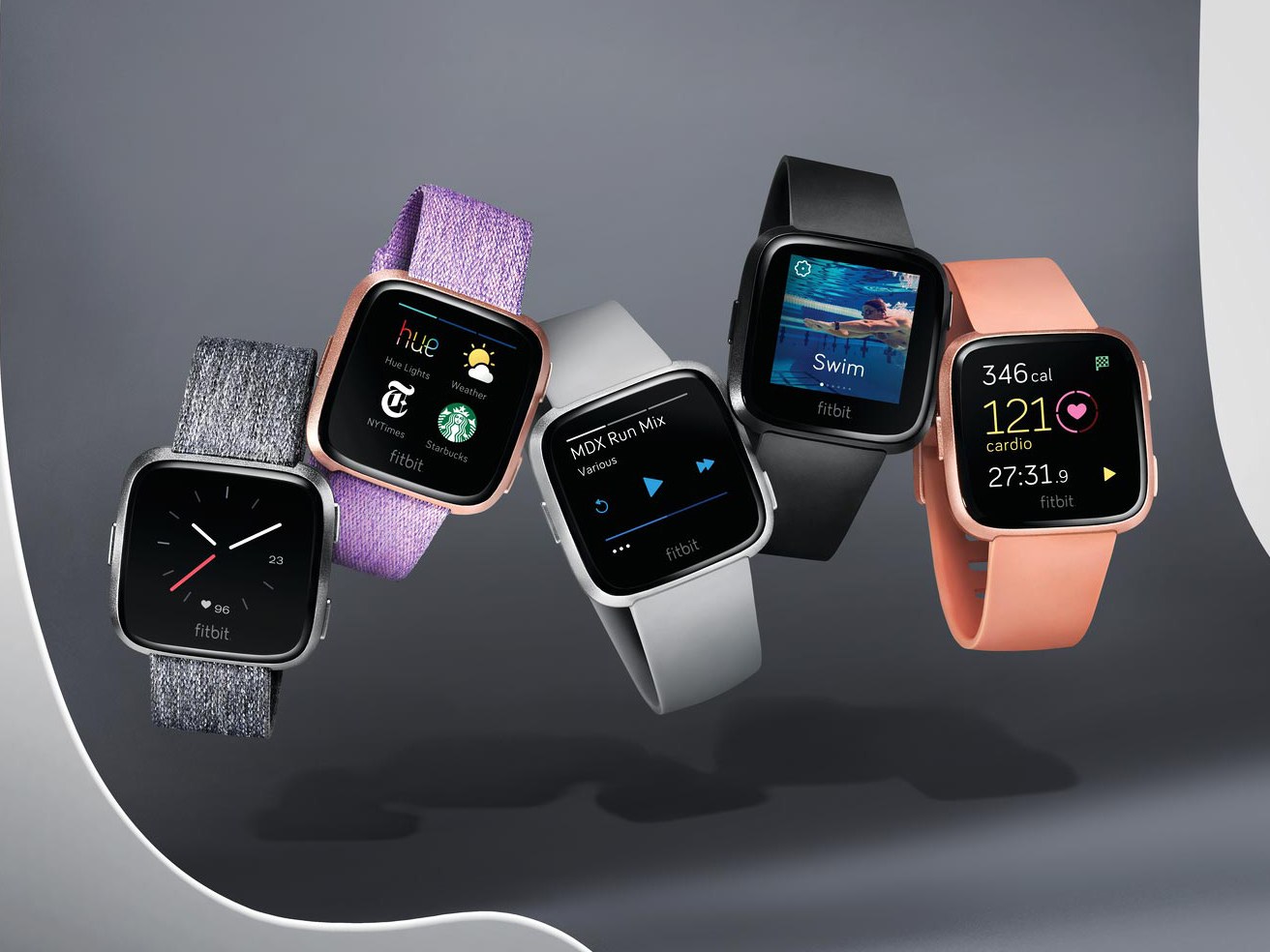
  • Fitbit Versa Special Edition with NFC support flies high

    Fitbit Versa Special Edition with NFC support flies high

    While it’s certainly not unusual to see older gadgets discounted shortly after new models are released, the recently unveiled Fitbit Versa Lite Edition is not actually an upgraded version of last year’s regular Versa. As such, deals on the original model weren’t exactly guaranteed, especially given Fitbit’s newfound success in a fast-growing global wearables market, owed in part to this specific low-cost Apple Watch rival.

    All things considered therefore, it’s definitely a nice surprise to be able to buy a Special Edition of 2018’s Fitbit Versa at a markdown of around 25 percent on Amazon right now. That translates into pretty hefty savings of 60 bucks (give or take a couple) for what was already one of the most affordable feature-packed smartwatches available in the US.

    In case you’re wondering what makes this device “special”, it’s the addition of an NFC chip compared to a standard Versa edition, which enables wrist payment support. We’re not talking about Google Pay, mind you, but rather’s Fitbit proprietary service, fittingly dubbed Fitbit Pay and compatible with credit and debit cards issued by more than 100 US banks

    You can get the marked-down Versa SE with a “Charcoal Woven” or “Lavender Woven” strap, both of which look… pretty unusual for a fitness-first wearable device. Otherwise, there’s no disputing the appeal of an inexpensive smartwatch with a decent touchscreen in tow, as well as stellar 4+ day battery life, a swim-proof design, built-in optical heart rate monitor, accelerometer, gyroscope, altimeter, and plenty of other tricks up its sleeve guaranteeing a top-notch activity and sleep tracking experience.

  • Wearable tech moves closer with graphene ‘solving’ the battery problem

    Wearable tech moves closer with graphene ‘solving’ the battery problem

    Wearable technology becomes more useable with a new development using graphene for printed electronic devices. The University of Manchester has demonstrated flexible battery-like devices printed directly on to textiles using a simple screen-printing technique answering the major problem of wearable tech being limited due to the problem of powering devices without cumbersome battery packs.

    Devices known as supercapacitors are one way to achieve this. A supercapacitor acts similarly to a battery but allows for rapid charging which can fully charge devices in seconds.

    Now a solid-state flexible supercapacitor device has been demonstrated by using conductive graphene-oxide ink to print onto cotton fabric.

    As reported in the journal 2-D Materials, the printed electrodes exhibited excellent mechanical stability due to the strong interaction between the ink and textile substrate.

    Further development of graphene-oxide printed supercapacitors could turn the vast potential of wearable tech into the norm.

    High-performance sportswear that monitors performance, embedded health-monitoring devices, lightweight military gear, new classes of mobile communication devices and even wearable computers are just some of the applications that could become available following further research and development.

    To power these new wearable devices, the energy storage system must have reasonable mechanical flexibility in addition to high energy and power density, good operational safety, long cycling life and be low cost.

    Dr Nazmul Karim, knowledge exchange fellow at the National Graphene Institute and co-author of the paper said: “The development of graphene-based flexible textile supercapacitor using a simple and scalable printing technique is a significant step towards realising multifunctional next generation wearable e-textiles.

    It will open up possibilities of making an environmental friendly and cost-effective smart e-textile that can store energy and monitor human activity and physiological condition at the same time.”

    Graphene-oxide is a form of graphene which can be produced relatively cheaply in an ink-like solution. This solution can be applied to textiles to create supercapacitors which become part of the fabric itself.

  • Wearables market shifting focus away from health

    Wearables market shifting focus away from health

    Global shipment for wearables reached an all-time high of 33.9 million units in the fourth quarter of 2016, up 16.9 % from the same quarter a year earlier.

    Total shipments for the entire year reached 102.4 million devices, growing 25% compared to 2015.

    IDC’s Worldwide Quarterly Wearable Device Tracker, which published the figures, noted that the market is huge but the utility and necessity of the devices have been questionable. With the market just a toss between the basic wearables and the smart wearables (or those capable of running third party applications), health and fitness remain a major focus for the major brands.

    Ramon Llamas, research manager for IDC’s Wearables team, however, noted that once these devices become connected to a cellular network, the market can expect unique applications and communications capabilities to become available. “This will also solve another key issue: freeing the device from the smartphone, creating a standalone experience,” he said.

    During the quarter, Fitbit maintained its dominance, holding the top position for both the quarter and the year. However, the company also faced one of its largest declines ever as it remained heavily focused on the US, a market that is quickly approaching saturation for fitness trackers. Though the company has grown in other parts of the world, IDC said it remained challenged as low-cost competitors eat away at Fitbit’s market share.

    China’s Xiaomi has continued to relentless pursue growth and the company has stuck with a low-cost strategy and has slowly tried to veer upstream in terms of pricing by introducing new devices with heart rate monitoring and a mildly higher selling price. However, IDC believes it still lacks the expertise and brand recognition to expand beyond its native borders in China.

    Apple Watch Series 1 and Series 2 proved to be a magnificent success for the company as it was the company’s best quarter ever in the wearables market. IDC said Apple is one of the few companies that has been able to quickly refocus its watch to gain traction in the consumer market and is now introducing the smartwatch category to the commercial segment.

    Garmin, which caters to a more dedicated fitness audience, experienced a slight decline of 4% in the fourth quarter. However, many of its users began to graduate from simpler fitness trackers to more sophisticated and expensive sport watches like those offered in the Fenix line. The new Fenix 5 announced at CES 2017 also shows promise as the new smaller size will help the device appeal to a broader audience.

    Samsung rounded out the top 5 with the launch of two new models (Gear S3 Classic and Frontier) and remains the only major company offering cellular-enabled wearables. LTE connectivity has been a key differentiator for Samsung’s watches as it has helped decouple them from smartphones, but more importantly it has opened up a new channel (telcos) to help promote the Samsung watches.

    Beyond the top 5 vendors are new entrants, including fashion icons like Fossil along with their sub-brands and emerging companies like BBK and Li-Ning, that are tapping into niche segments of the wearables market. Fossil’s wearable product is a luxury/fashion device, while BBK focuses on child-monitoring devices, and Li-Ning on step-counting shoes.

    “With the entrance of multiple new vendors with strengths in different industries, the wearables market is expected to maintain a positive outlook, though much of this growth is coming from vendor push rather than consumer demand,” said Jitesh Ubrani senior research analyst for IDC Mobile Device Trackers.

  • Apple’s In-Store Story, Android Pay Goes Wearable And Samsung Open For Business In Thailand

    Apple’s In-Store Story, Android Pay Goes Wearable And Samsung Open For Business In Thailand

    Samsung’s global march added another stopping point this week, as Thailand became the latest nation to come online for Samsung Pay. That announcement comes as most of the global payments-watching community was watching Samsung Pay’s imminent foray into India.

    Speaking of watching — and watches

    After four months of waiting, Android Pay has finally made the leap onto an Android Wear-powered smartwatch — thanks to a bit of as assist from LG. It’s not Android Pay’s first foray onto a wearable, but it is the first time Android Pay will be open for business on a smartwatch not made by Samsung.

    Apple’s move this week is about merchants. New research suggests that Apple Pay has gone from being accepted at 16 percent of U.S. merchants to 36 percent of U.S. merchants — which said report notes is good enough to make it the most favored form of in-store mobile payment among American merchants.

    So how’d all the territory grabbing come out this week – and who gained the most ground? Well…

    Samsung Pay In Thailand

    Samsung Pay is not entirely new to Thailand — the service has been rolling out slowly under the radar since a November soft launch with about 100 retail partners — but as of Tuesday, Samsung Pay was out in full for any Thai customer interested in taking it for a smartphone spin.

    And, it should be noted, Samsung has great expectations for the Thai market and has set a goal of attracting 1 million users to the platform by the end of the year.

    “Thailand is the ninth country in 10 markets globally with which we have established our mobile payment presence, and the third country in Asia-Pacific apart from Singapore and Australia,” said Elle Kim, vice-president for the payment business group at Samsung Electronics.

    Kim noted that Thailand presents a natural opportunity for a mobile payments platform — given the government’s national e-payment scheme and the widespread use of smartphones and e-commerce.

    At launch, to use the service, customers must use a Visa or Mastercard issued by one of the nation’s six largest banks: Bangkok Bank, KTC Credit Card, Citibank, Siam Commercial Bank, Kasikornbank and Krungsri Consumer.

    Those six collectively cover about 70 percent of the cards issued in Thailand — Samsung has confirmed that by the end of the year it hopes to have upped that to covering 90 percent of the nation’s card holders.

    And it is a 90 percent that Samsung will compete for unopposed, since neither Apple nor Android Pay have any immediate plans to take on the Thai market. As of right now, mobile payment transaction value in Thailand is estimated to reach US$4 million in 2017. That figure is forecast to reach $36 million by 2021.

    Samsung is also widely expected to announce an expansion into India for Samsung Pay by the end of the quarter — with more international expansion slated for 2017.

    Android Pay And Android Wear – Better Together?

    After a very public announcement of Wear 2.0 last October that included Android Pay — the updated and enhanced version of Android OS for wearables — the world sort of had to wait a while to see it in action, since there was no wearable on the market sporting the feature.

    That changed this week with a pair of new watches from LG that marked a collaborative design effort with Google: the Watch Sport and the Watch Style.

    The big change involves making the watch a device capable of standing apart from a smartphone — a true computer for the wrist.

    And while that extends to many of the Wear’s various features, it is drawing praise particularly in relationship to the Android Pay support now available on the wearable.

    Unique to this version of wearable-based payment, however, is its level of independence. Android Pay runs as a standalone app on the watch — a connected smartphone is not necessary to pay for stuff (though a phone pairing is necessary to set up Android Pay on the watch for the first time). Android Pay on a watch does not actually even need an internet connection for a limited number of transactions (though to fully complete the transaction the watch must eventually go online).

    Android Pay is not entirely new to wristbased devices — Samsung’s smartwatches support it — but as of this week, Android Pay supported by Android’s wearable OS is now on the market for the first time — though not the last.

    Google has announced that many more Wear 2.0 watches will be out in the market by the end of the year — presumably to satisfy a consumer demand that will make itself apparent any day now.

    Apple’s Adding Merchants

    According to new published data from Boston Retail Partners, Apple Pay has garnered the largest percentage of U.S. merchants supporting mobile in-store payments, with 36 percent of said merchants accepting the 2.5 year old mobile payments app. The study further suggested that an additional 22 percent of retailers will accept Apple Pay in the next 12 months and 11 percent on top of that plan to do so within the next one to three years.

    Apple’s lead is notable — but also highly explainable by time. Apple Pay is the granddaddy of in-store mobile payments apps, so it’s had more time to add merchants to its roster. But as we’ve noted, being present at the POS is only half the battle for Apple Pay — consumers still have to chose to use it. So far, by our numbers here at PYMNTS, they aren’t — at least 19 out of every 20 who can.

    Which, as it turns out, maybe the lesson this week. More is good — more devices, more ground and more merchants — but only if at the end those things net more customers — and more transactions.

    We’ll keep you posted on how more turns into market share for transactions. By the way, we’ll be releasing totally new data on mobile payments adoption – based on what consumers actually do at the point of sale when they are paying for what they bought – at Innovation Project 2017. This new study will measure adoption for the major in-store “Pays” – Apple, Android, Samsung, and Walmart (at Walmart only, of course).