Retail News CRM

Tag: zalora

  • Be Inspired by Zalora to showcase trends

    Be Inspired by Zalora to showcase trends

    Online fashion destination Zalora has launched Be Inspired, a curated page that consolidates fashion trends across various themes.

    Shoppers can readily obtain items on Zalora to help them achieve specific looks.

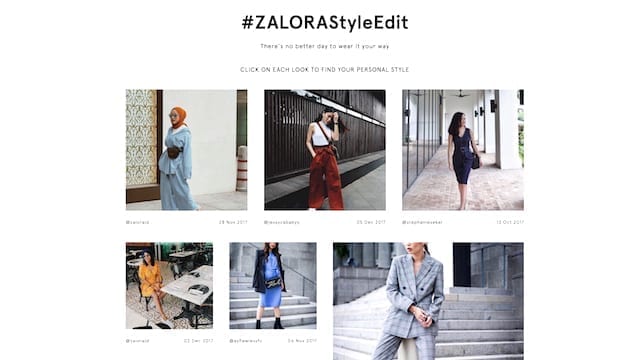
    Recognising the role of social media in influencing fashion choices, Zalora is also launching #ZaloraStyleEdit, a page for user-generated images from Instagram. By using the hashtag in their posts, shoppers can upload photos of their outfits.

    All the items featured can be bought on the spot as they are linked to either the exact Zalora product or a similar one sold on its site.

    The Be Inspired tab offers a curated experience with a navigation menu that highlights 16 evergreen and seasonal trends, as well as occasions and international fashion inspiration.

  • Zalora Group to focus on Its in-house labels

    Zalora Group to focus on Its in-house labels

    Singapore-based Zalora Group is featuring its own in-house labels Something Borrowed and Zalora in its upcoming Chinese New Year collection.

    Both labels will have capsule collections offering themes and styles that can be mixed, matched and worn beyond the lunar festivities.

    With a Scarlet Garden theme, Zalora the label will have 105 SKUs featuring practical and sophisticated silhouettes in multiple colours such as deep red, jungle green, soft pink and gold. Jacquard fusion metallic and satin jacquard pieces will debut in its collection to put a contemporary spin on traditional elements.

    For street-inspired styles, Something Borrowed will offer a spring-themed collection with 89 new SKUs that mix youth culture with Chinese New Year colours. The floral biker jacket is a key statement piece, and the floral print is worked into the other stories of the collection. As an update to previous collections, Something Borrowed will feature a full range of embroidered and precious denims.

    Founded in 2012 as part of Global Fashion Group, Zalora has a presence in Brunei, Hong Kong, Indonesia, Malaysia, Singapore, Taiwan and the Philippines. It offers international and local brands and products across apparel, shoes, accessories and beauty categories for men and women.

  • More online super sales for Asia online market

    More online super sales for Asia online market

    While the US formulated online super sales, such as this week’s Black Friday, Asia has adopted the concept with a vengeance.

    In fact, China has increasingly been exporting Alibaba’s Singles Day (11.11) event, which this month racked up a massive US$35 billion in sales. November is the favoured month for this new consumer mania, offering the Singles Day, Black Friday and Cyber Monday sales.

    Both Black Friday and Cyber Monday themselves have been catching on in the Asia Pacific, growing by 29 per cent last year, according to global payments company WorldPay.

    It says that despite forking out $17.8 billion on Singles Day last year, Chinese consumers still went hunting Black Friday bargains, with overall spending on the day up by 37 per cent from the previous year. In Hong Kong, the rate of growth was 32 per cent, and in Singapore 21 per cent.

    While retailers are among the biggest Black Friday winners, new WorldPay data suggests this year could also be a great opportunity for savvy APAC businesses in the travel and digital sectors. In Hong Kong, spending with travel and airlines saw a 30 per cent surge last year, with Singapore figures up 20 per cent as travellers jumped online to search for flight and hotel deals.

    Not just retailers

    Shoppers are also increasingly seeking out bargains for digital content such as subscriptions, e-books and on-demand box sets. Black Friday spending in this sector last year grew 62 per cent in Hong Kong and 14 per cent in Singapore.

    Not just retailers can benefit from Black Friday, but also a range of e-commerce businesses, says WorldPay Asia Pacific GM Phil Pomford.

    “While Black Friday and Cyber Monday have typically been the realm of retailers, a more diverse range of businesses are now recognising they can also take can take advantage of this special online opportunity.

    Shoppers during this time are highly engaged, proactive and looking for a wide range of online deals, so the potential to reach new customers and strengthen brand loyalty is huge, regardless of sector.

    “E-commerce businesses should set themselves up for success by ensuring their websites are prepared for heavy traffic, and offer simple payment options to drive shopping-cart conversions. They might also consider following the example of Amazon and kickstart Black Friday deals a week early.”

    Black Friday online sales surpassed $3 billion last year and are expected to rise this week, says Adobe Digital Insights, as buyers seek to avoid long queues and lost hours in retail stores.

    In Southeast Asia, Google searches for “Black Friday” have surged over the past five years, and 12 months ago major offline/online retailers like Robinsons, Sephora and Zalora offered generous discounts for the event.

    “Many industries rely on this event to make up a large portion of their fourth-quarter sales, in particular toys and games,” says Euromonitor International senior toys and games analyst Matthew Hudak.

    ‘Sure to jump on’

    Digital campaign company RTB House says Black Friday last year attracted 106 per cent more people to online stores, with 204 per cent more transactions.

    “We anticipate conversion rates surging this time,” says RTB House Southeast Asia country director Chandra Kuncara. “Customers who missed out on Singles Day will be sure to jump on this event.”

    He says personalised retargeting is an important selling tool during Black Friday. With AI technology and deep-learning algorithms, marketers can highlight most-desired products for each individual customer.

    More purchases mean more packages being shipped, and international courier service FedEx is again expecting to handle a record number of packages over the peak holiday shopping period, which starts on Monday and runs to December 24. This year it is expecting 380 to 400 million packages.

    The growth of cross-border e-commerce is turning the peak shipping season into a global phenomenon, says FedEx. For instance, 37 per cent of Singles Day purchases in China last year were from international brands or merchants. Cross-border shopping is expected to make up 20 per cent of e-commerce sales by 2022, led by Asia Pacific.

    “While an online purchase takes just a few clicks, logistics providers are working hard behind the scenes powering every moment,” says FedEx Express AsiaPacific president Karen Reddington. “Our business is the backbone of the e-commerce market.”

    Meanwhile, while shoppers scramble for Black Friday bargains this week, outdoor retailer REI is closing its 154 US stores for the third consecutive year, offering its nearly 12,000 employees a paid holiday. It is truly going against the tide by also putting a hold on online orders.

  • Visual search on Zalora Group apps

    Visual search on Zalora Group apps

    Online fashion destination Zalora Group has launched a visual search feature on its Android and iOS mobile apps.

    By clicking the search button, users can take a photo of their favourite clothing item or accessory and instantly see similar products available on the online fashion destination. It is a result of a partnership with artificial-intelligence company ViSenze, which specialises in visual commerce.

    ZALORA App Visual Search


    “We understand the pain of not being able to describe the perfect dress or shoe in a text search, and wanted to give our customers the simple joy of shopping for what they like by simply taking pictures of fashion items,” says Zalora Group chief technology officer Karthik Subramanian.

    ViSenze CEO Oliver Tan says Zalora is one of its earliest partners in the region.

    More than 20 million customers across Asia have downloaded the Zalora app, and to date more than half of the company’s orders come from mobile devices. Founded in 2012, the company has a presence in Hong Kong, Indonesia, Malaysia, Singapore, Taiwan and the Philippines. Zalora is part of Global Fashion Group.

    ViSenze delivers intelligent image-recognition software for retailers, its clients including Asos and Rakuten. The company has offices in China, India and Singapore as well as the UK and US.

  • Zalora embarks on company-wide project to deliver operational speed to employees

    Zalora embarks on company-wide project to deliver operational speed to employees

    SAP announced that ZALORA has selected SAP S/4HANA to enhance its operational capabilities and streamline processes for real-time business decisions.

    Founded in 2012, ZALORA is Asia’s online fashion destination, serving markets across Southeast Asia, Hong Kong and Taiwan. With more than 30,000 products online from over 500 international and local labels, ZALORA provides fashionistas access to the latest fashion goods from across the world. To meet the growing needs of its expanding online business, ZALORA looked to SAP for a reliable, scalable and industry-grade enterprise resource planning (ERP) system.

    Before adopting SAP S/4HANA, ZALORA’s accounting processes required manual input for details such as revenue and product costs, which were computed outside of its accounting system. This posed a challenge for the business due to the reliance on human input rather than processes for data integrity and reporting. Without an integrated solution, business information was often presented in silos with no flow between other key systems, presenting a lack of real-time data that were crucial to operations and planning.

    “To support our continued growth as a leading online fashion retailer, we needed a platform capable of automating and streamlining existing processes and the capacity for large scale expansion,” said Parker Gundersen, ZALORA Group CEO. “SAP’s S/4HANA solution fulfilled our objectives of visibility, compliance, automation, productivity and sustainability. We’re very excited that SAP’s real-time insights allows us to better meet the needs of our digital business.”

    SAP S/4HANA® is a business suite that helps organizations to run their core business processes digitally and live. Characterized by simplifications and high effectiveness, SAP S/4HANA is a system of intelligence which automates processes and provides end users with active decision support in real-time based on data from both internal and external sources. With SAP S/4HANA, ZALORA will be equipped to handle extremely high volume orders per day during peak sales periods and promotions and gain real-time customer and business insights.

    At the core, ZALORA also foresees that it will become more productive from enhanced real-time oversight of critical financial data that will grant insight and address issues in merchandising, sales, supply chain, finance and control, and compliance, through a single platform.

    ZALORA will also be leveraging the expertise of IBM for the implementation across its business. IBM will support ZALORA by working closely with its project teams to migrate ZALORA systems to the SAP S/4HANA platform.

    “Online businesses are increasingly driven to innovate and discover new ways to deliver values to their customers along the entire purchase journey,” said Khor Chern Chuen, Managing Director of SAP Singapore. “ZALORA has transformed the way people shop and interact with their favourite brands, and this project highlights how the company is blazing the trail in digital transformation. We are excited to work with ZALORA, one of the fastest growing online fashion retailer in Asia, to accelerate their business and provide a better experience for their customers and increase business value as an e-retailer.”

  • Zalora and SPH Magazines Announce Strategic Content Partnership

    Zalora and SPH Magazines Announce Strategic Content Partnership

    ZALORA, Asia’s Online Fashion Destination, announces its partnership with SPH Magazines Women’s Network. The partnership will see both organisations share editorial content and syndication between SPH Magazine’s Women’s Network Magazines and ZALORA’s fashion magazine, ZCOOP, as well as cross-channel promotions on their social media pages. This collaboration brings together two of Singapore’s fashion authorities, the country’s most popular fashion e-commerce website and Singapore’s top magazines including Her World, Female, Cleo, Singapore Women’s Weekly, and Shape.

    As one of the leading organisations in Singapore catering to women, SPH Magazine Women’s Network is an authoritative voice on the trends and wants of the Singaporean women, while being able to deliver relevant and useful content to their readers. They boast of award winning editorials and have intimate knowledge of the latest news in lifestyle, fashion and beauty.

    The content partnership with SPH Magazines Women’s Network is a step forward for both organisations in terms of engaging the consumer through separate channels. Today’s consumers are comfortable with the notion of mixing and matching different elements of their persona, a trait that carries over into their shopping choices, according to analysts and academics. Providing them a plethora of brands with mixes of independent designers and boutiques while being able to keep them entertained through online publications, social media and other channels is the ideal way to create and maintain the bonds created between ZALORA and our consumers.

    Tito Costa, Chief Marketing Officer of ZALORA Group said, “Media consumption is at its height in Singapore, and as a leading fashion e-tailer, ZALORA must communicate our fashion proposition in an entertaining manner and establish authority in curating styles. As such, ZALORA recognises the need to invest in engaging consumers through different touch points as well as providing an optimised presence on mobile devices. This partnership with SPH Magazines Women’s Network will allow us to deliver content that our consumers want and need while tapping onto that to build a stronger brand.

    We are very excited to see what SPH Magazines Women’s Network will create.” “A brand needs more than its own voice. SPH Magazines are uniquely positioned as a content partner as we give our clients the credible, persuasive voice of third-party endorsement with the authority of our editorial experts and the connection we have with our audiences,” said Eileen Chia, Head of Product and Partnerships, Women’s Network.

    Added Ivan Wong, Commercial Director, SPHM Pte Ltd, “Great content which attracts, delights and grows customer relationships is the one constant in the evolving digital economy. This bespoke partnership with Zalora affirms our strategy of placing audience and content at the heart of our business.”

    The partnership will include content syndication, content production and cross-channel promotion through social media and other publications. Exclusive ZALORA deals will also be available to readers of SPH Magazines through this partnership and special subscription rates will be given to ZALORA customers.

  • Zalora Vietnam becomes Robins after merger

    Zalora Vietnam becomes Robins after merger

    Online fashion platform Zalora Vietnam has officially merged with Robins, becoming one online platform, following the pair’s merger 12 months ago.

    As of May 12, Central Group-owned fashion retailer Robins and e-commerce giant Zalora Vietnam will be shopped at Robins.vn only, not on individual websites. The merger is believed to make the new platform the largest fashion e-commerce site for Vietnam.

    Zalora was the largest online fashion shopping website in Vietnam, specialising in fashion, where it stocks fashion and accessories collections from more than 700 brands.

    In April 2016, Zalora Vietnam was sold by Rocket Internet and bought by Thailand’s Central Group, who acquired both Zalora Vietnam and Thailand subsidiaries. At the time of the transaction, Zalora CEO Michelle Ferrario, said the move would allow Zalora to capture opportunities and strengthen its position in our markets, as we gear towards accelerating our growth.

    “We are happy to have contributed to the vibrancy of Thailand and Vietnam’s e-commerce scene, and we trust that the future owners will continue to build on what we started. We remain committed to providing consumers in the region the best online and mobile shopping experience possible,” said Ferrario, early last year.

    A Zalora representative told ICT News this week that with Zalora and Robins both being owned by Central Group, the group “decided to merge the two brands with the desire to bring the best shopping experience to customers.”The Zalora spokesperson said that all shopping activities at www.robins.vn would be maintained normally.

    Robins arrived in Vietnam in 2014 and has two department stores – in Crescent Mall, Ho Chi Minh City, and Royal City, Hanoi.

    Central Group is one of the Southeast Asia’s largest retail players with a huge footprint in Thailand and forays into Vietnam, Malaysia and Indonesia. The group’s assets, which include multiple shopping malls and national department store chains, are worth close to $10 billion and it employs some 70,000 people across its operations.

  • Zalora to stock Abercrombie & Fitch in Asia

    Zalora to stock Abercrombie & Fitch in Asia

    Abercrombie & Fitch has entered into a wholesale agreement with Asia’s online fashion destination, Zalora.

    From next week, Zalora will stock Abercrombie & Fitch in Asia – first Hollister-branded merchandise, followed by Abercrombie & Fitch-branded lines later this month.

    The deal puts authentic Abercrombie & Fitch products into 11 Asian markets including Hong Kong, Singapore, Indonesia, Malaysia, Brunei, the Philippines and Taiwan.

    “This partnership will provide Abercrombie & Fitch access to more than 600 million of Zalora’s online customers,” said Fran Horowitz, CEO of the US fashion giant.

    “We are looking forward to partnering with Zalora to build on our strong base of loyal customers across Southeast Asia. We work hard to connect with customers wherever, whenever, and however they prefer to shop and we continue to invest in relationships and innovation to support that.”

    Horowitz said Zalora provides customers benefits including quick deliveries – as fast as three hours in some markets – and up to 100-day free returns.

  • Zalora transforms e-commerce with regional e-fulfillment hub

    Zalora transforms e-commerce with regional e-fulfillment hub

    ZALORA, Asia’s Online Fashion Destination, is pleased to announce the inauguration of its new Regional e-Fulfillment Hub located in Selangor, Malaysia. Covering a total area of 470,000 square feet – approximately the size of nine FIFA football fields – and split across five levels, the e-Fulfillment Hub plays a crucial role in fulfilling thousands of orders per day and facilitating the movement of fashion goods 24/7 across eight markets: Singapore, Malaysia, Brunei, Hong Kong, Macau, Taiwan, Indonesia and Philippines.

    ZALORA gives consumers access to thousands of local and international brands. To ensure the highest level of delivery experience for consumers across all markets, ZALORA invested heavily in building its e-commerce infrastructure from warehousing facilities to last mile delivery fleets. ZALORA is revolutionising the e-shopping experience across Asia Pacific. The Regional e-Fulfillment Hub will be a key driver for ZALORA’s growth as the regional online fashion player in the years ahead.

    Best-in-class facilities and innovative technology

    ZALORA invested resources and time to develop in-house logistics and operations systems:

    One example is Mobile Picking, a customised solution that transmits picking information of customer orders through mobile devices, allowing greater scalability and on-time fulfilment. Since its introduction, picking productivity increased significantly and accuracy is now at 100 percent, due to the real-time item verification.

    To process all orders in real-time, an in-house Order Management System (OMS) was developed for the ZALORA Operations team to track movements of inventory into and out of its warehouses, process orders, manage customer returns and refunds and manage ZALORA’s own delivery fleets.

    By leveraging innovative and cutting edge technologies, ZALORA’s average lead-time from item ordered to delivered is now as low as two days for customers in the region.

    Driving e-commerce growth in the region

    The ZALORA Regional e-Fulfillment Hub holds a single pool of stock for all markets giving the 5-year-old fashion e-tailer the advantage of depth and width. In other words, ZALORA is able to offer a wider selection of goods with higher quantities available for the customers to order. The fulfilment centre can process up to 100,000 items per day and has the storage capacity to hold more than four million items at any time.

    Additionally, ZALORA is one of the few companies in Malaysia to hold the AEO status (Authorised Economic Operator). The AEO status gives ZALORA’s Regional e-Fulfillment Hub a form of “express lane” at customs, making 24/7 cross-border movements seamless and helping ZALORA provide an even faster delivery for its customers. ZALORA is the first and only fashion e-commerce retailer in Malaysia to obtain this status.

    Commitment to provide customers with best possible online shopping experience

    The Regional e-Fulfillment Hub in Malaysia serves as the sole fulfilment centre for Singapore, Malaysia, Brunei, Hong Kong, Macau and Taiwan and at the same time provides stock support for the Philippines and Indonesia markets. The facility’s strategic location and logistics capabilities make it possible for international brands to expand their reach into the Philippines and Indonesia and at the same time, customers are able to access a wide selection of brands and products including Mango, Ray-Ban, Steve Madden, Adidas, Topshop and more.

    ZALORA orders can be easily tracked either through automatic email notifications or by visiting ZALORA’s app or website in the ‘Order Tracking’ section. Thanks to the integration of courier partners into ZALORA’s platforms, the app now allows customers to track their deliveries with real-time updates.

    At the Regional e-Fulfillment Hub, returns are delivered daily where dedicated operators process and clear requests to ensure customers get refunded as soon as possible.

    Partnership with YCH Group

    To tackle an increasingly complex operating environment, ZALORA is collaborating with YCH Group, the region’s leading supply chain specialist. The two partners are working closely together on multiple fronts from infrastructure design, storage, order fulfilment solutions, and procurement. As a long-term strategic partner, YCH is supporting ZALORA’s growth, not only through investment in the e-fulfillment infrastructure, but also by giving the flexibility of future expansion – the warehouse can in fact double its operations area in as fast as six months.

    Parker Gundersen, ZALORA Group CEO commented: “ZALORA has experienced solid growth since it was established in 2012 and as Asia’s online fashion retailer, we’re committed to continuously drive e-commerce progress in the region. Offering the best range of products, coupled with a seamless online shopping experience, we are proud to deliver the first and largest Regional e-Fulfillment Hub. We’re thankful for the support of YCH and other logistics partners in the region, without them we wouldn’t have been able to build the infrastructure we, and our customers, need.”

    “Southeast Asia is poised to become one of the world’s fastest growing regions for e-commerce. We’re proud to partner with the e-commerce fashion market leader ZALORA in its regional growth”, said Margaret Toh, Executive Director of YCH Group. “Driven by innovation and the evolution of the business landscape, working jointly with ZALORA, YCH has transformed efficiency in infrastructure design and configuration, supported by automation to position the Regional e-Fulfillment Hub as a Centre of Excellence for regional e-Commerce fulfilment. Empowered by the synergies brought about by this partnership, our innovative solutions will equip ZALORA with game changing capabilities to remain competitive among its expanding consumer markets.”

  • Zalora Philippines partners with Inquirer.net

    Zalora Philippines partners with Inquirer.net

    Online fashion store Zalora Philippines has signed a partnership with media site Inquirer.net with the aim of making online shopping more convenient.

    Zalora Group sells fashion and lifestyle products online in Brunei, Hong Kong, Indonesia, Malaysia, Singapore and Taiwan as well as The Philippines. Its partnership with the news site is a response to the growing Filipino digital lifestyle.

    The contract signing was attended by Zalora Philippines co-founder/CEO Paulo Campos III and Inquirer.net president Paolo Prieto and COO Gary Libby.

    Campos says that with the average Filipino spending eight hours a day online, half on desktop and half on mobile, the Philippines is the leading country in terms of time spent on social media and on the internet overall.

    He says 70 per cent of the population is 35 years or younger, with the median age being 23, and with the average Filipino connected all the time “that’s something very revolutionary”.

    He says it is a “cataclysmic shift” in consumer behavior and in the market in a good way.

    However, he sees the challenge in online shopping as removing frustration and disappointment such as unexpected delays on deliveries.

    Campos says that in most cases, Metro Manila online shoppers will receive their purchases within a day, with the average delivery time being 1.3 days. In other key cities like Bacolod, Cebu, Davao, Iloilo, Pampanga, Tacloban and Zamboanga it will take an average of 2.5 days for an item to be delivered, and an average of 3.5 days to one week for further-flung cities and remote areas.

    Zalora will next month add international brands such as Abercrombie and Fitch, Burton Menswear, Dorothy Perkins, Hollister and Topshop/Topman to its site.

  • Central Group turns focus to e-commerce

    Central Group turns focus to e-commerce

    hai retail giant Central Group aims to raise the share of its e-commerce sales to 15 per cent over five years, up from the present 1 per cent.

    Presenting the company’s annual business plan, CEO Tos Chirathivat says the group will aggressively pursue expansion in the digital realm this year.

    About 10 per cent of the 45.53 billion baht (US$1.3 billion) capital investment allocation this year will be devoted to online business. The funds will mainly go toward developing a logistics network and an omni-channel platform, with capital spending on that front to double from next year.

    Central Group’s retail portal, Central Online, will be overhauled this year. The conglomerate acquired the Thai business of fashion e-tailer Zalora last year, and will adapt its know-how for Central Online’s makeover.

    The group is also eyeing markets outside of Thailand, including an online re-entry into China, from where it retreated two years ago. Central Group president Yol Phokasub says it aims to collaborate with a partner this time.

    Vietnam is another promising market. The group has two department stores there and is also a stakeholder in electronics retailer Nguyen Kim.

    Meanwhile, Central says its group sales last year increased 17 per cent to 332.7 billion baht. The refurbishment of key assets such as Bangkok’s Central Plaza Pinklao helped boost sales, along with Zalora and the acquisition of Vietnamese supermarket chain Big C.

    Central aims to reap sales of 382.2 billion baht this year, with a heavy reliance on overseas business, which accounts for 30 per cent of sales, as well as developed online business.

  • Mall bad news but some bright spots

    Mall bad news but some bright spots

    In just over a year, clothing retailer Hang Ten has closed more than a third of its stores.

    The 12 outlets, in suburban malls, had been bleeding money. Consumers were spending less but Hang Ten’s landlords were still charging high rents, said its general manager Andrew Kee.

    “We started to close non-profitable suburban shops since Q4 2015 to reduce losses and just concentrate on a few strategic locations.”

    The days of suburban malls as the retail sector’s bright spot are coming to an end, said property consultancies.

    For the past five years, as the rise of e-commerce and growing economic uncertainty pushed Orchard Road retailers out of business, suburban malls were fairly resilient.

    Such malls could fall back on shoppers living in the area, unlike the tourist-reliant Orchard Road, which is susceptible to competition from overseas destinations and lacklustre tourist arrivals.

    The turning point was last year, when the pace of decline of suburban rents quickened – from 1 per cent quarter-on-quarter in the first quarter to 2 per cent in the fourth quarter, said R’ST Research’s director Ong Kah Seng. This is a sign that rents in suburban malls are going downhill, he added.

    But as the challenges drag on, suburban malls are being dealt a belated reality check.

    Some mall managers are fighting back by offering short-term leases, filling their spaces with food and beverage outlets, and adding more lifestyle elements to their malls.

    According to property research consultancy R’ST Research, rents of retail properties in Orchard Road fell by about 11.1 per cent on average from 2012 to 2015.

    Over the same period, rents of suburban retail spaces dipped only marginally at about 1.4 per cent.

    The turning point was last year, when the pace of decline of suburban rents quickened – from 1 per cent quarter-on-quarter in the first quarter to 2 per cent in the fourth quarter, said R’ST Research’s director Ong Kah Seng.

    This is a sign that rents in suburban malls are going downhill, he added.

    Tenants are also feeling the heat.

    Czech shoe company Bata’s country manager Pierluigi Pontecorvo said it is increasingly difficult to operate in suburban malls now, compared with two years ago.

    Footfall has reduced “drastically”, while little has been done by malls to attract customers, he said, adding that landlords were also not flexible in reducing rental costs to help retailers cope with the challenges.

    To retain customers, Hang Ten – which has 21 stores – revamped its loyalty programme in 2015.

    With online stores such as Taobao, Zalora and Lazada gaining traction, retailers that sell mass market items and clothing are finding it harder to survive.

    Malls are hence devoting more space to food and beverage, a trend that became more prominent since mid-2015, according to real estate consultancy Knight Frank Singapore.

    Its executive director and head of retail Wendy Low said F&B, on average, makes up up to half of a suburban mall’s tenants, compared to about a quarter previously.

    Mr Desmond Sim, head of CBRE Research for Singapore and South-east Asia, said suburban malls are banking on experiential elements to draw shoppers.

    Next month, Waterway Point in Punggol will launch a new party room next to the mall’s playground on the second storey, where shoppers can hold family gatherings.

    Frasers Centrepoint Malls is working with existing tenants to pilot new ideas, including temporary short-term leases or pop-up stores, said its general manager of retail properties Stephanie Ho.

  • Zalora CEO denies Indonesia exit rumour

    Zalora CEO denies Indonesia exit rumour

    Last week, there was a  speculation that Zalora was withdrawing from Indonesia following a share acquisition of Zalora Philippines by Ayala Group.

    “The rumour that we are selling off our business in Indonesia is certainly not the case. And we announced a deal that’s actually very exciting – an investment from Ayala Corp into Zalora Philippines – which is in no way a signal of a retreat from the country, but more of a commitment,” Gundersen told this portal.

    But why did the rumour surface in the first place? Had there been actual talks about possible investments from MAP Group?

    Gundersen declined to comment. Right now, he said, discussions with MAP are only related to how Zalora could continue adding more brands from MAP’s large portfolio. The two companies have been working together with MAP as a supplier.

    “We are not retreating from Indonesia nor the Philippines,” stressed Gundersen.

    In 2016, Zalora sold its businesses in Thailand and Vietnam to conglomerate Central Group. When news about stake sale in Zalora Philippines and rumour on Indonesia exit emerged, it led to a speculation that Zalora had continued its retreat from the region. Gundersen denies this narrative, saying that the Philippines share sale was very different to what it had done in Thailand and Vietnam.

    “Our investors looked at the operations in Thailand and Vietnam (like they always do, regularly), and decided that it did not have the best outlook. Whereas in the Philippines is very different because we remain the majority. It just made sense to us to have a local partner in the Philippines,” he explained.

    Will Zalora implement the same partnership strategy in Indonesia, as it has now with Ayala? It is always a possibility that the company would always explore, Gundersen said.

    Indonesia, in particular, is a massive market for e-commerce, with high social media and smartphones usage, coupled with growing income. Gundersen reiterated that Zalora is committed to bring more brands – local, international, and in-house – that are more relevant for its Indonesian customers.

    The company is also on the lookout for ways to improve its services, particularly in payments, a sector which Gundersen called “very interesting” to watch.

    “Definitely the space that we want to watch – anything that can help make it easier for our customers to make a purchase we want to be involved. It’s still early days but definitely we want to monitor close,” Gundersen said, when asked about a possibility to partner with local fintech companies.

    Indonesian e-commerce industry has grown in two-digits annually over the past five years, according to a number of reports. This year, e-commerce transactions in the country are expected to reach $45 billion from an estimated $30 billion in 2016. While the opportunities are abundant, the competition is fierce.

    A few months earlier, local firms Berrybenka and SaleStock were reported to have laid off hundreds of their employees. While smaller firms are gasping for breath, giants like MatahariMall.com and Lazada are steadily marching forward. Last year both companies received major funding from global investors, with MatahariMall snatching $100 million from Mitsui (and at least another $25 million from Matahari Department Store) and Lazada pocketing $1 billion from Alibaba.

    Experts have projected that competition will start to sharpen even further – especially if US giant Amazon decides to enter Indonesia – and will force smaller firms to consolidate.

  • Zalora Indonesia future under a cloud

    Zalora Indonesia future under a cloud

    Is Zalora Indonesia for sale? Fresh after selling off a chunk of the Philippines business, Rocket denies further Asian withdrawal.

    Last week, Ayala announced it will buy 43.3 per cent ownership in Zalora manager BF Jade E-Service Philippines for an undisclosed amount, taking its ownership to 49 per cent. The investment marks Ayala’s first foray in eCommerce.

    But what of Zalora Indonesia? Parent, German eCommerce investor Rocket Internet, is also said to be in negotiations with Indonesian retail conglomerate Map Group, according to a report by TechCrunch. Other reports say it is withdrawing entirely from Indonesia. But Zalora PR director Christopher Daguimol denies a retreat from Indonesia.

    “Southeast Asia is a diverse region, and we will always look at adapting our strategy to local country dynamics and opportunities. Our objective is to build the online fashion leader in each of our Southeast Asia markets,” Zalora said at the time it announced its Philippines divestment.

    Zalora sold off its businesses in Thailand and Vietnam last year.

    Map runs nearly 2000 retail outlets in Indonesia, including fashion outlets, and more in partnership with global firms like Marks and Spencer, and Zara. The publicly listed company has more than 22,000 employees.

    Fierce competition has started escalating in Indonesia, marked by layoffs by Berrybenka and SaleStock a few months ago, says Deal Street Asia. Giants like Lazada and MatahariMall.com are meanwhile steadily marching forward with both companies received major funding from global investors last year.

  • Ayala buys stake in Zalora Philippines

    Ayala buys stake in Zalora Philippines

    Ayala Corporation has stepped into eCommerce by acquiring a 49 per cent stake in BF Jade E-Service Philippines, which owns and runs fashion platform Zalora Philippines.

    The conglomerate has announced it is buying 43.3 per cent of BF Jade, while in a separate disclosure Ayala Land says it will own 1.91 per cent. BPI Capital Corporation and Kickstart Ventures also acquired minority stakes in BF-Jade. BPI and Kickstart are wholly owned subsidiaries of BPI and Globe Telecom respectively.

    Ayala’s involvement is part of its strategy to invest in new disruptive businesses offering innovation to evolving markets, the conglomerate says.

    “This investment demonstrates how we at Ayala look at innovation and growth opportunities,” says chairman/CEO Jaime Augusto Zobel de Ayala.

    “We see the potential of eCommerce in the country, and believe the Ayala group can benefit and add tremendous value to Zalora. With resources in banking, real estate and telecommunications, the investment presents new opportunities for Ayala to generate synergies throughout the eCommerce value chain.”

    Zalora Philippines was co-founded in 2012 as part of the global network of the Zalora Group, which is 100 per cent owned by the Global Fashion Group.