Category: Research

Retail News Asia is committed to providing both local and global retailers with the latest Research throughout the Asian market. This on a daily base.

  • How enhanced customisation pushed brands’ sales growth

    How enhanced customisation pushed brands’ sales growth

    Starbucks and Samsung used the strategy to increase sales. Enhanced customisation helped in driving sales growth of some brands in 2022, Euromonitor International said in its latest study.

    More than 49% of global digital consumers aged 15 to 29 said they are willing to share personal preferences with brands online.

    An example of enhanced customization is Starbucks which implemented an app that allows users to choose from over 170,000 options on drink orders.

    “This has powered sales growth for the company, with app-enabled US sales expanding over 400% from 2017 to 2022,” said Euromonitor.

    Another way is Samsung’s Bespoke Design Studio which lets consumers order appliances customized to their individual specs.

    It contributed to 3% of sales growth in mobile appliances.

  • Singapore’s total fertility rate drops to historic low of 1.05

    Singapore’s total fertility rate drops to historic low of 1.05

    Singapore’s total fertility rate has been in decline for many years, hitting an all-time low of 1.05 in 2022. This is due to several factors, such as the Tiger year in the Lunar calendar and the global trend of people living longer and delaying marriage and having children. South Korea currently has the lowest total fertility rate globally, at 0.78 in 2022.

    In response, the Singaporean government has implemented various policies and incentives such as providing financial support for families with young children, maternity and childcare leaves, as well as increasing access to childcare services and promoting a positive attitude towards having children.

    It is up to individuals to decide how many children they wish to have, but a decrease in fertility rate must be addressed in order to ensure a healthy population growth in Singapore. The government is also welcoming immigrants to the country, taking into consideration the applicant’s family ties, qualifications, economic contributions and other factors to ensure that they are able to integrate and contribute meaningfully.

    In response, the Singaporean government has implemented various policies, incentives and support to parents and families, such as maternity and childcare leaves, increased access to childcare services, financial support and grants, and the promotion of a positive attitude towards having children.

    The Government also recognises the need to bring in immigrants to sustain a healthy population growth, and has put several measures in place to ensure that new immigrants are able to integrate and contribute meaningfully. This includes considering a comprehensive set of factors such as family ties, economic contributions, qualifications and more when assessing any applications for citizenship or PR status.

    Overall, Singapore is taking proactive steps to encourage family growth, while ensuring that new immigrants are welcomed and fully integrated into the society.

  • What is Zero-party Data and Why Will it Become so Important?

    What is Zero-party Data and Why Will it Become so Important?

    Data is being collected on individuals and exchanged everyday between systems and third parties, but soon the tools to collect this data are radically changing.  In order to understand why zero-party data is so important we must first understand the various ways that data is currently being collected.

    • Third-party data – Data purchased from outside sources that aren’t your own. This data is typically purchased from data aggregators, advertisers or platforms such as Meta or Google. This is very valuable in connecting brands with customers they have no previous interactions with, but third-party data is also the most unreliable of all data types as it is typically pulled from a large pool of data and openly sold.
    • Second-party data – obtained by a company via first party data collection methods and then is sold to another company. The key difference between second- and third-party data is second-party data is usually specialized as it often obtained through strategic partnerships and specific deals instead of openly sold like third-party data.
    • First-party data – directly obtained from a user via their behavior on a company’s website or mobile app. Examples of this are sections clicked, scrolling/hover time, active time spent in session, purchase history, and browsing data.
    • Zero-party data – obtained directly from your users. This data is often most valuable and accurate amongst all data types. The reason being is your customers are willingly giving up this information to you so you can trust the source more implicitly. New methods of zero-party data collection are evolving everyday but currently this information comes from surveys, customer profile information, and pop-up questionnaires.

    While third-party data can sometimes be unreliable, first and zero-party data can typically be very trusted as the information is coming directly from your customer in both cases. The main advantage of zero-party data over first-party data is that your customer is knowingly and freely giving you that information to act on so generally they are excited to receive something related to that information. On the other hand, since first-party data is not implicitly given, there may be more apprehension among consumers to respond to any marketing campaigns or promotions that was derived from the first-party data. This is just one reason why zero-party data is so valuable.

    Why is zero-party data important?

    With all thse various methods of collecting data, you might wonder why we need to focus on zero-party data so much as it seems simple to get data you need without doing the collecting yourself. It is imperative you are sourcing your own data in addition to any outside sources you are receiving for a variety of reasons:

    • The data collection landscape is changing

    We are entering a new phase of data collection due to new privacy regulations which have been a hot topic of debate after scandals such as Cambridge Analytical and documentaries such as “The Social Dilemma” have begun to open consumers’ and legislators’ eyes about how valuable data is and how it can also be misused. This trend of data protection will likely only continue so the time to develop your own methods of zero party data collection is now.

    • Third-party data tools are disappearing

    In response to this these trends, companies like Google and Apple are completely revolutionizing the way they collect and share data. Google is focused on removing the infamous “cookies” from its web browser that has been the leading tool in third party data collection. Of course, they won’t be eliminating data collection entirely, but most of their data will be stored in house and outside parties will not have nearly the same level of access available to them. Apple on the other hand is putting the ball back into the consumer’s court and giving them the option to allow information to be exchanged between apps

    These are just the start of the changes to data collection and with each change third-party data becomes more and more unreliable so you as a company must be proactive in your data collection and develop some tools for collecting zero-party data.

    How to collect zero-party data

    According to the Pareto principle, 20% of your customers provide 80% of the value, so if you can keep your best customer’s happy, engaged and feel rewarded your business will have a solid foundation. Customers are inclined to give up their information to a company if they feel they are receiving a more personalized and tangible benefit. Customers also prefer this route than the other data collection methods as its less likely to appear like they are being spied on or listened to by their devices. How you collect zero-party data can depend on your member base and their preferences but there are quite a few established methods which have generated great success.

    • Member attributes

    The most basic is capturing data from a member’s profile either upon enrollment or after the fact. This gives you the chance to collect some preferences from your customer beyond their basic demographic and contact information.

    • Pop-up quizzes

    Another great method of catching and instantly utilizing a new user’s attention is giving a small pop-up questionnaire to your customers that contains just a few questions that once answered will direct them to specific products that fit their interests.

    • Questionnaires

    Once you have a strong customer base you can also send your customers direct surveys which can range from details of level of service, specific products or preferences they are interested in, or general overall feelings of your brand.

    • Online polls

    Another popular feature being implemented today are online polls where members can vote on their choices for things like next month’s special release, their favorite designs, etc. This helps to give members a feeling of belonging and participation in the company’s direction.

    • Contests/competitions

    One way to drive engagement in your campaigns and promotions is to create an online competition amongst your customers where the top participants are granted an extra bonus on top of the regular promotion. These contests can be centered around certain information submitted or actions taken by your customers and can be incorporated into your zero-party strategy.

    All of these methods have their advantages, but the true road to success lies with utilizing a combination of these methods. Not all of your customer base will respond with the same level of enthusiasm to each method, so it is always wise to diversify your zero-party data marketing amongst your entire platform.

    How to use zero-party data

    Now that you have obtained a new higher level of data via your zero-party data strategy it is important that this data is not wasted. Make sure you understand your objectives before you launch your data collection, or it will be worthless. You are less likely to have customers repeat your data collection methods if they aren’t seeing a tangible benefit. Customers are tired of their data being harvested without being rewarded. There are also many ways of utilizing this data to reward your customers.

    • Quick and easy enrollment process

    Zero-party data should be used to ease enrollment by collecting the necessary minimal data points but also can be paired with a reward incentive if they complete a quiz that gives additional member profile answers. This combination can help lower customer acquisition price and start off your customer with a quick and easy signup as well as feeling rewarded for providing additional data points. This in turn helps to transform your program into a zero-party data platform.

    • Targeted messaging

    Once customers start giving you their preferences you can tailor your communications to each member in the form of newsletters, informational videos/blogs that are sent out, invitations to live events/workshops, new product campaigns and promotions, etc. to the customers who are most interested in those areas which should increase your acceptance and participation rates among customers.

    Benefits from zero-party data

    As we’ve highlighted, your time to utilize third-party data is running out as third-party data becomes harder to capture and, overall, more unreliable. Your ability to capture and utilize zero-party data from your customers will reap immense benefits. With zero-party data you know the data quality is reliable so you can act on it with more confidence and can translate into tangible results:

    • Building more personalized campaigns – your customers are telling you exactly which products and services they care for more, so you know exactly what to offer them. A clothing retailer, for example, can target customers by their favorite season or article of clothing and target new releases specifically for that segment. Once your campaigns become more personalized your customers will no longer see those as spam, but instead will be eager and excited to see the new campaigns and engagement will rise.
    • Improved forecasting – when you are collecting zero-party data from customers, you have the ability to employ your data collection for future events as well instead of just reporting on data from past behavior. This allows you to gauge interest on future releases or events to see what your members really desire going forward. For example, sending out a survey to your members on potential new products launching next year.
    • Simplified enrollment – when customers feel valued for their data they are more willing to give it up. This can play into easing your enrollment process by requiring fewer mandatory data collection points upon enrollment. Instead of being bogged down by a long enrollment process your members can give bare minimum details to get started in the program and then enter that information after the fact as they find out how much these answers benefit them and their experience.
    • Improve rewards – when you receive direct customer feedback your members can let you know how they want to be rewarded so you can tailor your promotions to hit those desired rewards and increase engagement & satisfaction. These rewards can also be applied to your referral program and turn your members into brand ambassadors.

    How Comarch can help guide you through the new era of zero-party data

    As a leader in the loyalty industry, Comarch has kept a close eye on the evolving landscape of data collection, processing and regulation. As we have seen and discussed where this landscape is heading, zero-party data collection, in GDPR compliance, has been a key cornerstone of our Loyalty Platform. Within our loyalty platform you will have access to a wide range of first party data such as transaction details, rewards redemption, participation within your program which combined with our zero party data collection tools will surely help gain and retain customers at a much higher rate. Some of these tools include:

    • Custom attributes – every program has member details it collects such as name, age, home location, etc. Our program gives you the option to create custom data points you want to collect from your members in a date, text or number format. These data points can be optional or mandatory depending on your preference and can be required for enrollment or adjustable within the member profile area. Once your members have submitted answers for these attributes, your member will automatically be assigned to any segments related to those attributes. Ideally, those segments would include personalized targeting for promotions and campaigns.
    • Surveys – we have gone a step further and are expanding on the custom attribute methodology. Instead of simple data collection points, surveys allow you to send out more in-depth questionnaires to your members which can be used to gauge interests in new products or services ahead of time. These answers can also be fed into your segmentation tool for increased personalization and communication to your members.
    • Tailored content – after employing these data collection tools you must now utilize that data properly or your customers will be less likely to volunteer their personal information. In combination with your platform’s data analytics and marketing automation tools you will be able to personalize discounts, newsletters, campaigns, invitations to your customers on an entirely new level. You will even be able to tailor your communications to their preferred medium and timing. Our artificial intelligence and machine learning are working in the background to determine your customer’s lifetime value and the source of this data is integral to the results.

    Our strategy and consulting experts are constantly learning the newest methods of data collection and helping our system evolve to meet those needs. Learn more about this process and if the Comarch Loyalty Management System is right for you, here.


  • Reimaging the retail store of the future

    Reimaging the retail store of the future

    Few people in the retail chain would argue that the role of the store is the same as it ever was. With the rate of change accelerating like never before, consumers are throwing new challenges at retailers faster than they can implement solutions.

    Events of recent years have brought into focus the impact that the stationary store can have on retail businesses and opportunities to adapt a store to the changed landscape it now occupies. To do so effectively, retailers will need to adopt agile, flexible and often unfamiliar ways of working to ensure ongoing alignment with the expectations of a continually changing customer base. With increased consumer expectations for convenience, transparency and personalisation, the opportunity to augment the store, if done correctly, has the potential to yield significant operating efficiencies and cultivate meaningful brand loyalty too.

    So, how can retailers work to reimagine and reinvent the role of one of their most valuable brand assets – the store? Below are some key tips.

    Understand what the customer wants

    In a world where discovery happens online and everything is available at our fingertips, it’s important to understand why your customers still go to the store.

    The most forward-thinking retailers are gathering consumer insights and real data to identify what role the store plays in the consumer journey and optimise accordingly. For some, the convenience and immediacy of the store is critical. For others, it’s a tangible and personalised buying experience and for most, it’s a unique blend that calls for a unified solution.

    Well trained store teams, fast and flexible technology, and data-informed decision making are almost always part of getting it right. If you asked your entire team why customers visit stores, would everyone give the same answer? And, more importantly, would it be the same answer your customers provide? Getting closer to your customers and understanding the way they think is step one.

    Measure the right thing, and then some

    While KPIs such as conversions, sell throughs and earnings before interest undoubtedly matter, they aren’t the be-all and end-all for top performing retailers. Once you’ve figured out why customers go to the store, the next step is to figure out how to measure and improve your performance against their expectations.

    Once retailers understand why their customers are visiting their stores, it’s important to be able to take a step back, look at the big picture and ask yourself – ‘do we really have the technology in place to continue to monitor our performance against these expectations?’

    For every measurement of fiscal performance or operating efficiency, there needs to also be a measurement for customer store satisfaction. Maybe it’s as simple as a Net Promoter Score, or maybe it’s something more advanced and revealing.

    For example, if you were to compare online sales to retail sales within defined proximity ranges to the store (i.e., 5 kms vs 10 or 25 kms), you could find out just how far customers are willing to travel for the store experience. And, within that customer segment, what are the differences between the digital customer, the store customer, and the customer who shops both. If you’re looking for advanced metrics to better understand how the store impacts your customer base, this would be the way.

    Invest in the right tools for the right experience

    So, how exactly should retailers be thinking about their stores in today’s changeable retail environment? It’s a big question, with many possible start points, but for us, we’d always start with data.

    For modern, future-looking brands, the importance of being able to generate and collect data is the key to success. This could include real-time inventory data, transactional, or even customer data passed back and forth through digital channels like social media.

    Take Point-of-Sale (POS) technologies as an example over the last few years. POS has come a long way since the rather superficial function of previous generations. The modern POS is no longer just a tool to complete a transaction, sale or return, but rather, it represents a key to seamless, unified commerce, enabling activities such as exclusive products, click & collect, store fulfilment of online orders, and customer retention.

    Today’s retailers require technology with the infrastructure, agility, flexibility, and scalability to join all the digital dots together if they are to maximise the potential of their stores and deliver a truly seamless and memorable customer experience.

    The store, redefined

    The recent changes the retail industry has witnessed, which have only accelerated by the pandemic, are no different to periods of change we’ve seen in the past – they are simply the latest in a long line of retail transformations and disruptions.

    While the store of yesteryear may have been resigned to the archives of retail history, today’s stores are enjoying somewhat of a renaissance, in large due to the new technology available at their disposal.

    With retailers today needing to rethink traditionally held ideas around assets and operations, it is no longer simply a matter of digital Vs. physical. Critically, it’s about how a brand can leverage all its merchandise and customer data to align with its sales channels to deliver a truly remarkable, seamless customer experience. Although the function of the store and the technology needed to operate it are fundamentally changed, today’s stores still have a key role to play in the retail narrative and are still very much at the forefront of this latest retail revival.

    Written by Richard Wright, Managing Director, SEA, at Manhattan Associates

    For more information on how your business can reimagine its retail store network, please visit: www.manh.com/en-sg


  • AI Spending Grew 20.7% in 2021

    AI Spending Grew 20.7% in 2021

    Worldwide revenues for the Artificial Intelligence (AI) market, including software, hardware, and services for both AI-centric and AI non-centric applications, totaled $383.3 billion in 2021, an increase of 20.7% over the prior year, according to an International Data Corporation (IDC) Worldwide Semiannual Artificial Intelligence Tracker. IDC expects the AI market value will reach nearly $450 billion in 2022 and maintain a year-over-year growth rate in the high teens throughout the five-year forecast.

    “Across all industries and functions, end-user organizations are discovering the benefits of AI technologies, as increasingly powerful AI solutions are enabling better decision-making and higher productivity,” said Rasmus Andsbjerg, associate vice president, Data & Analytics at IDC. “The reality is, AI offers solutions to everything we are facing at the moment. AI can be a source for fast-tracking digital transformation journeys, enable cost savings in times of staggering inflation rates and support automation efforts in times of labor shortages.”

    AI software again accounted for the largest share of the overall AI market in 2021. Combined, the four AI software categories – AI application delivery & deployment, AI applications, AI system infrastructure software and Artificial Intelligence platforms – delivered more than $340 billion in market value in 2021, with AI applications representing nearly half the total. Artificial Intelligence platforms delivered the strongest year-over-year growth at 36.6%, albeit from a smaller baseline.

    Within the AI applications category, AI customer relationship management (CRM) applications and AI enterprise resource management (ERM) applications each delivered about 16% of the category total. The remainder was delivered by the myriad of other AI applications available in the market. With nearly 300 companies vying for opportunities to gain share, the AI applications market remains highly competitive.

    IDC’s AI tracker also shows that AI-centric applications, in which AI technologies are central and critical to the function of the application, continued to slowly grow their share of the AI software market. In 2021, AI-centric applications captured 12.9% of the market, up 29.3% year over year. The remainder of the market was held by AI non-centric applications, where AI technologies are integral to certain workflows of the application, but if those technologies were removed, the application would still be able to function.

    Similarly, the deployment of AI software to the cloud continues to show steady growth. In 2021, 47.3% of AI software purchases were deployed to the public cloud, an increase of 4% over 2020 and 8.4% over 2019. IDC expects cloud deployment of newly purchased AI software to surpass on-premises deployments in 2022.

    The AI services market saw its total value increase 22.4% year over year to $24 billion in 2021. Client demand for expertise in developing production-grade AI solutions helped the AI IT services category grow 21.9% year over year to $18.8 billion. The AI business services category grew 24.2% year over year as organizations sought assistance on AI governance, business processes and talent strategies.

    AI hardware was both the smallest ($18.8 billion) and fastest growing (38.9% year-over-year growth) segment of the AI market. The hardware growth was driven by efforts to build dedicated AI systems capable of meeting the increased compute and storage demands of AI models and data sets. While both AI servers and AI storage delivered strong growth in 2021 – 39.1% and 32.9%, respectively – server purchases were notably larger at $15.6 billion.

  • Stop Making “Personalized” Content that Still Feels Generic

    Stop Making “Personalized” Content that Still Feels Generic

    Personalization – you’re doing it wrong.

    There are only a handful of trends or innovations in the world of loyalty marketing that can cause as much global stir as personalization does. And even though most companies have a pretty common understanding of what it is – an act of tailoring an experience or communication to your clients’ needs and preferences, that is – many of them still have troubles with implementing it correctly. The big question is: why?

    Presumably, the biggest reason for that is – personalization is hard; especially, when you have thousands of clients in your database. For real, how are you supposed to address each and every one of them while also paying attention to what they buy, watch, read (or whom they follow on Instagram)? Exactly.

    And so, hundreds of companies decide to lower the bar and opt for sending their clients “personalized” messages, which usually include a Hi-[name]-type greeting, and some bits of information regarding their activity (“Is it summer already? You’ve bought 10 bottles of anti-sweat lotion this month!”) – the rest remains the same for all.

    But is that personalization, really? To say it’s selective would be an overstatement. Anyone can notice that those are but cosmetics changes made to help create an impression that a given message is personalized. Some people fall for that, sure, but most clients – the ones that have seen hundreds of newsletters and special-offer signs in their lives – can tell it’s not real personalization (and so would you if you were in their shoes). That’s because the e-mails and notifications they receive don’t correspond with their needs and personal interests.

    Does that mean that personalization, as it is discussed and promoted by today’s marketers, is impossible to pull off? Nothing could be further from the truth. Think about it – do you actually believe that, with all the technology available to us, we cannot provide each customer with content they can relate to?

    We can, but it requires the right IT tools and… data. This is where modern loyalty management platforms enter the conversation.

    How well do you know your customers?

    Let’s start with the obvious – if you have a loyalty program, you are sitting on a gold mine right now. Why? Because you’re literally drowning in data concerning your customers. Not only can it tell you what, when, and how they usually buy, but it can also reveal what their hobbies, passions, interests, needs, and preferences are; how they perceive the world around them.

    Of course, with the amount of data we’re dealing with here, it is impossible for a human mind to process all of that information and produce findings that could help you improve your communication with your customers. For that, you must use an artificial one.

    In other words, what you need in this scenario is a modern AI-powered loyalty management system that can analyze insane amounts of customer data, identifying trends, interests, needs, and dreams within your clients’ shopping and loyalty program behavior in the process. Not only will a loyalty marketing platform (like the one that Comarch provides, for example) allow you to learn what your customers’ preferences are, but it will also help you craft the right message and send it over the right communication channel at the right time and place.

    How? Well, have you heard about customer segmentation? If you have, then you must know that AI-driven loyalty marketing platforms are now being designed to help you divide clients from your database into groups based not only on demographics but also on their hobbies and preferences. What it means is that the system can suggest creating specific messages for dedicated groups of individuals who feel the same way about particular products and how they want to be approached by a given brand. Because of its power, the system can identify thousands of such customer groups (or clusters, as we tend to call them) and help you automate your communication processes to make sure no client is left unsatisfied. Now, that’s an innovation.

    The important thing is that with AI, you can stop trying to create meaningful content and actually start creating it. Establishing strong customer relationships no longer feels like a job based on a gut feeling. Instead, you know exactly what you’re supposed to do – be genuine.

  • How to Meet Demand in an e-commerce Age with Supply Chain Automation  

    How to Meet Demand in an e-commerce Age with Supply Chain Automation  

    Retailers across the Southeast Asian region are under tremendous supply chain pressure due to increased demand for online orders, hyper-competitive pricing and faster delivery times. For online orders, customers want the cheapest price, shortest delivery time, up-to-date information on stock availability, access to the real-time status of their orders, and seamless return options. On top of all this, businesses continue to contend with increasing labour costs, high staff turnover, increasing costs for building space, pressures from increased regulation and safety requirements, and supply chain disruptions, be they from pandemics, natural disasters and geopolitical tensions.

    All these factors combined have made the task of cost-effective order fulfilment more challenging than ever before. However, there is a way business can tackle these challenges and turn them into an opportunity to improve competitiveness. As this new age of retail and eCommerce coerces supply chains to work faster and harder, automation and technology in Fulfilment Centres are proving to play a critical role in helping businesses streamline their processes towards achieving higher levels of efficiency in their distribution operations.

    So, what can retailers do to meet demand in an e-commerce age when the only constant appears to be disruption?

    Optimised processes make for streamlined operations

    The answer to succeeding in the future involves adopting a strategy to optimise operations around cost-effectively meeting and exceed consumer expectations. Optimisation falls into three broad categories: processes, human efficiency, and inventory management.

    Processes provide the structure for supply chains to function. Automation and technology help optimise processes by removing non-value-adding activities, improving productivity, reducing errors and increasing the speed of the necessary tasks. As an example, the order fulfilment processes can be improved significantly in terms of speed, productivity and accuracy with the implementation of wearable devices to provide real-time instructions and interaction with operators. The process of order tracking is automatically improved with the same software that drives the technology, also providing the capability to track every transaction and movement of inventory through the order fulfilment task.

    Inventory management is key

    Inventory storage has transitioned from being a static requirement to a dynamic one, with many supply chains now able to drive high levels of optimisation across their logistics operations and their retail operations as well.  Automation and technology often play a key role in achieving these high levels of optimisation.

    Manual forklift trucks and Automated Storage Retrieval Systems (AS/RS) are no longer the only material-handling technologies that can be used to store inventory.  Technologies such as Automated Guided Vehicles (AGVs), mobile robotics and shuttle systems can provide much more flexible, scalable and dynamic storage solutions in a wider range of supply chain facilities.

    Make your workers more effective

    In traditional order fulfilment operations, operator travel consumes the largest portion of an operator’s time in fulfilling a customer order. One of the most effective ways to improve the efficiency of operators is to minimise operator travel, or to eliminate it altogether. In terms of automation, Goods-to-Person (GTP) picking solutions can increase operator productivity by over 5 times by eliminating operator travel.  Advances in robotic fulfilment technology have enabled order fulfilment processes to be performed without the involvement of operators at all in some cases.

    Case Study: RedMart’s Advanced Online Grocery Fulfilment with GTP

    To meet surging demand and growth in online orders, RedMart – the online grocery service of e-commerce giant, Lazada – implemented automation at its logistics facility in Singapore, in order to improve productivity, speed, accuracy, and space efficiency.

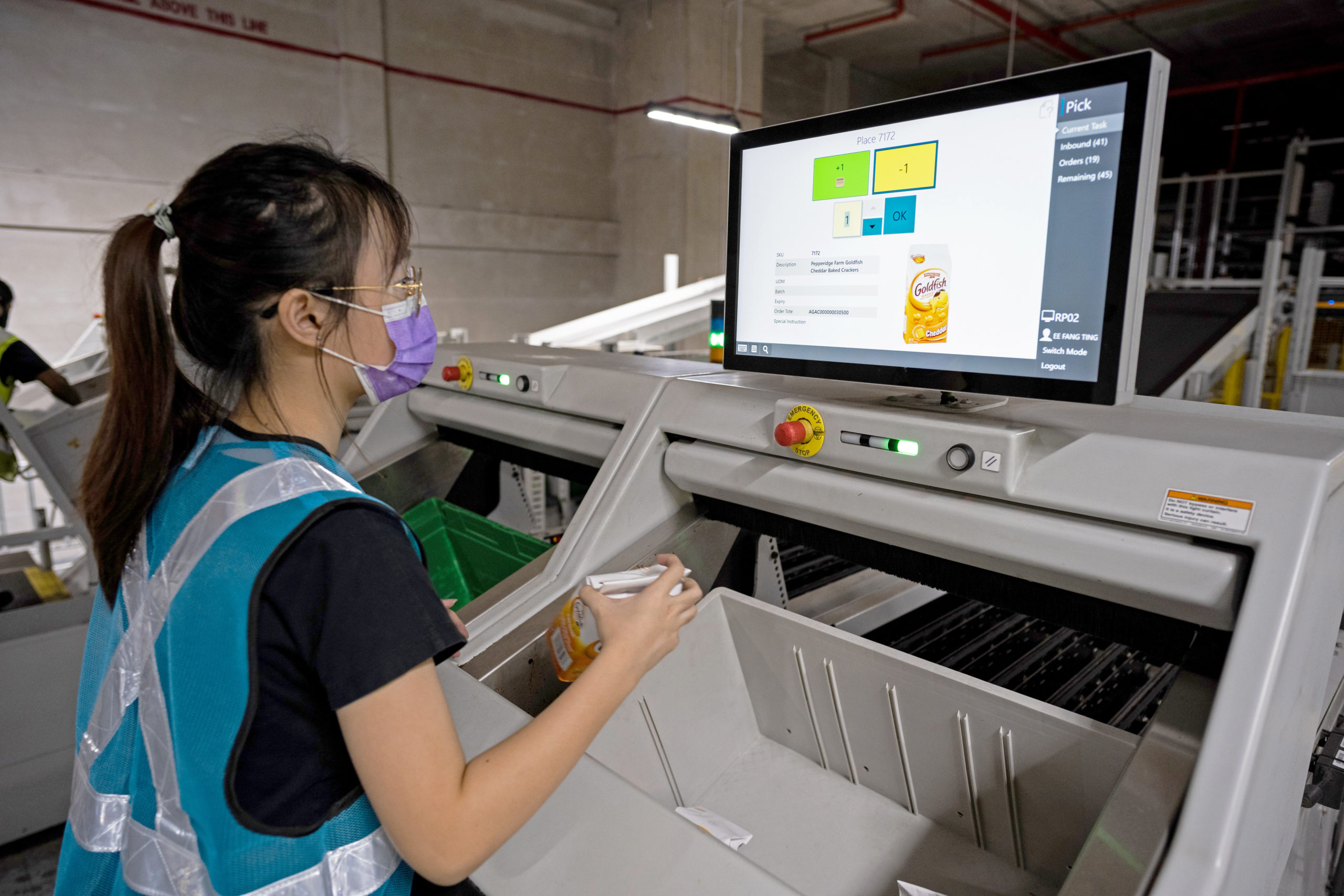
    A key part of the automation solution is the Goods-to-Person (GTP) order fulfilment, powered by a Dematic Multishuttle system. At the ergonomically designed workstations, operators pick orders up to five times faster than they were previously when they would have to manually travel through multiple aisles of shelving to pick the items required for an order.

    The GTP system covers a huge product range in a small footprint, with an extremely effective picking method. Workers stay in one place as items are automatically delivered to their workstation, increasing picking speeds, improving fulfilment accuracy, and advancing operator comfort and safety.

    Optimisation with information

    With the use of new logistics automation and technologies, retailers have a pathway to improve their fulfilment operations, achieving cost-effective and efficient fulfilment processes, higher levels of inventory availability, shorter lead times and improved traceability.  Robust and real-time integration between mechatronics, control systems and software platforms across fulfilment operations and their broader supply chain networks, is a key ingredient to achieving competitiveness and sustainable success in the future landscape of retail.

    For more information on how your business can optimise its supply chain operations and meet market demands, please visit: www.dematic.com/en-au

    Written by: Michael Bradshaw, Senior Regional Director Sales & Solution Development, Dematic Asia


  • How the Philippines Is Heading Towards a Digital Future

    How the Philippines Is Heading Towards a Digital Future

    In the next three years, 5G connections across the globe will reach 400 million, according to a recent study by the Global Systems of Mobile Communications Association (GSMA).

    Its Mobile Economy Asia Pacific 2022 report suggests that 148 million of these connections will include the Asia Pacific, with 333 million new mobile internet users in the region.

    While among the countries that are still lagging behind its regional neighbors in terms of fast internet connectivity, the Philippines is now gearing up for large-scale projects supporting what its new leader envisions to be a Digital Philippines.

    Most recent data provided by GSMA indicates that the Philippines has been advancing on 5G technology compared to its regional neighbors. Using Speedtest Intelligence data, Singapore stood ahead of its regional neighbors on median 5G upload speeds, recording 246.01 in the first quarter of this year, while the Philippines logged a median download speed of 163.51 Mbps. It also showed that LTE performance in the country has improved, from 11.15 Mbps in the first quarter of 2021 to 15.53 Mbps in the same period of 2022.

    Despite the improvements in internet connectivity, the country still sees some crucial challenges, including the growing digital divide among Filipinos.

    In light of the recent political transition in the country, how does it plan to bridge this gap as it moves forward towards a more innovative future?

    President’s Goal to Digitalize the Philippines, Bridge Digital Divide

    During his first State of the Nation Address, Philippine President Ferdinand Marcos Jr. stressed his goal to digitalize the country including government processes, as well as to enable universal connectivity. These are part of his plans to boost the development of the digital economy as a way to stimulate economic recovery from the pandemic.

    Latest data from Statista.com shows that, as of February this year, the Philippines has 79.6 million internet users, a 72.7% internet users penetration.

    The President stated in his speech, “As the world moves into rapid digitalization, the digital divide will be more pronounced. The depth and breadth at which these technologies will be transformative in our lives is fully expected.”

    He said that he sought the help of the country’s ICT chief to deploy digital connectivity across various islands in the country.

    In response, DICT Secretary Ivan John Uy told a local news agency that areas underserved by telecoms companies will be covered by a satellite-based internet to be provided by SpaceX’s Starlink, with availability expected by the end of this year.

    President Marcos further noted, “All relevant modes of digital transport should be utilized. These may be through a combination of terrestrial or submarine fiber optics, wireless, and even satellite technology.”

    Marcos added that they will address connectivity challenges by implementing two of the government’s priority measures, including the common tower plan that will allow telecom and internet service providers to share towers. And another is the National Broadband Plan that aims to fast-track the development of the Philippines’ network infrastructure.

    He said that the Philippines cannot just “stand idly by” amid the scale and speed at which all these technological changes are happening across the globe.

    Local Telecom and ICT Operators Pledge To Support Government’s Plans

    President Marcos’ plans were welcomed by major telecom operators and those from the information and communications technology (ICT) sector, who have expressed their support and commitment to the new administration’s goal to have a more innovative and technologically advanced economy.

    Among them is the PLDT Group, who expressed their willingness to cooperate with the President’s roadmap towards economic growth. In a statement, PLDT and Smart President and CEO Alfredo S. Panlilio said, “We support the government’s thrust to connect our countrymen and make sure that no Filipino is left behind as the world becomes more digital.”

    He added, “We are also prepared to assist in the government’s digitalization efforts, empowering its vision of an agile bureaucracy that is responsive to the needs of the public.”

    With President Marcos’ aim to employ digital solutions in order to streamline public services across government agencies nationwide, PLDT Group also said that it has continued to broaden the reach and capacity of its fiber infrastructure, which now allows its fiber-to-the-home services to be extended to upland areas in the country.

    It also continues to invest in its network, with 518.5 billion pesos spent in the last decade up to 2021.  Network-related projects accounted for the bulk of the 89 billion pesos spent for 2021. Capex guidance for this year is 85 billion pesos.

    Meanwhile, PLDT Group’s major industry competitor, Globe Telecoms, has also echoed the same response to the new Philippine leader’s call for a digital economy.

    The company affirmed its support of the government’s goal to digitalize government processes and deliver universal connectivity nationwide.

    Globe’s President and CEO, Ernest Cu said, “The administration can count on the universe of Globe’s digital solutions– from new technologies our core telco business offers to our portfolio companies in fintech healthtech, edutech and more– to provide innovative services to make its digitalization and connectivity goals a reality.”

    The CEO and Co-Founder of Converge ICT Solutions also pledged support to the government’s plans for universal connectivity. Dennis Uy said in his statement, “We’re pleased that the new administration is prioritizing universal connectivity, especially at this critical time when digitalization is at the heart of everything that we do. Converge is supportive of this initiative, as we push for digital democracy in the Philippines.”

    Converge boasts its nationwide rollout of fiber network, which has now reached 12 million homes as of the first four months of this year. As of March, 645,000 fiber ports were installed in the country.

  • Understanding Modern Retail Through the Gen Z Filter

    Understanding Modern Retail Through the Gen Z Filter

    Over the past decade retailers faced the challenge of managing their own digital transformation, while simultaneously scrambling to serve the needs of a younger and increasingly online-savvy audience – generally accepted as being digitally native. Today, brands are additionally tested to plan and accommodate for the increasing buying power of the emerging 11-24 age group of shoppers, colloquially known as ‘Gen Z’ or ‘Zoomers’.

    Generation Omnichannel

    Perhaps a more fitting nickname for Gen Z or Zoomers, would be ‘Generation Omnichannel’, as this is the first truly omnichannel generation to both physical and online stores and social media platforms in equal measure. This group are prepared to shop wherever suits them best, and in a more impulsive and immediate way.

    According to a recent article in Vogue, Zoomers are 56% more likely to have shopped for fashion in-store over the last three months and 38% more likely to have shopped online in the same timeframe. They are willing to shop across all channels and have an appetite for higher-quality items in an effort to stay on trend with cultural developments.

    This awareness of cultural trends is leading to some key generational spending indicators too; not to mention the fact that Gen Z consumers are more conscious about the planet and the future. They believe that the generations before them represented overconsumption, capitalism, and materialism, meaning they are more likely to associate themselves (and their wallets) with brands that match their own core values, such as sustainability, environmentalism, and equality.

    At the same time, Gen Z has been called the most critical consumer group of all, with a fundamentally different view of shopping and consumption to previous generations. They are the latest to enter the workforce and will have strong purchasing power over the next decade, meaning brands have to earn their loyalty before they become loyal shoppers.

    Furthermore, Zoomers’ frequency of shopping for new items is being disrupted by the second-hand, preloved, vintage market – a market that Zoomers are 27% more likely to shop. In Australia, preloved and vintage platforms, such as Depop & Vinted, are arguably slowing the cycle of new purchases and redefining the concept of the customer journey and what it really means to be ‘new’.

    Embracing New & All Forms of Payments

    According to PayPal, 22% of Zoomers have used buy-now, pay-later (BNPL) solutions such as Klarna and Afterpay since the start of the pandemic to buy more expensive, higher-quality products.

    Since the beginning of the pandemic, 123% more Zoomers have used BNPL than previously, representing the strongest uptake of any generation – and during April 2021, 33% of Gen Z respondents said they were likely to use BNPL solutions in the future too.

    Furthermore, Gen Z has continued to embrace mobile payment options such as mobile apps and e-wallets, including Apple and Android Pay, faster than any other consumer spending group. This expectation to be able to pay now, or later, with a device or platform is something that permeates Gen Z spending habits enormously, meaning traditional payment and Point-of-Sale (POS) technologies need to be modernised in order to offer these different payment options.

    A Window to the Future

    The pandemic and the associate rise in online activity grew usage and acceptance of eCommerce amongst consumers, regardless of generational status. If we glance into the future, beyond the Gen Z age group, Generation Alpha and subsequent cohorts will likely prove to be even more digitally-savvy – thus, the cycle of retail reinvention will likely have to start anew in another 20 years or so.

    The key to success for brands confronted by this continual sequence of progressiveness is to be agile and nimble enough to not only introduce different digital and in-store commerce options but have the capabilities to support these with the native omnichannel capabilities needed to deliver against the demanding expectations of these new generational groups.

    Gen Z is the emerging cultural and economic powerhouse in today’s retail landscape and it will continue to drive cultural change and retail spending habits on so many levels over the next two decades.

    While the full force of their dollars may not have hit retailers just yet, the race to meet the future expectations of Gen Z consumers is very much underway. The success of brands over the next two decades will not only be established by understanding what, how and from who Zoomers are likely to buy, but also on a retailer’s abilities to execute frictionless omnichannel experiences by having the right technology in place at within stores and supply chains.

    Written by Richard Wright, Managing Director, SEA, at Manhattan Associates

    For more information on how your brand can better serve customers in an omnichannel environment, please visit: www.manh.com/en-sg


  • Growing loyalty in a disloyal age through a frictionless customer experience

    Growing loyalty in a disloyal age through a frictionless customer experience

    Brand loyalty in the retail sector is on life support. In a fragmented omnichannel environment, comparison shopping, household budgetary pressures and online price transparency are driving declines in customer loyalty – and leading to tighter margins in the retail sector.

    As traditional retailers struggle to find a competitive edge in such a market, brick-and-mortar stores need to review their processes to deliver greater value and exceptional experience. In an in-store environment, this is leading to brands adopting contactless payment to create hassle-free checkout experiences, along with elevating their stores to offer more ‘experiential retailing.’

    Consumers are more digitally savvy than ever and place a high value on immediacy and quality of service. As a result, a retailers’ workforce needs to be equipped with the means to fulfill different orders with greater efficiency as store associates are now required to do more logistics related tasks, along with offering higher levels of in-store customer service.

    While there have been significant advances in delivering on the customer experience online, the pressure is on for retail stores themselves to meet growing customer expectations. This is not an easy process given that traditionally retail stores have been unstructured environments. Salespeople have had to balance competing demands, handling operational tasks while interacting with customers and immediately responding to their requests. These competing demands can result in inaccurate orders, inefficient bundling, and other errors that drive up labour costs, while employee satisfaction can also suffer if staff feel like they are being pulled in too many different directions at once.

    Meeting online customer service standards offline

    Repeat business remains a critical barometer of success, but like many aspects of the modern retail equation, achieving this means overcoming challenges. Customer loyalty programs matter less, while a high-quality, consistent experience matters more. Loyalty is a cross-channel concept, as customers who shop across all a retailer’s channels are more engaged, creating a more beneficial buyer-seller relationship.

    The modern shopper has access to real-time information and comparison expertise at every step of the journey online. Online retailers compete for customers through offering competitive product pricing and a seamless shopping experience. Customers now want an in-store and offline experience that meets the same standards of excellence they have already typically experienced online. This may mean in-store retail staff having to return an online purchase without hassle for a customer in-store, or sourcing stock in another store and organising delivery to the customer’s home; in-store shoppers expect service excellence at every stage of the buying journey.

    The challenge with trying to match the effortless online customer experience in-store is that many retailers still perceive the customer journey to be linear, which is no longer the case.

    Customers move between online and in-store, browse for goods across social platforms, may direct message for price comparison and email for detailed communication. Shoppers often do not buy where they browse, they may return elsewhere than where they bought and if they change their mind there is an expectation that a store associate will help resolve their issue without any hassle.

    As consumers are shopping on all channels, retailers must focus on delivering an excellent total shopper experience, ensuring that they service their customer how, when and where they are, be that in-store, curbside, or the comfort of their home.

    Built to match the realities of the shop floor

    Retail workers are at the frontline of customer service today and require enterprise level information at their fingertips. After all, every shopper interaction is an opportunity to build a positive impression and support a sale, or conversely create a negative perception and lose business. In such an environment, retail workers need to be supported by the right tools to resolve customer issues, address queries and offer a seamless retail experience.

    New retail-specific mobile technologies can drive efficiency and productivity in store operations and improve the customer experience. Compact, but durable handheld mobile computers, like the Honeywell CT30 XP or EDA5S mobile computers, make salespeople appear more approachable and work in tandem with other devices, enabling users to not only communicate and confirm work easily, but also view pictures of products and inventory locations, type on a keyboard, or scan barcodes.

    How retail stores can transform to meet the needs of an omnichannel world

    The competitive demands of today’s retail environment require in-store processes be optimised and expanded to meet customer needs. Just as Distribution Centres traded paper-based, word-of-mouth and other manual workflows for voice technology decades ago, forces are aligning for retail stores to make the same shift. Retail stores can now support ship-from-store and click-and-collect services – key customer experience differentiators that can also help limit shipping costs as online order volumes grow.

    Proven voice picking technologies allow retailers to empower store associates to fulfill these key logistic roles transforming a traditional a brick-and-mortar store into a modern, flexible fulfilment centre that can meet the demands of omnichannel customers. These technologies present a ‘hands-free, eyes up’ mode of working that can support the demands of a range of in-store workflows, such as order fulfillment, gap scanning, shelf replenishment, inventory management, and more.

    What should also not be overlooked by retailers in such an environment is that customers visiting for in-store pickup provide valuable boosts in foot traffic and opportunities for additional sales.

    Greater operational visibility is required

    Today, retailers need to empower and connect their workers through unified connected communications along with having greater visibility over their operations and workflows. Through these insights, management can analyse how long certain tasks take, leading to better understanding of retail workflows and workforce performance.

    Operational visibility data can fuel labour models to build staffing requirements, determining how much labour is necessary to provide high levels of customer service during peak times and to fulfil online orders from the store. Ultimately, this fuels data-driven decisions to avoid overstaffing while ensuring on-time, accurate order fulfillment and an optimal customer service and checkout experience.

    Empower staff to meet the needs of the omnichannel customer

    Retail stores have transformed from sites that purely existed to make a purchase into something far more complex. Stores now must fulfill several roles along the customer purchasing journey – from being a customer service site, to acting as a returns-facility, to picking and shipping online orders and offering click-and-collect buying options.

    To meet the needs of customers in an omnichannel world, where customers expect the same hassle-free shopping experience that they get online in an instore setting, retailers need to ensure that their staff are properly equipped with the right technologies, systems and knowledge.

    Written by: Vikas Wadhwa, APAC Retail Leader, APACI at Honeywell

    To learn more about how your retail store can meet the challenges of operating in an omnichannel environment, please visit: https://sps.honeywell.com/au/en/industries/retail


  • Disruption is the new normal – How automation builds business resilience

    Disruption is the new normal – How automation builds business resilience

    We are constantly being reminded that we are living through one of the greatest periods of disruption in history. Working and shopping patterns have changed, and supply chain disruptions affecting on-shelf availability and lead times have practically become commonplace throughout the pandemic.  In Southeast Asia, the recent eCommerce boom has seen an influx of 70 million new online shoppers since the pandemic, contributing to a total increase of USD $266 billion in online sales.  As a result, supply chains have been underpinned to cater for a new era of overflowing demand and ongoing disruption.

    The fact that these unexpected supply chain interruptions occurred during a period of wider disruption for businesses has underlined that the pandemic isn’t the only unforeseen challenge or crisis impacting supply chains. Those organisations that view the current period of challenging operating conditions as being temporary, are being overly optimistic, if not unrealistic. What is far more likely is that disruptions are the now the norm, not the exception, whether it be from a new variant of a global virus, natural disasters, or geopolitical or economic events.

    So, how can companies and their supply chain organisations manage their businesses under such challenging operating conditions? And how can they utilise new technologies to build resilience and agility into their supply chains to meet customer and business demands?

    Technology solutions for the new normal

    The current pandemic has shown that businesses who have invested in automation are more resilient to unforeseen disruptions. Automation has enabled these businesses to maintain and manage operations during difficult circumstances, and deliver customer orders with limited staff, whilst also facilitating social distancing. Automation has also equipped these businesses with the capacity, flexibility, and responsiveness to handle spikes in order volumes and changes to order profiles, such as an influx of online orders.

    Of these pioneering retailers choosing to automate operations, many stated that their highly automated order fulfilment system ideally positioned them to maintain high customer service levels, with rapid, error-free order fulfilment, as online orders spiked at the start of the pandemic. This has allowed these retailers to gain not only a greater market share, but also customer loyalty, providing them with a stronger foundation for future growth. Likewise, other large retailers with both automated distribution centres and manual warehouses in their extensive supply chain network reported significantly lower operational disruptions in their automated DCs compared to their manual warehouses. This allowed them to effectively maintain store replenishment activities and avoid undue stockouts from their automated operations.

    These stark experiences have underlined that businesses need to consider automation technology throughout their end-to-end supply chains to ensure they have the right capacity and flexibility to navigate unexpected events and manage periods of disruption as best as possible. Even before the pandemic, grocers and food and beverage manufacturers in Asia were struggling to achieve sustainable and profitable order fulfilment in an industry with notoriously tight profit margins. Now, with unprecedented pressures on global supply chains, this task has been made even more difficult.

    Intelligent Software: The Foundation for Resilience and Agility

    Logistics software integrated across sites can also provide a holistic, end-to-end view of an entire supply chain. Retailers, as well as manufacturers, can utilise connected data, smart algorithms, and data-driven intelligence and decision support tools to optimise operations and make more effective decisions based on a wide variety of factors including consumer behaviours — such as panic buying — to determine inventory needs, address major peaks in demand, and manage unexpected supply chain interruptions.

    Hedging against the unexpected  

    Given the ongoing global supply chain issues, many manufacturers and retailers are looking to increase inventory levels as a hedge against future disruption. However, this is leading to entirely new challenges with the shortage of commercial warehouse and industrial space in key fulfilment areas. Even pre-pandemic, warehouse and land space in Southeast Asia was extremely limited. This shortage of readily available facilities is leading many retailers and logistics companies to rethink their approach to commercial warehouse space.

    In this environment, businesses are increasingly investing in solutions like Automated Storage and Retrieval Systems for pallets and Multishuttle systems for cartons, cases, and totes to maximise storage capacity in a smaller footprint, while providing them with secure inventory management, improved traceability, and increased productivity.

    These space savings allow for the better utilisation of existing facilities beyond warehousing, and some customers have used this newly created space to expand manufacturing capacity or to free up space for other value-adding tasks such as kitting or custom build areas.

    Managing staff shortages

    Finding and retaining labour is a key issue facing many supply chain operations today. Indeed, the need to attract and retain staff is creating real business pressures due to a shrinking pool to hire from, as well as rising staff costs.

    Automated systems can help reduce a business’ reliance on manual labour, while also enhancing health and safety protocols for workers in the warehouse. Innovations such as Automated Guided Vehicles, for example, provide fully automated unit transport between subsystems, as well as automated storage for block stacking and rack storage.

    Moreover, Automated Storage and Retrieval systems (AS/RS), such as the Dematic Multishuttle, work to not only expand storage capacity but reduce a reliance on labour. As the storage engines for goods-to-person systems – where product cases or items are delivered automatically to pickers at ergonomically optimised high-rate pick stations – these work to optimise fulfilment operations, and to streamline efficiency levels with accelerated order responsiveness, be it for single item or case picking. With productivity gains of up to 500% over manual systems, goods-to-person systems significantly reduce the reliance on labour, and as stations are physically separated, they also support social distancing protocols for operators.

    Likewise, because all these automated systems are separated from employee working areas, workplace accidents are far less likely to occur. Automation enables businesses to continue operations during a period of massive disruption where labour is scarce or worker density limits are enforced, while maintaining employee safety protocols.

    Optimising the ‘last mile’ of eCommerce fulfilment

    With the ever-increasing growth in online orders and a downturn in business for physical stores, many retailers and even some food producers are now adopting micro-fulfilment solutions to implement online order fulfilment operations close to customers, addressing the challenge of last-mile deliveries.

    In markets such as the grocery sector, for example, which has forever been a stronghold for in-store only commerce – the influence of the pandemic saw an unprecedented increase of consumers shopping online for their groceries. Now, after being comfortable with the process and convenience of online grocery shopping, more consumers are likely to keep doing so beyond the pandemic.  With these prevalent changes to consumer shopping habits in the grocery market, it is expected that they will have a long-lasting impact – with many consumers unlikely to change their pattern of behaviour as they are already very in sync with the process of online shopping.  Online retailers recognise the ongoing repeat orders they receive from new customers once they have ordered 4 or 5 times, however, supporting this requires a distribution network that can reliably deliver on-time and in-full.

    While these extra online shoppers cause added pressure on supply chains and fulfilment operations, there are innovative technological solutions available to address them. For example, micro-fulfilment solutions comprised of highly compact Multishuttle goods-to-person systems tailored for eCommerce order fulfilment can be installed either in the back of existing store locations, in nearby distribution centres, or even in dedicated online fulfilment ‘dark stores’ to serve nearby consumers. Micro-fulfilment solutions are highly flexible and can serve or complement in-store fulfilment, click-and-collect, and support other stores nearby – making them ideal for hybrid or omnichannel sales.

    Automation is the future

    Now, more than ever, retail, wholesale, and manufacturing businesses should be evaluating automation technology and software to provide their supply chains with the flexibility to be able to adapt quicker and more proactively to changes in the market, ensuring long-term resilience and agility to any anticipated and unanticipated disruptions – and there’s never been a better time than now to start this transition into future-proof business operations.

    By Michael Bradshaw, Director, Southeast Asia, Dematic

    For more information on how your business can improve its supply chain resilience, please visit: https://www.dematic.com/en-au




  • Sandeep Raj, Senior Vice President, Affiliate Marketing, Lazada (Alibaba) answering questions from Retail News

    Sandeep Raj, Senior Vice President, Affiliate Marketing, Lazada (Alibaba) answering questions from Retail News

    As a Senior Vice President for the Affiliate business for Lazada Southeast Asia, I look after the channels user growth and revenues. I was fascinated by the potential of e-commerce in Asia as I was fortunate to be part of the International expansion team for Amazon. Over the past 10 years I have been part of early launch and scaling teams in e-commerce industry.

    Could you give us a short introduction about yourself and what you do at Lazada? As the Senior Vice President for Affiliate business for Lazada Southeast Asia, I look after the channels user growth and revenues. I was fascinated by the potential of e-commerce in Asia when I was part of the International expansion team at Amazon. Over the past 10 years, I have been part of early launch and scaling teams in the e-commerce industry.

    What recommendations do you have for product owners to successfully promote a product to stay on top of consumers mind?

    Product owners should think of the end to end customer journey and how to wow them at      every touch point. Since digital touch points are a significant portion of the customer journey       these days, product owners should measure impact and carefully assess the RoI in each step.

    How does Alibaba tap on affiliate marketing to drive customers to their website? By nurturing and growing high quality channels present in the Southeast Asian market, we work very closely on expanding all types of partners in the eco-system from programmatic partners, advertising networks, news, gaming and utility portals, KOLs to micro and nano influencers.

    What are some ways retailers can grow their affiliate programmes?

    We work with many retailers and help them onboard as affiliate partners. We are creating       a win-win model with the brands and sellers, helping them tap on their loyal customers who shop on the Lazada platform and stand out from their competitors. We also give them the       access to tools that takes them from x to y very fast.

    How do you measure the success of Lazada’s affiliate marketing program?

    The  number one method to measure the success is if you’re able to create a win-win model between sellers, retailers, and brands as one entity, the affiliate partners as the second entity and the customers as the third entity.  Firstly, you would want to make sure that the retailers are gaining additional traffic and additional sales by working with our affiliate partners. Secondly, the affiliate partners should be getting the best Roi in terms of diverting or channeling traffic and their customers to Lazada’s portal. Last but not the least, the customers need to find the best value by engaging with our platform. They should be able to find the products that they want, reach them on time etc.

    Can you talk us through the approaches used to grow your Affiliate Program?

    I think affiliate marketing is still in early stages in Southeast Asia compared to other developed markets. We want to grow content creators in Southeast Asia, making sure that we’re able to tap into the best and high-quality content creators, making sure that they work with us.

    We give them the right support and incentives so that they continue to work with us. We want to ensure that we tap into different communities in the SEA markets for credible sources of passive income or income opportunities.  We work with YouTubers, Instagram influencers, influencers on Twitter or KOLs on different social media platforms, young students, fresh graduates and different communities of women from different parts of SEA. We really want to double down on that segment and then grow those segments for our partners and at the same time, we’re also quite conscious that there are many frauds, fraudulent partners surfacing in the market and then calling themselves as affiliate programs. We are conscious that this exists and we want to spread the message that all our content creators come directly through Zeta’s Portal and sign up. We never work with any third-party agencies that are promoting through SMS and other mechanisms.

    How has eCommerce Affiliate Marketing changed over the years and what are some new things we will see in 2022 and beyond?

    The three points I summarized earlier is testament to what has really changed in the past few years. A couple of changes took place. Number one, the top e-commerce companies came up with the affiliate program that that kickstarted the affiliate marketing revolution then a lot of new players in the market attempted affiliate marketing. Most of whom were primarily blogs and then a couple of other advertising tech companies which were trying to do affiliate marketing in the recent past, especially after COVID, since they realized that affiliate marketing is a credible way to make revenue. We had a lot of new segments of partners that came into the ecosystem. Yes, number one, we see that it’s going to be a rapid proliferation of the influencers and the key opinion leaders and content creators, which is in line with the creative economy boom that is happening across the world.

    How effective is affiliate marketing in recruiting new customers?

    Affiliate marketing is a great channel for new customers of eCommerce or someone who’s not familiar with an eCommerce model to try online shopping for the first time Primarily, because this is a channel which works on building trust with partners. Second is price – we also work with a lot of cashback sites in SEA, which takes away the inhibition of making that first purchase. We also work with a lot of fintech companies, payment companies and banks which gives good vouchers and incentives for new buyers.

    In the hopes of supporting your staff and moving them forward decisively and productively, what are the key characteristics for being an effective leader? How has this proven successful for you?

    Having had the good fortune of working in big tech companies like Amazon and running my own startups, I’ve seen how employees or the current generation of the workforce that is coming into the companies are thinking about work and what work means to them. Also, how they look at leaders – I think number one is they definitely look for authenticity. And second, they want to see that they are learning, that value being added to them to their day to day lives. Thirdly, they’re the kind that values two-way connection.  I feel a leader should be conscious of these three items before they go and recruit or build their team.

    How do you evaluate where to prioritize digitalisation across different areas of the business?

    As a retailer or a B2C brand, the first area that they should really prioritize digitalization is their is their supply chain. We see a lot of retailers kind of missing that out, which of course can add a huge value because that’s the first part in the overall supply chain or overall chain of selling their products or goods. I would say the second area to digitize would be the customer acquisition or the marketing trend, making sure that they’re using the right tools to track the customers and their behavior and ensuring that the buyers are getting the best value for the money that they are spending.

    What is your vision for the future of Lazada and which verticals do you foresee the most growth?

    Think for Lazada, it’s still very early stage not just for Lazada but all all e-commerce companies   in SEA.  Unlike the developed economies where e-commerce accounts for easily 25% to 30% of   the total retail in a specific market, e-commerce is still in single digits in SEA which I would say is possible to grow in the coming few years. In fact, a Google report predicts that the e-commerce economy will be worth $1,000,000,000,000 by 2030 which is quite a significant achievement. $1,000,000,000,000 would probably be the top in economy of top ten countries in the world by  GDP. Lazada is doing the right things for the partners and for the customers so that they can also enjoy the fruits of the good opportunities available in the e-commerce market.

  • Workplace Technology Critical to Positive Customer Service Outcomes, Research Shows

    Workplace Technology Critical to Positive Customer Service Outcomes, Research Shows

    Only four percent of workers believe that technology did not play a role in their ability to serve customers today 

    Research by Humanforce, a provider of intelligent workforce management solutions, has shown seventy-four percent of frontline workers in Australia, including retail staff, believe that technology plays a critical role in customer service today.

    Alarmingly, while technology is being recognised as increasingly important to meeting customer needs, only twenty-eight percent of Australian retail workers feel that the technology they use in their workplace is advanced, with thirteen percent identifying that the technology in their workplace was either poor or limited.

    “Part-time and casual workers are at the frontline of customer service in Australia, making them commonly the first point of contact for customer queries and taking the lead for any issue resolution. Importantly, these workers rely on technology to connect with their employers and colleagues, assist in their roles and meet customer needs,” said Clayton Pyne, CEO, Humanforce.

    Workers themselves identify that they need advanced technologies to do their jobs, with only four percent of people surveyed saying that technology did not play a role in their ability to serve customers.

    Today, frontline retail workers not only prefer employers that offered workplace technologies that support their work but sought out companies that used technologies that empowered workers to manage their own shifts. Eighty-three percent of those surveyed would be more likely to join a company if they used automated technology to help better manage their work – including tasks, shift availability and pay. Conversely, twenty-three percent of frontline workers would consider leaving an employer if they did not offer technologies in the workplace that helped employees plan and manage their work.

    After mobile phones, tablets, and computers. the workplace technologies reportedly most used by frontline workers in Australia were:

    • Scanners – thirty-six percent
    • Point of sale (POS) systems – twenty-three percent
    • Wearable technologies – eleven percent

    “One bad experience or poor customer service interaction today can lead to customers abandoning a purchase and forming a negative perception of a brand, that may never subside. To meet Australian consumers’ expectations, businesses need to step up their customer service game and support workers with the right technologies,” said Pyne. “Solutions that can speed purchase processes, instantly surface a customer’s purchase history, or provide background on a product issue or complaint, equip frontline workers with invaluable tools and information to better meet customer needs, while in the flow of work.”

    Training was identified as a priority by retail workers to help them adapt to new workplace technologies, with hands-on training provided by a manager or colleague and online training accounting for 49% of respondents’ preferred training metholodogies.

    “In a competitive hiring environment, businesses need to focus on the employee experience by offering workers technologies that support positive customer service outcomes and enables them to better manage their work; while allowing businesses to optimise costs, improve productivity and realise compliance. Workforce management solutions can help simplify workplace processes and empower employees to manage their working lives through automating shift management, onboarding, training and more, while ensuring business objectives are met,” said Pyne. 

    Methodology

    • Humanforce contracted Zoho Survey to survey 500 Australian frontline workers (part-time and casual worker respondents) on technologies used in their workplaces in Q4 2021.

    About Humanforce

    The intelligent platform for your shift-based workforce.

    Almost every shift has its no-shows, late arrivals, and special requests, but you’ve also got to stay up to date with the big shifts in how people work – everything from new employee expectations to new technologies, new regulations and more. Humanforce brings a whole new approach to managing your teams by simplifying the process, giving you complete visibility and allowing you to stay ahead of the curve. That’s why thousands of businesses of all sizes – from hotels to hospitals, resources to recreation, stadiums to shops and more – use Humanforce to get ready for the next shift. www.humanforce.com

    Media Contact:

    Sarah Park

    Mulberry Marketing Communications

    +613 9023 9110

    spark@mulberrymc.com

  • Cryptominers unplug rigs as bottom falls out of market

    Cryptominers unplug rigs as bottom falls out of market

    Cryptominers are powering down operations, even selling equipment, as cryptocurrency prices continue to plummet. Nguyen Binh, a cryptominer in the southern Dong Nai Province, said his rigs can mine almost one Ethereum (around $2,000) a month, but hardly breaks even.

    “Electricity bills have taken away half of what I earned. With depreciation and operation and maintenance costs, I am losing money.

    “If prices of Bitcoin or Ethereum (the two largest cryptocurrencies) cannot recover in the next few months, more miners will have to shut down their machines.”

    He estimated that miners are losing 30-40 percent on selling graphic processing units, a key component in mining.Minh Nghia, administrator of a mining group, said some miners have disassembled their rigs to resell but are unable to find buyers despite falling prices.

    “Some told me they sold all their hardware and tokens but still cannot recoup their losses.

    “Financially independent miners can keep mining and wait until prices increase, but those who borrowed are finding themselves in hot water: They either sell their equipment and suffer losses or keep mining and cannot pay electricity bills and interest.”

    Experienced miner Tan Ha said many have unplugged their rigs.

    “GPUs, like other electronic devices, have a certain lifespan. It is not ideal to keep them running amid a plummeting crypto market, and so some miners choose to power down operations until prices recover.

    He said there is a high chance that prices might not recover for a long time.

    Bitcoin, the largest cryptocurrency by market cap, has fallen to $28,720 on May 18, the lowest in two years and down by half compared to its all-time peak of over $68,000 last November.

    Meanwhile, cryptocurrencies overall have lost nearly $800 billion in market value in the past month, according to data site CoinMarketCap, as investors fret about tightening monetary policy.

  • Reimagining the Customer Experience for New Breed of Shoppers

    Reimagining the Customer Experience for New Breed of Shoppers

    Retailers across the APAC region have had to quickly adapt to changing operating conditions over the previous two years, leading to many adopting new technologies and solutions to better serve customers across whichever touchpoints or platforms they prefer.

    As learned pandemic behaviours become the default setting for millions of consumers across the region, brands will continue to serve customers via click & collect and kerbside pickup, while simultaneously processing online returns in-store too.

    For many retailers, this agile, innovation-heavy fusion of online and physical demand is becoming more commonplace, placing the role of modern, dynamic Point-of-Sale (POS) technology squarely at the centre of a redefined connected commerce era.

    For brands today, a reimagined customer experience can be broken down into three key stages, with modern POS playing an important linchpin function at each of the three phases:

    • Pre-purchase: Retailers need to have full visibility of not just customer data such as purchase history, but also their own inventory too.
    • Purchase: Out-of-stock is no longer an option for retailers today. With modern POS, endless aisle capabilities mean shoppers can purchase goods from across an entire network, rather than being restricted by the availability of inventory at a single location.
    • Post-purchase: Stores have a critical role to play in the returns process, but without smart, joined-up store systems, returned goods can often fall into an inventory ‘black hole’.

    From retail industry’s first conception of a Point-of-Sale system, invented back in 1879, the retail landscape has come a very long way, and for those who want to meet the needs of the 21st century shopper, they need to be across all aspects of the omnichannel.

    But, as we observe an acceleration towards a true convergence point between physical and digital retail (fuelled by the effects of the pandemic), it’s important for retailers to continue to innovate and remove any remaining points of friction from this reimagined shopping experience.

    For example, if we go back to the perennial problem of out-of-stock predicaments, it’s hard to believe that even in this day and age, only a small minority of retailers are capable of offering in-store purchasing from another store’s inventory, or indeed from the warehouse.  From a customer experience perspective, this tends to feel like an outdated process, causing not only the risk of losing a sale but also brand loyalty.

    To truly reimagine the customer experience journey at a deeper level in 2022, we must recognise that the role of the store is no longer limited to selling, rather brick-and-mortar retail must be repositioned as a hub for fulfilment too.

    The benefits of this approach have been played out over the last two years and continue to do so today – with retailers with store fulfilment options seeing higher revenue growth – a 114% increase when click and collect is implemented and a 60% increase when ship from store is implemented.

    The future of the customer experience journey is closely linked to eCommerce, and the future of eCommerce is intrinsically linked to the evolving capabilities offered by stores.

    In order to meet supercharged customer expectations, retailers need to adopt a ‘sell/fulfil/engage’ mentality. However, when it comes to future-ready POS implementation, brands often make three common mistakes: adopting a store-only plan which could limit future agility, underinvestment in change management leading to uncertainty or failure to thrive, and selecting a “proven” vendor with old technology without consideration for new innovations.

    All too often, brands are still thinking in silos. Instead, they need to develop a unified commerce roadmap – encompassing a POS + clientele management + store fulfilment + customer engagement strategy. Likewise, retailers need to make a clear plan for organisational change and select the right vendor capable of delivering against long-term, aspirational, and often moving targets.

    As the evolution of POS continues amidst the backdrop of a pandemic-effected economy, one thing that has become increasingly clear is that customers are in the driving seat when it comes to how, when and where they want to shop.

    Today, it’s now up to retailers to take the reins of this new customer experience journey and drive the narrative forward, but they can only do this by having sophisticated, modern POS and order management systems in place that support their customers varied shopping journeys. Whether customers are shopping in-store, online, or via a smartphone or on social media, retailers need to ensure that they are capable of delivering a seamless customer experience journey across all the places their brand is represented, both online and physically.

    For more information on how your retailer business can enhance the customer experience in 2022, please visit: www.manh.com/en-sg