Blog

  • Mobility driving China’s economic growth

    Mobility driving China’s economic growth

    China’s mobile ecosystem added 5.2 trillion yuan ($750 billion) in value to the country’s economy in 2018, according to a new GSMA report.

    Mats Granryd, director general of the GSMA says the report confirms how China’s mobile industry has been a key driver of economic growth, inclusion and modernization – creating a new generation of digital consumers and transforming industry and society.

    Grandryd says China’s mobile operators will invest a further 401 million yuan with the rollout of 5G.

    Numbers speak volumes

    • China is the largest mobile market in the world with 1.2 billion unique mobile subscribers at the end of 2018, about 82% of the country’s population;
    • 69% of mobile connections in China are smartphones, with smartphone adoption expected to reach 88% by 2025;
    • 4G networks cover 77% of China’s connections peaking in the coming years before falling as consumers migrate to 5G services;
    • By 2025, there will be 460 million 5G connections – this will, however, only account for 28% of China’s total network connection;
    • By 2023, mobile connection will contribute 6 trillion yuan to the economy, up from 5.2 trillion yuan in 2018;
    • China’s mobile ecosystem directly and indirectly supported 8.5 million jobs in 2018 and contributed 583 yuan in tax revenue;
    • The number of licensed cellular IoT connections in China stood at 672 million at the end of 2018, supporting various industrial and smart cities applications.


  • Openet names Regan marketing development VP for APAC

    Openet names Regan marketing development VP for APAC

    Openet has appointed Tony Regan as vice president of market development for the APAC region, the BSS firm announced earlier this week.

    In his new role, Regan will run Openet’s market development team in APAC, working closely with regional sales VP and sales team to drive the company’s continued expansion in the region, the company said.

    Prior to joining Openet in 2016, Regan held various senior roles within the Telefonica group in Ireland, Spain and Latin America. In his previous role at Openet, Regan ran the company’s consulting division, advising operators on strategy development and execution.

    Regan will be based in Openet’s APAC headquarters in Kuala Lumpur, Malaysia.

    Openet was established in Kuala Lumpur in 2006 and has grown to provide regional service and support, managed services and software development for all of Openet’s APAC customers. The company employs over 180 people in Malaysia.

    Eric Updyke to take helms at Spirent Communications

    Spirent Communications has appointed a new chief executive officer. Eric Updyke, a former Amdocs executive, has started working for the company on April 1, and will take up the CEO role on May 1.

    Updyke will succeed retiring CEO Eric Hutchinson, who will step down on May 1. The company had announced last November that Hutchison planned to retire after 37 years of working for Spirent. He has held the CEO position since being appointed in 2013.

    In a statement, Spirent said Updyke “has extensive experience in international business management with a strong technical understanding of the markets in which Spirent operates.”

    He has worked in various sections of the industry over the last 30 years and has led transformative growth programs on a global scale.

    Updyke joins Spirent from Amdocs, where he most recently served as president of the company’s services group, with responsibility for its managed services, testing and system integration businesses.

    Prior to joining Amdocs, Updyke held executive roles at Nokia Siemens Networks and AT&T.

  • Autotalks trials C-V2X on Chinese road

    Autotalks trials C-V2X on Chinese road

    Israeli vehicle-to-everything (V2X) communications solutions provider Autotalks has announced the successful completion of cellular V2X field trials in China.

    The trials on a public road, conducted in collaboration with an unnamed large Chinese technology company, validated Autotalks’ C-V2X capabilities, including a communication range of over 2km with a nominal range of around 1.5km.

    The successful field test involved the use of hardware compliant with standards body 3GPP’s Release 15 for V2C communications improvements.

    Autotalks has been building momentum in China in a bid to target the large local market, growing its partner ecosystem and increasing staff.

    The company is a member of the government’s IMT-2020 (5G) Promotion Group, as well as the China Industry Innovation Alliance for the Intelligent and Connected Vehicles (CAICV) and China ITS (intelligent transport systems) Industry Alliance.

    In November, Autotalks recruited former Ceragon Networks country manager Yang Xiaobing to lead up its Chinese business development efforts out of its branch in Beijing.

    In February, Autotalks partnered with Taiwanese fabless semiconductor company MediaTek for a project focused on cooperating on integrating V2X and telematics technologies.

    Autotalks also recently launched the first global V2X solution supporting both C-V2X and dedicated short range communications (DSRC) technologies, the two main connected vehicle standards being adopted by car manufacturers.

  • Global fixed broadband subs to reach 1b by year-end

    Global fixed broadband subs to reach 1b by year-end

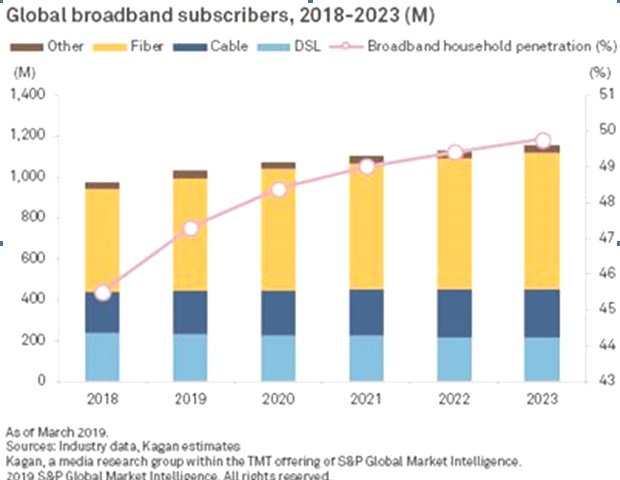
    The global fixed broadband market is on track to reach 1 billion subscribers by the end of 2019, driven by unprecedented growth of fiber connections in Asia Pacific, particularly China, according to Kagan.

    At the end of 2018, broadband subscriptions reached 974.7 million while broadband household penetration reached 45.5%, up from 43.2% in 2017. However, household penetration is projected to remain under 50% until 2025, the S&P Global Market Intelligence research unit said.

    Kagan: Global broadband subscirbers 2018-2023

    Source: Kagan

    China and US remain by far the largest fixed-broadband markets, together accounting for half (50.7%) of the global total in 2018. China alone claims 40.1% of the global total and 74.4% of Asian broadband subs due to large-scale fiber deployments as part of the country’s national Broadband China project.

    Singapore maintains the highest fixed-broadband household penetration in the world, at over 100%.

    In terms of access technology, 51.4% of the global fixed broadband subscribers are using fiber-to-the-premises (FTTP), which overtook DSL in 2016 to become the largest fixed-broadband platform on a global scale.

    FTTP remains the fastest-growing fixed-broadband platform, growing by 13.8% year over year in 2018.

    According to Kagan, fiber subscriptions have overtaken DSL in Asia and Eastern Europe, with China, Japan, Russia, South Korea and US being the five largest fiber-optic markets in the world.

    Western Europe, the Middle East and Africa are still in favor of using DSL, making it the dominant multichannel platform in these continents, while cable leads in North America and Latin America.

  • AirAsia, Vistara cash in on crisis-hit Jet Airways slots

    AirAsia, Vistara cash in on crisis-hit Jet Airways slots

    Tata-group owned airlines AirAsia India and Vistara have announced 11 new flights from Mumbai after the airport operator released unused slots belonging to Jet Airways. The slots have been released to the airlines on a temporary basis.

    Private airport operators in Mumbai and Delhi and the Airports Authority of India have held several rounds of discussions with other airlines to fill up the capacity shortage caused due to grounding of Jet Airways fleet. While reduction of flights led to a hike in fares, it affected airports too. Fewer flights means lower revenue by way of landing fees and less passenger footfalls

    Over 70 per cent of the airline’s fleet has been grounded, leading to massive cancellations. Jet has been a dominant carrier in Mumbai and its daily departures are down to 24 from the earlier 140. Delhi airport, too, is finalising the issue of slots belonging to Jet.

    Other private airlines also have been offered slots by Mumbai airport but are yet to announce new flights. Schedule changes depend upon aircraft utilisation and availability of pilots among other things. A source said airlines were advised to operate flights on routes flown by Jet prior to its crisis with a view to maintain capacity on routes.

    On Thursday, Vistara announced launch of five flights between Mumbai and Bengaluru and one new flight from Mumbai to Hyderabad and Kolkata. These would operate from April 16 to July 15. Currently, Vistara flies to Delhi and Amirtsar from Mumbai and its market growth has been stunted due to non-availability of slots.

    Vistara will be reducing frequencies on other routes to operate these additional services from Mumbai.

    AirAsia India announced three additional flights to Bengaluru and a new flight to Kochi from Mumbai, beginning April 15. The airline did not mention until which date these flights would remain in operations.

    “There is precedence for grant of slots on a temporary basis. During SpiceJet crisis, its unused slots were temporarily given to other airlines and IndiGo was the main beneficiary that time,” said aviation expert Ameya Joshi.

  • Telin Singapore secures OSPAR certification

    Telin Singapore secures OSPAR certification

    Indonesia’s PT Telkom has announced that its subsidiary in Singapore has secured certification that will allow it to serve a wider range of clients in the financial sector.

    Telin Singapore has completed an Outsourced Service Provider Audit Review (OSPAR) report signifying its compliance with the Association of Banks In Singapore (ABS) guidelines.

    The certification will allow the company to increase its client base in the financial sector, as local financial sector companies require technology service providers to be in compliance with ABS guidelines.

    An independent audit is a part of this certification process, and OSPAR meets this requirement.

    In addition, Telin Singapore has achieved Payment Card Industry Data Security Standard Compliance (PCI DSS) for companies that handle branded credit cards from the major providers.

    “The OSPAR proves that our controls and processes are secure and robust. Through obtaining OSPAR, our financial services clients could rest assured that their data is securely stored according to the highest security standards in our data centers,” Telin Singapore CEO Andreuw Th.A.F said.

    “A loss or breach of customer confidential data and disruption to banking services will result in reputational and financial damage to the financial institutions.”

  • New Deliveroo Subscription Service gives Food Lovers Free Delivery

    New Deliveroo Subscription Service gives Food Lovers Free Delivery

    Deliveroo the leading food-delivery company is today launching Deliveroo Plus, a new subscription service available for food lovers across Hong Kong. The new service, priced at HK$98 a month, will enable customers to get unlimited free delivery. Customers will be able to benefit further by trialling Deliveroo Plus free for two weeks or more.

    Deliveroo Plus is being rolled out following a successful launch in the UK. During their first two months of signing up to the pilot, half of all customers saved nearly £25 (around HK$ 260) over the time period, whilst one in ten saved over £75 (around HK$ 770).

    Brian Lo, General Manager, Hong Kong at Deliveroo said, “At Deliveroo, we are continuously striving to innovate our offer as well as expand our delivery platform. Through the launch of Deliveroo Plus, Deliveroo aims at rewarding our users with a better value for money. This new subscription service provides a more affordable option to the frequent users while the earnings of riders is expected to rise with the increasing demand for food delivery.”

    Customers throughout Hong Kong wishing to subscribe to Deliveroo Plus will see the option to sign up to the service on their basket at checkout and in the ‘Account’ section of the app and website.

  • Important change for next-gen Apple Watch Screen

    Important change for next-gen Apple Watch Screen

    It’s a little premature to make anything more than educated guesses regarding the key selling points and major new features of an Apple Watch Series 5 expected out sometime in the fall. But it’s certainly not too early for the manufacturer of the world’s most popular smartwatch family to line up its component suppliers and lay out some general production plans.

    While these are obviously rarely made public, we can typically rely on inside sources to spill the beans for reputable news organizations like Reuters. These often rock-solid informants are claiming Apple has reached a deal with Japan Display that represents a major breakthrough for the financially struggling screen manufacturer. The company, which is a long-time Apple partner, should start supplying OLED panels for the Apple Watch lineup at some point “later this year.”

    Even though there’s absolutely nothing wrong with the Apple Watch Series 4 screen, supply chain competition is always good, generally driving progress and innovation forward at a much faster pace than when a company holds a monopoly on one or several essential components. Unless we’re talking about Samsung, which has managed to exclusively take care of the iPhone X, XS, and XS Max OLED panels while maintaining an impressively high standard of quality and performance.

    By the way, you might be surprised to hear Samsung doesn’t also handle the production of the small but sharp OLED display on the Apple Watch Series 4. That’s actually LG’s business, which is soon expected to be shared with Japan Display. If and when that happens, Apple’s bill of materials could go down, as increased competition among suppliers has a tendency of impacting component prices.

    In other words, LG is likely to charge less for its Apple Watch Series 5 screens than those of the next-gen wearable’s predecessor, as Japan Display finally joins the OLED supply game. This company, which was born as an LCD technology joint venture by Sony, Toshiba, and Hitachi, realized the full potential of OLED (organic light-emitting diode) panels a little too late, staying focused on liquid-crystal displays past their prime. While Japan Display’s financial troubles are far from over, any OLED partnership with Apple would provide a welcome boost to a fledgling business division.

    What it means for future iPhones

    In short, not much. After all, it’s taken LG a long time to start supplying a small number of OLED iPhone screens. Meanwhile, Apple’s two 2019 and three 2020 OLED iPhones are all expected to primarily use Samsung-made displays. That’s obviously because the world’s largest smartphone vendor makes the most sophisticated handset panels out there, lightyears ahead of LG or Japan Display’s alternatives.

    Therefore, as much as Apple would like to further diversify its iPhone supply chain and reduce the company’s reliance on its Korea-based arch-rival, quality trumps any discounts Samsung’s display-making rivals could offer. Basically, unless Apple plans to release a lower-quality, lower-cost OLED iPhone variant in the near future, Japan Display is facing quite an uphill battle here.

    The same goes for LG, although the backup supplier could earn a slightly larger share of 2019 and 2020 OLED iPhone orders, offsetting its Apple Watch losses caused by Japan Display’s newly reported “breakthrough.”

    In theory, all these possible changes and shifts of suppliers could yield lower retail prices for future Apple Watch and iPhone generations, but knowing how the Cupertino-based tech giant typically operates, we wouldn’t hold our breath. After all, the best way to make up for shrinking sales numbers is to jack up profit margins.

  • Benoy completes design work of Jewel Changi

    Benoy completes design work of Jewel Changi

    International architecture and design firm Benoy has completed work on the interiors for Singapore’s new airport shopping centre, Jewel Changi.

    Opening its doors on April 17, the new 137,000sqm space connects three of Changi Airport’s current four terminals, making it easily accessible to the public and passengers. With more than 65 million passengers passing through Changi Airport last year, Jewel is designed to establish a new airport typology as a destination promoting community, commerce and entertainment.

    “We are incredibly proud of the work we have done for Jewel,” said Benoy director and head of Singapore studio Terence Seah. “We’ve created a dynamic environment that becomes a unique place for travellers and residents alike. This addresses the important question of place making in the aviation context.

    “In the process too, Jewel has enhanced the Changi experience. We are confident that other cities will be inspired to rethink the future of airports.”

    Benoy has drawn its capacities in retail, mixed-use, hospitality and leisure to deliver an experience-led destination for the city, offering a renewed sense of place for locals and visitors in connecting the city to the airport. The interiors navigate the many interfaces between aviation facilities and the retail centre.

    Celebrating the natural light offered by the forest valley at Jewel’s core, the retail design enables visitors to experience the vastness of the open space and the intimacy of nature throughout their elliptical journey of the building, reinterpreting the traditional sense of the commercial space.

    The expanded Terminal 1 also offers new pedestrian linkages to other terminals and the MRT via Jewel, improving connectivity and accessibility for all.

  • Westpac introduces Apple Pay in New Zealand

    Westpac introduces Apple Pay in New Zealand

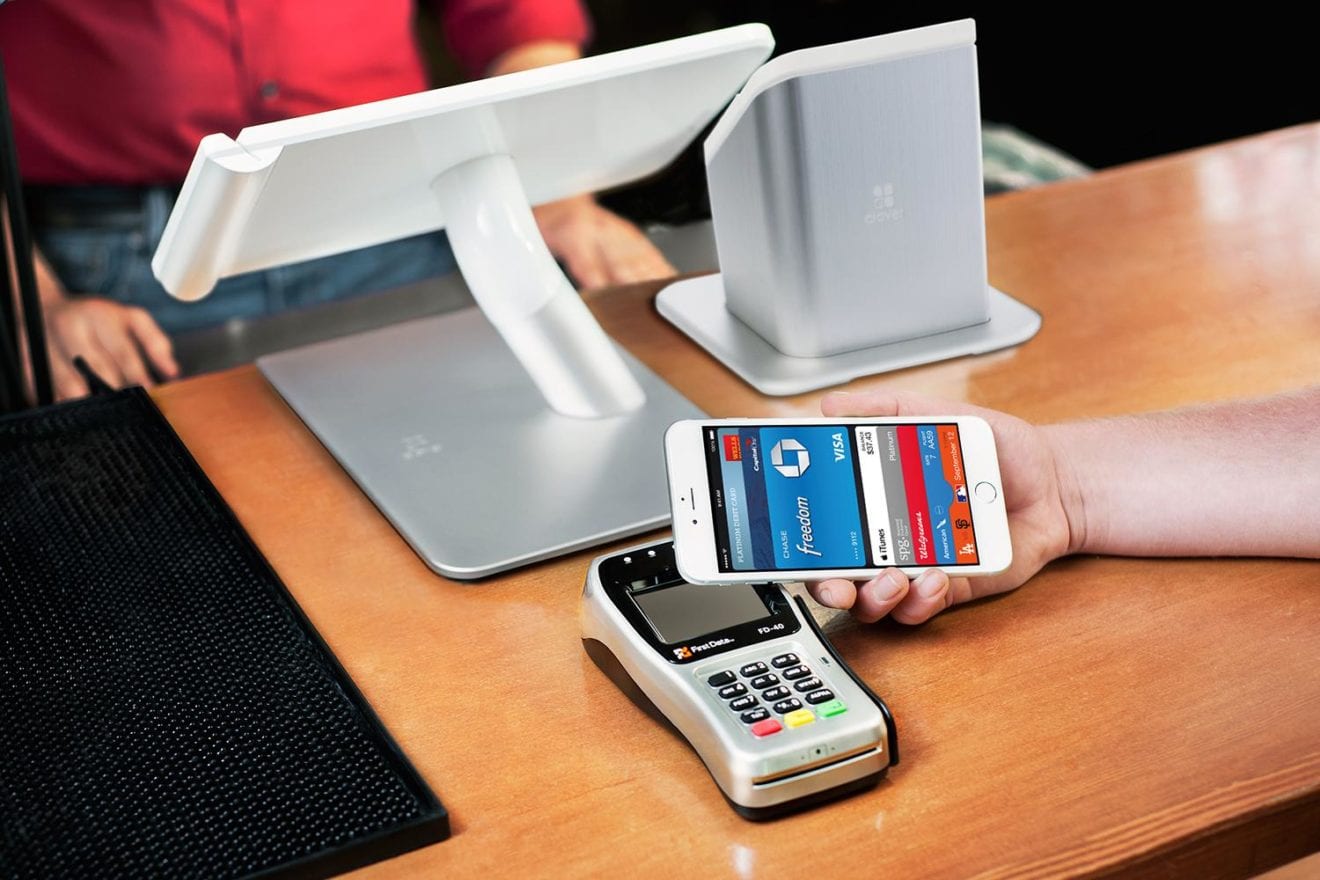
    Westpac New Zealand customers can now use Apple Pay wherever contactless payments are accepted.

    This reflects the findings of a recent study by Allied Market Research, which found that younger consumers appreciate the simplicity of mobile payments.

    The mobile payment market is expected to reach $4.5 trillion by 2023, according to the research firm, which also notes the market is growing with a “lightning-fast” rate in Asia-Pacific.

    However, even mobile payments are beginning to be superseded.

    The report noted that near field communication (NFC) and QR technology is fast becoming standard in various parts of Asia-Pacific, and various market players are already investing in this new technology.

    Westpac is celebrating the launch of Apple Pay by donating $2.50 for every customer who uses Apple Pay five times before May 2, 2019, to charity. Each customer will also receive a one-off payment of $10.

    “It is yet another reason for our customers to get excited about Apple Pay,” Shane Howell, Westpac’s chief experience officer, said.

    The four charities that will benefit from the initiative are the Mental Health Foundation, Shine, Sustainable Coastlines, and New Zealand’s rescue helicopter services.

  • Vinomofo partners with US wine Startup

    Vinomofo partners with US wine Startup

    Online wine retailer Vinomofo has partnered with US wine media mogul Gary Vaynerchuk to bring the inaugural wine from his label, Empathy Wines, to its customers in Australia, New Zealand and Singapore.

    The wine, which Vinomofo is launching this month, is available exclusively for pre-order from the online retailer.

    Vinomofo co-founder and CEO Justin Dry said the partnership was fitting, since Vaynerchuk’s approach to the industry aligns perfectly with Vinomofo’s mission to offer great wine at the right price.

    “The inclusion of Empathy Wines is an exciting one for us,” Dry said in a statement.

    “It strengthens our offering as well as supporting Californian winemakers who’ve been devastated by fires recently and cements our commitment to bringing really cool wines to our wine lovers.”

    This is just the first step in a bigger effort to introduce more wine from overseas to Vinomofo’s customers in Australia, New Zealand and Singapore, Dry told. 

    “We’re currently buying for our second container – after filling the first one with Gary Vee’s Empathy Wines Rosé – so look out for some super cool wines by iconic US winemakers like André Hueston Mack hitting our shores in 2019,” he said.Adtech Ad

    But there is still no word on when Vinomofo will officially launch in the US market, which it had previously planned to do in 2018.

    “We have some very exciting things happening in the background at Vinomofo. We will share these with you as soon as we can,” Dry said.

    “In the meantime, we are super excited to be forming this partnership and can’t wait for what’s ahead.”

    Gary Vaynerchuk, also known as Gary Vee, took his parents’ liquor business in the US, Shopper’s Discount Liquors, online in 2006, and started Wine Library TV, a daily webcast covering wine.

    He later started a digital ad agency, which provided social media and strategy services to several Fortune 500 companies, including Anheuser-Busch, Mondelez and PepsiCo.

  • The Athlete’s Foot to open several more stores in New Zealand

    The Athlete’s Foot to open several more stores in New Zealand

    Performance footwear retailer The Athlete’s Foot has confirmed it will be opening at least 12 new stores across New Zealand and Australia in the next year.

    The news comes as the retailer opens a new flagship in Melbourne Central shopping centre in Australia today, featuring a new format that it hopes to replicate in upcoming store openings.

    “We’re not going to waste any time once we’ve proved this concept over the next couple of months,” The Athlete’s Foot general manager Steve Cohen told.

    “I think The Athlete’s Foot hasn’t opened a lot of stores over the last couple of years, and we have the appetite to absolutely get onto the expansion path.

    “If the Melbourne Central flagship works, and we’re confident that it will work, we see another half dozen of these across Australia and New Zealand pretty quickly… plus another half dozen that we’ve highlighted across the country.”

    The new store features an expanded product line and new technology to better suit product to consumer needs, and provides a roadmap for the future of the business.

    “We have had a few different store evolutions, but it’s been a couple of years now since we’ve really gone out and started again,” Cohen told.

    “Being a flagship, it needed to be at the forefront of the performance footwear space. I think our investment in the store, and the way we’ve progressed the whole experience, is leaps and bounds from where we’ve been in the past.”

    For the first time, The Athlete’s Foot has ditched the traditional foot measuring tool, the Brannock, in favour of its new MyFit3D measurement technology, which creates a 3D render of a customer’s feet and measures their gait and pressure points within 1mm.

    This technology is set to be pushed out across the brand’s 140 stores in the next nine months.

    “It gives you a lot more information relating to the consumer’s foot, and it actually ranks their foot relative to the rest of the population,” Cohen said.

    “People like hearing about themselves, so when you put them on the MyFit3D and you show them how long, or wide, or deep their foot is compared to the rest of the population, it’s a nice interactive way to engage with the customer.”

    With a more accurate measurement, the team in the Melbourne Central store will be able to recommend footwear from its expanded product line, which includes exclusive ranges from Asics and New Balance.

    The store also features LED screens that react to consumer behaviour; for instance, by displaying information about a particular shoe after the customer picks it up off the shelf. This keeps customers in the moment, rather than browsing for additional product information on their phones – and potentially purchasing an item online from another retailer.

    “The main thing is that we can be a lot more nimble in our messaging to the consumer [about] our new arrivals, or product or brand that we want to call out in store,” Cohen said.

    “It’s touch screen as well, so if we decide to go down the path of shopping online or engaging with the consumer from a people point of view we can do that as well.”

    The location played a large part in the product line The Athlete’s Foot was able to secure, with suppliers having been asking for a “cutting-edge performance execution” for some time.

    “What we’ve found off the back of that is that the suppliers are giving access to product that we might not have had access to, and we think that this is an exciting step forward for our brand,” Cohen said, indicating this access will filter through the rest of the business moving forward.

  • RFG back to square one in asset sale process

    RFG back to square one in asset sale process

    Retail Food Group on Tuesday said sale talks with a potential buyer of its Donut King, Pizza Capers and Crust businesses have ended in disappointment, following months of negotiations.

    The deal fell through after the two parties failed to reach a formal binding agreement on terms that the board considered to be in the best interests of the company as a whole, RFG said in a statement.

    “Our Donut King and QSR brands [Pizza Capers and Crust] continue to provide solid earnings contributing to the company’s underlying profit,” Peter George, executive chairman of RFG, said.

    “The potential sale of any of these assets must be at a price not only acceptable to our board but in the best interests of our shareholders.”

    The franchisor, which operates Gloria Jean’s Coffees, Brumby’s Bakeries, Donut King, Michel’s Patisserie, Di Bella Coffee, The Coffee Guy, Café2U, Pizza Capers and Crust, had been pursuing an asset sale to help pay down its net debt of roughly $258.9 million, after restructuring costs and write-downs wiped out its declining profit in the first half of FY19.

    An RFG spokesperson said the failure to sell its Donut King and QSR brands will not impact the company’s recent agreement with NAB and Westpac to reset its financial covenants and waive a review of the business.

    The company continues to work closely with its lenders and maintains their support, the spokesperson said.

    The RFG board is investigating a range of other options to pay down its debt, including equity, other debt funding options and potential asset sales, and will update the market of any definitive option being reached.

    In response to a report that the Australian Securities and Investments Commission is “keeping an eye” on the franchisor, particularly around big announcements, the RFG board said it has not been made aware of any current investigations.

    A spokesperson for ASIC told that “ASIC supervises the market, so we monitor all share trading”.

  • The dying art of a good conversation

    The dying art of a good conversation

    What with Facetime, Skype, Whatsapp and Snapchat, for many people, face-to-face conversation is used less and less often.

    These apps allow us to converse with each other quickly and easily – overcoming distances, time zones and countries. We can even talk to virtual assistants such as Alexa, Cortana or Siri – commanding them to play our favourite songs, films, or tell us the weather forecast.

    Often these ways of communicating reduce the need to speak to another human being. This has led to some of the conversational snippets of our daily lives now taking place mainly via technological devices. So no longer do we need to talk with shop assistants, receptionists, bus drivers or even coworkers, we simply engage with a screen to communicate whatever it is we want to say.

    In fact, in these scenarios, we tend to only speak to other people when the digital technology does not operate successfully. For instance, human contact occurs when we call for an assistant to help us when an item is not recognised at the self-service checkout.

    And when we have the ability to connect so quickly and easily with others using technological devices and software applications it is easy to start to overlook the value of face-to-face conversation. It seems easier to text someone rather than meet with them.

    Bodily cues

    My research into digital technologies indicates that phrases such as “word of mouth” or “keeping in touch” point to the importance of face-to-face conversation. Indeed, face-to-face conversation can strengthen social ties: with our neighbours, friends, work colleagues and other people we encounter during our day.

    It acknowledges their existence, their humanness, in ways that instant messaging and texting do not. Face-to-face conversation is a rich experience that involves drawing on memories, making connections, making mental images, associations and choosing a response. Face-to-face conversation is also multisensory: it’s not just about sending or receiving pre-programmed trinkets such as likes, cartoon love hearts and grinning yellow emojis.

    When having a conversation using video you mainly see another person’s face only as a flat image on a screen. But when we have a face-to-face conversation in real life, we can look into someone’s eyes, reach out and touch them. We can also observe the other person’s body posture and the gestures they use when speaking – and interpret these accordingly. All these factors, contribute to the sensory intensity and depth of the face-to-face conversations we have in daily life.

    Speaking to machines

    Sherry Turkle, professor of social studies of science and technology, warns that when we first “speak through machines, [we] forget how essential face-to-face conversation is to our relationships, our creativity, and our capacity for empathy”. But then “we take a further step and speak not just through machines but to machines”.

    In many ways, our everyday lives now involve a blend of face-to-face and technologically mediated forms of communication. But in my teaching and research I explain how digital forms of communication can supplement, rather than replace face-to-face conversation.

    At the same time though, it is also important to acknowledge that some people value online communication because they can express themselves in ways they might find difficult through face-to-face conversation.

    Look up from your phone

    Gary Turk, is a spoken word poet whose poem Look Up illustrates what is at stake by becoming entranced by technological ways of communicating at the expense of connecting with others face-to-face.

    Turk’s poem draws attention to the rich, sensory aspects of face-to-face communication, valuing bodily presence in relation to friendship, companionship and intimacy. The central idea running through Turk’s evocative poem is that screen-based devices consume our attention while distancing us from the bodily sense of being with others.

    Ultimately the sound, touch, smell and observation of bodily cues we experience when having a face-to-face conversation cannot be fully replaced by our technological devices. Communicating and connecting with others through face-to-face discussion is valuable because it is not something that can be edited, paused or replayed.

    So next time you’re deciding between human or machine at the supermarket checkout or whether to get up from your desk and walk to another office to talk to a colleague – rather than sending them an email – it might be worth following Turk’s advice and engaging with the human rather than the screen.


  • Ex-Nissan Chief Ghosn Rearrested In Tokyo

    Ex-Nissan Chief Ghosn Rearrested In Tokyo

    Former Nissan chief Carlos Ghosn was rearrested early Thursday in Tokyo on fresh financial misconduct allegations, with the auto tycoon slamming his detention as “outrageous and arbitrary”.

    Authorities arrested the 65-year-old less than a month after he was dramatically freed on bail following more than 100 days in detention. Local media said prosecutors had entered Ghosn’s temporary accommodation in central Tokyo early Thursday morning and that he left with them by car shortly afterwards.

    An AFP reporter outside the home saw three men in dark suits guarding the entrance to the building’s car park and a police officer patrolling, as dozens of journalists gathered. Ghosn issued a statement through his representatives after the arrest calling it as “outrageous and arbitrary”.

    “It is part of another attempt by some individuals at Nissan to silence me by misleading the prosecutors. Why arrest me except to try to break me? I will not be broken,” he said, insisting that he is innocent of the claims against him. Reports emerged Wednesday that prosecutors were weighing rearresting Ghosn as they investigate claims related to at least $32 million in Nissan funds transferred to a distributor in Oman.

    According to a source familiar with the matter, some of this money is believed to have been used to buy a luxury boat for Ghosn and his family. The former high-flying executive already faces three charges of financial misconduct related to allegations he under-reported his compensation and sought to transfer losses to Nissan’s books.

    He has denied any wrongdoing and took to Twitter for the first time Wednesday, using a newly created account that his spokespeople confirmed was authentic, to announce plans for a press conference.

    “I’m getting ready to tell the truth about what’s happening. Press conference on Thursday, April 11,” said the tweet, sent in English and then Japanese.

    The ‘Razor’

    Ghosn currently faces two separate charges of deferring his salary to the tune of nine billion yen ($81 million) and not revealing this in official documents to shareholders. The Brazil-born auto sector pioneer, widely credited with saving Nissan from the brink of bankruptcy, also faces a charge of seeking to shift personal investment losses onto Nissan’s books and then using company funds to pay a Saudi associate who stumped up collateral for him.

    The case has been a rollercoaster ride of unexpected twists and turns from the moment Ghosn was first arrested at a Tokyo airport out of the blue on November 19.

    He has since been re-arrested on multiple occasions over a series of allegations, employed a little-used article of Japanese law to force a day in court and emerged on bail dressed in a workman’s uniform and cap in a bizarre attempt to avoid the media.

    Since his release on bail on March 6, he has kept scrupulously quiet despite daily attempts by local and international media to interview him. His lawyer Junichiro Hironaka, known as the “razor” for his mental sharpness, has done the talking for him, appearing twice in front of the foreign media to plead his client’s innocence.

    In his latest appearance on Tuesday, Hironaka announced he had filed a petition with the Tokyo District Court so that Ghosn’s case would be heard separately from that of Nissan and his former right-hand man Greg Kelly. Nissan has been indicted alongside Ghosn, as they filed the shareholders’ documents that allegedly mis-stated the then chairman’s income.

    Hironaka said this would not be a fair trial as Nissan has effectively sided with the prosecutors by providing them with documents they say show further malpractice.

    – ‘Trap’, ‘plot’ –

    Under Ghosn’s management, Nissan recovered and formed a three-way alliance with Renault and Mitsubishi Motors that has become one of the world’s top-selling auto groups.

    In an interview with AFP from his detention centre in January, Ghosn denounced a “trap” and a “plot” by Nissan prompted by opposition to his plans to bring the companies closer together.

    He was removed as chairman by Nissan and Mitsubishi Motors almost immediately after his arrest. Renault was slower to react but Ghosn eventually himself resigned from the head of the French firm.

    Ghosn’s arrest and a string of alleged financial misconduct has sparked questions over Nissan’s own corporate governance and the company established an independent body to propose changes to prevent a recurrence.

    The advisory group suggested doing away with the vacant role of chairman and laid the blame for the lapse in governance at the feet of Ghosn.

    The main cause of the misconduct was “the concentration of authority in Ghosn”, the group concluded.

    “He created a situation in which it would be difficult to detect his pursuit of personal gain.”