Tag: 5G

  • Nokia to launch its 4.9G technologies this year

    Nokia to launch its 4.9G technologies this year

    Nokia has announced plans to launch what it is calling its 4.9G technologies by the end of 2017, and to demonstrate its new Cloud Single RAN at Mobile World Congress 2017 later this month.

    The vendor said it will introduce new technologies including the 4.9G AirScale Massive MIMO adaptive antenna system by year-end to help operators meet rapidly rising infrastructure demands on the path to 5G.

    At Mobile World Congress 2017, Nokia plans to work with US operator Sprint to demonstrate the new technology using 3D beamforming software.

    The technology promises throughput gains of up to eight times uplink and five times downlink, with Nokia projecting peak data rates of 3Gbps using commercial TD-LTE devices..

    Also at the event, Nokia will demonstrate its Cloud Single RAN running virtualized 2G, 3G, 4G and 5G radios and 2G and 3G network controllers over commercial Nokia platforms.

    This year Nokia also plans to introduce a new component of its 4.5G Pro portfolio –  a micro remote radio head designed to allow operators to take advantage of unlicensed spectrum to enable gigabit speeds.

    “Nokia introduced 4.5G Pro and 4.9G last year to allow operators to implement network capacity increases where and when it made sense for them, Nokia head of mobile network products Frank Weyerich said.

    “Now we are delivering features that will maximize their resources, speed up deployment times and cut power and costs especially in the most densely populated locations. We are making 4.5G Pro a commercial reality now and working with customers to innovate with solutions to their network densification and evolution challenges in 4.9G and beyond.”


  • Hong Kong should be preparing for 5G now

    Hong Kong should be preparing for 5G now

    HKT has called on the HKSAR government to take action to prepare for the arrival of 5G, stating that the government has done nothing to advance 5G development in the city.

    In a discussion paper, HKT once again the government and criticized telecoms regulator OFCA for what it says is a failure to allocate enough spectrum to support an advanced mobile industry, expressing concern over the fact that no new spectrum allocation is planned for the next three years.

    HKT said the government’s “short-sighted policies on mobile spectrum… are set to negatively impact mobile users and the Hong Kong economy for the many years to come.” The paper notes that no new spectrum has been made available since 2013.

    In this regard, Hong Kong fares poorly compared to other markets such as Japan, Korea and China, which have been taking action to facilitate 5G trials and development, the operator said.

    “OFCA should be preparing the ground today for the emergence of true 5G services which will be available when we step into the next decade – disappointingly it is not doing so; and, worse, it is on the record as not wanting to do anything because it says ‘zero’ new spectrum will be available.”

    HKT separately noted that UK regulator Ofcom has released a new discussion paper echoing the company’s view that regulators and lawmakers should be taking immediate action to enable the development of 5G technology.

    The UK regulator already has plans in place to make the 700-MHz band available for services including 5G, and is undertaking work with an eye to potentially doing the same for the 3.6-GHz and 3.8-GHz bands.

  • M1, Huawei complete 5G mmWave demo

    M1, Huawei complete 5G mmWave demo

    M1 and Huawei have completed a 5G demonstration over 73-GHz E-band spectrum, achieving Singapore’s highest 5G transmission speeds of 35Gbps.

    The demonstration at M1’s main operating center in Jurong has validated the performance of 5G using millimeter wave high frequency bands, the companies announced.

    M1 CTO Denis Seek said 5G will support the massive number of low-latency connections critical to driving the next wave of technological development in areas including virtual and augmented reality, the connected car and autonomous vehicles as well as IoT applications.

    “Singapore’s mobile networks are widely acknowledged as amongst the most advanced worldwide, and M1 is committed to staying at the forefront of 5G technology to ensure our consumers enjoy the best experience and latest smart applications,” he said.

    In Hong Kong, SmarTone and Ericsson recently conducted the city’s first 5G demonstration using millimeter wave spectrum.

  • IMDA to hold 5G consultation this year

    IMDA to hold 5G consultation this year

    Singapore’s Infocomm and Media Development Authority (IMDA) plans to hold a public consultation covering 5G mobile networks later this year.

    The regulator will hold the consultation as part of its efforts to facilitate the commercialization of 5G services in Singapore.

    The IMDA is strongly urging the mobile industry to participate in the consultation to help the regulator better understand the industry’s needs, as well as the optimal spectrum roadmap and regulatory framework that will allow innovation to flourish.

    Other initiatives the IMDA will take during the transition to 5G will include the promotion of real-world trials to better understand how 5G will fit into Singapore’s business environment, as well as optimal deployment scenarios for operators.

    Singapore’s mobile operators are meanwhile themselves conducting preparatory work for the introduction of 5G – Singtel, for example, recently upgraded its LTE network nationwide to support the pre-5G technology 256 quadrature amplitude modulation (256 QAM), giving the network a peak speed of 450Mbps.

  • Indosat Ooredoo ready to launch 4.5G technology

    Indosat Ooredoo ready to launch 4.5G technology

    PT Indosat Ooredoo is ready to launch its 4.5G technology in 2017 that is two times faster than its 4G predecessor, said a company spokesman.

    “We have been developing the 4.5G technology since 2012 and we are ready to launch this year, starting with the introduction of new technological infrastructures such as modernized BTS (Base Transceiver Station) in several regions,” according to its Group Head of Network Strategy and Solution, Yune Marketatmo, on Wednesday.

    Singapore and Malaysia are already ahead of Indonesia in launching the 4.5G technology, along with some European and Middle Eastern countries.

    Marketatmo also noted that in order to prepare for its introduction, the company has been working to place 4.5G data centers in several areas around Java since 2016, while the headquarters will be in Jakarta.

    “The data centers will be built in strategic locations close to customers so they can communicate easily and take advantage of this new technology,” he added.

    Marketatmo further explained that existing customers who are currently using 4G would be automatically upgraded to 4.5G. This will also apply to mobile devices that are compatible with the 4.5G technology.

    Indosat Ooredoo currently has 81.6 million customers and the company saw an increase of their data usage by 114.2 percent compared to previous years.

  • 5G value chain to generate up to $3.5tr in 2035

    5G value chain to generate up to $3.5tr in 2035

    A new study commissioned by Qualcomm projects that 5G technology has the potential to create 22 million jobs worldwide and produce up to $12.3 trillion worth of goods and services by 2035.

    The landmark study into the potential economic and social impact of 5G worldwide projects that by this time, 5G’s full economic benefit should be realized across the globe.

    The 5G Economy study was jointly conducted by research firms IHS Markit, PSB and UC California economist Professor Dr David Teece.

    According to the study, the 5G value chain itself is anticipated to generate up to $3.5 trillion in revenue in 2035.

    Over time, 5G will boost real global GDP growth by $3 trillion dollars cumulatively from 2020 to 2035, which would be the quivalent in today’s dollars of adding a new economy the size of India to the world.

    “I’ve spent many years studying the impact of general purposes technologies, and it’s clear that 5G will propel mobile into that category, assuring the technology’s long-term impact on society and continued growth for decades,” Teece said.

    Polling research conducted in tandem with the economic study also suggests that  business decision makers and opinion leaders around the globe overwhelmingly agree than 5G will enable new products, services and use cases that have not been conceived yet.

  • Nokia, Vodafone trial cloud-based RAN

    Nokia, Vodafone trial cloud-based RAN

    Vodafone has teamed up with Nokia to trial cloud-based radio access network (RAN) technology to see how it will stack up for the transition from 4G to 5G networks.

    During the trial, which occurred at the operator’s testing facility in Italy, Vodafone used Nokia’s AirScale Cloud RAN running on its AirFrame network functions virtualization (NFV) infrastructure.

    By combining cloud RAN with NFV, Vodafone was able to split baseband processing functionality between real-time and non-real-time functions allowing for time-critical functions to be performed close to the edge of the network.

    Non-time critical functions were then centralized and virtualized in the NFV infrastructure platform at the end of the RAN. Ethernet-based fronthaul was used to provide connectivity to the virtualized functions.

    The trial looked at peak data rates as well as download and upload speeds during a variety of different scenarios on the macro network using high-powered macrocells.

    According to Vodafone, the test demonstrated that a cloud RAN-based architecture can provide the same level of service as a conventional LTE network. In addition, the cloud RAN met the operator’s criteria for throughput, capacity, and resiliency while also providing additional flexibility and scalability.

    Santiago Tenorio, head of networks, Vodafone Group, said: “Working with Nokia on this trial we have seen how the application of Cloud RAN architecture can help the network react to changing demands quickly. It speeds up the delivery of services and will help with the transition to 5G.”

  • SKT, Ericsson and Qualcomm collaborate on 5G NR trails

    SKT, Ericsson and Qualcomm collaborate on 5G NR trails

    SK Telecom, Ericsson and Qualcomm have announced plans to conduct interoperability testing and over-the-air field trials based on 5G New Radio (NR) standards currently under development by the 3GPP.

    In a statement, the companies said the trials will drive the mobile ecosystem toward rapid validation and commercialization of 5G NR technologies at scale.

    The interoperability testing and trials will launch in Korea starting in the second half of 2017.

    “As 5G rapidly gains momentum, a globally agreed and unified standard becomes imperative to achieve early commercialization of 5G and build an efficient ecosystem around it,” said Alex Jinsung Choi, EVP, chief technology officer at SK Telecom.

    “As 3GPP NR is a global 5G standard, we are delighted to announce early 3GPP NR trials with leading 5G players, Ericsson and Qualcomm, with which we have made remarkable world’s first footprints in the past with previous generations of groundbreaking mobile technologies.”

    During the trails, SK Telecom, Ericsson and Qualcomm will showcase new 5G NR technologies which utilize wide bandwidths available at higher frequencies to increase network capacity and achieve multi-gigabit per second data rates.

    The proliferation of 5G NR technology can make it more cost-effective and easier for multi-gigabit internet service to reach more homes and businesses.

    These technologies will be critical to meeting the increasing consumer connectivity requirements for emerging consumer mobile broadband experiences such as virtual reality, augmented reality and connected cloud services.

    The trials will employ 3GPP 5G NR Multiple-Input Multiple-Output (MIMO) antenna technology with adaptive beamforming and beam tracking techniques to deliver sustained mobile broadband communications at higher frequency bands, including non-line-of-sight (NLOS) environments and device mobility.

    It will also make use of scalable OFDM-based waveforms and a new flexible framework design which are also part of the 5G NR specifications.

    The trials will also provide valuable insight into the unique challenges of integrating 5G NR technologies into mobile networks and devices. This will enable timely commercial network launches based on 3GPP Rel-15 standard compliant 5G NR infrastructure and devices.

    “The roadmap of 5G technologies is incredibly complex, and trials based on the global 3GPP 5G standard, such as this, are critical to continuing our long history of leadership integrating advanced wireless technologies in form-factor accurate devices to ensure timely deployment of 5G networks,” said Matt Grob, executive vice president and chief technology officer, Qualcomm Technologies.

  • Smart, Nokia conduct Philippines’ first 5G demo

    Smart, Nokia conduct Philippines’ first 5G demo

    The Philippines’ PLDT, through mobile subsidiary Smart, has completed the first showcase of 5G speeds in the nation.

    During the trial the companies achieved a peak speed of 2.5Gbps using 100 MHz of spectrum, as well as a latency of just 1ms.

    The demo was conducted at the Nokia Manila Technology Center in Quezon City, and demonstrated use cases for 5G including 3D 360-degree VR streaming and the Nokia AirFrame data center platform for distributed cloud architectures capable of supporting real-time IoT operation.

    “We are excited to work with Nokia in conducting cutting-edge research and development for 5G,” PLDT and Smart CEO Manuel Pangilinan said.

    “This is a key part of our efforts to transform the PLDT and Smart network into the country’s most future-ready data infrastructure delivering a wide range of gigabit digital solutions.”

    He said 5G will be critical to realizing Smart’s full vision for the IoT. The operator has a track record of investing in and helping drive the development of the IoT, including the founding the Philippines’ first Internet of Everything consortium in 2014.

    Nokia’s Bell Labs predicts that there will be up to 5 billion IoT devices connected through mobile networks by the year 2020.

  • Huawei releases X-Ethernet tech for 5G

    Huawei releases X-Ethernet tech for 5G

    Huawei has proposed a new X-Ethernet technology for 5G bearer networks at the ITU-T 2020 FG Workshop and Demo Day Wireline Technology Enablers for 5G conference in Swizerland.

    The company has also proposed X-Ethernet for integrated fronthaul and backhaul networks to introduce likely 5G requirements including deterministic low latency and end-to-end network slicing.

    Huawei’s Network 5.0 team has developed X-Ethernet to address the problems presented by the high bandwidth, determinacy, low-latency, hard isolation and low-cost requirements of 5G.

    The technology includes innovations including a Layer 1.5 switch based on the native Ethernet kernel and compatible with traditional Ethernet, as well as hybrid multiplex with TDM-like characteristics and a flexible hard pipe based on an SLA-based path optimization algorithm.

    Rival vendor Nokia Networks has meanwhile announced it teamed up with Vodafone to trial cloud-based radio access technology for macro networks as part of a project to evaluate methods to enable a smooth transition from 4G to 5G.

    The trial at Vodafone’s testing facility in Italy used the Nokia Cloud RAN platform to evaluate the performance of centralized 5G-ready architecture.

    “Working with Nokia on this trial we have seen how the application of Cloud RAN architecture can help the network react to changing demands quickly. It speeds up the delivery of services and will help with the transition to 5G,” Vodafone Group head of networks Santiago Tenorio said.

  • Huawei forges 5G research partnership with BT

    Huawei forges 5G research partnership with BT

    Huawei has announced a partnership with UK-based operator BT to conduct joint research into potential new 5G applications.

    The companies will work at the BT Labs in Ipswich and other locations in the UK to explore aspects of 5G including future network architecture, a new air interface between devices and base stations, network slicing to proportion resources for specific services, 5G IoT applications and security technologies.

    The partners said they hope that the research will drive the development and industry-wide standardization of 5G technologies.

    “[Working with BT] we can explore the potential of 5G networks and analyze how this vital technology can best be delivered,” Huawei rotating CEO Ken Hu said.

    “The partnership also demonstrates Huawei’s continued commitment to partnering with world-leading business and academic organizations in the UK to further research and development. We have operated in the UK for 15 years and we look forward to continuing to help build a better connected UK in partnership with BT.”

    Huawei and BT have been collaborating on telecommunications R&D for 11 years. Most recently, the companies announced breakthroughs including a 3Tbps data transfer over BT’s core network, as well as research into 40Gbps speeds on the Openreach access network.

  • Huawei, LG U+ achieve 31Gbps peak in 5G tests

    Huawei, LG U+ achieve 31Gbps peak in 5G tests

    Huawei and South Korea’s LG U+ have completed a series of joint 5G tests based on three commercial scenarios – enhanced mobile broadband, ultra-reliable low latency communications (uRLLC) and massive machine-type communications (mMTC).

    The various tests achieved a cell peak rate of 31Gbps on high-frequency bandwidth and Massive MIMO, as well as latency under 0.5ms and mMTC single-cell massive connections.

    During the test procedures the two companies also verified key 5G New Radio technologies, including simultaneous use of short transmission time intervals and filtered orthogonal frequency-division multiplexing (f-OFDM), as well as sparse-code multiple access (SCMA).

    Huawei and LG U+ signed an agreement in July 2015 to jointly develop 5G technologies. The companies had already opened a joint R&D lab in Seoul dedicated to research into LTE-A and 5G.

    “LG U+ is dedicated to creating new better life for our customers through maximized value and improved experience,” LG U+ VP Kang Jung Ho said.

    “We hope to provide the availability of 5G services for Korean users by 2018, and Huawei’s innovation insights and accumulated expertise will help us in achieving this goal.”

    Huawei VP for wireless networks Gan Bin added that the companies plan to strengthen their 5G collaboration in the future.

  • Huawei demos 5G-LTE dual connectivity for 4K VOD

    Huawei demos 5G-LTE dual connectivity for 4K VOD

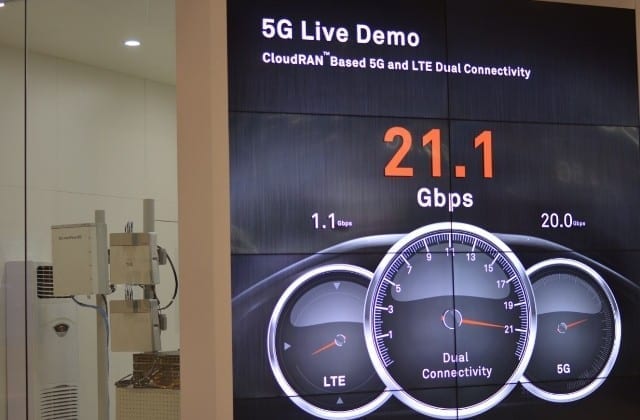
    Huawei has conducted a live demonstration involving 5G and LTE dual connectivity for a 4K video-on-demand service, achieving single user peak throughput of 21.1Gbps.

    At last week’s Global Mobile Broadband Forum, Huawei conducted a demonstration based on its CloudRAN architecture.

    With the development of new high-bandwidth services such as AR/VR and 4K video streaming and cloud-based services, Huawei said 5G new radio technologies will need to be deployed in central hotspots first to deliver the required capacity.

    LTE networks are meanwhile continuing to evolve with the introduction of new technologies including 3D Massive MIMO.

    Combining 5G and 4G networks has the potential to help operators protect their existing investments while improving network capacity, spectrum efficiency and coverage in urban areas.

    “It is of vital importance to guarantee end users with a ubiquitous high data rate experience in densely populated urban city areas with high buildings and complex roadways,” Huawei CMO of wireless network products Dr Yuefeng Zhou said.

    “Recently, 3GPP standardization has made significant progress in 5G and LTE dual connectivity. We expect to strengthen our cooperation with industry partners on 5G innovations based on these real application scenarios.”

  • DoCoMo achieves 11.29Gbps in 5G trial

    DoCoMo achieves 11.29Gbps in 5G trial

    NTT DoCoMo and Huawei have achieved a peak speed of 11.29Gbps during a 5G large-scale field trial in the 4.5-GHz band.

    The companies tested a 3GPP 5G New Radio compliant numerology and frame structure using macro cell coverage in a real-world scenario in Yokohama’s busy Minato Mirai 21 commercial district.

    The trial also achieved a sub-0.5ms one way user plane latency. The macro cell was made up of one base station compatible with the 4.5-GHz band and 200 MHz bandwidth, as well as 64 transceivers and 23 user equipment devices.

    According to the test, 11.29Gbps of user throughput was achieved in 24 layers, with each UE receiving two layers. Peak spectrum efficiency reached 79.82bps/Hz/cell.

    “Our success in 5G large-scale field trial in the 4.5 GHz band has brought the whole industry one step closer to 5G commercialization by 2020,” commented Takehiro Nakamura, DoCoMo’s VP and 5G Laboratory managing director.

    “DoCoMo and Huawei have been expanding their collaboration on 5G from R&D to international spectrum harmonization initiatives for 5G since December 2014. Together with Huawei, we will continue to promote 5G both from technical and ecosystem perspective.”

  • Global 5G subscribers to reach 500m by 2022

    Global 5G subscribers to reach 500m by 2022

    Global 5G subscriptions will grow rapidly once the technology is available, Ericsson has forecast, with the vendor predicting that subscriptions will reach 500 million by 2022.

    North America is expected to lead the way in 5G uptake, with 5G projected to account for 25% of subscriptions in the region by 2022. But APAC will be the second fastest growing region, with 5G accounting for 10% of subscriptions.

    Ericsson’s latest Mobility Report also projects that global mobile subscriptions will grow to 8.9 million, with 90% of these for mobile broadband, and 6.1 billion unique subscribers in 2022.

    As of the third quarter of this year, there were 84 million new mobile subscriptions being added per quarter, for a total of 7.5 billion. India had the most net additions for the third quarter of 15 million, followed by China’s 14 million, Indonesia’s 6 million and Myanmar and the Philippines’ 4 million each.

    By the end of 2016 there will be 3.9 billion smartphone subscriptions worldwide, Ericsson said, with nearly 90% of these registered on WCDMA/HSPA and LE networks. This is expected to grow to 6.8 billion and 95% of subscriptions by 2022.

    The report also shows that mobile video is projected to grow by 50% annually through to 2022 to account for nearly 75% of all mobile data traffic. Increased use of live video streaming to contact friends, family and followers is meanwhile expected to contribute to a 39% annual growth in social media traffic.

    Finally, the report suggests that IoT will account for around 18 billion of the 29 billion connected devices forecast by 2022.