Tag: bank

  • VN-Index plunges with rising trade

    VN-Index plunges with rising trade

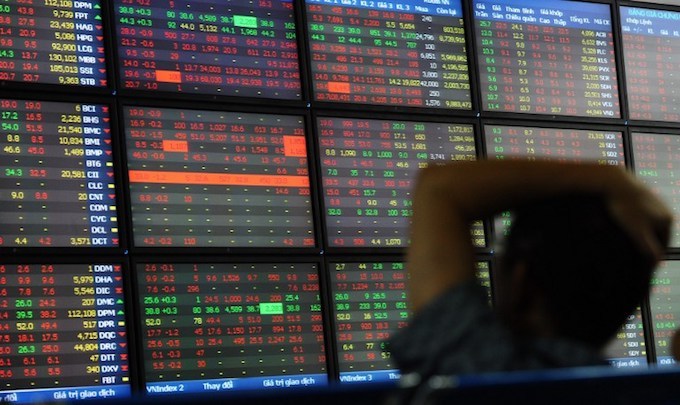
    Vietnam’s benchmark VN-Index dropped 1.56 percent to 1217.30 points Friday with trading value rising double-digit.

    The index closed 19 points lower after gaining nearly 23 points on Thursday. It has lost 67 points this week as global markets plunged due to concerns of inflation and disrupted supply chains.

    Trading on the Ho Chi Minh Stock Exchange (HoSE) increased by 17.5 percent to VND17.33 trillion, highest in four sessions. The VN-30 basket, comprising the 30 largest capped stocks, saw 22 tickers dropped.

    SSI dropped 7 percent to the lowest since March last year in its seventh losing session in a row.

    It was followed by eight banking stocks, losing between 6.4 percent and 3.6 percent, including MBB of lender MB, TPB of private TPBank and CTG of state-owned lender VietinBank.

    Five blue chips rose, with MSN of conglomerate Masan Group rising 5.7 percent and GAS of state-owned Petrovietnam Gas gaining 4.7 percent.

    Foreign investors were net buyers to the tune of VND309.68 billion, mainly picking up HPG of steelmaker Hoa Phat Group and VND of brokerage VNDirect.

    The HNX-Index at the Hanoi Stock Exchange, where mid and small caps list, was down 2.68 percent while the UPCoM-Index at the Unlisted Public Companies Market was down by 2.41 percent.

  • UBS to Stand Trial in French Harassment Case

    UBS to Stand Trial in French Harassment Case

    The French subsidiary of UBS must stand trial on suspicion of harassment. The focus is on the French subsidiary’s alleged crackdown on whistleblowers.

    UBS has suffered a defeat in France before the country’s Court of Cassation, one of the four courts of last resort in the country. The French branch of Switzerland’s largest bank must now stand trial for the alleged harassment of two whistleblowers who revealed tax fraud. The focus is on the French subsidiary’s alleged crackdown on whistleblowers.

    The decision of the court was viewed by the «AFP» news agency on Thursday. In a ruling on Tuesday, France’s highest court rejected appeals by the bank against its summons to appear before the Paris criminal court, according to Swiss news agency AWP.

    The former head of internal audit, Nicolas Forissier, as well as former event and communication manager Stéphanie Gibaud, helped get the tax fraud case against the major Swiss bank rolling in France, resulting in UBS being investigated for tax fraud.

    A lawyer for UBS France did not respond to inquiries from the French news agency AFP.

  • UBS Adds Private Banking Trio for Southeast Asia

    UBS Adds Private Banking Trio for Southeast Asia

    UBS’ global wealth arm has expanded its coverage of Southeast Asian high net worth individuals with the appointment of three new private bankers.

    Maria Lourdes Kristen Quintos joins UBS as a senior client advisor focusing on ultra-high net worth (UHNW) clients, according to an internal memo.

    Quintos has over 35 years of banking experience, most recently at Maybank ATR Kim Eng Capital Partners Inc. where she was its president and chief executive officer. Previously, she was also a chief representative at Bank of Singapore in Manila serving high net worth (HNW) clients, institutions and pension funds.

    In addition, Nicolo Nicandro and Natalie Boey have also joined UBS as client advisors focusing on HNW and UHNW clients in the Philippines.

    Nicandro was previously a senior associate and investment counselor at Bank of Singapore in Manilla where he advised and managed global multi-asset portfolios for private clients. Boey held a similar role at Citi where she spent nearly 15 years, including 10 years of focus on Philippines market coverage.

    The three new additions join the bank’s global wealth management APAC Thailand and Philippines business sector.

    A spokesperson for the bank confirmed the contents of the memo.

  • Hong Kong Must Reopen to Remain a Financial Hub

    Hong Kong Must Reopen to Remain a Financial Hub

    Outgoing city chief executive Carrie Lam makes frank comments to CNBC before her departure at the end of the month.

    Hong Kong’s embattled chief executive Carrie Lam, who has faced a difficult, tempestuous five-year term that included the 2019 pro-democratic protests, the subsequent introduction of the city’s National Security Law, and the Covid-19 pandemic, appeared to be more forcefully speaking her mind than had previously been the case in an interview with CNBC on Friday.

    She apparently indicated to viewers that the city could not continue to function as a financial hub if the current border controls remain in place, as this has made people impatient.

    The border control measures have really made people very impatient. Of course, they’ve undermined Hong Kong’s status as a hub. If you cannot travel freely to other places and into the mainland, how could you be a hub?

    Despite recent steps to relax some pandemic restrictions, Hong Kong continues to require a 7-day quarantine for any foreign arrivals. It also continues to employ extensive contact tracing and testing requirements city-wide, among other measures.

    Lam discussed the departure of foreigners and expatriates, saying that this was not due to the National Security Law, but the extent and duration of the strict pandemic controls. Other topics that were discussed included the one country, two systems governing principle in Hong Kong, which she believed had been mischaracterized by overseas media.

    I sometimes find it very disturbing that a lot of Western media try to portray Hong Kong as just another Chinese city and have no proper recognition or understanding of one country, two systems, Carrie Lam said.

    She maintained that freedom of expression, assembly and media continued to be upheld in the city.

  • Vietnam urges banks to merge, become more competitive

    Vietnam urges banks to merge, become more competitive

    The Vietnamese government is urging banks to merge and increase their scale toward becoming more competitive. It wants to make Vietnam an ASEAN leader in the banking sector.

    The government wants banks to have a capital adequacy ratio of at least 10-11 percent by 2023, and 11-12 percent by 2025, according to a recent plan to restructure credit organizations and handle bad debts during the 2021-2025 period.

    The capital adequacy ratio is a measure of how much capital a bank has available to handle a certain amount of loss before facing the risks of becoming insolvent.

    The government has said it wants Vietnam’s banking sector to become a top four leader in the ASEAN bloc. It has asked banks to make plans to increase their charter capital and improve their management.

    Big banks should have a minimum charter capital of VND15 trillion by 2025, and small and medium banks, VND5 trillion, it said.

    The government also wants banks to have a bad debt ratio of under 3 percent by 2025.

    Vietnam has 31 domestic commercial banks, with the biggest in terms of charter capital being state-owned lenders BIDV, Vietinbank and Vietcombank, according to the State Bank of Vietnam.

  • A German Bank Wants its Customers to go Cashless

    A German Bank Wants its Customers to go Cashless

    In a country where cash has been king for decades, Deutsche Bank will stop allowing customers to pick up cash at its counters.

    There is a German adage that Geld Stinkt Nicht, which translates into money doesn’t stink, and helps to explain the country’s strong, and perhaps a stereotypical, preference for cash over the years. Deutsche Bank is seeking to change that.

    In tapping into another German trait, that of frugality, Lars Stoy, who heads domestic retail banking operations of Germany’s largest commercial bank said at an investor conference that «In the future, I don’t want to offer cash in the branches anymore, because holding cash incurs costs.

    While not specifying a timeline for the changes, Stoy said that cash would only be offered in a few large centers and that generally, he wants to further reduce the number of branches in Germany.

    The main task of the branch is sales along with “advising customers on investments, mortgages, to a certain extent on consumer loans and insurance. Once that is the case, then the branches will be profitable again, Stoy said.

    Moreover, the plans are in response to changes in customer behavior, with the trend toward cashless payments significantly increasing, while at the same time demand for personal advice is also on the rise, Stoy said.

    In terms of cash supply, Deutsche Bank will maintain a nationwide network of ATMs adding that money can also be withdrawn at supermarkets or gas stations.

  • Deutsche Bank Raided Over Alleged Greenwashing

    Deutsche Bank Raided Over Alleged Greenwashing

    German prosecutors raided the offices of asset manager DWS and its controlling shareholder Deutsche Bank over allegations of «greenwashing,» according to media reports.

    Deutsche Bank and its around 80 percent-owned asset manager DWS were raided over allegations DWS misled investors about how green the investments marketed as green or greener really were, the reports said.

    The move may send shivers down the spine of investors globally as green investments, or investments marketed as using environmental, social and governance (ESG), indicators have surged in popularity. In early 2021, global ESG assets were projected to top US$53 trillion by 2025, or more than a third of the projected total of assets under management of US$140.5 trillion in that timeframe.

    The German authorities said they were responding to news reports and a whistle-blower’s allegations about DWS’ marketing tactics greenwashing its offerings, adding sufficient factual evidence has emerged about how little ESG factors were allegedly used to determine investments.

    DWS and Deutsche Bank have previously said they would cooperate with authorities, and DWS repeated its denial of the allegations. Deutsche Bank said the raid was directed at unknown people in connection with the DWS allegations.

    DWS has stopped using the label ESG integrated, in a move that came after DWS’ former sustainability head, Desiree Fixler, alleged the label didn’t result in meaningful moves by fund managers. Fixler was fired last year, and lost her unfair dismissal case in Frankfurt in January.

    Both U.S. and German regulators had begun investigations in 2021 into allegations from Fixler over potential greenwashing, «Reuters» said, noting both U.S. and EU regulators are working to create rules to define greenwashing.

  • UBS to Launch Banking App in Singapore

    UBS to Launch Banking App in Singapore

    UBS will soon be launching a new app in Singapore, CEO Ralph Hamers announced. UBS CEO Ralph Hamers announced that the world’s largest wealth manager will launch its Circle One digital product in Singapore on Tuesday. If successful, the new app which is designed to connect investors with ideas in a global ecosystem could be used in other markets.

    The offering is the latest digital effort from UBS, having launched its Key4 initiative last week.

    Hamers also commented on the financial markets during the interview at the World Economic Forum in Davos, noting investors are inclined to stay at the moment, given the market volatility. While clients are not necessarily exiting the market, they’re not exactly investing either, noting they are more or less sidelined and waiting for things to clear up, he said.

  • UBS Data Thief Headed for Prison

    UBS Data Thief Headed for Prison

    An appeal by a former UBS banker who was convicted in absentia of espionage was denied by Switzerland’s highest court.

    The banker, only known as Rene S. was convicted of selling the data of wealth clients to tax authorities in Germany, and sentenced to 40 months in prison and fines and court costs of over 125,000 Swiss francs.

    In 2020, the verdict was upheld by an appeals court, and was again by the Swiss Federal Court, dismissing an argument that the lower appeals court did not correctly conduct the proceedings.

    At the heart of the case was the accusation that Rene S. pocketed 1.1 million euros ($1.14 million) from the sale of the documents and moved to a small town in Germany near the Swiss border.

    Swiss banks have paid billions in settlements related to charges they made it possible to wealthy foreigners to hide their wealth.

    Earlier this week, an attempt to change Swiss banking secrecy laws to exempt whistleblowers and journalists was blocked by lawmakers

  • UBS Appears to be Mapping out a Digital Roadmap

    UBS Appears to be Mapping out a Digital Roadmap

    Many banks are making digital products an essential part of their offerings. It looks like UBS is joining the fray. UBS, Switzerland’s largest bank as registered several new brand names in the Swiss trademark register.

    Among the new brands are UBS Key4 banking, UBS Key4 wealth, and UBS Key4 business, which have been registered and are now legally protected product names of the bank.

    To date, however, Key4 is only the name of the online portal by which UBS has been selling its own and third-party mortgage loans since 2020. According to the report, the registrations of the new trademarks could indicate UBS is in the process of building additional brands for a future digital business.

    UBS rival Credit Suisse launched a digital product in 2020 and trades under the name CSX.

  • Saxo Bank: Female Investors Pile In to Stocks

    Saxo Bank: Female Investors Pile In to Stocks

    Inflation has finally managed what banks have been trying to for years – get women investors into equities, CEO George Falkner said.

    Everything is becoming more expensive but I am not getting anything on my account: George Falkner has been hearing that often. Although he has only been running the Swiss online arm of Danish lender Saxo Bank since last December, he has dealt with the pandemic, the Ukraine war, rising interest rates – and higher inflation. According to him, those same factors are driving his clients and an increasing proportion of them are women.

    One-third of our new clients are female», the CEO said, who finds himself running a pure-play digital bank after a career in investment and private banking. Inflation appears to be a driving impulse, he observes. They want to understand the forces that are driving inflation and figure out how to protect their assets against it.

    We see that women investors are more long-term oriented and not as interested in trading, Falkner conveys. They also appear to be particularly interested in material assets such as precious metals.

    That fits in well with the investment business that Saxo wants to build up in Switzerland. Although trading remains the online bank’s most important pillar, it is also on the look for revenues from medium- and long-term-oriented investors. Inflation has been a surprising driver in all of that as it attracts a younger – and more female – clientele.

    According to Falkner, Saxo Switzerland has been registering twice as many new investment clients as trading clients, with first-quarter 2022 revenues being up 15 percent from a year earlier.

    Looking back at 2021, he remembers how almost couldn’t onboard everyone, Falkner indicates. Yet purely from a performance perspective, 2021 was weaker than a year earlier, as the bank reported Wednesday. Net profit fell slightly to 7.7 million Swiss francs ($7.9 million). Operating revenues fell to 22.1 million francs from 25.3 million a year earlier. According to Falkner, that is partly due to the acquisition of Strateo, a domestic competitor.

    Saxo has also been drawing younger investors through its white label partnership with robo-advisors such as Selma Finance, Truewealth, and Invoya, which use it as a trading platform, and which are growing strongly. Some are seeing several hundred new clients a month, he says. It also comes after a long dry spell for bot-driven managers in 2019.

    This has all led to Switzerland becoming the third best market for the Scandinavian group, according to Falkner. In May, he wants to start testing something Saxo has been doing in Denmark – holding evening investment seminars for women. He wants to hold the first in a flower shop and he already has more than 200 guests signed up. But he himself will not be going, he emphasizes, as the event is women only.

  • Google Joins Swiss Open Banking Initiative

    Google Joins Swiss Open Banking Initiative

    Switzerland’s Openwealth initiative gains momentum as one of the world’s largest cloud providers becomes a member.

    Google Cloud becomes the latest addition to the Openwealth Association, joining as an API service provider, the organization announced on Thursday.

    The application programming interface (API) allows third-party providers to dock with IT platforms, in this case, banks and wealth managers. As a leading cloud provider, Google Cloud will allow Openwealth to disseminate the API standard globally.

    Apigee, Google’s API management platform, is one of the most widely used open API publishing software solutions in the world, used by many OpenWealth members, it said.

    The Swiss industry initiative aims to standardize the interfaces of a wide range of institutions and simplify data exchange between custodian banks and portfolio management system providers and custodian banks themselves.

    Google joins UBS, Credit Suisse, Julius Baer, ZKB, and SIX, among others, in the industry initiative.

  • No Back to the Office at UBS

    No Back to the Office at UBS

    The transition to a new working culture at UBS is well underway as many employees adopt agile working methods, while others gain total freedom.

    Around 10,000 – or one in ten – employees at Switzerland’s largest bank now work according to agile working methods, the bank said in its earnings release Tuesday.

    Agile, which is often used in software development where product cycles are short and requirements for a solution can change quickly, has the objective of making teams more efficient and flexible. It is central to CEO Ralph Hamers’ grand plan to foster a culture of engineers at UBS.

    Flexibility is also a priority when it comes to the bank’s working arrangements: In the USA, the bank is offering certain employees the possibility to work completely from their home office, while continuing to support hybrid working methods in other locations.

    In Swiss banking, a 40 to 60 percent rule for remote working could become the new standard, and one adopted by Credit Suisse last month.

  • UBS Weathers First Quarter Headwinds

    UBS Weathers First Quarter Headwinds

    Switzerland’s largest bank UBS has weathered multiple first-quarter headwinds, turning its best first-quarter net profit in over a decade. UBS reported Tuesday a net profit of $2.1 billion in the first quarter, exceeding expectations, showing the bank was able to steer a course through several challenges in the first quarter and posted its best first-quarter results since 2007.

    The result improved on the $1.3 billion reported for the fourth quarter of last year and was better than the $1.8 billion booked during the first three months of 2021.

    Switzerland’s largest bank accomplished this in the face of the Ukraine war, inflation showing no signs of abating anytime soon, and central banks that are tightening the loose-money spigots. «Our strong results today speak to our ability to accomplish our objectives regardless of the backdrop,» said UBS CEO Ralph Hamers.

    UBS said it reduced its Russia exposure early and actively and had a direct country exposure of $400 million as of March 31 of 2022. It expects a firm-wide P&L negative impact of $100 million.

    The bank said it is not conducting any new business in Russia or with Russia-domiciled clients. However, it will continue to monitor settlement risk on certain transactions with Russian bank and non-bank counter parties, which might result in unexpected increases in exposures.

    Pre-tax profit was $2.7 billion, improving by one billion dollars from the fourth quarter result of $1.7 and bettering the comparative year-ago quarter of $2.3 billion.

    Earnings per share were $0.61 in the first quarter, up from $0.38 in the fourth quarter of last year and higher than the $0.49 reported during the first quarter of 2021, the results showed.

    Global wealth management (GWM) booked a pre-tax profit of $1.3 billion, with the unit reporting net new fee-generating assets of $19 billion in the first quarter compared to 36.2 billion in the same year-ago quarter. Total fee-generating assets were $3.1 trillion As of the first quarter of last year, the GWM unit no longer reports net new money every quarter, and will only disclose the figure in its annual report.

    Earlier this month, finews.com reported that 2021 was a bumper year for Swiss banks attracting new money inflows. But this year, wealth and asset managers are facing geopolitical and economic uncertainty resulting from the ongoing war in Ukraine and inflation showing no sign of abating anytime soon. Add to the mix central banks that are starting to close the taps of easy money flowing into financial markets.

    The investment bank’s division’s 126 percent pre-tax profit growth from the comparative quarter was mainly attributable to Archegos-related losses in the same quarter last year. Excluding that loss, revenues increased by 4 percent, or just over $100 million, primarily from increased revenues in equity derivatives, rates, and foreign exchange.

    While the path of economic growth has become much more uncertain, UBS expects growth in economic activity to continue, but increased uncertainty could continue to affect client activity levels and asset prices. However, even as central banks are tightening policy to arrest rising inflation, the banks said that rising interest rates, notably the US dollar, are expected to lead to higher net interest income.
  • UBS Currently Sees Little Hope for Credit Suisse

    UBS Currently Sees Little Hope for Credit Suisse

    Switzerland’s two major banks are usually cautious about rating each other’s shares. But right now, UBS sees little potential in its rival. Credit Suisse’s share continued to lose value and they are now trading just above 7 Swiss francs ($7.3) after it made a warning earlier this week that it would report a first-quarter loss. There is little to suggest that the stock will recover in the foreseeable future, especially after CEO Thomas Gottstein spoke of 2022 as a transition year. Now, many bank analysts seem to be chiming in with the same view.

    British investment bank Barclays lowered its price target for Credit Suisse shares from 7.50 francs to 7.00 francs on Thursday, with their banking specialist, Amit Goel, rating the stock as underweight, which ultimately can be interpreted as a recommendation to sell.

    UBS banking analyst Daniele Brupbacher was a little less harsh on his employers’ rival, giving Credit Suisse shares a twelve-month price target of CHF 7.40 and rating the stock as neutral earlier this week. So while not advising to sell, he is advising against buying it even at such a low price.

    When the two major Swiss banks rate each other, they usually do so rather cautiously. Although they are ultimately competitors, they also play a decisive role in shaping the Swiss financial center. And no one is interested in having just one big bank in the future.

    In an interview earlier this year, UBS CEO Ralph Hamers said that it’s never a good thing when a competitor has problems because the reputation of all banks suffers as a result.

    For decades, the business models of UBS and CS were quite similar, but have diverged over the past decade or so. UBS saw no need to repaint, merely touching up its success model, as former UBS Chairman Axel Weber liked to say. Credit Suisse has been laboring for years to make a new start without success, and scandal after scandal has beleaguered the bank.

    This is reflected in the performance of Credit Suisse’s share price and the corresponding ratings of UBS. The last time UBS banking analyst Brupbacher gave his rival shares a buy rating was in April of last year. At that time, the stock was trading at 9.73 francs, and UBS had formulated a price target of 10.80 francs.

    In December 2021, UBS downgraded Credit Suisse shares to neutral, mainly due to the ongoing turbulence surrounding the Greensill funds and the Archegos hedge fund, but also because then Chairman António Horta-Osório had not succeeded in giving the bank a new, credible strategy. UBS’s target price for Credit Suisse’s shares was 9.30 Swiss francs, cut again in February to 8.50 francs and now to 7.50.

    It is quite clear. From now on, there will definitely be one financial center – two business models – and the two competitors will open up a new capital in Swiss banking history. While UBS pulls away, Credit Suisse will be hard-pressed to avoid announcing personnel changes when it presents its quarterly figures next Wednesday. That is the only real way it can credibly hold out the prospect of a new start.