Retail News CRM

Tag: Business

  • Vietnam Achieves Impressive $7.6B Trade Surplus in First Half of the Year

    Vietnam Achieves Impressive $7.6B Trade Surplus in First Half of the Year

    Vietnam’s export landscape has painted a promising picture, showcasing a remarkable 14.4% rise in export earnings, while imports surged by 17.9%, culminating in a notable trade surplus of $7.63 billion, according to the National Statistics Office (NSO) under the Ministry of Finance.

    June Brings Strong Export Growth

    In June alone, the export turnover surged by 16.3% compared to the same month last year, a solid indication of vibrant market activity. While the domestic economic sector faced a slight 5.7% dip, the foreign-invested sector, including crude oil, rebounded with a striking 24.4% increase, demonstrating robust foreign confidence.

    Mid-Year Export Performance

    From January to June, Vietnam’s total export value climbed to $219.83 billion, reflecting a 14.4% increase year-on-year. The domestic sector contributed $58.28 billion—an uptick of 9.4%—accounting for 26.5% of total exports. In contrast, the foreign-invested sector, which includes crude oil, saw a remarkable contribution of $161.55 billion, up 16.4%, thus representing 73.5% of all exports.

    Export Giants Take Center Stage

    A total of 28 export items broke the $1 billion barrier, collectively comprising a staggering 91.7% of the total export value. Impressively, nine items exceeded $5 billion in value, contributing 72.3% to the overall sums. Processed industrial goods firmly held their ground as the export champions, generating $194.28 billion and accounting for 88.4% of the total. Agricultural and forestry products added $19.12 billion (8.7%), while seafood reached $5.11 billion (2.3%), and fuel and mineral products totaled $1.34 billion (0.6%).

    Import Landscape and Trade Dynamics

    On the import front, Vietnam’s spending tallied up to $212.2 billion over the first half of the year, marking an increase of 17.9% year-on-year. A striking 33 imported items exceeded $1 billion in value, representing an impressive 89.0% of total imports, with six surpassing the $5 billion mark, accounting for 56.8% of the overall figures.

    The United States stood as the largest importer of Vietnamese goods during the first half, with turnover reaching $70.91 billion, while China remained the biggest source of imports into Vietnam, valued at $84.7 billion. Notably, Vietnam’s trade surplus with the U.S. reached $62 billion, a significant 29.1% increase from the previous year. The surplus with the EU also saw a healthy expansion of 11.6%, amounting to $19 billion. Adding some sparkle to the numbers, Vietnam’s trade surplus with Japan soared to $1.2 billion, up a staggering 69.1% compared to the same period last year.

    Deficits with Key Partners

    Despite these triumphs, challenges remain, as Vietnam continues to face trade deficits with several major partners. Notable among these are China, with a deficit of $55.6 billion (up 42.2%), the Republic of Korea at $14.6 billion (up 0.1%), and ASEAN nations collectively at $7.5 billion (an increase of 67.4%).

    Questions & Answers

    What drove the significant increase in Vietnam’s exports during the first half of 2023?
    The surge in exports can be attributed mainly to the performance of the foreign-invested sector, which saw an impressive growth of 24.4%, particularly in processed industrial goods.

    How did Vietnam’s trade surplus with the U.S. compare to previous years?
    Vietnam’s trade surplus with the U.S. rose to $62 billion, marking a substantial 29.1% increase from the previous year, underlining the strength of this trading relationship.

    Which countries are key players in Vietnam’s import and export dynamics?
    The U.S. remains Vietnam’s largest market for exports, while China is the predominant source of imports, showcasing the complex interdependence within the regional trade landscape.

  • Indonesia’s Fixed Communication Services Market Projected to Reach $3.7 Billion by 2029

    Indonesia’s Fixed Communication Services Market Projected to Reach $3.7 Billion by 2029

    Indonesia’s fixed communication services market is poised for steady growth over the next five years, with projections indicating a rise to USD 3.7 billion by 2029, up from USD 3 billion in 2024, according to recent analysis by GlobalData. This anticipated surge signifies a significant leap in the sector, reflecting the country’s ambitious digital aspirations.

    Broadband Boom: The Driving Force Behind Growth

    The primary catalyst for this growth is the expanding fixed broadband segment, expected to grow at a compound annual growth rate (CAGR) of 4.3%. The Indonesian government’s commitment to enhancing high-speed internet access plays a crucial role, aiming for affordable speeds of up to 100 Mbps to support digital inclusivity and national transformation initiatives.

    The Twilight of Fixed Voice Services

    Conversely, fixed voice services are on a downward trend, projected to decline at a CAGR of 1.3%. This drop can be attributed to a shrinking base of circuit-switched subscriptions and a decrease in average revenue per user (ARPU), as more consumers pivot to over-the-top (OTT) and app-based communication channels. It seems we are saying goodbye to the days of home phone lines, one fiber optic cable at a time!

    Fiber Optics: Connecting the Future

    Fiber lines currently hold an impressive 83.1% market share of total fixed broadband lines in 2024 and are expected to maintain their dominance through 2029, noted Neha Mishra, Telecom Analyst at GlobalData. This trend is fueled by a surging demand for reliable, high-speed broadband services and the government’s ongoing push for a nationwide fiber rollout.

    Rising Competition and the Quest for Connectivity

    As service providers work diligently to extend high-speed connectivity to underserved regions, a competitive landscape is emerging. Competition will likely center around service differentiation through bundled offerings, network reliability, and customer experience. Operators that invest strategically in infrastructure and innovate in pricing strategies are set to capture long-term value in what is becoming an increasingly digitally empowered Indonesia.

    Questions & Answers

    What is the projected growth of Indonesia’s fixed communication services market?
    The market is expected to grow to USD 3.7 billion by 2029, up from USD 3 billion in 2024.

    What segment is driving this growth?
    The expanding fixed broadband segment is the main driver, projected to grow at a compound annual growth rate of 4.3%.

    How are fixed voice services performing in Indonesia?
    Fixed voice services are expected to decline at a CAGR of 1.3% due to a decrease in circuit-switched subscriptions and a shift towards OTT communication methods.

  • Seoul Bankruptcy Court Approves Homeplus Sale To Repay Debt, Protect Jobs

    Seoul Bankruptcy Court Approves Homeplus Sale To Repay Debt, Protect Jobs

    The Seoul Bankruptcy Court has given the green light to the sale of South Korean grocery retailer, Homeplus. The decision was driven by a need to generate capital for debt repayment and to safeguard jobs within the company.

    Earlier this year, MBK Partners, the private equity firm that owns Homeplus, sought court intervention for the restructuring of the company. This marked a significant reversal in fortunes for a deal that originally cost US$6.1 billion over ten years ago.

    A representative from MBK announced on Friday that the firm is fully supportive of the successful sale of Homeplus. They also revealed plans to negate 2.5 trillion won (US$1.83 billion) worth of common shares they hold in the company as part of the sale.

    The court has mandated the appointment of accounting firm Samil PricewaterhouseCoopers to oversee the sale. This process is expected to take two to three months, according to a court statement.

    The sale is seen as a pivotal move to raise funds for the company, repay debts to creditors, and secure the employment of Homeplus workers. Simultaneously, the court believes this strategy will safeguard partner firms by averting bankruptcy.

    Questions & Answers

    Why is Homeplus being sold?
    The sale of Homeplus was approved by the Seoul Bankruptcy Court to generate funds to repay debts and to ensure job security for the company’s employees.

    Who is managing the sale of Homeplus?
    The court has appointed the accounting firm Samil PricewaterhouseCoopers to manage the sale of Homeplus.

    What role does MBK Partners play in the sale of Homeplus?
    MBK Partners, the private equity firm that currently owns Homeplus, has expressed full support for the sale. They plan to write off 2.5 trillion won ($1.83 billion) of common shares they hold in the company as part of the sale.

  • Samsung ‘shock’ as profits start to droop

    Samsung ‘shock’ as profits start to droop

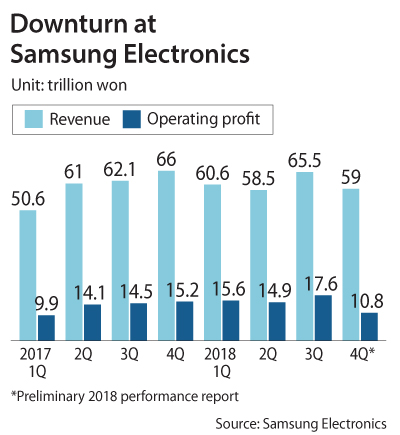
    Samsung Electronics announced sharply lower earnings for the fourth quarter, an earnings “shock” that suggested that the “supercycle” in the global semiconductor market is nearing an end. Preliminary 2018 performance numbers released Tuesday predicted the local IT giant’s operating profit between October and December of last year would be 10.8 trillion won ($9.6 billion), down 28.71 percent year on year.

    This is the lowest figure since the first quarter of 2017’s 9.9 trillion won. Between those two quarters, operating profit had consistently stayed in the 14 to 17 trillion won range.

    Revenue for last year’s fourth quarter slumped 10.58 percent year on year to 59 trillion won. Last year’s third quarter saw record quarterly highs of 65.5 trillion won in revenue and 17.6 trillion won in operating profit.

    Local analysts had expected 13.4 trillion won in operating profit for the fourth quarter and 63.2 trillion won in revenue, according to the stock information provider FnGuide.

    Samsung did not reveal performance figures for different business divisions, but the company cited “slow demand” in semiconductors as a major factor in a public announcement the same day. The IT giant has three major business divisions: chips, smartphones and home electronics.

    The results for all of 2018 showed that the company had a record high operating profit of 58.89 trillion won, a 9.77 percent jump from last year, and 243.5 trillion won in revenue, up 1.64 percent year on year.

    Before starting to slow, semiconductors were the main contributors to Samsung’s high performance over the last two years.

    In the announcement, the company added that demand from data center clients in the fourth quarter had fallen short of expectations.

    “Shipping of memory chips retreated from the third quarter, and the price decline turned out to be bigger than what we expected earlier this year,” it said.

    One reason is because companies with data centers such as Amazon, Facebook and Microsoft bought large amounts of dynamic random-access memory (DRAM) chips during the last two years, which are now piling up.

    DRAM prices started to fall after more than a year of increases – another factor that is affecting demand as companies anticipate more price cuts.

    Slow growth in smartphone sales and one-off expenses including the company’s offering of incentives to staff at the year’s end also affected the profit level.

    Worries that the semiconductor supercycle was ending have surfaced for years, but Samsung and other chipmakers have reported strong earnings – until the fourth quarter.

    December’s chip exports from Korea retreated for the first time in 27 months. The general consensus among local analysts is that Samsung’s revenue will continue to shrink in the first half of this year.

    But they have a more positive outlook for the second half.

    “Memory chip prices will bounce back in the second half of 2019,” said analyst Lee Jae-yun of Yuanta Securities. “Because the supply growth rate of major chipmakers in 2019 will be 19 percent [year on year], whereas demand growth is expected to reach 20 percent.”

  • Lululemon and employer branding

    Lululemon and employer branding

    Lululemon Athletica Inc. is beefing up benefits to attract and retain workers, offering full-time employees from three to six months of paid parental leave. The gender-neutral benefit awards three months of paid leave to full-time workers who have been at the yogawear company for two years. Employees with five or more years at the firm qualify for six paid months off. At Lululemon, workers are considered full-time if they work 24 hours a week.

    “When you think about an investment, there’s also all of those areas where it’s really hard to quantify because of the contribution and the return,” said Susan Gelinas, senior vice president for people and culture at Vancouver-based Lululemon. “We just see this as something that’s right to do for our people.”

    In the U.S., without any federal requirement for paid parental leave, it’s up to individual companies to offer a benefit, and about 35 percent do, according to a survey from the Society for Human Resource Management. Still, 84 percent of workers in the U.S. don’t have access to paid family leave, according to data from the Bureau of Labor Statistics.

    The majority of Lululemon’s full-time staffers in the U.S. have been with the company for two or more years, while one-fifth have worked there five or more years. As of January 2018, about 60 percent of Lululemon’s 13,400 workers were based in the U.S. The company declined to say how much the new policy would cost.

    Employees working in Canada already receive some paid parental leave, a portion of which comes from the government’s unemployment insurance program. That compensation is partial, and Lululemon’s offer there is a “paid top-up,” Gelinas said in an interview.

  • Luk Fook sales drop 10 per cent in latest quarter

    Luk Fook sales drop 10 per cent in latest quarter

    Luk Fook sales in the third quarter fell 10 per cent on a same-store basis. “Recent market sentiment has been adversely impacted by the US-China trade war, the depreciation of Renminbi, and downward pressure in the stock and property markets,” said chairman Wai Sheung Wong ina  stock exchange filing. Luk Fook says same-store sales of gold products fell by 9 per cent and of gem-set jewellery by 8 per cent.

    The company’s disappointing figures come in the same week as rival jeweller Chow Tai Fook reported an 11 per cent decline in sales across Mainland China, Hong Kong and Macau.

    Wong said the Renminbi’s depreciation led to higher tendency for customers to purchase lower-value items, resulting in a double-digit drop in the average selling price of gem-set jewellery products.

    Same-store Luk Fook sales in Mainland China fell by 14 per cent, with gold products down 16 per cent and gem-set jewellery down 5 per cent.

    As at December 31 the company operated 221 of its own Lukfook stores, including 150 on the mainland, 49 in Hong Kong, 11 in Macau and 11 overseas. It supplied 1573 licensed shops on the mainland, one in Cambodia and one in the Philippines, making a total of 1796 worldwide.

  • Grab, Vinasun to negotiate $1.8 million compensation dispute

    Grab, Vinasun to negotiate $1.8 million compensation dispute

    Top taxi firm Vinasun and ride hailing firm Grab have told the court that they’ll negotiate a compensation dispute. The People’s Court of Ho Chi Minh City on Friday approved the litigants’ wish to ‘sit together,’ and temporarily suspended the trial. The suspension of trial is for no longer than a month, and the reopening date will be announced later, the court said.

    “The lawsuit has dragged on for over a year, but the claimant was not able to prove the damage, as well as the causal relationship with Grab’s influence. The defendant is also very worn out wasting time defending a wrong it did not commit,” said Luu Tien Dung, Grab’s lawyer.

    “This is one of the reasons why both sides have decided to negotiate,” he added.

    Vinasun filed the suit against Grab in June last year, accusing the Malaysia-based firm of abusing the Ministry of Transport’s pilot scheme and committing violations.

    It said Grab’s illegal activities were responsible for nearly VND42 billion (nearly $1.8 million) of the VND76 billion ($3.25 million) in losses that it suffered in 2016 and the first half of 2017.

    The trial began last February, but was adjourned a month later to allow for more evidence to be gathered. Grab protested the valuation of Vinasun’s losses.

    Last October, prosecutors asked the court to accept Vinasun’s petition for compensation of nearly VND42 billion (nearly $1.8 million) in one payment, dismissing Grab’s claim that it was a tech firm and not a taxi company.

    Grab responded by sending a letter to Prime Minister Nguyen Xuan Phuc, saying that identifying Grab as a taxi firm would be “a step backwards from Industry 4.0.”

    Under the latest draft of a decree prepared by the Transport Ministry, transport firms offering services with under 9-seater cars should be registered as taxi firms before they can apply ride-hailing technologies.

    This means that Grab and other ride-hailing firms would have to register their services again as taxi businesses and comply with corresponding legal responsibilities regarding their operating licenses, drivers’ profiles and tax duties.

  • Addressing Security Challenges: The Upsurge of AI in Business Operations

    Addressing Security Challenges: The Upsurge of AI in Business Operations

    The global marketplace is undergoing a seismic shift as companies rapidly embrace artificial intelligence. A recent McKinsey report reveals that 78% of organizations are already utilizing AI, and a staggering 92% plan to ramp up their investments in this transformative technology over the next three years. Gartner even predicts that by 2029, AI agents will take charge of a whopping 80% of customer interactions.

    However, riding the AI wave isn’t all sunshine and rainbows. The reality is that only 1% of firms can be classified as AI-mature. Alarmingly, a significant 70% of businesses falter during AI deployment, and about 85% of projects fail to meet expectations. Rather than being the panacea many hoped for, AI has entangled companies in a web of challenges, including breaches of sensitive data, mishandled operations, and sophisticated security attacks—each leading to reputational damage and financial hits that could sink a ship.

    Addressing the Challenges of AI Adoption

    These pressing challenges raise an essential question: How can businesses successfully and safely integrate AI into their operations? In today’s fast-paced tech environment, speed alone isn’t enough. The new gold standards are robust security, data privacy, and user protection.

    In a proactive move, OplaCRM—a growing SaaS company specializing in AI-driven CRM and B2B sales solutions—has forged a partnership with VinCSS, a prominent regional cybersecurity firm. This collaboration aims to establish a standard for cybersecurity across OplaCRM’s AI offerings.

    Innovating with Security in Focus

    As part of this partnership, OplaCRM will subject its products to rigorous penetration testing by VinCSS before they hit the market. This will enable swift identification and resolution of any security vulnerabilities lurking beneath the surface. Additionally, VinCSS will help incorporate password-free authentication, utilizing FIDO2-compliant passkeys to boost user experience while fortifying defenses against emerging threats tied to traditional credential systems.

    Through this alliance, OplaCRM doesn’t just bolster its own security measures; it also enhances the safety of its customers and end users. This synergistic approach is a win-win, proving that collaboration can yield significant benefits.

    Educating for a Secure Future

    The two companies are committed to engaging the wider business community through educational events focused on the secure adoption of AI. These sessions arm participants with practical insights to navigate risks, stay informed on industry trends, and develop secure roadmaps for AI deployment. In an era where AI is becoming part and parcel of business strategy, VinCSS and OplaCRM make it clear: cybersecurity is no longer optional—it’s imperative.

    Their collaborative efforts stand as a model of how technological innovation and robust security can go hand in hand, empowering businesses to tap into the full potential of AI while safeguarding their operations and customers.

    What would happen if an AI program gave an unexpected answer during a critical moment? Well, it might be a good time to double-check those security measures!

    Questions & Answers

    What percentage of companies are currently using AI?
    According to McKinsey, 78% of organizations utilize AI, with 92% planning to invest further in the next three years.

    What are the main challenges companies face when deploying AI?
    Major challenges include AI-induced data breaches, incorrect AI actions, and overall deployment failures, with 70% of companies facing struggles in this area.

    How does the partnership between OplaCRM and VinCSS enhance AI security?
    Their collaboration involves penetration testing of OplaCRM products, integration of password-free authentication, and a shared commitment to educating businesses on secure AI adoption.

  • Vietnam Investment Seminar 2025: Strengthening Vietnam-Taiwan Retail Partnerships

    Vietnam Investment Seminar 2025: Strengthening Vietnam-Taiwan Retail Partnerships

    On May 9, a significant event targeting global investors will unfold at the Hsinchu Science Park in Taiwan. The Vietnam Investment Seminar promises to deliver essential insights into Vietnam’s burgeoning investment landscape, emphasizing collaboration opportunities and attractive incentives for foreign direct investment (FDI).

    Vietnam: A Rising FDI Powerhouse

    Vietnam is rapidly establishing itself as a leading destination for foreign investments, buoyed by a stable political environment and competitive incentives. The country’s modernization efforts have enhanced its industrial infrastructure, making it an appealing choice for international investors. Among its many provinces, Vinh Phuc stands out for its favorable industrial land availability, strategic location, and robust government support for businesses.

    Event Collaborators: Bridging Taiwan and Vietnam

    The seminar is a collaborative initiative by CNCTech Industrial and the Taiwan Science Park Association of Science and Industry (ASIP). The event will feature representatives from various Vietnamese ministries, highlighting the importance of government engagement in fostering foreign investment. ASIP encompasses companies from Taiwan’s leading science parks, including Hsinchu—often termed Taiwan’s “Silicon Valley.” This setup offers participants direct access to numerous high-tech partners and insights into successful industry practices.

    What to Expect from the Seminar

    Participants can look forward to a wealth of knowledge and networking opportunities, including:

    • Expert Presentations: Detailed discussions on Vietnam’s FDI incentives, investment procedures, and competitive advantages.
    • Showcasing Vinh Phuc Province: Insight into the province’s dynamic growth and industrial capabilities.
    • Case Studies: Success stories from Taiwanese companies thriving in Vietnam.
    • Networking Events: Engage directly with Vietnamese government representatives, CNCTech Industrial experts, and Taiwanese high-tech firms.
    • Investor Support Services: A comprehensive overview of CNCTech Industrial’s offerings, which include legal consultations and factory management.

    CNCTech Industrial, part of the larger CNCTech Group, will also showcase its standardized industrial parks and extensive investor support ecosystem. With over 600 hectares of industrial land in Vietnam, the company has successfully attracted a variety of FDI enterprises from Japan, Taiwan, China, and South Korea.

    Strengthening Ties for Future Growth

    The Vietnam Investment Seminar 2025 aims to cultivate new business connections while aligning Taiwan’s innovative industries with Vietnam’s expanding industrial base. By enhancing these relationships, the seminar seeks to spur the next wave of investment into Vinh Phuc and beyond.

    Event Details

    • Date: May 9, 2025
    • Venue: Meeting Room 203, 2nd Floor, Industrial Park Association Building, No. 2, Chien Yeh 1st Road, Hsinchu Science Park, Taiwan
    • Registration: Participants must register by May 6 here.

    As the retail sector continues to evolve, events like the Vietnam Investment Seminar not only foster international collaboration but also pave the way for increased consumer choice and economic benefits. With a concerted focus on investment, Vietnam’s growth trajectory is set to benefit not just investors, but consumers looking for greater product variety and innovation.

  • Revolut Targets Swiss Market with Yield-Focused Retail Strategy

    Revolut Targets Swiss Market with Yield-Focused Retail Strategy

    Revolut is enhancing its presence in Switzerland by introducing flexible money market funds and virtual Swiss IBANs tailored for business clients.

    In an exciting development for the Swiss business landscape, Revolut has announced the launch of a product suite designed to empower companies with new financial tools. By offering flexible money market funds in multiple currencies and virtual Swiss IBANs, Revolut aims to enhance financial management for businesses of all sizes.

    Flexible Money Market Funds

    Starting immediately, Swiss customers using Revolut Business accounts—specifically those on Grow, Scale, or Enterprise subscriptions—can diversify their liquidity investments. Available in euros, US dollars, and British pounds, this offering democratizes access to financial products that were once primarily available to large corporations.

    Revolut highlights the attractive yield of its GBP-denominated fund, which offers variable returns of up to 4.08 percent (as of April 27, 2025). “This innovative fund allows business clients to grow their assets effectively,” stated Revolut in their announcement.

    Introducing Virtual Swiss IBANs

    In addition to flexible funds, Revolut is now providing virtual Swiss IBANs to streamline payment processes for businesses. The key features of this service include no costs for deposits and withdrawals, daily yield payouts, and convenient access to funds. James Gibson, Head of Revolut Business, expressed enthusiasm about these offerings, stating, “We are excited to support businesses of all sizes in managing their money efficiently and without high fees.”

    Strong Growth Momentum

    Revolut’s expansion into Switzerland is backed by impressive growth metrics. The company reports nearly 80 percent increase in monthly transaction volumes and a 63 percent rise in business deposits, reflecting a strong demand for its services among local enterprises.

    Future Considerations

    While Revolut is rolling out a broader range of services, such as FX forwards and enhanced integration with Swiss accounting software, the reception of foreign currency money market funds remains uncertain amid current market volatility. Over the past year, the Swiss franc has appreciated against major currencies, with the US dollar dropping approximately 9.5 percent against the franc, and the euro and pound also seeing declines.

    As Revolut continues to innovate, its new offerings stand to significantly impact the retail sector in Switzerland by providing businesses with cost-effective financial solutions. This expansion not only aligns with current consumer trends favoring digital banking but also reflects a broader shift in how companies manage their finances in an increasingly volatile economic environment.

  • Indonesia rolls out $52B stimulus package for 2025

    Indonesia rolls out $52B stimulus package for 2025

    Indonesia has unveiled economic stimulus packages totaling IDR827 trillion (US$51.65 billion) for 2025, designed to mitigate economic shocks and address the weakening purchasing power of low- and middle-income groups.

    The stimulus also aims to cushion the impact of an upcoming increase in the value-added tax (VAT) rate from 11% to 12%, set to take effect on January 1, 2025.

    Minister of Finance Sri Mulyani Indrawati said the stimulus measures are carefully designed to provide balanced support, particularly for lower-income segments of society, to ensure their financial stability despite the VAT increase.

    A significant portion of the stimulus, amounting to IDR265.6 trillion, will go toward VAT incentives that benefit a range of sectors. These include micro-, small-, and medium-sized enterprises (MSMEs), essential food staples, education, healthcare, transport, energy, low-cost housing, and financial services. Basic necessities like rice, meat, fish, eggs, vegetables, and milk will remain exempt from the VAT.

    The government and the House of Representatives have decided not to impose VAT on essential commodities needed by the public, she said, adding some IDR394 trillion has been allocated for energy subsidies and compensation, which will cover the costs of subsidised fuel, electricity, and LPG.

    To further support the economy, the government is allocating IDR129 trillion to social aid programmes, including food aid, subsidies for health insurance premiums, and easier access to unemployment benefits for laid-off workers.

    In the automotive sector, the government will offer tax incentives for electric and hybrid vehicles. Electric vehicles and hybrid cars will receive substantial tax breaks, including a 3% reduction in luxury taxes for hybrid vehicles.

    For labor-intensive industries, the government will provide tax exemptions, financing support, and 50% subsidies for workplace accident insurance to encourage job creation and economic growth in this sector.

    In the housing sector, the government would extend VAT exemptions for house purchases. The sector not only meets the public’s basic needs but also has a significant multiplier effect, creating jobs and stimulating economic growth, the minister said.

  • Viettel Cyber Security’s Free Service Uncovers Risks for Philippine Businesses

    Viettel Cyber Security’s Free Service Uncovers Risks for Philippine Businesses

    In response to the growing need for enhanced cybersecurity, Viettel Cyber Security (VCS) has launched a free, innovative cyber threat check service specifically designed for businesses in the Philippines.

    The service provides real-time alerts on threats such as data breaches and compromised company accounts, along with personalized recommendations. Customers can access the service by simply entering their domain, allowing the system to conduct an automated scan.

    The VCS free cyber threat check quickly evaluates a company’s cybersecurity status. Within minutes, businesses receive a detailed report outlining vulnerabilities and risks, complete with metrics, severity scores based on asset value and threat intensity, and actionable recommendations from VCS. This real-time, no-cost service offers expert insights, helping companies of all sizes proactively protect their digital assets, prioritize critical risks, and strengthen their defenses—without the need for complex setup.

    The VCS free cyber threat check report offers essential insights into cybersecurity risks, helping businesses identify and address potential vulnerabilities. The report detects:

    • Compromised Accounts: Provides details on any compromised accounts associated with the organization.
    • Data Leaks: Supplies information on data breaches that may have exposed sensitive information.
    • Brand Phishing: Identifies fraudulent websites and phishing attempts that imitate the organization’s brand.
    • Impersonation Threats: Detects unauthorized entities attempting to impersonate the brand or business.
    • Unusual Open Ports: Highlights any open ports that could pose security risks.
    • Malware Infections: Identifies systems within the organization that may be infected with malicious software.
    • Web Security and Protocol Configuration: Assesses the security settings of the company’s web assets.

    After completing the scan, VCS compiles the findings and offers customized recommendations, including actionable solutions for each identified vulnerability. This detailed report helps businesses proactively enhance their cybersecurity measures and effectively manage risks.

  • Record number of new firms seen in eight months

    Record number of new firms seen in eight months

    A record number of 103,658 new firms were established in the first eight months of this year, a rise of 2.3% year on year, the Ministry of Planning and Investment (MPI) reported.

    In August alone, the country saw more than 14,000 newly established businesses, up 17.9% year on year. However, the number of firms returning to the market in the month dropped 3.1% year on year and 10.9% month on month.

    In the January-August period, 149,400 enterprises newly joined and returned to the market, a slight drop of 0.03% year on year, but 1.2 times higher than the average figure recorded in the period from 2018-2022, the ministry said.

    The education sector saw the highest rise in the number of new firms at 35%, followed by the healthcare sector at 18.9%, and employment services, tourism, machinery and equipment rental and other supporting services 16.3%.

    However, the total registered capital of the newly established firms fell 14.7% year on year to VND969.61 trillion (over $40.2 billion).

    Meanwhile, in the reviewed period, 124,684 businesses withdrew from the market, up 19.5% year on year, including 71,833 businesses halting operations, 41,064 logging dissolving requests and 11,787 others dissolved.

    In order to support business development, Deputy Minister of MPI Tran Quoc Phuong said that along with applying flexible, active and effective monetary and fiscal policies and measures to remove difficulties for business and production activities, the ministry will propose adjustments and supplementations to some relevant mechanisms and policies.

  • Bamboo Airways appoints new chairman to drive international expansion

    Bamboo Airways appoints new chairman to drive international expansion

    Bamboo Airways on Saturday appointed Nguyen Ngoc Trong who has worked for the airline since the early days of establishment as its new chairman.

    Trong, 65, took the new position after his predecessor Dang Tat Thang resigned as chairman and general director.

    Trong served as the first deputy general director of Bamboo Airways from 2018.

    In April this year, he was appointed vice chairman after a series of senior leaders were arrested for allegedly manipulating the stock market.

    He has more than 40 years of working experience in the aviation industry and has held many senior management positions at major firms like Vietnam Airlines, Vietnam Airlines Engineering Company, Vietnam Air Petrol Company Limited and Noi Bai Airport Services JSC.

    Bamboo Airways currently operates nearly 170 flights a day on 40 domestic and 12 international routes.

    The carrier plans to continue launching new international services to tourism markets in Asia, Europe and Australia.

    It also plans to increase its fleet to 35 by the end of this year and triple its fleet size to 100 aircraft by 2028.

  • The Relevance Of Customer Sentiment Analysis In Business

    The Relevance Of Customer Sentiment Analysis In Business

    Perception often becomes a reality in the business world. Perception has a habit of spreading like a forest fire through word of mouth. Therefore, it becomes essential to ensure that the perception of the customers and even non-customers towards your business is good. It has a direct impact on the credibility and reputation of the business. Even though perception is important, the real question is how can a business analyse customers’ perception of a business? The answer lies in customer sentiment analysis. 

    Just like we know, if someone has uploaded a Sad Status on their WhatsApp Status, the user is sad. Customer sentiment analysis allows the business to analyse how the customers feel about the business. With the analysis, a business can find whether the customer feels positively or negatively about the brand. 

    The Importance Of Customer Sentiment Analysis

    Customers are king for a reason. Their happiness and satisfaction matter for the growth of a business and there is no doubt about it. Research has indicated that a customer who has experienced a positive feeling while purchasing will tell an average of nine people about the experience. On the other hand, a customer who had a negative experience with a brand will tell 16 people about it. 

    In addition, customers with a positive experience will stay loyal to the business for more than five years compared to those with a negative experience. Further, the cost to serve a customer reduces by 33% when the customer experiences a positive feeling. It is why it is important to keep customer sentiment in check. 

    Customer sentiment analysis also throws light on customer loyalty and the customer lifetime value, which is essential to growing the business. 

    How To Do Customer Sentiment Analysis?

    If you are running a huge business, it is manually not possible to engage in customer sentiment analysis. Thankfully, there are software and tools that can automatically detect the customers’ sentiments through Natural Language Processing. 

    With the help of Natural Language Processing, it is possible to detect whether the customer’s sentiment is positive, negative or neutral. 

    The Benefits Of Customer Sentiment Analysis 

    The ultimate aim of any process involved in a business is to increase the profit for business. The same truth goes for customer sentiment analysis too. Here are a few benefits of customer sentiment analysis. 

    1. Better customer service 

    After experiencing bad service, most of the customers complained about it. There is a high probability that they will stop associating with the brand after the negative experience. However, it can be taken care of through customer sentiment analysis. After identifying the customers who have had negative experiences, the businesses can go ahead and provide them with better customer service by solving their business. Through this method, you can eliminate the negative experience of the customer. 

    2. Brand reputation management 

    Brand monitoring is essential, especially on social media platforms where everyone can view the comments. Through customer sentiment analysis, it is possible to monitor the mentions that a brand receives and is associated with negative emotions. Quick action towards it can help the brand to maintain its reputation. 

    3. Provides room for improvement 

    Customer sentiment analysis on the features of the product or services that require improvement. A sudden rise of negative mentions indicates a sudden need to fix an issue. Further, it helps the business better understand the customer’s requirements. 

    4. Hyper-personalized experience for the customer 

    Customer sentiment analysis can also be used to segment customers of your business based on their emotions towards the brand. It allows businesses to create hyper-personalized experiences and allows them to bring more sales. 

    5. Improved marketing and sales plan 

    With a new launch in the market, through customer sentiment analysis, it is possible to check whether the customers are experiencing any issues or not. Further, the reaction of the target audience can be measured. It gives the necessary data to the business for making any adjustment in the marketing or sales plan for the good. 

    Customer sentiment analysis is invaluable for any company. Every customer interaction provides room for growth for the business. The valuable information it provides makes it possible to improve the business and maximise profit. It is always wise to analyse customer sentiments and keep the brand’s image positive.