Retail News CRM

Tag: cbre

  • Premium Indian mall rents rise

    Premium Indian mall rents rise

    Premium Indian mall rents have risen “significantly” in the first six months of 2016.

    A report by property consultant CBRE South Asia shows rental rates at India’s more up-market shopping centres were led by major cosmopolitan mall clusters Noida (rising by 45 per cent), Gurgaon (by 30.8 per cent), Vasant Kunj (28.6 per cent), and East Bangalore (10.5 per cent).

    By region, rental rates have increased in the National Capital Region centered around Delhi (Vasant Kunj, Saket, and Gurgaon), Mumbai (Kurla, Ghatkopar and Lower Parel), and Bangalore (Whitefield, Ulsoor, and areas in West Bangalore).

    The steep rise in rent is due to the robust demand led by international retailers, and rapid expansion plans of established retailers. For example, during the first half of 2016, Swedish clothing retailer H&M, US clothing company Gap, Japanese lingerie brand Wacoal, and Dutch brand Hunkemoller opened new stores in India, while the more established retail stores – Shoppers Stop, Levi’s, Puma, Pepe Jeans, Fabindia, Gap, Haagen-Dazs, and Mebaz – further expanded their outlets.

    A gap between the demand and supply is also to blame, as building malls is a capital intensive activity and completion of projects may take up four to six years.

    However, the rise in rent and demand is restricted to premium markets. In another report, by property consultant Jones Lang LaSalle (JLL) India, findings indicate that tier 2 cities and even average and poor malls in tier 1 cities, continue to struggle with high vacancy rates, which began with the global financial crisis of 2008. Poor consumer and retailer sentiment has also prompted several mall developers to shelve or defer new projects across the country.

    JLL estimates that rental rates in premium markets will stay constant or increase till the gap between demand and supply gets bridged in about five to seven years.

    • This article was first published by Dezan Shira & Associates which, since its establishment in 1992, has been guiding foreign clients through Asia’s complex regulatory environment and assisting them with all aspects of legal, accounting, tax, internal control, HR, payroll, and audit matters. Dezan Shira & Associates is a full-service consultancy with offices across China, Hong Kong, India, and ASEAN.
  • CBRE: Hong Kong becomes the world’s highest-priced office market

    CBRE: Hong Kong becomes the world’s highest-priced office market

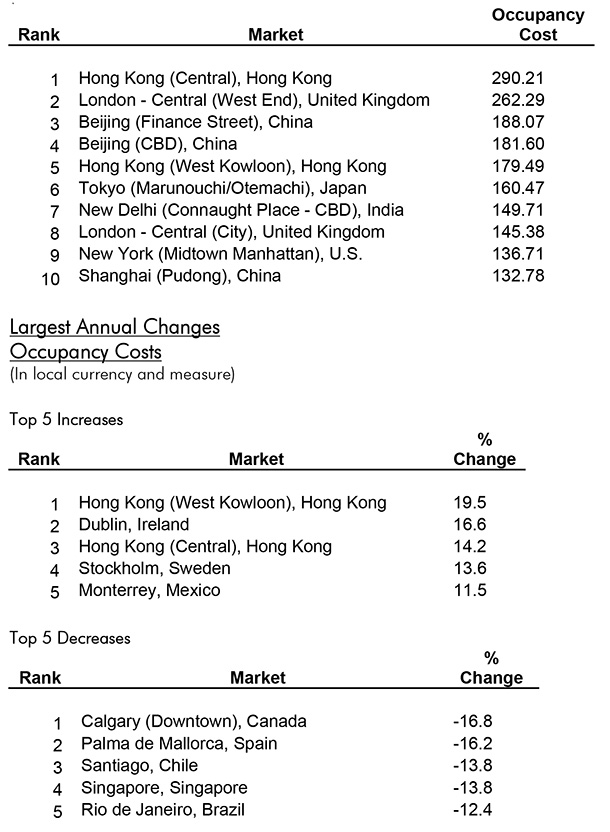
    Hong Kong’s (Central) overall prime occupancy costs of US$290 per sq. ft. per year topped the “most expensive” list, displacing London’s West End (US$262 per sq. ft.). Beijing (Finance Street) (US$188 per sq. ft.), Beijing (Central Business District (CBD)) (US$182 per sq. ft.) and Hong Kong (West Kowloon) (US$179 per sq. ft.) rounded out the top five.

    The study also found that the real estate recovery in Ireland continued to gain momentum, with Dublin, which experienced a 50 percent drop in rents during the downturn, showing the second-largest year-over-year prime occupancy cost increase among the 126 cities surveyed (up 16.6 percent year-over-year)—second only to Hong Kong West Kowloon (up 19.5 percent year-over-year). In North America, real estate fundamentals saw steady improvement with both Atlanta (Downtown) and Seattle (Downtown) among the 10 markets with the fastest growing prime occupancy costs.

    Global prime office occupancy costs—which reflect rent, plus local taxes and service charges for the highest-quality, “prime” office properties—rose 2.4 percent year-over-year, with the Americas up 2.3 percent, EMEA up 2.1 percent and Asia Pacific up 2.7 percent.

    “We expect the global economy to keep growing, and the global service sector, the primary occupier of prime office properties, will continue to expand through periods of volatility, “ said Richard Barkham, global chief economist, CBRE. “Since inflation is low, the growth in prime office occupancy costs is significant for both users and investors.”

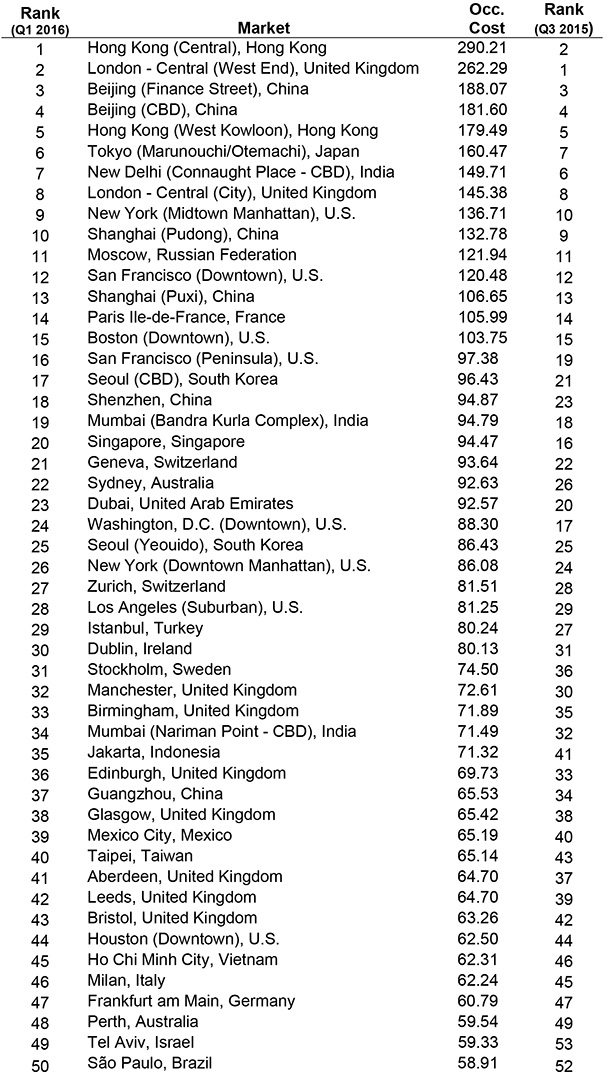
    CBRE tracks occupancy costs for prime office space in 126 markets around the globe. Of the top 50 “most expensive” markets, 20 were in Asia Pacific, 20 were in EMEA and 10 were in the Americas.

    Europe Middle East & Africa (EMEA)
    Europe is benefitting from a cyclical pick-up in consumer spending and business investment, as well as a very competitive currency and intense monetary stimulus, which helped to make Dublin, Stockholm and Barcelona the fastest-growing markets in the region. Most Central and Eastern European markets were down year-over-year, including Moscow, which is still in the midst of a recession. Costs accelerated quickly in South Africa, with Johannesburg, Cape Town and Durban all seeing increases of at least 6.9 percent from year-ago levels.

    Only 11 out of 56 EMEA markets recorded a year-over-year decline in prime office occupancy costs.

    In addition to London West End, the other market from the region in the global top 10 was London City (US$145 per sq. ft.).

    Asia Pacific
    Asia Pacific was home to seven of the top 10 most expensive markets—Hong Kong (Central), Beijing (Finance Street), Beijing (CBD), Hong Kong (West Kowloon), Tokyo (Marunouchi/Otemachi), New Delhi (Connaught Place – CBD), and Shanghai (Pudong).

    The service sector will show particularly strong growth in Asia as pensions and insurance products gain market share. So occupancy cost growth will continue to trend upwards at a moderate pace.

    Hong Kong (Central) is the only market in the world—other than London’s West End—with a prime occupancy cost exceeding US$200 per sq. ft. Hong Kong Central’s double-digit growth in occupancy costs was fuelled by two factors: an ultra-low vacancy rate due to lack of new development and continued demand for high-quality space in prime locations by mainland Chinese companies.

    The most expensive market in the global ranking from the Pacific Region was Sydney (US$93 per sq. ft.), in 22nd place.

    A few key Southeast Asian markets registered decreases, including Singapore and Jakarta.

    Americas
    In the Americas, four markets—Monterrey, Atlanta (Downtown), Seattle (Downtown) and Atlanta (Suburban)—recorded double-digit percentage gains year-over-year.

    New York Midtown, number nine on the global list, remained the most expensive market in the Americas, with a prime office occupancy cost of US$137 per sq. ft.

    Several energy-centric markets experienced material drops in occupancy costs, including Calgary (Downtown and Suburban), Houston (Suburban) and Denver (Suburban).

    In the U.S., economic growth is expected to pick up in the next several quarters following a turbulent opening quarter. Overall, occupier activity sustained last year’s momentum, leading to an increase in occupancy costs in 17 out of 22 U.S. markets covered in this survey.

    Mexico City remained the most expensive market in Latin America, posting an office occupancy cost of US$65 per sq. ft. and ranking as the 39th most expensive market globally. Both Brazilian markets, Rio de Janeiro and São Paulo, saw declines.
    Microsoft Word - Press release - POOC June 2016_FINAL.docx
    Note: The full Top 50 Most Expensive Markets chart is located at the end of this press release.

    Notes

    1. The Global Prime Office Occupancy Costs report is a survey of office occupancy costs for prime office space in 126 cities worldwide.
    2. The latest survey provides data on office rents and occupancy costs as of March 31, 2016.
    3. The Largest Annual Changes rankings are based upon occupancy costs in local currency and measure. The Most Expensive ranking is based upon occupancy costs in US$ per sq. ft. per annum.
    4. The figures given in this release refer to occupancy cost. This represents rent, plus local taxes and service charges. The occupation cost figures have also been adjusted to reflect different measurement practices from market to market.
    5. Due to methodology changes, comparisons with figures in previously released reports are not valid.
    6. To obtain a full copy of the report or to arrange to speak with a CBRE expert, please contact Robert McGrath ([email protected]).
    Microsoft Word - Press release - POOC June 2016_FINAL.docx

    About CBRE Group, Inc.
    CBRE Group, Inc. (NYSE:CBG), a Fortune 500 and S&P 500 company headquartered in Los Angeles, is the world’s largest commercial real estate services and investment firm (in terms of 2015 revenue). The Company has more than 70,000 employees (excluding affiliates), and serves real estate owners, investors and occupiers through more than 400 offices (excluding affiliates) worldwide. CBRE offers strategic advice and execution for property sales and leasing; corporate services; property, facilities and project management; mortgage banking; appraisal and valuation; development services; investment management; and research and consulting. Please visit our website at www.cbre.com.

     

  • Singapore retail rents: tenants’ market

    Singapore retail rents: tenants’ market

    With continuing restructuring in the Singapore retail sector it is a tenants’ market, but while rents are generally under pressure, well-located, well-managed suburban malls are in a strong position.

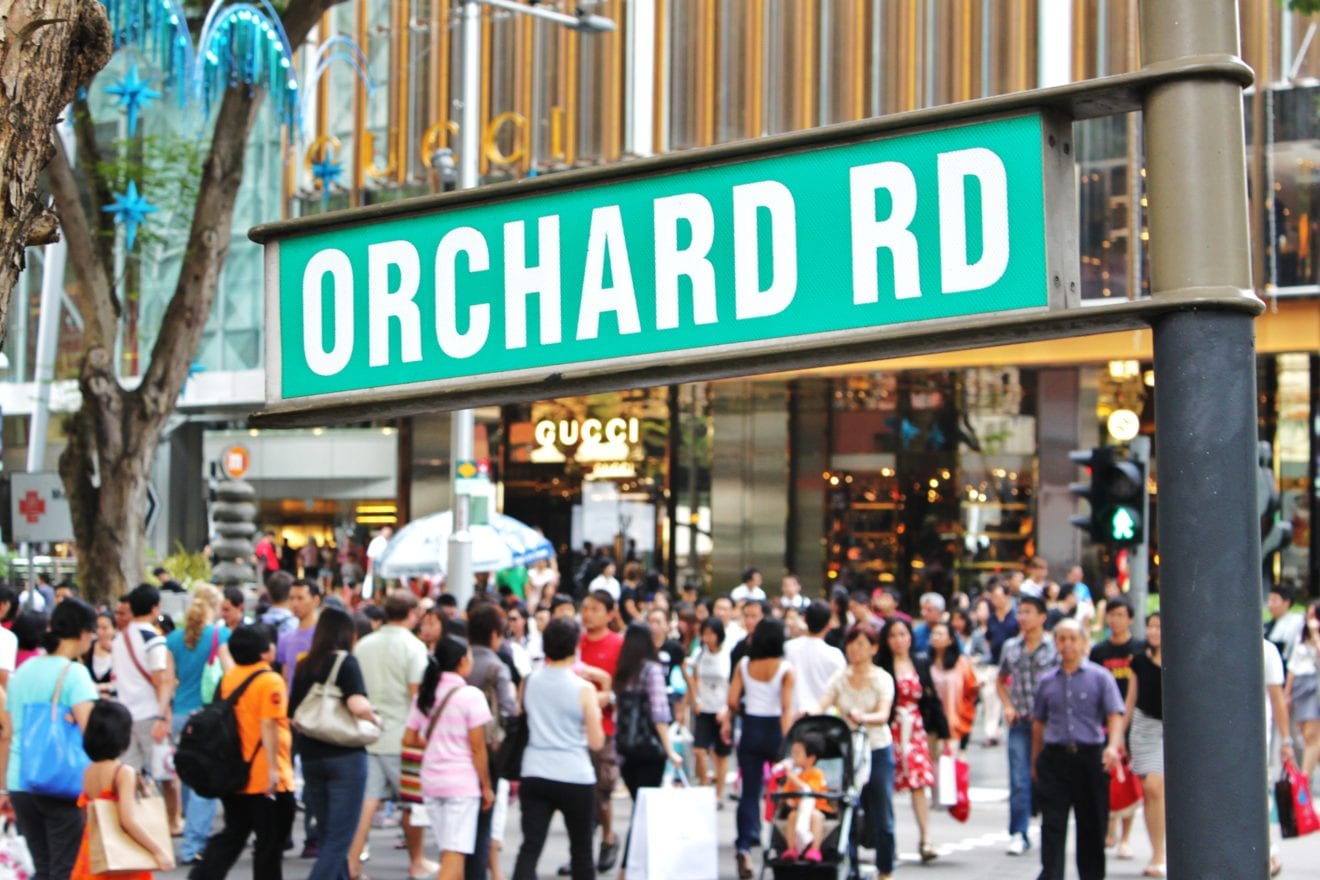
    Meanwhile, average prime retail rents in Orchard Rd and suburban areas continued to fall in the second quarter of this year, reports CBRE.

    “Our research shows a clear reduction of rentals, and it would not be accurate to report otherwise,” says CBRE SIngapore/Southeast Asia head of research Desmond Sim.

    Average prime Orchard Rd rents stand at S$32.50 (US$24) psf/mth, down 1.1 per cent from the first quarter – the sixth consecutive quarter of decline for the precinct.

    Average prime rent for the suburban submarket fell 0.7 per cent to $29.45 psf/mth from the first quarter. There rents began to fall only in the last quarter of last year.

    “There are still sparks of activity, particularly around well-located and well-managed suburban malls that have a strong positioning tilted toward families and the immediate catchment,” says Sim, citing Compass One, which has reported 90 per cent precommitment. “With the positive momentum continuing, I would not be surprised if Compass One achieves full occupancy ahead of its opening.”

    Compass One is about to reopen after an asset-enhancement exercise. It has seen a strong showing from returning tenants, attracted to its concept of a family mall.

    Malls near transport nodes with a good tenant mix and the guarantee of a day and night catchment will continue to be more resilient in terms of rents and occupancy under the current market climate, says the CBRE report.

    While general vacancy has been rising and more retail stock can be expected, the availability of prime space in good locations is scarce. This has deterred the expansion and entry of some retail brands as location, visibility and high foot-fall have become even more important factors than ever because of intense competition within the market.

    With no foreseeable new supply in Orchard Rd and Marina Centre in the next few years, at least until 2019, this should provide some support for prime rents in Orchard Rd for the next half of the year, says the report.

    F&B brands continued to be active in Singapore this quarter. Most new foreign cafes and restaurants that have opened or leased space in Singapore originate from the Asia Pacific region, such as Honolulu Cafe and the food-hall concept Itadakimasu by Parco.

    Cosmetics, streetwear and footwear are seeing signs of more activity, and flagship stores are also trending in tandem with the growth of eCommerce.

    “The market is particularly challenged by a mismatch of demand and supply at this point in the cycle. While most of the limits to expansion stem from consolidation activity, some retailers are constrained by the shortage of quality space,” says Sim.

  • eCommerce slows down international retail expansion

    eCommerce slows down international retail expansion

    Retailers are still looking for growth across borders, with Asia a particular interest to many. Nevertheless, high eCommerce investments have slowed down the international expansion, according to real estate consultant CBRE‘s “How Global is the Business of Retail?”‘s report.

    Hong Kong most appealing

    The annual study, in its 9th edition, analyzes 334 international retailers’ activities in 61 countries. In their quest for expansion, retailers target “established” shopping cities, according to the study. In at least 90 % of the cities, at least 1 new retailer appeared in 2015 (compared to 85 % of cities in 2014). 30 % of all markets in the study welcomed at least 10 new retailers.

    The top 20 of most popular cities for new retailers did feature some new cities: Asia is still the most important region in the top 10, with four of the five most attractive markets. Hong Kong was the most appealing market in 2015, with 73 new retail brands. Singapore is second with 63 newcomers, followed by Tokyo (57), Taipei (47), Moscow (40), London (39), Dubai (38), Beijing (37), Bucharest (35) and Doha (29).

    London is still the most international shopping city in the world, followed by Dubai, Shanghai, Hong Kong, Paris and Tokyo.

    Safeguard the right mixture

    CBRE expects international retailers’ attention to shift to growing cities in Africa and Latin America, especially if the economic situation in the East changes. Established markets like Germany, the United Kingdom, France, the United States and China seems to get priority over others, with retailers choosing a certainty over a gamble.

    International expansion is also slowing down slightly, a trend CBRE attributes to the fact many retailers have invested more in eCommerce platforms and multichannel environments. Retailers are looking at their store portfolio more diligently and are safeguarding the right mixture of locations. They will consider new formulas, like airport stores or stores in train stations.

    Shopping centers are also key for retailers looking to enter new markets. These will have to reposition themselves, in order to shift their focus to food, leisure or lifestyle.

  • Giant Cambodia launches in Phnom Penh

    Giant Cambodia launches in Phnom Penh

    Giant Cambodia has opened its first store in the kingdom, in Phnom Penh’s Grand City Mall.

    It is part of a major expansion into Cambodia by the Malaysian wholly owned subsidiary of pan-Asian retailer Dairy Farm International, which also has a 70 per cent stake in Lucky Private, the owner of Lucky Supermarkets.

    Dairy Farm International Indochina CEO Paul Sheldrake says Giant will offer a new experience and choices for Cambodians with its brand-name health and beauty products and housing accessories.

    New international shopping complexes are boosting retail supply in the capital, such as the 57,000 sqm Parkson’s Phnom Penh City Centre scheduled to open last year but revised to late this year. Also coming on line then will be Lion City, an integrated project by Malaysia’s Lion Group covering 61,000 sqm.

    Other new entrants include HongKongLand’s Exchange Square, covering 8000 sqm and opening early next year.

    Real estate analyst CBRE has forecast retail space in Phnom Penh to increase more than 110 per cent by early next year.

  • Orchard Road landlords reeling as key retailers exit

    Orchard Road landlords reeling as key retailers exit

    More shops are moving to the suburbs.

    More retailers are opting to vacate their prime spaces in Orchard Road and move to the heartlands instead, according to a report by CBRE.

    This trend exacerbates the problems ailing Singapore’s retail leasing scene, which has been hard-hit by a decline in both tourist and local spending.

    “As part of cost saving measures, more established retailers have opted to relocate out of prime corridors to secondary corridors, especially in the Orchard Road sub-market,” CBRE said in a report.

    Although exits have weighed on rents, CBRE noted that freeing up prime space has allowed landlords to pursue retailers seeking flagship space.

    “Demand is likely to stay patchy with retailers expected to be even more discerning about store location and openings as their operations evolve to include more retail channels. This does not bode well for overall occupancy with more supply dude to complete from now till 2019,” CBRE said.

  • Online boom not deterring global retailers

    Online boom not deterring global retailers

    Global retailers are undeterred from expanding their bricks and mortar stores this year despite growing online sales, says a new report.

    In the seventh edition of How Active Are Retailers Globally?, real estate service company CBRE also says China remains the top target market of global retailers in Asia-Pacific. Its study covered more than 150 major international brands based in the Americas, Asia Pacific and EMEA.

    While European countries dominate the target destinations this year, China is the top target market in Asia-Pacific and the fourth most popular globally, with 27 per cent of retailers looking to expand there. This is followed by Hong Kong in sixth position (24 per cent), Japan seventh (22 per cent) and Singapore ninth (21 per cent).

    Globally, the top three were Germany (35 per cent), France (33 per cent) and the UK (29 per cent).
    China and Hong Kong maintained fourth and sixth place respectively, while Japan (seventh), Singapore (ninth) and Australia (11th) all rose higher in the rankings, up from 13th, 18th and 15th respectively.
    Most Asia-Pacific markets saw increased interest for this year compared with last, except for China and South Korea, which softened somewhat, says the report. Meanwhile, interest in Southeast Asia surged, with Malaysia (10 per cent), Indonesia (9 per cent ), Thailand (8 per cent), Vietnam (8 per cent) and The Philippines (8 per cent) all receiving more than double the interest they saw last year, when those markets achieved only between 1 and 3 per cent.

    When questioned about the risk factors facing them in the coming year, brands indicated that real estate cost escalation (56 per cent) and unclear economic prospects (42 per cent) continue to be at the forefront of their minds.
    “We’re seeing more of a challenging economic environment, and concerns such as high  operating costs and a lack of quality space mean retailers are somewhat more wary this year,” says CBRE head of research for Asia Pacific Dr Henry Chin.

    “However, even as markets such as China and Hong Kong are seeing a slowdown, we see increasing numbers of opportunistic retailers looking to enter markets like Hong Kong, supported by strong underlying consumer demand. Japan and Australia remain attractive, while Southeast Asia showed strong growth because of opportunities for retailers around an expanding middle class and stronger economic growth.”

    He says there are still opportunities for retailers to grow their business in Asia, as the region has four of the top 10 most popular destinations worldwide.
    “The goal now for all brick-and-mortar retailers is to build an engaging offer that encourages people to stay longer and spend more,” says CBRE senior director and head of retailer representation Joel Stephen.
    Of the brands surveyed, 83 per cent suggest their physical store expansion plans for this year will not be affected by the growth of eCommerce, and only 22 per cent see online retailing as a threat to their business.

    At the same time, retailers are cautiously optimistic about physical expansion. Of those questioned, 17 per cent have large-scale ambitions, many of them looking to open more than 40 stores this year (up from 9 per cent last year). Most retailers (67 per cent) are considering up to 20 stores.
    “A physical store in key locations is still critical to the strength of a brand’s image,” says Stephen. “Stores still need to create an emotional affinity with shoppers, and customers still feel a need to go into stores, to touch a product and enjoy the feel-good factor associated with a particular brand experience.

    “The store is integral to the shopping journey and can be used in a number of different ways, such as to click and collect, research of the product or brand, or to test the product. It isn’t solely about the transactional side.”

    In a new trend, a fifth of brands, largely from the Americas and EMEA, intend to expand into travel hubs such as airports and train stations this year to gain access to high footfall in busy locations. However, for Asia-Pacific retailers, shopping malls are still the most-preferred destination by far (nearly 90 per cent).
    While globally the key concern for brands in lease negotiations is “lease length”, Asia-Pacific retailers are most concerned with turnover rent clauses as well as changing consumer behaviour (40 per cent), which is higher than the global average (31 per cent).

  • Asian retail outlook: “more cautious”

    Asian retail outlook: “more cautious”

    High operating costs – particularly rents and labor in Asia – will ensure retailers are more cautious this year, concludes real estate specialist CBRE.

    In its annual Asian retail outlook, the company’s research department predicts many retailers will shift their strategic focus from expanding their store networks to rationalisation, improving in-store profitability and upgrading to better locations.

    That trend is expected across the broad Asia-pacific market, including Hong Kong.

    “Leasing activity will diverge across markets, with Australia, Japan and New Zealand the most upbeat, whereas Hong Kong and Singapore will continue to struggle,” CBRE concluded.

    “Driven by ongoing urbanisation and wage increases, Southeast Asia will also see solid leasing activity. Demand across the region will be led by food and beverage retailers, while affordable and niche luxury brands will also be active.”

    CBRE also warns the rise of online shopping will continue to force shopping malls to embrace ‘retail-tainment’ and adjust their trade mix to include more experience-oriented retailers to retain foot traffic. Around 63.8 million sqft of new shopping center supply is scheduled to be completed in 2016. Against the sluggish leasing demand and ample new supply, overall retail rents are forecast to experience a mild correction of below 1 per cent in 2016.

    In a broader property outlook, CBRE forecasts that due to Asia Pacific’s steady economic growth – which will continue to outpace the rest of the world in 2016 – investment activity in the region will remain solid, although activity will be limited by asset pricing and availability.

    “The region’s investment market will continue to see strong demand from real estate funds and institutional investors. Institutional investors will continue to invest in Asia Pacific to increase their exposure to real estate for strategic diversification,” said Dr Henry Chin, head of research, CBRE Asia Pacific.

    “That said, Asia Pacific will enter a period of slower growth in the commercial real estate market with activity likely to moderate over the course of the year as it becomes more challenging to source investable stock able to meet investors’ target returns. Interest rates will remain low in 2016 so yields are largely to remain stable across Asia Pacific. However, we are expecting to see a mild yield expansion in 2017 together with the rise in interest rates.”

    The economic slowdown in China – as well as higher-than-expected US interest hike rates, and currency volatility – will also remain a key concern for investors, given the scale of its impact across the whole region.

    “However, macro trends of urbanisation and the rise of the middle class remain largely unchanged and will continue to drive growth across Asia.

    “There are structural investment-themed opportunities for investors to focus on in 2016, such as the growth of e-commerce, regional tourism and demographic changes. Demographic changes will create opportunities in niche sectors such as self-storage facilities, senior and student housing, and data centers,” said Chin.

    “Regionally, active markets will continue to be led by Australia and Japan, whilst India expects to see a positive year following the relaxation of FDI norms at the end of last year.

    “China will also remain on the radar for most international investors although demand will be largely confined to tier I cities. Overall, the long-term outlook remains positive for the region,” he concluded.

    CBRE’s 2016 APAC Real Estate Market Outlook report can be downloaded here.

  • Grim outlook for Singapore retailers

    Grim outlook for Singapore retailers

    Singapore retailers are facing “dark days”, including store closures, according to Singapore real estate company CBRE.

    With falling domestic demand and soaring costs, there will be more store consolidations and closures, it says in a new report.

    It predicts the retail market to undergo further restructuring following a muted performance last year, with weak brands being elbowed out, reports the Singapore Business Review.

    “This year will be marked by challenging conditions that could push weaker-performing brands to close or downsize.”

    There will also become harder to hire staff, with the report warning it is “highly unlikely” the government will lift restrictions on hiring foreigners. However, the costs and time associated with innovation and revamp are likely to keep a lid on expansion plans.

    CBRE says the fast-fashion segment will be particularly hit hard by manpower constraints and lack of suitable retail space. It says cheaper running costs in neighbouring countries have helped pull fast-fashion retailers’ attention away from Singapore.

  • Asians to invest more in properties beyond the region

    Asians to invest more in properties beyond the region

    Real estate markets in Asia will likely remain less appealing than those in the US and Europe this year, with Asia plagued by anaemic economic growth and waning rents and capital values amid a supply deluge.

    In a recent interview with The Business Times, CBRE head of global research Nick Axford flagged that there will be greater outbound capital flow from the region this year by Asian real estate investors, who snapped up some US$39.7 billion (S$55.3 billion) of properties outside the region last year, a 26.8 per cent jump from 2014.

    He said: “If you look at parts of Europe and North America, there is strong economic growth, recovering demand, rising rents and not much developments. In many Asian markets like Singapore and Hong Kong, it is almost the opposite – strong pricing, but weakening economic growth and demand.

    “The balance of attractiveness has shifted towards Europe and North America.”

    Asian investors invested US$14.3 billion in real estate within the region last year, a 12.3 per cent rise from 2014, going by CBRE’s preliminary estimates covering office, retail, industrial, hotel and mixed-use projects; the figures exclude residential projects and development sites.

    Rising interest rates will generally fuel upward pressures on capitalisation rates – the ratio of a property’s net operating income to its market value. With the spread between interest rates and property yields near historical highs in many markets in Europe, Dr Axford noted that it is possible that rising interest rates will be “absorbed” in the normalisation of spreads.

    Sovereign wealth funds (SWFs) in the region such as Singapore’s GIC have trained their eyes on Europe and North America as they re-balance their portfolios. CBRE estimates that some US$8.1 billion was invested outside the region by Singapore-based investors, compared to the US$6.6 billion they ploughed into properties within the region.

    Based on preliminary data from real estate data and analytics firm Real Capital Analytics (RCA) as at Jan 12, Singapore-based investors purchased a record US$26.3 billion in overseas real estate in 2015, up 49 per cent from US$17.6 billion in 2014.

    These outbound Singaporean investments were driven by big-ticket purchases by heavyweights such as GIC and Global Logistic Properties (GLP), Temasek Holdings, Mapletree, ARA Asset Management Group and Ascendas Real Estate Investment Trust.

    RCA’s database covers transactions above US$10 million in asset classes such as development sites, office, industrial, retail, apartment, hotel and serviced apartments.

    Dr Axford said that while rental declines are seen across all property segments in Singapore, investors can make opportunistic buys with a time horizon of five to 10 years.

    In Hong Kong, the retail and logistics segments have softened; the office sector is holding up. Last year, Hong Kong Central Business District office rents rose 14 per cent, with prime office rents hovering at levels more than double those in Singapore.

    Dr Axford said: “There is still demand from the Chinese in good-quality office space in central Hong Kong. We are expecting rental growth of 5 to 10 per cent for Hong Kong office this year.”

    He views the recent volatility in the Chinese stock markets as an over-reaction to negative news from China – even though there has been no significant change to its economic outlook over the past six months.

    But with the probability of further weakening of the renminbi against the greenback, there will be sustained interest from Chinese investors wanting to put their capital to work outside China, in European and North American real estate, he added.

    Capital outflow from China was evident last year. CBRE’s estimates indicate that real-estate investments outside Asia by Chinese investors jumped 35.9 per cent to US$13.1 billion, against a 7.5 per cent drop to US$9 billion which they sank into domestic real estate.

  • Chinese demand to drive growth in Australian luxury

    Chinese demand to drive growth in Australian luxury

    A surge in demand for luxury goods has seen Chinese-led spending overwhelmingly turn to international markets including Australia, according to the latest research from property group CBRE.

    According to the latest report, Luxury Retail 2015, 70 per cent of all Chinese-led luxury purchases are now transacted overseas, resulting in increased sales across the world, including Australian markets.

    “Chinese purchasers account for 30 per cent of the luxury spend worldwide and 70 per cent of these purchases take place overseas, showing that the downward shift in their economy has prompted Asian consumers to rethink their purchasing habits,” said CBRE head of research and consulting EMEA, Andrew Phipps.

    “The advent of the new ‘anti-extravagance legislation’ in China and their consumers’ growing awareness of price differentials of up to 70 per cent has led to many preferring to make their purchases overseas, where the prices are far more attractive,” said Phipps.

    CBRE head of retail brokerage leasing, Australia, Leif Olson said international brands were looking to capitalise on the uptick in demand for luxury goods by securing a presence in Australia’s biggest fashion hubs.

    “In 2015, the Australian retail landscape has transformed significantly, with a plethora of global brands lining up to open stores across the country,” said Olson. “This momentum shows no sign of slowing down, with affordable luxury brands to lead the charge in Australia over the next year, while top tier brands will look at securing flagship assets in core locations.”

    Olson said the next wave of growth in Australia’s luxury retail market would be centred on the expansion of retailers in Brisbane, Perth and Adelaide; the addition of food and beverage to luxury retail; and growth of premium childrenswear.

    “The addition of food and beverage to luxury retail stores is an untapped market in Australia, and a widespread concept already seen in the world’s largest fashion meccas, including Hong Kong and Macau,” said Olson.

    “Not everyone is in a position to splash out on a luxury branded handbag or wallet, but being able to have a coffee or meal at Armani, for example, broadens the brand’s appeal and makes it more accessible for everyone.“

    Luxury childrenswear represents another opportunity for growth in Australia says Olson.

    “Shifting the appeal of a brand from adults to families will be a major focus of retailers expanding in Australia, with this helping them to engage and reinforce relationships with their key clients – the parents – while building their future consumer base from the next generation.”

  • Bangkok retail rents hold firm despite competition

    Bangkok retail rents hold firm despite competition

    Bangkok’s retail market is now “the most competitive it has ever been” – yet there is another 1.1 million sqm of retail space under construction.

    When complete, by the end of 2017, that will bring the total completed supply of mall space in the Thai capital to nearly 8 million sqm – all in a market currently characterised by weak consumer sentiment and slow retail sales growth.

    But despite the intense competition, a leading property expert says Bangkok retail rents – in malls, anyway – are holding firm.

    In a column (which you can read in full here) written for the Bangkok Post Spectrum magazine CBRE Thailand MD Aliwassa Pathnadabutr, says the proliferation of new brands setting up shop in Bangkok, and the expansion of existing branded chains is fuelling unprecedented competition in the city.

    “In the upcoming festive season, we expect to see major retail developers competing with heavy promotions and retail events in a bid draw consumers and capture their holiday spending,” Pathnadabutr asserted.

    “The expansion by retail developers in the CBD and suburban areas, entry of new local and international retailers, combined with a challenging economic outlook and weak consumer sentiment is all adding up to the mix.”

    Pathnadabutr says the recent openings of EmQuartier and Central Embassy have intensified competition for existing CBD malls like the high-end Gaysorn, and the giant CentralWorld and Paragon centres.

    “As the major retail centres are chasing after the same group of consumers, retail events and promotions have become ubiquitous leading to a cut-throat competition and heightened promotion campaigns, particularly gearing up to the festive season where consumer spending typically peaks.”

    Expansion and development of suburban centres – like the Future Park Rangsit expansion which marked its soft opening in the last fortnight – may draw customers away from the CBD malls, although Pathnadabutr expects their impact to be limited and growing tourist base will keep the numbers up in the larger centres.

    Despite the competition, retail rents have held their own in Bangkok, according to Pathnadabutr.

    “It is often difficult to measure retail rents as there is a big range even within a single development. Prime retail rents in Grade-A downtown shopping centres range from THB1800 to 4500 (US$50 – $125) per sqm per month for ground floor spaces and THB1200 to 2380 (US$33 – $66) per sqm per month for suburban malls.

    “This level has been maintained throughout 2015 despite the growing competition.”

  • Retail landlords headed for another horrible year in 2016, says CBRE

    Retail landlords headed for another horrible year in 2016, says CBRE

    Retailing landlords will likely continue to feel the pinch in coming times, as the ongoing slump in tourism is poised to weigh negatively on capital values in prime shopping districts, thumping prices a further 20 per cent next year, on top of an expected 20 per cent drop this year, according to CBRE.

    But CBRE predicts the office market will be a bright spot next year as the potential launch of Shenzhen-Hong Kong Stock Connect will drive up demand from mainland firms.

    “Retail rents will continue to trend down as leases expire, but given a lower base of comparison, the pace of decline is expected to decelerate,” according to CBRE’s Hong Kong Commercial Real Estate Review & 2016 Preview.

    It predicts that rents will track the decline in capital values, tumbling as much as 35 per cent this and next.

    “Sales momentum of upmarket goods will remain slow but mass market sales should continue to have more resistance,” CBRE said.

    Symptomatic of the woes facing the luxury retail sector, on Friday high-end brands Prada, Miu Miu and Gucci unexpectedly offered up to 50 per cent discounts as a way to drum up sales and attract long queues of shoppers, including those from the mainland.

    In a stark contrast to the depressed retail market, CBRE expects overall office rents to increase 10 per cent for 2015, and a further 10 per cent next year.

    “Next year will be another year of landlords’ market but the rental cycle is approaching the peak,” CBRE said.

    In 2016 office rents in Central would register the largest year on year growth, climbing 10 per cent, after rising an estimated 15 per cent this year.

    The sector would also benefit from the limited supply with just 1.4 million square feet due for completion next year, it said.

    CBRE also expects the capital value of office real estate could rise as much as 10 per cent next year, after 5 per cent growth this year.

    Two noticeable office transactions in November offered an indication of the upwards momentum in the sector. Mainland developer Evergrande Real Estate agreed to buy the 26-storey Mass Mutual Tower in Wan Chai from Chinese Estates Holdings for a record-breaking HK$12.5 billion.

    On the same day, China Life, the mainland’s largest insurer, announced the purchase of an entire office tower with a two-storey retail block at One HarbourGate in Hung Hom for HK$5.85 billion from Wheelock & Co.

  • Asian eCommerce boom reshaping logistics sector

    Asian eCommerce boom reshaping logistics sector

    The Asian eCommerce boom is driving major changes in logistics developments and networks across the region, according to CBRE’s latest Global & Emerging Logistics Hubs report.

    “With a trickle-down effect to inventory management, this is leading to changes in the global supply chain network,” said Dennis Yeo, regional head, industrial & logistics services with CBRE Asia.

    “Speed-to-market is more important than ever. The service demands brought about by eCommerce – for example, shorter delivery times to consumers – has changed the entire retail supply chain of getting goods to consumers, including regional distribution strategies. The technical ability of locations and buildings to support the ever-increasing demands for both scale and speed of output is an ever-more important determinant of market position.”

    In Asia, the eCommerce and e-tailing market has been particularly strong, with eCommerce upending the traditional bricks-and-mortar distribution networks, forcing retailers and third-party logistics firms to adapt to an increasingly demanding consumer.

    “eCommerce shipments are smaller in size and require more technology and expertise to execute efficiently. As a result, modern logistics facilities are being developed in the traditionally strong logistics hubs of Tokyo, Seoul and Taipei. Besides the developed markets, the new consumer class in the emerging markets is creating opportunities for logistics development in in China, India and Vietnam,” said Yeo.

    Hong Kong under threat

    Meanwhile, the report concludes that while Hong Kong will remain one of the top global logistics hubs in the world, for the next decade, the territory will be in strong competition with several emerging Asia hubs including China’s Beijing, Hangzhou, Nanjing, Suzhou, and South Korea’s Busan.

    “Hong Kong has maintained its global logistics hub status due to its efficient transportation network and highly developed logistic services. It ranks third in the World Bank’s Logistics Performance Index,” said Darren Benson, executive director, industrial & logistics, brokerage services, CBRE Asia.

    “As the traditional global gateway to China, Hong Kong is likely to remain the hub for global distributors, due to its local trade and transport regulations and its ease of connectivity via seaports.“

    Hong Kong is currently the fourth largest global seaport by container volume, while emerging hubs such as Shanghai, Shenzhen and Busan rank first, third and fifth respectively. These emerging locations share a number of characteristics, including significant investments in infrastructure, new trade policies and agreements, and more advanced supply chains and technologies. As these cities continue to improve their regional transportation infrastructure so their viability for international trade increases.

    The shift in global supply chain dynamics and creation of new logistics hubs in Asia may also be spurred by China’s plans to revive the Silk Road trade route.

    In 2013, China launched a new strategic initiative, known as “one belt, one road,” which aimed to revive the importance of the Silk Road. The new Silk Road has two parts: the Silk Road Economic Belt, a land-based route that will connect central China to the Middle East and Eastern Europe, and the Maritime Silk Road, a sea-based path that will link South China to Southeast Asia, East Africa and Europe.

    In Asia, low-end manufacturing – such as garment and textiles production and electronics component assembly – has steadily been moving from Southern China to Western China and Southeast Asia. Southern China, encompassing the Pearl River Delta, has traditionally been the light industrial manufacturing center of the world, however, as wages continue to rise and China attempts to move up the manufacturing value chain, there has been a shift to more sophisticated heavy industry manufacturing.

  • Asia luxury retail revival ahead

    Asia luxury retail revival ahead

    While Asia Pacific may be experiencing a slowdown in luxury retailing right now, three key trends will fuel a renaissance in coming years.

    That’s the core finding of a research report by property specialist CBRE, The Future of Luxury Retail in Asia Pacific: New Demand Drivers and Shifting Occupier Requirements, which promises property owners can expect “a solid new stimulus for demand” in the coming years.

    Most major luxury retailers are now well established in Asia Pacific – their with China and Hong Kong penetrations already at 89 per cent and 81 per cent, respectively. And after several years of rapid expansion, these markets are approaching saturation point.

    “Accounting for one-third of personal luxury goods sales globally in 2014, Asia Pacific is a key region for international luxury brands with key markets including China, Hong Kong, Japan, Singapore, South Korea and Taiwan. However, the high growth period for luxury retailers in the region is gradually coming to an end,” commented Dr Henry Chin, head of research, CBRE Asia Pacific.

    ”Over-saturation, surging operational costs and weaker retail sales – especially in Hong Kong due to the slowing mainland China economy – have prompted retailers to consolidate their existing store networks and slow their rate of entry into new markets focusing on operational efficiency,” said Chin.

    But here is where there is hope: CBRE has identified three emerging trends which will partially offset some of the negative effects arising from the slowdown and compensate for the loss of demand.

    • The Emergence of Affordable Luxury

    Often referred to as bridge brands, affordable luxury retailers – for example Michael Kors – provide high quality branded goods at a lower price tag than top-tier luxury retailers. Several top-tier luxury brands are already so well established in the region that they are at risk of overexposure, a trend which is prompting many consumers to look for differentiation.

    • Inclusion of F&B

    Recent years have seen luxury brands begin to expand beyond their core fashion businesses into the F&B sector – examples include 1921 Gucci in Shanghai iAPM and Cafe Dior by Pierre Hermé on the top floor of Christian Dior’s flagship store in Seoul – transitioning their brand from being totally fashion-oriented to more lifestyle-driven. Including an F&B component in stores enables luxury retailers to provide their consumers with a more complete experience in which they can shop, relax and socialise.

    • Growth of Luxury Childrenswear

    As of 2014, Asia Pacific was home to 807 million people aged below 14, representing more than 20 per cent of the total population, offering an enormous opportunity for growth in this segment. The emergence of luxury childrenswear brands has been welcomed by landlords as many of them are looking to expand their offering into toys, bookstores and playrooms in order to attract and retain foot traffic amid competition from online retail.

    “With the momentum behind these trends, this will account for a bigger slice of leasing demand for prime retail space,” says Joel Stephen, senior director, head of retailer representation, CBRE Asia.

    “Retailers and landlords can benefit from the projected growth in these market segments.”

    Changes in Luxury Retailers’ Real Estate Requirements

    The emerging retail trends – combined with changing tourism patterns and the ongoing slowdown of the region’s luxury retail sector – are already impacting luxury retailers’ real estate requirements, resulting in new, and in some cases, weaker demand for different types of retail property.

    “The change in shopping behavior among mainland Chinese tourists – who are demonstrating a stronger preference for shopping in Europe and Japan – has prompted luxury brands to review their expansion and rationalise their real estate portfolios, strategies and requirements. Since most luxury retailers remain cautious towards expansion, especially in China, retailers are now focusing on consolidating their footprint into a solid network of stores in high quality locations, as opposed to expanding rapidly and opening many smaller stores, in order to extract the highest value from their sales network,” says Chin.

    Some of the key trends that CBRE have identified include:

    • Weaker interest in department stores despite continued interest in prime locations;
    • Stronger focus on flagship stores, displaying more product lines, thus making a stronger statement in the market;
    • Increased popularity in short-term opportunities for brands to set up exhibitions, pop-up and concept stores, and workshops, to generate greater consumer awareness;
    • Affordable luxury brands continuing to drive demand, encouraging more shopping center landlords to offer them anchor tenant space; and
    • More interest in upper floor retail space, but limited to top-tier malls and driven by F&B and childrenswear segments.

    Says Stephen: “Driven by the emergence of affluent consumers and the rise of the number of millionaires in the region, Asia Pacific will remain a hugely important market for international luxury brands with new names entering the region.

    “Even though leasing demand will slow to a more sustainable level, prime space in core areas will continue to be keenly sought after.”

    Penetration of luxury retailers into Asia-Pacific.