Tag: cimb

  • CIMB’s Indonesian unit posts big jump in profit

    CIMB’s Indonesian unit posts big jump in profit

    CIMB Group Holdings Bhd’s 97.9% owned Indonesia-based subsidiary PT Bank CIMB Niaga Tbk, boosted its unaudited consolidated net profit by 318.2% to 736 billion rupiah (RM228.4mil) for the six-month period ended June 30, 2016 (H1).

    The fifth largest bank in Indonesia by assets said in a statement that the higher net profit, which translated to earnings per share of 29.29 rupiah, was due to a 4.8% rise in net interest income (NII) to 5.81 trillion rupiah (RM1.81bil), a 24.1% jump in non-interest income to 1.46 trillion rupiah (RM453mil) and a 7.9% fall in provision expense.

    Its president director Tigor M. Siahaan said: “Despite the challenging environment, our H1 top line performance continued to improve. The 4.8% year-on-year (y-o-y) NII growth was recorded against a decline in interest expense, while non-interest income was 24.1% higher y-o-y due to better treasury and capital markets businesses.”

    He said CIMB Niaga maintained good control over its operating expenses which fell by 1.2% y-o-y.

    “In addition, the provisions for non-performing loans had gradually improved.”

    As the bank retained a conservative growth strategy, total gross loans were lower y-o-y at 175.34 trillion rupiah (RM54.41bil) as at June 30.

    Despite the slower overall growth in CIMB Niaga’s loans, selected business segments recorded encouraging performance.

    The personal and multipurpose loans business grew 9.2% y-o-y through the bank’s X-tra Dana product, while the credit card segment posted a 25.5% y-o-y growth to 7.18 trillion rupiah (RM2.23bil).

    As at end June 2016, the bank had issued over 2.1 million credit cards, an increase of 13.4% from a year earlier.

    To date, CIMB Niaga is the third largest credit card issuer in Indonesia, in addition to being the fifth largest bank with total assets of 239.38 trillion rupiah (RM74.33bil).

    Its current account savings account (CASA) grew 5.7% y-o-y to 93.21 trillion rupiah as at June 30, with the CASA ratio rising 457 basis points (bps) y-o-y to 51.99%.

    The loan to deposit ratio was higher at 96.54% at end-June 2016 compared to 95.81% in the same period last year.

    The Indonesian government has appointed CIMB Niaga as a perception bank assigned to accommodate funds repatriated by taxpayers who are participating in Indonesia’s tax amnesty programme.

    “With additional liquidity available through the programme, the national banking industry, CIMB Niaga included, will have greater capacity to disburse loans to various sectors,” Tigor said.

    CIMB Niaga’s capital adequacy ratio strengthened y-o-y to 17.62% as at June 30.

    “We will continue to selectively increase our assets with a key focus on cost management and asset quality.

    “We started 2016 on a more positive note and seen the potential of gradual improvement in the second half of the year, backed by numerous macroprudential government fiscal and monetary policies to stimulate sustainable economic growth,” added Tigor.

  • CIMB’s Corporate Card Solutions to see big growth

    CIMB’s Corporate Card Solutions to see big growth

    CIMB Bank Bhd’s newly-launched Corporate Card Solutions is expected to gain significant growth momentum, given that it is a gamechanger in the market.

    In collaboration with MasterCard, the CIMB Corporate Card Solutions offers convenience, control and transparency for business operational expenditure, through its corporate card, purchasing card and virtual card solutions.

    “We are very excited about this launch because the corporate segment has been a domain of the consumer segment in the past.

    “This is a very new solution, for us and in the market as well.

    “A lot of banks now do not do this business,” said CIMB Group transaction banking head Thomas Tan after the launch ceremony yesterday.

    New cards: (from left) MasterCard South-East Asia Indonesia, Malaysia and Brunei group country manager and Islamic payments group head Safdar Khan, Zafrul, MasterCard Asia/Pacific co-president Ari Sarker, and Tan having a closer look at the mock credit cards at the launch of CIMB’s Corporate Card Solutions.

    The Corporate Card Solutions offers unique, customised solutions for companies, such as setting spending limits and customising merchant categories by each individual card holder, with real-time overview of employees’ travel and entertainment expenditure.

    Meanwhile, the purchasing card automates the company’s procurement process by capturing card transactions in real time, which facilitates account reconciliation.

    Companies also have the option to decide on the billing cycles, like a 45-day or 60-day credit interest-free period, unlike consumer credit cards which have one determined billing cycle.

    As for the virtual card solution, businesses can randomly generate a 16-digit virtual card number that is associated with a specific payment, which is then securely transmitted to a specific supplier when payment is due.

    Data is captured real time and matching a unique virtual card number to a specific payment improves reconciliation and aids data analysis.

    These solutions help optimise cash flow, enabling businesses to operate more efficiently through the entire value chain.

    “In today’s business environment where cost management is a high priority, it is our aspiration to help organisations to significantly improve their operational and cost efficiency by automating their transactional flows.

    “These solutions offer unique savings features by optimising cashflows and working capital.

    “Our digital banking solutions such as these are also a response to Bank Negara Malaysia’s call for a reduction in the usage of cheques from 207 million in 2011 to 100 million by 2020,” said CIMB Group chief executive Tengku Datuk Sri Zafrul Aziz.

    The CIMB Corporate Card Solutions is targeted towards government and state agencies, small and medium enterprises (SME) as well as corporate sectors.

    Prior to yesterday’s official launch, CIMB had converted five corporate clients to its Corporate Card Solutions during the soft launch.

  • Gas Malaysia Q1 earnings beat CIMB Research forecast

    Gas Malaysia Q1 earnings beat CIMB Research forecast

    Gas Malaysia’s 1Q16 net profit, which rose 10% on-year to RM31mil (US$8mil), was at 29% of CIMB Equities Research’s full-year forecast and 24% of consensus.

    The research house said on Thursday the higher earnings were due to lower tax rate and lower losses from its joint venture. Its tax rate fell from 25% in 1Q15 to 21% during the quarter as it reversed some of its deferred tax liabilities.

    “We gather from the company that its tax rates should normalise closer to the statutory rate of 24% in the coming quarters. As for the joint venture, its losses narrowed from RM1.7mil in 1Q15 to RM100,000 in 1Q16. We believe this was due to lower start-up cost during the quarter,” it said.

    CIMB Research raised its FY16-18F EPS by 1%-4% to reflect the lower tax rate. However, it maintained its sum-of-parts based target price of RM1.80, which is 21.7% below the last traded price of RM2.30, and also its reduce call due to its expensive valuation.

    “We prefer Tenaga for its lower price-to-earnings (P/E) and more exciting earnings growth prospects,” it said.

    The incentive-based regulation (IBR) that regulates Gas Malaysia’s tariff and earnings was implemented on Jan 1, 2016. 1Q16 results are the first set of quarterly results reported by Gas Malaysia under the IBR.

    To recap, Gas Malaysia had previously revealed that the allowable WACC for its pipeline assets was set at 8% under the IBR, though it was still consulting with the regulator for a higher rate of return. CIMB Research assumed an allowable WACC of 8% in its earnings forecasts.

    “Although Gas Malaysia’s 1Q16 earnings beat our expectation, we are keeping our assumption as the outperformance was due mainly to the lower tax rate. Gas Malaysia’s 1Q16 EBITDA met our expectation as it accounted for 26% of our full-year forecast,” it said.

    CIMB Research also said there is no guarantee that Gas Malaysia will be allowed to earn the retail margin. A
    lower-than-expected margin approved, if at all, may de-rate the stock. Also, Gas Malaysia trades at 26 times CY16F P/E, higher than PetGas’s 23 times and Tenaga’s 11 times.

    “The latter two, especially Tenaga (Add, TP: RM16.40), provide cheaper exposure to the utilities sector. For exposure to the gas infrastructure sector, we prefer PetGas (Hold, TP: RM22.30) for its stronger earnings resiliency,” it said.

  • Profit of CIMB’s Indonesian ops grows by over three times

    Profit of CIMB’s Indonesian ops grows by over three times

    CIMB Niaga said in a statement, posted by its parent on Bursa Malaysia’s website, that the improved net profit came on the back of a 1.4% yoy increase in net interest income and a 18.5% yoy jump in non-interest income, mainly due to improved foreign exchange and capital market businesses.

    Operating expenses and provisions declined by 1.4% and 7.3% on a yoy basis respectively. “While we remain cautious given the economic situation, we hope our positive performance this quarter will provide a strong base for our results going forward. Our operating income held up well through strong contributions towards non-interest income from an uplift in the treasury business.

    “Our credit card business continued to garner market share, while current account and savings account (CASA) balances grew strongly, bringing about a CASA ratio of 52.05%.

    “CIMB Niaga capital ratio strengthened to 18%. Our improved capital position should hold us in good stead to face the market and economic uncertainties,” said CIMB Niaga president director Tigor M. Siahaan in the statement.

    With total assets of 231.67 trillion rupiah (RM68.54bil) as of March 31, CIMB Niaga maintained its position as Indonesia’s fifth largest bank by assets.

    Total gross loans were lower at 171.02 trillion rupiah (RM50.60bil) as at March 31 as the bank maintained a conservative growth strategy.

    Despite the slower growth in CIMB Niaga’s loans, several business segments posted positive expansion such as personal loans and credit cards.

    “We continue to pursue our aspiration of being a leader in digital services by focusing on customer experience and optimising the use of the latest technology to bring value to our clients,” Tigor said.

    In the syariah banking segment, CIMB Niaga’s Islamic business unit’s total financing stood at 7.60 trillion rupiah representing a growth of 13.9% yoy with third-party deposits of 8.16 trillion rupiah as at March 31.

    CIMB Niaga’s capital adequacy ratio (CAR) strengthened to 18% as at March 31, 2016.

    “The government has proposed some positive changes since the start of the year to boost the economy. Bank Indonesia cut interest rate to 6.75% from 7.50% and the government has also lined up several economic stimulus packages for 2016. I’m confident that as CIMB Niaga remains focus in the areas of asset quality, cost efficiency and CASA growth, the bank will be primed to capitalise on opportunities when the economy improves,” added Tigor.

  • CIMB expects more conducive economy for consumer banking in 2H2016

    CIMB expects more conducive economy for consumer banking in 2H2016

    Collaboration between CIMB and Tesco Stores (Malaysia) Sdn Bhd today, the group’s CEO of group consumer banking Renzo Viegas told pressmen that while the current marketplace remains tough for business, the mass affluent community will still continue to invest.

    “It’s a tough environment, so loan growth will be slower than last year for sure (in terms of) investment products, people are really concerned about the global economy and the Malaysian economy; (there are) a lot of volatility, so people are holding back their investment decisions, but the mass affluent customers will still invest, so the second half should pick up a bit,” he said.

    “(In the) second half (of 2016), the whole economy environment should improve to become more stable and predictable; investment by consumers should also grow, and therefore our wealth management would also do well,” he added.

    On the other hand, Viegas said CIMB is also monitoring its credit quality closely, to avoid any deterioration in the group’s consumer portfolio.

    “All in all, there will still be slower growth, and we are watching the credit quality. So far, there is no deterioration to our credit quality in consumer portfolio. But there are still challenges, and there are still going to [be] opportunities like the launch today,” he said.

    Viegas said the partnership will allow CIMB to benefit from Tesco Malaysia’s three million weekly customers, by the increased accessibility to other products offer by the bank.

    “In the next two years, we hope we can garner half a million new card customers,” he added.

    Earlier at the launching ceremony today, CIMB’s CEO Tengku Zafrul Aziz announced an exclusive five-year strategic partnership with Tesco Stores (Malaysia) Sdn Bhd to come out with the new card services.

    The collaboration will also see CIMB set up its consumer banking kiosks at 38 Tesco stores nationwide. Tesco Malaysia currently operates 55 stores, with about 8,000 employees.

    Zafrul said the partnership between CIMB and Tesco Malaysia represents a winning formula in delivering value to both companies’ customers.

    “Being able to bring our vast suite of products through a seamless and paperless process to Tesco stores, make for a truly compelling value proposition to customers, both current and new. We genuinely believe that this partnership is the start of many great things ahead,” he said.

    The new CIMB Tesco MasterCard members will enjoy an annual fee waiver. From April 1, 2016 to March 31, 2017, one Tesco Clubcard point will be awarded for every RM2 spent on CIMB Tesco MasterCard at other retail outlets.

    Tesco Malaysia CEO, Paul Ritchie, also commented that the partnership, which had taken a year to materialise, is the form of bringing the best of two companies to enhance customers’ shopping trip.

    “With Tesco’s variety in range at fantastic promotions and good prices, and CIMB’s strengths in the financial and banking sector, together we will be able to reward our customers and create value to earn their long-term loyalty,” he said.

  • CIMB Research retains Add for Berjaya Food

    CIMB Research retains Add for Berjaya Food

    CIMB Equities Research is maintaining its Add for Berjaya Food with potential re-rating catalysts are stronger sales on the back of a recovery in consumer spending and new contribution from its fast moving consumer goods (FMCG) business in FY17.

    However, the research house had on Thursday reduced its target price from RM3.27 to RM2.35. This was based on an unchanged 23.7 times target price-to-earnings which is a 30% premium over its peer average.

    It said on Thursday that BFood’s 3QFY16 revenue rose 10.3% on-year to RM147.3mil but core net profit fell 14.4% on-year to RM7.4mil.

    This brought BFood’s 9MFY16 core earnings to RM19.7mil (+0.3% on-year), with revenue surging 67.1% on-year to RM415.1mil.

    “Nevertheless, this was below our and consensus expectations, making up only 48% and 57% of full-year estimates, mainly on the back of the weaker-than-expected performance from its Indonesian and Singaporean operations,” it said.

    CIMB Research said there was positive same store sales growth (SSSG) of 4.4% on-year for Starbucks in 9MFY16.

    BFood’s 9MFY16 revenue growth was mainly fuelled by: 1) the full consolidation impact from the remaining 50% of Berjaya Starbucks since September 2014, 2) stronger SSSG at Starbucks, and 3) new Starbucks stores (+13 stores on-year).

    While Malaysia’s revenue jumped 81.5% on-year mainly due to the consolidation of the Starbucks franchise, revenues from Indonesia and Singapore weakened by 6.3% and 2.3% on-year, respectively.

    Starbucks recorded SSSG of 4.4% on-year, while KRR Malaysia and Indonesia saw SSSG drop 16.5% and 9.5% on-year in 9MFY16, respectively.

    Meanwhile, Singapore’s Jollibean business also saw weak SSSG of -5.5% on-year.

    Indonesian operations remained in the red while its Singapore operations recorded a loss of RM500,0000 versus a profit of RM600,000 in 9MFY15.

    BFood also incurred higher financing costs of RM9.5mil (due to the acquisition of Starbucks) and higher effective tax rates, which led to flattish core earnings growth.

    “We cut our FY16-18 earnings forecasts by 34%-46% to reflect slower performance from KRR in Indonesia and Malaysia and to take into account the higher effective tax rates,” CIMB Research added.

  • CIMB: No more job cuts in Malaysia, Indonesia this year

    CIMB: No more job cuts in Malaysia, Indonesia this year

    CIMB Group will not undertake any more job cuts in Malaysia and Indonesia in 2016 after last year’s mutual separation scheme exercise.

    CIMB Group chief executive Tengku Zafrul Aziz said the bank was now focused on improving productivity and meeting its business agenda.

    “We have done the mutual separation scheme and we are not planning to do it any more here or in Indonesia,” he told reporters after presenting prizes to winners of the CIMB Asean Stock Challenge 2015 in Kuala Lumpur today.

    On Friday, CIMB cut 32 jobs in its Hong Kong investment banking and equities business due to worsening capital market conditions.

    Zafrul said for the first six months of 2016, the bank expected the outlook to be challenging based on the current economic environment.

    “But having said that, I think the bank has started to appreciate because if we look at the capital and equity ratio of all banks in Malaysia, we more than meet the requirement by the central bank.

    “We are also looking at a compatible growth economic growth of between 4.5 and 4.8 percent for the banking industry this year,” he added.

  • CIMB Thai Bank branching out into Laos

    CIMB Thai Bank branching out into Laos

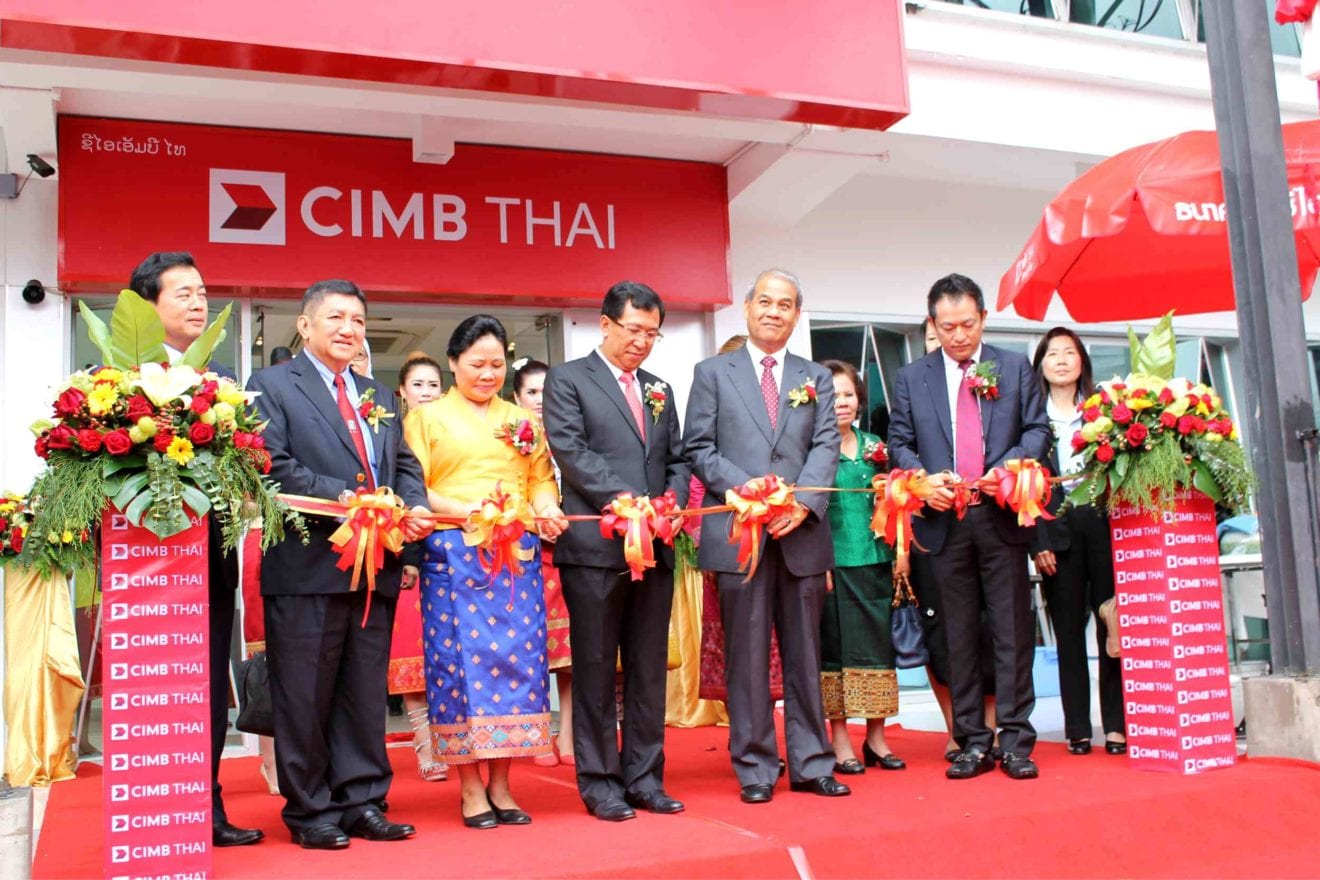
    CIMB Thai Bank will open its first overseas branch in Vientiane in the third quarter of the year to service trade and other business activities between Thailand and Laos.

    The new branch forms part of Malaysia-owned CIMB Group’s retail banking initiatives this year, Subhak Siwaraksa, president and chief executive officer of the Thai unit, said yesterday.

    After the upgrade of the retail banking platform system last year, CIMB Thai’s domestic performance is expected to show significant improvement.

    Subhak said CIMB Group wanted to see a rising return on equity from CIMB Thai, the target being a top-3 ranking in the Thai banking industry by 2015 with a return on equity of 16-18 per cent, against 10-13 per cent at present.He added that the ROE target would be challenging as the bank had to use its capital carefully because of Basel III requirements. It will, therefore, emphasise fee-based income from retail banking through to wholesale banking.

    Chief financial officer Narongchai Wongthanavimok said the Vientiane branch would have the capability to serve retail clients and offer cross-border products to corporate clients in Thailand and Laos.

    CIMB Group acknowledges that the Laos market should fall under CIMB Thai’s remit because of the tight relationship between the two countries and expanding bilateral trade value.

    According to the Lao PDR Trade Portal, in the first 10 months of last year, the value of bilateral trade was US$4 billion (Bt120 billion), representing a year-on-year rise of more than 30 per cent.

    The two governments have jointly set an annual trade target of $5.77 billion by 2015.

    Narongchai said that under Laotian law, the registered capital required for a bank branch was $12.5 million.

    However, given the unclear legal framework in Laos concerning consumer lending, CIMB Thai’s branch will focus on providing financial services to corporate customers and on wealth management, rather than on consumer loans, he said.

    The bank will not lend to Lao customers if they have no collateral base in Thailand, he said, adding that this would help reduce the risk from doing banking business in Laos.

    The bank will target Thai customers who have activities in Laos, as well as Laotian companies conducting business in Thailand, which are mostly small or medium-sized enterprises.

    Wealth management

    As well as their domestic operations, many Laotian companies have activities in border provinces in Thailand. As these companies are generally affluent customers, wealth management and deposits will be the priorities for CIMB Thai at the outset of offering financial services in the neighbouring country.

    “We can service three currencies for deposits: baht, kip and US dollars. Moreover, the branches in border provinces such as Nong Khai and Udon Thani will help support activities and transactions in Vientiane as well,” said the CFO.

    The Vientiane branch will have 10 staff, two or three of whom will be Thais, including the manager.

    CIMB Thai expects the branch to break even by 2016.

    Savannakhet and Pakse are other interesting locations for expanding the Laos network because of the potential opportunities they offer in terms of tourism and trading, Narongchai said.

    If the bank were to open more than three branches, the establishment of a local subsidiary would be a feasible option, he said.

    The registered capital required for setting up a commercial banking subsidiary in Laos is $30 million. – See more at: https://www.nationmultimedia.com/business/CIMB-Thai-Bank-branching-out-into-Laos-30201241.html#sthash.vYhTcDjX.dpuf