Tag: consumer

  • New Zealand Consumer spending finished stronger in 2017

    New Zealand Consumer spending finished stronger in 2017

    Consumer spending growth accelerated to five per cent year-on-year in the three months to the end of December last year, with retail trade picking up momentum over the holidays, new National Australia Bank data has revealed.

    Up from three per cent growth y/y in the third quarter, NAB’s latest quarterly customer spending report, which measures around 2.7 million daily transactions through the bank’s facilities, has tracked spending increases across the entirety of metro and regional Australia.

    Retail trade increased 3.4 per cent y/y in Q417, up from 2.4 per cent in the third quarter, while accommodation and food services spending was 10.4 per cent, up 3 per cent.

    The Northern Territory was the strongest growth state for retail trade, up six per cent, offsetting a 0.6 per cent decline in Western Australia.

    Retail trade spending growth was 4.7 per cent in Victoria and 3.3 per cent in NSW. Across the entire economy Victoria was the strongest performer, while NSW and NT lagged.

    Average monthly customer spending during the quarter was up $166 to $2306 in metro areas and up by $104 to $2089 in regional areas.

  • Consumers get their mojo back

    Consumers get their mojo back

    Consumers appear to have a spring back in their step, which will be a welcome relief to retailers after the recent run of poor household spending figures.

    The Westpac-Melbourne Institute consumer sentiment index jumped 3.6 per cent in October to its highest level in a year and for the first time since November 2016 showed optimists outnumber pessimists.

    Releasing the survey on Wednesday, Westpac chief economist Bill Evans said this welcome boost is consistent with an improving global economy, less concern over a rise in interest rates because of heated house prices and strong employment gains.

    Data last week showed retail spending in August dropped for a second month a row, posting the worst performance in seven years.

    Commonwealth Securities chief economist Craig James said in the space of two months consumer confidence has gained over six per cent.

    “Consumers are getting their mojo back,” he said.

    However, the International Monetary Fund’s latest World Economic Outlook brought both good and bad news on the economic outlook.

    While it has upgraded its global growth forecasts again, bad weather events have meant Australia has failed to live up to its earlier expectations.

    IMF economic counsellor Maurice Obstfeld says the global recovery is continuing and “at a faster pace”.

    “We see an accelerating cyclical upswing boosting Europe, China, Japan and the United States, as well as emerging Asia,” he said.

    The Washington-based institution now expects the world economy to grow by 3.6 per cent this year and 3.7 per cent in 2018, both 0.1 percentage points higher than previously predicted in July.

    That compares with 3.2 per cent growth in 2016.

    By contrast, the IMF expects economic growth in Australia to slow to 2.2 per cent in 2017 compared to 2.5 per cent in 2016 – a downgrade from its previous prediction of 3.1 per cent.

    “Growth is expected to soften temporarily to 2.2 per cent in Australia, where housing investment and mining exports in the first half of the year were undermined by bad weather,” the report says.

    National Australia Bank senior economist David de Garis thought that forecast was a “little low” and is below his bank’s 2.5 per cent prediction.

    It also falls to the lower end of the Reserve Bank’s two to three per cent forecast range for this year.

    The IMF expects the economy to grow by 2.9 per cent in 2018.

  • Personal consumer credit becoming lucrative business

    Personal consumer credit becoming lucrative business

    FE Credit is leading the consumer finance market with $1.4 billion worth of loans provided in 2016, accounting for 48 percent of market share.  Its rivals, Home Credit, HD Saison and Prudential, hold 15.7 percent, 12.2 percent and 8.1 percent, respectively, according to StoxPlus. The other well-known names in the market are Mirae Asset Finance, JACCS and Toyota finance.

    The consumer finance market has become bustling thanks to high demand from borrowers and readiness by commercial banks and finance companies. Since customers are in both large cities and rural areas, it is easy for finance institutions to expand the market and disperse risks.

    Lending to fund personal consumption is lucrative, which accounts for 42.5 percent, followed by lending to fund household goods (28 percent), and transport means (19.6 percent).

    Regarding the growth rate, lending to fund transport purchases and house upgrading witnessed the highest growth rate of 42 percent each in 2016.

    Business Monitor International (BMI) predicted that the consumer finance market would perform well in 2016-2019, as personal income has growth rate of 13.2 percent per annum.

    Also according to BMI, consumer finance targets people of working age, expected to reach 56.2 million by 2020. The figure was 54.4 million in 2015.

    The consumer finance assets were reported as making up 12.4 percent of total assets in 2016.

    By the end of the year, the finance consumer value had reached VND598.5 trillion, an increase of 30 percent over 2015. This included VND453.1 trillion worth of loans provided without mortgaged asset requirement.

    Consumer finance in Vietnam in 2016 made up 9.8 percent of GDP. Meanwhile, the figure was 320 basic points higher in regional countries.

    Regarding credit types, the cash is predicted to decrease from 89 percent in 2016 to 81 percent of total outstanding loans by 2019 as the market share will fall into credit cards.

    Regarding the market structure, consumer finance is undertaken by retail banks and finance companies. Commercial banks tend to set up subsidiaries specializing in consumer finance or to take over existing companies.

    MB Bank in March 2016 took over Song Da Finance Company (SDFC) and renamed it MCredit. Later, in November 2016, after joining hands with Shinsei Financial from Japan, MCredit once again changed its name to MB Shinsei with 51 percent of capital contribution from MB Bank.

    In recent years, Vietnam has not granted licenses to companies providing only consumer finance services, which was a barrier to market admission.

  • Davidoff’s Martin Kaufmann on the new cigar consumer

    Davidoff’s Martin Kaufmann on the new cigar consumer

    Cigars have been enjoying a revival in recent years, boosted by younger smokers and emerging cigar markets such as China. We spoke with Martin Kaufmann, Oettinger Davidoff’s Senior Vice president of Europe and Global Travel Retail, on his recent trip to Hong Kong to learn more about trends in the cigar industry and how Davidoff is taking on a new generation of consumers.

    How have Davidoff’s customers changed in recent years? Can you tell us about the new generation of cigar consumers?

    Cigars have typically been seen in the older days as something for the more established gentlemen. That has changed a lot. The majority of our new consumers are actually coming in the age bracket of 30-plus and they are from very different walks of life. For the younger generation, it’s not all about an origin—it’s more about discovering different taste experiences from different parts of the world.

    Do trends like social media and pop-up stores play a part in travel retail?

    Social media definitely plays an increasing role. We’re in a highly regulated environment, so it’s less of us talking about ourselves on social media, and more of aficionados and consumers talking about us. It’s very important that we provide the content and the experiences so that they have stories to tell.

    Pop-up stores is something we haven’t done yet, but we have a couple of projects coming up where we’re going to test this in Europe.

    What kind of experiences do you try to create for consumers so that they’ll talk about it on social media?

    Pairings are an important part of cigar tastings, and it’s not only about spirits or wine, but also pairings with fine food. So we do a lot of collaborations with gastronomic tours, with star chefs and special menus. We have the Chefs Edition, which was actually created by cuisine chefs. And that entire experience makes people talk—it’s really all a lifestyle, more than a product.

    How do multi-sensory experiences get translated with travel retail in airports?

    It is quite dependent on the environment. For example, we might have the ingredients on display, such as pepper to show it’s spicy, and we often have leaves on the ceiling. In some locations we can provide a full fledged multi-sensory experience, like the new walk-in humidor we just opened in Paris.

    What cigar trends are you seeing worldwide?

    It really depends a lot on where you’re looking at. In the US, for example, very big formats are a trend. In other parts of the world, short smokes have been popular for a while, where you only have maybe 20 to 30 minutes [in a smoke], and that is something we don’t see so much in Asia. It has to do with the maturity of the market—whether you have a well established cigar culture, or a younger market where cigars are still developing.

    Which products are doing the best in Asia?

    A lot of Asians are traveling, so when we talk about travel retail, you would find, for example, Chinese travelers all over the world. Gifting remains very important for Chinese travelers. Over 50 percent of cigars that are bought by the Chinese are actually for gifting purposes. That would be way less if you look at the US or Europe, for example.

    How do you engage with Chinese customers?

    We try to educate about the category in customers’ home countries. That’s really where it starts. Ideally, we want people to have an idea of Davidoff and cigars already before they travel.

    We also do specific city and country special editions, such as our zodiac editions that come out every year. Being on WeChat is a breakthrough for us, and of course our brand ambassadors play a role—they can speak Chinese, but they also know how the Chinese shopper wants to be approached. We do a lot of research to understand how Chinese consumers think.

    Do you think that cigars should be grouped with other kinds of tobacco?

    I think that cigars couldn’t be more different from cigarettes. While it’s all tobacco, there’s a very different motivation as to why you smoke. Most cigar smokers don’t come from cigarettes. It’s more comparable with drinking wine or champagne. It’s very much a luxury good, and I don’t think cigarettes have anything to do with that type of market.

    Lastly, what is your personal favourite cigar blend?

    There are so many great cigars. I like the Winston Churchill very much, specifically when we relaunched it a little over two years ago. The Millennium blend I love a lot. My personal favourite, independent from those I’ve tried on testing panels, is the Davidoff Nicaragua Robusto format. That is definitely my favorite.

  • Weak peso to weaken consumer spending

    Weak peso to weaken consumer spending

    Household spending in the Philippines is expected to post a slower growth this year because of rising consumer prices and a weaker currency, Business Monitor International, a unit of Fitch Group, said in a report over the weekend.

    “In US dollar terms, household spending growth will experience a significant deceleration from 6 percent in 2016 to 0.8 percent in 2017 as we forecast the Philippine peso to depreciate against the US dollar over 2017,” BMI said.

    “With that said, household spending will grow at an annual average of 8 percent between 2017 and 2021, reaching $337 billion up from $232 billion in 2017,” it said.

    BMI expects essential spending to remain dominant over its forecast period and account for 74 percent of total household spending in 2017 and 75 percent by 2021.  Essential items include food, beverage, housing, clothing, utilities and basic services.

    Essential spending is expected to grow at an average annual rate of 9.5 percent between 2017 and 2021, with non-essential spending growing at an average rate of 8.4 percent over the same period.

    “As a result of low average incomes and a large rural population, essentials will continue to account for the majority of household spending in the medium term at least. Food and non-alcoholic drinks, housing and utilities and transport will continue to account for the majority of household retail spending, rising from 74 percent of total spending in 2017 to 75 percent by 2021,” it said.

    The increasing cost of housing and utilities will demand a greater portion of household income over the coming years. Albeit declining, the share of household spending on food and drink will remain the largest, forecast at 37.3 percent in 2021 (down from 38 percent in 2017), it said.

    “Non-essential spending is expected to continue to account for a roughly stable portion of total household retail spending over our forecast period. Real wages are steadily on the rise, however, which should boost spending in the non essentials sector over the long term, and will prompt consumers to upgrade to higher quality essentials,” BMI said.

    Household spending in the Philippines is dominated by spending on food and non-alcoholic drinks; housing and utilities and transport, which accounts for 69 percent of total spending. BMI expects spending patterns in the Philippines to remain fairly static over the medium term with the top three spending categories retaining their positions.

    “Housing and utilities will make the greatest gains over our forecast period, increasing by 1.15 percentage points as a proportion of total spending on the back of rising costs in this segment. Food and

    non-alcoholic drinks spending will experience the largest decline over this period, registering a decline 0.7 percent as a proportion of total household spending,” it said.

    “Food and non-alcoholic drinks account for the largest share of retail spending in the Philippines, at 38 percent of total household spending in 2017. We expect that the sub-sector will maintain its

    dominant role in the Philippines’s retail basket, as low household income levels in the country encourage subsistence-based spending,” it said.

    Households are forecast to spend P4.4 trillion on food and non-alcoholic drinks in 2017, while spending another P190 billion on alcoholic drinks and tobacco. BMI said over the medium term, food and drink will continue to dominate household spending, as overall income levels remain low.

  • Vietnamese consumers the most socially-conscious in Asia-Pacific

    Vietnamese consumers the most socially-conscious in Asia-Pacific

    Vietnamese consumers are the most socially-conscious in Asia-Pacific according to the Corporate Sustainability Report from Nielsen released on April 26. The report indicates that up to 86 per cent of consumers in Vietnam are willing to pay higher prices for products and services that come from companies that are committed to positive social and environmental impacts, compared to 76 per cent of consumers in Asia-Pacific.

    After Vietnamese, Filipino, Indonesian and Chinese consumers are the most socially-conscious in Asia-Pacific, with 85 per cent, 83 per cent, and 80 per cent of respondents, respectively, stating a willingness to pay extra for products and services that come from companies who demonstrate their commitment to having a positive impact on society and the environment.

    According to Mr. Rakesh Dayal, Head of Consumer Insight at Nielsen Vietnam, in the last couple of years, people have witnessed some of the negative impacts of adverse weather conditions and pollution on Vietnam’s living and business environments.

    Therefore, it would be difficult to find consumers who do not show concern for environmental and societal issues nowadays.

    In small and big ways, consumers are trying to be responsible citizens, and they expect the same from corporations.

    “Committing to sustainability might just pay off for consumer brands,” he said. “Integrating sustainability into their business models and objectives helps society and, at the same time, raises goodwill toward their brands.”

    He added that companies with strong reputations can outperform others when it comes to attracting top talent, investors, community partners, and, importantly, consumers.

    The survey indicates that the top sustainability factors influencing the purchasing intentions of Vietnamese consumers are high-quality products (79 per cent), products known for their health and wellness benefits (77 per cent), and products made with fresh, natural and/or organic ingredients (77 per cent).

    Moreover, products known for their high standards of safety carry quite similar weight with consumers in Vietnam (76 per cent).

    “Finding opportunities to bridge health benefits and the ingredients that support the claim is a powerful and impactful way to connect with consumers,” Mr. Dayal advised.

    Equally important among consumers in Vietnam is brand trust. Seventy-five per cent of Vietnamese consumers indicate they would buy products from a brand or company that they trust.

    When it comes to purchasing intentions, a commitment to the environment has the power to sway product purchases for 62 per cent of consumers in Vietnam.

    Commitments to either social values or the consumer’s community are also important, influencing 61 per cent and 62 per cent of respondents, respectively.

    “We are seeing a change in the hierarchy among drivers of consumer loyalty and brand performance,” Mr. Dayal observed.

    “Commitments to social and environmental responsibility are surpassing some of the more traditional influences for many consumers. Consumer-goods brands that fail to consider this run the risk of falling behind.”

  • Vietnam’s fast moving consumer goods market ends 2016 on a high note

    Vietnam’s fast moving consumer goods market ends 2016 on a high note

    Fast moving consumer goods (FMCG) sales showed the best improvement in three years in the last quarter of 2016, with 7.3 percent growth against the same period last year, according to the latest Market Pulse quarterly report released by Nielsen on Thursday.

    “The build-up and positive sentiment towards the Tet period was one of the key drivers for FMCG growth,” said Nguyen Anh Dung, Nielsen Director of Retail Measurement Services.

    Beverages continued to be the key contributor to the total FMCG sales in the last quarter, accounting for 40 percent, followed by food and milk based products, which made up 15 percent each of the total.

    After being hit by a year of adverse weather conditions, growth in rural areas experienced a strong bounce-back from October-December with a 7 percent on-year jump, contributing 51 percent to total FMCG sales nationwide.

    “Rural areas are still the biggest consumer base and these consumers have increasing incomes that give them higher spending power,” Dung said.

    The Market Pulse Report is published quarterly based on the results of a Nielsen Retail Measurement study of FMCG in six cities across the country: Hanoi, Ho Chi Minh City, Hai Phong, Can Tho, Nha Trang and Da Nang.

    Fast-moving consumer goods refers to products that are sold quickly and at a relatively low cost.

  • Singapore’s consumer prices rise for first time in 2 years

    Singapore’s consumer prices rise for first time in 2 years

    After a record two years of negative inflation, consumer prices in Singapore finally rose in December last year, with headline inflation coming in at 0.2 per cent.

    The rise in the consumer price index (CPI) was due to a larger increase in private road transport cost, which rose by 1.7 per cent in December following a 0.2 per cent rise in November. The rise was the result of higher petrol prices and car park fees, said the Monetary Authority of Singapore (MAS) and Ministry of Trade and Industry (MTI) on Monday (Jan 23).

    Services inflation edged up to 1.6 per cent from 1.5 per cent in November, mainly due to a faster pace of increase in holiday expenses, which more than offset the larger contraction in telecommunication services fees.

    Food inflation was 2 per cent, unchanged from the previous month. Accommodation costs fell by 3.8 per cent in December, similar to the previous month, reflecting continued softness in the housing rental market, MAS and MTI said.

    Overall retail goods inflation eased to zero per cent in December from 0.2 per cent in November, largely on account of a fall in the prices of personal care products.

    December’s increase comes after the headline consumer price index stayed flat in November from a year earlier, coming off a deflationary trend for the first time in two years.

    For the whole of 2016, headline inflation came in at -0.5 per cent for the second consecutive year.

    Core inflation, which excludes the cost of accommodation and private road transport, was slightly lower at 1.2 per cent compared to 1.3 per cent in November. The decline was mainly due to a fall in retail goods inflation more than offsetting an increase in services inflation, MAS and MTI said.

    For the whole of 2016, core inflation rose to 0.9 per cent, from 0.5 per cent the year before.

  • Consumer credit seen to grow in Philippines

    Consumer credit seen to grow in Philippines

    Consumer credit demand in the Philippines remains strong, supported by President Rodrigo Duterte’s push to sustain economic growth, a loan provider said Friday.

    Home Credit Philippines expects to hit its target 500,000 clients this year and double its client base to one million in 2017, according to its chief executive, Annica Witschard.

    “Obviously, there’s going to be some ups and downs in the global economy but the Philippines has a strong track record of growth and I don’t seen anything that’s going to stop that in the coming years,” she told ANC’s “Market Edge with Cathy Yang.”

    Companies like Home Credit thrive with only three out of every 10 Filipinos having access to banks and only five percent with credit cards, she said.

    Home Credit Philippines, the local unit of Home Credit Group, plans to expand to more retail stores in 17 provinces nationwide to offer non-cash, no-collateral in-store financing.

  • Indonesian consumers regain confidence in Q3

    Indonesian consumers regain confidence in Q3

    Indonesian consumer confidence rose again in the third quarter of this year in line with their increasing confidence for the government’s recent economic policies, global research company Nielsen revealed on Wednesday.

    According to Nielsen’s Global Consumer Confidence Survey, the Indonesian consumer confidence index increased by three points to 122 in the third quarter from the previous quarter, an improvement that Nielsen Indonesia managing director Agus Nurudin attributed to a positive public response to the government’s tax amnesty, controlled inflation and manageable economic growth.

    “This is the first time we moved back to 120 after one year,” he told reporters, adding that Indonesia, since the third quarter last year, always scored below 120 in the quarterly survey because of political instability and economic uncertainty.

    The survey findings also suggested that although Indonesian consumers show an increasing willingness to spend, they are getting more rationale than before.

    “They prefer to reduce their spending on expensive tertiary goods, update their gadgets less often and change their foreign trips to domestic ones,” Agus said.

  • Enhancing last mile delivery, consumer experience with SMS Services

    Enhancing last mile delivery, consumer experience with SMS Services

    E-commerce is a fast-moving game and major forces are changing the rules. Forward-thinking retailers are investing to maximize the potential of both physical and digital channels. Global players that once stood on the sidelines are now poised to compete in South East Asia. Just recently, Indonesian department store chain MatahariMal raised $500 million to develop their e-commerce venture. Alibaba too, has invested $249 million in SingPost to expand their delivery network in SEA.

    As the world’s fastest growing internet region with 260 million users, South East Asia is fast becoming a unique e-commerce market. Primed for tough competition, e-commerce companies are fast prioritizing customer service as a way to stand out from their competitors. Keeping customers at the heart of their business strategy, and delivering the best possible value to them is becoming more important than ever.

    Today, last-mile delivery has become a priority for both e-commerce companies and their customers. Ensuring speedy, but prompt delivery has been proven to give companies an edge in the competitive landscape, while showing customers that companies could go the extra mile for them.

    In fact, local and regional players have still emerged as early winners, largely due to their ability to provide a better-tailored experience for local consumers than what global competitors usually offer. For instance, Singapore-based Lazada built local logistics footprints in each market to increase delivery reliability, and added motorbike fleets to provide speedier options to traditional truck deliveries.

    That said, enhancing last-mile delivery for consumers in the region comes with its own set of challenges.

     Consumer trust, diversity, slow infrastructure serve as roadblocks

    Firstly, the lack of consumer trust is one of the challenges the Southeast Asian e-commerce market is facing. Consumers today are wary of making transactions online due to various security issues such as fraud. According to the e-conomy SEA report by Google and Temasek Holdings, 58 percent of citizens in South East Asia expressed concerns over financial information being shared online. With cyber attacks on the horizon, trust between customers and e-commerce companies have been shaken and today, assurances must be given to customers on a consistent basis to maintain strong relationships.

    The region also encompasses a wide range of ethnicities, languages, consumer preferences and regulations, coupled by a politically and economically complex landscape. With such diversity, consumers in different markets have conflicting preferences and expectations, which means more time and money must be invested carefully into business planning to ensure that this is addressed adequately.

    Despite the immensely positive steps taken towards ASEAN economic integration, there are still socio-political and economic issues that can put a dampener on overall business growth of regional delivery companies.

    Southeast Asia also lacks a solid regional payment and logistics infrastructure, which were the foundation for China’s astounding digital-retail growth. Even though larger businesses today are investing in the development of delivery infrastructure, they are still weak and getting your goods delivered affordably and efficiently may still be an issue. As a result, organisations often find it a challenge to make a scalable business model work, and to justify the high levels of initial investment.

    The use of SMS to represent reliability and optimization

    In order to manage deliveries in a reliable and robust manner while ensuring customer trust is being built, e-commerce companies are looking at the option of sending SMS notifications to customers, and are turning to SMS services to manage the surge in SMSs.

    SMS services have been selected over mobile apps as it is ideally equipped for both application-to-person (A2P) or machine-to-machine (M2M) applications. While not a popular choice of communication between people today, businesses still leverage SMS because it is always delivered even when customers do not have smartphones or data connection, representing reliability and consistency.

    This step is critical for business continuity as it helps to ensure continued trust with customers. To best manage their communication processes when it comes to delivery, e-commerce companies can consider working with a messaging solutions provider to create a reliable and efficient distribution process and enhance overall customer experience.

    By outsourcing their communication processes to messaging solutions, companies can efficiently manage the large volume of messages they send to customers and delivery partners, through unlimited scalability and transmission capacity.

    Through implementing SMS messaging services, delivery processes are more convenient and transparent for e-commerce companies, their business partners and customers. SMS services can not only be used during the registration process to authenticate customers’ account mobile numbers, but also more importantly, update recipients on specific parcel delivery information such as estimated time of arrival.

    By selecting a provider with high quality of service, reliability, security levels and transparency, e-commerce companies can experience increased customer and partner satisfaction as communication becomes more efficient with important messages being sent and delivered in seconds.

  • Thailand’s Consumer Sentiment Sees First Improvement in 10 Months in October

    Thailand’s Consumer Sentiment Sees First Improvement in 10 Months in October

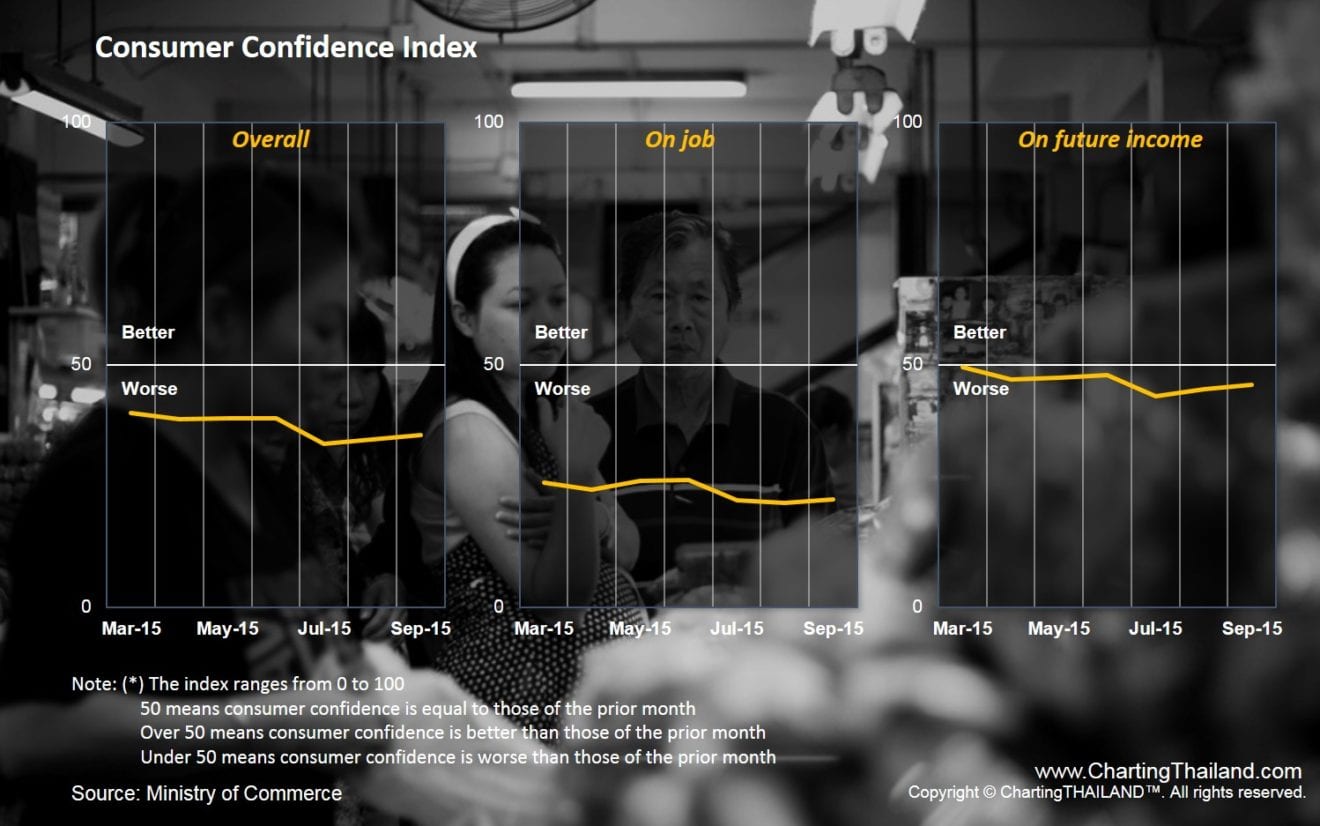
    Thailand’s consumer sentiment recovered for the first time in 10 months in October, thanks to the government’s continued introduction of economic stimulus measures.

    The University of Thai Chamber of Commerce said Thursday that the consumer confidence index rose to 73.4 in October from 72.1 in September, when the index hit its lowest level in 16 months. The monthly consumer confidence report is based on a survey of 2,244 respondents.

    Thanavath Phonvichai, director of the university’s Economic and Business Forecasting Center, told a news conference that the government’s continued introduction of a series of economic stimulus packages has helped boost consumer confidence.

    In the past few months, the Junta-installed government has unveiled a number of short-term economic stimulus measures, including a 136 billion baht ($3. 8 billion) package aimed at low-income households, a 10 billion baht ($282 million) budget to boost the property sector and new tax incentives for the private sector to speed up or increase investments.

    Deputy Prime Minister Somkid Jatusripitak, who is in charge of the economy, said this week that the government is confident that all measures will start yielding fruit from the fourth quarter of this year.

    Mr. Thanavath of the Thai Chamber of Commerce University said falling retail oil prices and a rebound on the Thai stock market have also helped improve sentiment.

    However, he noted that while the university believes the country’s economy might have bottomed out, its growth outlook remains fragile.

    The government has forecast the Thai economy will grow between 2.7% to 3.2% in 2015.

  • Lotte China loses a trillion

    Lotte China loses a trillion

    Reports from Korea suggest Lotte Group has lost more than 1 trillion won (US$853 million) in China in just three years.

    Data assembled by CEO Score shows Lotte China made heavy losses between 2011 and 2014 as South Korea’s fifth largest company struggled to understand the Chinese consumer and build market share.

    Last month, Lotte said it would close four loss-making stores in its Mainland China network – all in in East China’s Shandong Province.

    Lotte is said to be losing market share in Mainland China unable to differentiate itself in the middle ground between local retail chains and the growing power of online retailers such as Alibaba and JD.com.

    CEO Score’s data shows the losses are growing, not narrowing. It started with 92.7 billion won in 2011, reached 250.8 billion won in 2012 and a massive 580.8 billion won in 2014.

    Lotte Mart has 120 stores in China, 116 in Korea, 39 in Indonesia and 10 in Vietnam.

    The company is family owned with the leadership locked in a bitter power struggle and two brothers compete to take control from their 93 year old father.

  • China’s shoppers may take 10 years to step up

    China’s shoppers may take 10 years to step up

    Chinese policymakers are gung-ho to transition their economy away from investment and toward consumption, but that may not happen for another decade, new data shows.

    “Without a substantial intervention, we believe consumption’s share of China’s economy is unlikely to rise substantially before 2025,” The Demand Institute, a non-profit organization operated by The Conference Board and Nielsen, said in a new report.

    Private consumption as a share of gross domestic product (GDP) will average 28 percent from now until 2025, the think-tank said.

    To be sure, the mainland has long underperformed the global average in this regard as Beijing previously focused on export-led growth.

    Consumption as a share of GDP was 37 percent last year, according to the Brookings Institution, compared with around 70 percent in the U.S. and 60 percent in fellow emerging market, India.

    The indicator has only recently started to stabilize in recent years. Consumption relative to GDP declined 48 percentage points from 1952 to 2011, one of the longest and largest drops of any nation on record.

    Based on an examination of 167 countries between 1950 and 2011, the report found that nations with similar economic characteristics to China saw consumption remain flat relative to GDP for a considerable period following previous declines.

    China’s desire to rebalance its economy stems from the need to avoid the dreaded “middle-income trap,” in which developing countries are unable to graduate into high-income countries after achieving a certain level of per capita GDP.

    While many economists believe the economic transition is already underway, albeit at a gradual pace, they also expect it will take a while before consumption’s share of GDP spikes higher.

    “Only towards the end of decade, when the economy slows further to 5-6 percent, consumption’s share of GDP will become more important,” said Jian Chang, China economist at Barclays. “But we have seen investment slow significantly and I think total consumption as a share of GDP could near 50 percent this year.”

    Beijing’s strategic vision of boosting consumption was first outlined in 2011’s 12th Five-year Plan and since then, the government has unleashed a slew of measures, including raising wages and slashing import tariffs on high-demand goods.

    But The Demand Institute warns that the burden can’t rest on the government alone: “It is up to business to nurture the demand that policy unleashes, aligning goods and services with consumers’ shifting preferences.”

    Ensuring access to products and services via reliable distribution channels, satisfying demand across different income, regional and age groups as well as offering more financial services to support consumption are some of the factors that businesses can embrace, the report said.

  • Singaporean retailers thrive on on-line market

    Singaporean retailers thrive on on-line market

    A research by eBay exhibits that Singapore’s tech savvy retail exporters, who use the corporate’s on-line market place, promote to a mean 41 worldwide markets.

    eBay defines retail exporters as these sellers on its website who garner US$10,000 in gross sales to international clients (that’s consumers outdoors of Singapore).

    In accordance with an eBay spokesman, Singaporean retail exporters have been experiencing strong progress on the again of a revitalised US greenback. In South-east Asia, Singapore is ranked second when it comes to attain behind Thailand. Apparently, Singapore’s rating is 5 locations greater than US retail exporters.

    Jason Lee, director, eBay South-east Asia, famous that the US is the highest commerce hall for Singaporean retail exporters.