Tag: Counterfeit

  • Snapdeal unveils ‘Brand Shield’ to help firms fight counterfeits

    Snapdeal unveils ‘Brand Shield’ to help firms fight counterfeits

    India’s e-commerce major Snapdeal Monday said it has launched ‘Brand Shield’, an anti-counterfeiting programme to help brands report counterfeit products being sold on its platform. The programme has been designed based on the inputs received from various brand owners, Snapdeal said in a statement.

    The programme is aimed at enabling a structured interaction between the platform and brands with regard to any intellectual property (IP) issues flagged by the brand, it added.

    Under Brand Shield, there will be an online, triple-check point process for brands to report any violation of their IP rights in terms of trademark, copyright, patent or concerns related to design.

    Brands can also list specific issues relating to unlawful copying of logos, brand images, design features and packaging by sellers listed on Snapdeal’s platform. Brands will be required to establish their ownership of the IP, identify the listing of concern through proof and state their claim of infringement.

    The statement said designated teams at Snapdeal will review every report of IP infringement submitted through Brand Shield. Upon verification of the accuracy and adequacy of the information provided by the brand, Snapdeal will take down the listing within one business day, it added.

    In continuation of current practice, Snapdeal will also continue to de-list products/ listings in compliance with any directions or orders passed by the courts and other relevant authorities, the statement said.

    “The issue of unscrupulous sellers misusing online marketplaces to sell fake goods is a global problem. Brand Shield is part of our ongoing initiatives to collaborate with brands owners to combat counterfeits and infringement offences,” a Snapdeal spokesperson said.

    Snapdeal, an online marketplace, acts as an intermediary connecting buyers and independent third party sellers. It also prohibits the sale of counterfeit products on its marketplace and any sellers found in violation are penalised as per the terms of agreements with the sellers, the statement said.

  • Macau Customs raids two stores selling counterfeit products

    Macau Customs raids two stores selling counterfeit products

    Macau Customs officers have arrested five local residents after busting a luxury counterfeit-goods retailing business in the territory.

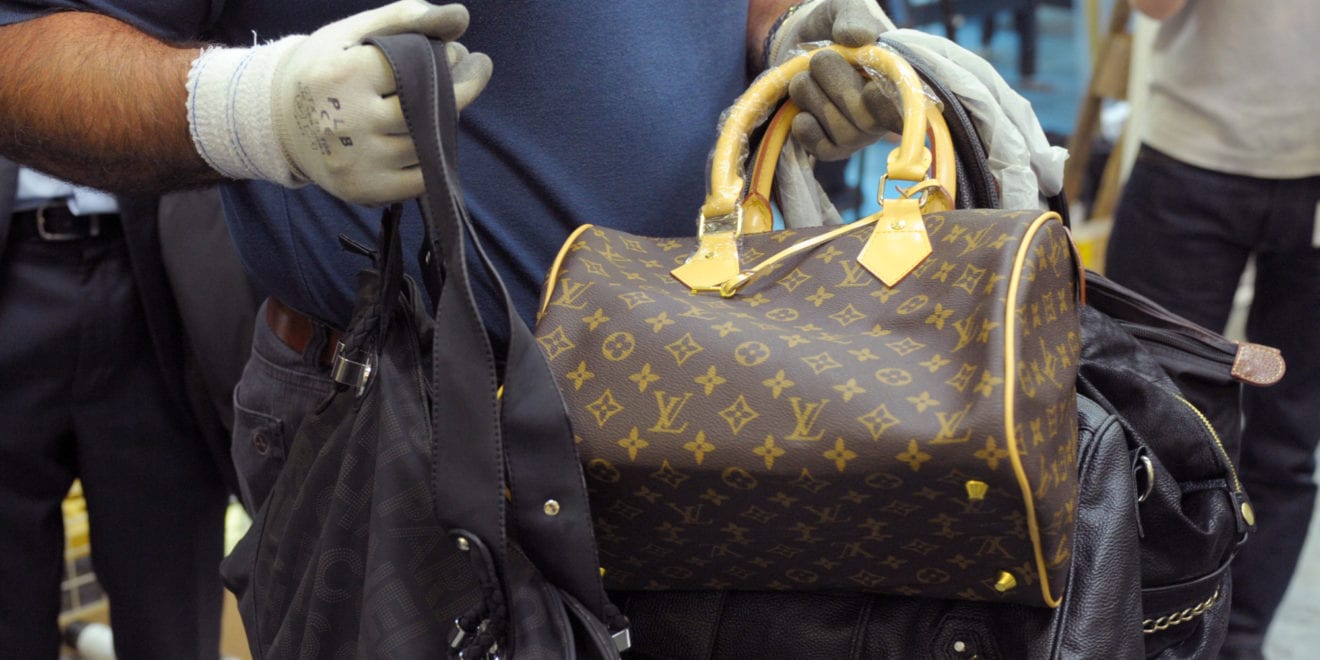
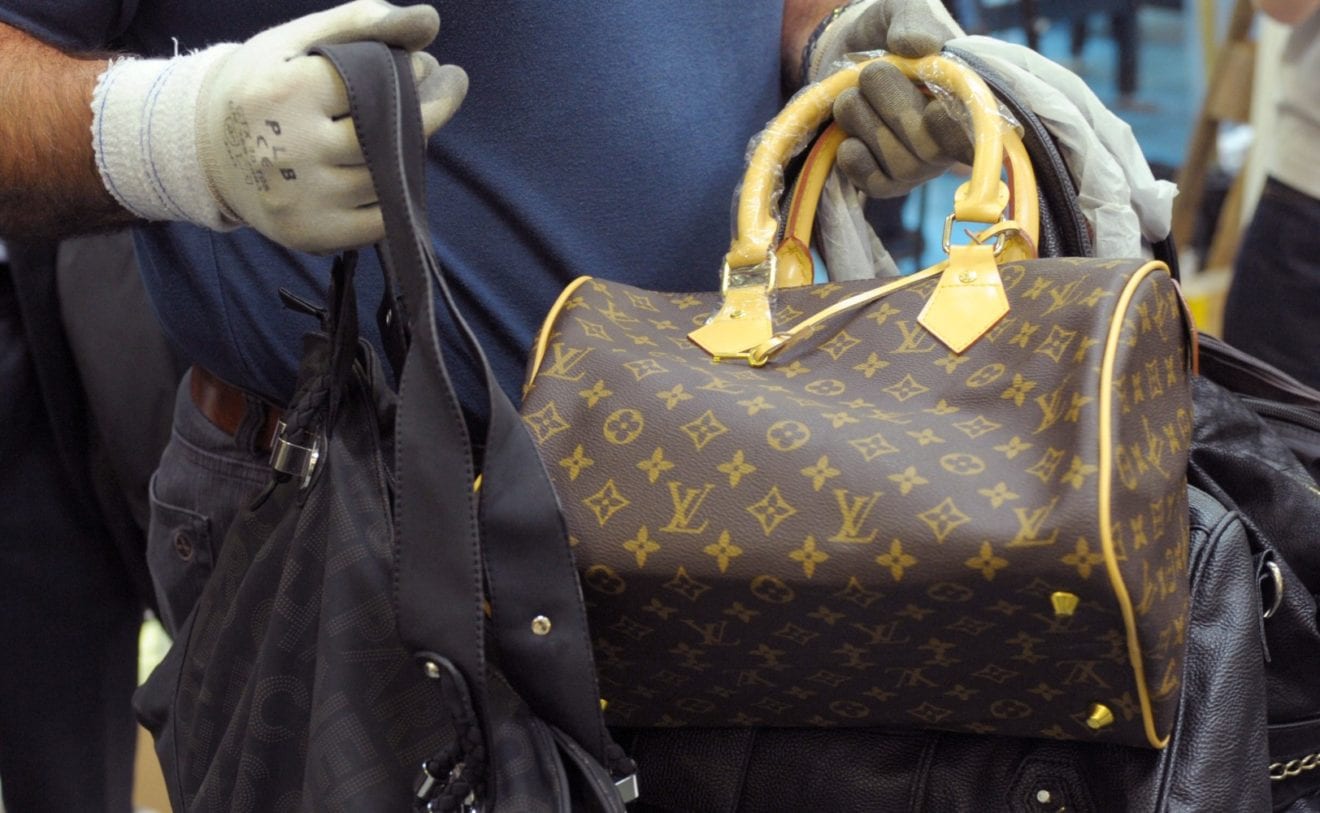
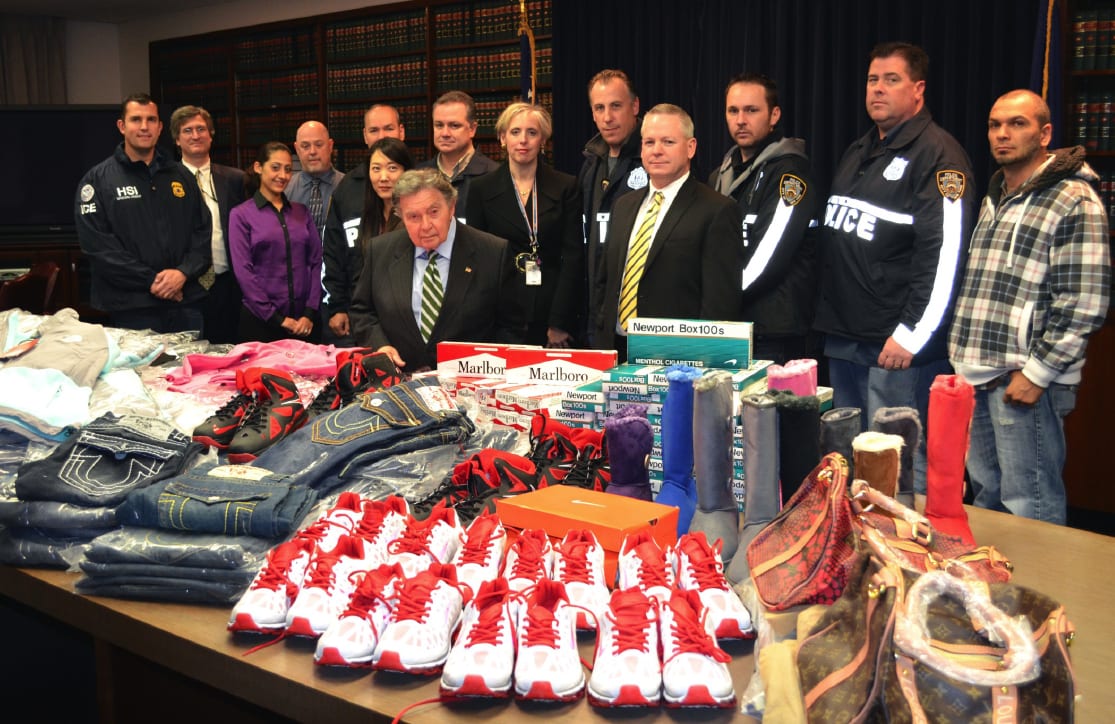
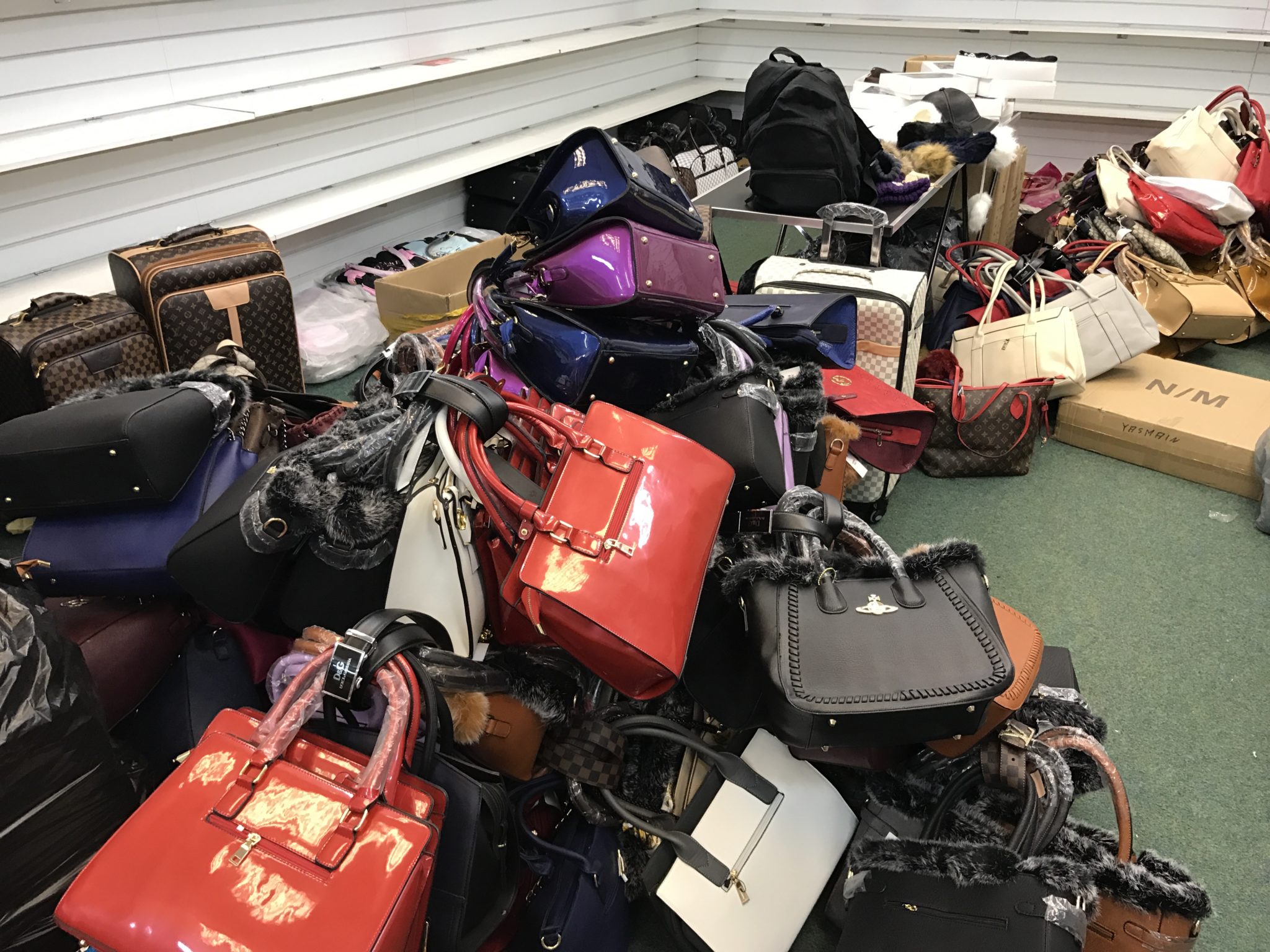
    Nearly 500 fake items of clothing, handbags, belts shoes and watches carrying brand names including Prada, Gucci, Louis Vuitton, Cartier, Chanel and Hermes were seized in raids. Officers suspect the goods had a street value of MOP3.65 million (US$451,445).

    The Customs action followed complaints by the brand owners. Two retail stores located in the NAPE and Central districts of Macau were raided, Customs announced this week.

    The goods were brought in from the mainland and were being sold in shops at retail prices matching those of genuine products on sale in the city.

    People caught selling counterfeit goods in Macau face jail terms of up to six months.

  • Hong Kong Customs Roll Up Counterfeit Phone Gangs

    Hong Kong Customs Roll Up Counterfeit Phone Gangs

    A territory-wide Hong Kong Customs raid has resulted in arrests and netted 100 smartphones suspected of being counterfeits.

    During the one-day Operation Snow Leopard, officers raided 12 shops and two storage places, seizing smartphones with suspected false trademarks or bearing possibly false trade descriptions. They also found about 3400 accessories also suspected of being fakes.

    Arrested were 18 men and a woman between 21 and 48 years old, including shop owners and salespersons, while the market value of the seized goods is estimated to be about HK$1.5 million.

    Customs had earlier received information alleging that some phone-repair shops sold suspected counterfeit smartphone accessories, and some shops were suspected to have engaged in unfair trade practices by selling old smartphones as new products, or selling parallel-imported smartphones as authorised products.

    After an in-depth investigation with the help of trademark owners, Customs took the enforcement action yesterday and raided 12 shops.

    Customs also cracked down on a syndicate in connection with export, supply and distribution of suspected counterfeit smartphones and accessories. A total of 64 suspected counterfeit smartphones and 330 suspect accessories were seized from the storage places in Sham Shui Po and Tsing Yi.

    A 32-year-old male head and 34-year-old female member of the syndicate were arrested. With the investigation ongoing, more arrests are possible.

    Intellectual Property Investigation Bureau chief Catherine Yip says the successful detection of the case was attributed to reporting by members of the public and the full help of trademark owners.
    She says Customs will step up inspection and enforcement with the approach of the Labour Day Golden Week.

    Customs says traders need to comply with the requirements of the Trade Description Ordinance (TDO) as the sale of counterfeit goods can lead to a fine of up to $500,000 and imprisonment for five years.

    Meanwhile, Customs has broadened reporting options by introducing a dedicated crime-reporting email account ([email protected]).

    Intelligence Bureau chief Kitty Poon says public reports received by Customs have risen progressively by 21 per cent, from 31,994 in 2015 to 38,819 last year. Of these, the proportion received via email has grown from 30 per cent in 2015 to almost 40 per cent last year.

  • Desire for cheap luxury drives counterfeit market in Vietnam

    Desire for cheap luxury drives counterfeit market in Vietnam

    Le Thu Trang recently switched from a Gucci bag to a Prada design for a fresh look, but the decision did not put a massive dent in her bank account.

    Both of her bags are counterfeits and cost 20 times less than the originals that can be found in the stores of luxury Italian brands.

    “I like to carry Gucci and Prada bags, but buying luxury goods is not easy because they’re expensive and fashion trends change quickly,” Trang said. “In that respect, fake bags are very appealing. They’re nice and quite cheap.”

    Trang’s case illustrates a trend among consumers, especially young people in Vietnam, who like buying fake products ranging from eyewear and shoes to garments and handbags. Their desire for cheap luxury has helped counterfeiters thrive in the country.

    On the streets of Hanoi and in some of its glistening air-conditioned malls, countless fake Hermes and Louis Vuitton handbags, Rolex watches and Gucci fashion accessories are openly on sale.

    Consumers who want an expensive logo or style can pick up goods for surprisingly cheap prices, even though they know the goods are illegal and might be confiscated by international customs agents who can impose heavy fines.

    Wealthy businessmen, savvy importers and even enthusiastic housewives are looking to make a profit from selling fakes from bricks and mortar stores or online, despite efforts to stop intellectual property right infringements.

    Retailers are also unconcerned about selling fake goods. “This is a knock-off, but no problem,” a woman said, pointing to a white polo shirt emblazoned with a Louis Vuitton logo.

    “Why should I have to worry about the police? I don’t sell drugs. I didn’t steal this shirt,” she said in a store on Hanoi’s Hang Ngang Street. “Lots of people here sell fake goods like me.”

    In a nearby handbag store, fake products with Chanel, Gucci and Louis Vuitton logos on them are on sale for $20-50.

    “The originals cost thousands of U.S. dollars,” the dealer said, convincing customers that her handbags look like the genuine article. “Same design. Same material. This one is made in China.”

    Fake products such as garments, footwear, eyewear, shampoo, body lotions and pharmaceuticals can be found all over Vietnam, from high-end shopping malls to street-side markets.

    Most of the knock-offs are smuggled in from China, Phan Hoan Kiem, head of the Market Surveillance Agency in Ho Chi Minh City, said at a recent meeting.

    However, some counterfeit products are made in Vietnam. Many households in Lich Dong Village, Thai Binh Province produce glasses and label them with famous international brands such as Ray-Ban, Gucci and Chanel, while Thao Noi Village in Hanoi is notorious for producing fake Chanel, Hermes and Louis Vuitton handbags.

    Without drastic measures to combat fake products, Vietnam could become a major counterfeiting center in the future, an official from the Department of the Intellectual Property under the Ministry of Science and Technology warned. Many handicraft villages that specialize in counterfeit goods have sprung up as farmland disappears as a result of the industrialization and urbanization process, he said.

    Vietnam has detected over 44,500 cases related to counterfeiting and piracy since 2014, said Truong Van Ba, a member of National Steering Committee 389, the government’s anti-smuggling body.

    Lack of enforcement

    Experts say Vietnam is not doing enough to stop the trend. Current laws do not impose fines on people who use counterfeit goods, but in many other countries buying and using these products is considered a crime.

    Hoang Van Truc, deputy director of the Investigation Bureau of Economic Crimes, said that only one in seven cases related to fake goods is prosecuted, while the rest receive administrative fines.

    Truc added that there’s a lack of cooperation between authorities, especially in border provinces, to prevent fake products from entering the local market. Many laws on counterfeiting and piracy overlap, while the current penalties aren’t enough of a deterrent.

    In addition, the fight against fake goods is made more difficult by the fact that some products are imported into the local market in the form of spare parts rather than finished products, making it almost impossible for authorities to identify them.

    Many enterprises also offer fake items that are 90 percent genuine, posing another problem for law enforcement officers.

    Even anti-counterfeiting stamps, which are used to protect trademarks, are being faked.

    The growing taste among local consumers for fake products has contributed to the market’s development in Vietnam, said Phan Thi Viet Thu, vice chairwoman of the Consumer Protection Association in Ho Chi Minh City.

    Her association rarely receives complaints about counterfeit products. “If consumers don’t say “no” to counterfeit goods, the trade will continue expanding.”

    Despite the warning, Trang is still happy with her fake bags. “I’ll buy genuine goods when I’m rich. For now, the cheap ones are still my best option.”

  • Thai retailers arrested for counterfeit footwear

    Thai retailers arrested for counterfeit footwear

    Thai authorities have arrested two men and seized 160,000 pairs of counterfeit footwear from six retail outlets.

    The footwear has a market value of about THB20 million (US$601,000), says Department of Special Investigation (DSI) deputy-chief Suriya Singhakamol.

    The DSI obtained warrants from the Central Intellectual Property and International Trade Court to search four locations in Samphanthawong and one in Rat Burana in Bangkok, plus another in Nakhon Pathom province.

    Suriya says 160,000 pairs of sneakers and other footwear were found falsely labelled as Adidas, Converse and Nike, as well as other brands.

    Two Chinese shop owners, Hongbin Lin and Lin Sow, have been charged with possession of products falsely labelled with registered trademarks, and with smuggling those products into Thailand in breach of trademark and customs laws.

    The men had set up companies to import counterfeit products, and traded them around the clock, says Suriya.

    The DSI has been talking with retail space owners over the past month, asking for their co-operation in not renting space to traders selling counterfeit products.

  • Retailers alerted to surge in trade for counterfeit goods

    Retailers alerted to surge in trade for counterfeit goods

    In Singapore and other parts of South East Asia, there has at least been a minimal market for counterfeit goods. Retailers across the region have wrangled with this issue for many years and today, it shows little sign of waning.

    Statistics for 2016 revealed that, worldwide, the market for counterfeit goods worldwide was worth an astonishing $650bn (US$460bn). Many of these products were sold online to customers the world over, with popular items sold including eyeglasses, electronics and designer footwear. Bargain-hunting consumers may find the price outweighs whether or not what they buy is genuine.

    Local trade

    The range of fake goods finding their way at customs is pretty wide. Aside from luxury items such as jewellery and smartphones, everyday items bearing counterfeited brand names including rice, noodles and chocolate are also sold as the genuine article. Singapore, as a major global port, sees a fair few of said goods reach customs.

    In September 2016, Singapore Customs seized over 5,000 bags of counterfeit rice imported from India. That same month, more than 1,300 wallets, bags and purses were confiscated. Both bore trademarks of brands which local authorities deemed to be illegal, highlighting the need for retailers to be wary of what they buy in from suppliers.

    When determining what is real and what is fake, Singapore Customs do a lot of the work, whether through performing checks at airport terminals and ports or by enforcing the Trade Marks Act. However, retailers are also tasked with staying on-side, whether selling products online or offline in the bustling streets and markets.

    Telling real from fake

    Retailers are advised to read the Trade Marks Act. Introduced in 1998 and revised in 2005, it states that it is illegal for traders to sell any products bearing un-trademarked logos or other forms of branding. Inspecting goods thoroughly is a must before buying; a good way of doing this is to compare a fully-trademarked product against one that has been offered for sale.

    Any differences in fonts, brand names, colours and materials should be easy to spot. If there are any signs that a product offered by a wholesaler is fake, it is recommended to contact local customs and turn down those products. This should be done regardless of whether or not they seem to represent value for money.

    Should any business find itself selling counterfeit goods, knowingly or otherwise, there are grave consequences. Hefty fines are often given per fake item sold, reaching as much as $10,000 per item. In such an instance, legal advice from local firms including Withers LLP is advisable, whether it’s before or after buying fake goods.

    Multiple sources

    Many counterfeit goods sold across Asia find their way onto online marketplaces such as Amazon, AliBaba and eBay. Retailers using these channels to sell their products are advised to take precautions to ensure what they sell on said sites are the real thing. AliBaba account holders are advised to register with AliProtect.

    Whether they come from China, India, Europe or within Singapore, the market for fake goods shows no sign of slowing down. Attempts by governments and online retailers to clamp down on them are improving, though.

  • Top 10 controversies in China’s luxury industry for 2016

    Top 10 controversies in China’s luxury industry for 2016

    From geopolitical disputes to debates over cultural appropriation, China tends to be a place where it’s easy for foreign brands to get embroiled in controversies no matter how hard they try to avoid it. That’s no different for the luxury industry, which saw its fair share of issues this year.

    Below is Jing Daily’s list of 10 major controversies in China’s luxury industry over the course of 2016, in no particular order: 

    1. Lancôme’s canceled Denise Ho concert. Thanks to antagonism by the Global Times, what was supposed to be a lighthearted promotional pop concert sponsored by the French beauty brand turned into a flashpoint in the ongoing tensions between China and Hong Kong. 

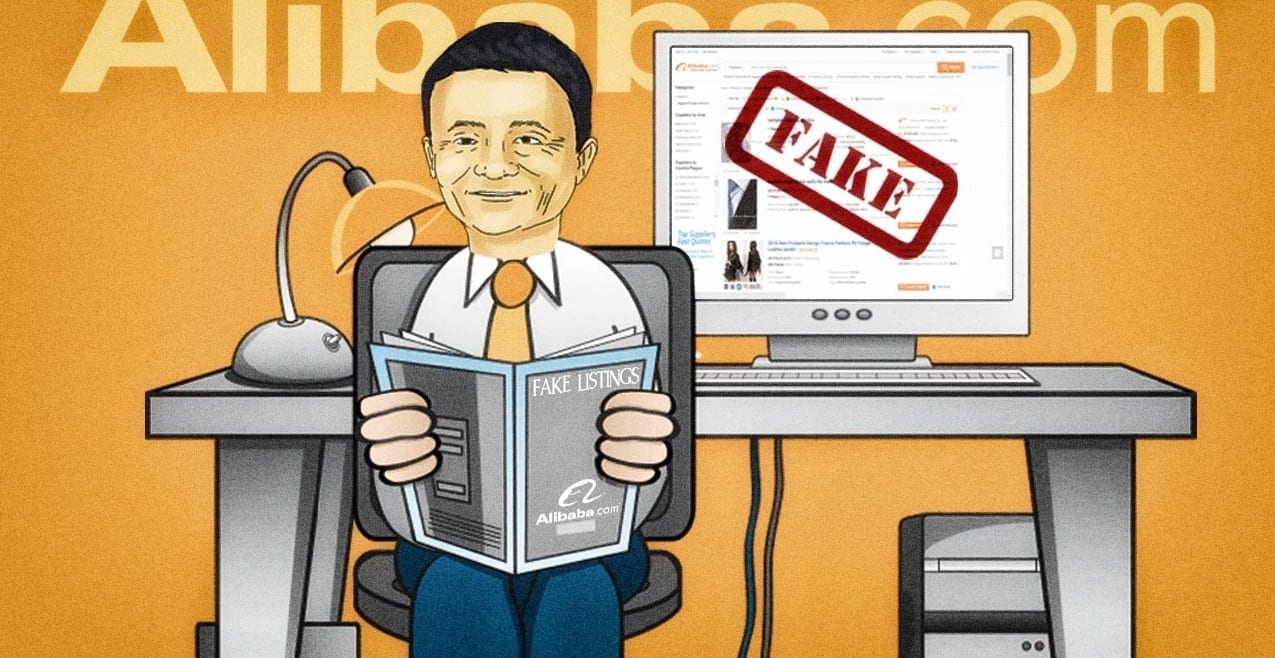
    2. Jack Ma’s statement that fake luxury goods are “better quality” and made in the “same factories” as real ones. In a speech to investors in June, Jack Ma incited luxury executives’ anger when he made his declaration about “fake” goods, which he later clarified in a Wall Street Journal op-ed to mean off-brand items. 

    3. The mutiny over Alibaba at the International AntiCounterfeiting Coalition. In another controversy over fakes on Alibaba platforms stirred up this year, luxury brands revolted when the IACC admitted Alibaba in a special “general membership” category. After Gucci, Michael Kors, and Tiffany & Co. quit the group in protest, Alibaba’s membership was suspended.

    4. A Daimler executive’s racist rant in Beijing. A People’s Daily report stating that a Daimler executive in Beijing shouted a racist remark and used pepper spray over a parking dispute resulted in the man being promptly relieved from his position. That didn’t keep the controversy from going viral online and sparking anger, however.

    5. Victoria’s Secret’s mix of dragons with lingerie at its annual fashion show. In a possible attempt to reach Chinese consumers, the brand featured several outfits with China-inspired designs for the Victoria’s Secret Fashion Show, but not all of China’s netizens were impressed.

    6. The revelation of tensions in the 2015 Met Gala planning process. This one isn’t much of a “controversy” per se, but this year’s release of Met Gala documentary The First Monday in May showed the behind-the-scenes debates over the curation of the China-themed exhibition. 

    7. A ban from China for the actress Birkin handbags are named after. While Chinese buyers have been paying record prices for Birkin handbags at auction, 60s icon Jane Birkin has been using her namesake handbag to display political messages. When she wasn’t granted a visa to perform at a concert in Shanghai this summer, Chinese media mentioned her participation in 2008 Tibet protests in France and her use of the handbag to display a Tibetan flag.

    8. China’s K-pop ban poses a problem for luxury brands. Long a source of major publicity for luxury brands in China, Korean pop stars have attracted investment from LVMH through its stake in Korean entertainment company YG Entertainment. But a recent reported ban on Korean TV shows on Chinese television and Korean pop stars entering China has the industry worried about the future.

    9. Taiwan’s mainland tourist slump. Politics have been known to cause significant shifts in where mainland Chinese tourists decide to travel in Asia, and Taiwan learned that lesson the hard way this year. After cross-Strait relations soured following the presidential victory of Tsai Ing-wen, mainland visitor numbers plunged, with a 69 percent decrease during Golden Week.

    10. Donald Trump’s China-related conflicts of interest. As Trump’s business interests around the world remain under scrutiny over conflict-of-interest issues, his China ties are receiving less scrutiny at the moment than links to Russia, but China plays no small role in his business. He’s personally bragged on the campaign trail about the multi-million-dollar luxury apartments he’s sold to elite Chinese buyers, while AFP reported that the Trump Hotel Collection negotiated a memorandum of understanding with China’s largest state-owned enterprise worth around $100 to $150 million.

  • Ladies Market fake products seizure largest for three years

    Ladies Market fake products seizure largest for three years

    Hong Kong Customs has arrested 10 people and seized HK$10 million (US$1.2 million) worth of fake products, smashing a counterfeit syndicate at the Ladies Market.

    It was the largest syndicate caught in three raids by the Customs and Excise Department this year on Tung Choi Street in Mong Kok. In January and August, officers nabbed 12 people and seized HK$7.5 million in fake goods.
    Following those busts, the syndicate just nabbed had chosen potential customers more carefully to avoid detection, says Customs official Guy Fong Wing-kai.

    “The gang served only tourists from Europe and America,” he says. “They did not approach locals or Asian tourists in case they were undercover customs officers.”

    The syndicate sold their goods at 5 to 20 per cent of the genuine products’ price, he says.
    An investigation revealed the syndicate sold counterfeit goods at four hawker stalls in the market, using electronic tablets to show clients photos of the products.

    “Some clients were taken to its upstairs showroom nearby, which was packed with about 600 counterfeit products,” says Fong. Four nearby flats were used as warehouses, and a female ringleader went to the mainland regularly to buy the fake products.

    After a month-long investigation, about 90 Customs officers raided the four hawker stalls, the secret showroom and the four warehouses. Seven men and three women were rounded up and more than 10,000 fake products seized including watches, handbags and leather goods.

    Fong says it was Customs’ largest seizure of fake products in a single operation in the past three years.

    Aged between 24 and 38 years, the 10 Hongkongers are being held for questioning. None have yet been charged.

    Fong says the department will enhance its enforcement activities against counterfeiting during the holiday season. He says that selling counterfeit goods is regarded as a serious crime, carrying a maximum penalty of a HK$500,000 fine and five years in jail.

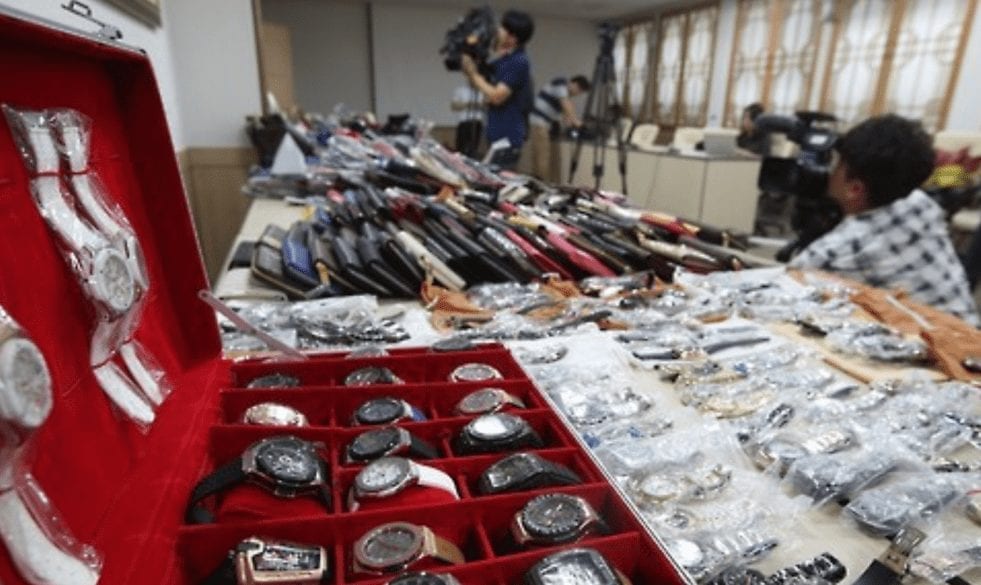
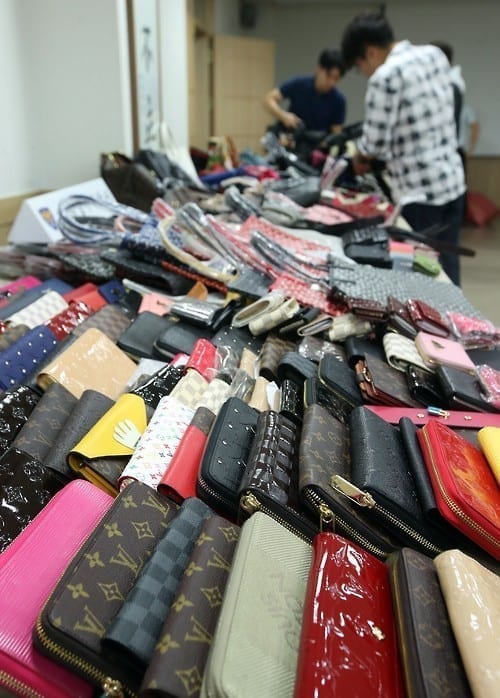
  • High-end Knockoff Retailers Busted in Seoul’s Busiest Tourist District

    High-end Knockoff Retailers Busted in Seoul’s Busiest Tourist District

    Seoul police busted four retailers Monday for selling counterfeit products of luxury brands in Myeongdong, one of the busiest tourist and shopping districts in Seoul. 
    fake-product-luxury

    The gang launched operations in April, and has since sold 40-million-won ($36,245) worth of knockoff products from 41 brands that included luxury brands Louis Vuitton and Rolex. Converting the sales figure to the retail value of their respective genuine products, they were worth over 8.3 billion won, the police said. 

    The suspects displayed the products without the logo engravings to evade police crackdowns. Instead, they sold the final products with the logos at a separate storage area only when visiting customers asked for counterfeit products.

    “Counterfeit products can badly hurt the image of Myeongdong, so we plan to continue our crackdown operations jointly with the local government and the intellectual property office,” said a police official.


    Image Credit: Yonhap 

  • Alibaba Group Holding Ltd Should Stop Fooling Stakeholders on Counterfeits

    Alibaba Group Holding Ltd Should Stop Fooling Stakeholders on Counterfeits

    On Tuesday, founder and chairman of Alibaba Group Holding Ltd, Jack Ma wrote to its investors, customers, and traders highlighting that his recent words about counterfeited goods was taken out of context and his company has no tolerance for fake goods trading on its e-commerce portal.

    Mr. Ma said in his article: “When Alibaba went public in 2014, I told our customers, employees and investors that what we had earned was trust—in myself, my team, and our company’s mission, vision and values.” Mr. Ma further highlighted that with trust come great responsibility and Alibaba’s responsibility is to protect all of its stakeholders.”

    Last week, Mr. Ma released a statement saying that “counterfeited goods are better than original products,” after which Alibaba came under fire and many foreign brands owners challenged the company’s credibility and its efforts to fight against fakes traded on its e-commerce platform.

    He stated: “The problem is the fake products today are of better quality and better price than the real names. They are exactly the [same] factories; exactly the same raw materials but they do not use the names.”

    Yesterday, Mr. Ma indicated that whatever he said was an observation and has nothing to with the reality. He further added that “Failing to protect original designs, trademarks, and technology is akin to thievery, and it is detrimental not only to innovation but also to the integrity of the marketplace,” and Alibaba will never forgive any act of stealing.

    Last year, several leading foreign brands filed lawsuits against the Chinese e-commerce giant, accusing it of deliberately promoting the counterfeited goods traded on its websites.

    Kering SA, a French luxury goods holding company filed a lawsuit against the Chinese e-commerce giant last year, claiming that Alibaba is directly involved in the promotion of counterfeited goods. However, the company denied all such accusations and later, the case was resolved on mutual consent. Like Kering, many other foreign brands have alleged Alibaba of doing little to stop the trading of fake goods on its leading platforms including Taobao and Tmall.com. Likewise, many of them have even shifted to other e-commerce stores including those of JD.com Inc.

    Last year, Alibaba also narrowly escaped the US black list for notorious goods; however, it received official warning from the US trade officials to quickly resolve the issue and prevent sale of counterfeited goods on its leading online platforms such as Taobao. Mr. Ma saw this escape a huge victory and assured the trade officials that his e-commerce firm is 100% committed to lead the fight against global counterfeiting, both online and offline.

    The Chinese e-commerce giant has invested heavily and devoted significant efforts to develop an unparalleled level of technology to put a stop to this counterfeiting work. The Chinese e-commerce giant takes out full-bodied data processing and analytics to enable real time scanning of nearly 10 million new products a day by looking at key features such as pricing, trademarks, and buyer and seller identity. Despite such aggressive measures the world’s second largest retail network is yet to satisfy customer, trade officials, and most importantly brand owners.

    In his write up, Mr. Ma emphasized on the fact that a cooperation spread globally is needed to fight the counterfeited goods issue. It’s a “long term crusade,” he said, a battle against human greed for which there are no short term fixes and easy way out.

    Mr. Ma’s statement was not welcomed with gratitude by investors, brand owners, and trade officials. According to some analysts by terming the case a long term crusade, Mr. Ma has indicated that the counterfeited goods is likely to continue to trade on Alibaba’s online platform. He said he expected Alibaba to become the “fifth largest global economy” after Japan by 2020. This is likely to happen because China’s middle class consumption has increased massively, and the country’s middle class holds about $4.6 trillion in savings.

    Recently, Security and Exchange Commission (SEC) have inquired Alibaba to present complete details of the company’s accounting policies and for one of its delivery affiliate, after the company was accused of using inappropriate financial measures and not disclosing complete transactions of its delivery affiliate.

    In May, the Chinese e-commerce giant was handed a suspension from International Anti-counterfeiting Coalition (IACC), a supervisory body for retail industry after several leading members threatened to step down against Alibaba’s inclusion. Those members included Tiffany, Gucci America, and Michael Kors.

    Role of Chinese Government

    Though the Chinese e-commerce giant faces tremendous international criticism and pressure from trade officials, the government has done little to tackle the counterfeited goods issue i.e. no more than a few warnings. Even Mr. Ma himself proclaimed that the Chinese government can’t even ban his company for two hours due to its significant economic importance. We believe that there are solid reasons as to why the Chinese government can do very little to take action against Alibaba.

    The following revenue table clearly depicts that Alibaba’s retail business generates significant profits, which is a vital catalyst for growth in China’s deteriorating economy. The country’s GDP growth is at its slowest in the past 25 years, and with crude oil continuously remaining on a lower side, the Chinese government is shifting to services and retail sector to inject growth in the Chinese economy, and Alibaba is the big connection to it.

    It is indicated that Alibaba’s China retail business amounted to nearly 78% of total revenue generated in the quarter, while international retail also surged 15% year-over-year (YoY).

    Its international retail segment growth also highlights the company’s eagerness to expand its footing in the international market. We depicts Alibaba’s international retail revenue for the past six years.

    Though the growth is imminent but many analysts opine that is far below the expectations. As a result of counterfeited goods scandal, the company’s international retail revenue growth has plummeted 41% on average in the past five years.

    At the recent investor’s day conference, the Chinese e-commerce giant also released its annual revenue forecast estimating a 48% YoY surge, mainly driven by the acquisitions of Youku Tudou and Lazada the Asian e-commerce giant. It said: “The Company expects to record 6 trillion yuan ($912 billion) in gross merchandise volume (GMV) in fiscal 2020, nearly double 3.09 trillion yuan in fiscal 2016.”

    Despite achieving significant success, the Chinese e-commerce giant is surrounded by controversies since the past few years. Earlier on Wednesday, it also won the dismissal of a US lawsuit accusing the company of defrauding its stakeholders by “concealing a regulator’s warning about its ability to suppress counterfeiting on its websites.”

    Overall, analysts have been keeping a mix view on whether Alibaba is right or wrong; however, Mr. Ma indicates that his company works hard each day to ensure that its stake holders are protected and its consumers are not fooled by shoddy fake products. However, he asserted that to completely eliminate the issue from the root cause, a time period is required and global assistance is necessary.

    We believe that it is high time now that Alibaba should stop fooling customers and brand owners and should work with sincerity, rather than consoling and giving false hopes. Authenticity of the product is of key importance and Alibaba should return its stakeholders a favorable response or get ready to lose customers. We also believe that the Chinese government should embrace the rule of law. The government should stop promoting double standards and treat both foreign and domestic firms at permissible level. Has it been Amazon Inc or any other foreign e-commerce retail network, the consequences and treatment would have been different.

  • Louis Vuitton and Chinese dispute

    Louis Vuitton and Chinese dispute

    Luxury retailer Louis Vuitton is suing three individuals in China for selling counterfeit items on Alibaba’s online shopping outlet Taobao.

    Damages of 250,000 RMB ($37,900) are being sought by the LVMH-owned company, says a statement on a Beijing court’s website uploaded yesterday. It says the suits are against a person surnamed Liang and two with the surname Han, who were sentenced in 2014 for selling counterfeit Louis Vuitton clothing, shoes and handbags between 2011 and 2014.

    This move comes nine months after luxury conglomerate Kering pursued legal action over fakes on Alibaba’s platforms. The group sued Alibaba directly, filing the suit in the US rather than China.

    In 2013 LVMH signed a co-operation agreement with Taobao to fight fakes on its platforms. Under the agreement, Taobao agreed to proactively track down and remove listings of counterfeit LVMH items.

    Meanwhile, Alibaba has been working to defend its reputation. It hired a former counterfeit investigator from Apple in December as its new head of global intellectual property enforcement. This followed the American Apparel & Footwear Association calling on the US Trade Representative to add Alibaba back to its blacklist of “notorious markets” for fakes (it was removed in 2012). Alibaba has also hired extra staff to fight fakes and is releasing an English-language version of its intellectual property reporting system.

    The courts’ decisions on the Kering and Louis Vuitton lawsuits could have an impact on the way brands formulate their China anti-counterfeit strategy in the years to come, observes Jing Daily. Kering has challenges with its US lawsuit as the Bank of China has refused to comply with a subpoena to disclose information about counterfeiters’ bank accounts to the New York District Court. The bank is also appealing a $50,000-a-day fine imposed by the court, arguing that the order violates Chinese bank secrecy laws.

  • 40 per cent of online trade in China fake or substandard

    Chinese lawmakers have been urged to tighten controls on online trade after a report suggested counterfeit and low quality goods accounted for just over 40 per cent of sales.

    The report on the implementation of the latest iteration of the Law on the Protection of the Rights and Interests of Consumers also notes that China is now the biggest online marketplace in the world, overtaking the $300bn US market, and was valued at 2.8trn yuan ($442bn) last year.

    An article notes that complaints concerning online purchases rose 357 per cent to reach 77,800 last year, according to data from the General Administration of Quality Supervision, Inspection and Quarantine (AQSIQ).

    This has prompted calls for the Chinese government to bring in new legislation to govern e-commerce, particularly with regard to the rights of consumers and the responsibilities of retailers.

    The report (in Chinese) was presented at a plenary meeting of the National People’s Congress (NPC) Standing Committee, which was presided over by Chairman Zhang Dejiang.

    The revelations come as China’s online retail platforms, and particularly Alibaba, have come under intense scrutiny of late over counterfeit listings, and the measures taken by the sites to take them down.

    Earlier this year, the State Administration for Industry and Commerce (SAIC) accused Alibaba of being ‘lax’ in what it allows traders to sell on its online retail platforms, prompting a war of words between the company and Chinese government.

    Alibaba’s chief executive Daniel Zhang said during the company’s financial results conference last week that the company “remains committed to providing a trusted consumer experience with authentic products by driving merchants that peddle counterfeit products off our marketplaces.”

    .

  • Jenny Bakery Shanghai store scam

    Jenny Bakery Shanghai store scam

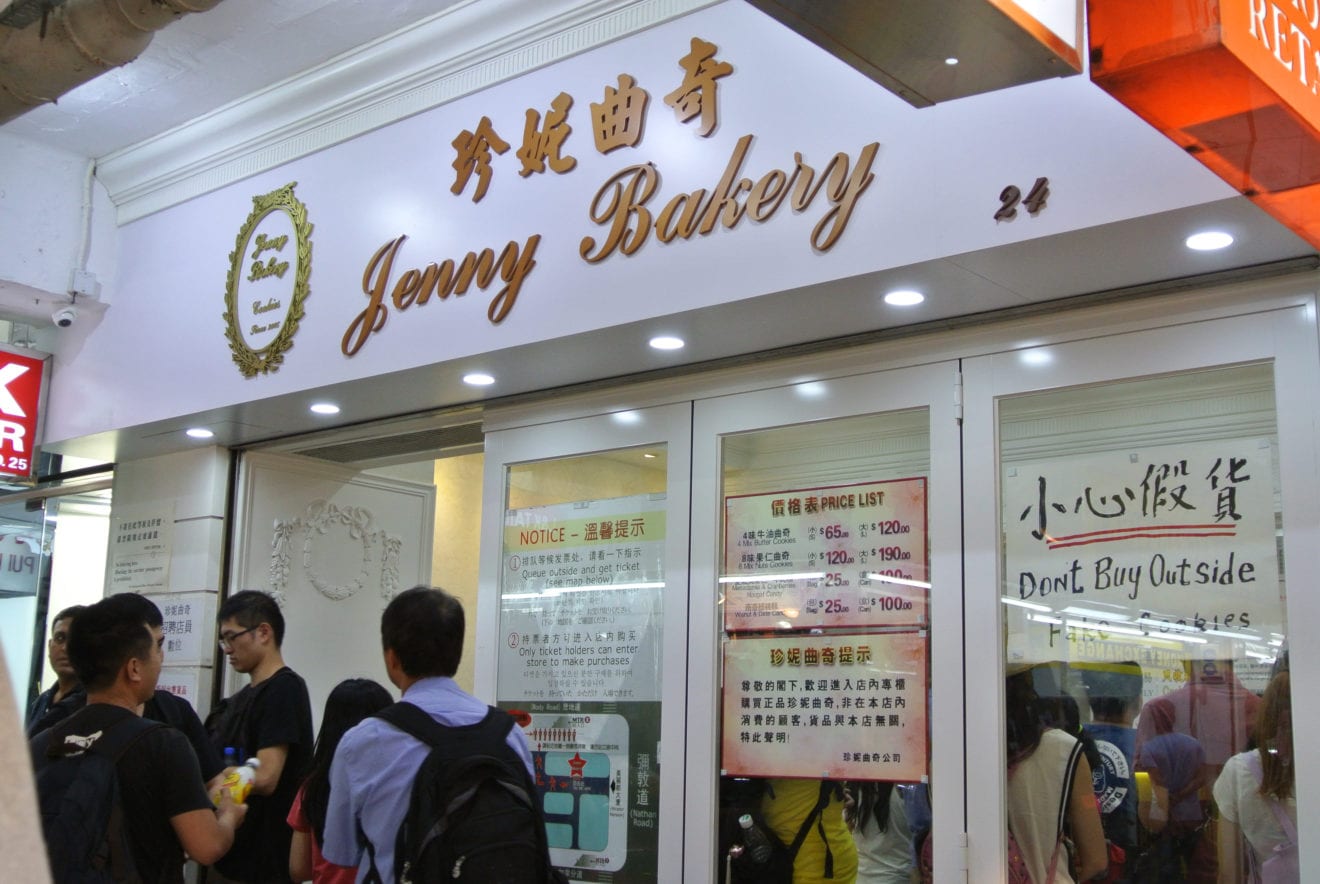
    A Jenny Bakery Shanghai store scam has angered the Hong Kong brand’s owners – not to mention Shanghai city officials and hundreds of customers who queued for hours only to find the cookies were copies.

    In the latest example of Mainland China’s seemingly contagious penchant for copying brands and labels and ripping off other people’s IP, crooked entrepreneurs launched a promotional campaign for the Shanghai opening of popular Hong Kong baker Jenny Bakery. It was even located in a respected shopping centre – the Global Harbour mall in the city’s Putuo District.

    Chinese media say that promotional material for the new store suggested the maker of the “most tasty cookies in Hong Kong had come to Shanghai”.

    The difference was in the signage: The Shanghai store bore the branding JENNY BAKERY (in capitals); the original Hong Kong business signage is Jenny Bakery. The Shanghai store even sold similarly packaged products: cookies in tins with teddy bear graphics which bore a strong likeness to the Hong Kong packaging.

    But such is the laxness of Chinese IP laws, it appears all that Putuo District city officials could do was reprimand the copycat scammers. They have been told to make it clear it has no association with the Hong Kong business and warned they could be fined if investigations prove they deliberately misled customers.

    The scammers had priced boxes of cookies at 98 yuan, or US$15.80 – nearing double the price of the original Hong Kong product, which sells for HK$70, or about US$9.

    While Jenny Bakery made it clear it does not have any stores in the mainland and that all its cookies are handmade, JENNY BAKERY maintained it had done nothing wrong by selling cookies baked at a factory in Shenzhen. The company said it was a legally registered brand and its business is legitimate.

    The Shanghai store has since closed, but not before affixing a notice to its door claiming it was the only legal owner of the brand name in the mainland – which is actually true; it was registered in Shenzhen earlier this year.

  • Multimillion dollar counterfeit goods ring busted

    Multimillion dollar counterfeit goods ring busted

    Hong Kong Customs and police have raided four properties, seizing nearly 4000 fake items in an ongoing clampdown on counterfeit rings in the city.

    The raids occurred in Mong Kok and Tsim Sha Tsui and resulted in the arrests of four men aged 23-47.

    The seized goods have an estimated value of HK$3.37 million (US$434,000) were seized. During an operation, suspected counterfeit goods were found mixed among genuine products in a retail store in Mong Kok. They were sold at the discount price to the genuine products. After further investigation, Customs officers found some more suspected counterfeit goods in a warehouse in Tsuen Wan. A total of 438 suspected counterfeit goods were seized in this case, valued at about $1.17 million. The arrested 47-year-old man has been released on bail pending further investigation.

    Three other clandestine storehouses keeping and selling suspected counterfeit goods were also smashed by Customs during the operations. The enforcement actions there resulted in the seizure of about 3500 items of various kinds of suspected counterfeit goods for sale, including watches, handbags, leather goods and sunglasses, with an estimated value of around $2.2 million. Three men, aged 23 to 28, were arrested.

    The Customs Divisional Commander of Intellectual Property Transnational Investigation Division, Mak Wai-chung, said Customs and police will continue to conduct joint enforcement actions to more effectively combat the sale of counterfeit products. He reminded consumers to shop at retail stores with good reputations or at the official stores of the brands.

    Under the Trade Descriptions Ordinance, any person who sells or possesses for sale any goods with any forged trademark, or applies a false trade description in the course of trade, commits an offence. Upon conviction, offenders are liable to a maximum fine of $500,000 and imprisonment for five years.

  • Counterfeit appliance business exposed

    Counterfeit appliance business exposed

    Vietnamese authorities have cracked a counterfeit appliance retailing business passing off cheap Chinese appliances as branded European goods.

    Thanh Nien News reports that a company called Romal Vietnam was selling gas ranges, electric stovetops, ovens and blow dryers inside supermarkets, online and at shopping centres in many provinces and cities across the nation.

    A nationwide crackdown has now been launched by teams of inspectors from the National Steering Committee for Combating Smuggling, Commercial Fraud and Counterfeit Goods (also known as Committee 389).

    A Romal Vietnam shop in Hanoi was raided on January 22 and 185 Chinese products bearing Italian and German brand names on labels were seized.

    Another 85 products were seized in the central seaside town of Danang and Ho Chi Minh City police sealed a Romal store after “the manager locked its doors and fled” according to Thanh Nien News.

    The company’s director, Nguyen Thi Ninh, and her husband Nguyen Huy Tho have been summoned by police for questioning. A police source told the newspaper that Ninh, Tho and their employees admitted importing Chinese products from Zhongshan Company in Guangdong since 2008.

    Labelling the goods as European allowed the shop to import the products for between $150 and $200 and sell them for as much as $750 to $800. The fraud had netted the business several hundred thousand dollars annually.