Tag: etail

  • Givenchy Wins on Gogoboi’s New E-Commerce Channel

    Givenchy Wins on Gogoboi’s New E-Commerce Channel

    It was only in April that top Chinese KOL Gogoboi launched his own WeChat boutique “Bu Da Jing Xuan,” a platform on which he curates selections of goods from luxury e-commerce retailers like Yoox, Net-A-Porter and Farfetch to sell to his fans (he’s got over 7 million followers on Weibo).

    But Gogoboi has already gotten his first luxury brand on his platform, Givenchy.On July 14, Givenchy launched its new Duetto handbag collection on this platform and became the first luxury brand to test out this influencer’s own e-commerce channel.

    The official price of the new collection is 7490 yuan, which is consistent with the offline price. This exclusive online sale includes seven styles (in addition to black and white, the bag also came in a variety of colors), and for each style, there were six bags available for purchase.

    The result was a success. The featured black-and-white style was sold out after half an hour after the campaign went live, and within 72 hours, all of the available styles were sold out.

    With a background in fashion editorial, Gogoboi’s distinct writing style is what first garnered him a loyal fan base. His witty humor and harsh comments on celebrity styles make his blog stand out in the competitive KOL landscape.

    Mr. Bags recently wore in a handbag collaboration with Tod’s and “Miss Shopping Li” stepped out of fashion to embark on her first collaboration with the car brand MINI and is in the midst of launching her own brand.

    It’s never a one-way street, while bloggers are busy broadening their horizons, brands are also looking for better ways to take advantage of their massive fan economy.

  • Korean online shopping growth surge as retail sales stumble

    Korean online shopping growth surge as retail sales stumble

    Online shopping is experiencing a growth surge, accounting for close to 20 percent of all retail sales in the first quarter of this year.

    Retail transactions in the three months to March totaled 96.56 trillion won (US$85.83 billion), a growth of 4.7 percent from the same period a year before, according to Statistics Korea. The sum of online shopping was 18.21 trillion won, or 19 percent of the total.

    This represents a 19.6 percent leap from the same quarter of the previous year and the largest total since related record keeping began in 2010.

    The ratio of online sales to all retail sales has grown in double digits every quarter since the fourth quarter of 2012, when it was 10.2 percent. It reached 17.7 percent in the last quarter of 2016.

    In monetary terms, the amount of transactions has also expanded by double digits, increasing the growth pace from 11.2 percent in the first quarter of 2013 to 23.2 percent in the third quarter of 2016. It fell to 19.6 percent in the first three months of this year.

    The mobile sector played a critical part in contributing to online shopping, accounting for 59 percent of the sales in March.
    “Mobile shopping has grown with the wide penetration of smartphones, and shopping malls have also been pushing their mobile platforms,” a Statistics Korea official said.

    Such high performance of online sectors contrasts with sluggish figures in the overall retail market. Retail sales gains that reached over 10 percent in the first two quarters of 2011 shrank to 0.6 percent by the second quarter of 2013. They bounced back somewhat to 3-5 percent last year.

    Sales at department store, the strongest source of offline shopping, have backtracked. The monetary amount of transactions fell 1.5 percent in January from a year before, 5.6 percent in February and 3.5 percent in March. The figures showed a decrease of 2.2 percent in April and 4.6 percent in May.

  • E-commerce dominates purchasing habits

    E-commerce dominates purchasing habits

    With the rapid evolution of technology and the internet, consumers are changing their attitudes and behaviours. Therefore, moving fast to understand changes in consumer demands is crucial for any business to grow sustainably, according to research conducted by Kantar Worldpanel Vietnam.

    Internet accessibility in Vietnam at present includes 94 percent of urban households and 69 percent of rural households.

    If internet accessibility continues to grow at the current pace, nearly 100 percent of Vietnamese households will be connected to the internet in the next five years, the research said, adding that the number of broadband subscribers in Vietnam is 53.411 million.

    The development of such services has prompted businesses and consumers to use the internet for different purposes like marketing, selling, buying and payment.

    According to Google, eight out of ten Vietnamese consumers are online at least once a day.

    Today’s Vietnamese consumers are also more familiar with shopping online. Even before they make a purchase, consumers use the internet to find information on products they considering buying, the research said.

    Higher purchasing power breeds greater aspirations, but does not mean that consumers will spend uncontrollably.

    “Over time, we have seen that households tend to save a greater proportion of their total income for the future and with interest rates in Vietnam still relatively rewarding, it is understandable. Anyone selling any consumer goods now has greater competition, within a smaller pie,” the research noted.

    Nguyen Huy Hoang, Business Development Director – Kantar Worldpanel Vietnam, said thanks to widespread internet coverage, Vietnamese consumers can access more diverse products and services. Through virtual stores, they can purchase products at home.

    With rising incomes and a growing middle class, cross border shopping is another developing trend. Many international brands start seeing Vietnam as a great opportunity for them to increase their sales. Today, this is happening in various industries such as fashion with many international brands moving into Vietnam and in fast moving consumer goods markets.

    More foreign brands can penetrate Vietnam‘smarket thanks to the proliferation of foreign retailers entering the market such as Emart, Aeon Mall and most recently 7-Eleven.

    Each has their own plan to expand with more store openings that will make more international products more accessible. With more foreign products more accessible to the masses in modern arenas but also in more traditional stores, this represents a threat to local products in Vietnam.

    Hoang said using the internet, businesses can promote their products to consumers in other countries quickly and cheaply, noting that borderless online shopping allows enterprises to maximise sales.

    The internet can also help farmers, small enterprises and communities introduce their products to the world.

    However, he said, the e-commerce market in Vietnam is still at the very early stage of development and needs big players to bring knowledge, know-how and expertise.

    Fabrice Carrasco, Managing Director of Kantar Worldpanel Vietnam and Philippines said Vietnamese consumers raise a lot of issues, with brand owners finding it hard to keep up with their modern lifestyle, independent decisions and demand for product sophistication. Such complexity requires developing on-trend products and talking to shoppers.

  • Find Me A Shoe virtual footwear fitting service app in beta trial

    Find Me A Shoe virtual footwear fitting service app in beta trial

    Find Me A Shoe, a retail technology start-up has launched the beta version of its virtual fitting service for footwear called ‘Try Me’.

    The app is described as an “end-to-end footwear size and fit recommendation application that aims at giving all footwear shoppers an oh-so-easy footwear shopping experience online”. The mobile and vision-based technology provides consumers with shoe recommendations based on precision measurements and personalised fitting algorithms that go beyond the traditional shoe scale system.

    Unlike other virtual fitting solutions, the app does not use analytics or purchasing history.

    “Our technology takes the purist approach to shoe fitting,” said Anand Ganesan, CEO of Find Me A Shoe.

    “Research shows two main factors that increase customer loyalty in retail-time-savings and personal attention,” he said. “Find Me A Shoe creates a brick and mortar experience by delivering a spot-on fit recommendation that’s personalised to the customer’s foot. No more trials in store and no more online returns.”

    The California-based company offers its fitting service to footwear retailers and brand outlets. The patent-pending technology enables the shoppers to find a shoe that fits in just a click. The recommendation engine simulates a shopper’s foot (with 12+ parameters) inside every model before suggesting the best size and fit.

    With cloud-based servers running Artificial Intelligence-enabled complex computer vision algorithms in the background, recommendations ensure customer’s toes and heels will fit comfortably in that new shoe.

    “Personalisation and customisation are the pillars of the next generation retail experience,” said Ganesan.

  • Vietnam’s e-commerce acceleration to gain a boost from DHL eCommerce

    Vietnam’s e-commerce acceleration to gain a boost from DHL eCommerce

    DHL eCommerce, a division of the world’s leading logistics company, Deutsche Post DHL Group, has launched its nationwide domestic delivery operations in Vietnam. The domestic delivery network will offer a high quality delivery service across Vietnam and a range of services tailored for the booming e-commerce industry, helping small, medium and large e-tailers and marketplaces increase their share amidst the rapidly growing Vietnam e-commerce segment.

    “The Vietnamese e-commerce market represents a huge and relatively untapped potential for local retailers, e-tailers and marketplaces: in 2016, total e-commerce spending hit US$1 billion despite barely over 50% of the population being online, ” said Charles Brewer, CEO, DHL eCommerce. “With e-commerce spending expected to grow at around 23% per year between now and 2020, local e-tailers need scalable, high-quality logistics solutions with nationwide coverage more than ever before.”

    DHL eCommerce Vietnam offers domestic delivery nationwide across the country, managed by hubs and depots strategically located throughout the country. DHL eCommerce’s fleet of vans and motorbikes, coupled with regular air and road connections between its hubs, will support next-day delivery in Ho Chi Minh, Hanoi and other primary markets.

    “Our new domestic delivery service brings to Vietnam DHL’s extensive experience in designing comprehensive logistics networks, coupled with tailored e-commerce solutions to tackle some of the most pressing roadblocks to e-commerce growth,” added Brewer, “With e-commerce, consumers are increasingly expecting greater choice, convenience and control in their delivery experience and we aim to deliver a smile in the last mile by providing an amazing and customer-centric delivery solution.”

    When using the network, local e-tailers can easily assign shipments requiring cash on delivery service through DHL eCommerce’s online portal, allowing for faster remittance and simpler management of shipment information. Consumers will also be able to open, check and return goods at the point of receipt thanks to DHL’s Open Box Delivery service, better aligning the online shopping experience with their preferred purchasing habits.

    “Only 15% of Vietnam’s e-commerce shoppers paid online in 2016, making cash on delivery a must-have feature for e-commerce to succeed. That, combined with concerns about the hassle of returns and refunds, has made growth an uphill battle for many local e-tailers,” said Thomas Harris, Managing Director, DHL eCommerce Vietnam. “We recognize that having a fast and reliable delivery service won’t solve these issues alone, which is why we’ve tailored our nationwide network to seamlessly handle cash payments with next day cash remittance and returns to take the burden off local e-tailers so they can fully focus on growth and customer experience.”

  • Foot Locker Launches E-commerce Platform

    Foot Locker Launches E-commerce Platform

    Foot Locker has launched its first Aussie e-commerce platform, opening a website that includes the shoe retailer’s full range of sneakers and apparel.

    In a statement, the shoe retailer said it anticipates the online store will further fuel the rise of sneaker culture in Australia.

    “We’re excited to expand into the online space and give our customers the opportunity to access our full range of product from anywhere in Australia,” said Natalie Ellis, VP GM Foot Locker Asia Pacific.

    The 24/7 website will house sneakers, apparel and accessories from brands including Jordan, Nike, adidas, Puma, Asics and Converse.

    Foot Locker said it’s built the e-commerce store to meet the needs and expectations from consumers and ‘to facilitate access to the best-of-the-best sneakers from anywhere in Australia’.

    Consumers will have access to the full range of House of Hoops, a-standard, Puma Lab and Converse Prime product that had previously been available for purchaseonly within flagship stores.

    The e-store allows free returns anywhere in Australia, free delivery nationally for orders over $150 and has a selection of over a thousand products.

    Foot Locker Australia, a subsidiary of the US corporation, Foot Locker Inc, was incorporated in 1994 and is based in Murarrie, Queensland. It operates approximately 100 stores across Australia and New Zealand.

    Sneaker culture appears to be a developing phenomenon, with Foot Locker’s British rival, JD Sports, recently asserting the success of its first local offerings.

    “The highly anticipated JD Sports Parramatta launch is expected to attract sneakerheads en masse, following the success of Melbourne Central’s flagship store, which went down as one of the largest launch days of any international territory within the JD Sports business,” said Hilton Seskin, head of JD Australia. The Parramatta store opened last week with over 500 customers queueing to get their hands on limited edition sneakers.

  • Ensogo Philippines to shut down

    Ensogo Philippines to shut down

    Ensogo Philippines will be closed down along with the online retailers’ other sites across Southeast Asia.

    Following the resignation of its co-founder Kris Marszalek, the Singapore-based tech company said it will cut its financial support to its sales and marketplace business units in Indonesia, Thailand, Hong Kong and the Philippines.

    “These business units will be shut down. All staff have been informed and communications will be made to customers in the coming days,” the company said in a statement.

    Australian internet entrepreneur Patrick Grove founded Ensogo, formerly iBuy. Grove also established the online businesses iProperty and iCar under Catcha Group.

    Recently the company reported growth averaging more than 100 per cent in the first quarter, after the launch of a cross-border marketplace business in January. It said the number of suppliers had skyrocketed from 3141 in the fourth quarter of 2015 to 13,599 in the first quarter of 2016. The first three months saw US$8.2 million in gross merchandise value.

    As of the end of March 2016, however, Ensogo reported A$22.6 million (about US$17 million) in receipts from customers, while total cash was only A$17.6 million, a 64 per cent decline from A$29 million by the end of last year. Earlier this year the company, which is headquartered in Singapore and listed in Australia, laid off employees.

  • Singapore sets e-commerce target for growth

    Singapore sets e-commerce target for growth

    Singapore has set a three-year target to grow the share of e-commerce from the current 3 per cent to 10 per cent of total receipts.

    This would match where China was three years ago, according to Senior Minister of State for Trade and Industry Sim Ann.

    She told Parliament that benchmarked against the 2014 figures of the UK (13 per cent) and the US (6.5 per cent), Singapore’s target was not unrealistic.

    One in four online retail transactions in Singapore were with foreign businesses, she said.

    Total e-commerce with locally issued credit and debit cards was valued at S$24.7 billion (US$17.8 billion) over the past three years, with foreign entities accounting for $6.4 billion worth of these transactions, said Sim in response to an MP query.

    “While e-commerce presents competition to our retailers, it also gives them the opportunity to expand their reach to the region and beyond,” she said.

    The retail industry transformation map outlined last year by the government envisioned a “vibrant” retail industry spanning physical stores, online retailing and mobile channels, as well as local brand owners with global presence.

    Sim said government initiatives were helping retailers build digital capabilities and access e-commerce…

    Enterprise agency Spring Singapore and the Info-Communications Media Development Authority (IMDA) have teamed up to pre-qualify e-commerce packaged solutions that can be readily adopted by small and medium enterprises.

    Spring is also partnering companies such as Google to help SMEs strengthen their digital marketing, while other private firms like DBS, Mediacorp and SingTel have given support by setting up an e-marketplace and training opportunities.

    Trade agency International Enterprise Singapore helps companies leverage e-commerce to unlock growth opportunities in overseas markets.

    At the same time, said Sim, trade associations and chambers of commerce were reaching out to SMEs to encourage them to adopt e-commerce.

    Being launched this year is Spring’s initiatives with SkillsFuture Singapore to help the retail industry workforce adapt and upskill to keep up with developments in e-commerce and digital marketing.

  • India’s Flipkart planning offline venture

    India’s Flipkart planning offline venture

    India’s Flipkart is planning to enter the brick-and-mortar space as a master franchisee for foreign brands. This follows other e-commerce companies opening on-ground ventures as the online market slows down.

    Flipkart is already in advanced talks with Giordano for a licensing deal to sell the Hong Kong­ apparel and accessory retailer’s products both offline and online in India. The plan is to set up a chain of Giordano­-branded stores along with a digital platform, says an insider.

    Flipkart will appoint sub-­franchisees with brick-­and-­mortar expertise to run the physical stores.

    Meanwhile, pure-play companies such as Faballey, Lenskart, Myntra, Nykaa, Pepperfry and Urban Ladder have already set up physical stores.

    Fashion retailer Myntra this year acquired the Indian franchisee agreement for Spain’s Mango and is appointing two sub-­franchisees for the label – Jaipur-­based Samarth, which runs more than 100 outlets of Benetton, Calvin Klein, Lee, Puma, Tommy Hilfiger, US Polo and Wrangler, and New Delhi­-based G&B which has 25 Benetton stores in the National Capital Region.

    Myntra is also selling its own brands. It opened its first brick-and-­mortar store in Bengaluru in March under its private brand Roadster on the 100 Feet Road.

    Beauty retailer Nykaa.com is also expanding on the ground. Its head of offline retail strategy, Adwaita Nayar, says touch and feel is important for customers in India. “Almost 90 per cent of the market for beauty products is still offline.”

    Nykaa.com intends to have large-format experiential stores as well as smaller outlets. Its aim is to have 30 stores at malls and high streets as well as travel retail by 2020.

  • Ho Chi Minh City to crack down on tax-evading Facebook retailers

    Ho Chi Minh City to crack down on tax-evading Facebook retailers

    The tax man is threatening to shut down social media accounts, but savvy retailers know that it’s an empty threat. Ho Chi Minh City sent out tax demands to nearly 13,500 Facebook retailers over a month ago, but a representative from the city’s Tax Department told that so far only around 1,000 of them have responded.

    As a result, the city’s tax authorities have decided to work on tougher solutions to crack down on potential tax-evading online retailers, and have asked the Ministry of Finance to finalize regulations regarding tax declarations and deductions at source, as well as the supervision of online business activities.

    The city’s tax department also said it is considering a name-and-shame approach to individuals and organizations that refuse to pay tax.

    To combat retailers that open multiple Facebook accounts to avoid detection, the department claimed it had come up with multiple solutions, such as closing down accounts or sending officials posing as customers to confront them in person.

    It also said it would ask the State Bank of Vietnam for copies of retailers’ bank statements to determine their incomes, and courier companies would be asked to provide information on the quantity and value of the goods they transport for them.

    However, many online retailers say that the tax man has no authority over Facebook.

    Nguyen Thi Cuc, who chairs the Vietnam Tax Consultants’ Association, also told that Vietnam does not have a comprehensive tax policy for online businesses, and that collecting taxes is difficult because most transactions are conducted in cash.

    Many retailers claim they already have business licenses and have declared tax, and only use Facebook to advertise their products, while others say they earn less than VND100 million ($4,400) annually so they are not required to declare tax by law.

  • The Alibaba Group is ready to do business in Macau

    The Alibaba Group is ready to do business in Macau

    Alibaba Group Holding Limited has had its application for trademark protection accepted in Macau, enabling the Chinese e-commerce giant to enter the MSAR with a series of products.

    Brands Ant Star, Ant Star Bank, Alimebot, 阿里蜜,星匯,星安,智惠,星匯銀行,智惠銀行, are now able to create and commercialise in Macau products ranging from newspapers and magazines to credit and debit cards, scientific and nautical instruments, file sharing software and GPS equipment. But also advertising, execution and supervision of loyalty programmes and incentives, business consulting to traffic optimisation of websites, large warehouse retail services or even insurance, financial and monetary businesses.

    In total, many hundreds of products and services that the company – based in Hangzhou and founded in 1999 by Jack Ma and Peng Lei – is now allowed to conduct here.

    With over 50,000 employees, Alibaba provides consumer-to-consumer, business-to-consumer and business-to-business sales services via web portals.

    Recently, the Chinese giant invested US$1 billion (MOP8 billion) in Southeast Asian online retailer Lazada Group increasing its stake to more than 80 per cent and making is presence even stronger in the region.

    According to Forbes magazine, over the past year Ma has spent more than 800 hours flying to dozens of countries, meeting business leaders and heads of state to introduce his grand vision: small businesses from all corners of the world trading freely and securely on the Alibaba platform.

    Highly reported Jack Ma’s ambition is to see his company reach the US$1 trillion mark in gross merchandise value by 2020.

  • Gucci launches China e-tail site

    Gucci launches China e-tail site

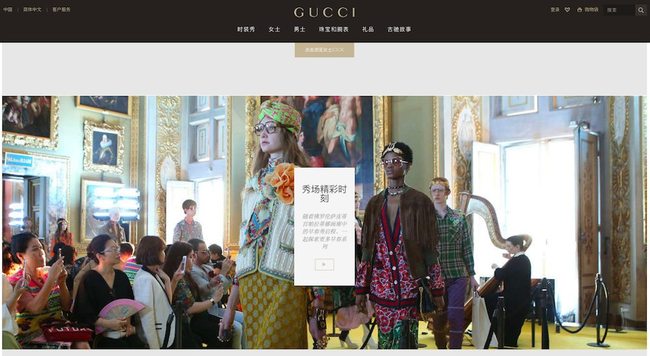
    Gucci has launched gucci.cn, its e-tail site for the Chinese market. In the words of the Italian luxury label, it will be Gucci’s only official Chinese website, created to “allow consumers a better access to Gucci products, without the limitations imposed by store location or opening hours. To optimise service speed, goods are shipped from local warehouses, and each transaction is assisted by a China-based customer service team, via live chat or phone.” In addition, payments on gucci.cn can be made using popular providers such as Alipay and WeChat.

    Content-wise, the site offers a wealth of images and a narrative with a strong visual impact, culminating in the ‘Stories’ section, which takes an in-depth look at  the sources of inspiration which influenced Creative Director Alessandro Michele’s collections, offering an exclusive glimpse of the designer’s own world.

    “Combining editorial content with commercial features – said Gucci – is an approach which has already proved effective in North America, Europe, the UAEs and Australia, where the new website was launched back in 2015.”

    As of today, Gucci’s e-tail sites are active in the USA, Japan, South Korea, Australia, Canada, the UK, Italy, Ireland, France, Germany, Spain, Portugal, Switzerland, the Netherlands, Austria, Belgium, Sweden, Norway, Denmark, Finland, the Czech Republic, Poland, Hungary, Romania, Bulgaria, Slovenia, Turkey and the UAEs.

  • Amazon prepares to take on South Korean e-commerce

    Amazon prepares to take on South Korean e-commerce

    Amazon is preparing to expand competition in the Korean online retail market, as evidenced by a recent wave of advertisements for positions in its office in Seoul.

    In the last week alone, the e-commerce giant advertised for 49 full-time positions and internships in Seoul, many within Global Selling, Marketing, and Business Development.

    To date, Amazon’s business in South Korea has focused on cloud computing rather than online retail. AWS opened an office in Seoul in 2012 and began accumulating customers and formulating partnerships with a broad base of Korean companies, including Samsung, Nexon Gaming, and Mirae Investments.

    Amazon added an AWS region in Seoul in January 2016, to provide local customers with low-latency access to AWS infrastructure services.

    However, with the addition of employees in Global Selling and Marketing, it appears that Amazon is ready to expand its retail e-commerce footprint in the region as well.

    South Korea represents one of the biggest e-commerce markets worldwide, with an existing market of $19.12 billion in 2016 expected to grow to over $32 billion by 2021. This represents the highest e-commerce penetration in the APAC market, with 72% active online shopping reach.

    South Korea’s online shopping reach was second only to the UK in a recent survey, roughly similar to that of Germany. However, South Korea is expected to surpass both the UK and Germany in online sales over the course of the next two years.

    The current market leader is 11Street, a subsidiary of SK Telecom, followed closely by newcomer Coupang.com. However, Amazon is expected to have a disruptive effect on the South Korean market in part due to its global reach. Through Amazon, sellers whose current efforts are focused on the South Korean market will be able to access a global customer base for their products.

    The most popular online shopping categories in South Korea are online travel and reservation services, home electronics and appliances, and fashion and apparel. Amazon recently made major gains in online sales of home appliances and is on track to become the leading US online retailer of consumer apparel.

  • e-retail brands out of the social media loop in SE Asia

    e-retail brands out of the social media loop in SE Asia

    Over 85% of consumers in Singapore, Malaysia and Indonesia, who mention e-retailer brand names in their social media posts don’t tag brand handles, according to Digimind.

    This means brands need to be vigilant in monitoring their brand reputation in the wider social media space to ensure they aren’t missing out on key conversations and trends, and are able to act upon any customer service concerns quickly.

    With the rise of empowered consumers and an increasing adoption of online shopping, e-retailers need to adopt customer-centric strategies in order to thrive. With so much of our daily conversations happening online, data from social media can provide key insights for e-retailers wishing to optimize customer experiences.

    Digimind’s study, Social Shopping in 2017, assessed the state of the e-retail industry in the three countries by monitoring 15 local and regional e-retailers, including Lazada, Zalora, and Berrybenka.

    “It’s no secret that brands who implement customer-centric strategies are excelling. With 2.8 billion active social media users in Southeast Asia, it is crucial for e-retailers to listen to what is being said about their brand, competitors and the industry online,” said Stephen Dale, general manager of APAC at Digimind.

    “Understanding what consumers are saying on social media can provide companies with an arsenal of insights that can be used to develop content strategies, improve customer service, build brand advocacy, and increase sales,” said Dale.

    He added that when analyzed in conjunction with other data such as web page visits and browsing behavior, this can further inform marketing plans and Voice of the Customer programs.

    The study also revealed that while the majority of e-retailer’s followers in the countries studied were on Facebook, consumers were most actively publicly posting their opinions and experiences on e-retailers on Instagram and Twitter.

    This means while Facebook is the ideal channel for brands to communicate with followers, Instagram and Twitter are key channels for community engagement.

  • Can Alibaba realize its global ambitions?

    Can Alibaba realize its global ambitions?

    Jack Ma, the man who turned Alibaba into China’s dominant e-commerce platform, now has his sights set on global domination.

    Over the past year, Ma met business leaders and head of states in many countries to introduce his grand vision: small businesses from all corners of the world trading freely and securely on Alibaba’s platform. His goals are equally ambitious: Ma wants Alibaba to hit $1 trillion in gross merchandise value by 2020. By 2036, the company sees itself serving two billion customers, effectively becoming the world’s fifth largest economy, with sales eclipsed only by the GDP of the U.S., China, Japan and the EU.

    But to sustain the near continuous 40% growth rate of Ma’s $300 billion empire, which centers on a marketplace connecting brands with buyers, globalization is seen as key. At home it faces heightened competition with the country’s second-largest shopping site, JD.com, which just posted record sales of $17.6 billion for its 6.18 shopping festival. Alibaba’s e-commerce dominance isn’t under threat but it nonetheless sees a “growth bottleneck” and feels “globalization is better done now than later,” said Teng Bingsheng, a professor of strategic management at the Cheung Kong Graduate School of Business in Beijing.

    Alibaba’s global footprint has grown through investments in local partners. As part of a $21 billion-acquisition spree over the past two years, the company has stakes in India-based marketplaces Paytm and Snapdeal, as well as Southeast Asia’s top shopping site, Lazada, which it now holds a 83% stake after investing another $1 billion. Its financial affiliate Ant Financial has investments in payment platforms in Thailand, South Korea and the Philippines, and is expanding in further afield in South Africa.

    Some analysts however question whether Ma might be painting an overly rosy picture for small business owners. While it is true that China has a growing appetite for niche brands from cosmetics to baby food, competition on Alibaba’s shopping sites is cutthroat.

    Already thousands of brands are selling on Tmall and the number of foreign brands on Tmall Global grew 169% last year — while total sales only grew 30%, according to Mark Tanner, founder of Shanghai-based consultancy China Skinny.

    This means another part of Alibaba’s strategy has brighter prospects. Outside the U.S., through the likes of Lazada, and its own cross-border commerce platform AliExpress, Alibaba wants to find fresh customers for Chinese manufacturers. On Lazada, for example, Taobao has opened a shop, offering a curated selection of Chinese-made clothes, gadgets and toys to tap Southeast Asia’s $22 billion e-commerce market.

    Compared with facilitating exports to China, this strategy may ultimately take on more importance. Southeast Asia, for example, is an ideal market for Chinese products, whose price advantages can win over more customers, CKGSB’s Teng said.

    What’s more, Alibaba will not only create more revenue streams by selling globally but fit itself nicely into Beijing’s vision. Through grandiose projects such as the One Belt, One Road initiative, Beijing wants to restore demand for Chinese goods along the ancient Silk Road trading route, which stretches all the way from its middle west provinces to Europe.

    But it isn’t a smooth ride either. The Electronic World Trade Platform (eWTP), Ma’s version of the World Trade Organization and a web-based approach to lowering trade barriers for small businesses in the region, is moving slowly. One year after its announcement, only Malaysiajoined the initiative, establishing in March a trading hub near Kuala Lumpur International Airport— a reflection of how stalling trade talks worldwide might be affecting Alibaba.

    That means, for now, international business remains a small part of Alibaba — contributing less than 10% of the group’s revenues in the last year. Evans said the company is on track to reaching its goal, eventually generating 40% of its revenues from international businesses over the next decade.

    The company has identified its chance of success. Aside from e-commerce, Alibaba’s payment, entertainment and cloud computing units are also expanding globally. AliCloud, for example, is wooing international customers with a price 85% cheaper than Amazon Web Services, according to CSLA analyst Elinor Leung. And Ant Financial, despite recent hurdles such as opposition to its acquisition of U.S. payment company Moneygram, has installed its service at millions of retailers in the U.S. through a partnership with payment processor First Data.