Tag: facebook

  • Facebook launches tool that lets users see and control data shared

    Facebook launches tool that lets users see and control data shared

    Facebook is making it easier for users to see and control the data that apps and websites share with the social network by launching a new tool called Off-Facebook Activity. The new feature will be gradually rolled out to Facebook users in Ireland, South Korea, and Spain. However, Off-Facebook Activity will be made available to everywhere over the coming months, so don’t lose hope if you’re not living in any of these countries.

    But what exactly is Off-Facebook Activity and is it as useful as Facebook claims? Well, first off, you can see a summary of the information other app and websites have sent Facebook through its online business tools, including Facebook Pixel and Facebook Login.

    Also, you will be able to disconnect all the information you see from your account if you want to. On top of that, you can choose to disconnect future off-Facebook activity from your account. Facebook says that you’ll be able to do that for all your off-Facebook activity, or just for specific apps and websites.

    Once you clear your off-Facebook activity, the social network will remove your identifying info from the data that apps and websites choose to send to Facebook. Basically, Facebook will no longer know which websites a user visits or what they did during their visit.

    Also, Facebook says that it will not use any of the data that users disconnect to target ads to them on apps like Facebook, Instagram or Messenger. The social network expects some impact on its business but believes giving people control over their data is more important.
  • Facebook users will now see reminders and showtimes in movie ads

    Facebook users will now see reminders and showtimes in movie ads

    Facebook has just started to roll out two new ad solutions aimed at film studios that want to increase ticket sales, as well as people who want to find movies they want to see. The new ad solutions, movie reminder, and movie showtime are now available for all film studios in the United States and the UK.

    But what does that mean for consumers? It’s quite simple, if you discover a film that you like months before its release, you will probably need a reminder for when the movie will hit theaters.

    With movie reminder ads, when you see an ad for a film in your News Feed, you will be able to tap an Interested button to receive a reminder in your Facebook notifications when the movie hits theaters. The notification will send you to the movie detail page on Facebook where you will be able to see showtimes and purchase tickets if this feature is available.

    Movie showtime ads for films that are already in theaters is another new feature rolling out today. If you’re interested in a certain movie that appears in an ad on your News Feed, you can tap a Get Showtimes button to go right to the Facebook movie details page to learn more about where and when to see the film.

  • Facebook introduces new Group Privacy settings

    Facebook introduces new Group Privacy settings

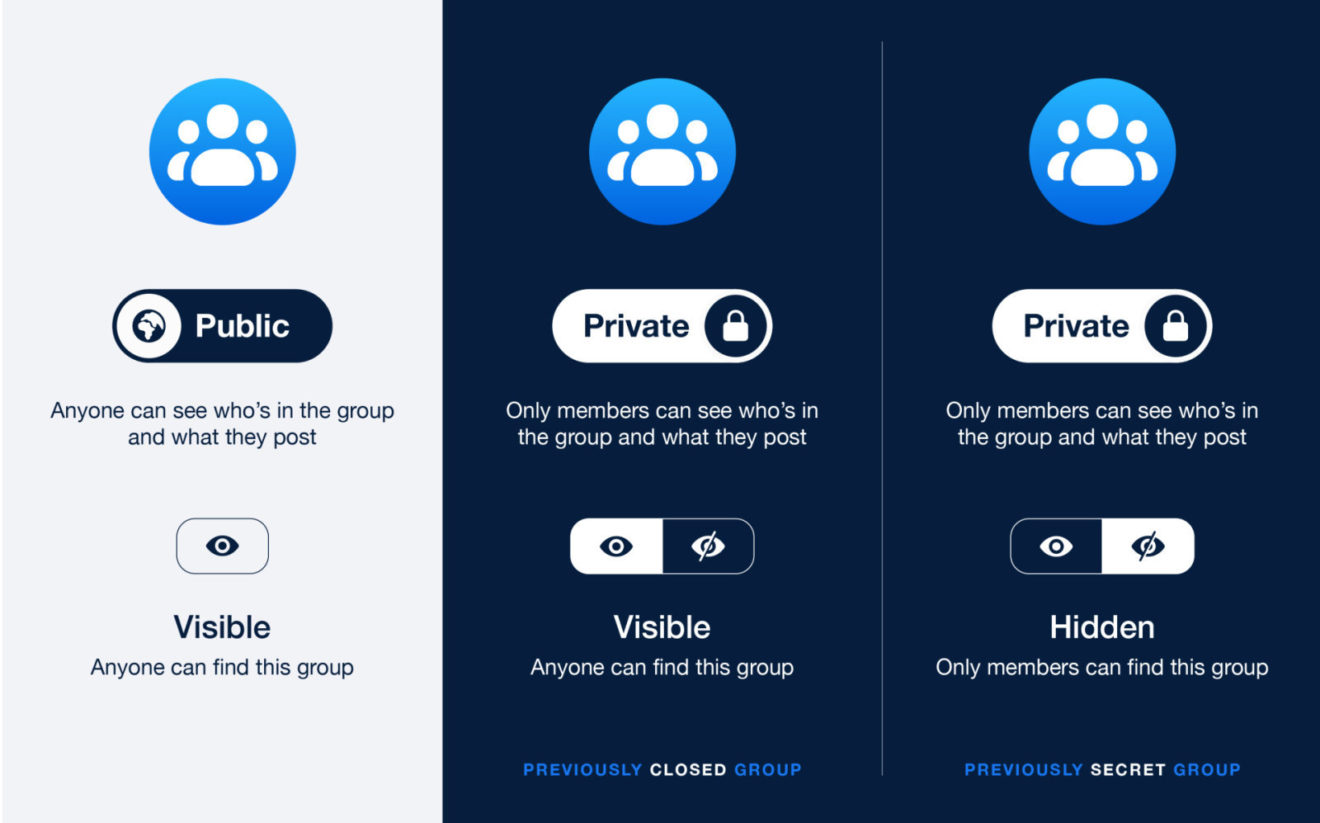
    In an attempt to make Groups easier to understand, Facebook announced the launch of a new simplified privacy model for the feature, public and private. The new Groups Privacy settings include two clear options, which should make the privacy model much more intuitive.

    For example, public groups allow anyone to see who’s in the group and everything that’s shared there. However, in private groups, only members can see who else is in the group and what they’ve posted.

    Also, with the new settings, admins will be able to clearly choose whether or not the group can be found in search and other places. It’s also worth mentioning that by default, a group that was formerly “secret” will now be “private” and “hidden.” On the other hand, groups that are “public” will remain “public” and “visible.”

    All the new options are now available for all admins in their Group Settings, but keep in mind that there are restrictions to if and when an admin can change the privacy setting of a group. However, all the updates made by an admin to the group’s privacy setting will be highlighted for all group members via notifications.

  • Facebook’s plan to avoid getting split up might be too late

    Facebook’s plan to avoid getting split up might be too late

    More than seven years have elapsed since Facebook bought Instagram for $1 billion. At the time, Instagram was known for its photo filters and was just reaping the rewards of dropping its Android version of the app. In hindsight, that was a spectacular deal for Facebook as Instagram now has over 1 billion monthly active users and some estimate that it takes in $2 billion a month in advertising revenue.

    In October 2014, Facebook closed on its purchase of messaging app WhatsApp. The final price was over $21 billion. At the time of purchase, the messaging app was free to users for a year and $1 a year thereafter, although that charge was removed in 2016. Annual revenue, estimated by Forbes, is $5 billion and the app will start running ads next year on its own version of Stories called “Status.” WhatsApp has more than 1.5 billion daily active users.

    Because Facebook didn’t go around and promote its ownership of Instagram and WhatsApp, it is quite possible that the vast majority of the smartphone-wielding public doesn’t even know that all three are owned by the same company. But that apparently is going to change. The Information cites three unnamed sources who revealed that Facebook’s properties are going to have new branding. The two apps will be known as “Instagram from Facebook” and “WhatsApp from Facebook.” The report notes that employees have already been informed about this surprising move that comes as a shock since the two have been running autonomously since their acquisitions.

    So why would Facebook do this now? After all, Instagram and WhatsApp both have achieved strong growth without having the Facebook name included with their branding. There is an answer. Reportedly, Facebook CEO Mark Zuckerberg is upset that the company doesn’t get enough credit for the two apps’ success. But another reason might have to do with the FTC’s investigation into Facebook and the calls from some presidential candidates to split up the company into separate units. By adding the “…from Facebook” line, it could appear to FTC staffers that those using Instagram and WhatsApp realize that they belong to one big happy Facebook family. Before adding the new branding, the FTC could have pointed out that most Instagram and WhatsApp users didn’t know who owned the apps and therefore breaking up Facebook wouldn’t matter to them.

    It is doubtful though that such a strategy will stop those calling for Facebook to be split up. With great power comes great responsibility and that is something that Facebook has yet to prove it can handle.

  • Eventbrite ‘Buy on Facebook’ launches in Singapore

    Eventbrite ‘Buy on Facebook’ launches in Singapore

    Eventbrite Singapore has launched local ‘Buy On Facebook’ integration.

    The integration will allow event creators and attendees to more easily sell and buy tickets directly through the social media.

    ‘Buy on Facebook’ streamlines the ticket-purchasing process, allowing event attendees to secure a ticket with just two taps, and without having to leave Facebook.

    Since its launched, the integration has been found to drive 20-per-cent more paid ticket sales and twice the number of registrations for free tickets.

    When event-goers purchase a ticket on Facebook, their attendance can be shared with friends with a single tap, expanding the event’s reach and generating more of a buzz.

    “Hosting our myriad events and workshops on Facebook enables our page followers to register with one quick click,” said Angie Chew, Brahm Centre’s founder, a customer of Eventbrite for four years.

    ‘Buy on Facebook’ integration is also now available in Hong Kong, Australia, New Zealand, the US and Canada.

  • Facebook to ban ads dissuading Americans from voting

    Facebook to ban ads dissuading Americans from voting

    Facebook issued an update on its Civil Rights Audit today and notes that the platform now bans messages that praise, support or represent white nationalism and white separatism. The report adds that Facebook posts should be banned even if those exact terms are not used. This would be done by picking out certain “hate slogans and symbols” connected to white nationalism and white separatism.
    Facebook says that it has also updated its policies to prevent it from being used to organize events that are meant to “intimate or harass people based on their race, religion, or other parts of their identity.” And the site will no longer allow messages to be posted that encourage others to bring weapons to certain events. Facebook says that it has a trial program running in the U.S. where some of its content reviewers focus on hate speech instead of the usual “bullying, nudity, and misrepresentation.” The company says that by focusing on hate speech, these reviewers will become more accurate in deleting such speech from the platform. Facebook hopes that these reviewers get better at determining which content should be left up, and which should be taken down. The report notes that some civil rights groups are concerned that some content meant to point out and fight discrimination is being taken down by mistake
    And to prevent a repeat of what happened during the 2016 presidential election when Russian trolls posted misinformation and tried to get Americans not to vote, Facebook has a number of departments working full time on the matter. They are working to ban ads that tell people not to vote and hope to have a new policy in place before the 2019 gubernatorial elections. Facebook is also treating the 2020 census like an election with technology at the ready to prevent interference on this important subject as well.
    Facebook also played a big role in the election by allowing 87 million members to have their profiles used by Russian-American ex-Cambridge University professor Aleksandr Kogan who sold the data to Cambridge Analytica. The latter was a U.K. consultancy with ties to former Trump advisor Steve Bannon. Cambridge Analytica reportedly used this information to create psychological profiles helping the Trump campaign learn where it needed to beef up campaigning. It also posted pro-Trump ads on Facebook and YouTube while at the same time posting ads disparaging of Hilary Clinton.
    Facebook is expecting to be fined as much as $5 billion by the FTC because of the Cambridge Analytica scandal. The company had agreed to a consent decree with the regulatory agency back in 2011 that prevented it from allowing member profiles to be used by others without their consent. This agreement was broken when Cambridge Analytica obtained data on the aforementioned 87 million Facebook subscribers.
    Facebook’s Civil Rights Audit was conducted by civil rights advocate Laura Murphy. She also received support from the civil rights law firm Relman, Dane and Colfax. Today’s report follows the first Civil Rights Audit released last December.
  • Facebook reveals its new digital currency called Libra

    Facebook reveals its new digital currency called Libra

    As expected, Facebook announced a brand new cryptocurrency coming in 2020 – Libra. Described as a new digital wallet for new digital currency, the new financial service will allow consumers to keep their cryptocurrency safe, as well as make various transactions.

    When it launches in 2020, the digital wallet will be available in Messenger, WhatsApp, but also as a standalone app. The decision to launch such a service is based on the people’s need to save, send or spend money even if they don’t have a bank account.

    Apparently, many people around the world still don’t benefit from even basic financial services, especially in developing countries. Calibra, the company behind the financial service, is meant to address this problem since it will allow those who don’t have a bank account to save, send and spend Libra.

    Most importantly, Calibra will allow users to send Libra to almost anyone with a smartphone just like sending a text message. Additional services will be provided to those using Libra later on, including the option to pay their bills.

    Facebook says that Calibra will not share account information or financial data with its servers or any third party without customer consent. Furthermore, the social network company mentions that Calibra will use Facebook data to comply with the law, secure customers’ accounts and prevent criminal activity.

    It remains to be seen what merchants will accept Facebook’s new crypto currency and how companies in developing countries will be convinced to pay their workers in Libra if they so choose.

  • Facebook’s Study program pays for information about the apps you use

    Facebook’s Study program pays for information about the apps you use

    Facebook announced today that it has launched a new app for Android users called Study from Facebook. The app will be used to help the company conduct market research and all participants will be paid. This isn’t an app that you can download from the Google Play Store at any time. Instead, Facebook will be running ads online and if you click on one, you can register to download Study. But you still have to qualify, and if you do, the app will then show up in the Play Store like magic.

    Those who do sign up will learn how the app works and what information it will collect. As the late Robin Williams might have said, “Transparency. What a concept.” Facebook also is now sensitive to the use of teen data and will require that those installing Study be 18 years of age or older. And yes, participants will be able to opt out at any time. Right now, the program will be available only in the U.S. and India.

    Facebook says that the information it collects will include:v
    • Apps you’ve installed on your phone.
    • How much time you’ve spend on each app.
    • The country you live in, the device you use and the type of network your phone runs on.
    • App features that you employ.

    The Study app will not collect user ID’s, passwords, or content stored on your phone. The information is not sold to third parties, used to serve optimized ads, or added to a user’s Facebook account if they have one.

    “Approaching market research in a responsible way is really important. Transparency and handling people’s information responsibly have guided how we’ve built Study from Facebook. We plan to take this same approach going forward with other market research projects that help us understand how people use different products and services.”-Facebook

    While Facebook doesn’t say how much it will pay you for this data, it does say that participants will earn money for sharing how they use apps.

  • New Facebook Portal devices are launching this year

    New Facebook Portal devices are launching this year

    New versions of Facebook’s Portal home smart speakers are coming out this year, while the first-gen models that launched in November 2018 will be making their way outside of the US. The Portal product lineup is the social network’s attempt to grab a piece of the smart home speaker market, where competition from Amazon and Google is stiff. Facebook’s take on the gadget is very camera-centric and allows users to make encrypted video calls through Messenger, while Portal’s camera follows them around.

    At the Code Conference in Scottsdale, Arizona, Facebook’s Vice President of AR/VR, Andrew “Boz” Bosworth, announced that the next-gen Portal speakers are coming “this fall.” There will be “new form factors” available as well, Bosworth said, though he didn’t elaborate on what this means, exactly. “Hardware is coming to the home, and we want to make sure that human connection, connection between two people, is a first-party experience on that hardware,” Bosworth added.

    Since one of the product’s differentiating features is the camera tracking, it’s not going anywhere, but the new models might make it even more prominent. According to rumors over the past months, Facebook may be working on a considerably smaller device than the first-gen Portals—pretty much just a camera—that can be attached to TV sets. This will also make the device cheaper and allow people to use their TVs as smart displays.

    The success of Facebook Portal was questioned ever since the company announced it. On the heels of some big privacy scandals over the past couple of years, having doubts over a Facebook-branded tracking camera isn’t all that far fetched. However, at the conference in Scottsdale, the company reassured that the first generation of Portal smart speakers sold “very well,” although the claim wasn’t backed by official numbers.

  • Facebook, Instagram, and WhatsApp will no longer be pre-loaded on Huawei phones

    Facebook, Instagram, and WhatsApp will no longer be pre-loaded on Huawei phones

    While Huawei continues to see a road ahead for its US government-threatened smartphone division, the exodus of major business partners, key components suppliers, and allies is far from over, posing new difficulties and creating bigger and bigger problems almost every single day.

    The latest bridge to be reportedly burned as a direct consequence of President Trump’s controversial executive order last month (which was since suspended for a period of 90 days) is arguably less critical than similar decisions previously made by the likes of Google, Qualcomm, Intel, and Arm. But it’s yet another thing that complicates Huawei’s existence, threatening to severely damage its Western brand image.

    Facebook is getting ready to pull out its support for future Huawei handsets, planning to no longer allow the pre-installation of the social networking giant’s crazy popular apps on the Chinese tech behemoth’s mobile devices. We’re obviously talking about the main Facebook platform first and foremost, but also WhatsApp and Instagram, all three of which are typically available for users of existing Huawei phones at first boot.

    The handsets that are already in circulation are unlikely to be affected by Facebook’s decision, as they will continue to receive any and all updates delivered to social networking and instant messaging apps. But Huawei phones that are not yet released and have not yet left factories are expected to come without the aforementioned services pre-loaded. That wouldn’t be such a big problem if Google wasn’t intent on cutting off access to the Play Store for future Huawei devices as well in compliance with the US ban expected to be enforced in a couple of months.

    Without Facebook, possibly Twitter, and other Western-leading apps and services, it seems Huawei truly needs to build its Android and Google Play alternatives from scratch. That’s probably going to take a while (if it’s even doable to begin with), during which time the company’s sales numbers could fall off a cliff. Of course, Facebook is still blocked in China, so at least there’s that.

  • Snapchat working to bring Facebook-like functionality to users

    Snapchat working to bring Facebook-like functionality to users

    Facebook has been guilty for copying many features from competitors, but that doesn’t mean it can’t go the other way around in some instances. Snapchat is reportedly working on a brand new feature that Facebook already offers to its users for quite some time.

    App researcher Jane Wong discovered a new Snapchat feature that will allow users to add events in the app. Support for events, once added to Snapchat, will open up new options for users, like the possibility to join group chats for the event.

    Once you create an event, you can invite Snapchat friends in a group chat. Also, swiping up on an invite will allow you to join a group chat for the event. The events a Snapchat users will be able to create can be assigned to specific locations, which means that they’ll likely to be integrated with Snap Map.

    Obviously, since the new feature hasn’t been made official, it’s unclear when exactly Snapchat will launch it. In fact, we’re not even sure whether or not it will make it to the general public.

  • Facebook reportedly launching new cryptocurrency in June

    Facebook reportedly launching new cryptocurrency in June

    Facebook is expected to announce its digital currency at some point this month, as the social network company has found outside backers that will help strengthen the trust in its upcoming cryptocurrency.

    The report mentions the digital token used by Facebook will work as a borderless currency without transaction fees. Apparently, Facebook employees who work on the project are given the option to be paid in the cryptocurrency token instead of real money.

    The new cryptocurrency will be available through Facebook’s app, including WhatsApp and Messenger, and is meant to help users in developing countries with volatile currency. Moreover, Facebook plans to make the cryptocurrency available through customized ATM physical terminals.

    The project also mentions sign-up bonuses for merchants that will allow customers to pay with Facebook’s digital tokens. Although the report contains pretty in-depth the details about the cryptocurrency, it misses one important aspect: release date. Well, at least the timeframe is narrowed down to June, so we won’t have to wait too long now.

  • Facebook launches new Avatar feature for News Feed and Messenger

    Facebook launches new Avatar feature for News Feed and Messenger

    Facebook is desperately trying to keep up with the competition by launching alternatives to some of the nifty features that other social network giants offer to their users. Facebook Avatar is such a feature that wants to compete with Snapchat’s Bitmoji selfie stickers, so if you’re using the latter, you’ll find Facebook’s new feature quite familiar.

    There’s been a ton of work put into this from the product and design perspective to find out, with how many people on Facebook, how to make this as representative as possible. They’re a bit more realistic so they can be your personal avatar vs trying to make them cute, funny, and cartoony, said Facebook Avatars communication manager Jimmy Raimo.

    The new Avatar feature is now available in Australia and it’s usable in Messenger and News Feed comments. The rest of the world will get it in late 2019 or early 2020 on all compatible platforms.

    If you’re living in Australia, you should start seeing a smiley-face button in the News Feed comment composer and Messenger sticker chooser, which will allow you to create your Facebook Avatar. Although only users in Australia will be able to create these Avatars, users worldwide will see them without any issues.

    Although there’s no option to create an Avatar starting with a selfie or profile pic yet, Facebook says that it’s going to implement it if they manage to master the creation process. Another important thing confirmed by Facebook is that these avatars won’t be monetized, at least not at launch, so there won’t be any accessories or clothing options that you’ll be able to get for real money.

    Last but not least, Facebook might allow users to include Avatars as profile pictures or in Groups, but that’s more of a long term project rather than an immediate plan.

  • Facebook Portal now has its own Android app

    Facebook Portal now has its own Android app

    If you feel that you don’t have enough Facebook in your life, you’re free to buy the company’s new smart display – Portal. Unlike Amazon and Google, Facebook had developed Portal with video calling in mind, so that’s pretty what you’ll probably want to do most of the time with it.

    The Portal, in case you didn’t know, offers Facebook users with a new way to video chat with their friends. If you don’t like texting through Messenger too much and rather talk to your friends, Facebook Portal is the perfect device for it.

    And now that Facebook has decided to launch a Portal standalone Android app, you’ll now be able to better manage photos and videos that you want to store on the smart speaker. Having the app installed on the phone will allow users to send photos directly to the Portal’s Superframe.

    Also, you can use the Portal app to call the smart speaker in your home and talk to household members. Or, you can add people in your home to your Portal so that they can use the smart speaker with their own Facebook accounts.

    It’s a nifty app that makes it easier to take advantage of Facebook’s smart speaker by adding new functionality to the device. The Portal app has already been listed in the Google Play Store and you can download it for free.

  • Massive leak exposed personal data of 49 million Instagram Accounts

    Massive leak exposed personal data of 49 million Instagram Accounts

    An Instagram database containing the private information of 49 million members, was accidentally left exposed on Amazon Web Services. The database could have been viewed by anyone since it did not have a password for protection. The accounts in the database included those belonging to Instagram influencers, celebrities, and corporate brand accounts and contained their biographies, profile pictures, number of followers, location (city and country), phone numbers and email addresses.

    The leak was discovered by security researcher Anurag Sen, who then contacted TechCrunch to help find the owner of the database. As it turns out, the information belonged to a social-media firm in India called Chtrbox that pays influencers to put up sponsored content on their Instagram accounts. The data included a ranking of each influencer depending on the number of followers they each have and the response to their posts by other Instagram members. While Chtrbox hasn’t commented yet on the matter, the database has since been taken offline.

    Facebook bought Instagram in April 2012 for approximately $1 billion and said that it will investigate the incident.