Tag: facebook

  • Time to win for Vietnam Tax Department on Facebook e-commerce case

    Time to win for Vietnam Tax Department on Facebook e-commerce case

    Ho Chi Minh City’s tax department has handed a bill of VND9.1 billion ($401,300) to a Facebook retailer in a rare successful attempt to levy sales on social media.

    A source from the department said that the tax declaration submitted by the cosmetics retailer was millions of dollars short compared to information acquired from the retailer’s banks.

    Le Thi Thu Huong, deputy director of the department, said the sum was the biggest amount ever to be claimed by her agency from an online retailer for tax evasion.

    The department contacted nearly 13,800 Facebook accounts earlier this year asking them to pay tax for businesses they were running on the social network, but few complied.

    Facebook is the most popular social network in Vietnam with more than 52 million active accounts, and is also used as an e-commerce platform that tax authorities have struggled to keep track of.

    Vietnam levies a 0.5 percent income tax and a 1 percent value added tax on sales of more than VND100 million ($4,400) per year.

    Local tax authorities have recently stepped up efforts to collect taxes from online businesses that use Facebook and other social media sites such as Instagram and YouTube.

    Tax departments in both Hanoi and Ho Chi Minh City have sent out tax demands to around 27,000 Facebook retailers in a move to target tax avoidance by online businesses.

    Online sales in Vietnam have expanded rapidly in recent years, currently accounting for 3.39 percent of the country’s retail market. The total retail market grew 10.2 percent last year to $118 billion, mainly fueled by a growing middle-class with expanding disposable incomes and an increasing number of internet users.

    In an effort to minimize tax losses, the Ministry of Finance is considering a plan to impose value added tax and income tax on sales with a value of VND1 million ($44) upwards, or multiple sales of a lesser value.

  • Louis Vuitton launches its Facebook chatbot

    Louis Vuitton launches its Facebook chatbot

    In a bid to think “client first”, Louis Vuitton has launched a chatbot on Facebook Messenger that advises shoppers on products, aiming to provide meaningful feedback during the busy holiday period.

    The bot is powered by mode.AI, which has also previously partnered with the likes of Levi’s with its artificial intelligence, visual search and machine learning technology.

    It aims to give clients a more “sophisticated, personalized, visual and conversational online shopping experience” via Facebook, where Louis Vuitton currently has more than 20 million followers.

    The main focus is on search– users can converse with the bot to discover the brand’s full line of products, as well as use it to get suggestions on specific items. It uses natural language processing to facilitate a more advanced search experience.

    They can also share items with friends directly through it, and get votes in return on what to buy. Additional services include info on stores worldwide, access to product care instructions and a conversational view on the brand itself, from its fashion shows to its history and the craftsmanship behind its products.

    LV

    Louis Vuitton CEO, Michael Burke, said: “At Louis Vuitton, we always think client first. Today, our clients like to be connected to the Louis Vuitton universe wherever they are. They shop in our stores worldwide and are often in contact with their personal shoppers. They also follow us on Facebook, Twitter, Instagram, etc. and find our products on louisvuitton.com. It became evident that we should create the Louis Vuitton Virtual Advisor powered by mode.ai, a 24h/7 service to be able to fully meet their needs.”

    “We are still in the very early stage of AI technology adoption in the retail industry. The dominance of e-commerce isn’t just a trend, but an ever-growing arena, giving luxury brands like Louis Vuitton the opportunity to reach and sell to their customers in new and exciting ways. As shoppers continue to move online, the most forward-thinking companies will turn to AI chatbot technology to meet these shifting client demands,” said mode.ai CEO Eitan Sharon.

    Burke added: “The [bot] is designed to increase the quality of the relationship we have with our clients by enhancing and personalizing the shopping experience. We see messaging platforms as future key drivers of conversations with our clients, and potential for the integration of artificial intelligence and chatbot technologies to further enhance service to clients across these new channels.”

    The experience is currently only available on Facebook Messenger in the US, but there are plans to roll it out to Europe and Japan next, as well as across additional platforms including WeChat and Line.

  • Facebook opens new London hub, creating 800 jobs

    Facebook opens new London hub, creating 800 jobs

    Social media titan Facebook will open a new office in London on Monday that is set to be its biggest engineering hub outside America, the company has announced.

    The investment in the office, near Oxford Street in the heart of the city’s West End district, will also lead to the creation of 800 jobs, more than half of which will be in engineering.

    The company, which opened its first office in the British capital ten years ago, said the new site would allow its local workforce to reach 2,300 by the end of next year, a sign that it “is more committed than ever to the U.K.”.

    The country “has been a huge part of Facebook’s story over the past decade”, Nicola Mendelsohn, Facebook’s vice president for Europe, the Middle East and Asia.

    “The U.K.’s flourishing entrepreneurial ecosystem and international reputation for engineering excellence makes it one of the best places in the world to build a tech company,” she said.

    The 23,000 square meters (247,000 square feet) of office space was designed by architect Frank Gehry, and is spread over seven floors while also incorporating a new public square.

    It includes an incubator space called “LDN_LAB” for technology start-ups.

    Finance minister Philip Hammond said it showed that Britain is “the best place” to grow new businesses.

    “It’s a sign of confidence in our country that innovative companies like Facebook invest here, and it’s terrific news that they will be hiring 800 more highly skilled workers next year,” he said.

    London Mayor Sadiq Khan said Facebook’s commitment indicated the city remained “at the forefront of global innovation”, while predicting that the incubator would “pave the way for the next generation of successful start-ups”.

  • Black Friday crushes Singles’ Day Chatter in Southeast Asia

    Black Friday crushes Singles’ Day Chatter in Southeast Asia

    Bigger is not always better – or so retailers are discovering following the conclusion of the biggest shopping extravaganzas.

    While Singles’ Day hit a record US$25.3 billion dollars in sales, it was Black Friday and Cyber Monday that dominated social media chatter in Singapore, Malaysia and Indonesia.

    Meltwater, a global media intelligence company, tracked online reactions in the lead-up to – and during – Singles’ Day, Black Friday and Cyber Monday and found that over eight in ten conversations (82.92%) online were focused on Black Friday and Cyber Monday.

    “The rise of Singles’ Day in recent years has been astronomical, breaking records every year and drawing interest from around the globe. While it’s clear that Chinese consumers are spending and talking about Singles’ Day, this massive spend and conversation in China seems to have translated poorly to other markets in Southeast Asia. Black Friday and Cyber Monday still prevail, highlighting the fact that these markets have yet to be fully penetrated by the Chinese phenomenon,” said Neil Brennan, Area Director, Meltwater Japan and South East Asia.

    Meltwater tracked online perceptions across Facebook, Twitter, Instagram, YouTube, blogs, forums, message boards and review sites from 28 October to 28 November 2017.

    Indonesia generates maximum buzz

    Regionally, Indonesia led the way driving the highest volume of online chatter with 88.6% of conversations centered around Black Friday and Cyber Monday.

    Out of the three markets monitored, Singapore generated the most social media buzz for Singles’ Day, accounting for 22.14% of the conversations, followed closely by Malaysia at 21.97%.

    Share of Voice Regional Singapore Malaysia Indonesia
    Singles’ Day 17.08% 22.14% 21.97% 11.4%
    Black Friday & Cyber Monday 82.92% 77.86% 78.03% 88.6%


    Alibaba for the win

    Conversations across all countries typically revolved around finding good deals and offers from specific retailers. It is noteworthy that Alibaba was a major source of online chatter thanks to its record breaking sales figures. Lazada, backed by Alibaba, also drew a considerable amount of chatter following their Singles’ Day push. The largest trending topic in Indonesia was Taman Anggrek, a famous mall located in Jakarta, known for being one of the biggest in Southeast Asia.

    Trending Keywords Black Friday & Cyber Monday Singles’ Day
    Regional
    1. Sales
    2. Amazon
    3. Best Buy
    1. Alibaba
    2. Lazada
    3. China
    Singapore
    1. Black Friday Sales
    2. Free Shipping
    3. Amazon
    1. Lazada Sale
    2. Taobao Buying Guide
    3. Qoo10 Deals
    Malaysia
    1. Amazon
    2. Black Friday Sales
    3. Cyber Monday Sales
    1. Alibaba
    2. Singles’ Sale
    3. China
    Indonesia
    1. Amazon
    2. Best Buy
    3. Black Friday
    1. Taman Anggrek
    2. Singles’ Sale
    3. Alibaba


    How the platforms stacked up

    A majority of the conversations took place on Twitter, Instagram and online forums. Twitter emerged as the top platform contributing to more than half of all conversations about Singles’ Day and over 85% of chatter on Black Friday and Cyber Monday.

    # Top Three Platforms – Black Friday & Cyber Monday
    1 Twitter – 86.51%
    2 Instagram – 6.81%
    3 Forums – 6.53%


    # Top Three Platforms – Singles’ Day
    1 Twitter – 57.92%
    2 Instagram – 29.67%
    3 Forums – 11.68%


  • China’s Tencent surpasses Facebook in valuation a day

    China’s Tencent surpasses Facebook in valuation a day

    Chinese internet giant Tencent has surpassed Facebook in terms of market value just a day after it became the first Asian technology firm to reach the $500 billion valuation mark.

    Tencent shares hit a record high of 439.6 Hong Kong dollars during Asian trading hours on Tuesday 21 November 2017, giving it a market capitalization of 4.17 trillion Hong Kong dollars ($534.5 billion).

    The Chinese firm’s value overtook Facebook’s $519.4 billion market capitalization, which was hit at the close of the U.S. markets on Monday 20 November 2017.

    Also Monday 20 November 2017, Tencent beat Alibaba to become the first Chinese technology company to hit the $500 billion market capitalization mark. Tencent is also within touching distance of Amazon’s $542.7 billion valuation.

    Tencent went public in Hong Kong in 2004 at 3.70 Hong Kong dollars per share. Since then, it has rallied over 11,000 percent. Tencent’s stock this year alone is up 126.69 percent.

    Still, the company is not well-known outside of China, but owns the country’s most popular messaging service, WeChat, which has close to 1 billion users. Tencent is a sprawling business that spans gaming, social media, news and content.

    Online and mobile games are a key part of the business — the division brought in over $4 billion in revenue last quarter. In 2016, Tencent acquired a majority stake in Finnish smartphone maker Supercell, the company behind the popular “Clash of Clans” mobile game.

    Tencent has also been trying to move outside of China, but not necessarily through the expansion of its own products. Instead, it has been making investments across the U.S. and Asia. It has acquired stakes in both Tesla and Snap, and invested in numerous start-ups in Asia, including India’s Uber rival Ola.

    Analysts were positive on Tencent’s stock after it smashed past market expectations when it reported third quarter earnings earlier this month. Barclays raised its price target for Tencent from $49 to $59, and upped its revenue forecasts for 2018 and 2019.

    “We mainly attribute accelerating revenue growth to the continued monetization improvement across multiple key business segments, such as gaming, video, and payment services, and note that user growth is still strong,” Barclays said.

  • Facebook launches Creator app for influencers

    Facebook launches Creator app for influencers

    Facebook wants to turn mindless, passive video consumption into “time well spent,” and now it is giving social media stars a powerful tool to foster communities around their content.

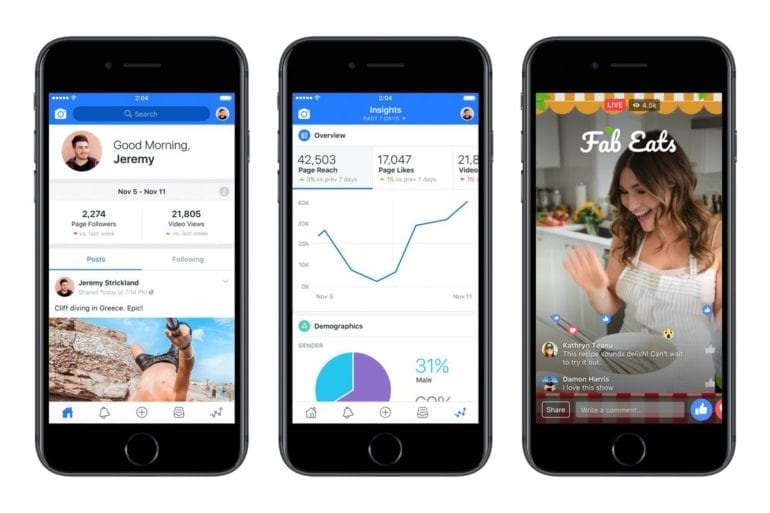
    On 17 November 2017 Facebook launches Facebook Creator, offering influencers Live Creative Kit for adding intros and outros to broadcasts, a unified inbox of Facebook and Instagram comments plus Messenger chats, cross-posting to Twitter and expansive analytics.

    Facebook promised the Creator app back in June at VidCon and today it launches globally on iOS with Android planned for the coming months. It is actually a rebrand and update of the 2014 Facebook Mentions app that was only available to verified public figures and Pages, but now is open to everyone. Weirdly, it still appears as “Mentions” in the App Store for now.

    Any individual profile or Page can download Creator for access to the enhanced fan engagement tools. Facebook is also launching a Facebook for Creators website with best practices for growing fan bases, examples of what other stars are doing and access to answers of frequently asked questions.

    “It is a big priority for us to bring people closer together around meaningful content and the people who are meaningful to them,” Facebook’s VP of video product Fidji Simo tells me. “Creators are right at the intersection of everything we think is pretty unique about Facebook.”

    And after CEO Mark Zuckerberg declared on this month’s earnings call that “time well spent” via video is Facebook’s new objective, the Creator app could help it make Facebook video a lot less isolating than watching TV.

    “The idea was there to give them a one-stop-shop for all the functionality to manage their presence on the go,” Simo explains about the Creator app, which breaks down into four parts.

    Live Creative Kit

    This bundle of tools lets users add intros, outros and custom emoji reactions to their live broadcasts. Creators go on Facebook’s site, upload an intro like a theme song or welcome, and an outro like a call to follow them across social media.

    Those can then be enabled in the Creator app so they play at the start and end of the broadcast. Simo notes that “[Creators] were saying Live is cool because it’s raw and authentic, but they’d like to be able to introduce every time what their show is about or what the theme is about.”

    Graph frames let makers add a pretty border to their videos for a more immersive feel. And custom reactions let creators replace one of the six default “haha,” “‘angry” or “wow” alternatives to the standard “Like” with a graphic of their choice.

    That could tie in with the theme of their broadcast or personality. For example, Simo says feel-good video star Markian could add an especially toothy smile reaction to entertain his fan club group on Facebook, the #SmileSquad.

    These features push Facebook Live well beyond the capabilities of Twitter’s Periscope, and could make it more viable than YouTube Live.

    Unified inbox & Unified Sharing

    Rather than having to constantly jump between Facebook, Instagram and Messenger, Facebook is putting all of a creator’s comments and messages in a single inbox with Creator. That could make it much more streamlined to actually hold a conversation with fans or respond to comments instead of just being an old-school one-way broadcaster. Same will work for the dissemination of the content, which could be automatically shared on different platforms, Twitter included.

    For Creators trying to moderate their comments reels, combining Instagram and Facebook could reduce the time it takes to scrub abusive trolls. And the more ravenous the community and clean the comments, the more interested brands will be to advertise on Facebook video and sponsor the stars.

    One thing sorely missing from Facebook Creator is new ways for influencers to monetize. There’s no subscriptions or tipping, and they cannot even inject revenue-sharing ad breaks into their videos.

  • Europe turns on Facebook, Google for digital tax revamp

    Europe turns on Facebook, Google for digital tax revamp

    With public coffers still strained years after the worst of the debt crisis, EU leaders have agreed to tackle the question, spurred on by French President Emmanuel Macron who has slammed the likes of Google, Facebook and Apple as the “freeloaders of the modern world”.

    As recently as March, five of the world’s top 10 valued companies were Silicon Valley behemoths: Apple, Google’s Alphabet, Microsoft, Amazon and Facebook. (Germany’s SAP was Europe’s biggest and 56th on the global list).

    But tax rules today are designed for yesterday’s economy when U.S. multinationals — such as General Motors, IBM or McDonald’s– entered countries loudly, with new factories, jobs and more taxes for the taking.

    These firms had what tax specialists call “permanent establishment”, when companies showed a clear physical presence measured and taxed through tangible, real world assets.

    But today in most EU nations, the U.S. tech titans exist almost exclusively in the virtual world, their services piped through apps to smart phones and tablets from designers and data servers oceans away.

    Ghost-like, Silicon Valley has turned Europe’s economies upside down, but often with just a skeleton staff and some office space in markets with millions of users or customers.

    Nation-less 

    According to EU law, to operate across Europe, multinationals have almost total liberty to choose a home country of their choosing. Not surprisingly, they choose small, low tax nations such as Ireland, the Netherlands or Luxembourg.

    Thus, it is through Ireland that Facebook draws its wealth from millions of accounts across Europe. There are 33 million accounts in France and 31 million in Germany, according to recent data.

    While users enjoy the platform, Facebook tracks likes, comments and page views and sells the data to companies who then target consumers.

    But unlike the economy of old, Facebook sells its data to French companies not from France but from a great, nation-less elsewhere, with no phone number, address or physical “presence” for a customer who probably cares little.

    It is in states like Ireland, whose official tax rate of 12.5 percent is the lowest in Europe, that the giants have parked their EU headquarters and book profits from revenues made across the bloc.

    Indeed, actual revenues from advertising are minimal in France and Germany, but at Facebook HQ Ireland they grew to 7.9 billion euros, even though the vast majority does not come from the tiny EU island-nation of a mere 2.5 million users.

    Google follows the same pattern: in Germany in 2015, it had a little over 71 million users, in France just over 55 million. But in both nations, revenues are minimal.

    Yet, in Ireland, where the number of search engine users is less than five million, revenues for Google-parent Alphabet reached 22.6 billion euros in 2015.

    According to an analysis by Paul Tang, a specialist on tax issues at the European Parliament, France lost 741 million euros in tax revenue and Germany 889 million euros between 2013 and 2015 due to so-called “tax planning” by Google and Facebook.

    ‘No transparency’

    The Organisation for Economic Cooperation and Development believes that such tax schemes cost governments around the world as much as $240 billion a year in lost revenue, according to a 2015 estimate.

    “The actual activity of each company, including U.S. tech giants, is not known,” said Manon Aubry, spokeswoman for the NGO Oxfam.

    “Beyond the number of accounts or users in each country, it would be necessary to know in the case of Google for example, the amount of advertising sales in each country. We do not have it.”

    For car-ride smartphone service Uber, “we need to know the number of rides, but we don’t have it,” she said.

    “One of the first issues, therefore, is that of transparency: to rule that large companies publish data on activities and taxes paid in all the countries where they are present.”

    To the European Commission, the digital shortfall on tax is clear. The effective tax rate on the profit of digital giants in the EU averages only nine percent, while that of traditional companies exceeds 20 percent, it said.

    ‘Political crap’ 

    Apple, also based in Ireland, became one of the EU’s most emblematic tax cases when Competition Commissioner Margarethe Vestager ordered the iconic iPhone maker to pay 13 billion euros in back-taxes.

    Vestager said the U.S. giant had benefitted from illegal state aid, a gift from Ireland in exchange for choosing Dublin as its headquarters, with thousands of jobs at stake in the deal.

    Brussels says Dublin’s red carpet treatment accorded Apple an effective corporate tax rate of one percent on its European profits in 2003 — a rate that decreased to a scant 0.005 percent in 2014 — just a fraction of the official rate.

    “It’s total political crap,” Apple chief executive Tim Cook barked at the time.

    Undeterred, Vestager has gone after similar arrangements, such as those revealed in the Luxleaks scandal that exposed deals struck between Luxembourg and a long list of multinationals, including online U.S. retail giant Amazon.

    Faced with this situation, several solutions are under study.

    Driven by Macron, France has proposed an unusual idea that has so far divided Europe: tax the U.S. tech giants on sales generated in each European country, rather than on the profits that are cycled through low-tax countries.

    France says this proposal, presented by French Finance Minister Bruno Le Maire in September, has received the support of some 20 countries, including Germany, Italy and Spain.

    But there is fierce opposition from states like Cyprus, Malta, Ireland or Luxembourg — countries that have linked their EU membership to low corporate tax and thus transformed their economies from rural backwaters to financial hubs in a globalised world.

    Global, not EU, solution 

    Member states now agree that the problem would be best addressed at the international level, in the G20 or by the OECD, in order to prevent a high-tech exodus from the EU.

    Caught by surprise by the French initiative, the European Commission announced at the end of September that it will also propose solutions in 2018.

    Ideally, Brussels agrees that there needs to be a major reform of international tax rules, which would establish a closer link between the way value is created and the place where it is taxed.

    Without rejecting the French proposal, the commission wants to dust off an old project from 2011 — for a long time deadlocked because of the differences among the 28.

    Relaunched in October 2016, the idea has one of the most cumbersome acronyms ever to come out of Brussels: the Common Consolidated Corporate Tax Base or CCCTB — an ambitious bid to consolidate a company’s tax base across the EU.

    This draft legislation is currently being examined by the 28 EU member states and taxation of the digital economy could easily be included in the scope of the rules that may be adopted.

    Under the plan, all multinationals operating in the EU with total sales of more than 750 million euros would be fixed at only one place of taxation, with one tax administration.

    However, this tax would be distributed in all the countries where the company operates, and not according to the level of booked profit in each of these states, but according to the level of activity.

    This level of activity in each member state would be measured using a combination of factors, including the number of employees, the importance of tangible assets (buildings, machinery, etc.) and sales.

    French MEP Alain Lamassoure, co-rapporteur of the project, proposes to add a fourth idea: the volume of personal data collected and used by a digital platform wherever its services are used.

    But in Europe, all is made infinitely more complicated since the adoption of new European legislation on tax matters requiring unanimity of the EU’s current 28 members.

    In addition to these European proposals, the OECD is working on a global solution, which it must present to the G20 finance ministers at their next meeting in April in Washington.

    This initiative would have the merit of including Europe as well as the United States, Japan and emerging countries.

    Until last October, the United States had dragged its feet in efforts to better tax its national champions, but changed attitude. Specifically, it agreed to set up a working group with France in the OECD.

    “The Americans are in the same situation as us: their own tax system is not adapted to the current economy and they too are experiencing very substantial revenue losses that must be compensated,” EU economics commissioner Pierre Moscovici said.

    “Taxation of the U.S. tech giants is a global problem and the answer should be as well.”
  • Facebook’s Mark Zuckerberg to visit Vietnam

    Facebook’s Mark Zuckerberg to visit Vietnam

    Founder and CEO of Facebook Mark Zuckerberg is expected to arrive in Vietnam on Saturday.

    Zuckerberg is scheduled to visit world heritage site Ha Long Bay in northern Vietnam and take a seaplane tour around the bay on Saturday morning.

    This will be his second visit to Vietnam after his first trip in 2011, when he toured the country with his then-girlfriend-now-wife Priscilla Chan for a Christmas vacation.

    On this visit, the world’s fifth richest person according to Forbes magazine, will be accompanied by colleagues.

    In March, Vu Tien Loc, chairman of the Vietnam Chamber of Commerce and Industry (VCCI), said Vietnam had invited Facebook leaders, including Zuckerberg, to attend the Asia Pacific Economic Cooperation (APEC) Summit that concludes Saturday in the central city of Da Nang.

    “We want Facebook leaders to join hands with Vietnam to support startups, and we hope Zuckerberg will accept the invitation,” he said.

    Facebook COO Sheryl Sandberg has been in Da Nang since Wednesday and delivered a speech at the APEC CEO Summit on Friday morning.

    She is scheduled to appear on a talk show to discuss equality in the workplace on Sunday in Hanoi.

    Vietnam is in the top 10 countries for Facebook users, and Google’s YouTube is also a popular platform.

    Last week, a draft law on internet security that would require foreign companies such as Google and Facebook to have offices and servers in Vietnam was met with strong opposition from experts and industry insiders.

    The VCCI said it went against commitments that Vietnam signed up to when it joined the World Trade Organization (WTO) and the EU-Vietnam Free Trade Agreement (EVFTA), as well as the Trans-Pacific Partnership Agreement (TPP).

    Insiders said if the bill is passed, Google, Facebook, Skype and Viber would have to invest in giant servers in Vietnam to legally operate in the country.

    In that case, local internet providers said there is a high possibility that they would drop out of the Vietnamese market.

  • Arl-shipping.com launches Facebook chatbot last mile container tracker

    Arl-shipping.com launches Facebook chatbot last mile container tracker

    Arl-shipping.com has launched it’s Facebook chatbot tracking of containers on the road en route from discharge port to import warehouse, giving real-time visibility of the truck(s) on the road. Import customer and warehouse operator follows the trucks in real-time and prepare for speedy container unstuffing upon arrival to the warehouse. The tracking is facilitated by truck drivers using arl-shipping.com’s free app, tracking the shipment and OCR’ed container numbers via driver’s smartphone GPS location services. The Facebook tracking service is fully embedded into the transport provider’s Facebook page as an integral service.


    “On top of Facebook chatbot cargo tracking, we are soon launching also Skype and WeChat Last Mile Container Tracking for shipping line agents, freight forwarders, warehouse operators or other intermediaries via the arl-shipping.com powered chatbot,” said arl-shipping.com director, René Bendt. He added, “We explore maturing technologies, which can be deployed with little effort to the benefit of real life shipping scenarios like container number OCR, GPS trackers and other IoT devices, drones and blockchain technology.”


    The tracking is facilitated by truck drivers using arl-shipping.com’s free app, tracking the shipment and OCR’ed container numbers via driver’s smartphone GPS location services.

    The Facebook chatbot Last Mile Container Tracker tracks shipment en route from discharge port to warehouse, prepping the warehouse operator for warehouse dock, unstuffing gang and x-docking operation readiness. Upon providing the warehouse’s location to the chatbot via smartphones’ built-in location sharing services, Last Mile Container Tracker alerts in Facebook messenger when container(s) is close to the warehouse, as well as giving hourly status messages while container(s) is on the road, en route to the warehouse.

    Soon the chatbot will also advise warehouse ETA imbedding online traffic pattern services into the Last Mile Container Tracker.

  • Amid soaring profits, Facebook vows to curb abuse

    Amid soaring profits, Facebook vows to curb abuse

    Investors worried that the probe into Russian meddling with U.S. politics will result in changes in regulation on social networks. Facebook on Wednesday reported that profits leapt on booming revenue from online ads in the third quarter, topping investor forecasts and buoying shares already at record highs.

    The leading social network said it made a profit of $4.7 billion in the quarter that ended on September 30, a jump of 79 percent from the same period a year earlier.

    Chief executive Mark Zuckerberg used the update to address criticism of Facebook for allowing disinformation and manipulation during the 2016 U.S. presidential election, hours after the company’s top lawyer faced a grilling at a Washington congressional hearing.

    “Our community continues to grow and our business is doing well,” Zuckerberg said.

    “But none of that matters if our services are used in ways that don’t bring people closer together. We’re serious about preventing abuse on our platforms. We’re investing so much in security that it will impact our profitability. Protecting our community is more important than maximizing our profits.”

    Facebook shares that ended the day up 1.4 percent to $182.66 but retreating in after-market trades to $179.25.

    Investor enthusiasm may have been tempered by rising costs at the California-based internet giant and executives stressing the company is firmly in “investment mode” while predicting ad growth will slow.

    “They made a ton of money but the Russia investigation is clearly putting a cloud over everything for the moment,” said independent analyst Rob Enderle.

    “Sometimes it just takes a trigger event to cause a bunch of people to take their profit and go someplace else, especially if they have decided this is as good as it is going to get at Facebook for a while.”

    The analyst added that some investors might be worried that the probed into Russia meddling with US politics will result in regulation on social networks that might hurt profitability.

    Investment mode

    Expenses rose to $5.2 billion from $3.9 billion in the same quarter last year, and headcount at the company was up 47 percent to 23,165 employees.

    “We will continue to invest aggressively in the many opportunities we see ahead,” Facebook chief financial officer David Wehner said during an earnings call with analysts.

    Zuckerberg outlined investment priorities that included video content, which he described as the biggest trend at Facebook.

    The number of monthly active users at the social network continued to grow, reaching 2.07 billion, an increase of 16 percent from the same time last year.

    Advertising served up on smartphones or tablets accounted for about 88 percent of revenue taken in from marketing messages in the quarter, Facebook reported.

    The quarterly earnings report was released as Facebook and other internet titans testified this week before Congress about a Russian-led effort to spread misinformation and sow discord ahead of the 2016 U.S. election.

    New details on meddling

    Facebook told Congress on Wednesday that the apparent political meddling included use of its image-oriented messaging service Instagram.

    Facebook general counsel Colin Stretch told a hearing that Instagram posts by suspect Russian accounts were seen by some 20 million Americans last year.

    “We now discovered, in the last 48 hours, 120,000 Russian-based posts on Instagram,” Stretch told the Senate Intelligence Committee hearing.

    The latest data on Instagram is on top of the estimated 126 million Americans exposed to Facebook posts from Russian entities seeking to create divisions during the election campaign.

    “So all told, that gets you to approximately — a little less than 150 million,” Stretch said in response to questioning from Democratic Senator Mark Warner.

    Senator Dianne Feinstein of California told the hearing which included lawyers for Facebook, Google and Twitter that the companies need to do more to help combat “cyber warfare.”

    “I asked specific questions, I got vague answers, and that just won’t do,” she told the companies.

    “You have a huge problem on your hands… You’ve created these platforms, and now they are being misused, and you have to be the ones to do something about it, or we will.”

    The hearing was the second in Congress this week in which social media and internet firms have been called to explain how fake news and other disinformation was allowed to spread during the election campaign.

    “I’ve expressed how upset I am that the Russians tried to use our tools to sow mistrust,” Zuckerberg said

    “What they did is wrong and we are not going to stand for it.”

  • Facebook moves toward revealing political ad backers

    Facebook moves toward revealing political ad backers

    People will be able to click ‘view ads’ on a page to determine the source. Facebook said Friday it would take steps to deliver on a promise to reveal backers of political advertisements to boost transparency in the wake of criticism of the social network’s role in the 2016 U.S. election.

    The leading social platform said it will begin testing and refining political ad transparency tools next month in Canada, with a goal of having them in place in the US before elections next year.

    Under the plan unveiled by Facebook vice president Rob Goldman, people will be able to click “view ads” on a page to determine the source.

    “Transparency helps everyone, especially political watchdog groups and reporters, keep advertisers accountable for who they say they are and what they say to different groups,” Goldman said in a blog post.

    “People should be able to tell who the advertiser is and see the ads they’re running, especially for political ads, That level of transparency is good for democracy and it’s good for the electoral process.”

    Facebook founder and chief executive Mark Zuckerberg said in a separate post this is more transparency than required for other media.

    “We’re making all ads more transparent, not just political ads,” Zuckerberg said.

    Additionally, he noted that political advertisers “will now have to provide more information to verify their identity.”

    Facebook in September announced a plan to increase “transparency” regarding political advertising and hire more than 1,000 people to thwart deceptive ads crafted to knock elections off course including “dark” messages crafted for specific demographic groups but invisible to others.

    Facebook has turned over to Congress some 3,000 Russia-linked ads that appeared to use hot-button issues to turn people against one another ahead of last year’s U.S. election.

    Facebook’s second-ranking executive, Sheryl Sandberg, has acknowledged that “things happened on our platform in this election that should not have happened, especially foreign interference.”

    According to Facebook, some 10 million people may have viewed the ads placed by a Russian entity that appeared aimed at sowing division and mistrust.

    Some 470 accounts spent a total of approximately $100,000 between June 2015 to May 2017 on ads that touted fake or misleading news, according to Facebook.

    Goldman said Canada is a “natural choice” to test the new system.

    “Testing in one market allows us to learn the various ways an entire population uses the feature at a scale that allows us to learn and iterate,” Goldman said.

    Twitter this week unveiled similar steps that will disclose the sources of political ads. The messaging platform separately said it would ban ads from Russia-based RT and Sputnik, accused of spreading disinformation during the 2016 campaign.

  • Facebook joins effort to boost newspaper subscriptions

    Facebook joins effort to boost newspaper subscriptions

    Facebook aimed at fostering ‘a healthy news ecosystem’ and curbing the spread of fake news. Facebook announced Thursday initiatives to help struggling news organizations gain paid subscribers, following a similar move unveiled earlier this month by Google.

    The social network giant said it will test “premium news models” for organizations that deliver their content on Facebook, to enable the publishers to have more control over pricing, subscriber relationships and revenue.

    “Earlier this year, many publishers identified subscriptions as a top priority, so we worked with a diverse group of partners to design, refine, and develop a test suited for a variety of premium news model,” said a blog post by Facebook executives Campbell Brown, Alex Hardiman and Sameera Salari.

    Facebook said it would soon roll out the test to support new subscription models in Instant Articles in partnership with a news organizations in the U.S. and Europe, starting with the Android application.

    The leading social network said it would allow for “paywalls” in its Instant Articles feature, aiming to encourage users to sign up and pay news organizations whose content is linked through Facebook.

    If a person subscribes after prompting, the publisher will handle the payment directly and keep 100 percent of the revenue, Facebook said.

    Facebook said it would allow for various paywalls including a “metered” system with a fixed number of articles as well as a “freemium model” where certain content is locked at the discretion of the publisher.

    Included in the test will be Germany’s Bild and Spiegel, France’s Le Parisien, Italy’s La Republicca, the Telegraph and the Economist of Britain and the U.S.-based Boston Globe, Washington Post, and news groups Hearst and Tronc, which includes the Baltimore Sun, Los Angeles Times, and San Diego Union-Tribune.

    Facebook said the changes are part of its Journalism Project created this year aimed at fostering “a healthy news ecosystem” and curbing the spread of fake news.

    The moves by Facebook and Google come with many news organizations blaming the internet giants for encouraging free content, while getting most of the ad revenues from news articles appearing on their platforms.

    Earlier this month, Google announced similar actions, ending a “first click free” policy that required news organizations to provide at least three free articles to be indexed in a Google search.

    This will be replaced by a “flexible sampling” model that will allow publishers to require a subscription at any time they choose, according to Google.

  • Facebook building $1b data center

    Facebook building $1b data center

    Reports out of Richmond say that Facebook is moving in next door. The tech giant is said to be building a $1 billion data centerin eastern Henrico County, a few miles east of town.

    The first phase of Facebook’s new facility will span 970,000 square feet and add more than 100 full-time jobs to the area. As currently envisioned, follow-up phases would bring that total up to 2.5 million square feet and 240 full-time jobs.

    The data center(s) will be on a 328-acre site at Technology Boulevard and Portugee Road within the White Oak Technology Park.  That’s the complex which also happens to also house the 1.3 million square foot former Qimonda semiconductor plant that is now a giant QTS data center.

    Virginia as a whole has been a hot infrastructure market lately. The construction of the new MAREA cable system is bringing the state its own submarine cable access point at Virginia Beach, and new fiber has been put in the ground and on poles throughout the region in anticipation.

  • Facebook to hire more than 1,000 people to thwart election manipulation ads

    Facebook to hire more than 1,000 people to thwart election manipulation ads

    Facebook on Monday said it will hire more than 1,000 people to thwart deceptive ads crafted to knock elections off course.

    The announcement came as the leading social network turned over to Congress some 3,000 Russia-linked ads that appeared to use hot-button issues to turn people against one another ahead of last year’s US election.

    “Today we are delivering those ads to congressional investigators,” Facebook vice president of global policy Joel Kaplan said in an online post.

    “Many appear to amplify racial and social divisions.”

    The ads appeared to be linked to a Russian entity known as the Internet Research Agency, and violated Facebook policies because they came from inauthentic accounts, according to Kaplan.

    “Aggressive steps” by Facebook will include hiring more than 1,000 people to bolster its global ads review teams in the coming year, Kaplan said.

    Facebook also planned to ramp up investment in machine learning to identify and take down ads violating the social network’s policies.

    “Enforcement is never perfect, but we will get better at finding and removing improper ads,” Kaplan said.

    Facebook will require those interested in running ads related to US elections to confirm businesses or organizations they represent.

    Asking forgiveness

    Facebook chief executive Mark Zuckerberg last month announced a crackdown on efforts to use the leading social network to meddle with elections.

    Zuckerberg outlined a series of steps that would help prevent the manipulation of the social network, including more transparency on political ads appearing on Facebook.

    Facebook last month agreed to hand over information about the ads from the Internet Research Agency to special counsel Robert Mueller’s investigation of the 2016 election..

    An internal Facebook review showed that Russia-linked fake accounts were used to buy ads aimed at exacerbating political clashes ahead of and following the 2016 US presidential election.

    Some 470 accounts spent a total of approximately $100,000 between June 2015 to May 2017 on ads that touted fake or misleading news or drove traffic to pages with such messages, a Facebook official said.

    While the amount of money involved was relatively small, enough to buy roughly 3,000 ads, the accounts or pages violated Facebook policies and were shut down, according to Facebook chief security officer Alex Stamos.

    Zuckerberg over the weekend posted a message marking the Jewish holiday of Yom Kippur, or day of atonement, asking forgiveness “for the ways my work was used to divide people rather than bring us together.”

    Free speech vs abuse

    Facebook vice president of communications Elliot Schrage on Monday posted answers to “hard questions” prompted by the Russia ads.

    The social network estimated that 10 million people in the US saw the ads, some 44 percent of those views happening before the November election and the rest afterward.

    Many of the ads did not violate Facebook rules regarding banned content, but instead broke a policy barring accounts from hiding who is really running them, according to the social network.

    “That means that for most of (the ads), if they had been run by authentic individuals, anywhere, they could have remained on the platform,” Schrage said.

    “This is an issue we have debated a great deal.”

    Facebook has become an important platform for debate on political and social issues, and faces the challenge of protecting free speech while guarding against malicious interference in elections.

    “We are dedicated to being an open platform for all ideas — and that may sometimes mean allowing people to express views we — or others — find objectionable,” Schrage said.

    “This has been the longstanding challenge for all democracies: how to foster honest and authentic political speech while protecting civic discourse from manipulation and abuse.”

  • Facebook hires AI expert, launches lab in Canada’s Montreal

    Facebook hires AI expert, launches lab in Canada’s Montreal

    The lab will be Facebook’s fourth, after sites in Palo Alto, New York, and Paris. Facebook Inc has hired artificial intelligence academic Joelle Pineau to head its new research lab in Montreal, the Silicon Valley social media company said on Friday.

    Once the exclusive domain of academic researchers, artificial intelligence has grabbed the attention of the corporate world as businesses from healthcare to financial services look to use algorithms to sort through reams of data in search of patterns to solve problems.

    The lab will be Facebook’s fourth, after sites in Palo Alto, New York, and Paris, and joins similar AI research efforts in the city from Microsoft Corp and Alphabet’s Google.

    The company will also invest $7 million to support AI research at academic institutions in Montreal, the Canadian Institute for Advanced Research said in a statement.

    Pineau is a co-director of McGill University’s Reasoning and Learning Lab whose work focuses on developing and applying models and algorithms applying robotics to healthcare, transportation and language processing.

    One project she has been working on at McGill, where she will maintain her academic position, is a robotic wheelchair.

    Pineau will be joined by fellow researchers Pascal Vincent, Michael Rabbat and Nicolas Ballat, and Facebook expects the team to grow to around 30 researchers.

    Facebook already uses AI for image recognition, language analysis and targeted advertising. It also uses AI to identify and remove what the company deems “inappropriate content.”

    The Facebook project will be connected to McGill University’s Centre for Intelligent Machines and to the Montreal Institute for Learning Algorithms, started by University of Montreal professor and machine learning pioneer Yoshua Bengio, two sources with knowledge of the plans said.

    Combined, University of Montreal and McGill have more than 200 researchers, including students, working on AI research projects, Bengio said. That is up from around 150 cited by Google last year, which it called the greatest academic concentration of AI research in the world.

    The mostly French-speaking province of Quebec boasts around 90 start-up companies focused on artificial intelligence.

    The Canadian federal government has pledged C$125 million to build AI expertise in Montreal, the Toronto-Waterloo corridor, and Edmonton, while the provincial Quebec government has also promised some C$100 million ($82 million) specifically for AI research.