Tag: HSBC

  • HSBC gears for new retail banking push in the UAE

    HSBC gears for new retail banking push in the UAE

    Global banking giant HSBC, with a focus on the premium segment of the consumer banking business is looking to expand its retail lending, liabilities and wealth management business to a wider audience.

    “We are looking at the full corporate employee programmes to expand our retail business. We want to deal with payroll type solutions from both wholesale and retail side, covering liability and asset side of the business,” Marwan Hadi, head of Retail Banking and Wealth Management in the UAE, told Gulf News in an interviMajority of the bank’s retail lending is against salaries. Although the bank’s focus is on premium segment of the retail banking, in the corporate employee programme, the bank aligns its lending policies to be more inclusive. However, the bank does not insist on taking on the entire payroll from a customer acquisition point.

    “The UAE is a market where customers have wider choice. Although we become a preferred bank for a company through our corporate programme, the customers have the freedom to choose which bank they want to do business with,” said Hadi.

    HSBC sees strong potential for retail assets growth. Given the positive economic outlook, the bank sees greater growth in numbers as it gains market share in this segment. As part of its new retail expansion strategy, the bank is investing in digital solutions and frontline staff. The bank is in the process of adding more relationship managers (RMs).

    The new retail strategy revolves around the concept of taking the bank to the customers. While a part of it relates to providing appropriate digital banking delivery channels such as mobile banking and internet banking, HSBC is equipping its retail staff with most advanced digital solutions to serve their customers better.

    The bank has a network of eight branches and seven customer service units focused on commercial hubs across the country. Unlike many leading local banks that have wider branch network and still expanding, HSBC plans to reach customers wherever they are.

    Bank’s new customer acquisitions are based on corporate relationships. “Our customer acquisition numbers in the first quarter this year is much more favourable than last year. We are experiencing more than 10 per cent growth in terms of new to bank customers,” Marwan said. On the lending side, with the exception of auto loans, for all segments such as mortgages, personal loans and credit cards the bank has witnessed double digit growth so far. Hadi expects the bank to keep up the momentum through the year.

    “We don’t see any reason why this trend will not continue for the rest of the year. The International Monetary Fund (IMF) expects the UAE economy to grow at 3.5 per cent this year. Our Group is very comfortable with the growth outlook,” he said.

    In the cards business, the bank has plans to expand its product suite to complement the existing successful cash back card programme and premium offering like fully metallic black card.

    Liability focus

    For the past several years retail banking has been largely focused on assets (lending) business. Hadi expects that to change as the interest rates rise. With the rising rates, banks are likely to make more income from liabilities business (deposits).

    HSBC with its focus on the premium segment of the retail business has a strong retail deposits base. The bank is currently working on strategy to match retail asset business with its strong retail liabilities business.

    Wealth offerings

    Bank’s wealth business, focused on premium retail customers will be largely driven by growth in relationship managers as it plans to increase the number by more than 15 per cent this year.

    “We have expanded our wealth proposition with a robust investment platform offering more than 75 mutual funds. Currently, we have two GCC funds but going forward we are looking to add more regional funds in our offering,” said Hadi.

    In addition to mutual funds, the bank has fixed income products on offer and has plans to add direct equity and exchange traded funds (ETFs) in the future. The bank’s portfolio advisory service offers a goal-based investment advice directly linked to the risk tolerance levels of customers.

    Quick payments

    HSBC has a very competitive payments business in the UAE. In the foreign exchange (FX) business within the Retail Banking space, the UAE is the third largest market for HSBC Group, after UK and Hong Kong. The bank offers linked accounts for premium customers across key global corridors, allowing customers to transfer money instantly between these accounts. The bank also offers opportunity to link the HSBC accounts of family and friends globally, making fund transfers within the group quick and seamless. Both these facilities are free of charge and are completed digitally to allow improved customer experience.
  • HSBC launches Singapore-dollar income bond fund for local retail investors

    HSBC launches Singapore-dollar income bond fund for local retail investors

    The fund will primarily invest at least 50 per cent in SGD denominated bonds issued by governments, government agencies, supranational bodies or companies that are Singapore and non-Singapore based issuers. All other investments will be hedged to SGD. The fund also invests across various countries and sectors which tend to behave differently at different market cycles enabling diversification.

    Puneet Chaddha, CEO, Southeast Asia, HSBC Global Asset Management, said: “We launched the fund because our retail customers want to grow their capital faster than the average savings rate but in a way that’s risk weighted and diversified. This fund gives them access to growth with limited downside exposure.”

    “Being located in the heart of Asia, Singaporeans understand the underlying economic growth of the region. Moreover, the diverse nature of the fund’s investment allocation across a multitude of Asian countries and sectors will provide confidence in the growth potential but with the added assurance of minimizing currency risk.”

  • HSBC names new retail head

    HSBC names new retail head

    HSBC Holdings has named Charlie Nunn as chief executive of its retail banking and wealth management business to replace John Flint, who will take over as the British lender’s overall chief executive.

    Nunn joined the bank in 2011 and is already acting head of HSBC’s retail banking and wealth management business.

    In Hong Kong, Kerry Properties (0683) announced that Wong Siu Kong, 66, will relinquish his position as chief executive and will remain chairman and an executive director.

    Wong has been the chairman of the board since 2013 and chief executive since 2015.

    Ho Shut Kan, 69, who has been an executive director of the company since 1998, will be re-designated chief executive and will become a member of the remuneration committee and the nomination committee of the company. He is also a director of Kerry Holdings Limited, the controlling shareholder of the company, and a director of China World Trade Center Co.

    TV operator i-Cable Communications (1097) announced that Irene Leung Shuk-yee has been named chief operating officer with effect from tomorrow.

    The 48-year-old is an experienced senior manager in the telecommunications industry, having developed her expertise in fixed and mobile telecom services, i-Cable said in a filing to the Hong Kong stock exchange.

  • Rosy results picture for HSBC

    Rosy results picture for HSBC

    HSBC Holdings releases its annual results this week and many investment houses seem positive.

    Goldman Sachs expects the total amount of share buybacks of the banking group to hit US$3 billion (HK$23.4 billion) this year and the dividend payout to be maintained at 51 US cents per share.

    The conglomerate has had three public repurchases in the past, ranging from US$1 billion to US$2.5 billion.

    It will record a US$3.7 billion profit before tax for the fourth quarter of the last financial year while the average market expectation is US$3.9 billion, up 49 percent from its result last year, Goldman Sachs added.

    Investors will tend to focus on the company’s retail business performance in Hong Kong in the fourth quarter last year when the local stock market surged and the interest rate grew, both of which should have benefited the HSBC’s wealth management and insurance business, Goldman Sachs said.

    According to the prediction made by analysts from Bloomberg, the company should see approximately US$20.35 billion annual adjusted profit before tax, growing 5.4 percent year on year. Internal securities and analysts from HSBC are more positive, forecasting a 10.4 percent annual growth in adjusted profit before tax to US$21.31 billion and a 7.6 times year on year gain in net profit to US$11.33 billion.

    However, China Goldjoy Asset Management managing director Matthew Kwok is not expecting too many surprises.

    He said the banking group is unlikely to have a large growth in net profit, plus the switch of management should drag the public attention to new strategy developments, though he agreed that HSBC has sufficient capital for share buybacks.

    Stuart Gulliver, chief executive of HSBC, will leave the position this week after the results’ announcement.

    Recently, he reportedly said the banking giant is unlikely to exercise any spinoff after many years of business restructuring.

    For a long time English politicians have been critical of HSBC for its merger and acquisitions in earlier years “have led the company to the stage of being hard to manage,” but now Gulliver said such concerns have faded.

    With the hope of an excellent result, the banking group’s stock price rose in Hong Kong before the Lunar New Year holiday and surged to HK$83.55 on the last trading day.

    Last October, HSBC released its third quarter result and signaled its pivot to Asia was paying rich dividends as quarterly profits leaped fivefold, and that it will continue placing strong investments in the mainland over next few years.

    The bank makes more than half of its profits in Asia, and its regional pivot is centered around the Pearl River Delta with plans to bolster its retail and wealth management business.

    Back then, Gulliver said that the group expected sustainable profit efficiency from the region.

  • Malaysia continues to attract expats from Europe and Eastern Asia region

    Malaysia continues to attract expats from Europe and Eastern Asia region

    HSBC Bank Malaysia said Malaysia continues to attract expats particularly from Europe and Eastern Asia regions.

    Country head, retail banking and wealth management, Lim Eng Seong said one of the reasons why expats love settling down here are the friendly nature of the Malaysians.

    “Looking for accommodation, organising healthcare and schooling are all easy to do in Malaysia, hence the plus points for expats to move here,” he said in a statement.

    Based on HSBC’s Expat Explorer survey conducted last year, he said Asia continues to provide promising economic prospects and improved quality of life that appeal to professionals and entrepreneurs both from within the region and across the globe.

    Now in its 10th year, the HSBC Expat Explorer survey is the world’s largest and longest running study of expats life, involving over 27,500 expats about their experience abroad.

    61 per cent expat experience in Malaysia found it was easier to make friends. In terms of active social life, 44 per cent noted they have better social lives now than they did at home compared to 31 per cent of all expats around the world and 40 per cent regionally.

    The survey revealed that Malaysia offers simplicity and smooth transition for expats in finding accommodation (61 per cent), organising healthcare (54 per cent) and arranging childcare and schooling (52 per cent).

    “In fact, once expats settle down, life continues to be positive for most of them where more than half (55 per cent) live in a better property than they would have had in their home country.”

    The survey also found that life abroad typically increases expats’ income by 25 per cent, with expats earning just under US$100,000 a year on average.

    “Far from compromising their wellbeing, expats seem to find the right balance. 41 per cent expats adopt a more positive outlook on life after moving abroad, with 44 per cent becoming more physically active.”

    The surveyed highlighted that expats in Asia said they have experienced an uplift in income of at least 10 per cent, including Australia, China, Hong Kong, India, Indonesia, Malaysia and New Zealand.

    Lim said Asia continues to draw expats from all over the globe for its buoyant economic prospects.

    “We still see a significant proportion of expats coming from Europe and North America but also a robust pool of Asian expats working in Singapore, Malaysia, Indonesia and Greater China – all trying to capture opportunities from the region’s fast-growing consumer services sector, increased tech and digital focus and infrastructure push,” he added.

    He pointed out the continued growth in China and Asean would require a diverse mix of talent from people who are internationally mobile.

    Lim said expats’ financial needs are more complex, citing that managing accounts in multiple markets and currencies, health and protection cover, as well as saving and investing for education, retirement and property aspirations are key aspects of their holistic financial plan.

    “Wherever they live, expats should seek financial advice from a trusted provider who can help them manage their more complex financial affairs,” he said.

  • HSBC profits up five-fold in third quarter

    HSBC profits up five-fold in third quarter

    ‘Our pivot to Asia is driving higher returns and lending growth, particularly in Hong Kong.’

    HSBC said Monday that profits were up more than five-fold in the third quarter as its Asia business drives higher returns.

    Reported pre-tax profit jumped to $4.6 billion in the three months to the end of September, compared with $843 million over the same period in 2016.

    The Asia-focused banking giant has been on a recovery drive over the past two years to streamline the business and slash costs, and has laid off tens of thousands of staff.

    Shares were up 1.1 percent at HK$77.95 ($9.99) by lunch, shortly after the results were released.

    Chief executive Stuart Gulliver said the bank had “maintained good momentum in the third quarter”, with higher revenue across its main global businesses.

    “Our pivot to Asia is driving higher returns and lending growth, particularly in Hong Kong,” he added.

  • HSBC debuts mobile stock app

    HSBC debuts mobile stock app

    HSBC has introduced a new stock trading mobile app for both Android and iOS to help Hong Kong customers more easily trade Hong Kong, China A and US stocks.

    The HSBC HK Easy Invest standalone stock trading app includes new features including a one-screen quick buy function, interactive charts, a sector heat map and tailored news.

    Customers can access the app using their existing HSBC Personal Internet Banking Details or Touch ID fingerprint authentication for Apple users. The app also employs several industry-standard security measures for further protection.

    To promote the new app, HSBC is offering new users a HK$100 brokerage fee rebate on customers’ first trade using the system until November 30.

    “With changing customer behaviour and increasing demand for faster and more convenient banking services, we are expanding our digital capabilities to better meet customers’ needs,” HSBC head of retail banking and wealth management for Hong Kong Greg Hingston said.

    “HSBC HK Easy Invest is a smart and powerful tool that is easy to use, fast and secure, helping us support our customers as they manage their wealth.”

  • HSBC ‘back in growth mode’ in Singapore

    HSBC ‘back in growth mode’ in Singapore

    British bank HSBC is now “back in growth mode” in Singapore after investing heavily in turning around revenue and profitability, said a top executive.

    Despite a fiercely competitive retail market, the bank has high hopes for its business here, said Mr Anurag Mathur, head of retail banking and wealth management at HSBC Bank (Singapore), who has been in the role for a year.

    He told recently: “Customers are also sophisticated (here), but that’s good as it encourages innovation and we’re often at the cutting edge in Singapore, where some of the things piloted here – and hopefully, increasingly developed here – can then be exported elsewhere in HSBC globally.”

    The bank has “spent quite a bit of time and investment in incorporating the company here”, said Mr Mathur, referring to its move last year to set up a local subsidiary for the retail and wealth business.

    “As part of that, we’ve also upgraded our core banking platforms and infrastructure, such as upgrading branches and opening new ones in the last few years, and improving our products and digital capabilities.”

    While Mr Mathur was unable to give specific numbers, recent data from the bank showed it has spent more than US$1 billion (S$1.4 billion) on its global digital investment since 2015.

    HSBC has 11 branches and about 1,000 employees under the retail banking and wealth management business here.

    Competition is particularly high here now, evident from moves by financial institutions here like DBS Bank, which acquired ANZ’s wealth management and retail banking business in five markets in Asia last October.

    Standard Chartered Bank for its part is chasing the silver dollar in Singapore with the release last month of a new offering for only those aged 55 and older, for instance.

    Customers of HSBC’s retail banking and wealth management unit are typically those with a minimum of $200,000 with the bank, be it through deposits, or investments, among other things – and that is where growth is for the bank too, said Mr Mathur.

    “In that space, we see Singapore continuing to be a growth hub. Wealth management is a key area of growth. The macro conditions are there.

    “Singaporeans obviously invest here, but people from around the world, particularly Asia, also like to invest here. According to the BCG wealth report of 2016, offshore wealth booked in Singapore is projected to grow at roughly 10 per cent annually through 2020.”

    He noted that HSBC is positioned to capture this segment because of several factors such as its international network, its “insurance and asset-management support pillars on the product side and a strong offshore base”.

    And almost a third of the mass affluent market in Singapore has an HSBC relationship – be it with a banking product or service.

    “In the last five years or so, we’ve seen our deposit balances in current and savings accounts grow at double digits, which is a strong and healthy indicator. Personal loans have grown by double digits in the last four to five years,” said Mr Mathur.

    While other bankers might say retail banking is surely a local business, HSBC looks at clients from a different point of view.

    “What our HSBC Premier customers find is that they can open accounts with us in multiple countries where they have property, investment or worked.”

    The bank has a feature dubbed “global view, global transfer” that lets clients access “all accounts on one screen”.

    Mr Mathur said this appeals to t Singapore’s expatriate population as they have banking relationships outside Singapore as well.

    He noted: “And almost all Singaporeans are international in some shape or form.

    “For instance, some reports show 95 per cent of them travel at least once a year, so they find the international offers we have on our credit cards powerful.

    “We believe Singaporeans will increasingly be international, in terms of where they study, do business, even where they invest. Our strengths are uniquely positioned to help them in that space.”

  • HSBC profits up in first half of 2017

    HSBC profits up in first half of 2017

    The Asia-focused giant has been on a recovery drive over the past two years to streamline the business and slash costs, and has laid off tens of thousands of staff.

    HSBC said profits were up Monday in the first half of the year in what it called an “excellent” result after a turbulent 2016.

    Reported pre-tax profit for the six months to June rose five percent to $10.2 billion compared with $9.7 billion for the same period last year.

    HSBC also announced a share buyback of up to $2 billion, expected to be completed in the second half of the year.

    Shares were up 2.77 percent at HK$78.55 ($10.06) in early afternoon trading in Hong Kong Monday.

    The half-year results showed operating expenses dropped 12 percent to $16.4 billion, partly stemming from a sell-off of its Brazil operations.

    Chairman Douglas Flint described the performance as “extremely pleasing”.

    Flint said there were still uncertainties due to increasing geopolitical tensions and “ambiguous predictions” around Britain’s future relationship with the European Union post-Brexit, but described HSBC’s performance as resilient.

    Analysts said the results had outstripped predictions.

    “HSBC’s earnings are definitely better than market expectations,” said Dickie Wong of Hong Kong-based Kingston Securities.

    He described the firm as in “very good shape” after wide-ranging restructuring programmes following the global financial crisis in 2008.

    Net profit for the first half of the year rose 10 percent to $6.99 billion from $6.36 billion for the same period in 2016.

    Pre-tax profits for the second quarter rose $1.7 billion to $5.3 billion year on year, beating Bloomberg analysts’ estimates, which had averaged out at a $4.6 billion forecast.

    HSBC announced the appointment of a new chairman in March as part of a management overhaul that will also see it choose a new chief executive to replace Stuart Gulliver, following a massive drop in 2016 profits.

    British businessman Mark Tucker, currently group chief executive and president of insurance group AIA, will take over from Flint in October.

    Gulliver has said he will step down in 2018.

    Gulliver and Flint were grilled by British lawmakers in 2015 and apologised for “unacceptable” failings at HSBC’s Swiss division following allegations the unit helped rich clients hide billions of dollars from the taxman.

    HSBC was one of six major U.S. and European banks that were fined a total of $4.2 billion by global regulators in a November 2014 crackdown for attempted manipulation of the foreign exchange market.

    It was also fined $1.92 billion by U.S. prosecutors in 2012 to settle allegations that it failed to enforce anti-money laundering rules exposing it to exploitation by drug cartels and terrorist organisations.

  • Banks are closing branches all over the world, but why not in Hong Kong?

    Banks are closing branches all over the world, but why not in Hong Kong?

    Retail banking in Hong Kong seems resilient if you look at the number of outlets. Elsewhere in the world, bank branches have been closing; in Hong Kong, by and large, they have stayed open.

    HSBC will have halved its UK presence compared to 2011 by the end of this year, but a spokesman for the bank said in January that there was no programme of branch closures in Hong Kong

    Meanwhile, earlier this month, Citi announced that it would close 80 per cent of its branches in Korea, a move that has not been replicated in Hong Kong to anywhere near the same extent. In both cases the move towards digitisation was given as a reason.

    The slower take up of digital services by Hong Kong residents is at least part of the reason why there have not been similar closures in Hong Kong.

    “While we see that a growing number of basic transactions like payments are shifting to online and mobile channels, our customers continue to use branches for wealth management and mortgage services which need more personalised support,” said Greg Hingston, HSBC’s head of retail banking and wealth management Hong Kong.

    “Also there are still segments of the population that don’t use digital banking and … we continue to invest in outlets to serve these customers.” This has had positive consequences for employment in Hong Kong.

    “In the Netherlands, ING laid off 1,000 staff as they moved to more digital operations. Because there has not been the same take up of digital in Hong Kong, we have not seen any significant decline in branch headcount,” said Maggie Li, associate director of banking and financial services at Randstad Hong Kong.

    “In fact at the moment in Hong Kong digitisation means that banks are hiring more staff as they adjust to the changes.”

    However, there are reasons for branches remaining open in Hong Kong above the digital dimension.

    “In Hong Kong it is also important to note that the degree of customer account concentration per branch is very high and our network is very productive, unlike other markets where [it] is much lower,” said Hingston.

    Hong Kong’s sky high housing prices are a factor in this too.

    “Mortgages in Hong Kong are much larger than mortgages elsewhere, and if a bank were to close branches, losing a small fraction of this business would still be a significant sum,” said Keith Pogson, senior partner for financial services at EY.

    Branch closures have been seen in less profitable areas, and last year, BEA closed all 22 branches of its East Asia Securities outlets.

    Customer behaviour is also playing a role.

    “In Hong Kong when customers are choosing a bank, the convenience of its location – usually how close it is to their place of work rather than where they live – is an important aspect, and so that is another reason why branches are staying open,” said Pogson.

    Hong Kong’s banking regulator is also keen for banks to maintain a physical presence.

    “The HKMA attaches great importance to the accessibility of basic banking services to the general public, and has been encouraging the banking industry to put the spirit of financial inclusion into practice when developing their banking networks,” a HKMA spokeswoman said.

    The spokeswoman added that there were even plans afoot for more bank branches to open. “Three note-issuing banks and five retail banks plan to open about 10 branches and deploy one mobile branch in the next 12 months or so to provide basic banking services for the residents in remote areas and public housing estates,” she said.

    Branches are becoming more about selling additional services to clients, and not just offering transactions

    Keith Pogson, senior partner for financial services at EY

    Nonetheless, bank branches in Hong Kong are starting to change.

    “Branches are becoming more about selling additional services to clients, and not just offering transactions,” said Pogson.

    “This means that there has been some change in the people employed in branches, as banks look to raise branch staff’s capabilities to offer more.”

    There are also now indications that banks are starting to adapt their offerings, and a number are exploring wholly digital branches.

    Other adaptations may even involve some closures or “rationalisations”.

    “Going forward, Bank of China Hong Kong will continue to explore the feasibility of using innovative forms of banking service delivery channels and to rationalise its branch network to provide customers with banking convenience beyond conventional branch services,” said a spokeswoman for the bank.

    As Hong Kong consumers gradually become more willing to use technology, and technology provided by the banks improves, then the pace of such changes may accelerate.

  • HSBC takes the long view with Guangdong strategy

    HSBC takes the long view with Guangdong strategy

    After two years of ploughing to become a universal bank in China’s southern Guangdong province that also serves the surrounding region, there is little sign of a full yield in near sight for HSBC Holdings. But HSBC stresses that it always knew the road to harvest would be long and treacherous, and is reiterating its commitment by pumping in more resources to expand services and hiring more staff this year.

    This is despite the fact that the lender made a loss of US$72 million in retail banking and wealth management in China last year. “The [Pearl River Delta] plan is on track,” said Kevin Martin, HSBC’s Asia-Pacific head of retail banking and wealth management. “What we’ve said is that in Guangdong we want to be a full universal bank. We feel that we are able to compete on the ground there, using digital capabilities, to bank the communities in Guangzhou and Shenzhen, and also the surrounds.” In fact, it was these efforts and investments to build out the Guangdong and Pearl River Delta plan that led to the loss last year. “It [the loss] largely reflects investment,” Martin said. “If you look at the underlying HSBC business in China retail, it is profitable. But as you invest into the future, your earnings are a tail.”

    HSBC’s choice of Guangdong and the Pearl River Delta to front its China strategy is hardly surprising, given their proximity to Hong Kong, which benefits the bank as far as Chinese consumers’ recognition of the HSBC brand goes. The bank, first called Hongkong and Shanghai Bank, was established 152 years ago in Hong Kong and a month later in Shanghai.

    “Guangdong residents don’t consider us to be the Bank of China, but when they look at their international needs… they know us and that we are well placed to meet those needs. And obviously for those who come to Hong Kong regularly, it makes sense,” Martin said. In Guangdong, HSBC has expanded its premier offering to mass affluent customers, grown out its mortgage book (though this has been affected by the Guangdong government’s cooling measures) and in December last year announced it would launch credit cards.

    Martin said there were currently 150,000 HSBC credit cards in the market by the end of April, or 5 per cent of the three-million-card target it aims to issue over three to five years that he announced in December when the card was launched. Currently, 600 million to 700 million credit cards are issued in China.

  • HSBC to add up to 1000 in China staff

    HSBC to add up to 1000 in China staff

    HSBC plans to add as many as 1,000 new employees to its Chinese retail banking and wealth management arm this year, the business’s regional head said, most of them in the Pearl River Delta, the heart of the bank’s growth strategy in China.

    If that target is hit, the new additions will mean HSBC will have hired twice as many people as it did last year for this part of the business. They will join an existing team for this unit of 2,400 employees in the world’s second-largest economy.

    HSBC has made the southern Pearl River Delta region – home to 11 industrial cities that are set to fuse into one megalopolis – its focus in China, betting on its growth and its own Hong Kong heritage.

    This region already has an economy larger than Indonesia’s and is shifting from a manufacturing base to a tech powerhouse.

    But since the strategy to reinvigorate profit growth after years of restructuring was announced in 2015, China’s economic growth has slowed, delaying the bank’s plans. HSBC makes more than half of its profit in Asia, the bulk of it in Hong Kong and China.

    “As of this point, we are very pleased with the progress in the Pearl River Delta. We certainly aren’t taking any backward steps,” Kevin Martin, HSBC’s Asia Pacific head of retail banking and wealth management, told Reuters.

    HSBC’s latest numbers for China retail and wealth management business suggest growth remained strong, with its customer base as well as mortgage volume expanding by 51 percent in the Pearl River Delta last year. It issued over 100,000 credit cards since launching it in December across all cities in the Pearl River Delta and 30 other cities in the country, Martin said.

    “We have done a lot of things in the Pearl River Delta … It remains one of the key opportunities for us.”

    Of the total 2,400 staff for retail and wealth management in China, about 800 are in the Pearl River Delta, the bank said, adding 60 percent of the hiring last year was for the southern region that counts Shenzhen and Guangzhou among its biggest cities.

    HSBC Group Finance Director Iain Mackay said last month the bank’s operating profit in China in 2016 was about $200 million lower than the previous year. That was mainly due to investments to grow the Pearl River Delta business and in financial-crime risk-management standards in China, he said.

    CHINA CALLING

    The bank’s outgoing top management campaigned heavily to promote the region and its role in HSBC’s China strategy.

    Chief Executive Stuart Gulliver, took analysts and investors on a tour of its operations there a year ago, promoting the region’s role as a gateway to tech businesses like Alibaba Group Holding and Tencent Holdings as well as new start-ups.

    Although investors have supported the plan, there has been increasing concern over the last few months about risks the lender faces in its Asia “pivot” strategy, due to the sluggish pace of China’s economic recovery and the patchy pace of development in the Pearl River Delta.

    Some sectors have struggled in the face of falling exports and tighter credit conditions.

    Gulliver said in February 2016 that the bank, which is facing downward pressure on its revenue in 2017 due to regulatory costs and lower rates in Britain, planned to hire 4,000 new staff in the region over five years instead of its initial three-year target.

    But Martin brushed aside concerns that HSBC’s investment could be scaled back as China’s economic growth slows, saying the bank remained committed to the region.

    HSBC’s newly appointed chairman, Mark Tucker, has also had an intense focus on Asia, most recently as head of insurer AIA Group.

    “We will see and we have seen it already even at 6.5 percent growth rate, (there is) massive underlying growth for China,” Martin said. “Clearly there’s real upside on that for us.”

  • HSBC closes 62 more UK branches, but all Hong Kong outlets to stay open

    HSBC closes 62 more UK branches, but all Hong Kong outlets to stay open

    HSBC is shutting 62 more British branches this year, meaning the bank will have closed 340 outlets across the country within the past two years.

    But in a divergence of strategies between two of its most significant retail banking markets, the bank said it had no such plans in Hong Kong.

    “While individual branches relocate from time-to-time, there is no programme of closures in Hong Kong,” insisted HSBC spokesperson Gareth Hewett.

    The bank has about 100 branches and more than 300 standalone express bank centres in Hong Kong. It blamed the UK closures on the changing habits of its customers, adding HSBC will still have 625 branches in the country by 2018.

    “More customers are using mobile and internet banking than ever before … and fewer people are using branches. More than 90 per cent of our interactions with customers are now through our digital channels – an increase from 80 per cent last year,” said Francesca McDonagh, HSBC’s head of retail banking and wealth management for UK and Europe.

    Last year HSBC halved its branch network in India, again citing the move to digital as an important factor in the decision.

    While the lender is pursuing a digital strategy in Hong Kong, which includes digital peer-to-peer payments systems and virtual assistants for its corporate clients, these new initiatives have not led to a need to reduce its branch network here.

    More customers are using mobile and internet banking than ever before … and fewer people are using branches. More than 90 per cent of our interactions with customers are now through our digital channels – an increase from 80 per cent last year

    Francesca McDonagh, HSBC’s head of retail banking and wealth management, UK and Europe

    Across the board, branch networks in Hong Kong have remained broadly solid, though last June Bank of East Asia said that its brokerage business, East Asia Securities, would close its 22 retail outlets.

    As has become standard practise, BEA too noted the vast the majority of its transactions were now being conducted via the internet or over the phone.

    The new closures mean HSBC has shut more branches than any other major UK high street lender, but the closures are by no means unique.

    Last week, the Yorkshire and Clydesdale bank group said that it would close 79 UK branches, and, in 2015 and 2016, more than 1,000 banks were closed across Britain according to consumer group Which?

    Dominic Hook, national officer at UK’s largest trade union Unite said in a statement: “Unite is again calling on the banking industry to rethink such branch culling exercises, which do nothing to reassure customers or staff that banking is accessible and open to all.

    “Without doubt customer service in financial services will suffer if our high streets are left with no local branches.”

  • Greenpeace Claims HSBC Helped Financing Deforestation

    Greenpeace Claims HSBC Helped Financing Deforestation

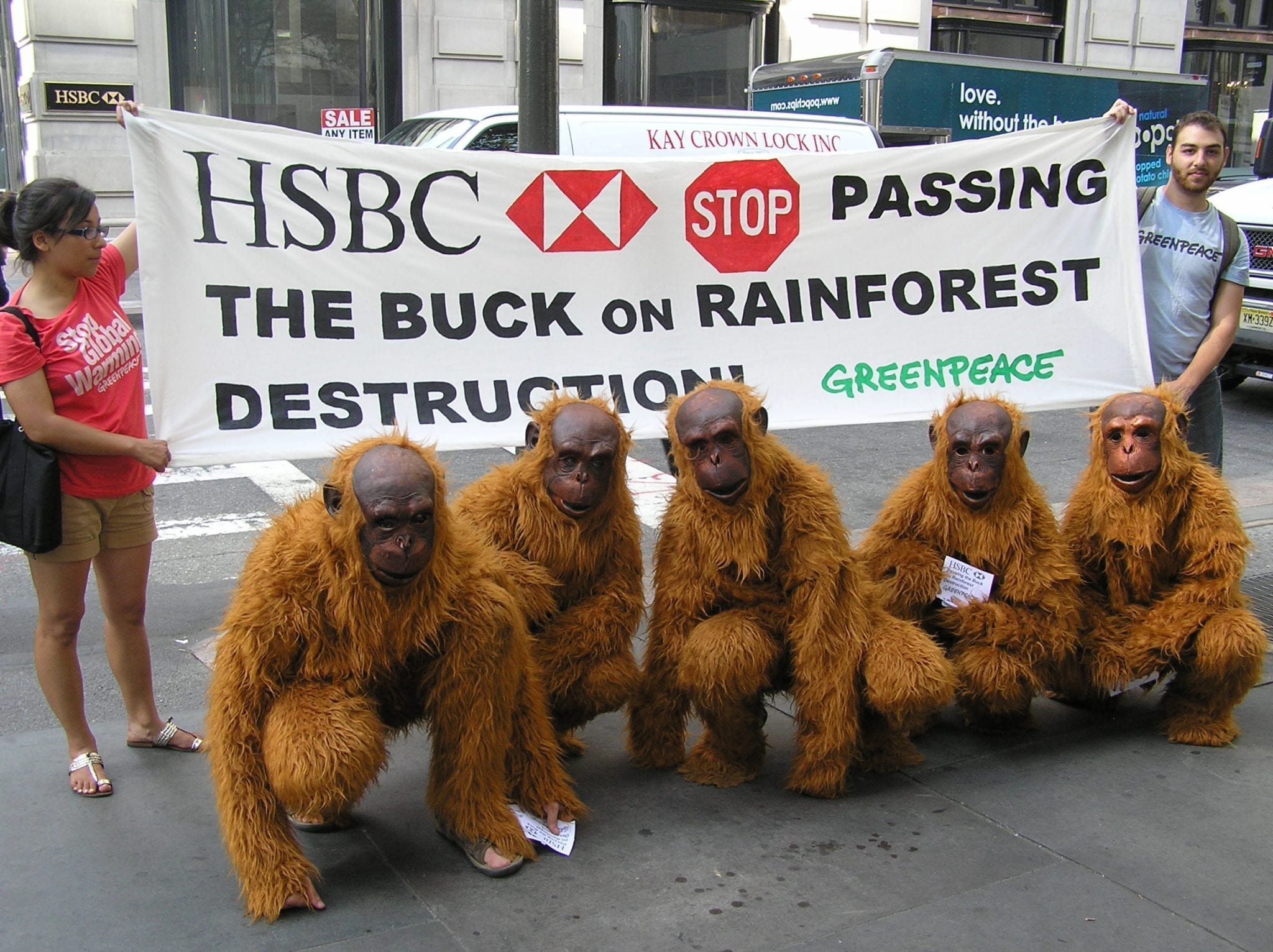
    Greenpeace International launched a new report on Tuesday, January 17, 2017, accusing British HSBC of supporting deforestation. The report stated that British HSBC provided financial services to palm oil companies that are causing rainforest destruction and human rights abuses in Indonesia.

    The report titled “Dirty Bankers: How HSBC is financing forest destruction for palm oil“, claimed that HSBC has been involved in arranging US$16.3 billion of loans and credit facilities to six palm oil firms. In addition, the is also said to have raised US$2 billion bonds for these firms.

    The palm oil companies listed in the report are Malaysian firm IOI; Indonesian Bumitama Agri and Salim Group; Singapore incorporated Goodhope Asia; Hong Kong-based and Singapore-listed Noble Group; and Korea’s Posco Daewoo Corporation.

    Greenpeace argued that HSBC has violated its policies of responsible lending by helping to finance the above-mentioned companies.

    Annisa Rahmawati, Greenpeace Southeast Asia senior campaigner said that although HSBC claimed to be a respectable bank with responsible policies on deforestation, “somehow these fine words get forgotten when it’s time to sign the contracts.”

    Not only HSBC, the report also listed several other banks claimed to be related to case studies in the report, including Japan’s Sumitomo and Tokyo Mitsubishi banks; Singaporean bank DBS; and the Australia and New Zealand Banking Group (ANZ).

    Despite the heavy criticism, the report did acknowledge HSBC as a “relatively progressive” bank that has shown a willingness to engage with criticism, and noted that the bank has a responsibility to set high standards for the rest of the sector.

  • Apple Pay for HSBC Cardholders in Singapore

    Apple Pay for HSBC Cardholders in Singapore

    HSBC Singapore is treating its HSBC Visa and MasterCard credit cardholders with Apple Pay, according to a statement sent on Monday. Customers using iPhone SE, iPhone 6 to higher versions, and Apple Watch can use Apple Pay in stores with Visa payWave or MasterCard contactless payment terminals in Singapore and overseas.

    As a kick off treat, HSBC customers will be given $5 off for every Apple Pay transaction with their HSBC credit cards, with a minimum spend of $10 per transaction. This promo will be on until January 15 next year.

    «Our findings show that awareness of contactless mobile payment is high amongst Singapore consumers (89 percent) and over half indicated interest to try this new payment method. We believe the security, privacy and convenience Apple Pay brings will appeal to all our customers, especially those who are also active users of our digital banking services,» Anurag Mathur, HSBC Singapore head of retail banking and wealth management said.