Tag: iot

  • Softbank, Chunghwa Telecom partner on AI, IoT

    Softbank, Chunghwa Telecom partner on AI, IoT

    Taiwanese incumbent carrier Chunghwa Telecom has signed an MoU with Japan’s Softbank for collaboration on artificial intelligence (AI) and IoT.

    In a statement, the companies said the technological and commercial cooperation aims to develop use cases for future smart cities in Taiwan.

    It will also involve ST Solutions Taiwan Co. Ltd., a wholly owned subsidiary of SoftBank Corp.

    The pair said they plan to leverage their insights and experiences from the collaboration in AI, IoT and related fields.

    The collaboration will initially focus on such areas as global IoT platforms, smart infrastructure, smart agriculture as well as utilization of high-accuracy location data and big data.

    The partnership with Softbank is Chunghwa Telecom’s latest push in IoT.

    In February, the Taiwanese operator inked a deal with Ericsson to use the Swedish vendor’s IoT Accelerator platform to develop IoT services for its enterprise customers.

    Max Chen, president of mobile business group, at Chunghwa Telecom, was quoted as saying in the statement that the partnership with Ericsson will boost its capabilities in machine learning and IoT operations.

    “As Taiwan’s industry is mainly export-driven, Chunghwa Telecom’s IoT innovation drive will help local industries to expand their international IoT business horizon,” Chen said.

  • CTG, Tata Communications form IoT alliance

    CTG, Tata Communications form IoT alliance

    China Telecom Global has entered a collaboration with India-based Tata Communications to launch a global internet of things service for the Chinese market.

    Under the collaboration, the two companies will develop IoT-based services targeting multiple industries, including consumer and industrial electronics, manufacturing, automotive, transport, and logistics.

    China Telecom Global will gain access to the Tata Communications MOVE service, which seeks to leverage the company’s relationships with more than 600 mobile operators worldwide to enable global connectivity for new IoT-enabled devices.

    Meanwhile China Telecom Global will provide Tata with connectivity for Hong Kong, mainland China, and Macau as well as access to the Chinese operator’s 4G network resources.

    For specific vertical industries including automotive, China Telecom Global will also provide Tata with IoT solutions that are compliant with Chinese market requirements and regulatory requirements.

    “We want to grab our share of the rapidly growing Chinese IoT market. China Telecom Global is working closely with Tata Communications to pave the way for innovative and advanced IoT solutions across industries,” China Telecom Global CEO Deng Xiaofeng commented.

    “We’re able to offer our customers the borderless, reliable and affordable network connectivity they need for their different IoT devices. As the volume of connected ‘things’ continues to grow, we are able to give our customers complete visibility and control to make the management of hundreds of thousands of IoT devices easier on a global scale.”

  • Docomo trials fiber manufacturing IoT in Thailand

    Docomo trials fiber manufacturing IoT in Thailand

    NTT Docomo and its Singapore subsidiary NTT Docomo Asia have commenced a trial of an IoT monitoring system to improve the manufacturing performance of a synthetic-fibers factory in Thailand.

    In the trial, Docomo Asia is deploying the IoT Solution Platform to visualize the operational status of production operations in the Thai factory.

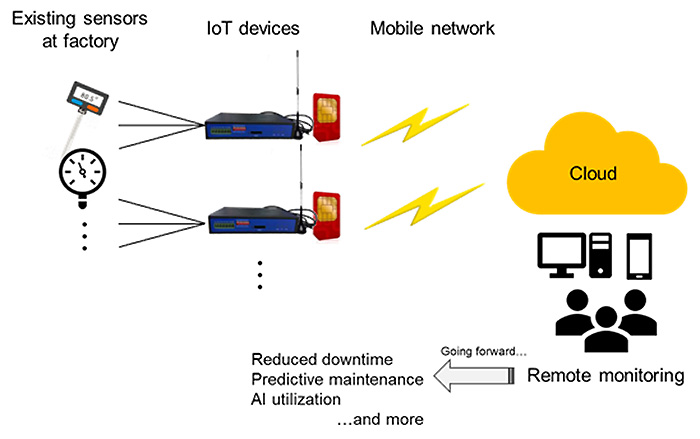
    Docomo said IoT devices equipped with up to 30 different sensors are collecting operational information on the factory floor and then transmitting real-time data to the cloud via a mobile network.

    “Technicians will be able to use PCs, smartphones or tablets to remotely monitor the status of production operations via the platform,” Docomo said in a statement.

    “The IoT Solution Platform enables manufacturers to digitalize their operations and rapidly gather information from factory floors for improved efficiency in production management.”

    It also helps to reduce production downtime by allowing manufacturers to closely monitor the status of their production equipment to detect malfunctions, maintenance needs and so on, the Japanese mobile carrier said.

    NTT Docomo fabric manufacturing IoT trial in Thailand

    Service scheme (Source: NTT Docomo)

    According to Docomo, the platform is already being used by an automotive plastic parts manufacturer and is now being introduced in the textile industry to enable manufacturers to realize more efficient and reliable production operations.

    The trial is part of Docomo’s global IoT initiative launched last July to provide global connectivity, operational support, and consulting to Japanese manufacturers with global IoT operations.

    The trial will be conducted until March 31, and is being conducted in collaboration with Teijin Polyester (Thailand) Limited, a Teijin Frontier subsidiary company that manufactures polyester fibers, filament yarn, chips and more.

    Docomo expects manufacturers of synthetic fibers and other products across Southeast Asia to increasingly adopt the IoT Solution Platform to increase the productivity and quality of their production operations going forward.

  • IOT Asia 2019 : Optimise Business Returns With IOT Applications

    IOT Asia 2019 : Optimise Business Returns With IOT Applications

    Asia’s leading platform for Internet of Things (IoT) returns to drive deeper insights into critical developments in the digital sphere, with new highlights on building value chains for Smart Cities and Industrial IoT. Bringing together a diverse spectrum of participants, IoT Asia 2019 aims to facilitate the application of IoT technologies in business communities. Singapore’s champion for the Smart Nation Initiative Dr. Vivian Balakrishnan, Minister for Foreign Affairs will be in attendance as guest-of-honour to deliver his opening address on 27 March 2019 at 10:30 am.

    Jointly organised by SingEx Exhibitions and the Singapore Industrial Automation Association (SIAA), the 6th edition of IoT Asia 2019 will be held at Hall 1, Singapore EXPO, 27-28 March 2019. It will be co-located with Last Mile Fulfilment Asia 2019, which addresses the agenda of disruptive technologies and their applications in the retail fulfilment and logistics space.

    Riding the wave of IoT transformation

    Set to welcome over 6,000 international attendees, IoT Asia 2019 will showcase more than 100 technology companies, start-ups and emerging IoT players with innovative products and solutions to help businesses improve efficiency and increase bottom-line.

    Furthering the agenda of creating collaborations in the IoT community, SIAA will be signing MOUs with the Singapore-German Chamber of Industry and Commerce (SGC) and the Indonesia IoT Association on March 28 to form strategic alliances that impact innovation adoption. These MOUs will reflect the commitment of the countries in supporting the formation of an IoT-centric ecosystem that taps into the strength of shared networks and expertise.

    “IoT trends and emerging technologies are set to reinvent the landscape by driving digital business innovation for a decade. We recognise that the adoption of IoT presents an

    unparalleled opportunity for us to identify the technologies that will impact businesses in multiple industries. In this context, IoT 2019 plays a key role as an enabler of technology adoption; a matchmaker of quality business leads; and a cultivator of skills development and education,” said Mr. James Boey, Executive Director, Industrial & Urban Solutions, SingEx Exhibitions.

    Mr. Terence Teo, President, Singapore Industrial Automation Association, further commented on the impact of technology innovations: “We are at a higher stage of civilisation where it has been exponentially transformed by accelerated technological development. Undeniably, emerging technologies have helped to grow businesses through greater data- driven insights, and as the industry grows at an unprecedented rate, advanced technologies will be required to make sense of the complex bulk of digital data collected.”

    Discover possibilities on Interchange

    IoT Asia 2019 has evolved into an active ecosystem that connects other business and emerging technology communities for cross-disciplinary collaboration and implementation in multiple industries. Launched at IoT Asia last year, the Interchange team has joined hands with De/Centralize, a Blockchain community, to curate conversations with seasoned technologists that examine the intersection of IoT and DLT (Distributed Ledger Technology).

    Through interesting onsite and digital-streaming formats, Interchange will provide companies with an opportunity to identify the possibilities offered by DLT and blockchain- defined perimeters in their enterprise deployment. To facilitate this engagement and to understand why blockchain is a game changer, Interchange will address the challenges and uncover the potential opportunities for cross-disciplinary collaboration. (For details on the Interchange, please refer to Annex A).

    Trending conference topics

    This year’s conference kicks off with a focus on building value chains with key segments on Artificial Intelligence and Blockchain. IoT 2019 will delve into specific industry sectors such as e-commerce and construction with a focus on key areas of application: 1) Superior infrastructure with enhanced security via Blockchain; 2) Advanced data analytics using Artificial Intelligence 3) Data analytics and 4) Enablers

    The conference programme features a stellar cast of international luminaries such as Saadia MUZAFFAR, Founder, TechGirls and former member of Waterfront Toronto’s Digital Strategy Advisory Panel, Canada; and Martin YATES, Chief Technology Officer, South Asia & Emerging Markets, Dell EMC who will take to the Unplugged Stage for a no-holds barred discussion on the implications of smart cities.

    Tackling the hot topic of IoT security is Prof. YU Chien Siang, Chief Innovation & Trust Officer, Amaris AI; and Oliver Meili, Head of IoT Development & Operations, Bosch Software Innovations, among others, while Anthony Burke, Professor of Architecture & Associate Dean of International & Engagement, Faculty of Design Architecture & Building, University of Technology Sydney, Australia; Joelle Chen, Director, Global Partnerships & Marketing, Intelligent Air Solutions, MANN+HUMMEL Group; and Salim Aslam, IoT Solution Architect, Social Innovation Business, Hitachi Consulting, Singapore will share insights on reimagining and redefining a truly intelligent city.

    AI and cyber terrorism: How to manage risks?

    Navigating the IoT security landscape with new technologies like 5G, blockchain and AI adds to existing challenges faced by governments and industries. We pose questions such as “how will future developments of these technologies take shape”, “what are the key considerations and implications for governments and industries”, and “what are the measures to better address security-breach concerns?”

    Join us for an interactive discussion on “Shake-ups in the emerging IoT security landscape,” on 27 March, 3pm at the Unplugged Stage

    What is the future of the workplace?

    Driven by progress in automation, human jobs will not disappear but rather evolve, renew and become more complex. The labour force will therefore have to acquire new skills. What are the new skills that will be in demand in an AI future? Find out how AI and humans are able to co-exist in the workforce and the types of management frameworks that have to be created to ensure successful collaborations between humans and machines.

    Join our discussion ”Human cognitive capabilities and skills that matter for an AI future

    – Will we have what it takes?” on 27 March, 4pm at the Unplugged Stage.

    Behind the design of Singapore’s first integrated “Smart district” At the forefront of Singapore’s Smart Nation push is the Punggol Digital District (PDD), envisioned to be a vibrant district where cutting-edge technology and social innovation transform the way we work, live, learn and play in the future. The first district in Singapore to adopt an integrated masterplan approach – combining a business park, a university and community facilities – PDD aims to create synergies, enable close integration between industry and academia, as well as foster vibrant and strong communities.

    Housing key growth sectors that abide within IoT such as cyber security, artificial intelligence and data analytics, the district will be an ecosystem of open innovation and a conducive test-bed environment, enabling businesses and the community to thrive in a digital economy.

    To learn more about Singapore’s first Smart district, join us on 27 March, 1:20pm at the Centre Stage. 

    For more information on the conference programmes at IoT Asia 2019 and LMFA 2019, log on to www.internetofthingsasia.com and www.lmfasia.com.

  • SK Telecom using quantum cryptography for 5G security

    SK Telecom using quantum cryptography for 5G security

    South Korean mobile carrier SK Telecom said it will use quantum cryptography technology to ensure security of its 5G mobile networks.

    The mobile carrier said Monday it has completed applying Quantum Random Number Generator (QRNG) technology of ID Quantique (IDQ), to its 5G subscriber authentication center. The move is designed to prevent hacking and ensure quantum-safe security.

    “The subscriber authentication process is the first and essential step in verifying a mobile device user before he/she is granted access to any voice and video data service, SMS, etc,” SK Telecom said in a statement.

    “Security in this process is crucial since the leakage of authentication key value can lead to serious crimes such as eavesdropping and hacking.”

    In February 2018, SK Telecom invested $65 million into IDQ to accelerate development of quantum technologies for the IoT and telecoms markets.

    SKT plans to expand the use of QRNG in its long-term evolution (LTE) networks in April.

    The mobile carrier will also strengthen security further by applying IDQ’s quantum key distribution (QKD) technology to its 5G and LTE networks between Seoul and Daejeon – the area which has highest mobile data traffic in the country- next month.

    QKD provides cryptographic security based on the laws of quantum mechanics. It enables two parties to produce a shared random secret key known only to them, which can then be used to encrypt and decrypt messages, the mobile carrier noted.

    “As security emerges as one of the most important issues in the 5G era, SK Telecom is determined to provide the most secure 5G network and focus on expanding the ecosystem by developing quantum cryptography technologies,” SK Telecom CTO Park Jin-hyo said.

    SKT will further enhance the safety and security of its mobile networks by expanding the application of quantum cryptography technologies by stages, Park added.

  • Convenience drives Chinese smart-home market

    Convenience drives Chinese smart-home market

    New research from market intelligence agency Mintel has suggested that convenience will drive the future of the Chinese smart-home market. However, affordability is the biggest barrier to purchasing, in an environment where today’s Chinese consumers are growing increasingly familiar with smart home devices. According to Mintel, as many as 68 per cent of urban Chinese consumers who have purchased or are interested in smart-home devices say that convenience is a primary reason for their interest. Meanwhile, 60 per cent attribute their interest in smart-home devices to trying new technology and half because smart home devices make them feel more relaxed at home.

    “Chinese consumers are now increasingly knowledgeable about how smart-home appliances can help to simplify daily lives,” said Mintel China research analyst Kaye Huang. “Convenience as well as an interest in trying new technology are big reasons for Chinese consumers to purchase smart-home devices. Parents are showing more interest in smart-home devices than those without children; which is likely to be attributed to how the devices can help parents save time and effort. On the flip side, price, more so than privacy, is what is keeping Chinese consumers from purchasing these devices. This indicates that companies in the smart-home market need to put more effort into communicating why these products are value for money.”

    Meanwhile, Mintel research reveals that automatic adjustment to environmental changes is a big opportunity for players in the smart home devices market; more than half of urban Chinese consumers think that this function is a necessity.

    “What will stand out in the smart-home market is the ‘automatic adjustment of parameters’ which enables smart-home devices to automatically respond to environmental changes, such as temperature and humidity. Today’s Chinese consumers have higher expectations on their living conditions and automation is an important part of making the living environment ‘smarter’,” said Huang.

    “Voice control has been a popular area of development in recent years especially since the industry believes that it could be the next generation of user interaction,” continued Huang. “Yet, our research finds that voice control, while widely-known, is a less-used smart home function. While playing music and asking for general information are two main functions that Chinese consumers are using for voice control, in reality this only counts for a handful of consumers, suggesting consumers’ habit of using voice control is far from being firmly established. In the future, brands can look at rolling out strategies and initiatives to instil the habit of using voice control among consumers in China.”

  • How technology shape the future of retail in India

    How technology shape the future of retail in India

    The Indian Retail Industry is considered one of the fastest growing industries in the world and technology has emerged as a helping hand to the industry. The world has seen a transition in retail planning –with the industry going from being product-centric to being customer-centric – and retailers are leveraging technologies to reach the modern shoppers.

    Over time, retail technology has transcended from an aspiration to an expectation and has wedged itself securely between consumer and experience to create an everyday interface. While it has definitely made life easier for consumers, retailers in India have spent a better part of the last decade on their heels, reacting to profound changes throughout the sectors of the industry.

    Retailers today are not fighting with retailers anymore; instead they’re fighting with different technological interventions in order to be the most competitive in the world. With growing competition, it has become extremely vital for retailers to innovate continuously and implement cutting-edge technologies to fulfil today’s demanding customers’ need.

    In order to stay relevant in a highly competitive market, every retailer needs to stay on top of technological advances and also learn how to exploit these technical innovations to forward their business goals.

    Over the past few years, a number of technology trends have evolved and dramatically altered the retail industry. The emergence and the transformational growth of the new economy has unleashed powerful forces which are eventually and successfully reshaping the retail industry at a transformational speed. In order to succeed, today’s retailers have to offer a seamless shopping experience across all channels – and should not lose track of their customers.

    Today, the entire retail ecosystem has smartened with technology. There are so many things one can experiment with if a retailer uses technology, for example: smart displays, in-store services, smart shelves, home delivery, brand optimization options, supply chain optimization, logistics automation to name just a few.

    Then there are wallets, point of sale data, social networking – where you can home in on complaints as well as get appreciated. All this is driven by the retailer into applications where the consumer sees, feels, asks the retailer questions and eventually buys the product.

    Giant players of the retail industry have accepted technology with arms wide open to captivate and secure customers and have made optimum use of technology to optimize their business. Whereas small retailers, most of them belonging to the unorganized sector, are yet to adopt technology to be adept with the changes and technological innovations taking place in the retail market. If the entire unorganized retail trade, which is 80 percent of the entire retail trade, adopts technology, the retail industry will usher in a new era providing a much-needed thrust to the Indian economy. Technology is the knight on the white horse that will ride the retail market towards prosperity and triumph.

    What took the year 2018 by storm is phrase ‘Experiential Retail’. It became the code of the moment; delivered through convenient accessibility, in-store features, customer engagement through ATL and BTL animation or out-of-the-box blends of the physical and digital shopping universe.

    Some other trends that impacted the retail industry in a big way in 2018 are:

    IoT (Internet of Things)

    IoT has big implications for in-store marketing efforts of retailers and brands. Connected devices aren’t just changing the way consumers live, work and play – they’re dramatically reshaping the entire industry. The IoT movement offers retailers opportunities in three critical areas: customer experience, supply chain and new channels-revenue streams.

    Leading retailers across the globe are already investing heavily in IoT. They are beginning to transform their business practices and recognize that, in time, IoT will touch nearly every area of retail operations and customer engagement. In the IoT of today, everything has the potential of coming under the IOT umbrella. From the lighting system in the store, the PoS (Point of Sales) system, to the electric switches and even garbage disposal units…IOT is at the heart of retail transformation. It connects people, machines, items, and services to streamline the flow of information, enable real-time decisions, and heighten consumer experiences.

    While the IoT may still seem like science fiction, it is becoming reality faster than most of us can comprehend. Retailers that hesitate to develop and execute an IoT strategy will open the door for competitors – old and new alike – to swoop in and capture early IOT mind and market share.

    SMAC (Social, Mobile, Analytics & Cloud)

    The relationship between consumers and enterprises has never been as intrigued as in the 21st century. As digital technologies augmented by SMAC are creating new touch points for enterprises to awe their consumers, there has been an evolution in consumer experiences. Social, mobile, analytics and cloud or SMAC are the nexus of forces, which are reshaping how consumers experience a brand.

    SMAC are currently driving business innovation. It creates an ecosystem that allows a business to improve its operations and get closer to the customer with minimal overhead and maximum reach. Digital is now an essential part of the whole shopping experience and the entire business of retail, inside as well as outside the store. You don’t need to leave a physical store to get your digital fix. Instead, retailers are leveraging a wide array of in-store technologies meant to draw consumers in the door. As the impact continues to increase, the way retailers think of digital and invest in it, besides addressing the digital wants and needs of their customers is changing dramatically.

    Big Data

    Today, retailers are constantly finding innovative ways to draw insights from the ever-increasing amount of structured and unstructured information available about their customers’ behaviour.

    Data gathering, and analytics are playing a key role in evolving business models in retail. Usage of data and analytics to better understand consumers in the form of branding, product management, leveraging loyalty card information to tracking customer buying behaviour and making better pricing decisions are the key factors. Collecting and leveraging customer information to provide personalized recommendations is the norm going forward.

    Retailers – large and small – have been reaping the benefits of analysing structured data for years but are only just starting to get to grips with unstructured data. There is undoubtedly still a great deal of untapped potential in social media, customer feedback comments, video footage, recorded telephone conversations and locational GPS data. Great benefits have come to those who put it to best work, and the best solutions have more likely come from innovative thinking and approaches to analytics, rather than those who simply try to collect as much data as possible and then see what it does.

    Omnichannel Retail Adaptation

    Omnichannel is a term that extends and supersedes multi-channel. Multi-channel (or cross-channel) refers to delivering content and considering consumer experience on more than one channel. Omnichannel is about understanding and optimizing for the entire journey across all channels.

    Omnichannel today is a necessity. Brick-and-mortar retailers have been left with no option but to add online channel to their offline operations in a bid to reach as many customers as possible, and quickly. Omnichannel retailing creates benefits for consumers and opportunities for retailers. For consumers, it empowers connected consumers by making it easier for them to access information and compare product details; by increasing choice; and by increasing convenience and the range of options for shopping. For retailers Omnichannel creates opportunities, ranging from potential extension of sales and increasing brand awareness and loyalty.

    A poorly executed Omnichannel or personalization strategy, however, can do more harm than good. Handling one or two channels discretely but satisfying expectations is better than disappointing your consumers when you fail to deliver added value — or worse still, confuse or frustrate — while tackling all channels. Personalization can be even more dangerous because of very real risks that your brand can be given the dreaded creepy label.

    To be successful at delivering a personalized experience in Omnichannel marketplace, adaptive content is a requirement. It is content that is designed for both personalization and delivery across many channels.


  • KT Telecop warns people to secure homes for Seollal

    KT Telecop warns people to secure homes for Seollal

    KT Telecop, the security arm under mobile carrier KT, has warned people to be careful leaving their homes empty over the Lunar New Year period. On Tuesday, KT Telecop said most incidents occur during the first day of the holiday period, according to three years of big data it has collected during the Lunar New Year and Chuseok holidays.

    Theft is the most commonly reported issue, accounting for 59 percent of incidents, followed by property damage at 24 percent and fire at 17 percent.

    A spokesperson from KT said travelling families should keep a tight watch on their front doors and windows before leaving the house to prevent crime.

    For those intending to leave the house empty for a long time, KT suggests keeping some lights on at all times so it appears occupied.

  • Tech sector forecast to see slower growth ahead

    Tech sector forecast to see slower growth ahead

    Hong Leong Investment Bank (HLIB) Research anticipates slower growth in the technology sector due to downside risks in the macro environment coupled with waning data trends. However, it expects automotive and Internet of Things (IoT) to take the forefront while smartphone takes a backseat. The research house said in a note that for the first 11 months of 2018 (11M18) global semiconductor sales were outstanding after growing 16%, thanks to the explosive growth of memory followed by discrete and optoelectronics.

    As for 2019, consensus is projecting 3% growth for that segment.

    “However, we see further downside to this projection considering the US-China trade conflict, stagnant smartphone demand, industry-wide inventory adjustment and weaker memory prices,” HLIB said.

    The automotive sector is expected to be the major growth driver for global technology industry supported by its development towards full autonomy. The equipment industry remained solid with billings increasing 11% in 11M18, supported by heavy investments in all regions except Taiwan.

    “However, year-on-year growth has been on a snail’s pace for the past five months, translating into a significant deceleration from past 20 consecutive months’ double-digit growth rates,” the research house explained.

    According to SEMI, this reflected the near-term weakening demand for personal computers, mobile phones and servers as well as pulled back investments in response to recent softening of memory prices.

    “This is in line with its expectation of expansion in capital spending not outpacing sales growth on the long run and potentially lead to industry-wide overcapacity,” said HLIB.

    The research house also highlighted that local semiconductor players may experience strong demand to support the disrupted global supply chain should the procurement levy and technology transfer restriction from US take effect.

    Note that China sources substantial fabrication equipment from US players for its expansionary semiconductor industry towards the “Make in China 2025” vision. Vice versa, US fabless semiconductor players outsource their product fabrication and some are produced in China.

    With strong greenback, HLIB expects tech firms to be marginally boosted thanks to their US dollar-denominated sales while partly offset by the US dollar cost items.

    It estimates the ringgit to be weaker in FY19 with at full-year average of RM4.20 against US dollar.

    Nonetheless, pricier commodities, compounded by stronger US dollar projection, will exert pressures on margins for traditional packaging.

    Maintaining a “neutral” call on the sector, HLIB displayed a cautious stance in the absence of near-term catalyst as it expects global sales and capital spending to grow moderately.

    As for stock picks, it gave Frontken a “buy” call at a target price of RM1.05 on the back of bullish global semiconductor market outlook, robust fab investment, leading edge technology, oil and gas recovery and strong balance sheet.

  • Signify launches Interact IoT platform in India

    Signify launches Interact IoT platform in India

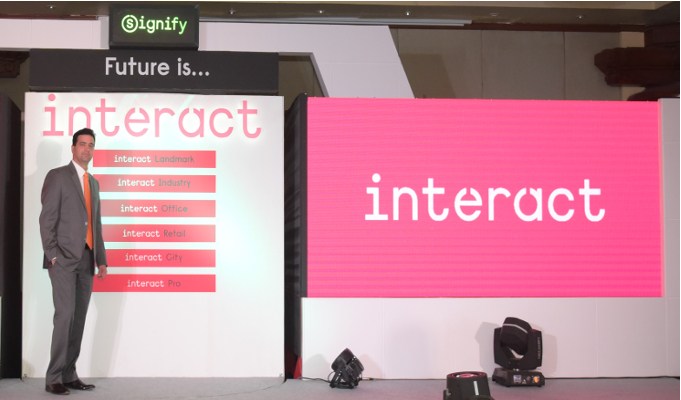
    Signify (formerly known as Philips Lighting), the world leader in lighting, has launched its new Internet of Things (IoT) platform, called Interact in India, which will enable its professional customers to unlock the full potential of connected lighting for the IoT.

    The platform delivers new insights to help customers drive operational efficiencies and take more effective decisions. It also supports the company’s strategy to deliver new data-enabled services as value expands from lighting products and systems to services.

    Signify has already installed 29 million connected light points worldwide and plans for every new LED product it produces to be connectable by 2020. This growing number of connected light points, sensors and devices, as well as systems, can collect large volumes of data for which Interact was designed to handle. The highly secure, scalable cloud-based Interact platform uses sophisticated and modern data management and data processing capabilities, including machine learning, to bring sense to all manner of data – creating data-enabled services for customers that will deliver benefits beyond illumination. It also offers a growing suite of licensed open application program interfaces (APIs) which will foster innovation from third-party developers, development partners and customers, enabling various data enabled services to be developed.

    A typical example of such a service is occupancy data from different buildings, combined and analyzed to help managers to understand and predict how people use office space. Such insights can help deliver savings by optimizing the use of existing office space and support better designed, more efficient buildings.

    In addition, data from authorized third-parties can also be analyzed by Interact. For example, for a municipal authority, news articles and social media posts, reacting to a new lighting installation on a bridge, can be analyzed and data sent to a social impact app dashboard that summarizes the public sentiment.

    Launching the platform in India, Sumit Padmakar Joshi, Vice Chairman and Managing Director of Signify’s operations in India said, “First, we led the way in energy efficient LED lighting, then in connecting lighting to deliver operational benefits for our customers. Now that light points are smart enough to collect data on their performance and the environment around them, we are tapping into that intelligence. By analyzing the data from our connected lights, devices and systems, our goal is to create safer cities, energy efficient buildings and industries and smarter retail stores in the country. We are confident that this platform will deliver immense value for our professional lighting customers in India”.

    Interact connected lighting systems

    These connected lighting systems, offering a unified user experience, feature applications that address industry-specific verticals. Available now are:

    – Interact Office – enables you to turn your office into a smart sustainable workspace with software that allows you to increase building efficiency and employee productivity.

    – Interact City – helps improve street lighting, safety, reduce energy consumption, improve efficiency and support your sustainability goals and beautify the urban landscape across roads.

    – Interact Retail – enables customers to group, zone and schedule connected lighting to create stopping power in stores. It also supports in-store location-based marketing services to increase shopper engagement and indoor navigation to improve staff productivity.

    – Interact Landmark – aids in managing and triggering light shows with dynamic architectural lighting to help increase tourism, regenerate downtown areas, and stimulate commerce.

    – Interact Sports – aids in monitoring, managing and coordinating across all lighting infrastructure from a single dashboard from pitch lighting, entertainment light shows, hospitality areas and exterior architectural lighting.

    – Interact Pro – an intuitive cloud-based software for small and medium enterprises that automates lighting and allows management via the Interact Pro dashboard.

    Signify became the new company name of Philips Lighting as of May 16, 2018. The legal name of Signify will be adapted in India in the beginning of 2019.

  • Xiaomi India to foray into appliances, white goods space

    Xiaomi India to foray into appliances, white goods space

    Xiaomi is all set to convert its India arm into an end-to-end consumer durables company. According to a report, Xiaomi officials are currently identifying potential categories including air-conditioners, washing machines, refrigerators, laptops and small appliances like vacuum cleaners and water purifiers for the Indian market. All the products will be smart appliances based on Internet of Things (IoT) or which can connect to the internet and other devices, and operated remotely.

    Xiaomi entered the Indian television market in February this year with products 30-50 percent cheaper than the top three brands — Samsung, LG and Sony. It eventually expanded TV sales to offline stores and started assembling them in India in partnership with contract manufacturer Dixon. It recently announced having shipped more than a million televisions into the Indian market.

    The company will follow the same model for appliances. The products will be priced aggressively in line with its announced strategy of keeping just 5 percent profit margin for itself and start local assembly after gaining some scale to take advantage of Make in India duty benefits, according to the report.

  • JD.com and Intel launch new research lab for smart retail

    JD.com and Intel launch new research lab for smart retail

    Chinese online retail platform JD has launched a joint lab with Intel that will explore the use of IoT in smart retail solutions. The Digitised Retail Joint Lab will develop next-generation vending machines, media and advertising solutions, and technologies to be used in the stores of the future, based on Intel architecture.

    Scientists at the new lab have so far integrated Intel’s technologies with JD’s computer vision algorithms to analyse customer traffic and in-store purchasing habits, working on solutions designed to help store owners provide a more personalised and convenient experience to their customers.

    Zhi Weng, VP of JD and head of JD Big Data Platform said: “This lab will combine our collective strengths to develop cutting-edge solutions to bring the precision of online shopping to offline players. We look forward to expanding our cooperation with Intel to deliver a best-in-class, personalised shopping experience wherever consumers shop.”

    Wei Chen, VP of Intel & GM of Intel IOTG China added: “As China’s most influential retailer and a leader in data-driven offline retail innovation, JD is an important partner for us to continue to develop a wide range of use cases for our latest technology developments. We are happy to take our partnership to the next level.”

    The new lab adds to JD’s “Retail as a Service” conceptual framework in a bid to share its technology and infrastructure with other retailers and industries. Other efforts include a suite of technology upgrades for brick-and-mortar store owners, including smart shelving, smart price tags, checkout solutions, and more.

  • Foldable phone coming early 2019

    Foldable phone coming early 2019

    Samsung Electronics will make its foldable smartphone available by the first half of 2019, with initial shipments estimated at least at 1 million units, according to Koh Dong-jin, president of the IT and Mobile Communications division at the company.

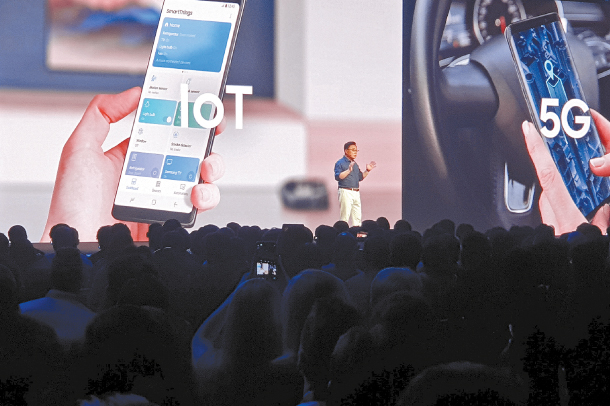
    The comments were made Thursday in San Francisco on the day two of the Samsung Developer Conference, where he discussed the rollout of the new flagship phone with considerable confidence.

    “We will definitely introduce the phone before the end of the first quarter next year, although I cannot pin down the date at this moment,” he said. “And we will maintain the line each year.”

    His comments indicate that Samsung will be adding foldables to its existing two flagship lines, the Galaxy S – released most recently in February – and the Galaxy Note – released in the fall. But the foldables will be released in a limited number of countries, including Korea and the United States. Koh added that Samsung has yet to confirm the name of the lineup.

    Given Samsung’s status as the No.1 smartphone vendor in the world and the fact that its flagship models sell at least 1 million units, Samsung is gearing up to churn out over 1 million foldables from the outset “if the market reaction is positive,” he added.

    Koh’s meeting came a day after Samsung introduced the foldable phone. The company demonstrated what it calls the “Infinity Flex Display,” which measures 7.3 inches diagonally when the phone is open like a book. The screen is slightly larger than the largest smartphone screen and slightly smaller than those of a conventional tablet PCs.

    The company has so far declined to provide additional specifications, including thickness, weight and the battery power.

    “We showcased the display to show off Samsung having reached the stage of commercializing the device,” he said. “We have overcome several barriers, such as making the central hinge through the screen invisible. What remains to be done is working on the user interface to make it more concrete.”

    He went on to say that Samsung distributed the foldable device to developers before the event so that they could help in designing the best-possible user experience.

    Two months earlier, he met with Google CEO Sundai Pichai to launch a task force for foldable user experience.

    Beginning with foldables, Samsung is getting ready to revolutionize smartphone display form factors – to rollables as well as stretchables.

    “As much as foldables will have a huge technological impact, so will rollables and stretchables. That’s why we are studying them,” he said. “But the entire workforce is devoted to foldables at present.”

    Samsung has been grappling with declining sales and revenue from smartphone business. Operating profit for the division during the third quarter fell 29.8 percent year on year to 2.22 trillion won ($1.96 billion), while revenue slid 10 percent to 24.91 trillion won over the same period.

    Chinese rookie Huawei is rapidly catching up.

    Koh mentioned 5G connectivity, artificial intelligence and the Internet of Things as breakthrough technologies that will help Samsung compete.

    “While we have been maintaining leadership with 4G over the past decade, 5G, AI, IoT and augmented reality will offer a new opportunity in 2019.”

    He added that foldables will achieve another leap when such technologies become reality and are combined with the device.

    “Next year will be the 10th anniversary of Galaxy smartphones, and it’s very meaningful to me,” he said. “We will be coming up with an impressive Galaxy S10 as well.”

  • Retailers Transforming Distribution, Expanding Online and Turning to the Cloud as They Revolutionize Customer Experience

    Retailers Transforming Distribution, Expanding Online and Turning to the Cloud as They Revolutionize Customer Experience

    As retailers race to deliver more unique and personalized customer experiences, the use of Cloud, IoT and Big Data will accelerate in stores, online channels and distribution centers. However, one quarter of retailers still lag in the process of adopting new technologies and integrating them across operations to present a more integrated customer experience, according to a new report from Vertiv.

    For the report, participants included executives from 50 of the world’s largest retailers, with a combined annual revenue of $953 billion USD in 2017. The study, “Into Uncharted Territory: Retail Transformation and its Impact on Digital Infrastructure”, co-sponsored by Vertiv and DatacenterDynamics, revealed a heightened focus on online retail, as businesses transform their digital resources and capabilities to address changes in customer behavior. Over the next two years, the amount of data center space dedicated to online retail – both on-premise and colocation – is expected to increase by 20 percent, while cloud hosting would increase by 33 percent to support store applications.

    An important part of the retail digital evolution includes a massive transformation of distribution centers. The research suggests the number of distribution centers and warehouses will increase by about 26 percent over the next two years as retail companies increasingly realign operations to meet consumer demand for online purchasing. The amount of data center space dedicated to distribution/logistics is expected to increase by 10 percent and the use of cloud hosting to support distribution will increase by 87 percent.

    “It’s no secret that online retail is driving significant IT investment for retailers. However, as this study makes clear, digital transformation in the retail space is about more than e-commerce,” said Lucas Beran, analyst, data center infrastructure at IHS Markit. “Today’s retailers are striving to improve the IT systems in their stores and distribution centers as they pursue impactful customer experiences across all interactions with their brand. More business-critical online, distribution and in-store environments require new approaches to physical infrastructure to increase IT reliability, speed time to market, hold down costs and reduce management complexity,” Beran added.

    The survey confirms that more computing power is being moved into stores to support edge computing types of applications providing greater customer immediacy and influencing them at the point of use.

    “Retailers are going to move more IT footprint into the stores, to communicate with customers and to influence them closer to the point of decision,” said Martin Olsen, vice president, global edge and integrated solutions at Vertiv. “Our forecast for the next couple of years shows about two dollars going into stores and distribution for every dollar spent in the core data center. And much of that data center investment is being made to support online and stores.”

    To support their transformation, retailers are adopting new physical infrastructure options that provide higher reliability and are easy and fast to deploy. These technologies are based on standardized, modular designs that are scalable with capacity demand and future-proofed for next-generation technological advances.


  • China Mobile Hong Kong names IoT startup competition finalists

    China Mobile Hong Kong names IoT startup competition finalists

    China Mobile Hong Kong has announced the four finalists who will represent Hong Kong in the semi-finals of the China Mobile OneNET Start-ups Marathon Competition later this month.

    Bravolinear Tech, IOTANET, Peacify and Stoneroad IOT will compete with IoT experts from across mainland China during the semi-final competition in Chongqing.

    Bravolinear Tech has developed a narrowband IoT (NB-IoT) based intelligent sensor system for elderly care. IOTANET developed a class consortium blockchain for smart community and device sharing. Peacify is working on a wearable device for monitoring the health of newborn babies. Stoneroad is applying IoT technology to monitor the health of trees on public property.

    The four companies won the first Hong Kong version of the marathon competition, which parent company China Mobile Limited has held in China for the past two years.

    China Mobile Hong Kong worked with HKSTP, the Communications Association of Hong Kong (CAHK) and the Hong Kong Wireless Technology Industry Association (WTIA) to organise the event.

    The startups competed with six other hand-picked teams of entrepreneurs. The teams were provided with free training sessions and technical support before the finals of the Hong Kong contest, which took place last month.

    Each of the four winners will receive a HK$50,000 seed fund as well as being invited to participate in the semi-final competition.

    The Hong Kong version of the competition was designed to align with the HKSAR government’s Smart City Blueprint. It focused on the six key themes of smart transportation, smart living, smart environment, smart city, smart government, and smart finance.