Tag: lifestyle

  • Global luxury goods sales drop: Bain

    Global luxury goods sales drop: Bain

    New data from Bain & Company shows global luxury goods sales will struggle to maintain growth, as the US-Sino trade war and other geopolitical events impact on consumer confidence.

    In June, Bain said the personal luxury goods market was “on a tear” this year and would grow by between 6 per cent and 8 per cent at constant exchange rates to reach €276-281 billion. It said the market could reach €390 billion globally in sales by 2025.

    But now, Bain has released a more tepid projection of €260 billion and a growth rate of 5 per cent this year.

    It has pared back its 2025 projection of personal luxury goods sales to €320-365 billion, slashing €35 to €70 billion off its forecast in just five months.

    And it cautioned that even this figure may be under threat saying “socio-political issues, commercial policies, and potential short-term soft recessions could make this road to growth a bumpy one in the short term”.

    The Bain & Company Luxury Study was released in Milan in collaboration with Fondazione Altagamma, the Italian luxury goods manufacturers’ industry foundation.

    In June, Bain said Mainland China is expected to account for the lion’s share of growth this year. “We forecast this market to grow by 20-22 per cent … Brands are learning how to cater to local consumers, often young and heavily influenced by social media.”

    China kept close to its projections, rising 20 per cent, albeit with the year still not over.

    “Chinese consumers are leading the positive growth trend around the world. Between 2015 and this year, their purchases in Mainland China contributed twice as much growth as their spending abroad. Their share of global spending has continued to rise (now estimated at 33 per cent of global luxury spend, up from 32 per cent in last year), while the share of Mainland China has also risen to 9 per cent (up from 8 per cent in last year). In Mainland China, luxury sales grew 18 per cent at current exchange rates to €23 billion (20 per cent at constant exchange rates), driven by rising demand rather than by price increases,” the report said.

    Claudia D’Arpizio, a Bain partner and lead author of the study, said luxury purchases in Japan softened slightly this year, pushing brands to find new solutions to bring consumers back to stores. However, retail sales still grew at 3 per cent at current exchange rates to €22 billion. “Increased consumption from tourists in Japan is prompting brands to rethink their distribution models.”

    Across the rest of Asia retail sales grew 7 per cent at current exchange rates to €39 billion, due to dynamic growth in South Korea, driven by strong local consumption. Brisk growth in other Asian countries – Singapore, Thailand and Taiwan – also contributed while Hong Kong and Macau benefitted from Chinese purchases.

    Europe lagged in 2018 due to a strong Euro that impacted tourists’ purchasing power. Local consumption was positive overall, despite mixed country performance, helping to boost retail sales 1 per cent at current exchange rates to €84 billion.

    The Americas grew 5 per cent at current exchange rates to €80 billion. “A positive US economy boosted disposable income and overall luxury spending from locals, even as brands remained wary of continued economic prosperity,” the report said. “However, the strong dollar impacted tourists’ spending from Asia and Latin America. Canada and Mexico were strong players in the region, while political uncertainties derailed Brazil’s performance.”

    In other areas, there was nil growth, holding at €12 billion, mainly due to stagnation in Middle East brought on by a recent government spending restriction.

    Luxury online

    The retail channel grew 4 per cent this year, with three-quarters coming from like-for-like sales growth. Wholesale channels grew at only 1 per cent, brought down by high-end department stores still trying to recover, and a slow-down among specialty stores facing tough competition from online.

    Luxury shopping online continued to accelerate this year compared with physical channels, growing 22 per cent versus 2017 to €27 billion.  The US market made up close to half of online sales – 44 per cent– but Asia is emerging as the new growth engine for luxury online, slightly ahead of Europe. Accessories remained the top category sold online, ahead of apparel; beauty and hard luxury (jewellery and watches) were both on the rise.

    Brands are catching up to other online players, comprising 31 per cent of sales, compared to e-tailers (39 per cent) and retailers (30 per cent).

    “New technologies are at once enriching the online and mobile shopping experiences, while potentially putting role of physical channels at risk,” said Federica Levato, a Bain partner and co-author of the study.

    “The luxury store-opening path is slowing down, leading to channel consolidation in the future. Brands must therefore rethink their physical channels and evolve their role from point-of-sale to point-of-touch, and use new technology to enhance customers’ in-store experiences.”

    Luxury consumers getting younger

    The report concluded that younger generations are becoming increasingly more important luxury brands. This year, Generations Y and Z contributed 100 per cent of the total luxury market growth, compared with 85 per cent last year. Bain predicts Generation Z, which today comprises just 2 per cent of the market will account for 10 per cent of it in 2025.
  • Korean lifestyle brand Mumuso enters Indian market

    Korean lifestyle brand Mumuso enters Indian market

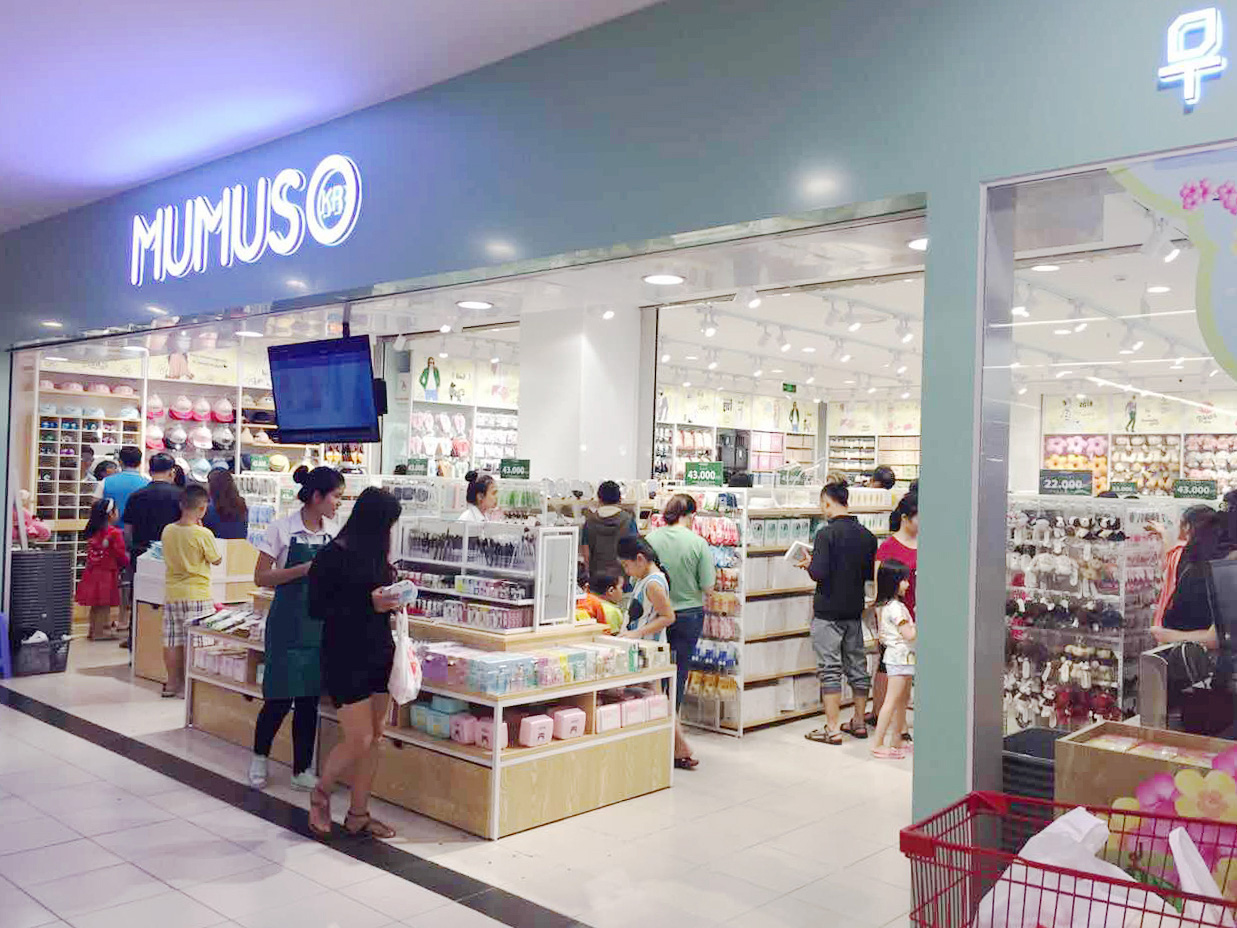
    East Asia’s affordable lifestyle brand Mumuso has announced its expansion plans in Kolkata while opening its first store. Mumuso is eyeing the Indian market aggressively with new stores in different parts of the country, a senior executive said.

    With a strong presence in over 30 countries across the world, the Korean lifestyle brand Mumuso has entered into the Indian Market and plans to open around 300+ stores by 2022 with an average investment of Rs 80 lakh to Rs 1.2 crore which will be spent towards setting up these company-owned and franchise stores. The brand is planning to open outlets pan India with its market reach in cities likes Kolkata, Hyderabad, Siliguri, Bangalore, Delhi, Mumbai, Surat, Durgapur, Chennai and so on.

    Mumuso India — the Indian entity of Mumuso —whose offerings include accessories, stationery, small electronics and lifestyle items, sources these mostly from South Asian nations such as Malaysia, Singapore, China, Indonesia and Korea.

    India has seen a sharp rise in the demand for lifestyle products in the recent years. Mumuso has product categories from Health and Beauty, Fashion Home Accessories to Apparel, Accessories, Digital Products and more. The products offered by the brand are not only beautiful, functional, high-quality and affordable but also provides relaxing and pleasant shopping experience to the customer.

    Speaking on the occasion, Raunak Agarwal, Managing Director, Mumuso India said, “Our expansion strategy is to set up 300+ outlets all over India along with entering the e-commerce market as online shopping has seen a big boost in India in recent years. We are also looking to source from Indian companies specially apparels and small leather products. The company will look to have 300-odd stores by mid-2022. India, being a fast emerging market for retail industry, we are expecting an escalated growth in a short span of time. Indian market has a big potential, where we believe our creative range of products will enhance the rich experience of customers since it’s an international brand with high quality and valued pricing.”

    He added, “There has been a high demand for the trendy and affordable products as far as lifestyle is concerned. People not only look forward to quality and style but also affordability. With Mumuso coming into the picture, people won’t have to travel to different stores for their needs, but just walk into our showroom and get their products. Mumuso brand always adheres to the principle of selling products with reliable quality and affordable price, strictly observes to the borderline of high quality, strives to improve the upper limit of taste and price ratio and provides well-designed products, continuously optimizes the supply chain service system to reduce the cost, creating relaxing and light-hearted shopping experiences for consumers.”

  • Thailand: fourth-most-profitable global tourism destination

    Thailand: fourth-most-profitable global tourism destination

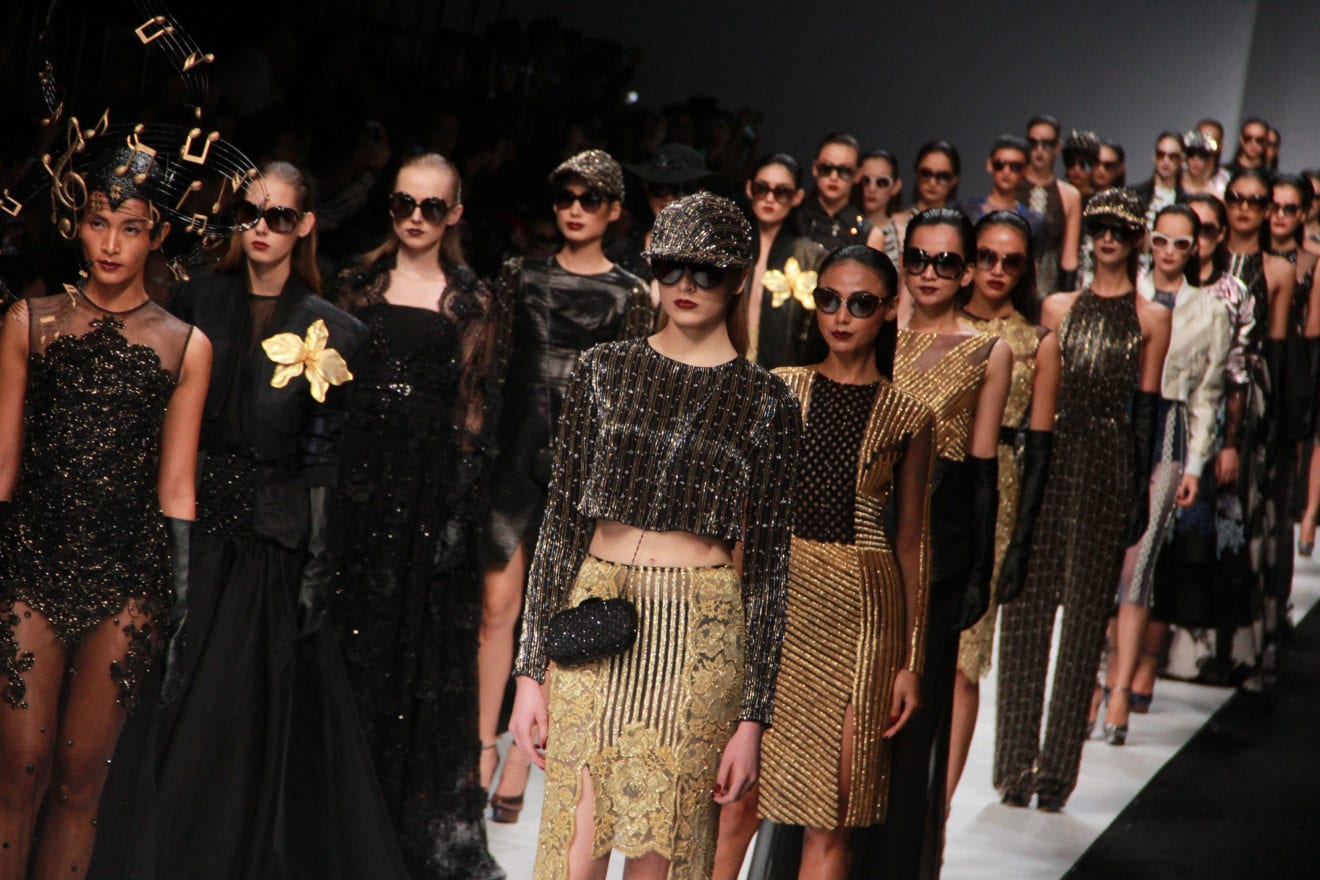
    According to the UN World Tourism Organization, Thailand outranks every other nation in Asia when it comes to tourism spend. Last year, it collected $57 billion in international tourism receipts, nearly doubling Macao ($36 billion), Japan ($34 billion), Hong Kong ($33 billion), and China ($33 billion).

    Globally, the only countries that out-earn Thailand in terms of tourism dollars are France ($61 billion), Spain ($68 billion), and the United States—which handily takes the gold medal, at $211 billion.

    It all comes down to volume. Foreign arrivals could hit 40 million next year, which is more than half the country’s population.

    “In Thailand, you’ve got something for everybody,” says Rebecca Mazzaro, a specialist for bespoke outfitter ATJ. “From the private island with the private villa to amazing street food meals that only cost a couple bucks, it has a diversity and variety that exists in few other markets. It’s no surprise lots of people are going—and spending,” she says.
    A Coming Luxury Boom

    Though gaps in the WTO’s data make it difficult to ascertain the per-visitor spend in each of these countries, given recent and forthcoming developments, that number is likely to be rising.

    “There’s no question that historically Bangkok—and Thailand in general—has always been perceived as a value destination,” says John Blanco, general manager of the forthcoming five-star Capella Bangkok. “But there has been a real effort to shift that perception.”

    Mastercard’s annual Global Destination Cities Index recently ranked Bangkok as the most-visited city in 2017 for the third year in a row.

    The study, based on undisclosed public data sources, rather than cardholder transactions, indicates that travelers shell out $173 for a day in the Thai capital, compared to $537 in Dubai or $286 in Singapore.

    This year, it forecasts travelers will spend an additional 14 percent more.

    By next year, the city will have gained even more opportunities to spend, such as superlative new resorts from Four Seasons, Rosewood, Mandarin Oriental, and Waldorf Astoria, plus a $1.6 billion Bal Harbour-esque mixed-use retail development called Icon Siam.

    “There’s a lot more meat on the bone now,” Blanco says of luxury offerings in the capital.

    Dino Michael, global head of Waldorf Astoria Hotels and Resorts, agrees. “We’ve been noticing the upscaling of Bangkok for a few years,” he tells Bloomberg. “The consumer has become more sophisticated; the dining scene has become more sophisticated.”

    Among Bangkok’s selling points, he says, are strong infrastructure and airlift, a “depth and breadth of tourists,” and an ingrained culture of hospitality. For tourists and brands thinking about charting the region, Michael adds, “It’s world renown—and an obvious starting point.”

    The Pitfalls of Popularity

    There may be a price to pay for popularity, particularly on Thailand’s beaches and islands.

    Already, throngs of partygoers on commercial yachts have done so much damage to the pristine marine ecosystem of Maya Bay—the picturesque backdrop to Leonardo DiCaprio’s 2000 film The Beach—that the area closed for four months earlier this year to recover.

    Unable to bounce back fast enough, it’s now being closed indefinitely. That follows similar measures in nearby Koh Khai and Koh Tachai islands, where coral was being destroyed at devastating rates.

    In Phuket, Mastercard’s 12th-most-visited destination in the world, there’s been a sharp decline in the local turtle population, correlated with the rise in beachside pollution. It’s led 70 hoteliers to band together to promote sustainability and encourage better etiquette among travelers.

    And in Thailand’s north, the dramatic growth of tourism has led to a sobering spike in unethical wildlife tourism, often centering around elephants and tigers.

    The capital, meanwhile, has stayed largely out of the way of these visitor-related troubles—perhaps because it’s hard(er) to justify bad behavior in a city with 40,000 Buddhist temples.

    “Of course, red light tourism is alive and well—like it or not,” says Catherine Heald, founder and chief executive of Asia outfitter Remote Lands. “But ultimately, tourism has really lifted the local economy.”

    At $57 billion a year, there’s no denying that.

  • Why you should adopt more diverse influencers?

    Why you should adopt more diverse influencers?

    Diversity, or lack thereof, is at the forefront of fashion industry discussions, with runways and advertising campaigns constantly—and rightly—scrutinised. Less has been said about diversity among prominent influencers, the new drivers of sales who are celebrated for their authenticity and ability to connect with customers.

    Thin, light-skinned women aren’t the only clothing shoppers, so why are so many of them the go-to for brands as they put together campaigns?

    Now several influencers, and a handful of talent agencies that represent them, are leading the charge to shake up the staid and stale landscape.

    They’re creating their own campaigns to highlight opportunities and content possibilities—along with #YouBelongNow, there are the hashtags #SupersizeTheLook and #ChicAtAnyAge — putting together initiatives to encourage and celebrate new voices in a greater range of ethnicities, sizes, and ages.

    The problem, many say, stems from the fact that the people organising the campaigns are not thinking about diversity when it comes to casting. It’s a continuation of the narrow view of beauty historically depicted in advertising, contends Jennifer Jean-Pierre Maull, a Haitian-American blogger and photographer from Washington, D.C with almost 16,000 followers on Instagram. “We need to change what we consider beautiful, we need to change what we consider marketable,” she said.

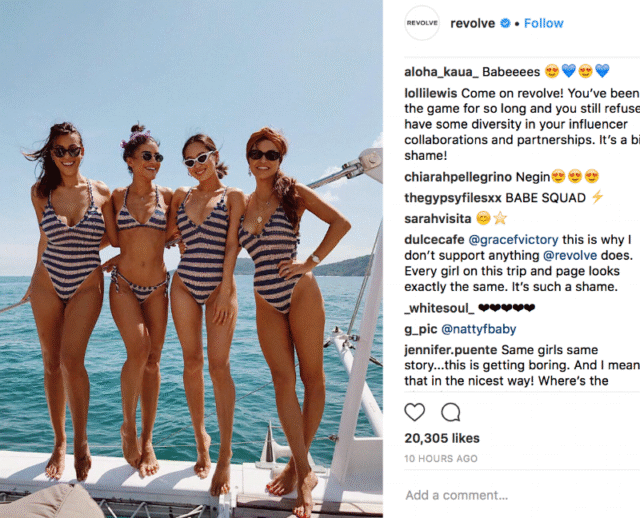
    Consider trendy online retailer Revolve: known for its influencer trips to far-flung corners of the globe, documented glamorously and exhaustively for its 2.6 million Instagram followers.

    Last January, as its squad took to the beach in Thailand, the attention turned from glowing to heated over the lack of diversity in its ranks. A shot of more than a dozen light-skinned swimsuit-clad slender women garnered more than 700 comments. A commenter tagged the picture #RevolveSoWhite.

    Revolve, which recently filed for an IPO and generated sales of $400 million last year, has never been a brand to highlight diversity, but whether or not that has had an effect on its sales is unclear.

    Revolve’s earned media value (EMV) dropped during the controversy to the brand’s lowest for the year, at $83.8 million. That cannot be solely attributed to the controversy, however, but “to the natural ebb and flow of events and campaigns.” And the dip was temporary: Revolve’s EMV bounced back to more than $140 million in each of the subsequent two quarters.

    In the firestorm, Valerie Eguavoen saw an opportunity.

    As the moment drew headlines, the North Carolina-based blogger and social justice advocate seized the chance to launch a new Instagram handle, @YouBelongNow, designed to celebrate people of all ethnicities, religions, sexualities and clothing sizes.

    “There are so many women who I could have seen on that trip, who belong in this space,” she said. “We have to get rid of this narrative that we don’t exist or it’s hard to find us.”

    Jean-Pierre Maull has kept tabs on what talent agencies she booked gigs with and which ones she hasn’t. In the latter camp was Fohr, based in New York and co-founded by James Nord. Over the summer, Nord addressed the Revolve controversy in a YouTube video, calling the retailer out for its practices while also suggesting it could be intimidating for brands to reach out to new influencers. Jean-Pierre Maull penned her response in a lengthy blog post. “Our POC (people of colour) community is not an alien force,” she wrote. “It is not hard to send a POC blogger the same pitch email that you send to others.”

    She emailed Nord, requesting to talk with him, one of many ongoing discussions Nord has had in recent months. “I leaned on this group of amazing women who did call me out,” he said.

    “Sometimes we just need to open up the conversation instead of just being angry,” Jean-Pierre Maull said. “Those in power must be self aware enough to see where they may be lacking or not doing enough.”

    One result of the chats Nord has had is a new mentoring program, called Freshman Class, to promote underrepresented influencers. More than 1,600 influencers applied, and 85 finalists were chosen. The ten winners include Alysse Dalessandro, queer plus-size fashion blogger; Ali Hemsley, a fashion influencer with a focus on chronic illness and mental health; and Destin Grayson, a menswear blogger. The winners will be flown to New York for three days of educational and networking opportunities.

    Nord hopes to help newer and lesser-known influencers build a network that can serve as sounding board, to discuss opportunities and pay rates.

    Jean-Pierre Maull said she was worried the initiative would seem like “someone need to swoop in and save” POC bloggers.

    The result, she says, has been anything but; it’s helping establish even more of a sense of community.

    “There is no lack of diversity in influencers, there is a lack of diversity in influencer campaigns,” Nord said.

    Relatability is a crucial part of influencer effectiveness, which is all the more reason why influencer campaigns should feature a more diverse range.

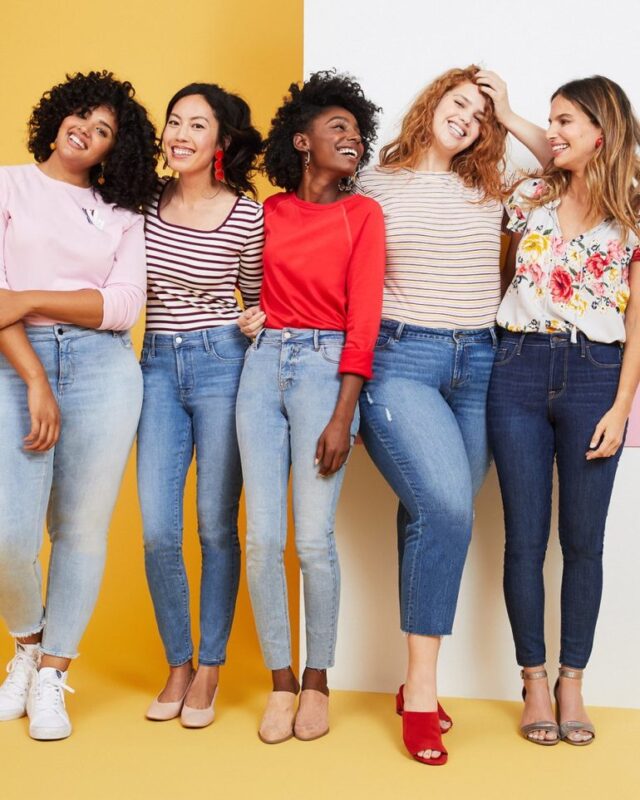
    Old Navy, a division of Gap Inc., looks for a range of sizes and family compositions in its influencer casting, then features them as models in its social feeds and digital marketing.

    “We’re looking for someone who people can see themselves in,” said Liat Weingarten, Old Navy’s vice president of brand communications.

    So far this year, Old Navy’s top two performing social posts featuring people (not just product), based on number of likes, comments and shares, are diverse group shots of influencers.

    One, highlighting dresses from its #SizeYES campaign, received more than 11,000 likes and more than a hundred comments. “My first thought when I saw this was: love this beautiful, diverse group of models!” wrote one commenter. “More of this, please!”

    And then there’s Revolve competitor Fashion Nova, which uses its Instagram account to highlight women of all ethnicities and sizes in its barely-there clothing.

    Its influencer hashtag, #NovaBabe, drove $54.1 million in earned media value from the second half of last year through the first half of this year.

    Mentions for @fashionnovacurve, the account for its plus-size line, generated $61.5 million in EMV.

    Followers are watching what brands are doing closely, too, said Scout the City blogger Sai De Silva.

    “When I go to events, I feel like there’s no one like me,” said Silva, whose followers have asked why she was the only woman of colour or woman with curly hair at a party “I live in New York City, how could there not be one other Puerto Rican [influencer]?”

    Influencers are finding that being proactive is the only way to move the conversation forward.

    Max Stein, founder and chief executive of agency Brigade Talent, said some of his clients will ask who else is participating before agreeing to a campaign, in the context of making sure a brand or company aligns on values—not just aesthetic. “It’s important to them that [diversity] is a value of the brand that they choose to partner with,” he said.

    However, not all brands are responsive in the way an influencer might want them to be.

    “There is sometimes a lack of cultural awareness and cultural sensitivities,” said Jaia Thomas, co-founder of The Presley Group, a management agency promoting diversity within the influencer space.

    Thomas, an entertainment lawyer, pointed to the time one of her African American clients was asked to do a post about watermelon. “There’s a long history of racial tropes and stereotypes associated with African-Americans, an affinity for watermelon being one of them,” Thomas said. “It’s important for there to be African-Americans in the room when creating social media campaigns so they can quickly and easily identify these stereotypes and ensure companies steer clear of them.”

    So, when will brands wise up? The enthusiasm that comes with a highly-engaged, targeted follower base is a big selling point in today’s noisy marketing field.

    “I don’t have a million followers,” said Katie Sturino, the force behind the handle and site The 12-ish Style. “What I do have is an audience that believes in what I’m saying and believe that if I’m showing them something, I like it.”

    Sturino’s best-performing content comes from two popular hashtags on her own account, both calling attention to sizing deficits within the industry. She recreates stars’ ensembles in #SupersizetheLook, with photographs of herself in similar outfits, performing 77 percent better than her average posts.

    Sturino also started the #MakeMySize hashtag, pairing pictures of herself in garments that are too small with captions asking brands to make a broader range of sizes, performing 65 percent better than her average posts.

    Sturino wishes more brands would take the time to find new personalities, and involve those newcomers earlier in the product-development process. “You pay them to wear the clothes, why don’t you pay them for their opinions, too?” she said.

  • Indonesia’s Garuda Shares Soar on News of Sriwijaya Deal

    Indonesia’s Garuda Shares Soar on News of Sriwijaya Deal

    National flag carrier Garuda Indonesia’s share price surged 19 percent on Thursday after the airline said it had taken over operational control of low-cost rival Sriwijaya Air. The move is seen as an effort to help Sriwijaya improve its financial performance, while potentially expanding Garuda’s market share to challenge Indonesia’s largest airline company, the Lion Air Group.

    Garuda announced the joint operation through its subsidiary, Citilink Indonesia, on Wednesday after signing an agreement with Sriwijaya Air and NAM Air – both under the Sriwijaya Air Group – on Nov. 9. The partnership could also be escalated to share ownership in the Sriwijaya Group, Garuda said in the statement.

    The joint operation will give the flag carrier a combined 46 percent share of the country’s domestic aviation market, while the country’s largest budget carrier, Lion Air, controls 51 percent, according to the Sydney-based CAPA Centre for Aviation.

    The remainder of the market is shared by the local unit of Malaysia-based AirAsia, charter service Susi Air and Jakarta-based Trigana Air Service.

    “The joint operation is intended to help the Sriwijaya Air Group improve its operational and financial performance to help Sriwijaya fulfill its commitments to third parties, including those within the Garuda Indonesia Group,” Garuda managing director Askhara “Ari” Dhanadiputra said in a statement.

    Sriwijaya Air planned to undertake an initial public offering last year, but its weak financial performance put a stop to that.

    The carrier suffered a loss last year due to rising fuel costs and the weaker rupiah after three profitable years. Most of Sriwjaya’s revenue is in rupiah, while the carrier’s expenses are mainly in US dollar, including fuel, aircraft maintenance and debt.

    According to Garuda’s financial report, Sriwijaya owed the flag carrier around $9.33 million as of Sept. 30 this year for the overhaul of 10 CFM56 turbofan aircraft engines.

    “We hope the partnership will help restore the financial performance of the Sriwijaya Air Group amid increasing competition in the domestic aviation industry. We believe the Garuda Indonesia Group has an excellent ability to manage the airline business,” Sriwijaya Air managing director Chandra Lie said.

    Price War

    Domestic air traffic in Indonesia more than tripled over the past decade as rising prosperity and lower fares made flying affordable for more people.With 129 million passengers in 2017, Indonesia is the world’s 10th-largest aviation market and it is projected to continue growing.

    Transportation Minister Budi Karya Sumadi expressed hope that the consolidation between Citilink, Sriwjaya Air and NAM Air would also help end a ticket price war among local airlines.

    “We hope this would end the price war and establish a new price equilibrium that covers the costs and margins to allow every airline to grow,” Budi said on Thursday.

    His ministry has long held the view that airlines’ race to the bottom in their price offerings would put pressure on their finances, which could make them more likely to neglect safety precautions.

    Budi said the joint operations between Citilink and Sriwijaya could also help to reduce redundancy on some of the country’s busiest routes and divert resources to other destinations.

    “There are many airports in eastern Indonesia that want to be served,” he said.

  • Xtep Sports opens sportswear store in India

    Xtep Sports opens sportswear store in India

    Hong Kong-headquartered Xtep Sports has opened its first Indian flagship store, in Bengaluru. The Xtep group, which specialises in footwear and sportswear, currently has 6035 stores in 31 Mainland China provinces as well as in Vietnam, Nepal, Saudi Arabia and Spain. The company was founded by Ding Shui Po, now its CEO, in 1999 as an original equipment manufacturers for global sports brands. It launched its own label in 2002.

    The company is reportedly planning to open five stores in India by the end of this year and will also sell through local online marketplaces.

  • Malaysia Aviation appoints Philip See as Firefly CEO, as Ong out

    Malaysia Aviation appoints Philip See as Firefly CEO, as Ong out

    Malaysia Aviation Group (MAG) has appointed Philip See as the new CEO of Firefly, effective Jan 1, 2019. Philip will replace Ignatius Ong who joined Malaysia Airlines as group chief revenue officer in June 2018. Ignatius has been double-hatting as CEO of Firefly and group chief revenue officer.

    Philip, whose appointment was announced internally earlier, is currently the Head of Strategy and Network for Malaysia Airlines, reporting directly to the group CEO. He joined the airline in 2015 from consulting firm McKinsey & Company, where he was an associate.

    He is however, no stranger to the group having previously served in the Turnaround Management Office (TMO) in Malaysia Airlines, back in 2004. Under the TMO he was responsible for implementing the Business Turnaround Plan and consequently the Business Transformation Plan. Philip left the airline in 2010 and rejoined Malaysia Airlines in 2015 as a Network Planner.

    In his role as group chief revenue officer, Ignatius oversees Sales and Revenue Management for the entire group. Ignatius has almost 15 years of professional experience in the aviation industry and is no stranger to revenue management having previously covered route and revenue under the then Turnaround Management Office. He has also headed the whole portfolio of Sales, Distribution and Marketing under the Project Management Department of Malaysia Airlines.

    Other changes in the management also include Ibrahim Mohamed Salleh as CEO of MABKargo effective Sept 1, 2018 and Hazman Hilmi Sallahuddin as CEO of Project Amal effective Oct 1, 2018.

    Ibrahim has over 20 years of experience in various fields within Cargo Handling with the company. Prior to his appointment as CEO MABKargo, he was COO of PT Jasa Angkasa Semesta (a subsidiary of SATS Limited, Singapore).

    Hazman was with Khazanah Nasional Bhd where he served in various roles across the organisation. This included Senior Vice President of Khazanah Europe Investment Limited based in London.

    Malaysia Aviation Group CEO Izham Ismail said, ”I am confident that the new leadership will bring new energy and purpose to the business. The diversity of our new leaders, their backgrounds and experience will help us reach our goals as a group.”

  • Who is Hong Kong’s new luxury shopper?

    Who is Hong Kong’s new luxury shopper?

    As one of Asia’s leading retail hubs, Hong Kong has long been a mecca for luxury shoppers. Despite being home to APAC’s most expensive retail real estate (second globally to New York City’s 5th Avenue), there’s a reason why large, sprawling luxury shopping malls continue to dominate in a crowded city.

    Hong Kongers will be glad to know, though, that it holds its own when it comes to homegrown luxury spending, which recently overtook foreign consumption at 55% of total purchases.

    This figure is staggering when considering the total population of Hong Kong is roughly 7.3 million people, less than a quarter of the 60 million visitors it hosts each year.

    For these locally based consumers, luxury isn’t a one-off, aspirational purchase — it’s an innate part of their lifestyle, which explains why 93% of shoppers intend to maintain or increase spending in luxury goods in the next five years.

    This holds true especially for the younger millennial shoppers who will be driving the majority of the growth going forward.

    Source: Think with Google

    The evolving nature of consumers is a common challenge for many marketers, and the luxury industry is no exception.

    The task at hand for brands in Hong Kong is to understand this distinct group of younger customers and the behaviors that shape their expectations when it comes making high-value purchases.

    A curious and demanding bunch

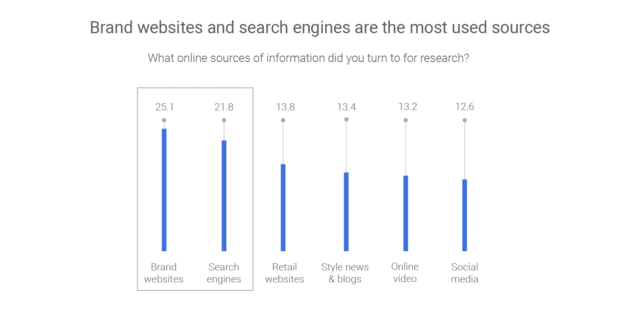
    Reportedly, 90% of luxury shoppers conduct research online before making a purchase, and brand websites and search engines are the two most popular sources people turn to. In fact, they’ve become the digital storefront for this generation of digital natives.

    Source: Think with Google

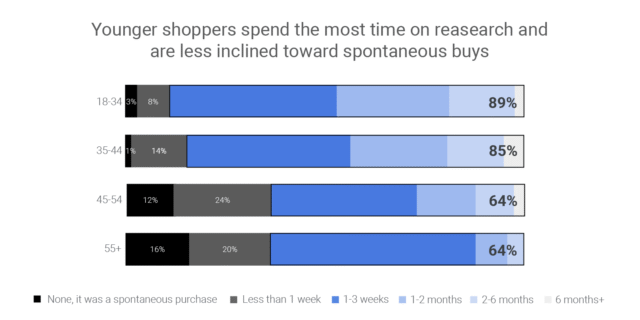
    Having grown up with readily available information online, millennial and Gen Z consumers spend more time on research than ever before.

    In fact, 89% of shoppers aged 18-34 spend up to three weeks researching a luxury purchase. And they’re not alone: 64% of consumers over 45 will spend the same amount of time on research leading up to a purchase.

    Source: Think with Google

    Retailers may have once treated online as a separate channel to physical stores, but this notion is quickly becoming outdated.

    Whether customers are online or offline is a distinction made by businesses, not consumers.

    Online and offline consumer behaviors are increasingly blurring, and the respective experiences need to follow suit, particularly when it comes to the inspiration and research phases.

    In short, consistency across the two worlds is key.

    It’s hard to imagine a luxury label leaving a customer linger unattended to in its boutique, so, by the same token, a customer should never be left unanswered or ignored on Google, YouTube, or social.

    More is more

    With a more exploratory consumer mindset, brand loyalty may be more elusive for brands targeting younger shoppers.

    Engaging potential millennial and Gen Z luxury shoppers constantly by trying to stay top of mind and being always on will be crucial to gaining consideration.

    In today’s environment of fast fashion and overnight style sensations — while couture brands used to produce two collections per year, they now produce five to six — one of every three consumers surveyed said they make luxury purchases to keep up with trends.

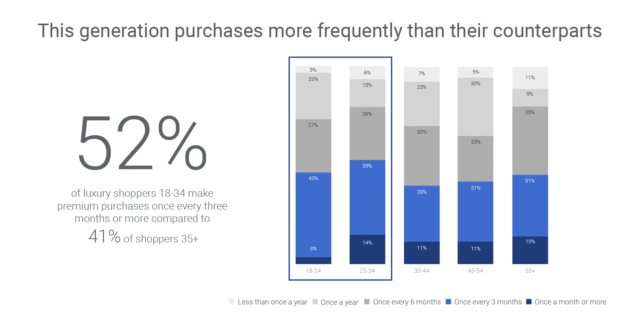
    The tendency to shop more often is evidenced among shoppers aged 18-34, of whom 52% reported making premium purchases once every three months, compared to just 41% of shoppers 35+ who did the same.

    Source: Think with Google

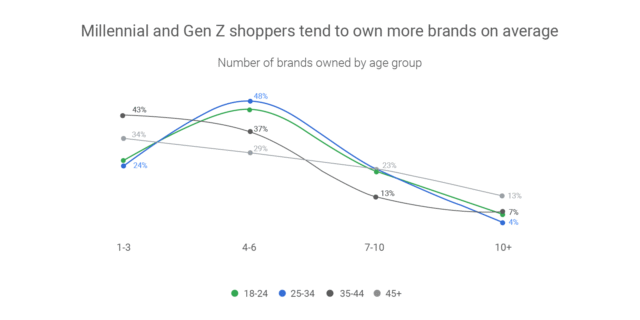
    In addition to a higher frequency of purchase, our research also shows that millennial and Gen Z shoppers are likely to consider a wider breadth of brands. On average, this group owned products from a repertoire of four to six brands; compared to more brand-loyal 35+ shoppers, who owned between one and three brands.

    Source: Think with Google

    Inspiring online with offline

    When it comes to in-store shopping, the aspects that customers value most are: 1) guaranteed authenticity, 2) the ability to touch and feel the product, and 3) personalized customer service.

    How might these values translate online? With 63% of people expecting the same high-touch brand experience online and offline, the challenge is to emulate these qualities and provide satisfying digital experiences.

    Offering free shipping on returns, for example, gives peace of mind to customers wary of counterfeit goods. Similarly, detailed product videos on the brand site or as a pillar of content on YouTube can help shoppers inspect items for quality while engaging them in a rich experience.

    Leveraging customer data, such as previous purchases, to create individualized interactions and recommendations is no longer a nice-to-have, but a must. Just as consumers expect personalized customer service in store, personalization is fundamental for designing a top-notch digital brand experience.

    Source: Think with Google
    The shopping experience begins online for Hong Kong’s luxury consumers.
    Search and brand sites are key because 90% of purchases are digitally influenced.

    Millennial and Gen Z consumers spend the most time on research, so it pays to provide as much information as possible to this group. They also purchase more frequently, and they consider more brands when they do so.

    To stay top of mind, brands should ensure that they are present at as many touch points as possible and that their media strategies are always on.

    Expectations for online shopping are growing higher by the day, and this is especially true for premium brands.

  • LG U+ IPTVs get Netflix in Korea

    LG U+ IPTVs get Netflix in Korea

    Netflix content will be available on LG U+ internet protocol TVs (IPTV) today. Under an exclusive IPTV deal inked with LG U+, Netflix content, including Netflix Originals, will be aired through LG’s platform, the carrier said Wednesday.

    LG subscribers won’t have to replace their existing set-top boxes as they will be automatically upgraded, though services will be first offered to the 1.07 million users of LG’s latest set-top box, dubbed UHD2, and gradually rolled out to other set-top boxes.

    Considering Netflix offers over 22,000 movies and television shows, including its big-name original content like “House of Cards,” “Stranger Things” and “Orange Is the New Black,” this is a good chance for the smallest carrier in Korea to steal some subscribers.

    By next month, the carrier will also reform the user interface of its IPTV so users have easier access to Netflix content as well as its own kids’ content platform, dubbed “Kid’s World,” that is gaining popularity among customers in their 30s and 40s with children. LG is banking on both services for the further growth of its IPTV business, according to Song Gu-young, senior vice president and head of home and media business at LG U+.

    The revamped interface could look similar to the Netflix app. When a user selects a video, an image related to the video will fill up the whole screen and a preview will run automatically, which is similar to how video previews are played on the Netflix app.

    The partnership between LG U+ and Netflix is no surprise as the market has long been expecting the announcement, but what’s still not clear is whether the carrier will offer a phone plan centered on Netflix. Without a useful plan, existing users of Netflix might not feel the urge to migrate to LG just for the IPTV service because it would only mean they get better access to Netflix content on the LG platform, but for the same monthly fee.

    LG is reportedly planning to roll out phone plans with a Netflix discount, according to an industry source, but it might take some time as new plans need government approval.

    For the time being, LG U+ is giving out free three-month Netflix trials to new subscribers of its IPTV plans worth at least 15,400 won ($13.50) per month until the end of this year.

    Korea’s mobile carriers have shifted their focus to the IPTV business as sales from traditional mobile phone subscriptions faltered after the government pressured them to make monthly phone bills cheaper last year.

  • Hanoi revives $500 million horse racing, entertainment complex

    Hanoi revives $500 million horse racing, entertainment complex

    A $500 million complex including horse racing in Soc Son District is off the shelf after 10 years. Hanoi authorities have approved the addition of the long-delayed Soc Son multi-purpose entertainment complex and horse racecourse project to the city’s master plan on socio-economic development to 2020 with orientation until 2030.

    The total investment for this project is currently estimated at about $500 million. The project is expected to go into operation after 2021.

    The planned site is mostly agricultural land. Once put into operation, the project will employ an estimated 5,000 direct laborers and 20,000-25,000 indirect laborers, generating a relatively large, regular revenue for the city’ budget.

    The project, which will be built in a planned tourist area about 40 kilometers north of Hanoi, will add a high-quality tourism product to Soc Son District in particular and the capital in general, the city stated.

    According to Hanoi authorities’ data, the capital has received over 26 million visitors this year, including 5.7 million foreign visitors, which are a 9 percent and 16 percent increase compared to last year respectively.

    The project to build a horse racecourse in Hanoi was first researched in 1999, with the racecourse’s proposed location in the southern districts of Hoang Mai and Thanh Tri.

    However, as Vietnam’s legal framework for sports betting and horse racing was incomplete at the time, the city’s foreign partner eventually withdrew from the project.

    The project was then revived in 2007 when the travel company Hanoi Tourist and South Korea’s Global Consultant Network asked for the city’s permission to research it, and was told by the government that it would be approved once the legal framework for sports betting is completed.

    Vietnam’s legislative body, the National Assembly, approved a bill legalizing sports betting last year and the government earlier this year promulgated a decree regulating the sports-betting business, throwing open opportunities for foreign investors to build racecourses in the country.

    In addition to the racecourse in Hanoi, foreign firms are also said to be pursuing plans to build horse racecourses in the northern provinces of Bac Ninh, Vinh Phuc and in Ho Chi Minh City.

  • Number of Cinema Screens in Indonesia Expected to Double Over Next 3 Years

    Number of Cinema Screens in Indonesia Expected to Double Over Next 3 Years

    The head of the Creative Economy Agency, or Bekraf, said he expects the number of cinema screens in Indonesia to double over the next few years, amid growing interest in the national film industry.

    “We expect to see at least 3,000 screens – twice what we have today. This is because local films thrive in small towns, but that’s also where we face a lack of theaters,” Bekraf chairman Triawan Munaf said on the sidelines of the World Conference on Creative Economy in Nusa Dua, Bali, last week.

    According to the agency’s 2019 Creative Economy Outlook, there are currently nearly 1,700 screens across the country. Triawan expressed hope that this could be nearly doubled over the next three years.

    The report further states that film is currently the fastest-growing subsector of Indonesia’s creative economy.

    However, as imported films still drive demand among moviegoers, the industry must figure out how to get local films to compete with those from abroad in terms of screening and scheduling.

    Triawan said the national film industry is growing rapidly, as illustrated by the fact that 40 percent of films screened in the country are local.

    This year, teen drama “Dilan 1990” attracted more than 6.3 million viewers nationwide, making it the second best-selling Indonesian film of all time after the 2016 reboot of the popular 1980s comedy franchise, “Warkop DKI Reborn: Jangkrik Boss! Part 1,” which boasted more than 6.8 million viewers.

    The number of moviegoers in the country has meanwhile also increased to more than 42 million by 2017 from around 16 million in 2015.

    More screens in other parts of the country can therefore facilitate this growth, as 183 of Indonesia’s 488 theater complexes are located on Java Island, Bekraf said.

    Cineplex 21, CGV Cinemas and Cinemaxx currently dominate the movie theater industry in Indonesia with 1,003, 275 and 203 screens, respectively.

    In her speech at last week’s conference in Bali, Finance Minister Sri Mulyani Indrawati also highlighted the importance of more vocational training to support the creative economy, of which the film industry is part.

    Despite the large number of moviegoers, many of them are less enthusiastic about local films because there are limited choices in terms of storyline and variety, which shows that there is a need for more quality screenwriters.

    “Indonesia has huge potential when it comes to writers and screenwriters, and this is an area we must explore further,” the minister said.

    Sri Mulyani also said that she was keen to learn more about the creative economy and how she could assist in its development.

  • “Falling Stars Challenge” has striked Asia

    “Falling Stars Challenge” has striked Asia

    The Falling Stars Challenge, a meme that has rocketed through Asia, features people posing as if they’ve fallen out of their luxury cars, with the luxury contents of their luxury bags spilling out on the pavement for all to see. The expensive goods are meticulously arranged so followers can admire the makeup, jewelry, shoes and other items that have oh-so-embarrassingly been laid bare.

    But the meme has become democratized, spreading from its beginnings as a way to take the humble out of humblebragging.

    It now encompasses any number of chosen identities, becoming a way to display the physical items and pursuits most closely associated with oneself.

    It’s popular among beauty and photography bloggers, fitness and food enthusiasts, and artists of all sorts.

    Hospital workers have shown off the tools of their trade, while others, with a touch of self-deprecation, have offered their more accessible collections of yoga mats, junk food and trash. They don’t even need to fall out of cars.

    The challenge originated in Russia and has spread throughout Asia, especially in China, where thousands of people have participated on Weibo, a popular social network.

    Even rigid government departments have joined in.

    The Consular Protection Center of China’s Ministry of Foreign Affairs posted a photo that showed a worker falling into a pile of paper.

    A police school photographed a fallen officer surrounded by bullets.

    The challenge has spread beyond Russia and China, with tens of thousands of posts from various countries appearing on Instagram.

  • Vaping Maker Juul Sounds Out Asia for Expansion

    Vaping Maker Juul Sounds Out Asia for Expansion

    United States-based Juul Labs is exploring selling its compact vaping devices in Asia and has sounded out government officials in Indonesia, one of the world’s most smoker-friendly countries, although gaining approval there could face significant hurdles.

    Expansion into Asia would provide the fast-growing firm with new markets at a time when it faces increased regulatory scrutiny in the United States and Israel over the potential health risks of its products’ high nicotine content.

    Juul representatives held discussions with the Indonesian government last month about introducing its vaping devices, finance ministry officials said.

    Indonesia has one of the world’s highest rates of smoking among adults and teenage boys and imposes no penalties for selling cigarettes to minors. Its population of 260 million also makes it a highly attractive market for tobacco and vaping firms.

    A person familiar with Juul’s plans said executives for the San Francisco-based company are concerned authorities may be reluctant to grant approval due to likely opposition from the traditional tobacco industry, which provides much of the country’s tax revenue.

    Tobacco taxes accounted for nearly Rp 150 trillion ($10.2 billion) or about 11 percent of national tax revenue in 2017, government data showed. Each province also imposes taxes on cigarettes.

    Juul also worries its argument that vaping is healthier than smoking will not hold much sway in Indonesia, which is not as concerned as other countries about health issues, said the person, who declined to be identified as the discussions were not public.

    Juul representatives reached out to the Ministry of Finance to discuss how it would be taxed on any sales of devices there, the officials said.

    The government needs to examine the domestic e-cigarette market to determine how a foreign player such as Juul could hurt local small and labor-intensive e-cigarette firms, said Sunaryo, a senior official at the Directorate General of Customs and Excise.

    “We will need it to study it,” he said, adding that he was not sure Juul would comply with a regulation that requires e-cigarette devices and liquids to be sold separately.

    Juul also would need approval from the Food and Drug Monitoring Agency (BPOM). Officials at the agency said Juul had yet to be in touch.

    Other Asian countries the three-year-old firm is actively considering for expansion include India, South Korea and the Philippines, the person familiar with Juul’s plans said.

    In addition to Indonesia, Juul filed trademark applications for those countries between April and October this year, as well as in Malaysia and Singapore, according to a review. It opened its first Asia office in Singapore in July.

    So far Juul, currently valued at $16 billion, is available only in the United States, Canada, Britain and Israel. It has plans to enter Russia later this year.

    Juul said in that it is “proactively learning more” and engaging with local officials in Asia “to understand and hear their views.” It does not have immediate plans to launch in any Asian country, it said. Juul spokeswoman Victoria Davis declined to elaborate.

    A Taxing Question 

    Indonesia is one of only a handful of United Nations member states that has not signed on to the World Health Organization’s global treaty that sets standards for tobacco control.Roughly two-thirds of Indonesian men smoke tobacco daily, and more than 21 percent of boys aged 13-15 smoked cigarettes regularly, according to a WHO report last year.

    E-cigarettes, available in Indonesia since at least 2013, is a small but growing market. The customs office estimates that there are about 300 unsupervised liquid makers, known as brewers in Indonesia, producing various liquid products to more than 4,000 vape stores and 900,000 smokers.

    Philip Morris International, maker of Marlboro cigarettes, which now controls about a third of Indonesia’s market through its stake in Sampoerna, does not offer any of its noncombustible cigarette products in Indonesia.

    That includes its IQOS device, a heat-not-burn tobacco product, according to a company spokesman, who declined to comment on why it has not introduced the product.

    In October, the government imposed a 57 percent tax on e-cigarette liquids, on par with taxes on traditional cigarettes. But tax collection, particularly from smaller companies, is difficult in Indonesia and new rules are often ignored.

    Juul now commands a nearly 75 percent share of the US e-cigarette market, up from 13.6 percent in early 2017, according to a Wells Fargo analysis of Nielsen retail data.

    Its products, like most electronic cigarettes, vaporize a liquid containing nicotine. One Juul pod contains as much nicotine as a traditional pack of 20 cigarettes, according to the company’s US marketing.

    Juul liquid in the United States has a nicotine concentration of 59 milligrams per milliliter, much higher than the liquids typically sold in earlier versions of e-cigarettes and nearly three times the allowable limit in the European Union.

    In August, Israel banned Juul devices with nicotine concentration of more than 20 mg/mL, citing “a grave risk to public health.” Juul is appealing that decision and currently offers a lower nicotine-strength electronic cigarette in Israel.

    In September, the US Food and Drug Administration opened an investigation into Juul and other electronic cigarette companies, citing the rising number of teens who appear to be using Juul and other vaping devices. This week it is expected to issue a ban on fruit and candy-flavored e-cigarettes sold in convenience stores and gas stations.

    In its statement, Juul said its products are intended for adult use only, and that it aims to “improve the lives of the world’s one billion adult smokers” by providing an alternative to cigarettes.

  • Tencent closed to buy sports firm Amer

    Tencent closed to buy sports firm Amer

    Social media conglomerate Tencent Holdings is believed to be close to joining a Chinese investment group bidding to acquire Finnish sports goods firm Amer. The consortium, spearheaded by Anta Sports Products, would see Tencent participating as one of a few minority investors under the proposal. Its involvement would serve to boost considerably Amer’s brands in the Chinese market.

    In a statement made two months ago, Anta spoke of joining with local buyout company FountainVest Partners to offer a potential €40 (US$45.60) per share for Amer, a target value of around €4.7 billion ($5.3 billion). The consortium has sought at least €3.5 billion ($3.99 billion) in loans. Anta has a market value of about $11.6 billion.

    The acquisition agreement could potentially be complete within several weeks.

  • J.Crew’s CEO Jim Brett is leaving the firm

    J.Crew’s CEO Jim Brett is leaving the firm

    J.Crew chief executive Jim Brett is exiting the company, the retailer said, and a committee of four executives will step in to manage operations until a replacement is found. The statement said the decision had been mutual between Brett and the board of directors.

    “Returning J.Crew to its iconic status required reinventing the brand to reflect the America of today with a more expansive, more inclusive fashion concept,” said Brett. “However, despite the recent brand relaunch already showing positive results, the board and I were unable to bridge our beliefs on how to continue to evolve all aspects of the company.”

    Brett will be replaced by four executives: chief operating officer Michael Nicholson, chief experience officer Adam Brotman, chief administrative officer Lynda Markoe and Libby Wadle, president of the Madewell brand.

    Brett joined the specialty retailer in July 2017, at a time when the company was struggling with looming debt payments and declining consumer sentiment toward the brand. Over the next year and a half, he overhauled the executive team, bringing in former colleagues from West Elm — where he was CEO — and URBN — where he worked at both Anthropologie and Urban Outfitters — to revamp the brand identity and restructure the business. In 2017, the company was able to bide a bit more time to implement a turnaround, negotiating with creditors to push back the maturity of $566.5 million in debt from 2019 to 2021.

    He lowered prices, launched new brands and tried to reposition J.Crew as an inclusivity-driven, one-for-all label not so tied down by its preppy heritage, especially as it had most recently been interpreted by agenda-setting designer Jenna Lyons.

    In a sharply worded email sent to senior staffers in July 2018, he dismissed Lyons’ work, which turned polarising near the end of her tenure, while laying out his own priorities.

    “PRETTY always sells. A glen plaid jacket with a graphic tee and camouflage pants is anything BUT pretty,” he said. “The new feminist fashion movement is enjoying the POWER of femininity (see latest Dior shows) vs. the last feminist movement which was about women finding power in dressing like men. Femininity is critical — pretty is critical — femininity is powerful. These things are in starch [sic] contrast to Jenna’s masculine, sexual and overtly aggressive J. Crew.”

    While Lyons’ vision had stopped resonating with consumers, Brett’s fix was viewed by some analysts as a watering down of the product. There were too many changes at once — from the introduction of a bare-bones loyalty programme to changes in fabric suppliers to the implementation of a marketplace — all with varying impact. He also continued to discount heavily, something many of J.Crew’s competitors are trying to move away from. Talk of a decline in morale also permeated Brett’s run, with multiple corporate-level employees leaving, including one of Brett’s own hires, chief marketing officer Vanessa Holden, who recently announced her departure.

    In the second quarter of 2018, the group — which also includes Madewell — reported that same-store sales rose 1 percent from a year earlier after 15 straight quarters of decline. Star performer Madewell, which drives about a fifth of sales, saw comps jump 28 percent. Total sales at the company were $588 million, up 3 percent from the same quarter in 2017. The company still experienced a net loss of $6 million, compared to a $19 million loss during the same period last year.

    Whether the company has managed to keep up the momentum will be revealed imminently, as third-quarter earnings are expected to be released this month. The period was marked by J.Crew’s official September relaunch, including the rollout of its #meetmycrew marketing campaign. Just this past week, J. Crew launched another brand, Nevereven, which is also being sold at multi-brand retailers such as Fred Segal in Los Angeles.

    But talk of the company giving up more of its corporate office space to Facebook and Instagram — which occupies the same building — and news of a “for rent” sign in the window its popular men’s concept shop, the Liquor Store, indicates that the J.Crew is still in cost-cutting mode.