Tag: LTE

  • Nokia showcases LTE drones for public safety

    Nokia showcases LTE drones for public safety

    Nokia has conducted a demonstration showcasing the use of LTE-enabled drones to facilitate efficient rescue operations in disaster areas.

    The demonstration involved the creation of an instant LTE network using its Ultra Compact Network portable base stations to establish connectivity between camera-mounted drones and a control center.

    Nokia conducted the demonstration at the UAE Drones for Good Award event in Dubai. The company said the drones can be used to stream video and other sensor data in real time from the disaster site to a control center.

    At this control center, data is analyzed using Nokia’s video analytics technology to help emergency responders make informed decisions to ensure efficient and safe rescue operations.

    “Nokia always strives to expand the human possibilities of technologies for the benefit of mankind. We are committed to corporate social responsibility, and with ‘Nokia Saves Lives’ we want to use our technologies with drones to show efficient rescue operations in collaboration with NGOs and network operators,” Nokia head of Middle East Bernard Najm said.

    “The selection of this initiative by the UAE Drones for Good Award for a public demonstration in Dubai clearly shows usefulness of this innovative initiative for smart disaster recovery.”

  • Wi-Tribe to launch Pakistan’s first LTE-A network soon

    Wi-Tribe to launch Pakistan’s first LTE-A network soon

    Pakistan’s Wi-Tribe is on track to deploy the market’s first LTE-Advanced network in around May this year.

    The former Wimax operator plans to launch a network capable of speeds of up to 100Mbps within the next few months.  The company expects to raise this speed to 200Mbps by end-2018 and to 400Mbps by around 2019 as more advanced customer premises equipment becomes available.

    On Facebook, Wi-Tribe group chairman Hasan Bokhari and Wi-Tribe advisory board chairman Shahid Malik Chairman confirmed that the company has awarded Huawei a $15 million contract to help deploy the network.

    The executives said the network will be the first LTE-A deployment in the 3.5-GHz band in South Asia and the Middle East, and is expected to be fully operational in June.

    Wi-Tribe plans to invest over $25 million in LTE-A over the next three years, and its owners have committed to reinvesting all profits from the company’s operations over this time back into the business.

    “We see a very bright future through LTE-A insha’Allah, and intend to offer not just competitive packages with unrivalled technology, speed and reliability but with the advantage of having all this backed up by our Tribers who will continue to deliver the best customer support in Pakistan,” the executives wrote.

  • Cellcard aims for nationwide LTE by April

    Cellcard aims for nationwide LTE by April

    Cambodia’s Cellcard reportedly plans to roll out nationwide LTE services by April, becoming first past the post in the race to deploy 4G services covering the whole country.

    The operator recently contracted Nokia to expand and modernize its 3G and LTE networks, including by deploying around 1,500 new cell sites.

    Now Cellcard aims to achieve nationwide coverage by April. The operator has reportedly invested around $150 million in the 4G expansion project.

    Cellcard’s main rivals Smart and Metfone are also investing heavily to expand their 3G and 4G presence. According to the report, Smart has to date rolled out 4G coverage to areas in all 25 provinces of the country and has upgraded around 65% of its roughly 2,100 base stations to 4G.

    The company now plans to invest around $80 million towards upgrading around 80% of its base stations to 4G by the end of the year.

    Metfone meanwhile aims to cover nearly the whole country with 3G and 4G coverage, with a goal of having 3,000 base stations supporting both technologies, but has not disclosed a timeline for meeting this target.

    According to data from the Telecommunication Regulator of Cambodia, mobile internet subscriptions reached nearly 7.5 million in November, compared to a total mobile subscription base of around 19.5 million.

  • Telstra launches Gigabit LTE in key CBDs

    Telstra launches Gigabit LTE in key CBDs

    Australia’s Telstra has launched the world’s first commercial Gigabit LTE network in the central business districts of key state capital cities.

    The operator’s LTE-A network in these CBDs has been upgraded to support 4X4 multiple input multiple output (MIMO), three carrier aggregation and 256 quadrature amplitude modulation (QAM) on the downlink.

    The network also supports 64QAM and two carrier aggregation on the uplink for a peak upload speed of 150Mbps.

    Telstra, Ericsson, Qualcomm and Netgear jointly developed the first Gigabit-class commercially ready LTE network and Gigabit-class mobile device in October.

    Netgear’s Gigabit LTE device, the Nighthawk M1, will launch in Australia late this month, which will allow customers to use the Gigabit LTE service. The Nighthawk M1 utilizes 4×4 MIMO to support 4-way receive diversity.

    “Gigabit LTE is also an important step on our journey to 5G and demonstrates Telstra’s commitment to delivering Australians a world class network now and into the future,” Telstra group managing director for networks Mike Wright said.

    “We are well placed to evolve our 4G network and are putting the building blocks in place for Australia to be ready for 5G – this will deliver more bandwidth and lower latencies which are critical for emerging applications such as downloading 4K video, IoT, autonomous vehicles, augmented reality and shared virtual reality.”

  • Mobile operators should embrace LTE Broadcast now

    Mobile operators should embrace LTE Broadcast now

    Mobile operators, especially those with multi-screen assets and ambitions of providing superior mobile video and data experiences to customers, should adopt eMBMS, or LTE Broadcast, more aggressively, says a new report by Strategy Analytics.

    Accessing mobile TV services, particularly live events, over the mobile network will only increase in future as competition drives larger data bundles to 4G users, the research firm predicts.

    To meet growing mobile video demand while maintaining performance for all users mobile operators must embrace LTE Broadcast to drive support from smartphone vendors such as Apple.

    The LTE Broadcast market has changed from optimism to caution in the last two years. No other mobile operators have launched commercial LTE Broadcast service since Verizon Wireless did so in 2015.

    Strategy Analytics believes two main impediments are holding momentum for LTE Broadcast back — the lack of a reliable monetization model and weak mobile device support.

    “Although LTE Broadcast is the best tool to deliver the same content simultaneously to multiple users using the broadcast channels, therefore ideal for covering live events, for example, sports or concerts, live video alone is not enough to make a paid for service,” says Wei Shi, analyst of wireless media strategies at Strategy Analytics .

    “However, the cost saved from offloading the traffic data, largely generated by mobile video consumption, from unicast to multicast will justify operators’ limited investment to upgrade the network,” adds Wei. “In addition to packaging LTE Broadcast as part of operators’ service portfolios, there are other non-live video opportunities for the technology, for example, batch software updates, public information dissemination, and supplementing terrestrial broadcasting.”

    Out of the 26,000 models tracked by Strategy Analytics’ SpecTRAX, more than 1,000 are using eMBMS capable chipsets, though very few devices are shipped with the feature enabled. None of the iPhone models, which account for a combined 15% of smartphone installed base, supports eMBMS.

    The launching and expanding of LTE Broadcast Alliance in 2016 is a positive sign that the industry, led by a group of leading operators and technology companies, is actively addressing the device support issue.

    “Leading mobile device makers have not rushed to equip a large number of their phones and tablets with the LTE Broadcast feature, the most obvious absence being Apple’s iPhones and iPads,” adds Nitesh Patel, the firm’s director of Wireless Media Strategies.

    “One of the main objectives of the Alliance is to shore up the mobile device support for LTE Broadcast. More important than the publicity, operators should take the lead to break the ‘no business therefore no device, no device therefore no business’ cycle,” notes Patel.

    “By embracing LTE Broadcast more seriously, operators will send a clear signal to the device makers, including Apple, that it is time they should bring the feature to a broader portfolio of their products.”
  • Singtel launches 450Mbps LTE-A nationwide

    Singtel launches 450Mbps LTE-A nationwide

    Singtel has announced the nationwide deployment of its 450Mbps LTE-Advanced service as part of the operator’s journey to 5G.

    The company has upgraded its LTE network in Singapore to support the pre-5G technology 256 quadrature amplitude modulation (256 QAM).

    The technology is designed to increase the number of unique waveform shapes to allow the carriage of up to a third more data, as well as increased spectral efficiency.

    Singtel will make the 450Mbps service available to all its 4G customers with compatible devices at no extra cost.

    Customers with Galaxy S7 and S7 Edge smartphones can take advantage of the faster speeds already, and Samsung plans to release a software update to also support the LG V20. More compatible smartphone models are expected to reach the market early this year.

    “Singtel is investing ahead to deliver faster speeds and wider connections with the steady deployment of innovative technologies on our live network,” Singtel CEO consumer Singapore Yuen Kuan Moon said.

    “With more customers consuming and sharing mobile videos, 450Mbps speeds will enable them to download movies in a flash and give them a better entertainment experience while on the go.”

    Singtel also announced it teamed up with Ericsson to demonstrate download speeds of 1Gbps in a live 4G network pilot at two sites. The speed was achieved by combining 256 QAM with 4×4 MIMO and tri-carrier aggregation technologies.

    The operator plans to roll out 4×4 MIMO technology on its network from next year. The first compatible devices are expected to be ready for launch by the end of 2017.

  • Huawei demos 5G-LTE dual connectivity for 4K VOD

    Huawei demos 5G-LTE dual connectivity for 4K VOD

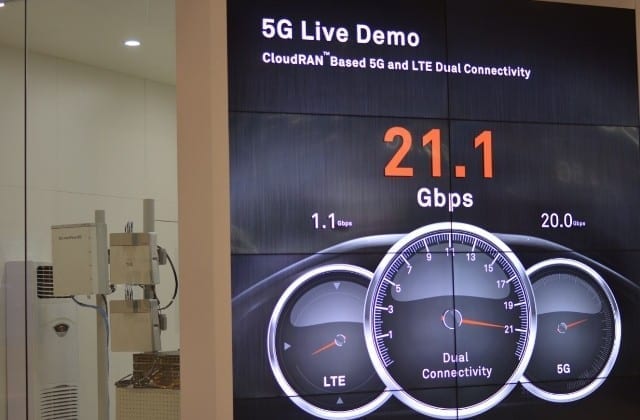
    Huawei has conducted a live demonstration involving 5G and LTE dual connectivity for a 4K video-on-demand service, achieving single user peak throughput of 21.1Gbps.

    At last week’s Global Mobile Broadband Forum, Huawei conducted a demonstration based on its CloudRAN architecture.

    With the development of new high-bandwidth services such as AR/VR and 4K video streaming and cloud-based services, Huawei said 5G new radio technologies will need to be deployed in central hotspots first to deliver the required capacity.

    LTE networks are meanwhile continuing to evolve with the introduction of new technologies including 3D Massive MIMO.

    Combining 5G and 4G networks has the potential to help operators protect their existing investments while improving network capacity, spectrum efficiency and coverage in urban areas.

    “It is of vital importance to guarantee end users with a ubiquitous high data rate experience in densely populated urban city areas with high buildings and complex roadways,” Huawei CMO of wireless network products Dr Yuefeng Zhou said.

    “Recently, 3GPP standardization has made significant progress in 5G and LTE dual connectivity. We expect to strengthen our cooperation with industry partners on 5G innovations based on these real application scenarios.”

  • YTL launches 4G LTE data, VoLTE services

    YTL launches 4G LTE data, VoLTE services

    YTL Communications in Malaysia has deployed Elitecore’s Revenue and Customer Management (RCM) Platform to roll out its 4G LTE high speed data & VoLTE services.

    The platform will enable the operator to roll out new business models like, HD Voice (VoLTE), Enterprise LTE and LTE Roaming, in addition to the Double Double buckets, one for wireless broadband and another for mobile internet, VoLTE and data services bundled with devices.

    YTL Communications said it is the only operator in Asia Pacific to commercially launch nationwide Voice over LTE (VoLTE) services.

    Elitecore’s NFV ready and Virtualized platform comprises of integrated policy and charging, 3GPP AAA, convergent billing, fulfillment, mobile self-care catering to voice, data and VAS services supporting multiple networks such as LTE, Wi-Fi and Wimax.

    “Elitecore’s product roadmap alignment with YTL’s business vision and proven experience in convergent billing and integrated policy and charging supports our growth strategy and helped us migrate from our legacy billing and operational support systems,” said Ali Tabassi, COO of YTL Communications. “The platform offers high agility for faster time-to-market and feature rich functionalities.”

    Elitecore said its RCM is a modular and feature ready platform that offers operators the speed and flexibility to roll out, new monetization and personalization use cases needed to innovate in next-generation data services. The platform promises significant contribution to capex and AMC cost reduction.

  • Nokia to deploy first LTE-R network in Korea

    Nokia to deploy first LTE-R network in Korea

    Nokia has secured a contract to deploy the world’s first LTE-R (LTE-railway) LTE network in South Korea.

    The vendor will deploy the network on a railway line between Wonju and Gangneung as part of a line extension to prepare for next year’s Winter Olympics in PyeongChang.

    The network will support both operational and maintenance services on a high-speed commercial railway line operating at speeds of up to 250 km/h, providing high-speed connectivity between trains, stations and other railway facilities.

    Nokia said the project is intended to serve as a model for future deployments of LTE-R technology and help further define LTE-R standardization efforts.

    “South Korea has been a world leader in the use of mobile broadband technology to make public services of all kinds safer, more efficient and reliable,” Nokia head of Korea Andrew Cope said.

    “With a thirty-year history in the delivery of GSM-R mobile networking technology for railways, and as a pioneer in the development of LTE-R solutions, we are pleased to partner with KRNA to bring these cutting edge capabilities to the country as they prepare to host one of the world’s premier sporting events.”

  • Telstra, Ericsson achieve five-carrier LTE aggregation

    Telstra, Ericsson achieve five-carrier LTE aggregation

    Telstra and its technology supplier Ericsson claim to have achieved a world-first with a test that used four separate radio frequency spectrum bands with five carriers for very high long term evolution-advanced (LTE-A) bit rates.

    The trial at an undisclosed location used Telstra’s production network, with a Cobham Aeroflex TM500 4G network testing device as the receiver.

    It used 20 MHz each in the 700 MHz, 1800 MHz and 2100 MHz ranges, as well as two 20MHz bands in the 2600 MHz frequency range, for a total of 100MHz aggregated bandwidth.

    Five carriers and 100MHz are the maximum under the current LTE-A specification.

    Ericsson utilised high encoding rate 256 quadrature amplitude modulation (QAM) for the signal to provide better peak data speeds.

    Using the stateless user datagram protocol (UDP), the trial achived 950Mbps downlink speeds.

    With the more commonly used transmission control protocol (TCP), Ericsson and Telstra hit 843Mbps against the Speedtest website, the two telcos said. They declined to reveal the latency of the connection or the distance over the air for the signal.

    Telstra operations managing director of networks Mike Wright said that was “a widely accepted view that 4G should achieve peak speeds in the range of 1Gbps”.

    In reaching such high speeds, Wright said it could be argued that LTE technology was finally moving beyond the 4G barrier.

    “The demonstration of 1Gbps end to end capability shows the advanced state of these standards and our ability to rapidly bring them into commercial service in order to deliver increased capacity in our network to meet growing demand,” he said.

    “In addition to Telstra consumer customers, we are preparing our networks for growth in business use, as well as emerging technologies, which rely on our ability to deliver high capacity and low-latency solutions.”

    There are currently no handsets or devices capable of working with the combined five carrier LTE signal, and Telstra would not say when or whether it is planning on launching commercial services.

  • Ericsson to launch 5G New Radio in 2017

    Ericsson to launch 5G New Radio in 2017

    Ericsson has announced plans to commercially launch the first 5G New Radio (NR) equipment in 2017, a key enabling technology for future 5G networks.

    The 5G NR radio supports Ericsson’s Massive MIMO and Multi-User MIMO 5G plugins. It uses advanced antennas and a large number of steerable ports to support these new technologies, as well as beamforming, another expected component of 5G networks.

    In addition to being 5G ready the 5G NR supports LTE, so it will be deployable in today’s networks. They support Gigabit speeds for LTE and advanced TDD beamforming.

    New network builds will be supported by Ericsson’s new Industrialized Network Rollout Services offering, which involves providing configuration, installation, integration, shakedown and handover in a single site visit.

    China Mobile Research Institute deputy head Huang Yuhong has welcomed the planned launch.  “Massive-MIMO, also known as 3D MIMO, is an important milestone in China Mobile’s technology roadmap from 4G to 5G,” he said.

    “We are very happy that Ericsson’s new radio product is coming to market soon to meet our needs and enable us to integrate 5G technologies into our existing networks.”

    “Mobile operators, today, are clearly focused on the race to 5G commercialization, while also continuing to invest in their existing LTE networks,” Current Analysis VP of consumer and infrastructure services Peter Jarich added.

    “With a new 5G radio and LTE offerings which echo key 5G concepts – small cells, licensed-unlicensed band combinations, Cloud RAN, network densification, spectrum optimization – Ericsson’s new portfolio additions and Ericsson Radio System innovations provide a compelling way forward.”

  • Globe fast-tracking LTE 700 rollout

    Globe fast-tracking LTE 700 rollout

    The Philippines’ Globe Telecom is fast-tracking the rollout of LTE over its recently-acquired 700-MHz spectrum.

    The operator revealed it has recently rolled out more than 150 700-MHz base stations, mostly in Metro Manila.

    The new sites cover major business districts and populated areas in the country. Globe launched its first 700-MHz base station Quexon City in June, and the company said its LTE 700 sites now cover the majority of the city.

    Globe is planning an initial rollout of 200 compatible LTE 700 base stations, and has committed to deploying around 4,500 multiband, multimode software defined radio base stations covering 95% of municipalities and cities in the country.

    “We are confident that more and more of our customers will experience improved services as adoption of LTE-capable devices increases and as we continue to deploy LTE 700 in more sites,” Globe senior vice president for network technical group program governance Joel Agustin said.

    “This is consistent with our strategy of continuously improving internet services using the previously idle 700 MHz spectrum that the NTC now allowed us to co-use.”

    Globe acquired rights to co-use the 700-MHz spectrum after joining with rival Smart to acquire San Miguel Corporation’s telecoms assets for a combined 69.1 billion pesos ($1.5 billion) earlier this year.

  • Vodafone Fiji launches LTE-Advanced

    Vodafone Fiji launches LTE-Advanced

    Vodafone Fiji has become one of the first operators in the Pacific to roll out an LTE-Advanced network.

    The operator has gone live with an LTE-A network that currently covers 65% of the population, and aims to expand this to 85% by Christmas. The network offers theoretical peak downlink speeds of 225Mbps.

    Customers with compatible smartphones will be able to take advantage of the LTE-A network without any additional costs or setup requirements.

    Vodafone has had a presence in Fiji since 1994, and has now been the first mobile operator in the country to roll out every generation of mobile technology since upgrading from 2G to 2.5G GPRS. The company first launched 4G services in the market in 2013.

    “[The rollout] ensures that Fiji is on par with the developed countries in the world and remains on the forefront of digital revolution,” Vodafone Fiji CEO Pradeep Lal said.

    “Billions of people across the world are already online and more are expected to join them in the next few years as broadband coverage expands transforming the world into a highly connected and interactive world. The world is fast evolving with the power of mobile communication and Internet of Things are no longer seen as a distant future but more so is happening now.”

  • M1 commences Singapore’s first HetNet rollout

    M1 commences Singapore’s first HetNet rollout

    Singapore’s M1 has announced it has commenced Singapore’s first commercial HetNet rollout in collaboration with Nokia.

    As part of the rollout, M1 plans to progressively deploy Nokia’s Flexi Zone small cells and Wi-Fi equipment at hundreds of high-traffic hotspots across Singapore, including mass transit stations, malls and popular outdoor areas.

    The operator will also use small cell technology to bring connectivity to hard-to-reach areas including car parks, basements and parks.

    M1 plans to use LTE-WiFi Aggregation (LWA) technology to deliver peak download speeds of more than 1Gbps over its 4G+ network by 2017.

    The rollout follows HetNet trials earlier in the year at multiple locations including three MRT stations. During the trial, download speeds were improved by 60%.

    M1, MyRepublic, Singtel and StarHub have all been working with the Infocomm Development Authority (IDA) of Singapore on nationwide HetNet trials. M1’s participation has included trials of HD VoWiFi, as well as Wi-Fi on public buses.

    “The results from our HetNet technology trials were positive. 90% of users enjoyed a better mobile experience, with faster download and upload speeds. We are pleased that the trials have given our partners such as M1 useful insights and confidence to further enhance the mobile experience through commercial HetNet deployment,” IMDA chief executive designate Gabriel Lim said.

    The IMDA is due to be formed through the merger of IDA with the Media Development Authority (MDA) of Singapore.

    “As Singapore moves towards a Smart Nation, we look forward to working closer with companies in the tech, engineering and R&D space to develop solutions that can enhance connectivity and improve Singaporeans’ lives,” Lim added.

  • Ooredoo Myanmar reaches 500,000 LTE subs

    Ooredoo Myanmar reaches 500,000 LTE subs

    Ooredoo Myanmar has signed up 500,000 LTE users since launching 4G services in May and is pushing ahead with the operator’s ambitious rollout plans.

    The operator’s CEO Rene Meza told that the operator now has a total 4G population coverage of 4.6 million people in Yangong, Mandalay and Nay Pyi Taw.

    The company is concentrating its 4G rollout efforts on urban areas. It has a target of covering half of Yangon’s townships, all of Mandalay and about 90% of Nay Pyi Taw.

    Main rival Telenor Myanmar has been later to offer 4G. The operator launched in Nay Pyi Taw in July and is at the testing phase in Yangon and two other cities.

    Telenor is also taking a different strategy of focusing its rollout efforts away from heavy usage areas to minimize the impact on existing 3G services.

    Both Telenor and Ooredoo’s 4G networks are currently data-only, and neither operator currently charges a premium for 4G. Meza noted that 80% of the operator’s Myanmar customers are now using mobile data.

    But both operators’ 4G ambitions will be dependent on the acquisition of more mobile spectrum. The government plans to auction 40 MHz in the 2600-MHz band in mid-October and to auction 1800-MHz spectrum by the end of the year.